




Abstract
The coexistence of harsh disapproval of corruption and the limited electoral consequences of malfeasant behavior remains a conundrum in social sciences. While elections should be used to hold politicians accountable, evidence shows that voters only mildly punish corrupt politicians. This paper assesses the trade-off hypothesis, which suggests that voters forgive corrupt candidates when these candidates provide other valued outcomes. It distinguishes two possible factors against which integrity can be traded—partisanship and economic performance—and tests them in a multidimensional experiment. With the results of an original conjoint analysis, this paper provides compelling evidence for the relative importance of corruption when casting a vote and the mitigating effects of other valued candidate characteristics. Even when obtaining highly credible information, partisanship determines the vote to the same extent as corruption. Additionally, co-partisanship and a strong economic performance moderate the negative effect corruption has on the vote.
Corruption has severe negative consequences for societies. It hinders economic development (e.g. Mauro, 1995), increases economic inequality (e.g. Fisman and Golden, 2017), decreases trust in government and other political institutions (e.g. Ares and Hernández, 2017), and obstructs the fundamental democratic principle of citizens’ impartial access to political institutions (Rothstein and Varraich, 2017). Despite its damaging side effects, corruption is still widely spread and is present in all types of political systems (Shleifer and Vishny, 1993). Even though research on the causes and remedies of corruption has exponentially grown since the 1990s, it is still unclear as to what the best strategies are to curb corruption; some anti-corruption policies have failed dramatically (Fisman and Golden, 2017). One of the key queries that must be further addressed is the presence of corruption in democratic countries. From a theoretical point of view, it is puzzling how corrupt governments survive in democratic societies, as one of the main functions of free elections, a fundamental to every democracy (Dahl, 1971), is to hold governments accountable. Schmitter and Karl (1991) define modern political democracy as “a system of governance in which rulers are held accountable for their actions in the public realm by citizens…” (p.76).
According to both the sanctioning and the selecting model of voting behavior, it is theoretically unconceivable why an informed and free citizen would vote for a corrupt incumbent (for a review on voting models, see Healy and Malhotra, 2013). Corruption is a clear signal of a harmful government that will not act in the voters’ best interests, and also a distinct motive to sanction the ruling government (Fearon, 1999). Yet, empirical evidence drawn from observational data, field and survey experiments, shows that voters around the world only mildly punish corrupt politicians (e.g. Chang et al., 2010; Dimock and Jacobson, 1995; Peters and Welch, 1980; Reed, 1999). However, when interviewed in surveys, citizens were able to identify malfeasant activities, express their clear rejection of corruption (Afrobarometer Round 3 1 ; World Values Survey, Wave 6, V202 2 ), and their low intentions to support corrupt politicians (e.g. Muñoz et al., 2016).
Different arguments have been used to explain the coexistence of a harsh disapproval of corruption and the low electoral punishment of corrupt politicians (for a review, see De Vries and Solaz, 2017). This paper tests the trade-off hypothesis, which proposes that voters condone corruption when politicians offer other valued characteristics. While some studies have looked at the moderating effects of (co)partisanship, others have looked at the conditioning effects of the candidate’s economic performance. Through a multidimensional survey experiment, this article tests both trade-off hypotheses in one experimental setting. It consequently increases the external validity of the study, as it provides a more accurate account of what is happening in real elections where voters are confronted with multiple trade-offs when casting their vote. In addition, the paper discusses two means of understanding the trade-off hypothesis and the differential impact these could have on anti-corruption policies.
Theoretical framework
Regarding the reasons that informed and free citizens vote for corrupt politicians, the literature has highlighted the relative importance of corruption when selecting a candidate. According to Rundquist et al. (1977), voters seem to care about corruption, but they also have other concerns and may trade integrity for other valued characteristics of the candidate. These authors pointed to an implicit exchange between the integrity of the candidate and her position on certain policies or issues. Voters might forgive corruption when malfeasant candidates take a position on issues that are more important to them.
A number of previous studies have shown that partisanship moderates the perception of corruption (e.g. Anduiza et al., 2013; De Vries and Solaz, 2017; Eggers, 2014) and electoral fraud (Beaulieu, 2014). In a survey experiment conducted in Spain, Anduiza et al. (2013) found that respondents consider corruption less severe when it affects the party they feel closer to. Nevertheless, Konstantinidis and Xezonakis (2013) did not corroborate these results in a study conducted in Greece. The authors of the latter study argued that the different results might be due to the strong partisan alliances in place in the political context where the survey experiment by Anduiza et al. (2013) was launched. In this paper, I reassess these results in the same country, but during a time when new parties have recently entered the political arena and, therefore, party loyalties might not yet be as strong.
Moreover, this paper poses a harder test for the partisan trade-off. Respondents also received varying information regarding other candidates’ attributes that have been found to be important determinants of the vote, such as the economic performance of the candidate (for a review, see Lewis-Beck and Stegmaier, 2007). Building on the same idea of the relative importance of corruption, recent studies set their attention on a trade-off between integrity and the competence of candidates in other areas. According to this literature, voters disregard corruption when candidates deliver other benefits, such as economic growth or other public goods. Several prior studies on voting for corrupt politicians provide evidence that corruption is less punished in good economic contexts (Klašnja and Tucker, 2013; Zechmeister and Zizumbo-Colunga, 2013), when the politician has a good management record (Esaiasson and Muñoz, 2014; Muñoz et al., 2016), or when he/she has implemented favorable economic policies (Konstantinidis and Xezonakis, 2013). Nevertheless, other research did not obtain the same results. According to Winters and Weitz-Shapiro (2013), when voters learn about corruption, they punish those candidates even if they performed well. Therefore, it is essential to reassess this hypothesis and verify if the economic performance of a candidate actually determines whether voters condone corruption at the polls. Likewise, this study poses a hard test for this hypothesis as respondents also received information on the candidates’ partisan affiliations.
This paper provides at least two contributions to the literature. It is one of the first studies to test both trade-offs in one survey experimental setting. By using the data of an original conjoint analysis, this study evaluates how respondents make decisions in a multidimensional scenario where they have to take several trade-offs into consideration. Whereas most previous studies have tested the moderating effect of partisanship and a good economic performance separately, this paper reassesses their moderating effect in a multidimensional scenario. Respondents received information on various candidates’ characteristics, thus posing a more difficult test for both hypotheses.
Currently, other researchers are assessing corruption accountability with a multidimensional perspective. However, the main aim of these studies differs substantially from this article, both in the hypotheses they are trying to assess and in their research design. While in this paper I assess the moderating effect of candidates’ characteristics on the electoral punishment of corruption, Visconti and Mares (2018) and Klašnja et al. (2017) implemented conjoint experiments to mainly assess whether certain corruption characteristics moderate the negative effect of malfeasant activities. Perhaps the study by Franchino and Zucchini (2014) is most closely related to this article; however, this also differs considerably from this paper in terms of the literature it engages with and the candidate characteristics that it assesses (refer to online Appendix B for a more specific comparison).
In addition to assessing the conditional effect of co-partisanship and the economic performance of a candidate, this study also estimates and compares their relative weight on the likelihood of voting for a politician. Participants were presented with profiles of two mayors with randomly assigned information on the candidates’ party affiliation, economic performance, integrity (corruption), educational and managerial qualities, and gender, and were asked to report their probability of voting for each candidate. This allows for determining the relative causal effect of each candidate’s characteristics on the respondent’s probability of supporting the candidate (Hainmueller et al., 2014).
The distinction between the relative importance of different factors and their moderating effect on the electoral punishment of corrupt candidates is directly linked with the second contribution of this paper. Previous research has not agreed on exactly what the trade-off hypothesis entails, and is, therefore, unclear on how to measure it. Some studies have looked at the factors that moderate the electoral punishment of corruption, while others have theorized about the relative importance of corruption. Nevertheless, these two ways of explaining the trade-off hypothesis entail a different causal mechanism and, therefore, may entail a different consequence for policies that aim to combat corruption by increasing citizens’ awareness.
The relative weight argument, drawn from the discussions in previous literature and the public arena, proposes that corruption is just another factor voters consider when casting their vote and that they might give more importance to issues other than corruption (e.g. Fisman and Golden, 2017). This explanation is in keeping with the argument of Rundquist et al. (1977), which assumes a rational voter that weighs the candidates’ characteristics and votes accordingly. According to this hypothesis, voters choose a crooked politician when they weigh her partisan affiliation or her economic performance stronger than her integrity. The second approach, which I call the “conditional punishment argument”, proposes that the negative effect of corruption on the support of a candidate may diminish when the candidate exhibits other positive characteristics. This argument is in keeping with the research, showing that a good economic situation moderates the negative evaluation of a corrupt candidate (e.g. Zechmeister and Zizumbo-Colunga, 2013). In this case, the causal mechanism could be less rational, as voters might vary how they weigh a candidate’s corruption allegations depending on other candidate qualities. Therefore, the assumption here is not that voters rationally choose a corrupt candidate because they give priority to other characteristics. In this case, voters could be equally or more concerned with the candidate’s integrity; nevertheless, other positive candidate characteristics could unconsciously influence integrity’s relevance on their decision-making. For example, Anduiza et al. (2013) provide evidence that respondents diminish the perceived severity of a co-partisan’s corrupt activity to avoid cognitive dissonance.
Both hypotheses have different substantive implications. While the relative weight hypothesis conceives a rational voter that simply chooses to overlook corruption, the conditional punishment hypothesis conceives a voter that might be unconsciously driven by psychological biases. Moreover, these two conceptions have different implications for anti-corruption campaigns. If voters are rational and vote according to the importance they attach to each candidate’s characteristics, anti-corruption campaigns simply have to inform about politicians’ malfeasant behavior, insist on the negative consequences of corruption for society, and address the necessity for voters to hold politicians accountable. However, if voters are driven by unconscious biases, the strategies to motivate them to hold politicians accountable at the polls might not be as straightforward and successful. In that case, even if voters are informed about the negative consequences of malfeasant behavior and their ability to hold politicians accountable, psychological biases, driven by co-partisanship or a strong economic performance, might affect how they perceive the severity of malfeasant activities of their preferred politicians.
Empirical strategy
To test the trade-off hypotheses, this study uses the data of an original conjoint experiment embedded in a representative survey of the Spanish population. Survey experiments have proven to be a unique technique to assess causal inference and to overcome social desirability biases, which could be in place in this study as it is dealing with a sensitive issue (for a review on advantages and limitations of survey experiments, see Sniderman, 2018). In conjoint experiments, in contrast to standard survey designs, several pieces of information are manipulated in one setting. It consequently allows for varying and analyzing different dimensions of the studied phenomenon and so increases the external validity of the research.
Respondents were presented the profiles of two mayors with a set of five attributes with independently randomly assigned categories (or components) and were asked to report their likelihood of voting for each candidate if they were running for elections in their hometown. Each respondent was asked to repeat the same task three times with random and varying pairs of candidates. The experiment was completely randomized, so no combination of attributes was restricted; the sequences of the attributes were also randomized across each respondent but kept constant over the three tasks. This procedure allows for the estimation of the relative influence of each attribute and enables us to assess how the attributes interact with each other (Hainmueller et al., 2014). Hence, the conjoint design is ideal to evaluate what is the variable that most determines the vote (relative weight argument) and whether any factors moderate the negative effects of corruption (conditional punishment argument).
The experiment was embedded in an online survey (n = 2275) in Spain in June 2016. The sample included quotas to achieve an accurate representation of the Spanish population (refer to online Appendix B for more information about the survey). Spain is an appropriate setting to conduct this experiment for various reasons. It is a democratic country that holds free elections with average levels of corruption, scoring 58 on a scale of zero (highly corrupt) to 100 (very clean) in 2015 according to the Corruption Perception Index of Transparency International. Thus, corruption scandals are salient issues in Spanish politics. This makes it a good setting to test our hypotheses, as respondents are confronted with situations they have either experienced or, at least, heard of and read about. Moreover, Spain is a typical case in that citizens report a highly negative view of corruption in surveys but often do not punish corrupt politicians in elections. According to a survey conducted by the official survey institute of the Spanish government (Centro de Investigaciones Sociológicas, 2905) in 2011, 87% of respondents considered that corruption is a problem of paramount importance. Consistent with these perceptions, only 10% acknowledged that they would vote for a corrupt but efficient candidate. However, if we turn to the actual electoral results, electoral punishment is very low or even nonexistent (Costas-Pérez et al., 2012; Rivero and Fernández-Vázquez, 2010).
Table 1 shows the categories for each attribute and the corresponding text that was shown in the experiment. Please refer to online Appendix B for a precise justification of the selection and operationalization of each attribute included in the experiment.
Attributes and text for each component.

Concerning the dependent variable, respondents expressed their probability of voting for each candidate on a scale from zero (“would never vote for”) to 10 (“would definitely vote for”). The answers were rescaled from zero to one. I selected this dependent variable instead of a forced choice between candidates because the probability of voting allows respondents to not vote for any candidate and, therefore, bears a stronger resemblance to real elections. 3 Furthermore, Hainmueller et al. (2015) show that paired conjoint experiments with a question for each option are better at eliciting behavior in real situations.
Overall, there were 12,284 evaluated profiles or 6142 pairs of candidates. Table A.1 in the online Appendix shows the distribution of the vote probability across the different treatments. The average vote probability of an honest candidate is 0.49.
Results
In this article, the probability of respondent i voting for a candidate k in task j is modeled as a function of the candidate’s (co)partisanship, 4 economic performance, integrity, and other characteristics:

According to the relative weight model, voters elect corrupt candidates when they weigh other issues or characteristics more strongly than corruption. Consequently, this hypothesis is corroborated if the effect of other variables, such as partisanship and economic performance, is stronger than the effect of corruption on the probability to vote for a candidate.
The complete randomization of the experiments allows us to estimate the average marginal component effects (AMCEs) by fitting a linear regression and clustering for respondents, as each respondent repeated the same task three times (Hainmueller et al., 2014). 5 The AMCEs (shown in Figure 1) can be interpreted as the marginal effects of changing a given characteristic (or category) on the population’s probability to vote for a candidate averaged over all possible values of the other characteristics. Results show that the information about corruption has a strong negative effect on support. The accusation of corruption by other political parties decreases the support of a candidate by 0.22 (on a scale from 0 to 1) as compared to the level of support for an honest candidate, while the accusation of a judge does so by 0.27. It is especially remarkable to observe that even though the experiment uses a strong treatment of corruption and refers explicitly to corruption, under certain conditions, partisanship has an equally strong effect on the support of a candidate as corruption. 6 Seeing the profile of a candidate belonging to a different party decreases the support to the same degree as an accusation of corruption by a judge. These results were corroborated using a variable that differentiates between nonpartisans and partisans of another party and another variable that measures party preferences instead of partisanship (see online Appendix A, Figures A1 and A2).

Average marginal component effects (AMCEs).
Regarding the economic performance of the candidate, a weak economic performance has a significant negative effect on the support of a candidate, but this effect is considerably weaker than the effect of corruption. A low education and little management experience also significantly decrease the level of support for a candidate.
Overall, the results of the experiment show that respondents not only care about corruption, but there are other candidate characteristics that determine the likelihood of voting for that candidate. Indeed, a certain combination of variables increases the probability of voting for a corrupt candidate. For example, respondents’ average probability of voting for an honest candidate from a different party with a weak economic performance and low educational and managerial qualities is only 0.39, while the probability of voting for a co-partisan candidate with a strong economic performance and high educational and managerial qualities who is accused of corruption by other parties is 0.61.
To test the conditional punishment argument, it is necessary to determine whether the negative effect of corruption on the support of a candidate varies according to the partisanship or the economic performance of the candidate. To do that, I estimate the average difference in the AMCEs of corruption between different profiles of candidates (see Hainmueller et al., 2014: 12). The conditional punishment hypothesis is corroborated if corruption has a weaker negative effect when the candidate is a co-partisan or delivered a strong economic performance.
Table 2 shows the percentage of change in the probability of voting for a co-partisan candidate or a candidate with a strong economic performance when accused of corruption (grouping both partisan and judicial accusation of corruption). The results show that an accusation of corruption has a weaker negative impact on the likelihood of receiving a vote when the candidate belongs to the same party as the voter. Corruption decreases the probability of voting for a candidate belonging to a different party by 52%, while the vote probability only decreases by 40% for a co-partisan candidate. The semi-elasticities in Table 3, which provide the proportional change in Y for a change in X, confirm that this differential impact is strong and significant at a 99% confidence interval. As far as the economic performance of the candidate is concerned, the conditional punishment hypothesis only holds true to some extent. Information on corruption has a weaker effect when a candidate delivered a strong economic performance; nevertheless, the difference is small (2 percentage points) and only holds at a 90% confidence interval. In summary, the results of this experiment show that the negative effect of corruption is indeed attenuated by co-partisanship and, to a lesser extent, by the economic performance of the candidate.
Predicted probabilities and the relative reduction of corruption.
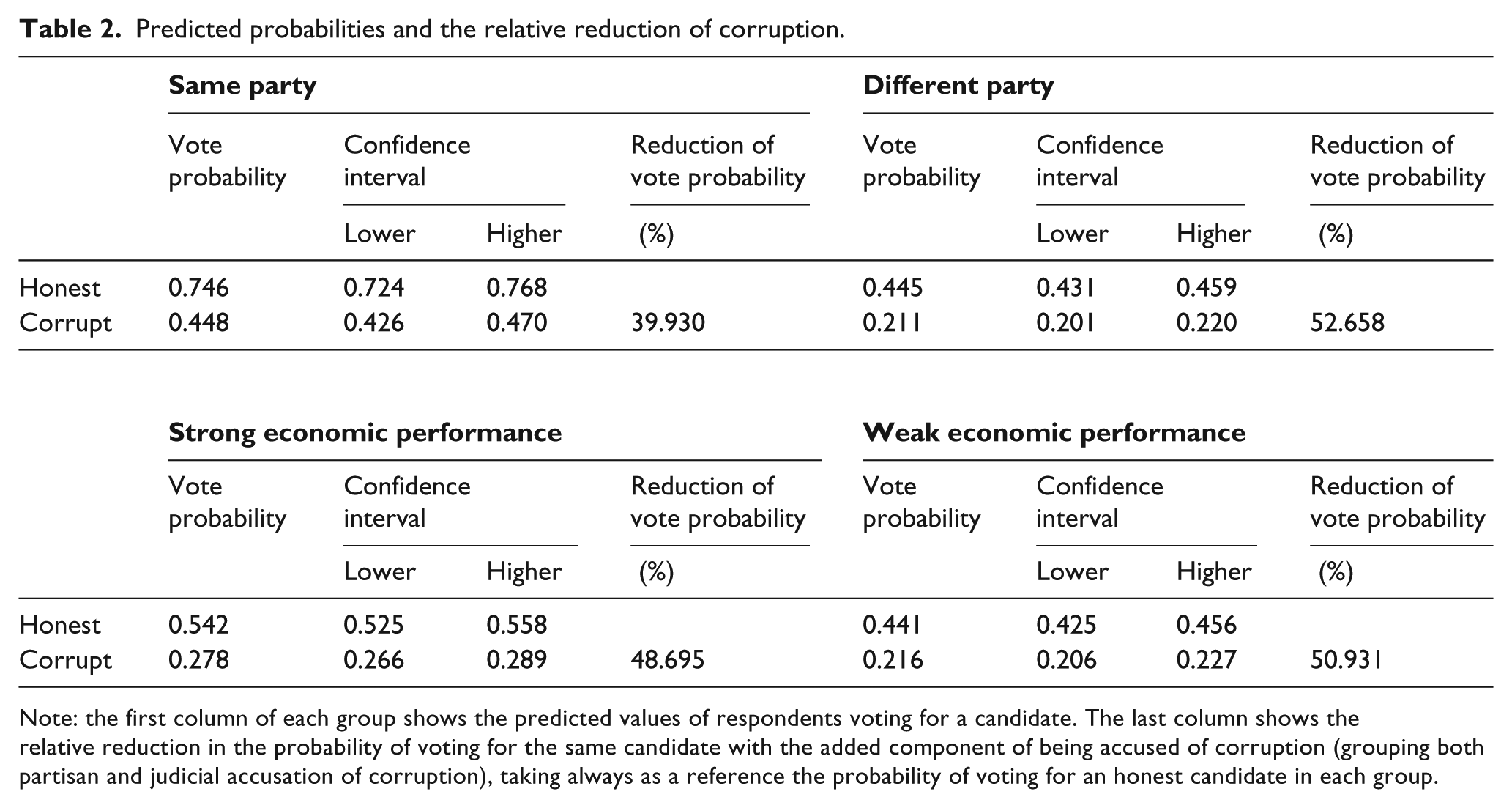
Note: the first column of each group shows the predicted values of respondents voting for a candidate. The last column shows the relative reduction in the probability of voting for the same candidate with the added component of being accused of corruption (grouping both partisan and judicial accusation of corruption), taking always as a reference the probability of voting for an honest candidate in each group.
Derivatives expressed as a semi-elasticity.

p < 0.01.
p < 0.05.
p < 0.1.
Note: the first column shows the proportional change of Y when the candidate is corrupt across the different categories of partisanship and economic performance. The contrast column shows the difference in the change of Y between each reference category and the rest of the categories and the significance associated with these differences.
Conclusion
This paper provides compelling evidence that respondents care about corruption but also care about other candidate characteristics. Analyzing the results of a conjoint experiment proves that in a multidimensional setting, participants trade out integrity for other valued characteristics. While previous studies have tested the moderating effect of partisanship and a good performance individually, this study contributes to the literature by assessing how respondents react when they also receive information on many other candidates’ characteristics. In addition, this study helps us to understand not only the moderating effect of partisanship and a strong economic performance, but also their relative importance on the probability of voting for a candidate.
The results of this multidimensional survey experiment confirm a trade-off between integrity and co-partisanship. In line with previous findings (Anduiza et al., 2013; Barnes and Beaulieu, 2014; Beaulieu, 2014), co-partisanship strongly moderates the negative effect corruption has on the likelihood of voting for a politician. Furthermore, partisanship, together with corruption, is the attribute that most determines the vote. However, the results only partly corroborate a trade-off between the economic performance and the integrity of a candidate. While in this experiment corruption determines the vote to a much greater extent than the economic performance of a candidate, the economic performance does moderate the negative effect of corruption. However, this conditioning effect is mild and does not hold across all robustness checks. In summary, this study corroborates the importance of partisanship in condoning corruption. While this study finds some evidence in favor of the economic performance trade-off, these results are by no means as strong as the partisanship trade-off.
As shown in the analysis of this paper, the relative weight and the conditional punishment model can be compatible, as partisanship determines the vote to the same extent as corruption; however, partisanship also moderates the effects of corruption. Although these models are not mutually exclusive, it is important to distinguish them in future research as they could entail different causal mechanisms based on distinct rationality in voters’ decision-making. Ultimately, these models could have a differential impact on anti-corruption policies that aim to engage citizens in the control of corruption. Due to the properties of the conjoint design, in this paper, I could not test the rationale behind respondents’ decisions. Future research should now determine the exact pathways that might drive each argument.
Concerning the elicitation of stated preferences with hypothetical scenarios, Hainmueller et al. (2015) demonstrated that paired conjoint experiments are highly successful in replicating the decision-making that takes place in real settings. Furthermore, I consider the high credibility of the information provided in this experiment an advantage of this study as it poses a solid test for the trade-off hypotheses. This paper shows that even when obtaining highly credible information and, therefore, being certain that a candidate is corrupt, respondents are willing to trade integrity for other valued characteristics of the candidate. Hence, I provide clear-cut evidence that even informed citizens might choose to overlook corruption.
Supplemental Material
Appendix_Choosing_the_crook – Supplemental material for Choosing the crook: A conjoint experiment on voting for corrupt politicians
Supplemental material, Appendix_Choosing_the_crook for Choosing the crook: A conjoint experiment on voting for corrupt politicians by Sofia Breitenstein in Research & Politics
Footnotes
Acknowledgements
I would like to thank Eva Anduiza and Jordi Muñoz for their insightful comments and suggestions. I also thank the two anonymous reviewers and the editors of Research and Politics for their valuable feedback. Previous versions of this paper were presented at the International Meeting on Experimental and Behavioral Social Sciences 2016, the ECPR General Conference 2016, and the EPSA General Conference 2017. Thanks to all discussants and participants for their helpful comments.
Declaration of conflicting interests
The author(s) declared no potential conflicts of interest with respect to the research, authorship, and/or publication of this article.
Funding
The author(s) disclosed receipt of the following financial support for the research, authorship, and/or publication of this article: This work was produced in the context of the author’s PhD in Politics, Policies and International Relations at the Universitat Autònoma de Barcelona, funded through an FPI grant (BES-2015-072756) from the Spanish Ministry of Economy and Competitivity and the European Social Fund. The data were collected within the project “Living with Hard Times: How Citizens React to Economic Crises and Their Social and Political Consequences” (LIVEWHAT). This project was funded by the European Commission under the 7th Framework Program (grant number 613237).
Supplemental materials

Notes
Carnegie Corporation of New York Grant
This publication was made possible (in part) by a grant from the Carnegie Corporation of New York. The statements made and views expressed are solely the responsibility of the author.
References
Supplementary Material
Please find the following supplemental material available below.
For Open Access articles published under a Creative Commons License, all supplemental material carries the same license as the article it is associated with.
For non-Open Access articles published, all supplemental material carries a non-exclusive license, and permission requests for re-use of supplemental material or any part of supplemental material shall be sent directly to the copyright owner as specified in the copyright notice associated with the article.
