




Abstract
Does the state of the domestic economy change the size of the effect of audience costs? As public opinion research has shown, citizens assess the performance of their leaders based not only on foreign policy, but also on the domestic economy. Thus, if leaders are subject to audience costs, they should be even less able to afford failure in an international crisis when the economy is performing badly than when the economy is doing well. As a result, such leaders should be even more able to make their threats credible and, therefore, are more likely to be successful in coercive diplomacy. This novel prediction finds no empirical support in a replication study using Moon and Souva (2016). I discuss possible reasons for this result and avenues for further research.
Since it was proposed by Fearon (1994), audience cost theory has received much scholarly attention. One of the central hypotheses is that regimes whose sustainability is subject to public support (“audience cost-sensitive regimes”) can make threats more credible to foreign opponents than those that are autonomous of public support (Fearon, 1994; Kurizaki and Whang, 2015; Weeks, 2008). Issuing threats publicly and subsequently backing down will result in a public backlash against leaders (i.e., audience costs). If foreign opponents know this, they will perceive threats from leaders in audience cost-sensitive regimes as credible, and thereby will be more likely to back down. Consequently, audience cost-sensitive regimes are more likely to succeed in coercive diplomacy.
This article proposes a new direction for audience cost research, examining whether the state of the domestic economy conditions the effect of audience costs on the probability of successful coercive diplomacy. The motivation is simple: as public opinion research has shown, domestic audiences evaluate the performance of their leaders based both on foreign policy and on the domestic economy (McAvoy, 2006; Ostrom et al., 2018; Wang and Cheng, 2015). In particular, empirical models in Ostrom et al. (2018) imply that the effects of foreign policy performance and economic policy performance on leadership approval are additive to one another; for example, the negative effect of poor foreign policy performance will be reduced by the positive effect of good economic policy performance. 1 The implication for audience cost theory is that, if the domestic economy is doing well, an audience cost-sensitive regime should be more able to afford failure in an international crisis than when the domestic economy is doing badly. Under the conditions of a good economy, citizens will tolerate failure in an international crisis; it is a risk for citizens to replace a leader who is helping the economy just because she has failed in an international crisis, as there is no guarantee that the leader who follows will be able to sustain the same economic performance. Under the conditions of a poor economy, on the other hand, an international crisis would be a leader’s last chance to gain popular support, and failure would be the last blow.
I am not arguing that leaders in audience cost-sensitive regimes ignore audience costs when the economy is good, or that, when the economy is good, leaders in audience cost-sensitive regimes are as immune from audience costs as leaders who are not in audience cost-sensitive regimes. Even when the economy is good, leaders in audience cost-sensitive regimes may well care about audience costs, and may well be more sensitive to those costs than leaders not in audience cost-sensitive regimes. My argument is that leaders in audience cost-sensitive regimes should incur smaller audience costs from backing down in a crisis when the economy is good than when the economy is poor; therefore, these leaders should be more likely to prefer backing down to fighting in a crisis because audience costs may not be large enough to make the expected cost of war lower than that of peace after backing down. 2
If the opposing country is meant to interpret the credibility of signals from the other side based on audience costs, then the success or otherwise of the economy in an audience cost-sensitive regime should differentiate the extent to which the opposing country sees as credible a threat issued by the audience cost-sensitive regime. The predictions are as follows. On the one hand, when facing a crisis initiated by an audience cost-sensitive regime that is doing well economically, the opposing country should be less likely to see the threat as credible. This is because a good economy allows leaders in audience cost-sensitive regimes to incur relatively small audience costs from backing down in a crisis. Thus, the opposing country is more likely to believe that, for the leader of the audience cost-sensitive regime, the expected cost of war is higher than the expected cost of peace after backing down (= small audience costs), leaving the threat non-credible. On the other hand, when facing a crisis initiated by an audience cost-sensitive regime that is doing badly economically, the opposing country should be more likely to see the threat as credible. This is because a poor economy increases the size of audience costs that leaders in audience cost-sensitive regimes incur from backing down in a crisis. Thus, the opposing country is more likely to believe that, for the leader of the audience cost- sensitive regime, the expected cost of war is lower than the expected cost of peace after backing down (= large audience costs), making the threat credible. In short, I anticipate that a good economy in audience cost-sensitive regimes should weaken the effect of audience costs on the probability of successful coercive diplomacy, while a poor economy should strengthen this effect.
I examine these novel predictions empirically as a new direction for research on audience cost theory. In order to increase confidence in the causal argument of a theory, it is valuable to “test as many relevant implications of a causal theory as possible” (Keele, 2015: 327). Thus, if we find empirical evidence for the above predictions, we might be more confident in the causal argument of audience cost theory. If we do not find such evidence, we should ask why this is so. Thus, rather than directly testing the original version of audience cost theory, the article capitalizes on the novel predictions to present a way forward to develop the theory further.
To this end, I replicate Moon and Souva (2016), one of the latest studies on audience costs and the success of coercive diplomacy. Replication is a productive way to accumulate scientific knowledge, since readers can attribute any difference in the results to the modification alone, rather than to different estimators, different measures or different datasets. I use multiple measures of the state of the domestic economy for robustness: annual GDP growth rate, biannual GDP growth rate, annual per capita GDP growth rate and biannual per capita GDP growth rate.
In short, the replication finds no empirical support for the theoretical expectations here. The finding is important, given the high level of scholarly attention to audience cost theory and the widespread consensus, endorsed by both observational and experimental studies, that audience costs do exist (e.g., Kertzer and Brutger, 2016; Kurizaki and Whang, 2015; Moon and Souva, 2016; Levy et al., 2015; Tomz, 2007; Weeks, 2008). In the concluding section, I discuss possible reasons for the finding that the state of the domestic economy does not condition the effect of audience costs as expected.
The article is structured as follows. First, I develop the theoretical discussion and address several potential criticisms of my predictions. Next, I explain the research design and the results of the empirical analysis. The final section discusses the implications of the findings.
Theoretical discussion
Much quantitative research has been done to test audience cost theory empirically, albeit with some modifications regarding the exact mechanisms and specific conditions (Kertzer and Brutger, 2016; Kurizaki and Whang, 2015; Levendusky and Horowitz, 2012; Potter and Baum, 2014; Levy et al., 2015; Moon and Souva, 2016; Tomz, 2007; Uzonyi et al., 2012; Weeks, 2008). However, these studies assume that citizens care about foreign policy success or failure alone when evaluating their leaders. Yet, public opinion research has shown that citizens decide whether or not to support leaders based on both economic and foreign policies (McAvoy, 2006; Ostrom et al., 2018; Wang and Cheng, 2015). My expectation is that, if the domestic economy is doing well, failure in foreign issues is less important to citizens than when it is doing badly. Thus, the state of the domestic economy should be a “domestic political environment within states [that] shapes the size and extent of audience costs” (Levendusky and Horowitz, 2012: 324).
The literature has found that the exact mechanisms by which citizens impose audience costs may be different, depending on who they are. For example, the nature of audience costs may differ among different constituencies – such as hawks punishing a leader for backing down and doves punishing a leader’s use of threat (Kertzer and Brutger, 2016). In addition, people with strong policy preferences may not punish a leader who fails to fulfill her initial promise as long as their policy preferences are satisfied (Chaudoin, 2014). Yet, it is also plausible to say that the public in general – both the rich and the poor – prefer a healthy economy over a bad economy.
Three criticisms of my theoretical predictions are possible, pointing out that the direction of the conditioning effect of the domestic economy is the opposite of what I predict. First, the public might not be interested in foreign affairs when the economy is poor; they might be able to pay more attention to foreign affairs when the economy is strong. Thus, it might be the case that a poor economy reduces the effect size of audience costs and a healthy economy increases it. However, this argument is inconsistent with the logic of audience cost theory. The theory argues that, when the government initiates an international crisis, it becomes a public matter: “Measures such as troop deployments and public threats make crises public events in which domestic audiences observe and assess the performance of the leadership” (Fearon, 1994: 577). Thus, if we follow the logic of the theory, once a leader starts an international crisis, citizens should assess her performance through the outcome of the crisis, even when the economy is poor.
Second, it might be argued that, when a leader initiates a crisis in the situation of a poor economy, she is already deemed to lose office precisely because of that economic situation and, therefore, backing down will not be costly. Consequently, the opposing country will not take the threat as credible and will not back down. However, while a leader facing a poor economy is certainly less likely to retain her incumbency, she also has to think about her post-tenure position (Baturo, 2014). If leaders leave their office with at least a triumph in an international crisis despite economic difficulties, they will have better prospects in the post-tenure period. In democracies, they will increase their chances of finding a good job in other sectors. In autocracies, they will, at the very least, not be punished as badly as those who have achieved neither foreign nor domestic success; and they might increase their chances of garnering some respect from the military and hardliners, securing their post-tenure circumstances. In short, for leaders the political cost of backing down is added to the already existing political cost of a poor economy.
Third, it might be argued that, when the economy is doing well, the country has more to lose through war than when it is doing badly; therefore, it is a costly signal for a country with a flourishing economy to engage in a crisis. This argument is, however, about the effect of the state of the domestic economy in general, not about its conditioning effect on audience costs. The question in this article is how the public assesses a leader’s performance in an international crisis in combination with the state of the economy. If the economy is doing well and, the country therefore has more to lose, the public may actually praise a leader who backs down in a crisis and avoids the economic cost of war. Of course, the leader may still incur some audience cost, since she will have initiated a crisis and failed to achieve the objective. The point is that the size of audience cost is much larger if a leader does the same thing when the economy is doing badly. In such a case, the public has nothing to praise in their leader; she has initiated an international crisis, despite it being a time when the government should have been paying attention to the economy, and she has not even managed to obtain anything from the crisis!
In short, it is plausible to expect that a healthy economy will decrease the effect size of audience costs, and a poor economy will increase it. It then follows that opposing countries should be less likely to back down when facing crises initiated by audience cost-sensitive regimes that are doing well economically; and that opposing countries should be more likely to back down when facing a crisis initiated by audience cost-sensitive regimes that are doing badly economically. I test these predictions empirically below.
Empirical analysis
As I mentioned above I replicate Moon and Souva (2016), who examine the effect of audience costs on the probability of failed threats using the Militarized Compellent Threats (MCT) data (Sechser, 2011). Downes and Sechser (2012) argue that the commonly used Militarized Interstate Disputes data (Palmer et al., 2015) are not an appropriate measure of coercive threats and that empirical models using them to test audience cost theory are flawed. Using the MCT data, Downes and Sechser reported that democracies are no more likely to be successful in coercive diplomacy than autocracies.
Yet, Moon and Souva (2016) argue that audience costs are a mechanism to reduce information asymmetry as a costly signal, thus separating the disputes caused by information asymmetry from those caused by commitment problems (Fearon, 1995; Powell, 2006). Using the MCT data, Moon and Souva (2016) successfully recover the association between audience costs and coercive diplomacy in those disputes caused by information asymmetry. 3
Their dependent variable is threat failure, coded 1 if a threat fails and 0 if a threat succeeds. Moon and Souva (2016) use the Audience Cost Capacity Index (Uzonyi et al., 2012) to measure the sensitivity of regimes to audience costs. They dichotomize this index into high versus low audience cost capacities. This variable is then used in combination with whether or not a disputed issue is strategic territory. Moon and Souva (2016) argue that disputes over strategic territory are about commitment problems rather than a result of incomplete information. The two-by-two combination of high versus low audience cost capacity and the presence versus absence of disputed strategic territory produces a total of four binary regressors (one being the baseline category in the regression models). Moon and Souva (2016) find that only when states have a high audience cost capacity and disputed issues are not over strategic territories are they more likely to make coercive diplomacy successful.
I add to their empirical models the interaction term between the category of high audience cost capacity and no strategic territory and each of the four measures for the state of the domestic economy: annual GDP growth, biannual GDP growth, annual per capita GDP growth and biannual per capita GDP growth. The expectation is that a lower growth rate should increase the effect size of the category of high audience cost capacity and no strategic territory that enables states to coerce a target state by threat. The data on GDP and GDP per capita are from Gleditsch (2002, ver. 6.0 is used). The distributions of these variables are shown as histograms in Figure 1 for all used observations and in Figure 2 for the observations of the category of high audience cost capacity and no strategic territory. The distributions are fairly similar in both cases, suggesting that the estimation of the interaction effect is not significantly affected by the unequal distribution or variation over the presence or absence of the conditioning variable.
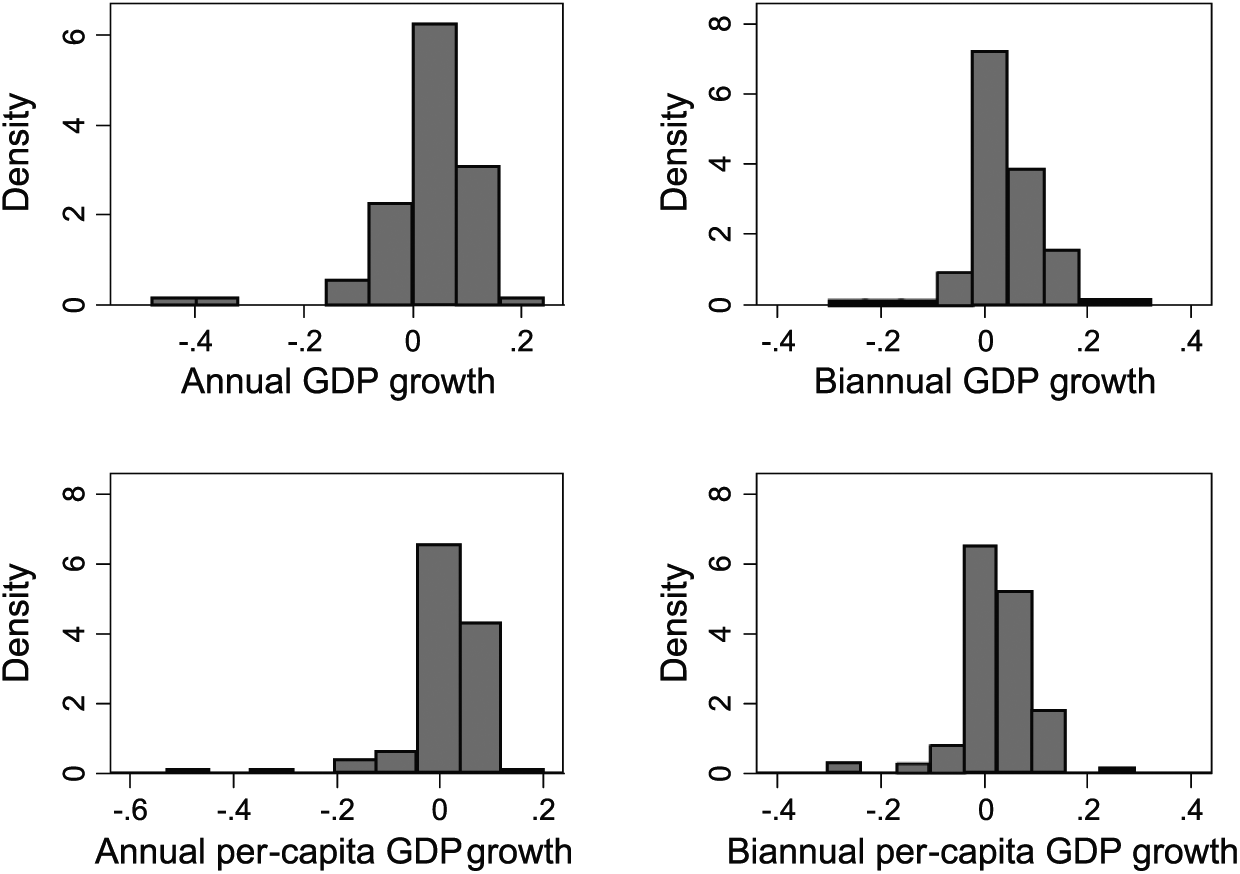
Histograms of the economic growth variables.

Histograms of the economic growth variables (where the category of high audience cost capacity and no strategic territory = 1).
In the literature on the diversionary use of force, the estimation issue has been pointed out that not all leaders are equally blamed for a poor economy – e.g., those who have just assumed office after the economy has already been stagnating for a while (Johnson and Barnes, 2011). This issue does not apply here. Even if a leader is not blamed for a poor economy ex ante (which poses a challenge to the estimation of the effect of a poor economy on dispute initiation), once she has initiated a crisis (as in the case of this article as well as other works on audience cost theory that use crisis episodes as the unit of analysis) the poor economy should still strengthen the effect of audience costs. This is because citizens will associate foreign policy failure with the poor economy ex post, concluding that it was inappropriate for the leader to initiate a crisis when the domestic economy needed attention.
Table 1 presents the results. In Model 1, the replication is done without adding any growth rate variable, but excluding the observations that are dropped when the annual growth rate variables are used because of the availability of GDP data (only from 1952 onwards). This is to show that the reduced number of observations does not cause the category of high audience cost capacity and no strategic territory to lose its presumed effect on the probability of successful coercive diplomacy. As expected, this category is associated with a lower probability of failed threats.
Logit regression of failed threats.

Note: p-values by two-tailed tests in parentheses; * p < 0.1.
In the remaining models, each of the economic growth rate variables interacts with the category of high audience cost capacity and no strategic territory. As is clear from the table, none of the interaction terms has the p < 0.1 level of statistical significance by two-tailed tests. And, more importantly, the sign of their coefficients is opposite to the theoretical expectation. Because the interaction term between a continuous variable and a binary variable indicates the effect of the continuous variable conditional on the binary variable taking the value of one, it substantively means that (if there is any conditioning effect of the state of the economy) a higher growth rate decreases the probability of failed threats, provided that a regime is sensitive to audience costs and the disputed issue is not over strategic territory. The same conclusion can be drawn if I estimate the average marginal effect of the category of high audience cost capacity and no strategic territory across the full range of each of the growth rate variables (the results are available in the online Appendix). The category has a larger effect to reduce the probability of failed threats when the growth rate variables take higher values (i.e., when the economy is doing well). Thus, the theoretical expectations receive no empirical support.
The small sample size might explain the wide standard errors, and therefore the statistical insignificance. But it cannot explain why the direction of the effect is opposite to the theoretical expectation, unless a different time period is meant to exert a different effect of audience costs. The MCT dataset covers all compellent threats made by states against other states from 1918 to 2001, and the empirical models here run from 1952 to 2001. If including either the pre-1952 or post-2001 period would indeed change the sign of the coefficient of the interaction term to the opposite (i.e., from minus to plus, meaning that greater economic growth increases the probability of failed threats by audience cost-sensitive regimes), this would indicate significant causal heterogeneity between the coercive threats from 1952 to 2001 and those outside that period. However, many previous studies include, or even explicitly focus on this period, finding empirical evidence for audience costs (e.g., Haynes, 2012; Moon and Souva, 2016; Weeks, 2008). Thus, it is inconsistent to argue that audience costs do not work during the period.
Conclusion
The finding of this article poses a new question: why does the state of the domestic economy not affect the effect size of audience costs? I point to two potential avenues for further research.
First, it might be the case that opposing countries do not correctly interpret the costly signal of audience costs from the other side given its domestic economy. Experimental research has found that citizens are indeed willing to punish a leader who backs down in a crisis (e.g., Kertzer and Brutger, 2016; Levy et al., 2015; Tomz, 2007). However, it also implies that the opposing state in the crisis may not always interpret the implication of the audience cost for the leader (i.e., hand-tying and therefore supposedly credible) in the same way as is done by the theory (Yarhi-Milo et al., forthcoming). 4 Previous observational research suggests that institutional characteristics, such as regime types, allow the implication of audience costs for the leader to be interpreted by the opposing country in the theoretically expected way (e.g., Haynes, 2012; Moon and Souva, 2016; Weeks, 2008). This article indicates that the state of the domestic economy does not do so. It is possible that institutional characteristics, which are usually a static factor, are easier for opposing countries to interpret than the state of the domestic economy, which is a more dynamic factor.
Second, there may be a variation in how the average citizen weighs foreign and economic affairs when evaluating her leader. This kind of research has already been called for in the area of comparative politics (e.g., Gallagher and Hanson, 2015: 378–381). For example, if the average citizen is a hardliner who cares about national pride much more than about economic prosperity, her leader may be able to generate audience costs better and, therefore, is likely to be more successful in coercive diplomacy regardless of the state of the domestic economy. If this were indeed the case, it might be the reason why, in the material produced in this article, I did not find the theoretically expected conditioning effect of the state of the domestic economy.
In short, focusing on the state of the domestic economy, this article has presented novel implications for the literature on audience costs.
Supplemental Material
online_appendix_rr2 – Supplemental material for Audience costs, domestic economy and coercive diplomacy
Supplemental material, online_appendix_rr2 for Audience costs, domestic economy and coercive diplomacy by Akisato Suzuki in Research & Politics
Footnotes
Acknowledgements
The author would like to thank the editors and anonymous reviewers for helpful comments. A previous version of the paper was presented in a political behavior workshop at the European University Institute. The author is grateful to the participants for helpful comments. Alyson Price helped with proofreading. The data analysis was conducted through Stata 14.2.
Author’s note
The author is also affiliated to Institute for International Conflict Resolution and Reconstruction, Dublin City University.
Declaration of conflicting interests
The author(s) declared no potential conflicts of interest with respect to the research, authorship, and/or publication of this article.
Funding
The author(s) disclosed receipt of the following financial support for the research, authorship, and/or publication of this article: The major part of this research was conducted during the author’s Max Weber Fellowship funded by the European University Institute and the Canon Foundation in Europe.
Supplemental material
The supplemental files are available at http://journals.sagepub.com/doi/suppl/10.1177/2053168018787119. The replication files are available at: 
Notes
Carnegie Corporation of New York Grant
This publication was made possible (in part) by a grant from the Carnegie Corporation of New York. The statements made and views expressed are solely the responsibility of the author.
References
Supplementary Material
Please find the following supplemental material available below.
For Open Access articles published under a Creative Commons License, all supplemental material carries the same license as the article it is associated with.
For non-Open Access articles published, all supplemental material carries a non-exclusive license, and permission requests for re-use of supplemental material or any part of supplemental material shall be sent directly to the copyright owner as specified in the copyright notice associated with the article.
