




Abstract
The use of self-reported contextual factors is prominent in political science. While recent research demonstrates that perceptions of contextual factors positively associate with census measured factors, it is less clear for whom and under what conditions this relationship holds. In this paper, I examine the relationship between census measured racial and ethnic composition and perceived racial and ethnic neighborhood composition. I use the 2008 and 2012 Collaborative Multi-Racial Post-Election Study (CMPS) datasets and append US Census data to test how well respondents understand the racial and ethnic composition of their neighborhood. Leveraging the non-White oversamples in the CMPS, I am able to test this relationship among Latinos, Blacks, and Whites. I find a positive relationship between perceived neighborhood composition and census measured composition. Respondents who live in areas with higher proportions of a racial/ethnic group are more likely to perceive that their neighborhood is composed of that group. These findings hold across Black, Latino, and White sub-samples. These findings complement and extend recent work about how well respondents understand their local environment.
Introduction
Contextual factors have been important in political science at least since Key (1949) first outlined how political opinions could be shaped by a respondent’s environment. Out of this literature, a number of theories developed as a way to explain attitude formation and attitude change given demographic composition and change in one’s residential context (Giles and Hertz, 1994; Matthews and Prothro, 1963, 1966; Oliver and Wong, 2003). Across various time periods and through a variety of statistical models, scholars continue to demonstrate that contextual factors are associated with political participation, public opinion, and racial attitudes (Gay, 2004; Hopkins, 2010; Hopkins and Williamson, 2012; Oliver, 2010; Oliver and Wong, 2003; Wilcox-Archuleta, in press).
Recent research suggests that respondents are fairly accurate in responding to contextual factors associated with one’s local environment (Newman et al., 2015; Velez and Wong, 2017). Velez and Wong (2017) show that respondents’ perception of their local community is positively associated with census measured composition, providing evidence that factors associated with context relate to perceptions of context at least at the ZIP Code level. If this is the case, then it is imperative that scholars understand for whom and under what conditions residents receive the contextual stimuli from their surroundings. While Velez and Wong (2017) show that respondents accurately perceive contextual stimuli at one census measured boundaries (ZIP Code), their study is in some ways limited by the use of a general population sample through MTurk. 1 And yet, much of the work that examines context and contextual factors considers racial and ethnic minority groups explicitly. Because of this, a central question moving forward is the degree that respondents of various racial and ethnic backgrounds receive the contextual stimuli from their surroundings. In this paper, I analyze this question explicitly and I test the degree that respondents across different racial and ethnic backgrounds understand the racial and ethnic composition of their local contexts at the census tract level.
I find a strong positive association between census measured racial and ethnic composition and self-reported racial and ethnic composition among Latinos, Blacks, and Whites. Regardless of race/ethnicity, respondents associate their perceived racial and ethnic composition with the racial and ethnic composition of their local context. I demonstrate these results at the census tract level, a smaller unit of geographic aggregation not explored in other studies that might better map onto a respondent’s neighborhood better than ZIP Code (Newman et al., 2015; Velez and Wong, 2017).
Towards a more unified measure of context
In terms of local residential context, Wong (2007) shows that residents perceive local context more accurately. 2 While this is initially promising, there are two important considerations in Wong’s (2007) study. First, respondents were asked to estimate the composition of their community. As Wong (2007) underscores, this is highly subjective spatial conception. Is a community one’s neighborhood, city, or county? Or, does it refer to one’s social or work network. Second, Wong (2007) was unable to gather microlevel census data and relied on 100 primary sampling units for census measured composition. These units do not follow a uniform size or shape. Some are the size of counties, some approximate various metropolitan statistical areas, etc. Despite these limitations Wong (2007) concludes that local contextual factors structure how individuals understand and interpret contextual phenomena at much higher levels of aggregation.
More recently, Newman et al. (2015) show that residents “receive the treatment”—that is they correctly perceive the number of immigrants as well as the economic conditions of their local community when compared against census measures at the ZIP Code and county levels. 3 Velez and Wong (2017) provide the most insightful study to date regarding the relationship between census measured context and perceived context. They find a strong positive relationship between census measured racial and ethnic composition and perceived racial and ethnic composition, but only when using one’s ZIP Code as a boundary. When using a respondent’s individually defined boundary, they do not find a relationship between the census measured racial and ethnic composition and perceived racial and ethnic composition.
Despite these developments in the literature, it is not clear if these findings hold across racial and ethnic groups living in the USA. Newman et al. (2015) and Velez and Wong (2017) rely on general population samples for their analysis. And while much of the substantive work on contextual effects has assumed that all groups are equally receptive to contextual stimuli (Bledsoe et al., 1995; Gay, 2004; Hopkins, 2010; Lau, 1989; Oliver and Wong, 2003), existing work has yet to corroborate this claim. While this claim may certainly be the empirical reality, the general population samples used in the existing work cannot credibly test this claim. To fill this gap, I conduct a research design that explicitly considers how Latinos, Blacks, and Whites understand the contextual stimuli they are exposed to. Given existing substantive work that shows that important political outcomes for Blacks, Latinos, and Whites are related to context, I predict that respondents across racial and ethnic backgrounds will accurately perceive the racial and ethnic composition of their local environment. Given problems with innumeracy among respondents, I do not expect to see perfect congruence, but rather I expect to see a strong positive relationship between census measured racial and ethnic composition and perceived racial and ethnic composition.
Data and methods
This study uses data from the 2008 and 2012 Collaborative Multi-Racial Post-Election Study (CMPS) merged with racial and ethnic composition data from the 2010 US Census. The 2008 CMPS is composed of 4,503 registered voters who self-identified as Latino (n = 1517), Asian American (n = 919), Black (n = 945), and White (n = 1122). Respondents were interviewed via telephone in their choice of the following languages: English; Spanish; Mandarin; Cantonese; Korean; or Vietnamese. The 2012 CMPS comprises 2,616 citizens and non-citizens who self-identified as Black (n = 804), Latino (n = 934), or White (n = 878). The German GfK Group conducted the survey between November 16, 2012 and November 26, 2012 in both English and Spanish via a probability-based web panel. 4
Methods
To measure perceived neighborhood racial and ethnic composition, I use the following question asked in both surveys: “Would you describe the neighborhood where you currently live as mostly Black, mostly White, mostly Hispanic, mostly Asian, or mixed?” Respondents were then asked the following: “Is it almost entirely [ANSWER TO FIRST QUESTION] or is it mostly [ANSWER TO FIRST QUESTION]?” Using these variables, I create a measure of perceived neighborhood composition for each respondent with the following levels: 0 = something else; 1 = mostly but not entirely; and 2 = almost entirely.
This ordinal measure is by no means fine-grained like a percentage. Though this may appear problematic, a number of researchers have shown that people are quite imprecise when estimating percentages (Nadeau et al., 1993; Sigelman and Yanarella, 1986) and using ordinal measures is more promising (Newman et al., 2015). As Newman et al. (2015) point out, ordinal measures may better map onto individual assessments of racial and ethnic compositions. For census measured racial and ethnic composition, I use the proportion of Latinos, Blacks, Whites, and Asians within respondents’ census tract. These data were obtained from the 2010 US Census. The online Figure SI 0.8 shows the distribution of the census measured composition at the census tract level across the pooled responses. To understand mixed neighborhoods, I create a census-based mixed neighborhood measure based on an entropy score that incorporates % Black, % Asian, % White, and % Latino. 5
Results
I begin with Figure 1, which shows LOESS fits for each neighborhood type given the proportion of census measured composition for each racial and ethnic group. Overall, the results suggest a strong positive relationship between census measured composition and perceived composition across the different neighborhood types. The y-axis on each panel indicates whether a respondent said that their neighborhood is almost entirely, mostly, or not at all composed of a certain group. The x-axis is the census measured racial and ethnic composition of that group in the census tract. 6 The first panel in Figure 1 can be interpreted in the following way. Respondents who live in census tracts that have very small Latino populations are most likely to say their neighborhood is not at all Latino. As the proportion of the Latino population in the census tract increases, respondents are more likely to say that their neighborhood is mostly Latino. When the Latino proportion in the census tract approaches 100%, respondents are more likely to say their neighborhood is almost entirely Latino. The evidence for this claim is indicated by positive slope of the LOESS fit in the panel. As expected, there is not a perfect 1:1 relationship, which likely comes from the coarseness of the perceived measure and issues with innumeracy among the respondents. However, the central takeaways from Figure 1 are the positive slopes across all neighborhood types. As each panel shows, perceptions of neighborhood context are positively associated with census measured neighborhood context, replicating the findings presented in Velez and Wong (2017). 7
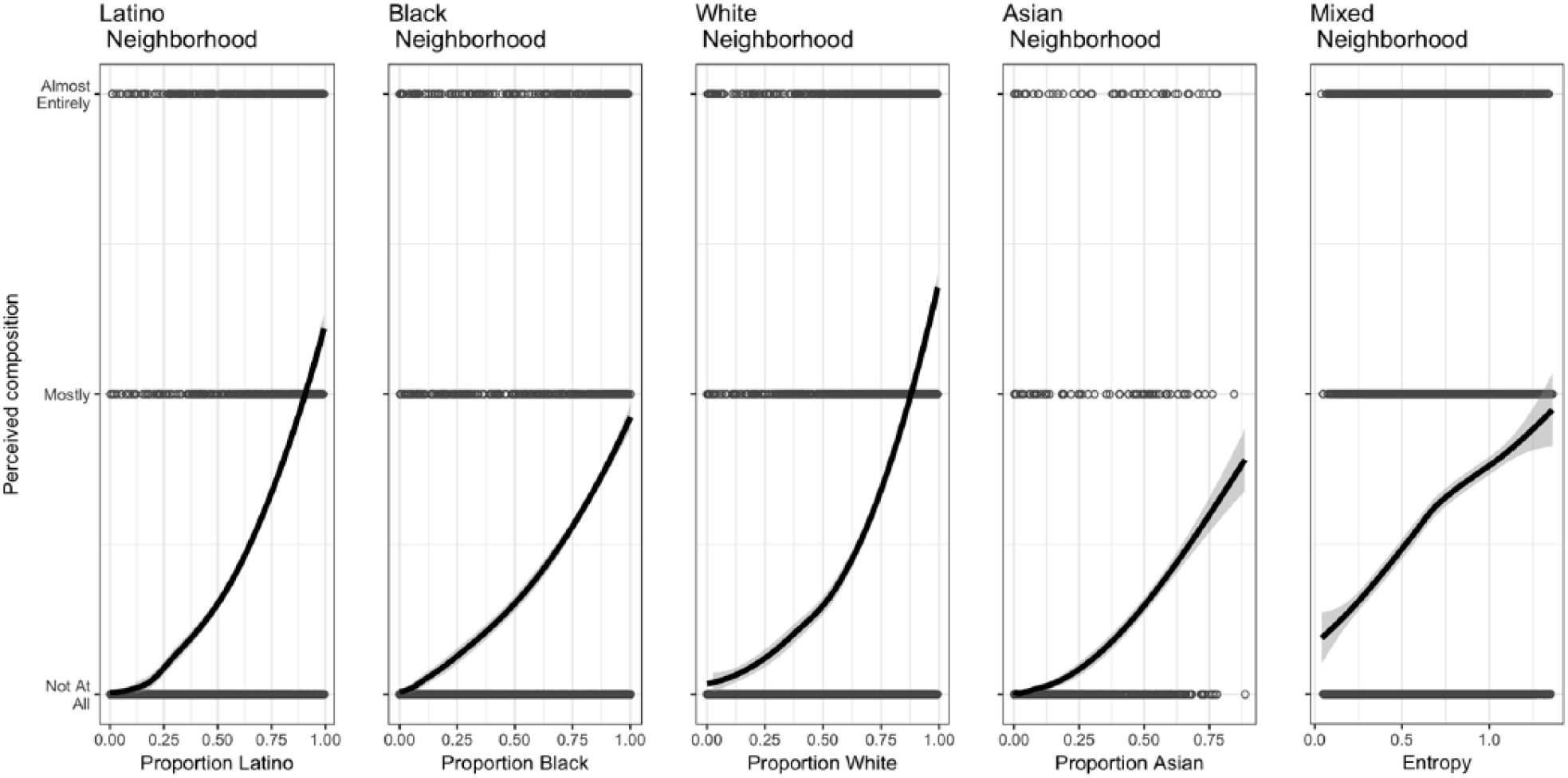
Relationship between census measured racial and ethnic composition and perceived racial and ethnic composition.
Figure 1 shows strong evidence that respondents are responsive to the racial and ethnic composition of their residential context. The LOESS fits, which rely on minimal modeling assumptions and account for non-linear and non-additive features of the relationship between census measure composition and perceived composition provide strong support for this relationship. One limitation in these non-parametric models comes from the difficulty in understanding the substantive effects or statistical significance. While the confidence intervals in Figure 1 are all quite small, suggesting strong certainty in the relationship, it is not clear how a one-unit change in the census measured racial and ethnic composition maps on to a change in the perceived composition. To provide more information, I model the perceived composition using an ordered probit regression. These results are presented in Table 1. As Table 1 shows, for each perceived neighborhood type the census measured composition is a positive and statistically significant predictor of perceived composition. These findings suggest a strong positive relationship between census measured racial and ethnic composition and perceived racial and ethnic composition, even when controlling for a host of other factors. 8
Relationship between census measured and perceived composition.

Note: *p < 0.05; **p < 0.01; ***p < 0.001.
Table 1 presents ordered probit regression coefficients from a model regressing perceived racial and ethnic composition on the census measured racial and ethnic composition within a respondent’s census tract along with a number of control variables (source: 2008 CMPS and 2012 CMPS).
Contextual effects across racial and ethnic groups
To test a central claim of this paper, I examine whether these patterns hold when the sample is separated by racial and ethnic sub-groups. As I noted earlier, one of the advantages of the CMPS is the large sub-samples of Blacks, Latinos, and Whites. As Figure 1 revealed, respondents appear to be slightly more receptive to the number of Whites in their neighborhoods given the slope of the LOESS curve. This could be driven by the high number of Whites in the sample or the mere fact that most people tend to live in neighborhoods with more Whites.
Figure 2 shows the plots and LOESS fits for each perceived neighborhood type among the Latino sub-sample. The relationships between census measured context and perceived context in Figure 2 mirror those presented in Figure 1 and suggest that Latinos’ perceptions of context positively associate with census measured contextual stimuli at the census tract level. Regardless of the neighborhood type, perceived racial and ethnic composition is positively associated with the census measured composition among Latinos. Latinos, however, are less responsive to Black census measured composition. The slope of the LOESS fit in panel 2 of Figure 2 is not as steep as the other relationships. This finding is likely driven by the fact that there are very few Latinos who live in census tracts where more than 75% of the census measured population is Black, but this could be an indication of a weaker association between certain types of perceived and census measured stimuli among Latinos.
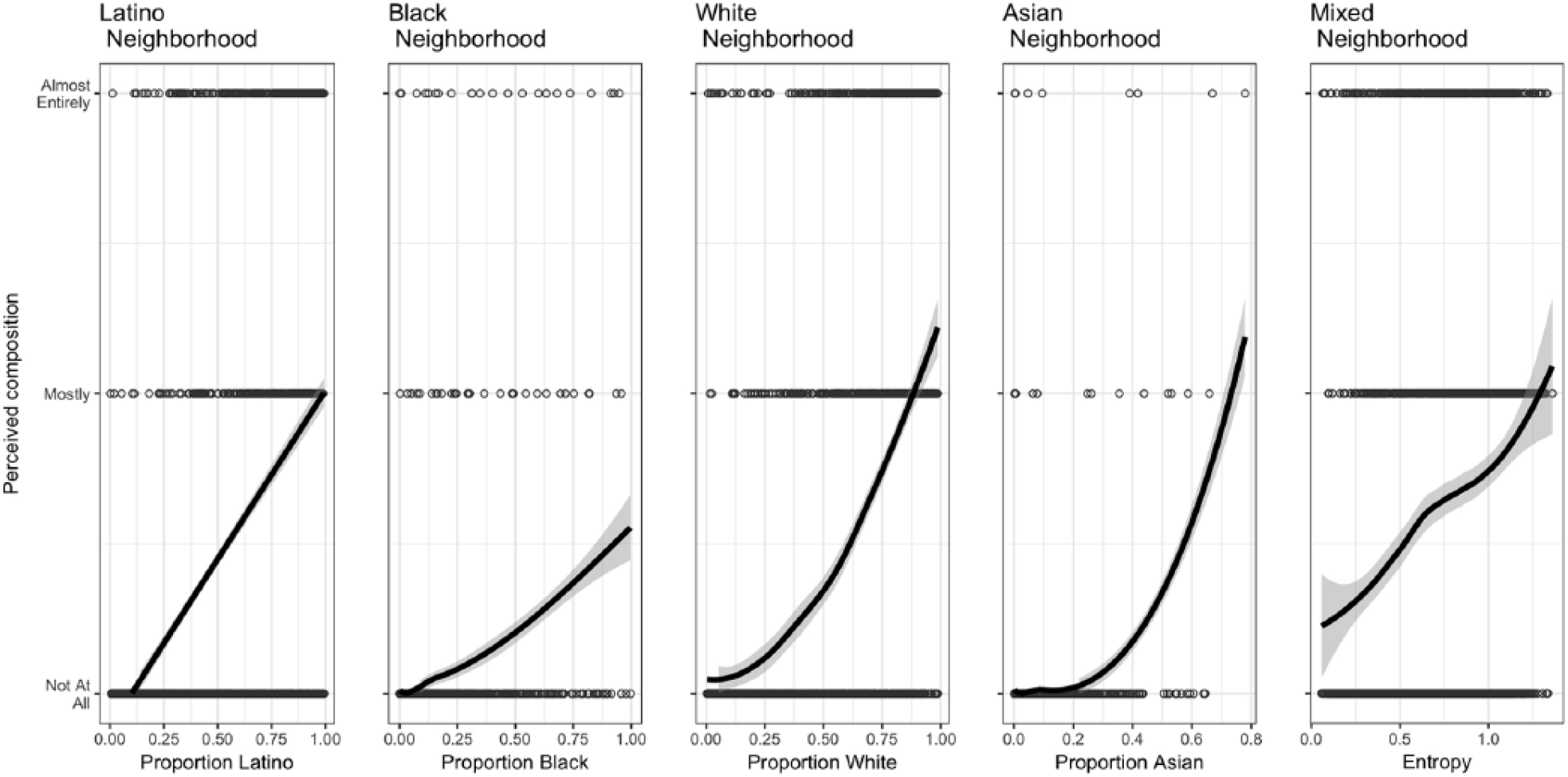
Relationship between census measured racial and ethnic composition and perceived racial and ethnic composition among Latinos.
Figure 3 shows the results among the Black sub-sample. Among Blacks there is a strong positive relationship between the census measured racial and ethnic composition and perceived racial and ethnic composition. Even in situations where there are very few cases, such as Blacks living in census tracts with many Asian Americans (panel 4), the LOESS fits still indicate a strong positive relationship. These findings suggest that Blacks are very aware of the contextual stimuli in their immediate surroundings.
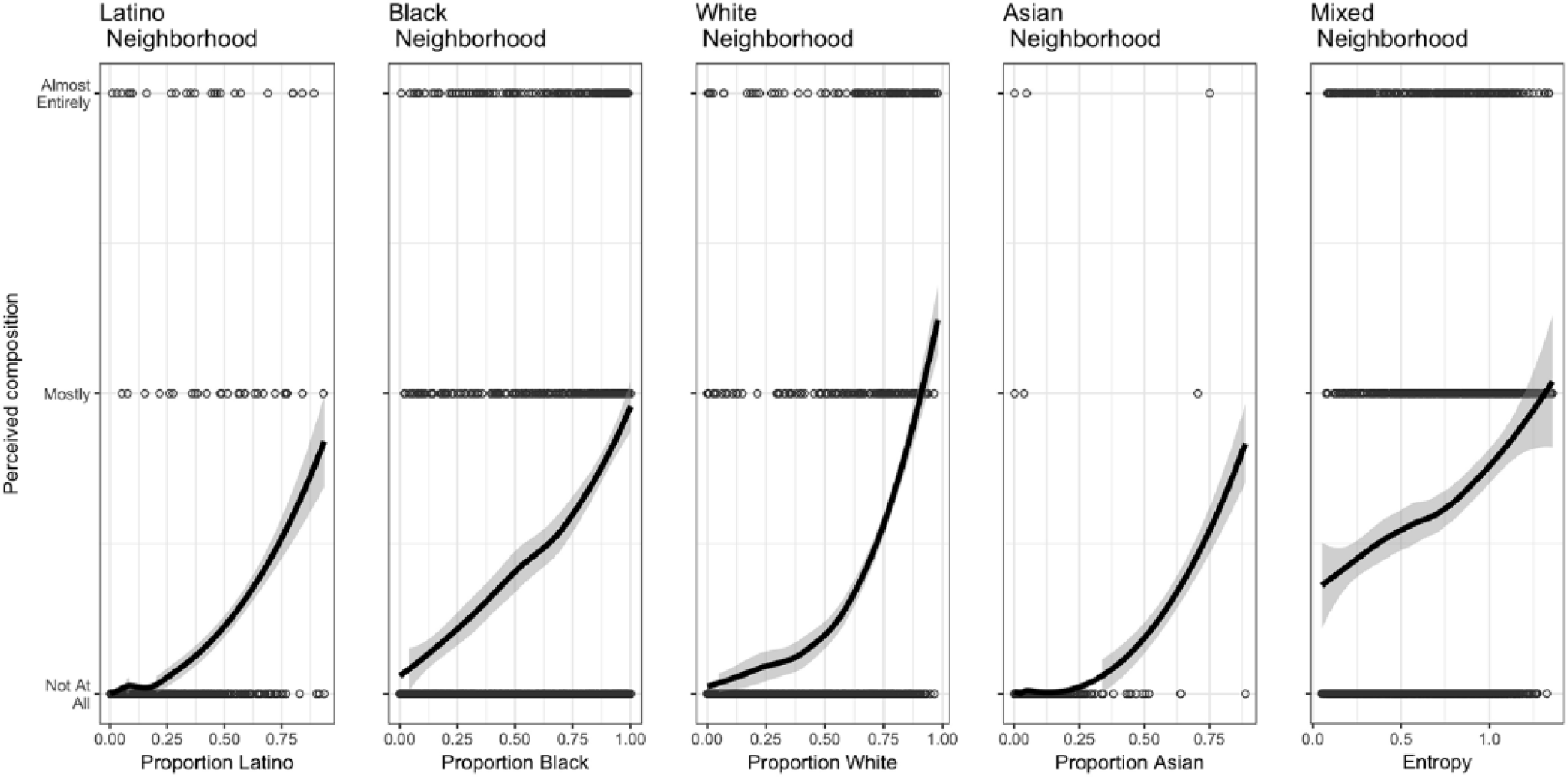
Relationship between census measured racial and ethnic composition and perceived racial and ethnic composition among Blacks.
Figure 4 shows the results among the White sub-sample. The results in Figure 4 provide evidence that the relationship between perceived racial and ethnic composition and census measured composition among Whites is weaker when compared to Blacks and Latinos. While the slopes of each LOESS fit are positive across all neighborhood types, there are two interesting patterns that emerge among the White sub-sample. First, Whites living in census tracts with high proportions of Asian Americans and Blacks do not perceive those neighborhoods as being mostly or almost entirely Asian American or Black, respectively. Despite the slope being positive for both neighborhood types, the relationship is not as strong as the pattern seen in the other neighborhood types within Figure 4 or among other racial and ethnic groups (Figure 2 and Figure 3). This finding is likely the result of so few Whites living in census tracts with a larger proportion of Asian Americans or Blacks, but it could speak to a larger implication that Whites chronically misperceive residential context along racial and ethnic dimensions, especially when compared to other racial and ethnic groups.

Relationship between census measured racial and ethnic composition and perceived racial and ethnic composition among Whites.
The second notable finding is in the last panel of Figure 4, which shows the relationship between perceiving a mixed neighborhood and the entropy score, a measure of mixed composition based on census measured racial and ethnic composition. The LOESS fit increases and then levels off before slightly dropping near the end of the distribution. My thought here is that at a certain level of census measured racial and ethnic diversity, Whites simply no longer perceive that they live in a mixed neighborhood and thus report that they live in a racially monolithic neighborhood. The threshold which Whites consider a mixed neighborhood is different from Blacks and Latinos, who do not show a curvilinear relationship. The corresponding panels in Figure 2 and Figure 3 suggest that Blacks and Latinos are more cognizant of the diversity in these mixed environments.
For the most part, Blacks, Latinos, and Whites demonstrate a positive relationship between census measured racial and ethnic composition in their census tract and the perceived racial and ethnic composition. As the proportion of a racial and ethnic group increases in the census tract, Blacks, Latinos, and Whites are more likely to report that they live in an area that is either mostly or almost entirely composed of that racial/ethnic group. As a group, Blacks demonstrate the strongest relationship between census measured context and perceived context. Whites, on the other hand, demonstrate the weakest relationship (see Tables SI 0.2 and SI 0.3). 9
Conclusion
In this paper, I show that respondents’ perception of their local context positively associates with the census measured racial and ethnic composition of their census tract. I find that this finding is largely consistent across Blacks, Latinos, and Whites. When respondents live in census tracts with larger proportions of a certain racial/ethnic group, the degree to which they correctly perceive their residential context is positive. The most surprising finding and one that should be explored in future work is the finding that Whites’ relationship between census measured and perceived context is the weakest. This finding is especially important given that much of the existing work has relied on general population samples, which tend to be primarily composed of Whites. Furthermore, this finding is crucial for scholars examining the substantive impact of contextual factors as well. Important political attitudes and behaviors may not be uniformly impacted by contextual stimuli as many scholars have assumed. The relationship between context and political outcomes must be considered in light of these findings.
The key takeaway from this paper is that respondents are generally able to accurately perceive the racial and ethnic composition of their residential context. This should not be surprising given that a number of recent studies have successfully shown similar findings (Newman et al., 2015; Velez and Wong, 2017). This also should not be surprising given recent work that suggests that psychological changes can take place in the face of contextual change (Enos 2014, 2015; Hopkins et al., 2014). These findings should be considered in the larger panoply of literature on contextual effects. While this research makes clear that there is not a 1:1 correspondence between census measured context and perceived context, there exists a strong positive relationship.
Supplemental Material
RAP768672_Supplementary_Material_REV2 – Supplemental material for The treatment works: Revisiting a key link in contextual theories of political behavior
Supplemental material, RAP768672_Supplementary_Material_REV2 for The treatment works: Revisiting a key link in contextual theories of political behavior by Bryan Wilcox-Archuleta in Research & Politics
Footnotes
Acknowledgements
I would like to thank Matt Barreto, Tyler Reny, Angela X. Ocampo, Yamil Velez, Christopher Skovron, and Gaurav Sood for their helpful feedback and comments. Thank you to panelists and discussants at the Midwest Political Science Association and Western Political Science Association, the University of California, Los Angeles, Political Psychology Laboratory, and anonymous reviewers for helpful feedback and suggestions.
Correction (June 2025):
Declaration of Conflicting Interest
The author(s) declared no potential conflicts of interest with respect to the research, authorship, and/or publication of this article.
Funding
The author(s) received no financial support for the research, authorship, and/or publication of this article.
Supplementary Material
The supplementary files are available at: http://journals.sagepub.com/doi/suppl/10.1177/2053168018768672. The replication files are available at: 
Notes
Carnegie Corporation of New York Grant
This publication was made possible (in part) by a grant from Carnegie Corporation of New York. The statements made and views expressed are solely the responsibility of the author.
References
Supplementary Material
Please find the following supplemental material available below.
For Open Access articles published under a Creative Commons License, all supplemental material carries the same license as the article it is associated with.
For non-Open Access articles published, all supplemental material carries a non-exclusive license, and permission requests for re-use of supplemental material or any part of supplemental material shall be sent directly to the copyright owner as specified in the copyright notice associated with the article.
