




Abstract
How did the Austrian public think about immigrants at the peak of the 2015 migrant crisis? News media and policy makers suggested a cleavage in public opinion along the lines of humanitarian support and economic competition. We empirically disentangle these groups using a Single Category Implicit Association Test (SC-IAT). The data were collected by Project Implicit as a part of an online panel survey initiated by the Austrian National Election Study (AUTNES). The analyses reveal that Austrian citizens predominantly associate immigrants with the need for support. However, implicit associations also seem to vary depending on citizens’ backgrounds and beliefs. The findings further indicate that implicit associations towards immigrants affect citizens’ policy preferences.
Introduction
How did the Austrian public think about immigrants at the peak of 2015 migrant crisis? While the Austrian news media initially emphasised humanitarian support for immigrants referring to a “wave of solidarity” (Der Kurier, 2015, September 5) and the “days of humanity” (Kronen Zeitung, 2015, September 5), the tone quickly changed stressing the demand to end the welcoming approach (Der Standard, 2015, November 1), to return all migrants to their home countries, and to deny access to additional refugees (Der Standard, 2016, January 21).
As a transit country between Hungary – one of the initial European contact points for the immigrants – and Germany – the country that many migrants aimed for -, Austria became a central actor in the crisis (see Gruber, 2017 for a detailed description): especially with the partial suspension of the Dublin III agreement by Germany, pressure on Austria increased. The inflow of immigrants from the Balkans continued, but reinstated border controls between Austria and Germany halted the outflow of migrants. The new challenges Austria faced seemed to result in a divide in Austrian politics and society creating, a cleavage between citizens perceiving migrants as people in need of humanitarian support and citizens perceiving immigrants as competitors for jobs, welfare, and resources. To date, academic research lacks empirical evidence of the existence of these groups.
This paper presents a Single Category Implicit Association Test (SC-IAT) (see e.g. Karpinski and Steinman, 2006) that allows us to measure respondents’ implicit evaluations towards immigrants and to capture the divide between need for support and economic competition. It also explores how these attitudes vary across survey respondents with different sociodemographic and attitudinal profiles. Following Pérez (2016, 2010) and including our SC-IAT measure in a model predicting preferences for immigration policy, we are further able to investigate the meaning of the implicit associations. We begin with a review of the literature on attitudes towards immigrants. Next, we present the study design and provide details about the empirical strategy. After presenting our results, we close with a discussion of our findings and their implications for future research.
What constitutes attitudes towards immigrants?
Social identity theory suggests that citizens have the need to assimilate with, but also differentiate themselves from others (Brewer, 1991; Hogg, 2006; LeVine and Campbell, 1972; Tajfel, 1979; Tajfel and Turner, 1986). These needs, especially when in conflict with each other, may determine how people feel about immigrants. One observable indicator is group membership, which often, but not exclusively, clusters around ethnicity, race, or religion. While majority and minority groups may peacefully coexist in some contexts, divergences between these groups may escalate in contexts where one group’s goals are perceived as incongruent, incompatible, or contradictory (see e.g. Esses et al., 1998; Hogg, 2006; LeVine and Campbell, 1972; Tajfel, 1979; Tajfel and Turner, 1986). Consequently, intolerance and negative sentiments towards, or rejection of this group may emerge. More often, it is a majority group developing negative attitudes against a particular minority group. If competition additionally centres around resources, such as jobs, benefits, or welfare, group conflicts may be particularly severe (e.g. Citrin and Sides, 2008; LeVine and Campbell, 1972).
Previous research has linked citizens’ sociodemographic backgrounds as well as specific attitudes to negative sentiments towards immigrants. For example, older citizens and people in rural settings appear more inclined to hold anti-immigrant attitudes than their counterparts (Ceobanu and Escandell, 2010, 2008; Chandler and Tsai, 2001; Coenders and Scheepers, 2003; Cutts et al., 2011; Gorodzeisky and Semyonov, 2009; Hainmueller and Hopkins, 2014, 2015; Hello et al., 2002; Quillian, 1995; Scheepers et al., 2002; Semyonov et al., 2008; Wagner and Zick, 1995).
Studies have also found that citizens placing themselves on the far-right of the ideological left-right spectrum or those with perceptions of immigrants as a competitive threat are more likely to develop intolerance towards migrants (Coenders and Scheepers, 2003; Gorodzeisky and Semyonov, 2009; Rowatt et al., 2005; Scheepers et al., 2002; Sides and Citrin, 2007).
Moreover, Eurosceptics and those disillusioned with democracy in general have been found to support far-right parties, which often centre their policies around anti-immigrant beliefs (Billet and De Witte, 1995; Ceobanu and Escandell, 2010, 2008; Citrin and Sides, 2008; Coenders and Scheepers, 2003; Janus, 2010; Sides and Citrin, 2007; Tajfel and Turner, 1986).
Finally, prior evidence suggests that areas characterised by the absence of minorities; a weak economy; high unemployment; and higher crime levels foster anti-immigrant attitudes (Ceobanu and Escandell, 2010; Coenders and Scheepers, 2003; Dinas and Van Spanje, 2011; Jackson et al., 2001; LeVine and Campbell, 1972; Scheepers et al., 2002; Semyonov et al., 2008).
In the following, we analyse the impact of citizens’ sociodemographic backgrounds, their beliefs, and their context on what they implicitly associate with immigrants.
The study
Our analyses rely on panel data collected by the Austrian National Election Study (AUTNES) fielded from 2013 to 2016 (Kritzinger et al., 2016 a,b). The survey data were collected in Computer Assisted Web Interviews (CAWI; total n=3,084). The online panel was based on a quota sample of Austrian citizens eligible to vote (i.e. individuals aged sixteen and above) with an Internet connection. Survey respondents were randomly selected from an existing online access panel provided by Lightspeed/TNS Opinion, Brussels, with quotas set for gender, age, region, and household size (see Table A1 for a Sample Description and Kritzinger et al. (2016 b) for further information).
As direct measures of public opinion towards migrants may be biased by social desirability pressures, that is, respondents’ tendency to present themselves as open, liberal, and good citizens (Abronson et al., 1998; Cook and Selltiz, 1964; Janus, 2010; Khan and Ecklund, 2012; Krumpal, 2012; Quillian, 1995; Velasco Gonzalez et al., 2008), our dependent variable is citizens’ implicit associations with immigrants. We propose capturing citizens’ implicit associations with migrants to circumvent the social desirability problem. Implicit associations are relatively unconscious evaluations that are automatically activated by a particular stimulus (Murphy and Eckhardt, 2005; Johann et al., 2018; also Gawronski and Bodenhausen, 2006; Greenwald et al., 1998; Greenwald et al., 2005; Johann et al., forthcoming; Karpinski and Steinman, 2006; Ksiazkiewicz and Hedrick, 2013). In line with the current literature accepting the added value of implicit associations in explaining social and political behaviour (Albertson, 2011; Friese et al., 2016; Gawronski et al., 2015; Glaser and Finn, 2013; Haider et al., 2011; Ksiazkiewicz and Hedrick, 2013), we assume that these indicators are relatively unbiased by social desirability concerns.
Further support for this assumption in the area of immigration studies has been provided by Pérez (2016, 2010): Pérez has shown that implicit attitudes towards Latino immigrants are indeed different from any alternative measure of intolerance towards foreigners. In other words, implicit attitudes measure a different facet of sentiments towards immigrants and have the power to influence policy preferences on immigration.
The SC-IAT module was implemented in the 6th wave of the panel study fielded from 14 October to 3 November 2015 and 13 November to 25 November 2015 (n=1,162). At the end of the questionnaire, survey respondents were redirected to Project Implicit’s webpage (https://implicit.harvard.edu) to complete the module. Their data were then linked to the survey data using unique identifiers (total n=800). The participants were first introduced to module-specific definitions of need for support or economic competition and test-specific instructions (see Appendix D for an overview of the SC-IAT design and Kritzinger et al. (2016 b) for further information). They then completed three blocks of assignments (see Table 1): The first block served as training (total n of trials=20). Participants were asked to assign terms (need: the needy, the distressed, war refugees, displaced persons, refuge seeker; competition: economic refugee, welfare tourist, job competitor, wealth refugee, job rival) to the two target categories (need and competition) as quickly as possible using their keyboards. In the second and third block, participants also sorted stimuli related to the category “migrant/immigrant” (each 48 trials). In block 2, the category “migrant/immigrant” shared a response key with competition; in block 3, the category “migrant/immigrant” shared a response key with need. Participants’ implicit associations are revealed by the individual’s response latencies to the respective stimulus in the critical blocks 2 and 3. Respondents whose response time exceeded 3000 or fell below 300 milliseconds, respectively, in at least 10% of all trials were excluded from the analysis. The SC-IAT D-scores were calculated by averaging the responses in the critical blocks 2 and 3 separately, subtracting these from each other, and dividing the difference by each respondent’s standard deviation during those trials. Participants completing the second block more quickly than the third displayed an implicit association of migrants with economic competition; respondents completing the third block faster than the second block displayed an implicit association of immigrants with humanitarian support. Data from participants incorrectly sorting words in over 25% of the trials were dropped (Bluemke and Friese, 2008; Greenwald et al., 2003, 1998; Johann, 2015; Johann et al., 2018; Plitschke, 2012).
SC-IAT block sequence.

Empirical strategy
We begin by empirically inspecting the distribution of our SC-IAT measure. To conduct further analyses, we recategorize the SC-IAT measure into three categories: stronger implicit association of immigrants with economic competition in relation to need for support (<-0.15); equally strong implicit association of immigrants with need for support and economic competition (-0.15 to 0.15); and stronger implicit association of migrants with need for support relative to economic competition (>0.15) (Greenwald et al. 2005; Haider et al. 2011).
We then run a multinomial logistic regression (MNL) with the recategorized SC-IAT as the dependent variable to test whether implicit association with immigrants varies depending on the survey respondents’ background and beliefs. Stronger association with economic competition relative to need for support serves as the baseline outcome. The model includes the following explanatory variables: citizens’ age, whether they obtained a qualification for higher education (=1, 0 otherwise), and their migration background (=1, 0 otherwise). Moreover, we incorporate citizens’ religiosity (1=religious, 0 otherwise), self-reported democracy satisfaction (1=satisfied, 0 otherwise), whether they are proud of the European Union as an indicator of Euroscepticism (5-point scale, higher values indicate more Euroscepticism), and their party identification (none, SPÖ, ÖVP, FPÖ or Greens affiliate). To indicate context, we include the region (Burgenland, Lower Austria, Styria, Carinthia, Upper Austria, Tyrol, Salzburg, Vorarlberg, Vienna).
Finally, in order to explore the meaning of the implicit associations, we estimate an Ordinary Least Square (OLS) regression predicting explicit self-reports of preferences to stop immigration to Austria. We use the recategorized SC-IAT measure as a predictor while including other common explanations for attitudes towards immigrants, as outlined above. Following Pérez (2010, 2016), we also specifically add an indicator of authoritarianism controlling for how people’s tendency to hold authoritarian values may affect their preferences for immigration policy. We capture to what extent respondents agree with the statement “The age in which discipline and obedience for authority are some of the most important values should be over.” (higher values indicate disagreement with this statement and thus more authoritarian beliefs).
Results
Figure 1 displays the distribution of implicit associations with immigrants running from a strong association with economic competition to a strong association with need for support. More than half of the participants (55.4%) revealed a stronger association of immigrants with need for support than with economic competition. Only 17.3% associated immigrants more strongly with economic competition than with need for support. Approximately 27.4% displayed equally strong implicit associations of immigrants with need for support relative to economic competition.

Distribution of implicit associations towards immigrants.
Figure 2 presents a coefficient plot based on the MNL model predicting the categorical SC-IAT measure. Full results are presented in Table B1 in Appendix B. 1 Looking at the equally strong implicit associations presented at the top of Figure 2, the graph reveals that more religious and more Eurosceptic citizens appear to be statistically significantly less likely to hold equally strong implicit attitudes, instead associating immigrants with economic competition rather than need for support.

Predicting implicit associations towards immigrants.
By contrast, people living in Carinthia and Tyrol seem to be significantly less likely to hold equally strong implicit associations with immigrants and need for support in relation to economic competition. It is noteworthy that in both regions, Austria’s far-right Freedom Party (FPÖ) is among the largest share holders.
Turning to stronger associations with need for support versus stronger associations with economic competition, the bottom of Figure 2 reveals that more religious Austrians are statistically significantly more likely to associate immigrants with need for support. Considering that the majority of Austrians practise the Christian faith fostering charity and altruism, this is not a surprising finding.
In addition to this, citizens living in Carinthia and the Burgenland appear to be significantly less likely to show an implicit association with need for support than one with economic competition. Noting that the influx of immigrants during the 2015 migrant crisis was more prominent in some regions, this is also not a surprise.
We now turn to preferences for immigration policy. For emphasis, higher values of the dependent variable indicate disagreement with the statement to stop immigration to Austria. The results are presented in Figure 3. Full results are presented in Table B2 Appendix B. 2 The coefficient plot suggests that, compared to those associating migrants with economic competition, people who associate immigrants with humanitarian need for support tend to disagree with the statement to stop immigration to Austria. This coefficient is statistically significant (p < 0.05).
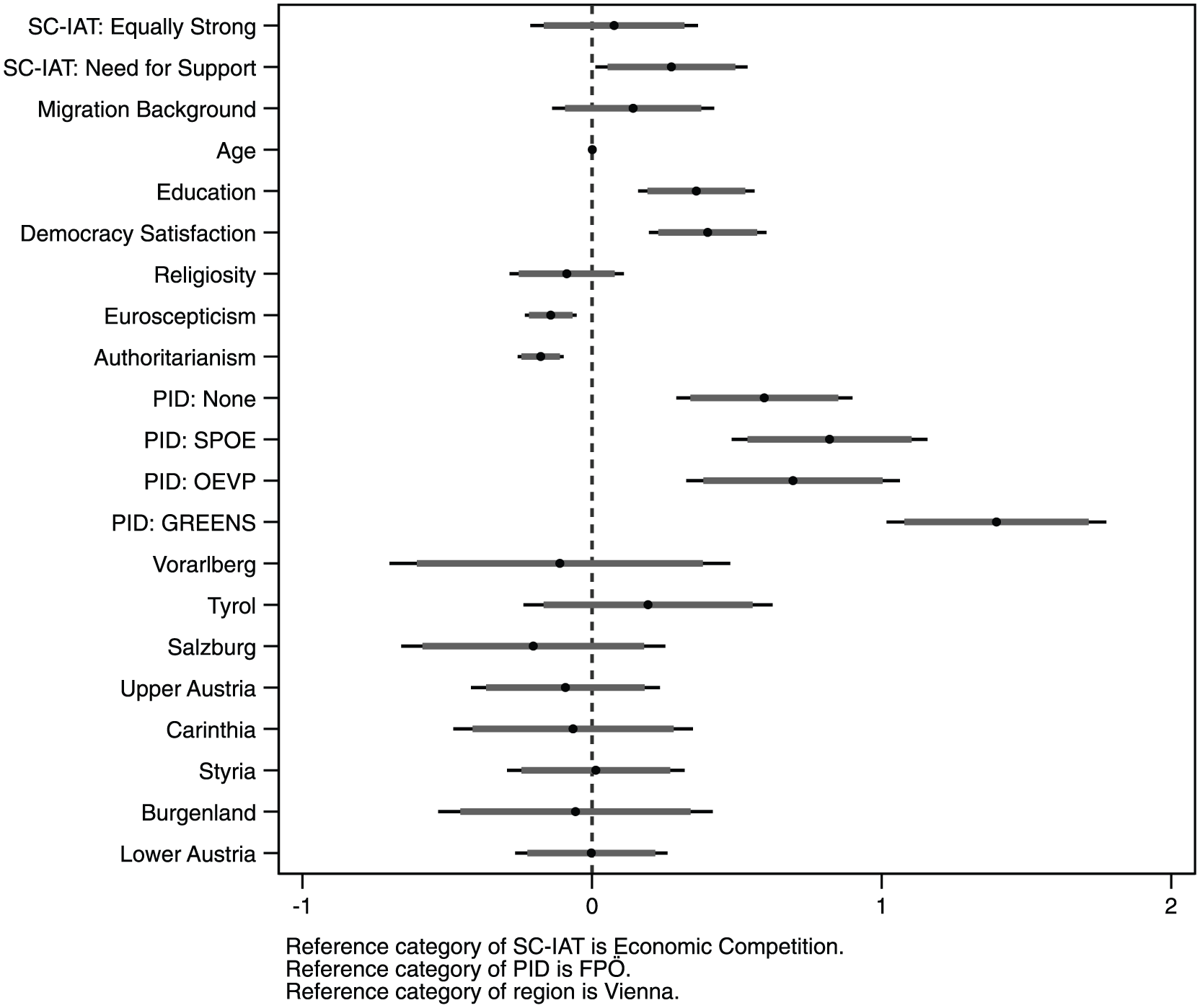
Predicting explicit self-reports against stopping immigration using implicit associations with immigrants.
In addition, we find that higher education and democracy satisfaction coincides with a higher likelihood to disagree with stopping immigration to Austria. Similarly, identifying with any other party than the far-right FPÖ or no party at all seems to statistically significantly affect pro-immigration policy. Looking at authoritarianism and Euroscepticism, we also find statistically significant effects: Eurosceptics and respondents with a tendency to support authoritarian beliefs reveal a trend towards stopping immigration. The latter result corresponds with the empirical findings in Pérez (2010, 2016).
Conclusion
Austrian policy makers and the news media suggested a divide in society between citizens associating immigrants with need for support or economic competition. However, empirical research has been unable to empirically describe these groups so far. Our Single Category Implicit Association Test has successfully measured this divide.
We find that citizens seem to be overwhelmingly supportive of immigrants during the peak of the migrant crisis. However, almost a fifth of the population perceived migrants as economic competition. When investigating respondents’ backgrounds and beliefs, our findings suggests variation though: for example, more religious people display stronger associations with need for support. This is not surprising given that we may expect religious citizens to follow values such as altruism and charity. At least with a predominant Christian faith in Austria, this makes sense.
One remarkable finding is that we identify people living in the Burgenland and Carinthia as associating migrants rather with economic competition than with need for support. Reflecting on the reasons for the regional differences, it is worth noting that the Burgenland was one of the major migration routes for the immigrants. The region directly borders Hungary where the immigrants started their journeys towards Germany. In addition to this, Nickelsdorf, a small village in the Burgenland, quickly established one of the largest detention centres for the immigrants. After the tipping point during the crisis, the centre also became the focus of controversial debates around the crisis. Moreover, the Burgenland recorded third highest unemployment rate in Austria (Austrian Economic Chamber, 2016). It is also classified as economically underdeveloped with its income predominantly generated by agriculture, tourism and wind energy. Even though the region is further away from the core migration routes, Carinthia is well-known for its large share of FPÖ supporters. The far-right party held the second largest vote share in Carinthia in the 2013 parliamentary election and won the majority of votes in the region in the recent 2017 parliamentary election. Carinthia also registered the second highest unemployment rate within Austria in 2016 (Austrian Economic Chamber, 2016).
Putting things in perspective, these factors may in sum have evoked fears about the region’s economic stability, with more and more people potentially competing for jobs and financial support.
In conclusion, our findings confirm previous claims that “[i]mplicit attitudes toward immigrants appear to be […] group-specific in nature yet nonetheless influential in political decision-making” (Pérez, 2010, 539), as they clearly suggests variation across citizens with different backgrounds and beliefs.
Regarding the method, we believe that our design worked well. The Single Category Implicit Association Test enabled us to disentangle the two groups outlined in news media reports. In line with Pérez (2010, 2016), our design supports the assumption that implicit associations with immigrants can be measured validly and effectively using Implicit Association Tests. However, our data do not include an explicit equivalent to our implicit measure. We are thus unable to provide evidence of any unique leverage of the implicit measures.
Admittedly, our survey was fielded during the peak of the crisis when humanitarian motives prevailed. Towards the end of 2015, public opinion seemed to have shifted with increasing problems in crisis management. If we had been able to repeat the experiment in early 2016, we would have expected to find a stronger association with economic competition. It is up to future research to implement our design at a different time and in a different context to validate our study.
Supplemental Material
RAP768136__Supplementary_Material_REV2 – Supplemental material for Need for support or economic competition? Implicit associations with immigrants during the 2015 migrant crisis
Supplemental material, RAP768136__Supplementary_Material_REV2 for Need for support or economic competition? Implicit associations with immigrants during the 2015 migrant crisis by David Johann and Kathrin Thomas in Research and Politics
Footnotes
Acknowledgements
We would like to thank Colin Tucker Smith for his helpful support in developing and implementing the SC-IAT module and for his helpful comments on previous drafts. We are indebted to Wolfgang C. Müller, Sylvia Kritzinger, and Hajo Boomgarden, Principal Investigators of the AUTNES, for their support and their openness to include the SC-IAT in the online panel. We would also like to thank Julian Aichholzer and Patricia Oberluggauer for their assistance with the development of the SC-IAT. Last but not least we would like to thank the anonymous reviewers and the participants of several international conferences for their constructive and concise feedback.
Authors’ note
Kathrin Thomas was previously affiliated with City, University of London. This work was conducted and submitted in her position as Research Associate in Survey Methodology at City, University of London.
Contributor’s statement
Order of co-authors is alphabetical. The authors contributed equally to the development of this manuscript.
Declaration of conflicting interest
The author(s) declared no potential conflicts of interest with respect to the research, authorship, and/or publication of this article.
Funding
The author(s) disclosed receipt of the following financial support for the research, authorship, and/or publication of this article: This work was supported by the Austrian National Election Study (AUTNES), a National Research Network (NFN) sponsored by the Austrian Science Fund (FWF) [S10902-G11].
Supplementary material

Notes
Carnegie Corporation of New York Grant
This publication was made possible (in part) by a grant from Carnegie Corporation of New York. The statements made and views expressed are solely the responsibility of the author.
References
Supplementary Material
Please find the following supplemental material available below.
For Open Access articles published under a Creative Commons License, all supplemental material carries the same license as the article it is associated with.
For non-Open Access articles published, all supplemental material carries a non-exclusive license, and permission requests for re-use of supplemental material or any part of supplemental material shall be sent directly to the copyright owner as specified in the copyright notice associated with the article.
