




Abstract
While authorship assignment has been studied extensively in the US Supreme Court, relatively little is known about such decisions in the intermediate federal courts. Moreover, what we know about circuit courts relates only to published opinions (those which constitute precedent under the doctrine of stare decisis and, thus, influence policy). Little is known about authorship of less influential unpublished opinions. Distinguishing between the costs, benefits, and risks inherent in authoring published versus unpublished opinions, we develop and test theoretical expectations about how demographic characteristics of opinion assignors and assignees influence authorship across opinion type. We conduct empirical tests using an exhaustive original dataset containing all authored dispositive circuit panel opinions issued in 2012. The results reveal that White and male judges are more likely to assign White and male judges to write published opinions and less likely to assign them to write unpublished opinions. The substantive sizes of the discrepancies are somewhat modest, but our results indicate that judges from historically disadvantaged groups have fewer opportunities to shape policy and they shoulder a disproportionately larger share of the routine chore of resolving individual cases.
Introduction
While authorship assignment has been studied extensively in the US Supreme Court, relatively little is known about such decisions in the intermediate federal courts. Moreover, what we know about circuit courts relates only to the published opinions that constitute precedent under the doctrine of stare decisis and, thus, influence policy (Farhang et al., 2015). Yet most circuit opinions are unpublished, which means they resolve a dispute and have little (if any) other influence. We explore whether, and why, demographic characteristics influence which judges are more likely to write influential published opinions and which are more likely to write obscure unpublished opinions. Specifically, we look for patterns consistent with biased task assignment, differential risk perception, or ingroup favoritism.
We conduct empirical testing using an exhaustive original dataset containing all dispositive authored circuit panel opinions issued in 2012. The results from this dataset of more than six thousand opinions reveal that White and male judges are more likely to assign White and male judges (including themselves) to write published opinions and less likely to assign them to write unpublished opinions. The substantive sizes of the discrepancies are somewhat modest, but our results indicate that judges from historically disadvantaged groups have fewer opportunities to shape policy and they shoulder a disproportionately large share of the routine chore of resolving individual cases. Moreover, there is reason to conclude that this pattern emerges from an overall tendency of members of privileged demographic groups to disproportionately allocate less important work to their historically disadvantaged colleagues. This finding suggests the importance of exploring the possibility of similar disproportionate task assignment in other contexts as well. Furthermore, the underlying demographic distribution of circuit judges also plays a role in the differences we observe, which highlights the importance of continuing to diversify the judiciary.
Authorship, publication, and judicial demographics
Most of what we know about how opinions are assigned on collegial courts is based on the particular institutional context of the US Supreme Court. Considerable empirical evidence suggests that chief justices exercise the opinion-assigning power in an ideological and strategic fashion; even changing their vote to the majority in some instances to avoid ceding that power (Maltzman and Wahlbeck, 1996). The power of assignment is valuable because the opinion author possesses a first-mover advantage in framing the scope and content of the legal rule (Lax and Cameron, 2007). The limited evidence from federal circuit courts suggests that collaboration and issue specialization may be more important than strategy and ideology (Bowie et al., 2014; Farhang et al., 2015). At this level, evidence suggests opinion assignors respond to requests from their peers, and there is no indication that assignors rely more heavily on their ideological allies (Farhang et al., 2015).
Most federal circuit cases are resolved by three-judge panels, and the senior active (i.e., not retired) judge on the panel is responsible for assigning the opinion author (Bowie et al., 2014). This power is typically exercised when the panel meets in conference after hearing oral arguments in a set of cases (Bowie et al., 2014). After the panelists reach a consensus on how each case will be resolved, the assignor splits up the cases amongst the panel judges. One other key decision is made at this stage as well. Since circuit courts do not have agenda control, they reduce their workload by dispatching a wide swath of uncontroversial cases by means of opinions not designed for a wider audience (Hazelton et al., 2016). Consequently, a panel also tentatively decides whether to designate each opinion as “Not for Publication” (Bowie et al., 2014). While there is evidence that institutional rules, strategy, ideology, and circuit decisions can influence the publication decision at the margins (Hazelton et al., 2016; Law, 2005; Songer, 1990), in most instances the features of the case itself dictate whether it merits a published opinion (Bowie et al., 2014). More importantly, regardless of the nature of a case an opinion designated as unpublished carries no precedential weight (Hazelton et al., 2016).
The costs, benefits, and risks associated with writing an opinion vary based on its publication status. The author of a published opinion incurs greater cost in terms of time and effort. The primary purpose of using unpublished opinions is that they can be written more quickly with less effort and fewer resources (Law, 2005). However, published opinions also offer substantially greater benefits because they provide an opportunity to influence legal development (Bowie et al., 2014; Lax and Cameron, 2007). Published opinions constitute binding precedent for all future cases in that circuit while unpublished opinions have little impact beyond the litigants (Farhang et al., 2015; Hinkle, 2015; Law, 2005). Consequently, writing an unpublished opinion provides very little utility to the authoring judge, and none in terms of policy influence. Although such opinions are necessary to guarantee that litigants are provided at least one appeal as of right, they are rarely glamorous. Working on such cases is often banal, repetitious, and tedious (Law, 2005).
The two types of opinions also carry different risks. Publication raises the possibility, although rare, that an opinion may be reversed either by the Supreme Court or by the full circuit sitting en banc (Hazelton et al., 2016; Law, 2005; Wasby, 2001). Although review of an unpublished opinion is possible, scarce resources are almost never expended to review an opinion that only resolves a single dispute (Hazelton et al., 2016). In short, the costs are higher, and there is some risk of reversal, when authoring a published opinion but these shortcomings are outweighed by the substantial policy benefit of exerting influence over legal development. This is particularly true when a judge is less concerned about being reversed. Since federal circuit judges have little chance of advancement and hold life appointments, there is little reason to care about reversals beyond reputational concerns (Epstein et al., 2013).
Existing theories suggest three reasons why we might expect demographic characteristics to be related to authorship of published and unpublished opinions. First, the opinion assignor might assign different types of opinions based on the assignee’s race or gender. Second, the types of opinions assignees request may vary based on the assignee’s race or gender. Third, the characteristics of the assignor and assignee may operate in tandem. We begin by focusing on a theory of workload distribution. Research on workplace task assignment generally has provided some evidence of African-Americans and women being assigned tasks of low variety and little decision authority, as well as heavy workloads (Hughes and Dodge, 1997). Within academia, there is empirical evidence that, at least in some fields, female faculty engage in more teaching and minority faculty shoulder a disproportionate share of service responsibilities while their White male colleagues spend a higher percentage of their time on research (Bellas and Toutkoushian, 1999; Brown, 2000; Seaberg, 1998). Moreover, there is some indication that similar patterns may extend to courts. Bowie et al. (2014) find that White judges are significantly more likely to author published opinions (although gender had no significant effect). Since there is a norm of sharing opinion-writing duties equally (see Bowie et al., 2014), logic suggests that if White judges author a disproportionately large share of policy-making published opinions, then minority judges author a disproportionately large share of mundane unpublished opinions. To the extent that race and gender-based differential task assignment exists in the circuit courts, we hypothesize that White and male judges author more published opinions and fewer unpublished opinions.
Differential task assignment is only one possible explanation for the hypothesized pattern. A second reason such a pattern might emerge is gender or race-based differences in the types of opinions judges prefer to write. Circuit judges can request opinion authorship in particular cases, and research suggests that the assignor often grants these requests (Farhang et al., 2015). A variety of studies provide evidence that there are both gender and race-based discrepancies in the level of risk humans perceive (see, e.g., Finucane et al., 2000). One explanation for such differences is that for White males “the world seems safer” (Finucane et al., 2000). It is possible that the world also seems like a safe place for women and minorities who reach the exalted status of federal appellate judges, but there is also research that shows demographic differences in risk perception among scientists, another highly educated group of elites (Barke et al., 1997). 1 If there is such differential risk perception among circuit judges, White and male judges may perceive the risk of reversal to be lower and, consequently, request authorship assignments for published opinions more frequently.
A third reason why White and male judges might author more published opinions (and fewer unpublished opinions) is ingroup favoritism combined with their numerical advantage on the circuit courts. Social psychologists have long recognized the importance of shared group membership to human behavior and demonstrated that individuals show favoritism to others who share their group memberships (Tajfel, 1970). Such ingroup favoritism may manifest on courts as assignors being more likely to assign the plum, policy-shaping assignments of published opinions to colleagues who share their gender or race. White and male circuit judges have substantially more opportunities to benefit from such ingroup favoritism by virtue of their larger numbers.
Biased task assignment, differences in risk perception, or ingroup favoritism may result in White or male judges writing more published and fewer unpublished opinions compared to minority or female judges. Untangling these explanations is challenging, but not hopeless. The easiest theory to disentangle is ingroup favoritism because it implies that similarity matters most rather than the underlying demographic characteristic. Distinguishing between biased task assignment and differential risk perception is more difficult because both predict variation based on assignee characteristics, and we have no way to observe actual requests to author particular opinions. However, the theories do vary in the extent to which they implicate the role of assignor characteristics. If biased task assignment exists, it is almost certainly a product of subtle, unconscious bias. Individuals who have experienced prejudice or discrimination are generally more aware or conscious of the possibility of perpetuating the same types of bias they have suffered from (Boyd et al., 2010; Patton and Smith, 2017). As a result, we expect that female or minority opinion assignors are more aware of the demographic distribution of their task assignments. Conversely, White male judges whose privileged position in society has insulated them from similar experiences should be more likely to engage in unconscious, biased task assignment simply because they are usually not primed to consider that possibility. Differential risk perception does not similarly implicate assignor characteristics. Therefore, if the hypothesized pattern emerges only when the opinion assignor is White and male, we posit that biased task assignment (rather than differential risk perception) is primarily driving the result. Figure 1 illustrates the empirical implications of each theory.
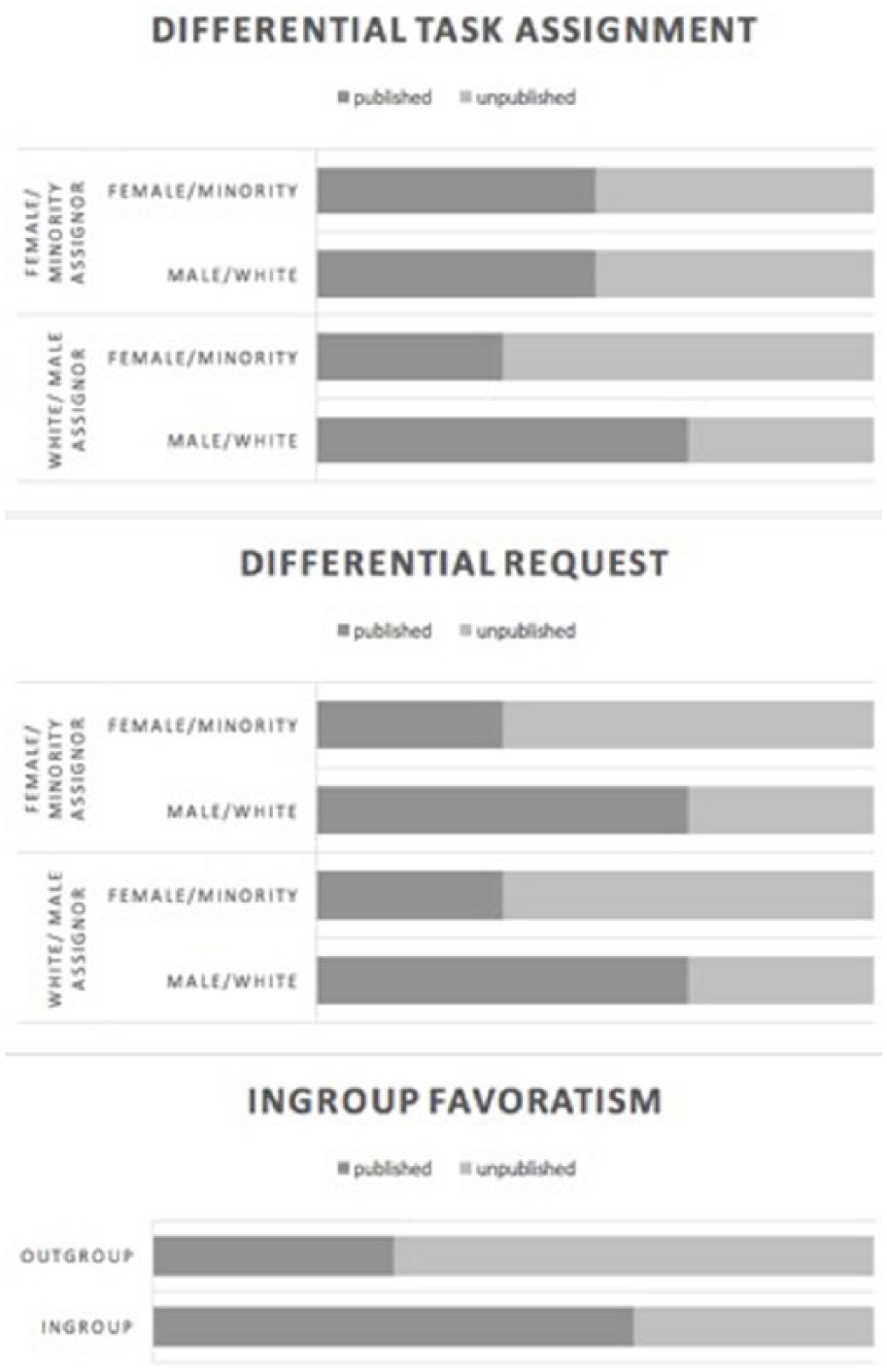
Illustration of empirical predictions by theory.
Data, methods, and results
We explore the role of race and gender on opinion assignment using an original dataset of all dispositive authored panel opinions issued by the US courts of appeals in the calendar year 2012. 2 Our dataset, obtained using Lexis, contains 6,154 opinions from the eleven numbered circuits, the DC Circuit, and the Federal Circuit. Using the content of these opinions, we coded the circuit, judges, author, whether any of the judges were sitting by designation, and whether the opinion was designated as unpublished. Next, we obtained biographical and demographic information on each listed judge from the Federal Judicial Center database. Three-quarters of opinions were issued by panels with at least one woman or minority. Table A1 in the Online Appendix A contains further breakdown of these cases.
Our study focuses on whether each judge writes a signed majority opinion for the panel, so the unit of analysis is each judge in each case. Judges who authored a dissenting opinion are excluded on the basis that they are not available to have the majority opinion assigned to them (Farhang et al., 2015). 3 To test our theory, we create a series of dummy variables that reflect the relevant characteristic of the opinion assignor and whether the judge in question shares that characteristic. The baseline category for each is a male/White assignor paired with a male/White judge. Then we interact each of the dyadic variables with a dummy that indicates whether the opinion was published. The outcome variable equals one if the judge authored the majority opinion in the case and zero otherwise. Since the outcome variable is binary, we estimate a probit model with robust standard errors clustered on the case. A conditional logit model can account for the reality that an opinion will be assigned to only one judge, but such a model only estimates within-case variation (Farhang et al., 2015). The latter feature is problematic here because assignor characteristics and publication status only vary across cases. The Online Appendix B illustrates that an alternative specification using multiple conditional logit models leads to similar conclusions. Finally, we estimate circuit fixed effects to account for variation across circuits.
In addition to the primary explanatory variables, several other factors may also influence whether a particular judge authors an opinion. We measure the ideological distance between a judge and the opinion assignor using Judicial Common Space scores (Epstein et al., 2007; Giles et al., 2001). Circuit judges are more likely to assign opinions to themselves (Farhang et al., 2015), so we control for whether the judge in question has the opinion assigning responsibilities in the given case. Finally, we control for a variety of judicial characteristics that may reflect a judge’s level of experience or expertise. Judges who clerked for a judge, who have been on the bench longer, or who were rated highly by the American Bar Association (ABA) may be perceived as having greater expertise. We classify a judge as “Highly Qualified” if they obtained an ABA rating of “Well Qualified” or “Exceptionally Well Qualified.” Conversely, circuit judges who have been on the court for fewer than two years may be perceived as less well-equipped to write opinions. Similarly, circuit judges from other circuits and district judges sitting by designation may be less likely to be entrusted with opinion-writing duties. Summary statistics for all variables are available in the Online Appendix A.
The regression results are presented in Table 1, but the model is too complex for the coefficients to shed much light. To evaluate our hypotheses, we present predicted probabilities of authorship for various combinations of our key explanatory variables while holding all other variables at their median. Figure 2 demonstrates that in most categories with judges who are male or White (see comparisons that are circled), the probability of authorship is higher for published cases. The only exception is when a minority judge is assigning the opinion to a judge with a different race or ethnicity. However, it is also possible for this category to also contain minority judges when the opinion assignor and judge are different minorities.
Probit regression estimates of the effects of assignor characteristics, judge characteristic, publication status, and control variables on the probability that a panel judge will author an opinion. Model includes fixed effects for circuit (not shown) and robust standard errors are clustered on the case.


Predicted probability of authorship by publication status and opinion assignor characteristic when a judge shares the assignor’s characteristic (left panel) and when they do not (right panel). All other variables are held at their median. Bars display the 95% confidence interval around each estimate. Bars and estimates in black denote that the relevant estimate for published cases lies outside the 95% confidence interval for the corresponding estimate of unpublished cases. The circled estimates denote probability of authorship when the judge in question is male or White (as applicable).
Not only are White and male judges more likely to author published opinions and less likely to author unpublished opinions, that difference is only statistically significant when the opinion assignor is male or White. 4 The null findings for female or minority assignors may be due to fewer data, but the estimates for published and unpublished opinions are quite close to each other indicating that imprecise estimates do not appear to be driving these null findings.
White and male judges may assign more published than unpublished opinions to other White and male judges as a matter of simple ingroup favoritism. If this is the case, then we would expect to see such favoritism exhibited by women and minorities as well. While both groups do tend to assign more published than unpublished opinions to members of their ingroup, the difference is only statistically significant for minorities.
Although the results for ingroup assignment suggest that group favoritism may play a role, looking at how judges assign opinions to those who are different from themselves suggests the operation of an additional dynamic of asymmetric task assignment of routine, unchallenging work to women and minorities. Both male and White assignors are significantly more likely to assign unpublished than published opinions to judges who do not share their relevant demographic characteristic. Yet there is no evidence that female and minority assignors engage in the same type of behavior.
Statistical significance only tells part of the story. Although these racial and gender discrepancies exist, they are somewhat modest in size. When the assignor is male, the predicted probability of writing an opinion is 0.34 if published and 0.31 if not. Conversely, a female judge has a 0.31 probability of writing a published opinion and a 0.36 probability of writing an unpublished opinion. The numbers are nearly identical for race when the opinion assignor is White. The only difference is that a minority judge has a somewhat lower probability of writing an unpublished opinion, 0.34, compared to a female judge. The largest gap emerges when the opinion assignor is both male and White and the opinion assigner is neither. Under this scenario (which only occurs in 1% of our data), the probability of authoring an unpublished opinion is 0.39 compared to 0.26 for a published opinion.
Concluding thoughts
The importance of the US Supreme Court is tremendous, but the federal circuit courts quietly shape most of the federal legal landscape without input from on high. While that work is done via published opinions, sometimes fully understanding the process of legal development can benefit from comparison to unpublished opinions. Such is the case here. Looking at the aggregate distribution of workload and influence across both opinion types reveals that gender and race play a role even in an increasingly diverse judiciary. All-White manels 5 are no longer the most typical type of panel litigants face, but power discrepancies between White male judges and their colleagues appear to persist. Furthermore, these discrepancies can arguably be traced to biased task assignment and ingroup favoritism rather than differential risk perception.
Two items suggest reason for optimism in the face of these findings. The first is the fact that the size of the discrepancies we uncover is modest. The second is that research indicates that unconscious biases such as those presumably driving disproportionate task assignment can be erased once brought to the attention of White male judges. Patton and Smith (2017) find that gender-based patterns in questioning at oral arguments evaporate in cases addressing gender-related legal issues. They argue that this pattern indicates that justices refrain from treating female lawyers worse than male lawyers when they are explicitly thinking about gender inequality (Patton and Smith, 2017). This suggests that bringing biased task assignment to light could arm White male judges with the type of information their female and minority colleagues have already gained through personal experience. Nevertheless, we are left with the sobering fact that simply looking at who is on the federal bench is not sufficient to fully understand who is shaping legal policy.
While our contributions here shed important light on the role of gender and race on workload distribution in circuit courts, they raise many more questions as well. Does issue specialization play a different role based on race and gender? Are more diverse circuits less susceptible to these patterns? Do such patterns appear in state courts or other political institutions? How have the role of race and gender in workload distribution changed over time? Investigating such questions will require substantially more data. The results presented here suggest not only the utility, but even the urgency, of further investment to address such questions.
Supplemental Material
RAP762869_Supplementry_Material_REV1 – Supplemental material for Of Whites and men: How gender and race impact authorship of published and unpublished opinions in the US courts of appeals
Supplemental material, RAP762869_Supplementry_Material_REV1 for Of Whites and men: How gender and race impact authorship of published and unpublished opinions in the US courts of appeals by Elizabeth A. Tillman and Rachael K. Hinkle in Research & Politics
Footnotes
Correction (June 2025):
Declaration of conflicting interest
The author(s) declared no potential conflicts of interest with respect to the research, authorship, and/or publication of this article.
Funding
The author(s) received no financial support for the research, authorship, and/or publication of this article.
Supplementary materials
The supplementary files are available at http://journals.sagepub.com/doi/suppl/10.1177/2053168018762869. The replication files are available at  .
.
Notes
Carnegie Corporation of New York Grant
This publication was made possible (in part) by a grant from Carnegie Corporation of New York. The statements made and views expressed are solely the responsibility of the authors.
References
Supplementary Material
Please find the following supplemental material available below.
For Open Access articles published under a Creative Commons License, all supplemental material carries the same license as the article it is associated with.
For non-Open Access articles published, all supplemental material carries a non-exclusive license, and permission requests for re-use of supplemental material or any part of supplemental material shall be sent directly to the copyright owner as specified in the copyright notice associated with the article.
