



Abstract
Recent studies show that traditional institutions and their representatives—such as chiefs or elders—are influential political forces in Sub-Saharan Africa and elsewhere. In this paper, we explore the causal mechanism through which traditional institutions increase cooperation and mobilization. We employ a lab-in-the-field experiment using modified public goods games involving the Buganda Kingdom of Uganda. We incorporate references to traditional authority to measure whether participants contribute more when traditional institutions are involved. We explicate and test two possible mechanisms through which traditional institutions might affect cooperation and mobilization: a horizontal mechanism driven by peer-to-peer effects; and a vertical mechanism driven by access to social hierarchies. We find evidence for the latter. This suggests that traditional institutions increase cooperation, because individuals expect that their cooperation and investment will be rewarded by traditional social elites.
Introduction
An increasing number of studies analyze traditional political institutions and representatives, that is, chiefs, elders, or councils and courts made up of traditional leaders (Acemoglu et al., 2014; Baldwin, 2013, 2014, 2015; Baldwin and Mvukiyehe, 2015; Koter, 2013). Traditional institutions and leaders can have a significant influence in mobilizing their constituencies, since constituents perceive them as legitimate political actors in otherwise weak states (Logan, 2013).
In this paper, we explore the causal mechanisms through which traditional institutions increase cooperation in their constituencies. We argue that a better understanding of how traditional institutions affect cooperation will provide key insights into how mobilization plays out in local communities. Specifically, we posit that traditional institutions buttress cooperation by providing the selective incentives necessary to solve collective action problems. To test this argument, we worked with the Buganda Kingdom in Uganda, one of the oldest and largest pre-colonial institutions remaining in Africa, and employ a lab-in-the-field experiment using modified public goods games. The experimental design allows us to test two possible causal mechanisms through which traditional institutions might affect cooperation and mobilization: a horizontal mechanism driven by peer-to-peer effects; and a vertical mechanism driven by access to social hierarchies. We find evidence for the latter, and none for the former. This suggests that traditional institutions increase cooperation because individuals’ expect that their cooperation and investment will be rewarded by social elites, rather than through an increase in the salience of ethnic identity among co-ethnics. Our findings not only speak to the role of traditional institutions in these communities, but may also be informative for other contexts in which culturally-based institutions and recognized representatives of identity-based groups (e.g., religious leaders) can align individual interests to increase social cooperation in their constituencies to overcome collective action problems.
Linking traditional authorities and social cooperation
When discussing traditional institutions, we do not necessarily refer to ancient, static institutions, but rules and regimes that constituents of an ethnic group deem legitimate based on narrative, history, or custom. While in Sub-Saharan Africa, traditional institutions have undergone significant changes during colonial and postcolonial periods, several scholars have recently shown the persisting importance of traditional political institutions (for an overview see Holzinger et al., 2016).
Regarding contemporary traditional institutions, using data from the Afrobarometer, Logan (2013) demonstrates that constituents across the continent see traditional leaders as influential local actors. In her work, Baldwin (2013, 2014, 2015) provides an extensive analysis of traditional leaders as “development brokers,” and how they leverage public goods provision to mobilize constituents. Koter (2013) shows that where strong traditional leaders exist, cross-ethnic allegiances can emerge when political candidates, via these intermediaries, reach out to non-co-ethnic communities. Baldwin and Mvukiyehe (2015) demonstrate that chiefs selected by customary mechanisms perform better in providing public order in Liberia.
Yet, the link between traditional institutions and collective mobilization in contemporary politics is still insufficiently understood. For instance, in explaining the positive effects that Gennaioli and Rainer (2007) find linking centralized traditional institutions with local public goods provision, they are careful to highlight their findings as association, not causation. Similarly, in their analysis of regional development patterns, Michalopoulos and Papaioannou emphasize that, while robust, their results do not imply causation (Michalopoulos and Papaioannou, 2015: 62). They call for further research into the causal channels behind their findings. Our study constitutes an attempt to identify the causal mechanisms by which contemporary traditional institutions affect social cooperation by using an experimental design.
Theory and hypotheses
We assume that traditional institutions provide the mechanism through which co-ethnics can better solve collective action problems. We hold that signalling to constituents that traditional institutions are involved in collective action scenarios cues the trust individuals have in their traditional polity, and assures participants that greater utility through cooperation—the collectively and individually more desirable outcome than mutual defection—is achievable. This, in turn, increases the potential of constituents to cooperate for a collective cause. 1 In other words, if constituents find themselves in situations of uncertainty which may lead to collectively inefficient outcomes, the involvement of traditional institutions and their representatives may offer assurance that individual contributions and investments will be rewarded, thereby fostering cooperation. Thus, our general hypothesis H1 is:
H1 If the involvement of traditional institutions in collective action is signaled to constituents, cooperation among constituents increases.
We assume that traditional institutions in general foster social cooperation. We use a stronger and a weaker definition of constituents: the stronger definition entails individuals whose ethnic identification matches that of the traditional polity (co-ethnics). That is, respondents of the Baganda ethnic group may place trust in the institution of the Kabaka and the Kingdom. The weaker definition refers to individuals who live within the geographic sphere of influence of the traditional polity (co- and non-co-ethnics). For example, an individual identifying as Munyankole who lives in Kampala among a majority of Muganda may also adhere to calls for immunization by the Buganda Kingdom. Using the stronger and weaker definitions reflects recent evidence, showing that ethnic identification can go beyond one’s core group if linked to potential public goods provision because of the local ethnic geography (Ichino and Nathan, 2013), and that governance authorities are strategic in their activities regarding the provision of public goods depending on the ethnic setup of their constituency (Ejdemyr et al., Forthcoming).
We identify two causal mechanisms which may foster ethnic identification and cooperation involving traditional institutions: (a) a horizontal “peer” effect; and (b) a vertical effect based on social hierarchies of the polity. We discuss each related hypothesis in order:
H2.1 Horizontal signaling of support for the traditional institution to peers increases cooperation among constituents.
Constituents can signal their support for the involved traditional institution to each other. This horizontal signaling may increase contributions to the public good, as it cues a coherent group identity, and fosters a constituent’s trust in her/his peers’ contribution. Constituents may rally even without their traditional leader instigating mobilization, by referencing their institution to each other. This horizontal signaling may trigger an increase in the salience of group identity, which would buttress cooperation. This increased salience could provide a greater psychological utility to the individual, thereby balancing the cost the individual incurs from engaging in collective action.
H2.2 Vertical signaling of support for the traditional institution to traditional representatives increases cooperation among constituents.
That is, constituents can signal their support for the involved traditional institution to that institution’s representatives. This vertical signaling may increase contributions to the public good, with constituents under the hope or expectation that their contribution is rewarded at some future point, given their previous experience with public goods provision of traditional institutions and their legitimate representatives. Signaling can happen via popular elections, although these frequently do not exist in more centralized traditional polities. Alternatively, constituents can voice their support or critique to representatives of the organization of the traditional polity, for example, village level chiefs or traditional bureaucracies who communicate the critique through the ranks, similar to mechanisms in smaller, more decentralized polities. This theory suggests that selective incentives, in the form of increased favor with superior traditional representatives, provides the benefit to override costs incurred from collective action. Mares and Young (2016) provide related evidence that traditional leaders provide these selective incentives, in the form of both positive and negative inducements, to further clientelistic practices. Similarly, Gottlieb (2017) suggests that traditional leaders can employ threats of retribution to encourage pro-social behavior in a lab-in-the-field experiment in Senegal.
Experimental design
The Buganda Kingdom as a target polity
The Buganda Kingdom represents a prominent case of a traditional polity, since it plays a significant role in Ugandan politics (Englebert, 2002; Lindemann and Goodfellow, 2013). Buganda is the most influential of the constitutionally recognized traditional institutions in Uganda. With about 17% of the population identifying as Baganda, the ethnic group constitutes the largest in the country. Over 40% of Muganda constituents surveyed in the Afrobarometer (2009) say they trust their traditional leaders “a lot,” and a majority of about the same percentage would like their influence to “increase a lot.” The king (kabaka), his administration, and parliament (lukiiko) are based in Kampala, Uganda’s capital. Today, the Kingdom lays claims to much of the land in Uganda’s Central Region, and is frequently in open conflict with the Ugandan government, which is dominated by President Museveni’s co-ethnics, the Muyankole.
The partner in our experiment, the Buganda Cultural and Development Foundation (BUCADEF), was established by the Buganda Kingdom as a non-governmental organization in 1994 “spearheading and directing social economic development in communities.” 2 To fund some of its activities in areas such as food security or sanitation, the BUCADEF provides certificates to recognize individual donations and contributions. For their donation to the Kingdom, benefactors receive a formal certificate stating the amount of the donation, and displaying a text in Luganda language “blessing” the donor, the seal of the Buganda Kingdom, as well as the signature of the prime minister of Buganda (the Katikiro). Both the success of the BUCADEF’s efforts and previous work suggest that these certificates are highly prized and considered a badge of social honor. 3
Sample and experimental game
To tease out the causal mechanisms linking traditional institutions and social cooperation, we employ an experimental design. While observational methods might allow us to test hypothesis H1, without experimental manipulation, it would be impossible to disentangle horizontal and vertical effects, as both are a large part of the Kingdom’s official recruitment strategies. Therefore, a lab-in-the-field approach provides an opportunity to disentangle the isolated effects of each theoretical mechanism in a controlled environment. Due to space constraints, the online Appendices B, C, and D present the sample selection strategy and sample details, the enumerator instructions, and the accompanying survey questionnaire employed several days prior to the intervention. Overall, we aimed at a sample of 225 participants with 75 individuals for each of three treatment conditions (see below), to which participants were assigned randomly upon arrival at the experimental site.
Our primary outcome of interest is cooperative social behavior. Following the behavioral economics literature, we operationalize this outcome with a public goods game. In the classic public goods game set-up, each individual is provided with an endowment, from which they can allocate any amount to a central pot, keep it themselves, or split their endowment between the two options. All contributions to the central pot are multiplied by 1.5, and then divided evenly among the participants. In this set-up, it is individually rational to defect and keep one’s entire endowment. However, we suggest that due to the salience of the Kingdom, our treatment conditions may cause individuals to select the socially optimal solution and contribute a greater portion of their endowment to the public goods pot.
At this point, our design diverges from the classic public goods game set-up. In addition to the contributions being divided evenly and returned to the players, in our design participants are informed that all contributions would be matched and given to a charitable organization. This does not alter the individual payouts that would be received from a standard public goods game. There are three groups or experimental conditions, to which participants were assigned at random. The first, or secular condition, is that all contributions to the central pot would be matched, and the sum donated to a local school that caters to orphans and other disadvantaged children within Nansana district (the location of our experiment). Any individual who chooses to contribute could also opt to receive a certificate bearing their name, the seal of the school, and the amount of their donation. The second, or horizontal condition, also matches each player’s contribution to the pot, but instead donates the money to the BUCADEF. In this condition, respondents are also given the choice to receive a certificate closely resembling the original, bearing their name, the original Buganda Kingdom seal, and the amount of their contribution. 4 The final, or vertical condition, also matches each player’s contribution to the pot and donates the money to the BUCADEF, but instead of a certificate, the player is given the choice to sign a letter to the Director of the BUCADEF, disclosing their name and the amount that they contributed. 5 These conditions are summarized in Table 1, and the materials (i.e., sample certificates in Luganda and letter in English) provided to the recipients are shown in Figure 1 (Panels 1 and 2) and Figure 2.
Experimental conditions.

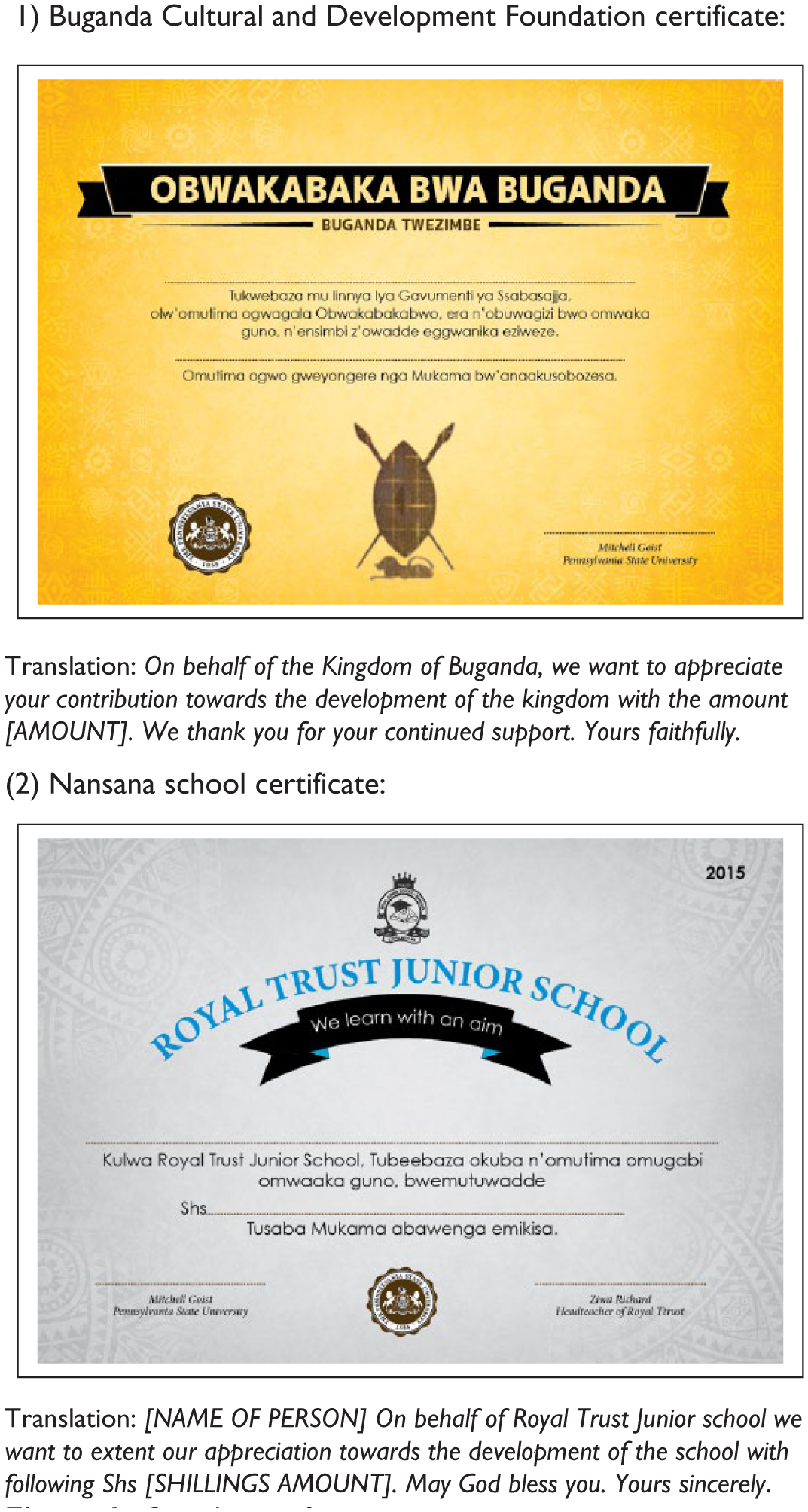
Sample certificates.
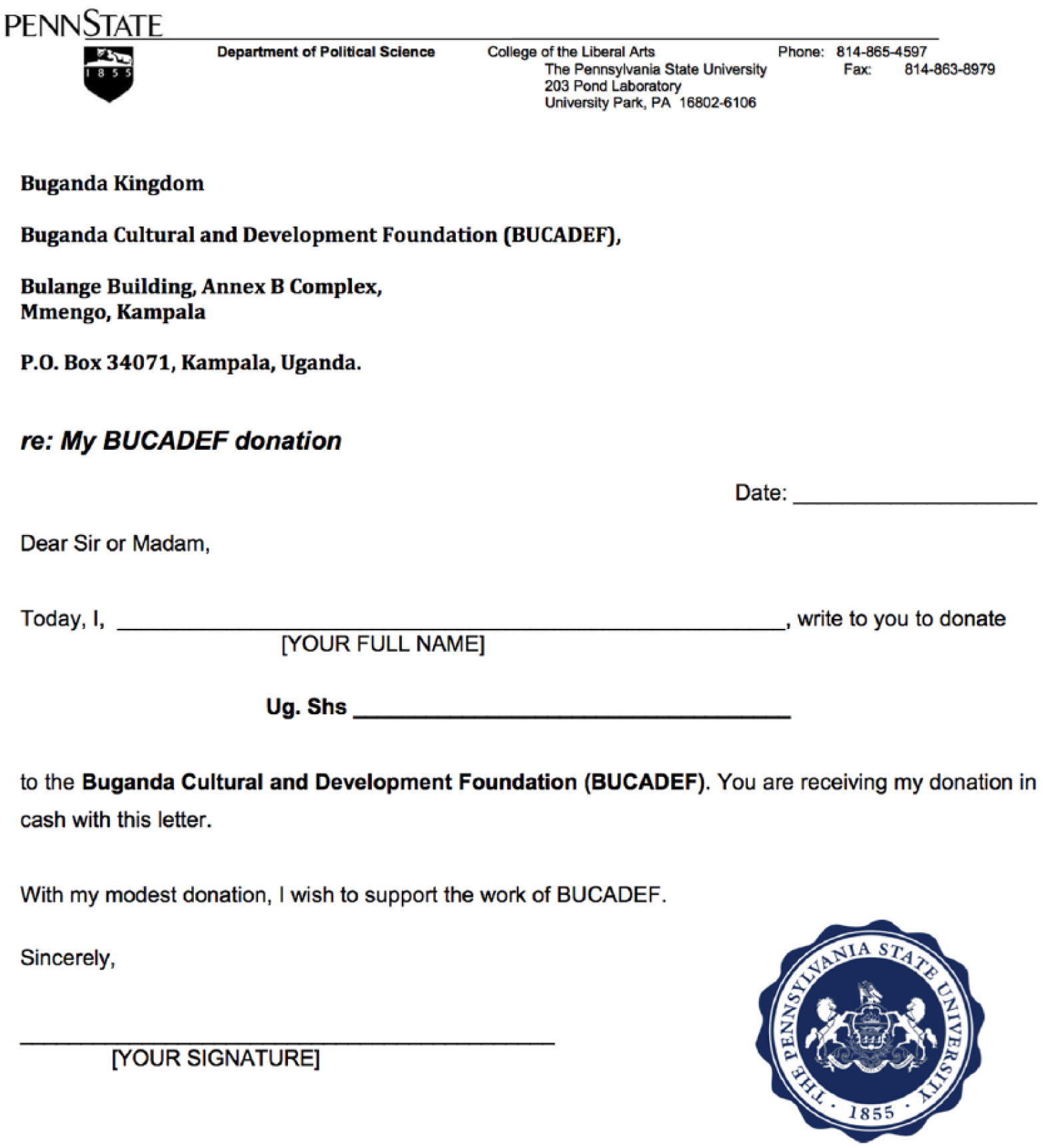
Buganda Cultural and Development Foundation sample letter.
The control condition—that is, where matched contributions to the public goods game are provided to the local school—is designed to isolate the effect of altruism. In other words, this allows us to distinguish whether or not respondents are responding to an explicitly ethnic appeal to contribute to a good cause, or whether they only wish to contribute to local public goods provision, and are indifferent as to the ethnic character of that contribution.
The first treatment, corresponding to the horizontal hypothesis, is ecologically valid, due to the previously discussed policy of the BUCADEF providing similar certificates to benefactors. We argue that this proxies peer-to-peer effects, as individuals can only display the certificates to friends and acquaintances, thereby signaling their commitment to the ethnic institutions, but not garnering them special favor with representatives of the Kingdom. Our argument is that this provides the potential for a positive inducement towards cooperation, as individuals receive a psychological utility for contributing to the Kingdom’s efforts and receiving an official certificate from the Kingdom, and/or that individuals receive a social utility from displaying this certificate, which would be widely recognized throughout the territorial jurisdiction of the Kingdom, to members of their social network.
The second treatment does the opposite. The letters were collected at the end of the game and hand delivered to the head of the BUCADEF. This does not allow the individual to signal to their peers that they contributed to the ethnic institution, but instead allows them to potentially curry favor, receive recognition, or encourage service provision by Kingdom institutions. It is this potential for future service delivery, or the chance to make a contact with a powerful agent of the Kingdom, that we suggest will induce cooperation under the vertical hypothesis. It is important to note that our design somewhat differs from findings by others studying traditional leaders, in that the design itself, due to anonymity concerns, explicitly rules out the chance for retribution or negative inducements towards cooperation (Gottlieb, 2017; Mares and Young, 2016). Therefore, the appeal to traditional institutions under the vertical condition only contains the potential for positive, or reciprocal, inducements to cooperate, and precludes the possibility that individuals would be sanctioned for their lack of contribution.
A similar condition, that is, a letter provided to the school headmaster was deemed unnecessary, as the headmaster was present when we played the games, in the general intake area, but was not present in the room where the actual games were being played. 6 This allowed individuals who donated to the school to discuss their contributions with him, thereby obviating the need for a formal letter. The dual effect of the control condition, providing both peer-to-peer and vertical recognition of a contribution to a secular institution, biases against a finding in either of the BUCADEF conditions.
Discussion of the design
Before turning to the analysis, we ease two possible concerns with our design at the outset. The first would be that respondents were induced to contribute, not, as we hypothesize, to take advantage of the opportunities afforded by the Baganda polity (the vertical condition), or benefits they would receive from displaying the certificate to their peers (the horizontal condition), but rather by the threat of social sanctioning. We argue that these concerns are misguided. Contributions were made confidentially, with only the enumerator able to determine the amount each individual contributed. Furthermore, certificates were handed out after the experiment concluded, and on an individual basis. Finally, during this entire process, no names were ever recorded. The only exception—if an individual chose to provide his or her name on the letter to the BUCADEF—would have taken place after the game concluded. The lack of names and the secrecy with which contributions were recorded strongly minimized the threat of sanction as a potential mechanism driving our results.
The second, and perhaps more serious matter, is that we do not have a fully saturated design by eschewing a separate secular analogue to the vertical condition. The concern here may be that treatments included only a letter to the BUCADEF, and, because they were not provided with a letter to the school, that this some how biases our findings. However, this was a conscious design choice on our part to enhance ecological validity. As stated before, we argue that, with the headmaster present after the debriefing, we create a stronger control condition that potentially biases against our results.
To illustrate our argument, it is helpful to consider possible confounding explanations that would explain a positive finding for the vertical condition. The first is that respondents chose to donate more, not due to any features of the Kingdom itself, but rather out of a sense of altruism. By including the secular control condition benefiting the local school, if altruism were driving our results, we would expect even contributions among all conditions. A critical reader might suggest that altruism is still driving our results, however, as it produces greater contributions to the Kingdom because individuals judge the BUCADEF as a more reliable provider of community goods. If this were the case, then we would expect even contributions in both the vertical and horizontal conditions.
The only plausible confounding relationship that would produce a false positive finding in favor of the vertical condition would be that individuals have a strong preference to write letters, for the sake of writing letters. For example, one could argue, if there was an increase in contributions under the horizontal treatment, this could be explained by people merely preferring certificates, which could have some utility in and of themselves. This is why we provided a similar treatment for the horizontal condition. However, we see no reason to suspect that individuals value a letter, a copy of which they do not get to keep or ever see again, for the sake of a letter itself, and rather eschew an analogous, secular control for the vertical treatment. In other words, our assumption is rather that the letter is useful only insofar as it allows access to social hierarchies that the respondent deems advantageous, which is exactly the theoretical mechanism that we propose under the vertical hypothesis. For this effect to be observed without the social-hierarchy explanation being true, there would have to be a plausible explanation for people preferring to contribute under the vertical condition independent of: (a) altruism; (b) ethnic affiliation (as this would suggest equal contributions under both the vertical and horizontal treatment); or (c) perceived social pressure from other participants (since the contributions under the vertical and horizontal treatments go to the same place, it is assumed that any social desirability bias towards increasing contributions would be the same).
Analysis
The results confirm the vertical hypothesis, and show no significant difference (substantively or statistically) for the horizontal hypothesis. Table 2 provides the mean and standard deviations of the outcome, or the amount of money contributed by each individual during the public goods game. Each of the three experimental conditions consisted of 75 individuals, each randomly assigned to playing one round of the public goods game – thus, overall our experiment involved 225 participants. Figure 3 shows the distribution of the outcome, as well as the horizontal and vertical conditions. This figure shows that the larger mean of the vertical group is largely due to the increased density in the amount of individuals that contributed their entire endowment, which is the social optimum of the public goods game. This is reassuring, because it suggests that increased cooperation is actually leading to greater payouts to all members, and is not about sacrificing individual benefit. Furthermore, this gives us confidence that participants understood the game and correctly weighed their incentives.
Difference in means.


Outcome distribution.
In addition to the Student’s t-test, we avoid making parametric assumptions by using a permutation test to compare the observed values from the experiment with potential other draws from the resampled outcome distribution. As discussed in the design section, each individual in the experiment was randomly assigned to one of the experimental conditions. The permutation test re-assigns experimental conditions for the 225 other values resampled from the outcome distribution. In other words, a permutation test mimics the logic of counterfactual analysis, by illustrating the distribution of outcomes if respondents in the control group were assigned treatment and vice versa. Unlike a t-test, which assumes a sampling distribution in order to generate null-hypothesis significance tests, a permutation test rebuilds a sampling distribution from observed data. In this regard, it is similar to bootstrap or jacknife methods of inference.
The logic of the permutation test is illustrated in Figure 4, which confirms the earlier result: there is no discernible or significant difference in average contributions in the horizontal condition, but there is a significant and positive shift in contributions in the vertical group. Figure 4 displays the sampling distribution calculated by resampling 2000 times from observed outcomes, and then shuffling treatment and control conditions to obtain a distribution of potential effect sizes. The blue line illustrates the observed effect given the actual assignment of treatment and control conditions. As is evident from Figure 4, this effect in the vertical condition represents one of the strongest possible effects given the observed data, where it falls roughly in the center for the horizontal condition.

Permutation test for vertical and horizontal groups.
Discussion and conclusion
Signaling to constituents the involvement of traditional institutions and their representatives in collective action may indeed increase cooperation among individuals (H1). The presented results suggest the relevance of the mechanism put forward in hypothesis H2.2 : vertical signaling between ethnic constituents and traditional institutions can be a crucial instrument for collective action. This speaks to studies assuming the path dependence of pre-colonial political setups and related effects on public goods provision today (e.g., Gennaioli and Rainer, 2007). Our analysis of the vertical mechanism contributes to the understanding of the contemporary significance of traditional political institutions and how they assure individuals to take part in collective action and the provision of public goods. These theoretical and empirical claims are corroborated by recent events, for example, the involvement of the Mogho Naba, king of the Mossi, in the deal to re-establish an administration after a military takeover in Burkina Faso. 7 We find no significant difference in effects for hypothesis H2.1 on the horizontal signaling between constituents for mobilization. Overall, this may indicate that the identification mechanism primarily runs between constituents and the traditional polity, rather than between constituents.
Our findings and theoretical propositions show the potential for further exploration of the link between traditional institutions, social cooperation, and mobilization. First, moving forward, similar dynamics could be tested across ethnic groups with varying degrees of organizational hierarchy. Second, the mobilization potential of traditional institutions could be compared with those of other actors, such as state or religious authorities. Our findings regarding traditional institutions’ role point to the more general potential of other recognized cultural institutions and their representatives to solve collective action problems in their communities, for example, religious leaders. Such knowledge could be informative for practitioners trying to involve stakeholders for development purposes. Third, it may be insightful to compare whether traditional authorities do not only increase mobilization with their co-ethnics, but also among non-co-ethnics in the same community, reflecting previous findings of Ichino and Nathan (2013).
Supplemental Material
goist_kern_R_R_12122017_final_appendix – Supplemental material for Traditional institutions and social cooperation: Experimental evidence from the Buganda Kingdom
Supplemental material, goist_kern_R_R_12122017_final_appendix for Traditional institutions and social cooperation: Experimental evidence from the Buganda Kingdom by Mitchell Goist, Florian G. Kern in Research and Politics
Supplemental Material
goist_kern_R_R_12122017_final_appendix – Supplemental material for Traditional institutions and social cooperation: Experimental evidence from the Buganda Kingdom
Supplemental material, goist_kern_R_R_12122017_final_appendix for Traditional institutions and social cooperation: Experimental evidence from the Buganda Kingdom by Mitchell Goist, Florian G. Kern in Research and Politics
Footnotes
Acknowledgements
We are indebted to Rose Nambooze and our team of enumerators who provided outstanding research assistance in Uganda. We also thank the Buganda Kingdom administration and the Buganda Cultural and Development Foundation (BUCADEF) as well as the Nansana Royal Trust Junior School for their readiness to provide assistance. Finally, we thank Kristian Skrede Gleditsch, Federica Genovese, Florian Foos, and the participants of our panel at the European Political Science Association Annual Conference (June 2016), the New York University Center for Experimental Social Science 9th Experimental Political Science Conference (February 2016), and the Workshop on Traditional Governance and Indigenous Peoples (June 2016) at the University of Konstanz for offering constructive feedback on this manuscript.
Correction (June 2025):

Declaration of conflicting interest
The author(s) declared no potential conflicts of interest with respect to the research, authorship, and/or publication of this article.
Funding
The author(s) disclosed receipt of the following financial support for the research, authorship, and/or publication of this article: We thank Penn State University for providing funding for this research with a Comparative Politics Field Research Award.
Supplementary materials
The supplementary files are available at http://journals.sagepub.com/doi/suppl/10.1177/2053168017753925. The replication files can be found at https://dataverse.harvard.edu/dataset.xhtml?persistentId=doi:10.7910/DVN/HGUI9K&version=DRAFT
Notes
Carnegie Corporation of New York Grant
This publication was made possible (in part) by a grant from Carnegie Corporation of New York. The statements made and views expressed are solely the responsibility of the author.
References
Supplementary Material
Please find the following supplemental material available below.
For Open Access articles published under a Creative Commons License, all supplemental material carries the same license as the article it is associated with.
For non-Open Access articles published, all supplemental material carries a non-exclusive license, and permission requests for re-use of supplemental material or any part of supplemental material shall be sent directly to the copyright owner as specified in the copyright notice associated with the article.
