




Abstract
Previous research on presidential powers has demonstrated predictable variation in the level of support for presidential usage of those powers. However, much of this work has focused solely on unilateral powers. Here, we seek to further explore public attitudes towards constitutionally prescribed powers—namely that of the executive veto. Using original survey data, we find that public support of the president’s use of the veto is dependent on respondent partisanship as well as approval of both the president and Congress. Overall, our findings provide some support for previous research on the topic, but also offer new insights. First, we find a higher baseline level of support for presidential powers. Second, our results indicate that the president’s copartisans are more supportive of the veto even after controlling for presidential and congressional approval.
While presidential power has been a cornerstone of research on executive politics (Howell 2003; Neustadt 1990), many studies focus exclusively on institutional dynamics. As such, variations in the use of policy tools such as presidential vetoes and executive orders has been explained as a function of constraints imposed on presidents by the larger political system. In their discussion of political constraints on presidential actions, Christenson and Kriner (2015) note that public opinion has not been directly incorporated into scholarship on the use of and constraints on presidential power. Presidential scholars have begun to correct this oversight with a growing body of scholarship that explores the public’s attitudes toward presidential power (Christenson and Kriner 2017a, 2017b; Lowande and Gray 2017; Reeves and Rogowski 2015, 2017; Reeves et. al. 2017).
Although there is some debate over the exact factors that shape public attitudes toward presidential power (Christenson and Kriner 2017a; Reeves and Rogowski 2016), it is widely believed that public opinion can at least theoretically inform a president’s decision to act. According to Christenson and Kriner (2017a), any potential deterrent effect of public opinion will be indirect as “presidents anticipate the public’s reaction and forgo unilateral action when the expected political costs exceed the policy benefits” (348). Most of these studies, however, focus exclusively on some aspect of the president’s unilateral powers, which are not directly articulated in the Constitution. Reeves and Rogowski’s (2015) inclusion of a question about presidential veto powers is, to our knowledge, the only study that explores attitudes toward a constitutional rather than a unilateral power. 1 In this study, we build on Reeves and Rogowski’s (2015) earlier research to examine the public’s attitudes toward the use of the presidential veto.
We believe it is important to study the public’s attitudes toward constitutional as well as unilateral presidential powers. The potential for public opinion to constrain presidential unilateral action would entail a check on the president circumventing the traditional policymaking channels. In contrast, if public opinion deters the presidential exercise of constitutional powers, it could mean the executive branch failed to act in its full constitutional capacity. Under such a scenario, we may have reason to be concerned that sparking the public’s ire could undermine the system of checks and balances.
Furthermore, if, as Christenson and Kriner (2015, 2017a) argue, public opinion constrains presidential action, then it is important to rigorously explore the factors that shape the public’s attitudes toward presidential powers. Indeed, a greater understanding of how individuals evaluate presidential actions speaks to the quality and desirability of public opinion as a check on presidential action. It might also suggest that the constraint of public opinion would deter presidents from making hard choices out of fear for damaging their standing with the public.
Public attitudes toward presidential powers
Previous research on public opinion toward presidential powers has identified a number of factors that shape evaluations. First, there is general agreement that partisanship is a key determinant of evaluations of presidential powers (Christenson and Kriner 2017a, Reeves and Rogowski 2015; Reeves et. al. 2017). On balance, the president’s co-partisans hold more favorable views of most presidential tools than members of the opposition party, although the magnitudes of these differences vary across studies. Second, there is a general agreement that policy considerations shape evaluations. All else being equal, the public is more supportive of presidential power when they agree with the direction of the policy change (Christenson and Kriner 2017a ; Reeves and Rogowski 2016) or when they are told that a majority of the public supports the president’s position (Reeves et. al. 2017).
Third, building upon earlier work on public attitudes toward Congress (Hibbing and Thesis-Morse 1995), Reeves and Rogowski (2015) argue that scholars should distinguish between institutional support, which they define as attitudes toward specific presidential powers and tools, and specific support, which is measured as approval of a specific president. They note that while “both quantities are likely to be influenced by some of the same factors… we expect that Americans are generally in more agreement about the nature of presidential power than they are about the person who occupies the White House” (748). The uniformly low level of support for presidential powers is consistent with their claims about institutional support (Reeves and Rogowski 2015, 2016). As evidence of the impact of specific support, Reeves and Rogowski (2015, 2016) note that approval of the current president helps to predict support for presidential powers.
Although research on public attitudes toward presidential powers is a fairly recent development, there is an ongoing debate about whether the rule of law or beliefs about general constitutional limits on presidential power shape attitudes toward unilateral presidential power. The present study does not, and arguably cannot, speak to this burgeoning debate. The ambiguity of Article II means that the executive’s unilateral powers are built upon an interpretation of the Constitution (Howell 2003). As such, it is reasonable to posit that more abstract concepts like the belief in the rule of law, which can likely transcend partisanship and ideology, would structure attitudes about the exercise of unilateral powers. In contrast, the veto power is enumerated in the Constitution and has been a constant feature of executive politics since the Washington Administration. Although the scope and proper exercise of the veto power has been debated throughout American history (Watson 1993), the fact that it is constitutionally sanctioned necessarily means that it is within the rule of law.
It is entirely plausible, however, that many survey respondents will not be aware that the veto is a constitutionally defined presidential power given American’s notoriously low level of political knowledge (Delli Carpini and Keeter 1996). While we unfortunately do not have a question that specifically taps respondents’ knowledge on this particular matter, we can account for this by controlling for each respondent’s political knowledge and engagement. In the analysis that follows, we do this in two ways. First, we control for factors like education and news consumption. Second, we examine whether our results vary based on respondent’s level of political knowledge.
Public attitudes toward veto powers
In light of the previous discussion, we examined the public’s support for the executive’s veto power as part of the 2016 Cooperative Congressional Election Study (CCES). Our survey questions were in the field from 28 September to 7 November 2016, which means all respondents were contacted before the results of the 2016 election were known. It is also important to note the political context of the 114th Congress, which was in session during this survey. Namely, it was a period of divided government with Republicans controlling both chambers of Congress and a Democratic President, Barack Obama, serving in the White House. Since partisanship is expected to influence attitudes toward presidential powers (Christenson and Kriner 2017a, Reeves and Rogowski 2015; Reeves et. al. 2017), these political dynamics lead us to expect that the president’s copartisans, who at the time of our survey were the Democrats, will be more supportive of veto powers.
As part of the survey, respondents were asked a series of background questions, which included both demographic and political questions. Our primary question of interest, however, examines respondents’ attitudes toward the president’s veto powers. Each respondent was asked the following question: “To what extent do you agree with the following statement? The president should be able to veto legislation that has been passed by both chambers of Congress.” Potential answers ranged along a five-point scale from “Strongly Disagree” to “Strongly Agree” with “Neither Agree nor Disagree” serving as the mid-point. 2
In the first panel of Figure 1, we report the proportion of respondents in each of these five categories. There are several notable patterns meriting preliminary discussion. First, unlike Reeves and Rogowski (2015), we find that a majority of the public supports the president’s veto powers. Approximately 55% of respondents agreed that the president should be able to exercise his veto powers. The higher baseline level of support, however, may simply reflect differences in President Obama’s job approval between the time period in which these two surveys were in the field. Reeves and Rogowski (2015: 749) report that just under 40% of respondents approved of President Obama’s job performance, but his approval rating was almost 53% in our survey. Second, nearly 20% of respondents indicated that they neither supported nor opposed a president’s use of the veto pen. 3 The proportion of people who have more neutral attitudes toward the veto is around 4 points less than the proportion of respondents who expressed any level of disagreement with the president’s veto power. We cannot say definitively whether or not providing respondents with a neutral response option is the reason we find less opposition to the veto, but it could be one plausible explanation.
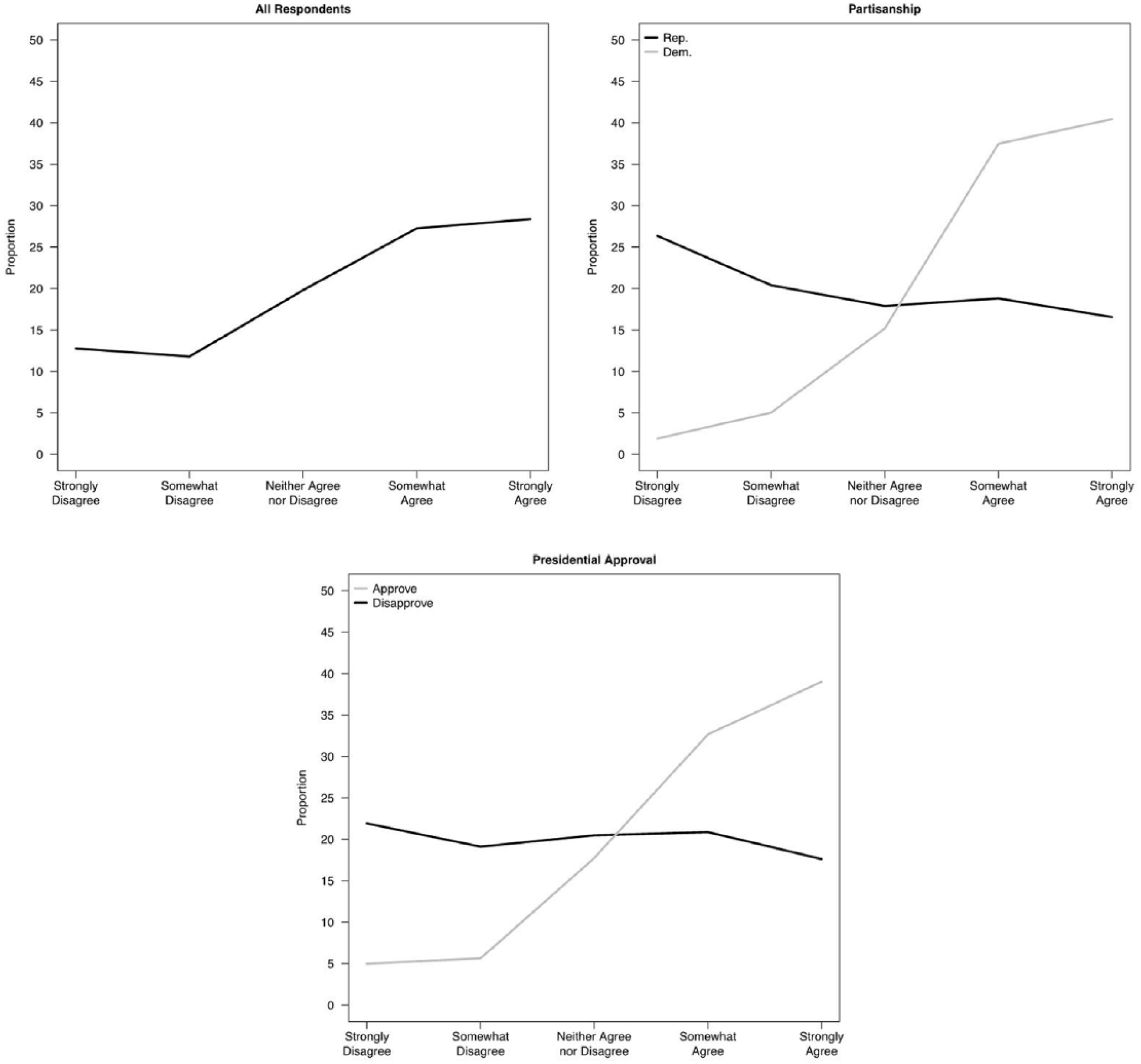
Attitudes toward presidential veto powers.
While we find greater support for veto powers, it does not mean that our results necessarily contradict Reeves and Rogowski’s. Before turning to our regression analysis, we revisit the question of institutional and specific support. In order to do so, we calculated the proportion of respondents in each response category by both partisan identification and presidential approval. According to Reeves and Rogowski, specific support should result in a clear relationship between approval and attitudes toward presidential veto powers. Institutional support, however, would lead to a pattern in which “partisan differences over presidential power are smaller than they are for presidential approval” (Reeves and Rogoswko 2015: 751). In the second panel of Figure 1, we report the proportion of Democrats (gray line) and Republicans (black line) who fall into each response category. As expected, an overwhelming majority of Democrats—approximately 78%—support the president’s veto powers while a mere 6% stand in opposition. In contrast, a plurality of Republicans, around 46%, oppose the president’s exercise of the veto pen. What is somewhat surprising, however, is that over a third of Republicans also indicated that they supported the presidential veto power. In short, our survey suggests that the effect of partisanship on attitudes toward presidential powers may differ across categories. While the president’s co-partisans overwhelmingly support his veto power, opponents do not uniformly oppose it and instead hold mixed attitudes. 4 As such, we treat party identification as a nominal rather than ordinal variable in our regression models.
In the final panel of Figure 1, we examine how presidential approval shapes attitudes toward veto powers. The gray line denotes support among those who approve of the president’s job performance while the black line tracks opinion among those who disapprove of the president. As before, there is clear positive relationship between job approval and support for the president’s veto power. Over 71% of respondents who approved of the president’s job performance also agreed with the exercise of veto powers. In contrast, around 40% of those who disapproved of the president’s job performance also disapproved of the veto power. As with partisanship, there is a somewhat muted relationship between job disapproval and attitudes toward the veto power. Around 38% of respondents who disapproved of the president’s job performance approved of the executive’s constitutional right to veto legislation. As such, we find more pronounced differences across partisanship than we do over approval. The difference between approvers and disapprovers was around 30 percentage points compared with an approximately 40 percentage point difference between Republicans and Democrats. 5
With respect to institutional support, we contend that these findings do not necessarily undermine the idea that there is greater consensus about the executive’s institutional powers than about the individual who occupies the White House. After all, a majority of Republicans and those who disapprove of the president’s performance hold neutral or positive attitudes toward the veto powers. While there are still clear partisan differences, it is not the case that Republicans uniformly line up in opposition to constitutionally granted powers while Democrats uniformly support these same powers. Furthermore, these differences are still smaller than the partisan gap in job approval. Over 86% of the Democrats in our survey approved of President Obama’s job performance compared with 11% of Republicans. The approximately 75 percentage point gap in job approval is nearly double the observed partisan gap in attitudes toward the veto power. In short, these data still suggest that there is greater consensus in attitudes toward the president’s constitutional powers than in attitudes toward the sitting president, but the attitudes toward the former are more positive than those uncovered by Reeves and Rogowski (2015).
While the descriptive data reported in Figure 1 is informative, we also estimated a series of regression models in which we control for other relevant factors in order to examine the robustness of these relationships. The outcome variable in each model is a respondent’s support for the use of executive veto powers and ranges from 1 (Strongly Disagree) to 5 (Strongly Agree). In order to account for specific support, we include a respondent’s job approval rating for both the president and Congress. Since the use of presidential veto power places the president in conflict with Congress, we expect that evaluations of both branches to shape attitudes toward presidential veto power. We therefore take the difference between a respondent’s approval of the president and her approval of Congress with higher (lower) values indicating greater support for the president (Congress). The resulting measure ranges from -3 to 3 with a score of 0 indicating a respondent’s evaluations of the president and Congress are the same. We also account for a respondent’s partisanship by including a binary variable for both Democrat and Republican with Independents serving as the reference category. 6 Lastly, we also include controls for each respondent’s ideology, whether she graduated from college, and her news consumption. 7 In order to measure political knowledge, we utilized two questions that asked a respondent which party controlled the US House and Senate respectively. In the analysis that follows, we estimate separate regression models for respondents who could and could not correctly identify partisan control of both chambers of Congress.
In Figure 2, we report the results of the regression models outlined above. 8 The black dots correspond to coefficient estimates for the pooled regression models while the black diamonds and grey squares denote the estimates for the subset of respondents who did and did not know which party controlled both chambers of Congress. Overall, we find robust support for the effect of specific support. Across all three models, a 1-unit increase in support for the president relative to Congress leads to a 0.25-unit increase in approval of presidential veto powers. Furthermore, the comparable point estimates across all three models suggest that political knowledge does not change the manner in which respondents translate their attitudes toward the president and Congress into their attitudes toward veto powers.
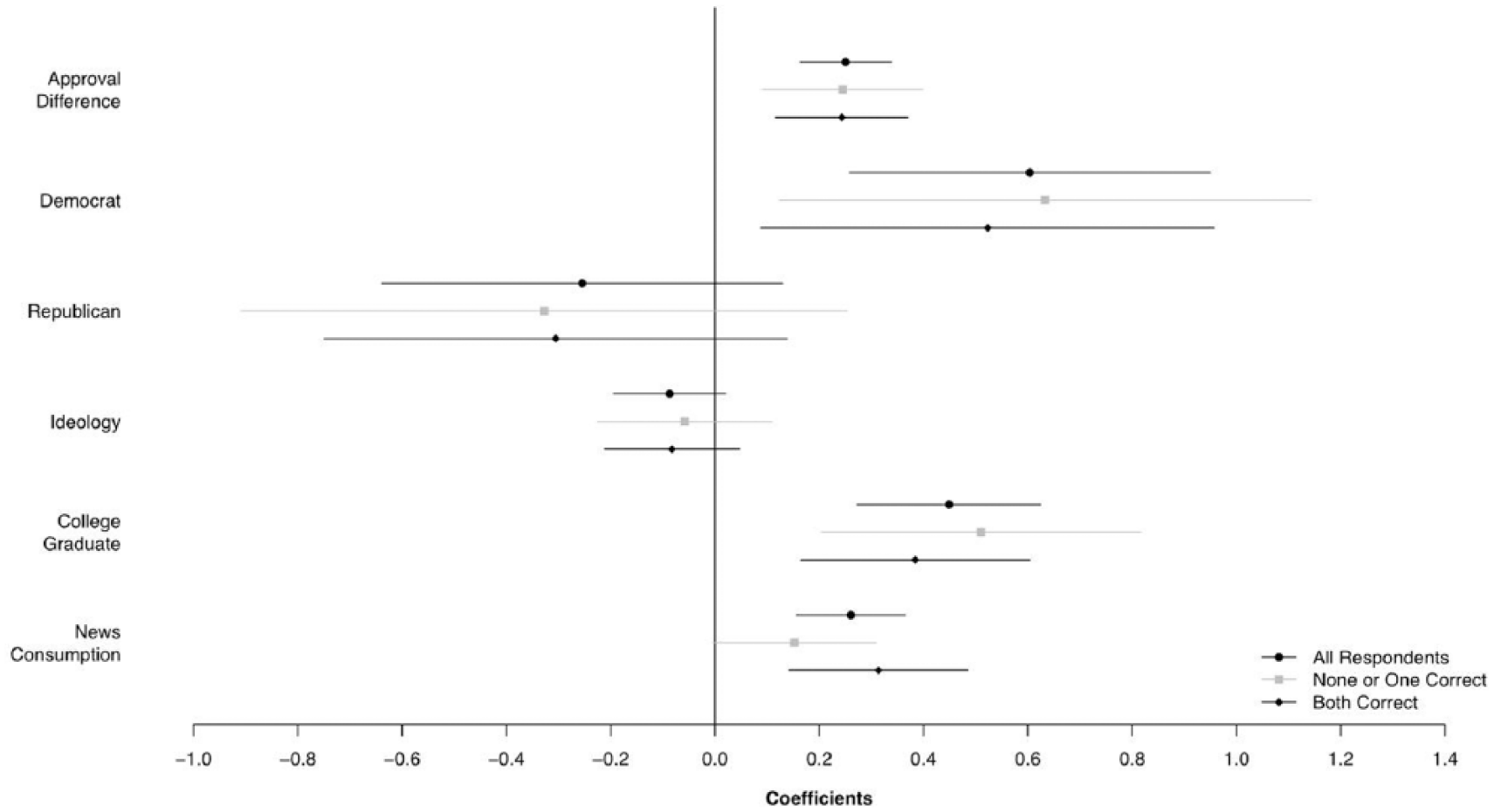
Attitudes toward veto powers, OLS regression.
As expected, we find some evidence of partisan differences in attitudes toward presidential veto powers. Democrats are more than 0.5 units more likely to support the presidential veto than Independents on our 5 point scale. Republicans, however, do not appear to be any less supportive of the executive’s veto power than Independents. In short, the non-monotonic effect of partisanship we observed in Figure 1 remains even after we account for other relevant factors including differences in political knowledge.
In addition to partisanship, we also find that education and news consumption can shape attitudes toward the executive veto. In the pooled model, college graduates are predicted to be 0.44 units more supportive of presidential veto powers than those without a college degree. We also find slight differences across levels of political knowledge. The coefficient estimate, 0.38, of those who could correctly identify partisan control of Congress was slightly smaller than the estimate, 0.51, for those who could not. Lastly, we only find evidence of a statistically discernible effect for news consumption among those who could correctly identify partisan control of Congress. 9
In sum, our results indicate that increased support for the president relative to Congress begets greater support for his use of the veto, even after controlling for a number of factors including partisanship. Therefore, an unpopular president may still be able to veto legislation without necessarily experiencing a backlash from the public, provided he still has an approval advantage over Congress. However, Congress may be able to pressure the president into signing legislation he may veto otherwise if Congress has the approval advantage, which raises interesting questions regarding the role of public opinion in policymaking.
Conclusion
While our analysis largely comports with previous studies, it does present some notably different conclusions. First, we find a higher baseline level of support for presidential powers. As noted earlier, we suspect that this may be due in part to the fact that President Obama’s job approval rating was higher at the time of our survey than when Reeves and Rogowski (2015) had their questions in the field. Our results, however, indicate that it will be instructive for future research to continue to examine attitudes about the executive’s veto powers, as well as other presidential powers, to more accurately assess the relationship between specific support and evaluations of presidential power. Second, although we find evidence of partisan differences, the effect does not appear to follow the same linear pattern suggested by previous studies. While Democrats were overwhelmingly supportive of the president’s veto power, Republicans were far more divided. Indeed, the mix of attitudes among Republicans suggest that, at least in some cases, support for, or perhaps even demand for, presidential action may be able to overcome the considerable barriers imposed by partisan identification.
Lastly, we find that respondents’ evaluations toward both the president and Congress appear to shape attitudes toward veto powers. Those who hold a more (less) favorable opinion of the president relative to Congress are more (less) likely to support his veto powers. We believe this finding is fairly intuitive since the veto not only highlights conflict between the two branches, but it can also send a signal to the public about which branch of government is on their side in a given policy area (Groseclose and McCarty 2001). It is therefore important to account for attitudes towards both Congress and the president.
We believe our findings also provide insights about possible directions for future research. First, it would be instructive to examine how much the public knows about presidential powers. Ours and other studies largely assume that individuals know which presidential powers are or are not specified in the Constitution. It would be beneficial, however, to gauge the public’s baseline level of knowledge about presidential powers. Second, the recent change in control of the White House presents an ideal opportunity to explore how partisanship shapes evaluations of presidential powers. It will therefore be prudent to explore whether or how partisans’ attitudes toward presidential power change in light of the new administration. Indeed, our findings suggest that a majority of Republicans, rather than Democrats, should support the president’s veto powers now that their party controls the White House, especially should Democrats gain control of at least one congressional chamber in 2018.
Footnotes
Correction (June 2025):
Declaration of Conflicting Interests
The author(s) declared no potential conflicts of interest with respect to the research, authorship, and/or publication of this article.
Funding
The author(s) received no financial support for the research, authorship, and/or publication of this article.
Supplementary Material
The supplementary files are available at http://journals.sagepub.com/doi/suppl/10.1177/2053168017753873. The replication
files can be found at 
Notes
Carnegie Corporation of New York Grant
This publication was made possible (in part) by a grant from Carnegie Corporation of New York. The statements made and views expressed are solely the responsibility of the author.
References
Supplementary Material
Please find the following supplemental material available below.
For Open Access articles published under a Creative Commons License, all supplemental material carries the same license as the article it is associated with.
For non-Open Access articles published, all supplemental material carries a non-exclusive license, and permission requests for re-use of supplemental material or any part of supplemental material shall be sent directly to the copyright owner as specified in the copyright notice associated with the article.
