




Abstract
In an election characterized by countless headlines, the refusal of Republicans to support their party’s nominee was a constant topic of discussion in 2016. Our paper looks to explain why Republican members of Congress joined the so-called #NeverTrump movement. In the first part, we document the varied—and often contradictory—explanations of the #NeverTrump movement offered by journalists, pundits, and politicians during the campaign. We then categorize these popular explanations into four theoretical categories: policy preferences, identity, electoral motivations, and establishment dynamics. In the second part, we test the varied claims. We believe two findings stand out and have broader implications for American politics. First, despite the popular belief that members of Congress are single-minded in their pursuit of reelection, we found that a lawmaker’s religion and sex—both in the identity category—had the largest effects on the decision to join the #NeverTrump movement. Second, the results show that establishment Republicans were more likely to support Donald Trump’s candidacy. Notably, the direction of this effect is inconsistent with popular explanations of the #NeverTrump movement but consistent with a range of academic studies.
Introduction
It is hard to overstate: the 2016 presidential election defied expectations. While the nomination process was memorable on its own, the refusal of Republicans to endorse their nominee surprised many. Concerns about Donald Trump’s experience, intelligence, ideological convictions, and controversial statements led many of his copartisans to join the so-called #NeverTrump movement. Our paper seeks to explain this phenomenon.
As a substantive matter, the #NeverTrump movement garnered considerable media attention in 2016. At times the Republican Party (commonly referred to as the GOP) seemed to be breaking apart. For example, Nate Silver, of FiveThirtyEight fame, wrote an article 1 aptly titled “The Republican Party May Be Failing.” As an academic matter, the #NeverTrump movement challenged a range of scholarly expectations. One was the fact that Trump won the nomination without the critical aid of much of the GOP establishment (Cohen et al., 2008). It is also odd that in a highly polarized era, dozens of lawmakers would refuse to back their own nominee (McCarty et al., 2001; Steger, 2007). For these reasons, we think the #NeverTrump movement deserves rigorous analysis and is a topic of interest to academics and non-academics alike.
Popular explanations of the #NeverTrump movement
Over the course of the 2016 campaign, journalists, pundits, and lawmakers cited various explanations for the #NeverTrump movement. Table 1 presents the most common explanations based on our contemporaneous observations. In an effort to impose some order on the varied claims, we classified them into four theoretical categories: (1) policy preferences, (2) identity, (3) electoral concerns, and (4) establishment dynamics. We offer the caveat that the quotes cited in Table 1 are merely illustrative and many rely on lawmakers’ own explanations. Furthermore, while the explanations are framed in terms of Trump’s actions, the dynamics of Hilary Clinton’s campaign may have played a role as well. Because we cannot simply take politicians “at their word,” these caveats underscore why a rigorous analysis of this phenomenon is needed.
Popular explanations of Trump’s support in Congress.
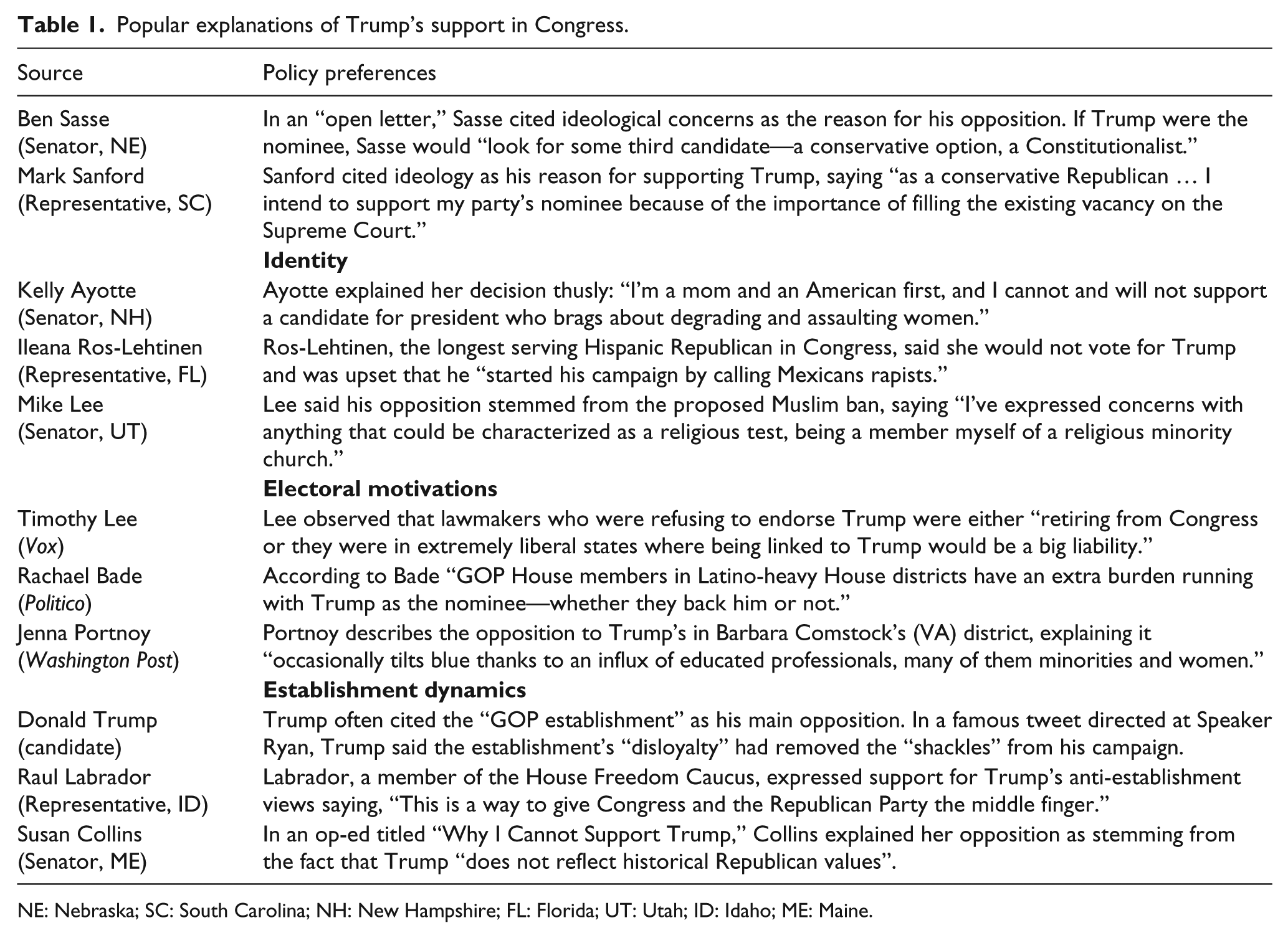
NE: Nebraska; SC: South Carolina; NH: New Hampshire; FL: Florida; UT: Utah; ID: Idaho; ME: Maine.
A key conclusion that emerges in the popular claims is that varied, and often contradictory, explanations were debated in 2016. One disagreement concerns policy preferences. Mark Sanford (SC) cited his conservatism as the reason for endorsing Trump, while Ben Sasse (NE) said he was holding out hope for a “conservative option.” Likewise, while many commentators mentioned identity, they often cited competing factors. Whether it was Trump’s statements about women, as Kelly Ayotte (NH) noted, his views on religion, as Mike Lee (UT) claimed, or his statements about Hispanics, as Ileana Ros-Lehtinen (FL) argued, it seems a lawmaker’s personal characteristics were key. On electoral motivations, multiple observers cited characteristics of a lawmaker’s constituents. After all, conventional wisdom says that lawmakers care about reelection above all else. Nonetheless, there were disagreements about which constituent factor(s) mattered most. Unlike these three, one received almost universal agreement: establishment Republicans opposed Trump’s candidacy. Trump himself noted this dynamic, as did multiple lawmakers and journalists.
Scholarly explanations of the #NeverTrump movement
While journalists, pundits, and lawmakers reach a wider audience, political scientists have much to offer when it comes to explaining the #NeverTrump movement as well. In this section, we juxtapose the popular explanations cited during the 2016 campaign with a theoretical discussion aided by research drawn from the literature on legislative behavior. Our review leads us to conclude that electoral concerns, identity, and policy preferences are well supported in academic studies. In other words, each of these causal processes are likely to have played some role in shaping the #NeverTrump movement, though in the case of ideology the direction of the effect remains to be seen. In contrast, the expectation that the GOP establishment would be more likely to oppose Trump runs counter to conventional wisdom in a few respects.
Electoral motivations
A canonical claim is that lawmakers are single minded seekers of reelection (Mayhew, 1974). Although Mayhew’s quote is not literal, the reelection motive is foundational to explanations of legislative behavior. For this reason, we view the electoral concerns noted in popular discussions as consistent with academic work. After all, endorsements are an example of what Mayhew called a position-taking action. As expected, evidence finds that position-taking actions indeed affect an incumbent’s electoral success (Bovitz and Carson, 2006). Although roll-call votes are the most common way lawmakers take a position, endorsements also reveal one’s views. Research has also shown that lawmakers avoid taking a position (Jones, 2003) and abstain on roll-call votes (Cohen and Noll, 1991) for electoral reasons as well. Consequently, we expected the endorsement and non-endorsement of Trump to be motivated by electoral factors.
Policy preferences
A second claim offered during the 2016 campaign was that Trump’s Republican opposition stemmed from ideological concerns. As a conceptual matter, researchers often contrast a lawmaker’s personal preferences with their electoral motivations. While scholars recognize that lawmakers have both sets of goals (Fenno, 1978), as an empirical matter it can be difficult to disentangle the two. Evidence that legislative behavior stems from lawmakers’ preferences can be found in the stability of voting behavior when electoral pressures are lessened (Jenkins and Nokken, 2008; Lott and Bronars, 1993) and when a lawmaker’s district is redrawn (McCarty et al., 2001). In one study, Keith Poole (2007: 435) famously claimed that lawmakers “die in their ideological boots.” Notably, research has shown that a lawmaker’s ideology explains their decision to endorse a candidate as well (Cohen et al., 2008; Steger, 2007). For these reasons, the claim that Trump’s opposition was motivated by policy preferences is supported in the literature.
Identity
A third claim in 2016 was that the demographics of lawmakers—in particular their race, religion, and sex—were key factors among their opposition to Trump. While electoral motivations and preferences are often considered the top two predictors of legislative behavior, there is substantial evidence that personal characteristics matter as well. Indeed, proponents of descriptive representation posit that personal factors shape a lawmaker’s identity, values, and information (Burden, 2007). While a lawmaker’s identity may mirror that of their constituents, known as substantive representation, and identity certainly overlaps with preferences, theorists draw clear distinctions between these processes (Mansbridge, 1999). As an empirical matter, dozens of studies have shown that personal factors including race (Canon, 1999), religion (Burden, 2007), sex (Swers, 2002), socioeconomic class (Carnes, 2013), and sexual orientation (Haider-Markel et al., 2007) indeed shape legislative behavior. A related series of studies have posited that legislative behavior stems (in part) from group identity (Garand and Clayton, 1986; Loomis, 1984; Ragusa, 2016). Based on this work, we believed identity would be a motivating factor in the #NeverTrump movement.
Establishment dynamics
A final claim is that the #NeverTrump movement was made up of establishment Republicans. Despite agreement among journalists, pundits, and politicians, this claim does not align with conventional wisdom in political science in at least three respects. One is the extent of party discipline in Congress in the modern era (McCarty et al., 2001). In a polarized era, where the median Democrat is quite distant from the median Republican in an ideological space, it is unlikely that a member of Congress would be “closer” to their rival party’s candidate (Downs, 1957). It would be especially odd for this kind of disunity to occur in the GOP given evidence of their cohesion in endorsements (Steger, 2007). A second relevant body of work is the party decides thesis, which rests on claim that parties “work together in order to succeed” (Cohen et al., 2008: 5). While the thesis focuses on endorsement behavior in primary elections, the theory emphasizes the powerful role of the party establishment and their tendency to cohere around a favored candidate. After all, the central finding of Cohen et al.’s (2008) work is that party insiders win nomination contests because insiders are “the chosen favorites of a party establishment” (170). We believe a natural extension of this logic is that, because establishment lawmakers have the most at stake in terms of the success (or failure) of their party’s nominee, it would be surprising if the establishment defected en masse. A third reason why it would be odd for the establishment to oppose their own nominee is evidence of an anti-establishment wing of the GOP that behaves like a third party (Ragusa and Gaspar, 2016). Simply put, the mere existence an anti-establishment wing in the GOP leads us to expect this group of lawmakers—not the establishment bloc—to oppose the Republican nominee as they have on a range of the party’s legislative priorities.
Data and method
Dependent variable
We defined the #NeverTrump movement as lawmakers who made unambiguous statements of opposition to Trump’s candidacy. We therefore classified explicit statements that the lawmaker was (1) not endorsing him, or (2) not voting for him. 2 Likewise, a lawmaker was classified to the pro-Trump camp if they explicitly stated that they were endorsing or voting for him. In this respect, our measure prioritized conceptual clarity over variation. We did not code “statements of concern” because we viewed them as highly subjective. Simply put, we viewed explicit non-endorsements and non-votes as the clearest indication of a lawmaker’s position. From a methodological standpoint, we had to combine non-endorsements and non-votes into a single opposition category because few lawmakers stated both. Some said they could not endorse Trump without making their vote choice known, while others said they could not vote for Trump but did not issue an explicit non-endorsement. Our dependent variable was thus coded “1” for those who opposed Trump’s candidacy and “0” for those supported Trump’s candidacy.
Our raw data came from journalistic and academic sources that catalogued the #NeverTrump movement throughout the campaign. 3 We used a lawmaker’s final position on November 8, 2016, as our dependent variable. Of the 302 Republicans in the House and Senate, we had clear statements (in either direction) for 96% of cases. Figure 1 presents the raw data. Based on the media’s focus on #NeverTrump, it may come as a surprise that 80% of Republicans supported Donald Trump in the end. We identified just 49 lawmakers, 16% of cases, who made unambiguous statements of opposition to Trump’s candidacy. Of the 49, 35 were in the House (14% of the caucus) and 14 were in the Senate (26% of the caucus).

Republican lawmakers’ position on Donald Trump’s candidacy.
In the analysis below, we estimated a second model that captured variation in the strength of a lawmaker’s support or opposition. While we remained skeptical about parsing statements of concern, the timing of a lawmaker’s decision is a relatively clear indication of the strength of their position (Galdieri and Parsneau, 2016). While early endorsements are considered sincere efforts to aid the endorsee, late endorsements, especially those made after the candidate becomes the nominee, lag behind public opinion and are often a strategic decision to maintain party loyalty and/or win support from the party’s nominee (Cohen et al., 2008; Galdieri and Parsneau, 2016). On the pro-Trump side, while the vast majority of Republicans supported him in the end, those who backed Trump before the Indiana primary (when he became the presumptive GOP nominee) represent his strongest supporters. On the #NeverTrump side, the release of the Access Hollywood video in October caused a number of Republicans to defect and join the #NeverTrump ranks in the final month of the campaign. Leveraging this variation on both ends of the spectrum, our dependent variable was coded “4” for lawmakers who opposed Trump before the Access Hollywood video, “3” for those who opposed him only after the video surfaced, “2” for those who supported him after he became the presumptive nominee, and “1” for those who supported Trump before the Indiana primary. 4 Figure 2 presents these data.

Strength of Republican lawmakers’ position on Donald Trump’s candidacy.
Independent variables
In the models below, we included a range of variables that operationalized the varied explanations of the #NeverTrump movement. We acknowledge that some variables could be classified into multiple theoretical categories. In these cases, we did our best to follow conventions in the literature.
We tested electoral motivations with 11 variables. Obama Vote Percent is the raw partisan makeup for a lawmaker’s district or state, where higher values indicate Democratic leaning constituents. We also included Trump Primary Vote Percent, which is the percentage of the vote Trump received in the GOP primary. 5 While the raw partisan makeup taps general election dynamics, the second measure may capture a lawmaker’s concern about a pro-Trump primary challenge. We tested five constituency characteristics: Hispanic Population, Muslim Population, Black Population, College Educated Population, and Manufacturing Population. 6 Also included were three attitudinal characteristics from the Cooperative Congressional Election Study (CCES) Dataset: Terrorism Concerns, Racial Resentment, and Economic Anxiety. Lastly, Up For Reelection was a variable coded “1” if the member ran for reelection in 2016 and “0” for senators not up for reelection and representatives who were retiring. We note that these factors tap not only a lawmaker’s electoral concerns about winning reelection with Trump, but also a calculation about the probability of a Hillary Clinton victory.
Our main measure of a lawmaker’s policy preferences was derived from their roll-call record. Following conventions, Conservative is a lawmaker’s first-dimension DW-NOMINATE score, where higher values indicate greater conservatism. 7 Given Trump’s fluid policy positions, and likely off-dimension or even non-existent ideology, we note it is difficult to draw clear inferences from this variable. Given the competing popular claims about the orientation of conservatives vis-à-vis Trump, we felt compelled to test this effect nonetheless. We also included a second variable coded “1” if the lawmaker endorsed one of Trump’s rivals in the GOP primary. Because endorsements stem (in large part) from ideological agreement with the endorsee (Cohen et al., 2008; Steger, 2007), we believe Endorsed A Rival is a proxy for various policy considerations. 8
We included three demographic variables that captured relevant aspects of a lawmaker’s identity. In each model were three 1/0 variables for whether a lawmaker is a Hispanic, Female, or Mormon. Our data came from the Congressional Biographical Directory and/or the member’s personal website. Given Trump’s controversial statements about women, and racial and religious minorities, the expectation was that lawmakers from these demographic groups were more likely to join the #NeverTrump movement while non-Mormon non-Hispanic white males were more likely to support Trump (even when controlling for policy preferences and electoral motivations). As noted earlier, such an effect would be consistent with the theory of descriptive representation.
Lastly, we included three variables that captured an establishment/anti-establishment split in the GOP. Our main measure was a lawmaker’s second dimension DW-NOMINATE score. While seldom used in the literature, Keith Poole has written that in recent congresses the second dimension taps within-party conflict (where higher values indicate establishment roll-call patterns). For example, a post on Keith Poole’s VoteView Blog
9
notes that the second dimension helps explain an anomalous vote in 2015 on the Department of Homeland Security funding bill: The meaning of the second dimension has largely shifted from representing regional differences within the parties (e.g., between northern and southern Democrats) to intra-party divisions that are more subtle and less clear. One of these divisions appears to be an “insider vs. outsider” cleavage that pops up on votes such as raising the debt ceiling, domestic surveillance, and government funding bills.
As one example, while John McCain and Rand Paul are ideologically distant in the first dimension (0.38 and 0.90, respectively), they rank among the most anti-establishment lawmakers in the second dimension (-0.62 and -0.43, respectively). We included two additional variables that attempted to capture the complexity of the establishment vs. anti-establishment dynamic. Congressional Leader is a 1/0 that records whether the member is a party leader or the chairperson of a standing committee while Tea Party/Freedom Caucus is a 1/0 that records if a member belonged to either caucus. 10 We posited that lawmakers in leadership positions and those who refused to join the Tea Party/Freedom Caucus were part of the establishment.
Findings
Table 2 presents the results. 11 Model 1 contains the dichotomous #NeverTrump response, estimated via probit, while Model 2 contains the ordinal strength response, estimated via ordered probit. 12 Model 1 has a pseudo-R2 of 0.44 and Model 2 has an R2 of 0.24. Concerning the covariates, we found some support for all four theoretical explanations.
Why Republican lawmakers joined the #NeverTrump movement.
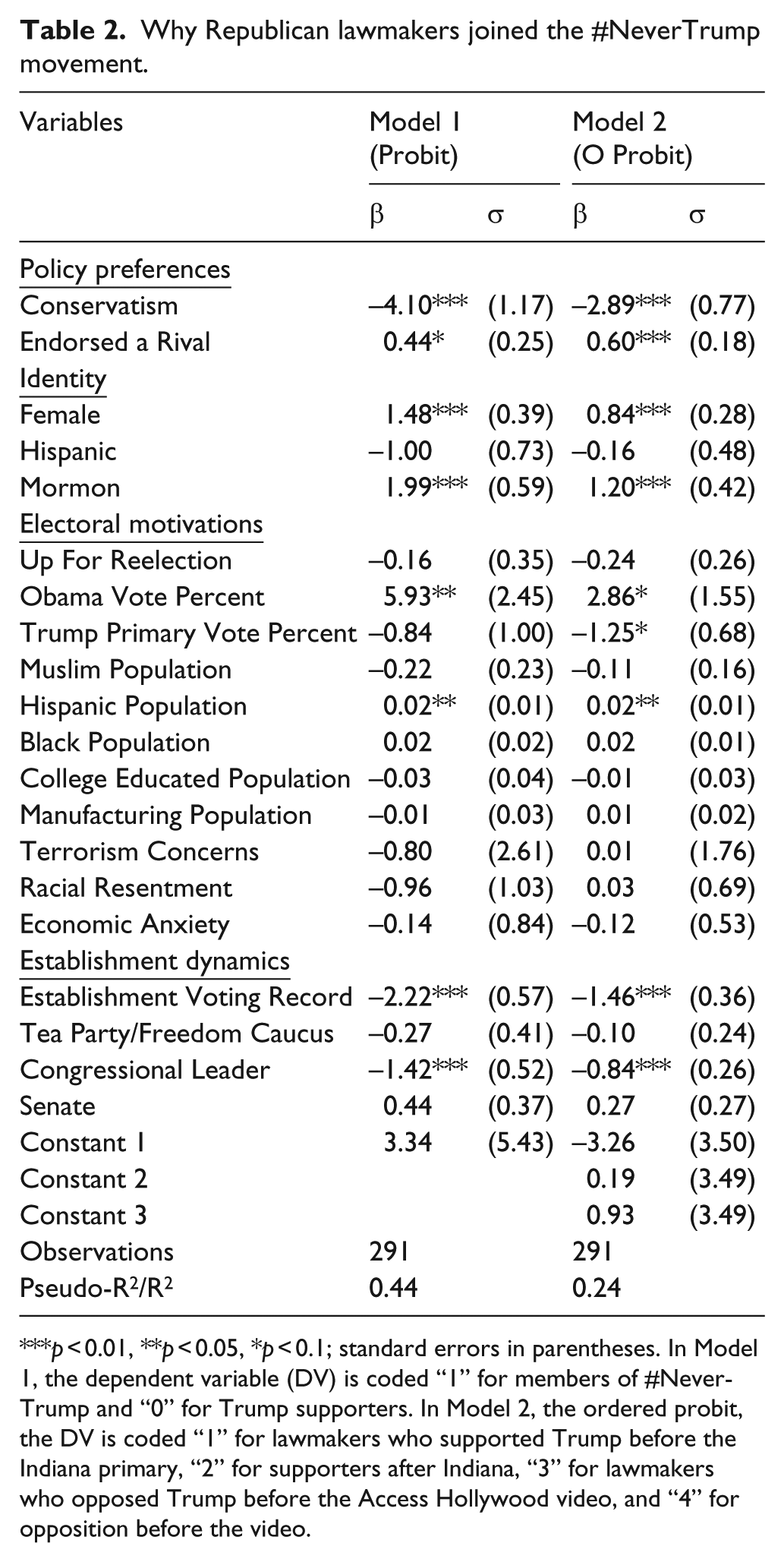
p < 0.01, **p < 0.05, *p < 0.1; standard errors in parentheses. In Model 1, the dependent variable (DV) is coded “1” for members of #NeverTrump and “0” for Trump supporters. In Model 2, the ordered probit, the DV is coded “1” for lawmakers who supported Trump before the Indiana primary, “2” for supporters after Indiana, “3” for lawmakers who opposed Trump before the Access Hollywood video, and “4” for opposition before the video.
On policy preferences, in both models we found that conservative Republicans were less likely to join the #NeverTrump movement. In our review of the popular explanations of Trump’s Republican opposition over the course of the 2016 campaign, we cited disagreements on the direction of this effect. Despite George Will’s claim that “Donald Trump’s rise reflects American conservatism’s decay,” our results show that conservative lawmakers were more likely to back Trump’s campaign. 13 As noted earlier, it was difficult for us to isolate the precise cause of this effect due to the fact that first-dimension NOMINATE scores are a highly aggregated measure of a lawmaker’s policy preferences and given Donald Trump’s uncertain ideology. Greater research, and a longer time-span, are needed to fully understand why conservatives supported Trump. We also found a marginally significant effect (p = 0.06) of a rival endorsement in the probit model and a significant effect (at conventional levels) in the ordered probit. We conclude that there is modest, though mixed, evidence that lawmakers who supported another candidate in the primary were more likely to join the #NeverTrump movement. As noted earlier, we believe this effect is a proxy for disagreement with Trump’s policy positions.
We also found support for two of the three identity variables. Both models indicate a significant effect of sex and religion, as female and Mormon members of Congress were more likely to join the #NeverTrump movement. Needless to say, these results are consistent with both popular explanations and research on descriptive representation. We did not find an effect on the variable for Hispanic lawmakers. While perhaps surprising, this null effect may stem from the fact that most Hispanic Republicans are of Cuban descent, not Mexican descent.
On electoral motivations, both models indicate that the Hispanic Population explains the decision to join the #NeverTrump movement. As one would expect, lawmakers with a large percentage of Hispanics in their district/state were more likely to oppose Trump’s candidacy. We also found a marginally significant effect (p = 0.09) of Obama’s vote share in a lawmaker’s district/state in the ordered probit and a significant effect (at conventional levels) in the probit model. We conclude that there is modest, though mixed, evidence that the raw partisanship of a lawmaker’s constituents explains the decision to join the #NeverTrump movement. For example, while he lost reelection despite his opposition, it is no secret why Mark Kirk (IL) was the first Republican senator to oppose Trump’s candidacy (Obama won Illinois with 58% of the vote in 2012). We also found a marginally significant effect of Trump’s primary vote share in the ordered probit but an insignificant effect in the probit model. We conclude that there is weak evidence that Trump’s margin of victory in the primary explains the #NeverTrump movement.
Lastly, the results indicate that conflict between establishment and anti-establishment wings of the GOP explains the #NeverTrump movement. Our key finding, however, is that the popular explanations of this effect during the 2016 campaign were backward. In the models, the negative effects indicate that establishment Republicans were less likely to join the #NeverTrump movement. Although Trump repeatedly chastised the establishment for their “disloyalty,” the opposite is true according to our data. In both models we found that lawmakers with establishment voting records, as measured by their second dimension DW-NOMIANTE score, and those in leadership positions were more likely to support Donald Trump. Stated in the other direction, anti-establishment Republicans were more likely to join the #NeverTrump movement.
Although there is some support for each of the various explanations, a secondary question is “how much” each factor mattered. Simply put, some of the significant covariates no doubt mattered more than others. We addressed this question by standardizing the continuous variables to have a common scale and computing the marginal effects of each variable while holding all others at their means. Figure 3 presents the results. In the figure, the dot indicates the absolute estimated effect size with 95% confidence intervals. 14 A green dot indicates the variable decreases in a lawmaker’s #NeverTrump probability and a red dot indicates the variable increases in a lawmaker’s #NeverTrump probability.

Magnitude of significant effects on #NeverTrump movement.
Our main finding was that the two factors with the largest effect sizes are in the identity category. In both models, the results indicate a lawmaker’s religion and sex were the two strongest determinants of whether they joined the #NeverTrump movement. Whether a lawmaker was in a leadership position—an establishment characteristic—had the third largest absolute effect size. Notably, a lawmaker’s establishment voting record comes in fourth in the binary probit and fifth in the ordered probit. From these two effects, we conclude that establishment dynamics mattered second most as a whole. Regarding a lawmaker’s policy preferences, the results reveal that a lawmaker’s conservatism had the fifth largest effect size in the binary probit and the fourth largest effect size in the ordered probit. In addition, in the ordered probit a rival endorsement had the fourth largest effect size. Lastly, and to our surprise, the electoral factors had smallest effect sizes. Indeed, each of the electoral factors appear at the bottom of Figure 3 in both models. We discuss the implications of these results in the conclusion section.
Another way to examine how much the various predictors mattered is to estimate the probability of joining the #NeverTrump movement for a range of hypothetical lawmakers. 15 Unlike the individual effects in Figure 3, this allows us to estimate the combined effect of the significant variables in each category. As a baseline, if we hold every variable at its mean, the average Republican has a 5% chance of opposing Trump’s candidacy. Needless to say, this low probability reflects the fact that the average Republican is conservative, from a Republican-leaning district/state, has some establishment characteristics, and is a non-Mormon male (all factors that decrease their #NeverTrump probability). If, however, we hold each factor at its mean, but place our hypothetical lawmaker in a Democratic district with a large percentage of Hispanic voters (i.e. adjust the electoral motivations), his probability of joining the #NeverTrump movement climbs to 43%. If we hold each factor at its mean, but make our lawmaker an ideological moderate who supported another candidate in the GOP primary (i.e. adjust the policy preferences), his #NeverTrump probability is 45%. If we hold each factor at its mean, but make our lawmaker a non-party leader with an anti-establishment voting record (i.e. adjust the establishment dynamics), his #NeverTrump probability jumps to 46%. Lastly, if we hold each factor at its mean, but make our hypothetical lawmaker a Mormon female (i.e. adjust the identity characteristics), her #NeverTrump probability increases to 94%.
Needless to say, the high #NeverTrump probability for Mormon females confirms our conclusion about the importance of the identity variables. We note that this lawmaker profile is not just a hypothetical. Mia Love, a female Mormon Republican, was a prominent member of the #NeverTrump movement. At the other end, the estimates described above again reveal that a lawmaker’s electoral motivations had the smallest combined effect size on the #NeverTrump movement. It is important to note, however, that the difference in the combined effect sizes between electoral motivations and both policy preferences and establishment dynamics is small in magnitude (2% and 3%, respectively). As we noted above, electoral motivations are indeed important predictors of the #NeverTrump movement and should not be dismissed. Our point is simply that the electoral factors have smaller effect sizes compared to factors in other categories.
Conclusions and discussion
We believe two of this paper’s findings stand out and have broader implications for our understanding of American politics. First, we believe it is surprising that the two identity variables had the largest effect on Trump’s support in Congress. Despite the canonical view of lawmakers as single minded seekers of reelection (Mayhew, 1974), we found that electoral concerns were the weakest determinants of the #NeverTrump movement. As we have pointed out, however, the electoral variables were significant in the models (just small in magnitude). Moreover, the fact is that congressional scholars know lawmakers have multiple goals including both reelection and good policy (Fenno, 1978). Nonetheless, the large effect sizes of religion and sex, coupled with the small effect of the electoral variables, is contrary to how most observers explain legislative behavior.
A second notable finding is the fact that establishment Republicans represented some of Trump’s strongest supporters. We see two interpretations of this result given extant scholarship. First, we believe this result can be understood in the context of the party decides thesis (Cohen et al., 2008). Just to be clear: the party decides thesis does not address endorsement dynamics in general elections. Nonetheless, the theory is premised on the notion that parties “work together in order to succeed” (Cohen et al., 2008: 5). We believe our result shows that lawmakers with the strongest attachments to the GOP were indeed “working together” to elect their party’s nominee in the general election. Second, this result reveals that that there is a viable anti-establishment wing of the Republican Party. Such a finding is consistent with Ragusa and Gaspar’s (2016) conclusion that the anti-establishment faction of the GOP behaves like a third party. On that point, it is notable that conservative activists (such as George Will and Bill Kristol) led the fight to recruit a conservative alternative to Trump, while conservative lawmakers were more likely to back their nominee. All in all, these findings shine a light on the factional nature of the modern GOP.
We believe our paper’s two main findings mirror post-election events in addition to explaining endorsement dynamics during the campaign. On the power of identity politics, we see parallels in many of Trump’s controversial actions—his response to the National Football League (NFL) protests, his decision to pardon Joe Arpaio, and his response to the violence in Charlottesville, VA—and in the apparent electoral realignment centered on cultural issues. In an article aptly titled “It’s the Culture, Stupid,” New America senior fellow Lee Drutman cited identity politics as the key to understanding the 2016 election and noted that these cultural forces are “likely to remain” important in the future. 16 On the role of establishment dynamics, we see a clear establishment/anti-establishment split in the GOP’s failed attempt (thus far) to repeal the Affordable Care Act. Despite their six-year effort, and Trump’s campaign promises, the GOP failed to repeal Obamacare at the hands of five Republican senators: Rand Paul, Lisa Murkowski, Mike Lee, John McCain, and Susan Collins. While these senators span the ideological spectrum, all five are among the strongest anti-establishment Republicans (according to the data we use) and four of the five were part of the #NeverTrump movement.
A final point is that that the #NeverTrump movement is not the sole example of partisans refusing to endorse their nominee. A similar split emerged in the GOP in 1964 over Goldwater’s candidacy. While the most visible Republican opponents were governors, a number of prominent members of Congrerss opposed Goldwater as well. Senator Jacob Javits (NY) said he “must in conscience withhold my support for the national Republican ticket.” 17 And while Senator Kenneth Keating (NY) made similar claims based on ideological concerns, many observers noted that he was running for reelection in a state with a high percentage of moderate Republicans. 18 Goldwater, by comparison, cited establishment dynamics, saying the “establishment is desperate to defeat me.” 19 All in all, we think it is notable that some of the same explanations for the #NeverTrump movement were also cited as explanations for the “Stop Goldwater” movement. Future research could apply the results of this study to the 1964 campaign to unveil the similarity of these two opposition movements. As is often the case, greater research is needed.
Footnotes
Acknowledgements
We would like to thank David Rohde and Connor Phillips for providing the data used in this study. We would also like to thank Neil Chaturvedi, Nick Howard and Matt Nowlin for feedback on an earlier version of this paper. We are grateful to participants at the College of Charleston’s Economics Seminar for helpful suggestions as well. Lastly, we would like to thank the editors and referees at Research & Politics for thoughtful feedback on this manuscript. As always, all errors are our own.
Correction (June 2025):
Declaration of Conflicting Interest
The author(s) declared no potential conflicts of interest with respect to the research, authorship, and/or publication of this article.
Funding
The author(s) received no financial support for the research, authorship, and/or publication of this article.
Supplementary material
The supplementary files are available at http://journals.sagepub.com/doi/suppl/10.1177/2053168017751250. The replication files are available at 
Notes
Carnegie Corporation of New York Grant
This publication was made possible (in part) by a grant from Carnegie Corporation of New York. The statements made and views expressed are solely the responsibility of the author.