




Abstract
Was 9/11 the opening salvo in a new age of terrorism? Some argue that this act ushered in a more chaotic world. Others contend an increased focus on terrorism in the past 15 years is the result of conflating terrorist activity with insurgency. We shed light on these claims by analyzing data on domestic and transnational terrorist incidence from 1989 to 2014. The evidence suggests that the years since 9/11 have been different from those preceding them. Once the prevalence of conflicts is accounted for, the post-9/11 era is a significantly less terror prone period than the years before it. A country not suffering civil conflict was upwards of 60 percent more likely to experience terrorism prior to or during the year 2001 than since. However, the opposite trend holds for those countries with a higher proportion of Muslims. Prior to 2001, countries with higher Muslim populations experienced less domestic terrorism. Since 9/11, these countries have experienced significantly more terrorism – both domestic and international – than they had previously.
Keywords
Introduction
In the immediate aftermath of the 9/11 attacks, policymakers were swift in declaring transnational terrorism the next extreme threat to international security. 1 Some even gave expression to the notion that 9/11 fundamentally changed the world by framing the conflict between the West and Islamist terror as “World War IV” – a perpetual state of conflict between militant Islam and the West. 2 Others have situated the September 2001 attacks within the broader historical context of terrorism. Just as the end of the Cold War heralded a transformation in the phenomenon of terrorism from nationalist, leftist, and often separatist ideologies, 9/11 reflects a shift in the primary motivation for terrorism to the religious and fundamentalist realm. 3
Indeed, these narratives tend to comport with a view that the world is more volatile and unstable than it has been in the past—an interpretation often perpetuated by popular media reports. A 2016 article in the New York Times notes that the number of deaths attributed to terrorism in North America and Europe rose markedly in 2015. 4 However, the article also adds that more than three-quarters of all terrorism fatalities over the last five years transpired in six countries: Afghanistan, Iraq, Nigeria, Pakistan, Syria, and Yemen – all places beset with civil strife.
The latter point is in line with a host of research drawing important connections between terrorism and civil wars (Findley and Young, 2012). Weak or failed states are centers for terrorist activity (Bapat, 2007; Piazza, 2008). Terrorism is a tactic often employed by rebels in civil wars for various purposes (Stanton, 2013). Terrorism may additionally serve as a spoiler to peace processes (Findley and Young, 2015). This research program makes clear that any accounting of terrorism should seek to contextualize it, particularly when the setting of much terror is insurgency and civil war.
When one does so, how, if at all, does this impact how we appreciate terrorism since 9/11? In the roughly 15 years since 9/11 and the start of the “global war on terror,” the world experienced more civil and terrorist violence. But is this modern era remarkably different from the one preceding it? Has 9/11 impacted the prevalence of terrorism and its fundamental relationship with civil conflict? 5 Furthermore, is such conflict-related terrorism largely domestic or transnational in nature? We leverage data on worldwide terrorist incidence to address these issues.
Our results suggest that after accounting for the prevalence of terrorism in conflict settings, the post-9/11 era is much less terror-prone than the years preceding it. We also highlight another shift in terrorist activity from predominantly non-Muslim to Muslim majority countries. Prior to 2002, the higher a country’s Muslim population, the less domestic terrorism it tended to experience. Since 2002, this trend has strongly reversed. And finally, interventions into civil conflicts by Western countries are highly correlated with domestic terrorism.
Trends in terrorism
Figure 1 depicts the number of terrorist attacks worldwide by year as reported by the University of Maryland’s Global Terrorism Database (GTD), an open-source collection of information on terrorist events from 1970 through 2014. 6 The data reveal a gradual increase in the frequency of attacks from 1970 until 1992. From here until 2004, a period of decline is evident beginning in the wake of the Cold War’s end and lasting roughly a dozen years. For the past decade, however, there has been a dramatic rise in the number of terrorist attacks from just over a thousand in 2004 to almost 17, 000 in 2014. The trend remains consistent even when excluding all events from Iraq and Afghanistan.

Terrorist attacks 1970–2014.
The regions most affected by the sharp increase in terrorist attacks are South Asia, the Middle East and North Africa. They collectively account for over 70% of the attacks in the last ten years. Sub-Saharan Africa, however, has seen the most dramatic increase in attacks as a percent of global totals. Accounting for just 3% of annual attacks in 2004, this number increased 65-fold by 2014, when 14% of global attacks took place in the region. These volatile regions with the largest growth in terror attacks also represent those most prone to armed conflict.
Table 1 offers evidence of this: it shows that the average number of annual attacks in countries with conflict in the post-2001 period is almost three times that of the years after the end of the Cold War and before the “global war on terror.” 7 At the same time, the number of attacks in countries with no active conflict was halved between the two periods. Differences of means tests suggest both groups of countries exhibit statistically significant mean shifts.
Average number of terrorist attacks per year and active conflicts.

Note: Global war on terror (GWOT) corresponds to 2001. Post-GWOT begins in 2002.
Figure 2 offers a visual interpretation of this dynamic. It shows terrorist attacks per year between 1989 and 2014 in countries with and without active civil wars. A sizable and widening gap between the two curves emerges around 2004.

Terrorist attacks 1989–2014 in countries with and without active civil wars.
Research Design
For our analysis, we use data on terror events from the GTD. 8 The GTD includes approximately 140, 000 terrorism events from 1970 to 2014 and is one of the most extensive sources of data on terrorist attacks. 9 The models below specifically examine the years after the Cold War up to 2014. Our unit of analysis is the country-year; and the data include 194 countries. 10 Our dependent variable is a count of terrorist incidents in a given country for each year. We further disaggregate this variable to distinguish international or transnational from domestic terrorist attacks, as the two types of terrorist phenomena may have differing causes or impacts (Enders et al., 2011). 11
We employ a negative binomial model rather than the traditional Poisson model. This is because our terrorist events data violate the Poisson assumption that the variance is equal to the expected value. Because the variance far exceeds the expected number of occurrences, the data exhibit considerable overdispersion. 12 Also, to account for potential dependence within countries over time, we cluster standard errors by country.
To reflect the incidence of conflict in a given country, we construct three independent variables from the ACD. The first is a binary indicator reflecting conflict within the borders of a given country in a given year. In the supplementary file we also specify a count variable reflecting the number of conflicts that may be ongoing within a country for each year. Also, to discriminate between conventional war and minor conflicts, we include a conflict variable consisting only of wars exceeding 1000 battle deaths. 13
We control for (logged) GDP per capita with data from the World Bank. 14 We also control for the (logged) population size. We account for regime characteristics with Polity indicators, ranging from -10 to 10. 15 Similar to Robinson et al. (2006), we include a non-time-varying, country covariate for the percent of the Muslim population. Because foreign policy behavior can affect terrorism (Savun and Phillips, 2009) we also control for Western intervention in civil wars. We code a binary measure reflecting military involvement by the USA, the UK, or France on behalf of governments fighting civil conflicts. 16 We also create a binary indicator reflecting whether an observation is before or after 9/11. This post-GWOT indictor takes on values of 1 in all years after 2001 and 0 otherwise. 17 Finally, as a robustness check we incorporate a count of the number of attacks from the previous year. 18
Results
Table 2 presents the results from various specifications of the negative binomial regression models. We report the incidence rate ratio (IRR), which indicates an increase or decrease in the number of terrorist attacks for a single-unit increase in the respective explanatory covariates. Standard errors are in parentheses. IRR may be more intuitive to interpret than coefficients in these adapted Poisson models such as the negative binomial. The IRR is interpreted relative to 1.0, the precise value signifying no change in the number of terrorist events. Values greater than 1.0 indicate an increase in the anticipated number of attacks, and those less than 1.0 reflect a decrease.
Negative binomial regression models of terrorist events.

Note: Robust standard errors in parentheses. *p<.1, **p<0.05, *** p<0.01. “BD” stands for battle-related deaths. Intercepts omitted. +Afghanistan & Iraq omitted from this model.
Model 1 includes the full set of controls and the binary indicator for the presence of conflict. Model 2 repeats this model but with Afghanistan and Iraq removed from the data. The effect of an armed conflict overwhelmingly increases the count of terrorist attacks. The IRR for conflict in models 1 and 2 suggests a substantial increase that is statistically significant at the 0.01-level. Countries at war are expected to have an incidence rate for terrorist attacks upwards of nine times that of countries without conflict. Remarkably, this result obtains even when we omit Afghanistan and Iraq from the data. 19 Relatedly, we see that Western military intervention raises the expected number of attacks in both of these models. However, the IRR is more than halved when Iraq and Afghanistan are omitted from the estimation (model 2).
In terms of the temporal aspect of the data, the IRR for the Post-GWOT indicator in the first two models reveals that the relative rate of terrorist attacks has fallen since 9/11 and that this substantial decrease is statistically significant. 20 The cumulative results suggest that after accounting for conflict and other covariates, a given country was upwards of 60% more likely to experience a terrorism incident prior to or during the year 2001 than after. 21
Models 3 through 6 separate the dependent variable according to type: domestic versus international terror attacks. 22 Models 4 and 6 use the higher casualty threshold for the conflict covariate. In these four models the post-GWOT covariate always points to a statistically significant reduction in terrorist activity. Furthermore, the diminishing effect of the post-GWOT variable is more pronounced in the models estimating international attacks. Conflict (both minor and major) also remains highly predictive of terror, both domestic and international; the effect is especially strong in the models specifically estimating domestic attacks. Additionally, the Muslim covariate is a statistically significant predictor of terror in these four models. And intervention appears to only significantly affect domestic terrorism but not international attacks.
In sum, the models of Table 2 strongly suggest that conflict is an important consideration in determining where to anticipate increases in terrorist activity, particularly domestic attacks. They also indicate that once we control for a whole host of potentially confounding factors, the period since 2001 has enjoyed a significant fall in terrorism compared to the era preceding it. This is true for domestic and especially international terrorism. To probe the potentially conditional nature of the relationship between the post-GWOT era and the explanatory variables, below we employ both interactive models and split-sample models.
The models in Table 3 include an interaction term between post-GWOT and Muslim. Models 7 and 8 estimate domestic attacks, respectively incorporating the lower and higher battle-death thresholds. Interestingly, a unit increase in the Muslim covariate (pre-GWOT) in both models suggests a reduction in domestic attacks, but only the first model is (mildly) statistically significant. However, the interaction term (post x Muslim) in both models reveals a strong and significant reversal in this trend. Once again, civil conflict is hugely predictive of domestic terrorism. And the positive effect of western intervention is largely in line with previous estimates of domestic attacks. Models 9 and 10 similarly estimate international attacks. There is no effect from the Muslim variable on international attacks prior to 2002 (Post-GWOT=0). However, we again see a strongly positive relationship between the percent Muslim and terrorism in the post-GWOT era, as is evident in the interaction terms in both models. Intervention does not have the same impact it has in models estimating domestic attacks. Of note, we also see that the post-GWOT indictor in model 9 points to a roughly 75% decrease in international attacks.
Negative binomial regression models of terrorist events.

Note: Robust standard errors in parentheses. *p<.1, **p<0.05, *** p<0.01.
“BD” stands for battle-related deaths. Intercepts omitted.
To estimate the marginal effects of the Muslim variable in the pre- and post-GWOT periods, we employ four split-sample models: one for the sample of domestic observations between the years 1989 and 2001 and one for the sample of observations between 2002 and 2014. We repeat this process for the international attacks. Figure 3(a) shows the marginal effect on domestic terrorist attacks over the full range of the Muslim covariate for the years 1989 to 2001, with all other covariates set to their sample means. Figure 3(b) offers the same results for the years 2002 to 2014. The downward slope in Figure 3(a) indicates that as the percent Muslim increases, the predicted number of domestic attacks falls. The decrease is roughly 40% as we move from zero to 99% Muslim. However, Figure 3(b) reveals an opposite pattern in the marginal effect for the post-GWOT years. During this period, an increase in the Muslim variable translates to an increase in attacks. Figures 4(a) and 4(b) repeat this analysis with international attacks. There is not a statistically significant relationship between international attacks and the percent Muslim in the pre-GWOT period. However, Figure 4(b) shows a remarkably similar pattern to the domestic data – a steady increase in the predicted number of international attacks as the Muslim percentage rises.
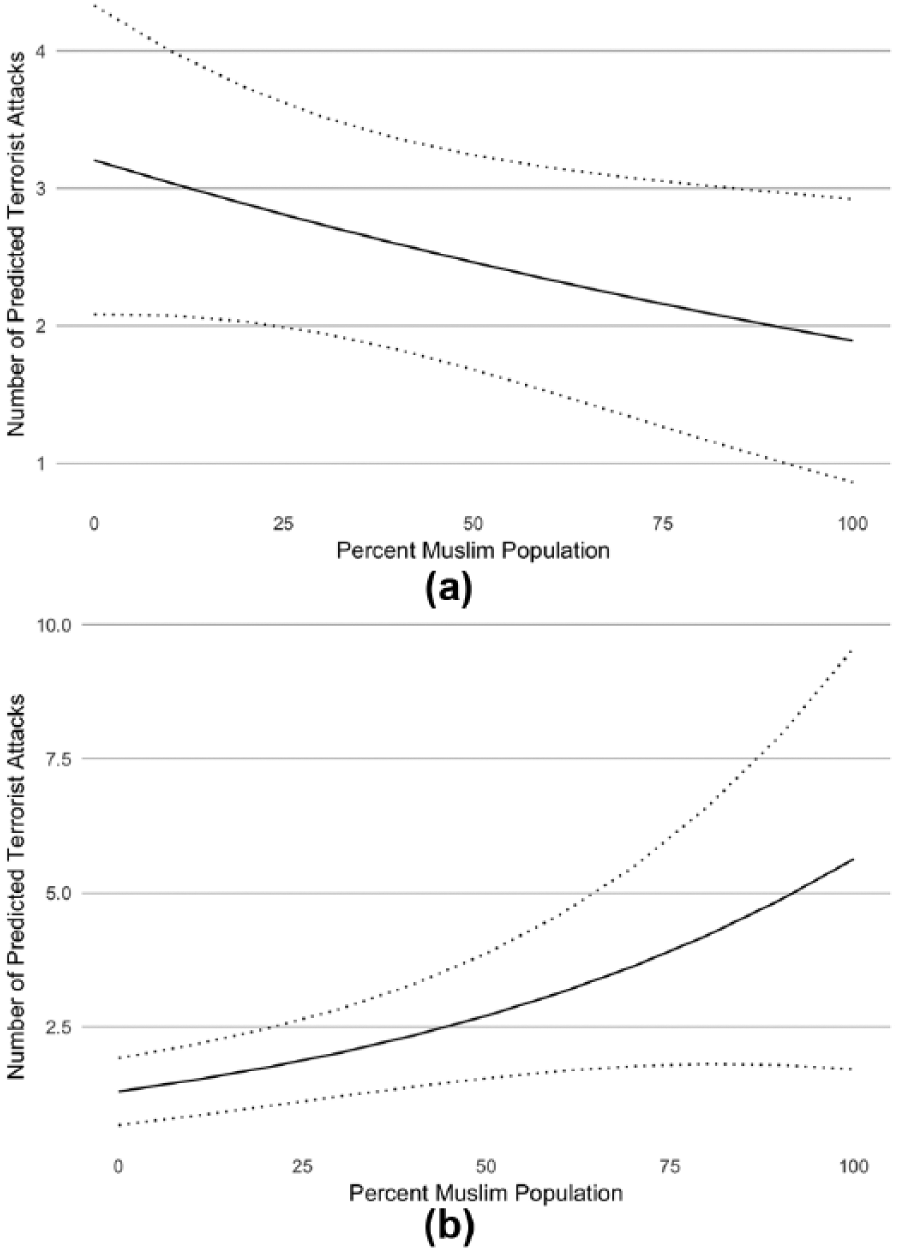
(a) Predicted domestic terrorist attacks & percent Muslim population 1989–2001 (b) Predicted domestic terrorist attacks & percent Muslim population 2002–2014.
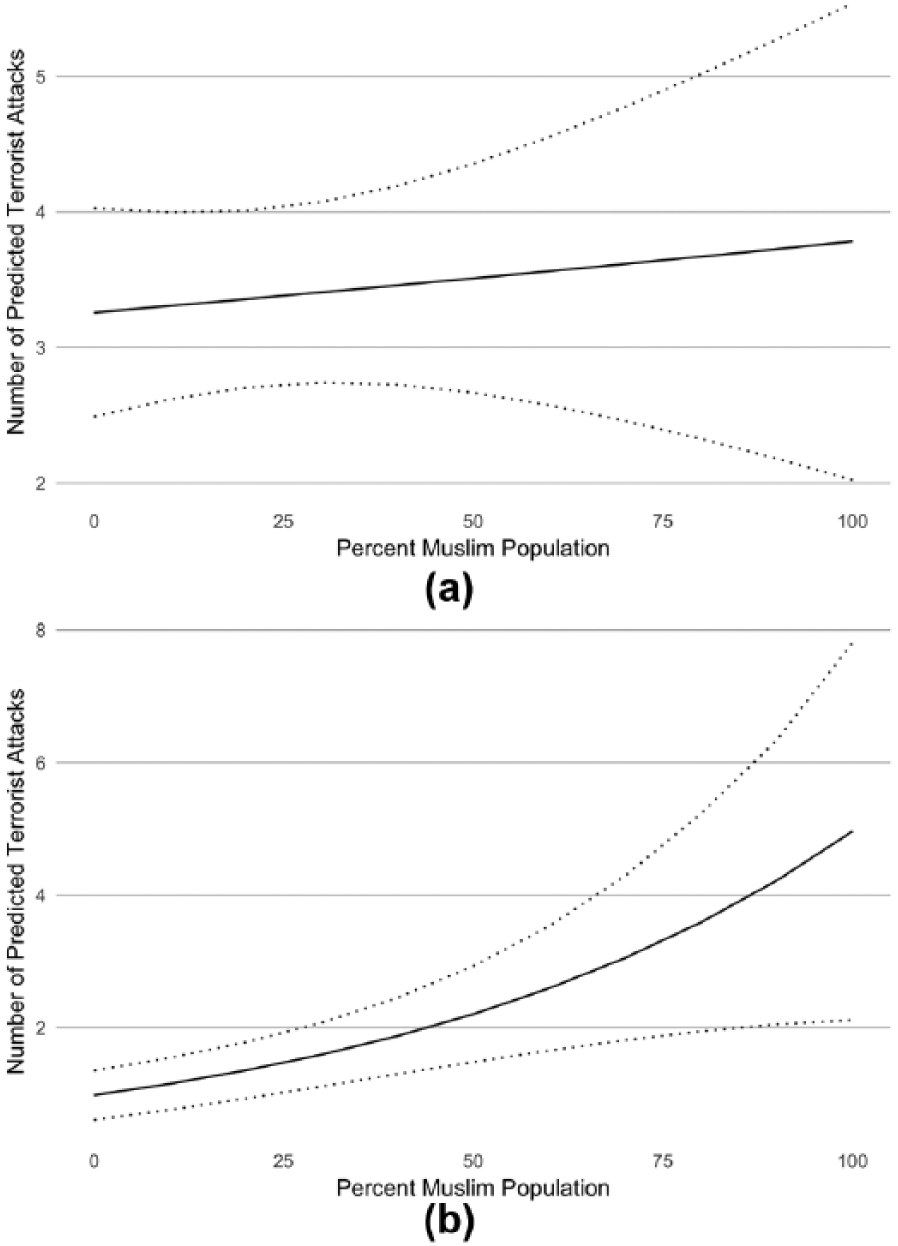
(a) Predicted international terrorist attacks & percent Muslim population 1989–2001 (b) Predicted international terrorist attacks & percent Muslim population 2002–2014.
To gauge the fully interactive effect of a shift between the eras on all the covariates, we again split the sample of observations into two periods (1989–2001 and 2002–2014). 23 Models 11 and 12 respectively estimate domestic terrorism for the two timeframes; Models 13 and 14 repeat this process for international attacks. The results from the first two models (Table 4) indicate that domestic terrorism in predominately Muslim countries has expanded considerably since 2001. Civil wars are strongly associated with increased attacks in both periods. And intervention by Western states is highly correlated with domestic terror, but especially in the post-GWOT period. Turning to international attacks, we note that an increase in the Muslim percentage has no discernable impact prior to 2002, but exhibits positive and significant effects in the subsequent era. Western interventions are largely without effect in both periods. Once again a civil war greatly raises the expected number of international attacks, and the effect roughly doubles as we shift between eras.
Split-sample models.

Note: Robust standard errors in parentheses. *p<.1, **p<0.05, *** p<0.01. “BD” stands for battle-related deaths. Intercepts omitted.
Concluding Discussion
Was 9/11 a watershed moment? We have attempted to gain leverage on this question by inspecting terrorist activity in the years before and after the event. Though we strictly examine correlations here, the analysis indicates some meaningful distinctions between the two periods – although in important respects these differences run counter to the oft-cited narrative about 9/11. And while we cannot say that 9/11 precipitated any of the changes we observe, several points merit highlighting.
First, terrorism primarily exists within the context of insurgency. The strongest predictor of terrorism within the borders of any given state is the presence of armed conflict, especially for domestic attacks. This result lends credence to the argument that terrorism is primarily a tactic. This result is also in line with Mueller and Stewart’s (2011) argument that, “…terrorism’s apparent incidence, and therefore the seeming importance, has been multiplied by effectively conflating it with insurgency.” Second, it is not just that the balance of terrorism inside and outside areas with active conflict remains tilted toward conflict zones, but that terrorism incidents outside of warzones in the post-9/11 era have decreased in absolute terms. The downward effect is particularly strong for transnational terror incidents. It is entirely consistent with the evidence presented here that this reduction is a consequence of counterterrorism measures enacted since September 2001. However, any number of factors might explain this change. Moreover, this result may ultimately reverse as foreign fighters return to their countries of origin (or migrate elsewhere) from current warzones in places such as Iraq and Syria.
Third, we demonstrate a marked shift in terrorism within predominantly Muslim countries. Prior to 2002, states with higher Muslim populaces could expect less domestic terrorism within their borders. Since then, the opposite is true. There is significantly more terrorism – both domestic and international – in predominantly Muslim nations. Jihadist terrorism looks to have become more enduring and widespread in the past 15 years. One explanation for this may be that Jihadi groups have made a strategic decision to focus their fire on the “near enemy” rather than on foreign powers. Another could be that defensive measures in the West have forced a shift in target set. This swing may also owe as much to domestic upheavals in parts of the Muslim world combined with Western responses to them.
Islamist conflicts have risen since 2001, and our work here is broadly in line with Gleditsch and Rudolfsen’s (2016) proposition that the increase in conflicts in Muslim countries after 2001, in absolute but especially relative terms, is reflective of a reaction in the Muslim world to interventions by major powers. It is difficult to parse out the singular effects that Western interventions into multi-sided insurgencies in Muslim countries may have on terrorism. Doubtless these interventions suffer selection bias, whereby interveners only participate in the most protracted and pernicious wars. However, consistent with our results is the possibility that the counter-terrorism policies of governments in Muslim majority countries and foreign states intervening militarily on their behalf since 9/11 are provoking more terrorism than they are preventing. Our effort suggests that this may be the case for much of the domestic terrorism plaguing many Muslim countries. This is an obvious area for future work.
In sum, this research aims to present a focused and balanced reckoning of the GWOT by comparing it to the era immediately preceding it. The results do not generally comport with popular or mainstream accounts of terrorism. This may be owing to an implicit negative bias in the manner in which terrorist news is reported. Terrorism provokes a pronounced media reaction easily reflected in headlines, often strengthening the public’s sense of threat (Gadarian, 2010). It is not our intention to trivialize the threat of terrorism but to put it in a measured perspective. We hope our effort will spur further analysis and informed debate about an important issue to scholars, the wider public, and those making policy decisions related to terrorism.
Footnotes
Acknowledgements
We thank Navin Bapat, Greg Howard, Trevor Johnston, Daniel Kremaric, Jeffrey Martini, Raymond Mercado, John Mueller, Karl Mueller, Michael O’Hanlon, Jan Pierskalla, Arturas Rozenas, Alexander Stephenson, Paula Thornhill, and Alan Vick. We are grateful to Ashley Weiler for research assistance. The views expressed here are our own and do not necessarily reflect those of RAND or the DoD.
Correction (June 2025):
Declaration of Conflicting Interest
The author(s) declared no potential conflicts of interest with respect to the research, authorship, and/or publication of this article.
Funding
The author(s) received no financial support for the research, authorship, and/or publication of this article.
Supplementary Material
The supplementary files are available at http://journals.sagepub.com/doi/suppl/10.1177/2053168017739757. The replication files are available at  .
.
Notes
Carnegie Corporation of New York Grant
This publication was made possible (in part) by a grant from Carnegie Corporation of New York. The statements made and views expressed are solely the responsibility of the author.
References
Supplementary Material
Please find the following supplemental material available below.
For Open Access articles published under a Creative Commons License, all supplemental material carries the same license as the article it is associated with.
For non-Open Access articles published, all supplemental material carries a non-exclusive license, and permission requests for re-use of supplemental material or any part of supplemental material shall be sent directly to the copyright owner as specified in the copyright notice associated with the article.
