




Abstract
A number of recent studies suggest that individuals who exhibit high levels of racial animosity strongly support Donald Trump, while racial liberals strongly oppose him. This paper provides a new experimental analysis of the extent to which supporters and opponents of Trump respond differently to race-related stimuli. Specifically, we examine whether attitudes toward Trump moderate the political impact of racial cues in the environment. We find that white Trump supporters randomly exposed to a black (versus a white) man in the context of soliciting their support for a housing-assistance policy were more opposed to the policy, angrier about the policy, and more likely to blame beneficiaries for their situation. The opposite pattern prevailed among whites with unfavorable opinions of Trump. Our results help provide new insight into how Trump supporters and opponents differ in their responses to the salience of race in American politics.
Keywords
Donald Trump’s presidential candidacy and election victory was both unexpected and unusual. He has no experience in elected office, a brash style, and policy positions that often diverge from those traditionally espoused by Republicans (e.g. on Social Security and Medicare). Scholars have attempted to explain the basis of support for Trump as a product of feelings of economic anxiety, the growing populism of the Republican Party (with a focus on anti-immigrant sentiment), sexism, and authoritarianism (e.g., MacWilliams, 2016; Rahn and Oliver, 2016; Schaffner et al., 2017; Sides and Farrell, 2016; Wayne et al., 2016). Perhaps most important, analysts have focused on Trump’s appeal to white Americans who harbor animosity toward “undeserving” racial minorities. Trump’s lack of support among people of color and his popularity among white subgroups with less tolerant attitudes (such as whites without college degrees) provide suggestive evidence that support for his candidacy was rooted in racial hostility. Moreover, Trump’s call for law and order in the context of discussing urban unrest—to give just one example—is reminiscent of previous racial appeals in American politics, including George HW Bush’s Willie Horton ad (Mendelberg, 2001) and Richard Nixon’s “Southern strategy” (Hillygus and Shields, 2008). More diagnostic still are studies showing that variables measuring white in-group favoritism and those measuring bias against racial and ethnic out-groups strongly correlate with support for Trump (e.g., Cohen et al., 2016; Gest, 2016; Nteta and Schaffner, 2016; Schaffner et al., 2017; Tesler, 2015, 2016a; Wood, 2017).
While previous work has shown that racial attitudes predict support for Donald Trump, no studies that we are aware of have examined whether attitudes toward Trump moderate the political impact of racial cues in the environment. In this research note, we examine whether such effects are heterogeneous, and whether heterogeneity stems from evaluations of Donald Trump as he sought to win the 2016 presidential election. To do so, we directly examine the question of whether Trump supporters and opponents exhibit distinct reactions to racial cues in the environment. Given the unusually racialized nature of Trump’s campaign appeals and the resulting differences between Trump supporters and opponents in racial attitudes, we argue that the policy judgments of Trump supporters and opponents will be influenced in divergent ways by cues that make black Americans salient.
Our study addresses this racial-cueing hypothesis in a novel survey experiment. Specifically, we randomly assign respondents to view a subtle image of either a black or a white man in the context of soliciting attitudes toward a housing-assistance policy. As a social welfare issue, attitudes toward government housing assistance tap into perceptions of deservingness that many see as central to the growing populism of the Republican Party, and upon which Donald Trump based his candidacy (e.g., Cramer, 2016; Gest, 2016; Tesler, 2016b). By examining the effect of racial cues on attitudes toward housing assistance, our study allows for an examination of whether attitudes related to perceptions of deservingness change upon exposure to an image of a black versus a white man, and whether this effect varies depending on one’s level of support for Donald Trump. To the extent that Trump supporters and opponents differ in how they respond to racial cues, we hypothesize that:
Hypothesis 1: for Trump supporters, subtle presentation of a black racial cue—versus a white racial cue—will (a) decrease support for government housing assistance, (b) increase anger that some people receive government assistance, and (c) increase the belief that individuals are to blame for their situation.
We also hypothesize that Trump opponents will have the opposite reaction. Consistent with Tesler and Sears (2010) and Tesler’s (2016c) finding of “two-sided” racialization in evaluations of President Obama (such that racially sympathetic whites held more favorable evaluations of Obama than previous Democratic candidates, and that racially resentful whites held more negative evaluations of Obama than previous Democrats), we hypothesize that:
Hypothesis 2: for Trump opponents, the presence of a black (versus a white) racial cue will (a) increase support for government housing assistance, (b) decrease anger towards people receiving government assistance, and (c) decrease their belief that individuals are to blame for their situation.
Finally, we examine whether it was Donald Trump alone—and not also Hillary Clinton—whose candidacy divided the electorate on the basis of responsiveness to racial cues. Given his clear racial and ethno-nationalist appeals—for example, about President Obama’s country of origin, his support for a Muslim ban, the state of the African American community, and negative comments about Mexicans—Trump is similar to other explicitly ethnocentric white candidates who appealed to individuals high in racial resentment, such as Pat Buchanan (e.g., Sears et al., 1997). Thus, we expect that responsiveness to racial cues will vary as a function of feelings about Trump, but not feelings about Clinton. Finally, we examine the robustness of our findings by examining whether traditional political predispositions—partisanship and ideology—can account for our Trump-moderated experimental findings.
In short, we examine whether Trump supporters and opponents exhibit distinct reactions to experimentally provided racial cues when forming attitudes related to social welfare and deservingness, and whether racial appeals can work to further polarize Trump supporters from opponents. We find strong support for both hypotheses; moreover, we find that the impact of racial cues varies solely as a function of feelings about Donald Trump—and not feelings about his Democratic opponent, partisanship, or ideology. In sum, we provide causal evidence that when racial cues are salient in the environment, Trump supporters and opponents have fundamentally different reactions and become even more divided.
Data and methods
To provide a test of the theory that racial cues increase attitude polarization between Trump supporters and opponents, we conducted an experiment using a national sample of 2020 respondents who completed the first two waves of an Internet panel study. The data were collected through Survey Sampling International. Of the respondents who completed Wave 2, 964 were randomly assigned to receive the stimuli for the current experiment. 1 Given the very low support for Donald Trump among African Americans, Asian Americans, and Latinx, our analyses include only the white respondents who completed the experiment; this produced a final sample of n = 746. Details about the study sample can be found in Appendix A, and details about the stimuli and measures can be found in Appendix B.
Experimental stimuli and dependent variables
To examine the influence of racial cues, our experiment measured support for a federal mortgage-assistance program in the presence of either a black or a white racial cue, signaled by the presence of a black man (n = 370) or a white man (n = 376) standing next to a foreclosure sign.
As Figure 1 shows, the activation of racial categories was subtle; no attention was called to the photo, and neither the instructions nor the dependent measures made any reference to the individual depicted in the photo. Respondents were randomly assigned to either the black or white photo condition. The experiment was introduced with brief text and was accompanied by a photo of a foreclosed home and the black or white target individual. The introductory text read: “Recently there have been proposals to help people who are struggling with their mortgages and may lose their homes.” Participants then indicated their support for the mortgage-relief program, whether the possibility of such help made them angry, and the extent to which they blamed potential beneficiaries of the program for their own predicament. Responses to these items served as the dependent variables and were rescaled to run from 0 to 1, with higher scores indicating greater policy opposition (M = 0.52, standard deviation (SD = 0.30), greater anger (M = 0.40, SD = 0.32), and greater individual blame (M = 0.56, SD = 0.28). We find no direct treatment effects of the white versus black racial cue on these dependent variables: policy opposition (b = 0.01, p > 0.10), anger (b = 0.01, p > 0.10), and individual blame (b = −0.01, p > 0.10). 3

Stimuli from the racial-cue conditions: (a) white condition. (b) black condition.
To establish that our experimental treatment did, however, polarize respondents on the basis of racial attitudes, we estimated a series of models interacting treatment assignment with racial resentment, ethnocentrism, and perceptions of white disadvantage (along with control variables). These results show that our manipulation of race did lead to distinct reactions among racial liberals and conservatives, as measured by multiple indicators of racial bias (see online Appendix Tables A2 to A4).
Independent variables
Besides a dummy variable for experimental condition, we include the following independent variables (unless indicated, all were measured in Wave 1 and rescaled to run from 0 to 1). Trump favorability was assessed using repeated feeling-thermometer ratings from Waves 1 and 2 of the survey; these items correlated highly (Pearson’s r = 0.80), so they were averaged (M = 0.42, SD = 0.36). 2 Clinton favorability was similarly assessed with repeated feeling thermometers from Waves 1 and 2 (r = 0.79, M = 0.39, SD = 0.36). We control for basic demographics: age (left in its original metric), income (rescaled to run 0 to 1), sex, education (seven ordered categories, rescaled to run 0 to 1), and employment status (1 = unemployed). However, we note that the results are not substantially changed when no control variables whatsoever are included (see online Appendix Table A1).
Results
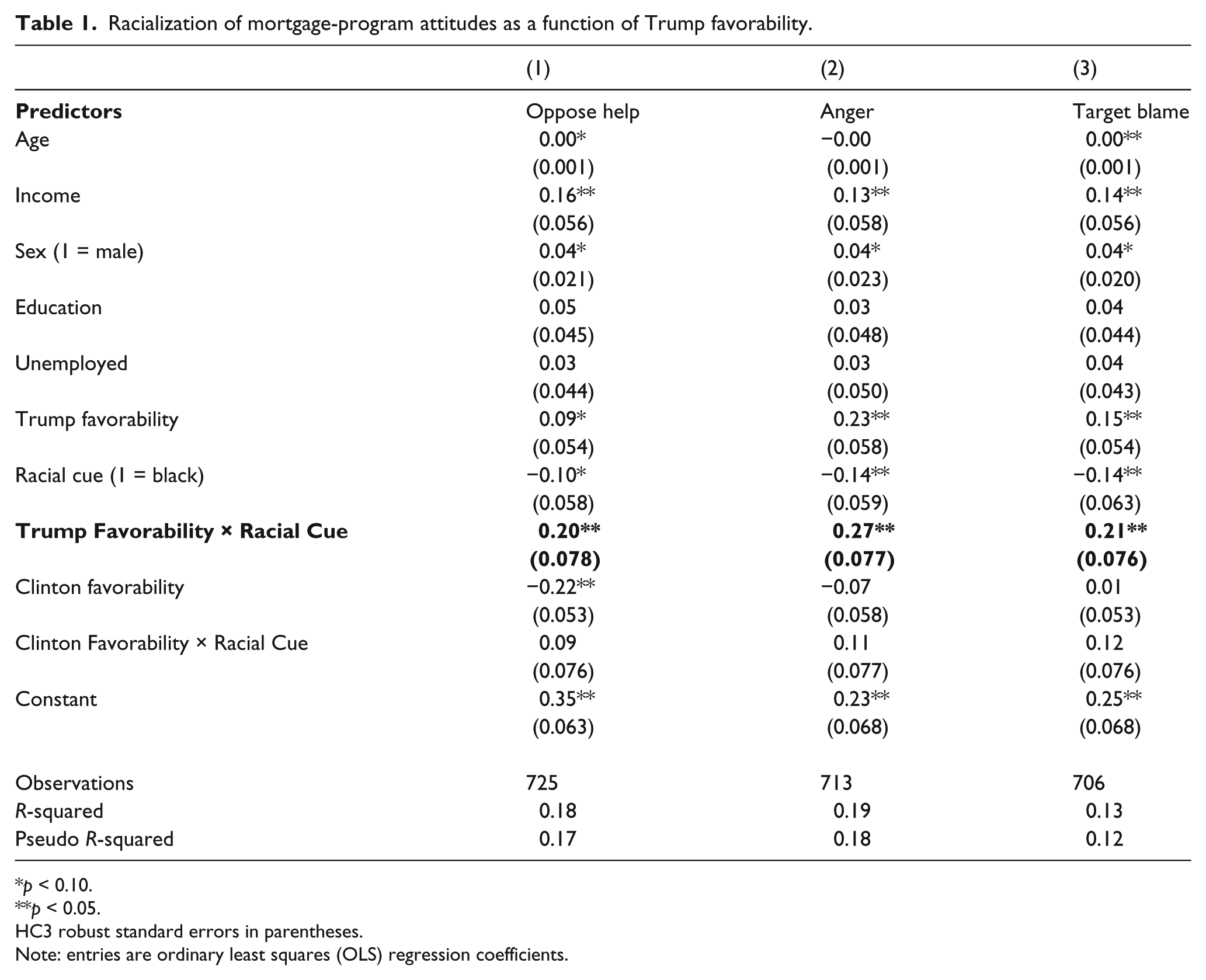
To test whether the effects of racial cues varied directly as a function of white respondents’ opinions of Donald Trump, we estimated a series of ordinary-least squares regression models. Each dependent variable was regressed on Trump favorability, a dummy variable representing cue condition (0 = white, 1 = black), and the interaction between the two, along with the aforementioned controls. We also compare the extent to which responses to racial cues differed as a function of Trump favorability—as opposed to Clinton favorability—during the 2016 presidential election by including an additional interaction between cue condition and our measure of Clinton favorability. To guard against heteroscedasticity, HC3 robust standard errors were used in all analyses (Long and Ervin, 2000). The results are summarized in Table 1.
Racialization of mortgage-program attitudes as a function of Trump favorability.
p < 0.10.
p < 0.05.
HC3 robust standard errors in parentheses.
Note: entries are ordinary least squares (OLS) regression coefficients.
In each model, the coefficient for the Trump Favorability × Racial Cue interaction provides the critical test of our hypothesis that attitudes toward Donald Trump moderate the impact of racial cues on political judgment. This interaction is significant and correctly signed for all three dependent variables: opposition to mortgage assistance (b = 0.20, p < 0.01), anger about assistance (b = 0.27, p < 0.001), and blaming targets of the assistance for their own situation (b = 0.21, p < 0.01). By contrast, attitudes toward Hillary Clinton failed to moderate the impact of the racial cues for any of the dependent variables (i.e., the interaction between Clinton favorability and cue condition fails to reach significance in any of the models). Furthermore, tests constraining the two coefficients to equality indicated that the coefficient for the interaction between Trump favorability and the racial cue is significantly stronger than the coefficient for the interaction between Clinton favorability and the racial cue for anger (p < 0.05) and individual blame (p < 0.10), and marginally stronger for opposing mortgage assistance (p < 0.10, one-tailed). These findings indicate that responses to the racial cue varied as a function of feelings about Donald Trump—but not feelings about Hillary Clinton—during the 2016 presidential election. 4
To unpack these interactions, we estimated conditional effects for the racial-cue manipulation across the full range of Trump favorability values from the most negative evaluation (0) to the most positive (1). These conditional-effect estimates are plotted in Figure 2; values on the y-axis represent the effect estimates and can be interpreted as the proportion change in each dependent variable associated with moving from the white-cue condition to the black-cue condition. For the mortgage help policy question, opposition was greater in the black condition than the white condition when Trump evaluations were at their most favorable, b = 0.13 (standard error (SE) = 0.05, p < 0.05), and lower in the black versus the white condition when Trump evaluations were at their least favorable, b = −0.07 (SE = 0.04, p < 0.10). Similarly, for the anger rating, anger was higher in the black than the white condition when Trump favorability was at its maximum, b = 0.17 (SE = 0.05, p < 0.01); but lower in the black condition than in the white condition when Trump favorability was at its minimum, b = −0.09 (SE = 0.04, p < 0.05). Finally, with respect to the blame variable, respondents were more likely to blame beneficiaries for their own plight in the black condition compared to the white condition when Trump evaluations were at their most favorable, b = 0.12 (SE = 0.05, p < 0.05); but less likely to do so in the black versus the white condition when Trump evaluations were at their least favorable, b = −0.10 (SE = 0.04, p < 0.05). In sum, this pattern of results supports both hypotheses 1 and 2.

Effects of racial cue as a function of Trump support.
Figure 3 presents the conditional-effect estimates—moving from the white to the black racial cue on all three dependent variables—across levels of support for Hillary Clinton. As Figure 3 shows, at no level of Clinton support does cue condition affect support for government housing, anger at beneficiaries, or blaming beneficiaries for their situation. Thus, it is support for Donald Trump—not Hillary Clinton—that captures differences in reaction to racial cues in the environment.

Effects of racial cue as a function of Clinton support.
Robustness analyses. Does support for Donald Trump uniquely capture distinct reactions to our cue manipulation, or does this pattern of polarization simply reflect the deep-seated partisan and ideological divide in American politics? In Table 2, we present a model in which we also interact our experimental treatment with partisanship and ideology, two other central predispositions related to Trump support. Our results are highly similar with these interactions included. 5 Support for Donald Trump—not partisanship or ideology—uniquely captures distinct reactions to our experimental manipulation of race (i.e. neither the partisanship-by-race-cue manipulation nor the ideology-by-race-cue manipulation is significant). 6 This indicates that Trump support is not merely a proxy for long-standing ideological and partisan divides in responsiveness to racial cues. That is, support for Donald Trump appears to serve as a basis for polarized responses to racial cues in its own regard.
Racialization of mortgage-program attitudes as a function of Trump favorability, not ideology or party identification.

p < 0.10.
p < 0.05.
HC3 robust standard errors in parentheses.
Note: entries are ordinary least squares (OLS) regression coefficients.
Finally, we examine feelings about Donald Trump as a moderator of our racial manipulation while controlling for the interaction between the experimental manipulation and racial resentment, ethnocentrism, and perceptions of white disadvantage. Because these racial attitudes measures are highly correlated, we analyze these results with each racial attitude measure included separately (to protect against multicollinearity). The results are presented in the online Appendix Tables A6 to A8. We find that the Trump Favorability × Racial Cue interaction continues to be significant in each of these analyses. Moreover, in each case, the interaction involving the racial attitude variable and the cue manipulation is reduced in significance. What are we to make of these findings? In our view, they suggest that feelings about Donald Trump mediate the effect of racial attitudes in response to racial cues in the environment. That is, Trump supporters and opponents may respond differently to racial cues because of prior differences in racial attitudes. Because they are learned early in childhood and adolescence (Sears, 1993), racial attitudes should be exogenous to attitudes toward Donald Trump—who was a novel (but racialized and highly salient) political stimulus in the context of the 2016 election. Therefore, attitudes toward Trump most likely serve as a proximal variable—in the sense of coloring other political judgments—in conveying the impact of racial attitudes on downstream political judgments. In sum, these results continue to show that feelings about Donald Trump directly capture a distinct and highly salient expression of differences between racial liberals and conservatives, as indicated by their polarized response to our subtle experimental manipulation of race.
Discussion and conclusion
Across all three dependent variables, our hypotheses received clear support. Among citizens with favorable views of Donald Trump, black racial cues increased opposition to mortgage assistance, anger at such assistance, and the tendency to blame policy targets for their own plight. In contrast, among citizens with unfavorable views of Donald Trump, black racial cues had the opposite effect: decreased opposition to mortgage assistance, anger, and individual blame. Importantly, these effects were exclusive to attitudes toward Trump: effects of the racial cue did not differ according to feelings about Hillary Clinton. Thus, Trump supporters and opponents respond in fundamentally different ways to racial cues in the environment.
These findings underscore the extent to which supporters and opponents of Donald Trump respond in a polarized fashion to the salience of racial cues. These distinct dynamics of racialization suggest that when race becomes salient in public discourse, support for Donald Trump will serve as a fulcrum for divergent policy judgments. Thus, to the extent that race-related issues remain at the top of the public agenda, supporters and opponents of Donald Trump are likely to become even more divided in their policy judgments, emotional reactions to policy proposals, and perceptions of social groups that are likely to be helped (or hurt) by various policies. Together with recent findings suggesting that racial attitudes are a key correlate of evaluations of Donald Trump (e.g., Tesler, 2016a, 2016b), our findings serve to underscore the continuing centrality of race as a contributor to polarization in American political life. In this regard, we join other analysts (e.g., Tesler, 2016c) in doubting that the developments of the present era—as momentous as they are—have truly brought about a “post-racial” America.
We conclude with a few suggestions for future research. First, our study merely establishes that going from white to black racial cues produces fundamentally distinct reactions among Trump supporters and opponents in their support for government housing assistance, anger about said assistance, and blaming individuals for their struggles. However, it cannot determine whether Trump supporters and opponents are differentially reacting primarily to the white or black racial-cue condition (or both). This is an important distinction that future work should investigate by examining reactions to black cues and white cues relative to an additional non-racialized control condition. Second, future research should examine the effect of racial cues in the context of policies Trump has expressed more support for. For example, Trump—in contrast to other Republicans—promised to preserve Medicaid during the 2016 campaign. Thus, it would be interesting to see whether cues implying that this program benefited disliked outgroups were as effective in reducing support among Trump supporters. A result of this sort would suggest that the identity-based antecedents of Trump support may be capable of turning his voters against even those policies he has clearly endorsed. These and other questions await examination.
Footnotes
Correction (June 2025):
Declaration of conflicting interests
The author(s) declared no potential conflicts of interest with respect to the research, authorship, and/or publication of this article.
Funding
The author(s) received no financial support for the research, authorship, and/or publication of this article.
Supplementary materials
The supplementary files are available at http://journals.sagepub.com/doi/suppl/10.1177/2053168017737411. The replication files can be found at 
Notes
Carnegie Corporation of New York Grant
This publication was made possible (in part) by a grant from Carnegie Corporation of New York. The statements made and views expressed are solely the responsibility of the author.
References
Supplementary Material
Please find the following supplemental material available below.
For Open Access articles published under a Creative Commons License, all supplemental material carries the same license as the article it is associated with.
For non-Open Access articles published, all supplemental material carries a non-exclusive license, and permission requests for re-use of supplemental material or any part of supplemental material shall be sent directly to the copyright owner as specified in the copyright notice associated with the article.
