




Abstract
There has been a great deal of discussion about the large volumes of foreign fighters involved in civil conflicts in Syria and Iraq over recent years. Yet, there remains little systematic evidence about the effect, if any, that foreign fighters have upon the conflicts they join. Existing literature distinguishes between the resources fighters bring to rebel groups and the liability they represent in regards to campaign cohesion. We seek to establish preliminary evidence as to whether or not foreign fighters contribute to the success of the campaigns they join. Our multinomial logistic and competing risks regression analyses of civil conflicts between 1946 and 2013 suggest that foreign fighters are associated with a decreased likelihood of government victory. Furthermore, we offer partial evidence to suggest that foreign fighters from non-contiguous countries are more likely to help rebels achieve a negotiated settlement or to continue their struggle against the government, but not to directly help them achieve victory.
Introduction
Contributors to academic, policy, and popular commentary communities have increasingly voiced concerns regarding the threat posed by foreign fighters entering and exiting civil conflicts around the globe (Braithwaite and Chu, forthcoming; Hegghammer 2013). These unpaid, non-national combatants, with no apparent link to the conflict they enter, commonly join the side of rebel groups who are violently resisting the government of the state. Concerns relate to the possibility that foreign fighters can radicalize the rebel groups that they join, causing an escalation in violence in conflicts, lengthening their duration, and/or reducing opportunities for their resolution. These concerns are fueled by the ongoing case of the Syrian Civil War, which has received as many as 30,000 foreign fighters from over 100 countries.
Foreigners participating in campaigns abroad is not a new phenomenon. According to Malet (2013), foreign fighters participated in at least 70 civil conflicts over the past two centuries, including the Texas Revolution (1835–6) and the Spanish Civil War (1936–9). During the post-9/11 period (and prior to the onset of the Syrian Civil War in 2011), more than 20,000 foreign fighters fought in conflicts including in Afghanistan, Chechnya, Iraq, and Nigeria. Despite the prevalence of this phenomenon, we know relatively little about the security and broader policy implications of these fighters. 1
This paper asks and seeks answers to an important question regarding this particular type of combatant: How does the presence of foreign fighters affect the outcome of the campaigns that they join? Specifically, are some foreign fighters more likely to aid in rebel success than others? Existing evidence suggests that the effects of foreign fighters can be heterogeneous. Take the long-running conflict in Chechnya, as an example. Starting in 1994, Jihadi foreign fighters from across the Middle East and Central Asia entered the conflict alongside Chechen rebels. They appear to have had the effect of increasing the intensity of conflict events whilst also undermining the cohesion between the rebels and the local population.
In order to understand the effect of foreign fighters on conflict processes, we derive and test nuanced expectations regarding the effect of foreign fighters on civil conflicts. Existing studies imply that foreign fighters that are from similar and neighboring populations are most likely to benefit the rebels that they join. By contrast, the underlying logic of our test hypotheses suggest that foreign fighters positively affect the insurgencies they enter only when they are strongly committed to the cause. Perhaps counter-intuitively, we suggest that this is the case when fighters come from more distant populations, because this is most likely to reflect the supply of fighters that closely matches the demand for them. Empirical analyses offer some support for this expectation.
Foreign fighters as resources or liabilities?
Most existing research speaks to the question of who is likely to become a foreign fighter and how they are recruited and/or mobilized (Hegghammer, 2010). This includes support for arguments regarding their choice between conflicts at home and those overseas (Hegghammer, 2013), group-level recruitment practices (Malet, 2013), and the role of network ties and processes of social learning (Bakke, 2013). By contrast, there is a relative paucity of literature on the effect foreign fighters have upon the conflicts they enter. What little evidence exists on this topic poses an interesting puzzle, with a split in theoretical bases as to whether foreign fighters represent a resource or liability for the local rebels they join.
Broad-strokes empirical rates suggest that insurgencies welcoming foreign fighters enjoy disproportionate levels of success. Malet (2013) shows that across 331 civil wars since 1800, incumbents won 60% of the time and insurgents won 27% of the time. By comparison, in just those conflicts with foreign fighters, incumbents won 44% of the time and insurgents 39%. Malet accounts for this variation by arguing that chances of victory are enhanced because of the roles played and resources brought to bear by the presence of foreign fighters. Beyond the descriptive statistics presented by Malet, there is no comprehensive and robust evidence that foreign fighters’ contributions on the battlefield critically influence conflict outcomes in either direction (Mendelsohn, 2011). Intuitively, each new recruit arriving to join the fight represents a resource that could potentially be tapped by the campaign.
The role of resources is central to common understandings of how and when rebel groups are able to act collectively and mount opposition against more powerful government forces. The literature places equal emphasis, in this respect, upon the roles played by natural resources (Ross, 2004) and the recruitment of personnel (Humphreys and Weinstein, 2008). Herein, we focus attention upon the latter of these two potential assets. If managed well, the personnel-based resources that can benefit campaigns can take a wide variety of forms (Weinstein, 2007). Mobilization capacity helps groups bring in individuals to fight and be successful in their campaign (Cunningham et al., 2009). New recruits can fill gaps in planning or operating roles, enhancing the capacity of the campaign. Recruits can also bring with them key innovations that help campaigns overcome the asymmetry they face at the hands of their governing counterpart. Perhaps most importantly, leaders are shown to be able to convert relatively few resources in valuable tactical and strategic gains in their campaigns (Hazen, 2013).
By contrast, in-depth case studies have concluded that overseas recruits can have detrimental effects on the insurgencies they join. Bakke (2013) demonstrates this to be the case in the Chechen conflict, where foreign fighters have come from across the Middle East, Central Asia, and North Africa. Bakke (2014) provides a discussion of two important ways in which foreign fighters can negatively affect domestic insurgents’ strengths. First, they may be more likely than locals to be responsible for atrocities that generate considerable political liabilities. Second, new arrivals bring with them a set of expectations, goals, and plans that frequently diverge from those of local activists. Foreign fighter recruits might also have insufficient understanding of the local conditions, poor language skills, and little experience in harsh conditions (Mendelsohn, 2011; Moore, 2016). This may be especially the case for Western recruits, who may even become a liability: “[i]nstead of a force multiplier on the front, many need the equivalent of babysitting” (Mendelsohn, 2011: 195). Overall, then, while mobilization of recruits is generally necessary for a group to continue fighting (Weinstein, 2007), recruiting foreign fighters might not easily translate into an increased likelihood of success for rebels.
The supply and demand of foreign fighters
The competing descriptions of foreign fighters as resources or liabilities might arguably both have merit. These mechanisms need not be thought of as mutually exclusive. Indeed, empirical analyses might be blighted by these two effects contradicting one another. Therefore, in addition to exploring whether or not foreign fighters have an impact on the conflicts they join, we focus here upon trying to draw out the characteristics of foreign fighters that might determine whether or not they help or hinder the rebel campaigns that they join.
The aforementioned studies speak indirectly to the question of characteristics. By and large, the literature implies that foreign fighters that originate from socially similar populations, such as ethnic kin, are most likely to represent resources, rather than liabilities, for the groups they join. This expectation appears, at least superficially, to be consistent with a logic of recruitment and collective action (Olson, 1965). Mechanisms that help rebel groups overcome the recruitment barriers center upon a series of “distances” between individuals—in terms of current and potential recruits. Gates (2002) highlights three such distances: ethnic, ideological, and geographic. The shorter these distances, the more likely groups will be able to recruit.
We suggest that proximity, whether social or geographic, may result in more frequent joining behaviors. Foreign fighters from contiguous countries or co-ethnic populations might be expected to more readily join “local” rebellions, because it is easier to do so. First, foreign fighters who are located nearby can access the war zone more easily, since transportation options such as driving or flying are at a lower cost (Zelin, 2015). Second, Hegghammer (2010) suggests that for Islamic conflicts, there has been a shift in the Islamic doctrines that calls for individuals to fight, regardless of their nationality. Third, shared ethnicity can reduce uncertainty by enabling potential co-ethnic foreign fighters to gain access into groups (Lyall, 2010).
Yet, while these ties may help alleviate the recruitment problem, they might not speak equally to the ability of the group to absorb and exploit the resources provided by potential foreign recruits nor, relatedly, the foreign fighters’ commitment to the cause that they are joining. Specifically, we suggest that characteristics of the foreign fighters and the relationship they have with the rebel group will influence whether they help or hinder the campaigns they join. In other words, not all foreign fighters, despite their commitment, are created equal. Closer social ties between local and foreign combatants can aid the prospects of ongoing rebellions. One such social tie is co-ethnicity. Co-ethnic foreign fighters will be more likely than non-co-ethnic fighters to share cultural understanding of their new surroundings and to be able to communicate functionally with their new neighbors and fellow combatants. Accordingly, we contend that,
In addition, greater geographic distance traveled by foreign fighters to join the local rebellion ought to better reflect their commitment and, thus, their positive contribution to rebel group success. Foreign fighters differ from local rebels or socially similar recruits because they are selected mainly for ideological commitment and because they may have fewer personal stakes in the conflict, such as land or assets in the conflict country (Gates and Podder, 2015). In addition, those that have traveled further likely overcame greater obstacles and have undergone stricter vetting procedures. Simply put, not all potential foreign fighters arrive at the battlefield. Many are caught in transit by their home government (Holman, 2016). Individuals who desire to become foreign fighters, especially those from further afield, are typically required to meet with a “facilitator,” a person that directs them to the rebel group. Facilitators are instructed to vet the fighters so as to ensure their commitment. Without a “facilitator,” the probability a would-be recruit makes it to the battlefield as a foreign fighter is small (Holman, 2016). Potential foreign fighters are also more likely to have some military experience (Fritz and Young, 2016). Collectively, these factors make it more likely that these more distant recruits are more ideologically committed to the cause and are more likely to adhere to local command and control. 2
Furthermore, the absorption of more “distant” foreign fighters may signal that the local rebels have a greater demand for additional resources. In other words, in such instances, the supply of foreign fighters might better match the rebel group’s demand for them. In particular, rebel groups’ need to employ facilitators to vet potential fighters signals both greater organizational capacity and a demand for quality recruits. This leads to the following expectation:
Research design
In order to assess how foreign fighters affect the prospects of rebel groups in their struggles against governments, we designed a series of tests on a dataset with the rebel group-government dyad as the unit of analysis. This includes all civil conflicts between 1946 and 2013. A civil conflict is defined as a contested incompatibility between the government of a state and an armed non-governmental group that results in at least 25 battle-related deaths. We are interested in how the presence of foreign fighters influences local rebel groups’ prospects in their struggles. Accordingly, we operationalize a dependent variable that categorizes how a conflict ends. Conflict outcome has four potential categories: (1) peace agreement, (2) government victory, (3) rebel victory, (4) or “other” outcome. 3 This variable is coded from the Non-state Actor dataset (Cunningham et al., 2009).
In order to test the proposed expectation, we employ a series of multinomial logit and competing risks regression models. 4 Our primary independent variable accounts for foreign fighters joining a non-state group in their fight against the government. Foreign fighters is a binary variable coded 1 if foreign individual(s) participated in a local rebel group’s insurgency against their government; it is coded as a 0 otherwise. In order to assess the differential impacts of the characteristics of foreign fighter populations, we utilize two variables measuring the “distance” between the foreign fighters and their local host group. Beyond neighboring is a dichotomous variable coded 1 if the foreign individual(s) traveled from further afield than a neighboring country to fight in a civil conflict and 0 otherwise. Co-ethnic is a binary variable coded 1 if the foreign fighters who joined the insurgency shared the same ethnicity as the majority of the rebel group. Both variables are drawn from Malet (2013). 5
We include a set of conflict-specific control variables across each of our models. The logged duration of the conflict in years, the number of rebel groups currently fighting the government, the fighting capacity of the rebel group, and the mobilization capacity of the rebel group are all expected to influence the rebel group’s prospects (Cunningham et al., 2009). Fighting and mobilization capacity are each coded as 1 if the rebel group is considered to be stronger or at parity with the government with respect to these capabilities. We also control for whether the conflict ended during the Cold War or in the post-9/11 period. Finally, we include three country-level control variables: the regime’s Polity score (Marshall et al., 2014), logged GDP, and logged population from the year prior to that of the conflict’s termination. Summary statistics for all variables included in our main models are reported in Table A1 of the Appendix.
Results and discussion
Table 1 displays the results of our multinomial logit regression model. We detail estimates for each of the three decisive conflict outcomes compared with the baseline category: peace agreement (PA), government victory (GV), and rebel victory (RV). 6 Columns with a (1) correspond to models including a general measure of the presence of foreign fighters, whereas those with a (2) correspond to models including indicators of the geographic and social ties between fighters and the rebels that they join.
Multinomial logit results of conflict termination.

N=638.
p<0.05, **p<0.01, ***p<0.01.
PA: peace agreement; GV: government victory; RV: rebel victory.
Reference category is “other” outcome.
We look first to the average general effect of foreign fighters upon the conflicts that they join (the results in columns (1) in Table 1). Here we find that foreign fighters generally appear to bring benefits to the groups that they join. The point estimates suggest that foreign fighters are associated with increases in the likelihood of rebel victory and a decrease in the likelihood of agreements or government victories. Importantly, however, only the estimates for government victories achieve conventional levels of statistical significance. When foreign fighters enter a conflict on the side of the rebels, they decrease the likelihood of government victory by more than 430%. 7 These results lend some credence to the logic that foreign fighters are more of a resource than they are a liability.
We next explore the effect of foreign fighters dependent upon their social and geographic ties to the conflicts that they join (the results in columns (2) in Table 1). Upon disaggregating foreign fighters’ characteristics, we find that the previously observed effect of a reduction in the likelihood of government victory holds only in instances in which foreign fighters come from countries beyond the immediate neighborhood of the local rebellion. Beyond-neighboring foreign fighters decrease the odds of a government victory by more than 160%. This lends some support to our second test hypothesis that fighters overcoming greater geographic distances reflect higher levels of commitment to the cause. Our results do not, however, provide support for our first test hypothesis regarding co-ethnics. While the coefficient estimates are in line with the idea that co-ethnic foreign fighters increase the likelihood of rebel victory and reduce the likelihood of government victory, these estimates fall short of achieving conventional levels of statistical significance.
In order to further explore the effect of foreign fighters on the duration of the conflicts that they join and the timing of their likely outcomes, we also conducted a series of competing risks analyses. In sum, we find that foreign fighters in general, and those from beyond neighboring countries specifically, are associated with a decrease in the likelihood of government victory. 8 Observed effects for other outcomes are again in line with general expectations; however, they once again do not achieve statistical significance. Figure 1 displays the cumulative incidence functions for government victory in the top row and rebel victory in the bottom row. In the left column, we display findings from the general model with the inclusion of the binary foreign fighters’ variable. Overall, we see that the likelihood of a government victory is lower when foreign fighters fight on the side of the rebels, as shown by contrasting the dotted (those conflicts with foreign fighters) and bold (those without foreign fighters) lines in the top left panel. By contrast, foreign fighters seem to not greatly enhance the prospects of a rebel victory (as shown in the bottom left panel). In the right-hand column, we display findings for the models isolating the effects for foreign fighters that traveled from beyond the neighborhood. Here we again find that foreign fighters from beyond the neighborhood have a meaningful effect in reducing the likelihood of government victories. The positive effect on the likelihood of rebel victory is, by contrast, much less pronounced.
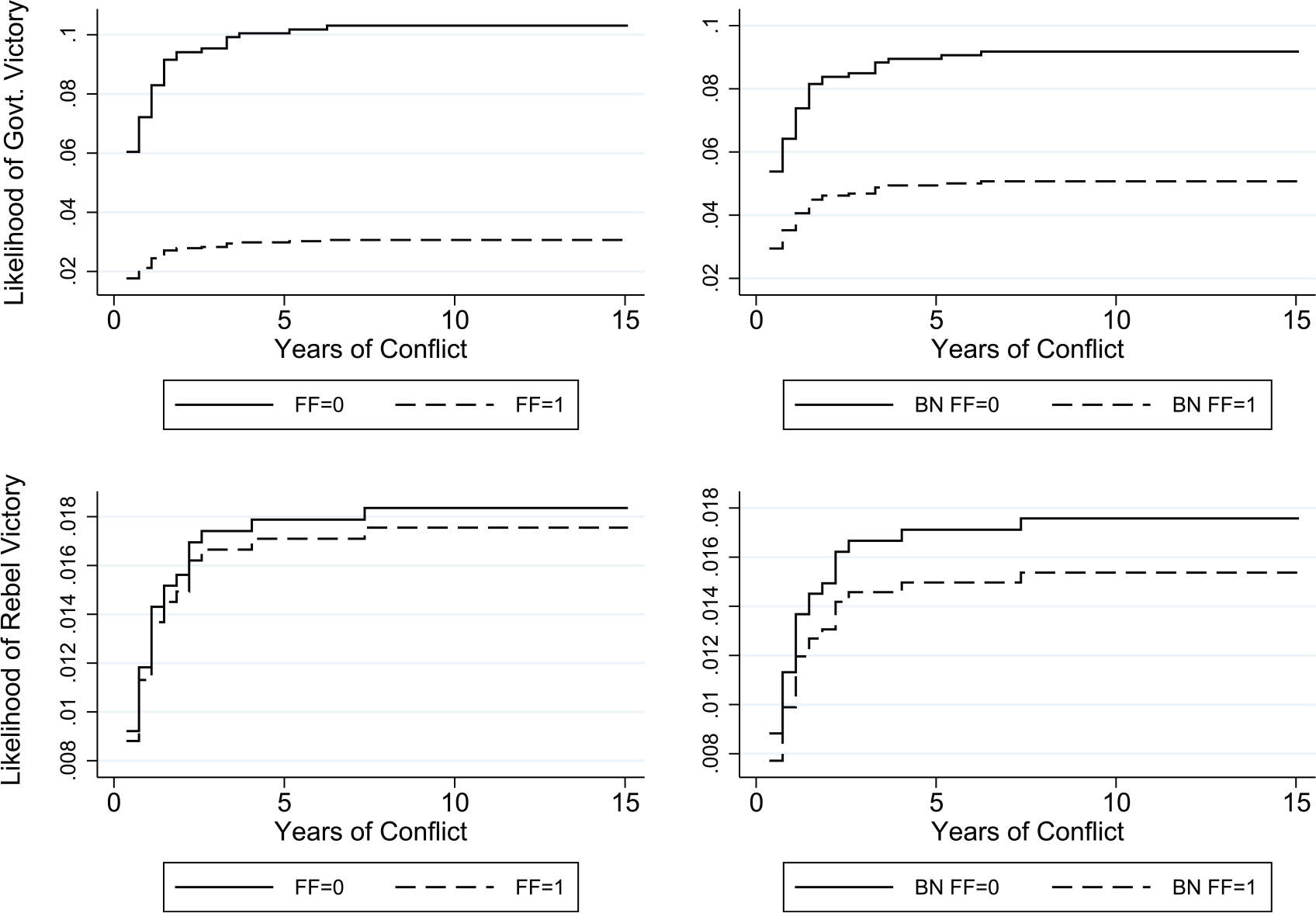
Cumulative incidence functions of Government and Rebel Victory.
In sum, our results suggest that foreign fighters do indeed have an impact on the rebellions they join. Foreign fighters tend to represent a resource but only under a limited condition. Those conflicts involving foreign fighters appear to be less likely to end in government victory. This effect appears to be driven, especially, by foreign fighters from beyond the neighborhood. In other words, we have evidence in support of hypothesis 2. We do not, however, identify statistically significant evidence for the expectation laid out in hypothesis 1; co-ethnic foreign fighters do not appear to strongly influence the outcomes of conflicts that they join any more so than non-co-ethnic foreign fighters.
Conclusion
This paper endeavored to unpack the effect of foreign fighters on the prospects of the rebel groups they join. There is a debate in the current literature as to whether or not foreign fighters have a positive or negative effect on the conflicts they enter. On the one hand, foreign fighters are viewed as a valuable resource that help local rebels to overcome their collective action and resource scarcity problems. On the other hand, scholars have argued that foreign fighters might be a liability to the organizations that they join. Our initial results suggest support, perhaps, for a hybrid logic. Foreign fighters appear to serve as an important resource, as argued by Malet (2013); however, only when they are committed or aligned with the struggle they join, as argued by Bakke (2014).
Beyond this, we sought to identify the characteristics of foreign fighter populations that might have a clearer bearing upon the outcomes of the conflicts they fight for. We argued that foreign fighters positively affect the insurgencies they enter only when they are strongly committed to the cause. From this theoretical perspective, we derived two test hypotheses in which we expected that co-ethnic foreign fighters and those that have traveled from more distant countries have an increased likelihood of having a positive effect on the prospects of the rebel groups they join. While our models suggest that both of these types of foreign fighters return estimates in line with our expectations, these findings are only statistically significant in the case of foreign fighters from beyond the neighborhood.
Research on the effect that foreign fighters have on the conflicts they join enables both academics and policy makers to assess the validity of security concerns. There is, for instance, evidence that once foreign fighters leave a conflict, there may be an uptick in domestic terrorist attacks abroad, because there is now a surplus of well-trained foreign fighters that are not tied geographically to the conflict country (Braithwaite and Chu, forthcoming). The present study suggests that foreign fighters from further afield likely extend the duration of their employment by reducing the odds of a government victory without necessarily achieving victory and remaining in the conflict country indefinitely. The combination of the emerging body of empirical evidence regarding foreign fighters and the conflicts they join and the impact they can have once these conflicts end could facilitate efforts to counter the motivations behind foreign fighting, mitigate their effects in the conflict zone, and lessen the possibility of attacks once they return home.
Of course, this study is not without its limitations. Perhaps most importantly, the study would benefit from further improvements to data quality and quantity. We have happily drawn from the rich data of Malet (2013); nonetheless, future studies could benefit from further disaggregating measures of foreign fighter presence in conflicts, including details on origin countries, sizes of foreign fighter populations, and the precise timing of their entry into and exit from conflict zones. Ongoing research by Aaron Zelin, David Malet, and others look set to provide advances in this respect.
Footnotes
Acknowledgements
We would like to thank Ashley Covarrubias, Kristin Bakke, David Malet, Barak Mendelsohn, Pauline Moore, and the reviewers and editors of Research & Politics for useful comments and suggestions.
Correction (June 2025):
Authors’ Note
An earlier version of this paper was presented at the International Studies Association’s 2016 Annual Meetings. All remaining errors are our own. The data used in the analyses conducted in this study, along with our online appendix, are available through the Research & Politics Dataverse page:  .
.
Declaration of Conflicting Interest
The authors declare that there is no conflict of interest.
Funding
This research received no specific grant from any funding agency in the public, commercial, or not-for-profit sectors.
Supplementary Material
The supplementary files are available at http://journals.sagepub.com/doi/suppl/10.1177/2053168017722059. The replication files are available at: .
Notes
Carnegie Corporation of New York Grant
This publication was made possible (in part) by a grant from Carnegie Corporation of New York. The statements made and views expressed are solely the responsibility of the author.
References
Supplementary Material
Please find the following supplemental material available below.
For Open Access articles published under a Creative Commons License, all supplemental material carries the same license as the article it is associated with.
For non-Open Access articles published, all supplemental material carries a non-exclusive license, and permission requests for re-use of supplemental material or any part of supplemental material shall be sent directly to the copyright owner as specified in the copyright notice associated with the article.
