




Abstract
Given the potential attitudinal and behavioral impact of Anthropogenic Global Warming (AGW) conspiracy beliefs, it is important to understand their causes and moderators. Here, two explanations for the variation in these beliefs are engaged: the first is the choice among elites to frame AGW using the phrase ‘global warming’ (GW) as opposed to ‘climate change’ (CC); the second is partisan motivated reasoning. A theory is then developed about the role of trust in moderating the impact of the two frames on AGW conspiracy beliefs. In the case of CC, which is perceived as less severe than GW (and is therefore less identity threatening among Republicans), it is hypothesized that trust will moderate hoax beliefs among Republicans. In the case of GW, where the implications of existence beliefs have policy consequences that are more unpleasant, motivated reasoning will ‘win out’, and trust will not moderate conspiracy endorsement among Republicans. The results from an original question framing experiment are consistent with the author’s hypotheses. Whilst trust is a welcome commodity to those looking to persuade citizens to support AGW-ameliorating policies, it is not a cure-all, especially in the face of elite partisan cues that edify pre-existing attitudes/identities and arouse a strong desire to engage in motivated reasoning.
Keywords
Partisan conflict was not always the norm regarding climate policy (Ogden, 1971). However, contemporary elite battles, with Republicans in the USA usually leading the opposition to Anthropogenic Global Warming (AGW) policies, demonstrate a heightening partisan polarization through both policy stances and rhetoric (Dunlap and McCright, 2011; Fisher, 2006; McCright and Dunlap, 2010). Over the same period, American public opinion on many different aspects of the AGW challenge has become similarly polarized: Republicans have sustained a low level of concern and low support for government-led policy responses to AGW over the last two decades, while Democrats have consistently become more concerned and supportive of policy interventions over time (Dunlap et al., 2016; Whitmarsh, 2011). Not only have concern and policy attitudes polarized, but contemporary political debate on AGW has also seen a rise in AGW conspiracy theories (CTs) (Boussalis and Coan, 2016; Elsasser and Dunlap, 2012; McCright and Dunlap, 2010), primarily coming from the right (e.g., Smith and Leiserowitz, 2012).
Conspiracies and misinformation are politically and socially significant (e.g., Nyhan and Reifler, 2010; Oliver and Wood, 2014; Uscinski and Parent, 2014); the misinformation and conspiracies surrounding climate change are consequential for myriad reasons (e.g., Uscinski et al., 2017), namely the clear linkage between conspiracy theory belief and behaviors affecting the political system. For example, beliefs that AGW is a hoax are negatively correlated with pro-environmental behaviors (Jolley and Douglas, 2014), create an environment where attempts at deliberation, negotiation and action about AGW are increasingly difficult (Lewandowsky et al., 2015) and, through elections, put into place a balance of representatives unwilling to address the challenge that climate change presents (Douglas and Sutton, 2015). 1
Given the potential attitudinal and behavioral effects of belief on AGW CTs, it is important to understand the causes of such beliefs, as well as any potential moderators. Here, I engage two explanations – elite framing of the terms ‘global warming’ (GW) as contrasted with ‘climate change’ (CC) and partisan motivated reasoning – for the belief that AGW is a conspiracy or hoax. I then develop a theory about the moderating role of trust, not only in AGW conspiratorial ideation but also across GW and CC frames.
Frank Luntz, elite framing, and the CC/GW distinction
It is impossible to understand fully the causes of beliefs about the existence and/or seriousness of AGW without accounting for the different ways in which the AGW issue has been strategically framed by increasingly polarized political elites in order to affect attitudes (e.g., Leiserowitz et al., 2014; Schuldt et al., 2011). As such, the first explanation is elite-driven partisan polarization and framing (e.g., McCarty et al., 2006; Zaller, 1992) on the issue of AGW (McCright and Dunlap, 2011; Dunlap and McCright, 2011).
In 2002, pollster and strategist Frank Luntz advised the Bush Administration to frame its discussion of AGW using the term ‘climate change’ instead of ‘global warming’. Luntz (2002) suggested this because CC was naturally occurring and therefore ‘less frightening’. The logic behind Luntz’s recommendation was to broaden the consensus in the public that climate change was not that big of a deal. In his strategy memo to Republican leaders, ‘Mr. Luntz urges that the climate change term be used instead of global warming because “while global warming has catastrophic communications attached to it, climate change sounds a more controllable and less emotional challenge”’ (Lee, 2003). The recommendation was based in part on the policy implications of the GW frame (the solution for which would be much stricter anti-pollution regulations that would affect businesses) versus CC (a naturally occurring fluctuation in temperature for which fewer, if any, policy fixes are needed). Thus, elite discourse conducted through the CC frame would be less likely to lead to division on the issue inside the Republican coalition, leading to fewer calls for policies antithetical to Republican values.
Political operatives like Luntz know that the framing of an issue matters because it clarifies and condenses the issue for the public (e.g., Nelson et al., 1997). In fact, framing experiments confirm Luntz’s assertions (but see Dunlap, 2014; Villar and Krosnick, 2011). For example, compared to CC, people are more concerned and worried about GW (Whitmarsh, 2009; Leiserowitz et al., 2014), believe that it is more tractable (Whitmarsh, 2009), and are less likely to believe in its existence (Schuldt et al., 2011; Schuldt et al., 2015).
The role of partisanship and motivated reasoning in the AGW discourse
However, the framing research described above obscures the role that partisanship plays in the effect of strategic AGW framing on individuals’ attitudes. Partisan framing is a conditioning factor in the delivery of information that directs reasoning about that information: party elites can polarize the discourse by structuring the frames around an issue (Slothuus, 2010; Slothuus and de Vreese, 2010). In fact, compared to CC, GW evokes stronger ratings of negative affect, greater worry, and greater perceptions of personal and family threat among Democrats than Republicans (Kraft et al., 2015; Leiserowitz et al., 2014; Villar and Krosnick, 2011). In contrast, the gap in the belief in the existence of GW versus CC is greater for Republicans than Democrats, with Republicans being more likely to deny the existence of GW than CC (Schuldt et al., 2011; Schuldt et al., 2015; but see Dunlap, 2014). This pattern of responses is consistent with motivated reasoning: people will engage in reasoning processes such as selective-exposure, counter-arguing, and outright denial in the face of identity-threatening or counter-attitudinal information in order to protect, bolster or defend their pre-existing attitudes and identities (Kunda, 1990; Lodge and Taber, 2013).
When it comes to the impact of AGW seriousness and existence beliefs on environmental attitudes and partisan identity, Republicans would be expected to be more likely to engage in motivated reasoning than Democrats. Specifically, Republicans are less supportive of pro-environment policies than Democrats (e.g., Dunlap et al., 2016). As such, Republicans would be expected to engage in motivated AGW conspiracy endorsement to a greater extent than Democrats (e.g., Smith and Leiserowitz, 2012), to protect their pre-existing (anti-) environmental policy attitudes. 2
It also stands to reason that Republicans would be more sensitive to the differences between the GW and CC frames on conspiracy endorsement than Democrats. Given that GW evokes, on average, stronger feelings of worry, personal threat and associations with severe weather than CC, belief in the existence of GW would have more severe environmental policy implications in the direction antithetical to Republicans’ pre-existing policy attitudes. Consistent with this reasoning, Republicans are less likely to believe that GW, rather than CC, exists, whereas Democrats (for whom the policy and identity implications are more consonant with their pre-existing attachments and beliefs) do not distinguish between the two frames with regard to existence beliefs. 3 In summary, based on motivated reasoning, the ‘default’ is that Republicans should be more likely than Democrats to believe that AGW is a hoax, doing so to bolster/protect their pre-existing attitudes and identities. Moreover, this motivated reasoning among Republicans should be stronger when the CT is framed as GW than as CC, because GW is more identity-threatening to Republicans than CC.
Research has demonstrated that Democrats and Republicans alike are willing to suspend disbelief and endorse CTs on all sorts of topics in the service of identity and attitude protection, thus demonstrating the power of motivated reasoning (e.g., Miller et al., 2016). To believe that AGW is an elaborate hoax, for example, one must believe in a vast conspiracy of elected and appointed governmental officials, scientists, academics and journalists, all coordinating to perpetrate an elaborate lie for decades (e.g., see Grimes, 2016 and Keeley, 1999 on the viability of unwarranted conspiracy beliefs). If partisan-motivated reasoning affects AGW conspiracy beliefs similar to how it affects endorsement in other CTs, is there anything that could moderate this process?
The moderating role of generalized trust in motivated AGW conspiracy endorsement
Kunda (1990) argued that motivated reasoning (‘directional reasoning’ in her language) was not as ubiquitous as many contemporary scholars and observers perceived it to be: ‘People do not seem to be at liberty to conclude whatever they want to conclude merely because they want to… They draw the desired conclusion only if they can muster up the evidence necessary to support it’ (Kunda, 1990: 482–483, emphasis added). In other words, people engage in a balancing act between wanting to protect and bolster their attitudes/identities, and wanting to maintain an ‘illusion of objectivity’ (Kunda, 1990: 483). In this article, I shine a spotlight on a heretofore under-examined factor which might moderate motivated reasoning, especially in the context of conspiracy endorsement – generalized trust (in people, the media, and politicians and other political actors).
Why trust? As Hetherington (1998) argued, trust is more than just an indicator of how much people like politicians, political institutions, and the like. Trust is an important political and social commodity. Interpersonal trust and trust in government are positively related to civic engagement and, thus, social capital (Brehm and Rahn, 1997). Trust in government also fosters inter-party cooperation among political leaders (Hetherington and Rudolph, 2015). Trust is also negatively correlated with conspiracy endorsement in general (Miller et al., 2016). Not only does conspiracy endorsement require some level of suspension of disbelief, 4 it also requires a low level of trust in people, the media and political institutions to do, at best, the right thing (or, at the very least, to not engage in secret plots that involve lying to the public in perpetuity).
With regard to the AGW conspiracy theory specifically, I argue that Republicans who might otherwise be motivated to believe that AGW is an elaborate hoax (to protect their partisan identity or pre-existing policy attitudes) will be less likely to be able to ‘muster up the evidence necessary’ 5 to do so if they also believe that people and political actors are trustworthy. This gives rise to Hypothesis 1:
Miller et al.’s (2016) finding that trust moderates motivated conspiracy endorsement across a wide range of CTs implies that trust could be a ‘cure-all’. But is trust powerful enough to mitigate conspiracy endorsement when the implications for pre-existing attitudes and identities are strong and salient? In other words, trust has promise as a mitigating factor regarding motivated conspiracy endorsement; does it also have limits?
With regard to AGW hoax beliefs, the effect of trust may be more nuanced than previous research suggests. 7 As reviewed above, the desire to engage in motivated conspiracy endorsement when the issue is framed as being about GW is likely to be stronger for Republicans (compared to the CC frame) because the policy and identity implications are much more unpleasant. Therefore, I hypothesize that the two-way interaction between generalized trust and party identification (H1) will be qualified by a three-way interaction between trust, party identification and hoax frame. Specifically, generalized trust will moderate motivated conspiracy endorsement among Republicans when it comes to CC, but will not have a similar moderating effect when it comes to GW. In the balancing act between identity/attitude protection (motivated reasoning) and maintaining an illusion of objectivity (thus rejecting that trustworthy actors would engage in conspiracies), maintaining an illusion of objectivity will ‘win out’ with regard to CC (when Republicans’ identities are less threatened), whereas identity/attitude protection will ‘win out’ with regard to GW (when Republicans’ identities are more threatened). Hence I offer Hypothesis 2:
Description of study and measures
To test these hypotheses, I analyzed an original online survey experiment of 2316 Republicans and Democrats administered between 21 November and 13 December 2013 via Amazon.com’s Mechanical Turk (MTurk). The use of MTurk in social science research is growing in popularity because it provides access to more demographically diverse samples of the US voting-age population than other commonly-used convenience samples, and provides high-quality data (e.g., Clifford et al., 2015; Huff and Tingley, 2015; Mullinix et al., 2015).
Experimental manipulation and dependent variable
Respondents were randomly assigned to receive one of two CT question frames: ‘Some people believe that [global warming/climate change] is a hoax. Others do not believe this. What do you think?’ Responses were coded such that 1 = ‘definitely not a hoax’, 2 = ‘probably not a hoax’, 3 = ‘probably is a hoax’, and 4 = ‘definitely a hoax’, which were then recoded to 0–1. 8 1174 (807 Democrats, 367 Republicans) respondents were assigned to the GW condition and 1142 (809 Democrats, 333 Republicans) were assigned to the CC condition.
Explanatory variables
The primary explanatory variables of interest are party identification and generalized trust. For party identification, the standard seven-point partisanship measure was recoded into a Republican dummy variable with ‘leaners’ coded as partisans (1 = Republican, 0 = Democrat; pure Independents were dropped from the analyses).
The trust index is an average of responses to four questions (coded on four-point scale ranging from 0–1 such that higher numbers equal greater trust) which assessed how much of the time respondents thought that (1) the federal government, (2) law enforcement, (3) the media and (4) people in general can be trusted to do what is right (alpha = 0.58). 9
To isolate the effects of trust, analyses below control for the following (all coded to range from 0–1): political knowledge, authoritarianism, efficacy, need for cognition, need for evaluation, assessment of federal power, religiosity, education, income, gender, age, ethnicity/race and the Big Five. 10
Results 11
Using OLS, I estimated the two-way interaction between party identification and trust to test H1 (that the party identification effect on AGW hoax belief will be moderated by generalized trust, regardless of question framing). The interaction is positive and statistically significant (b = −0.35, se = 0.10; see Model 1 in Table 1). Figure 1 displays the shape of the interaction. Consistent with H1, generalized trust is negatively associated with hoax beliefs among Republicans (b = −0.39, se = 0.09) and is not associated with hoax beliefs among Democrats (b = −0.04, se = 0.04, owing to a floor effect on hoax beliefs). Generalized trust moderates AGW hoax beliefs among Republicans.
OLS estimates of global warming/climate change as a hoax.
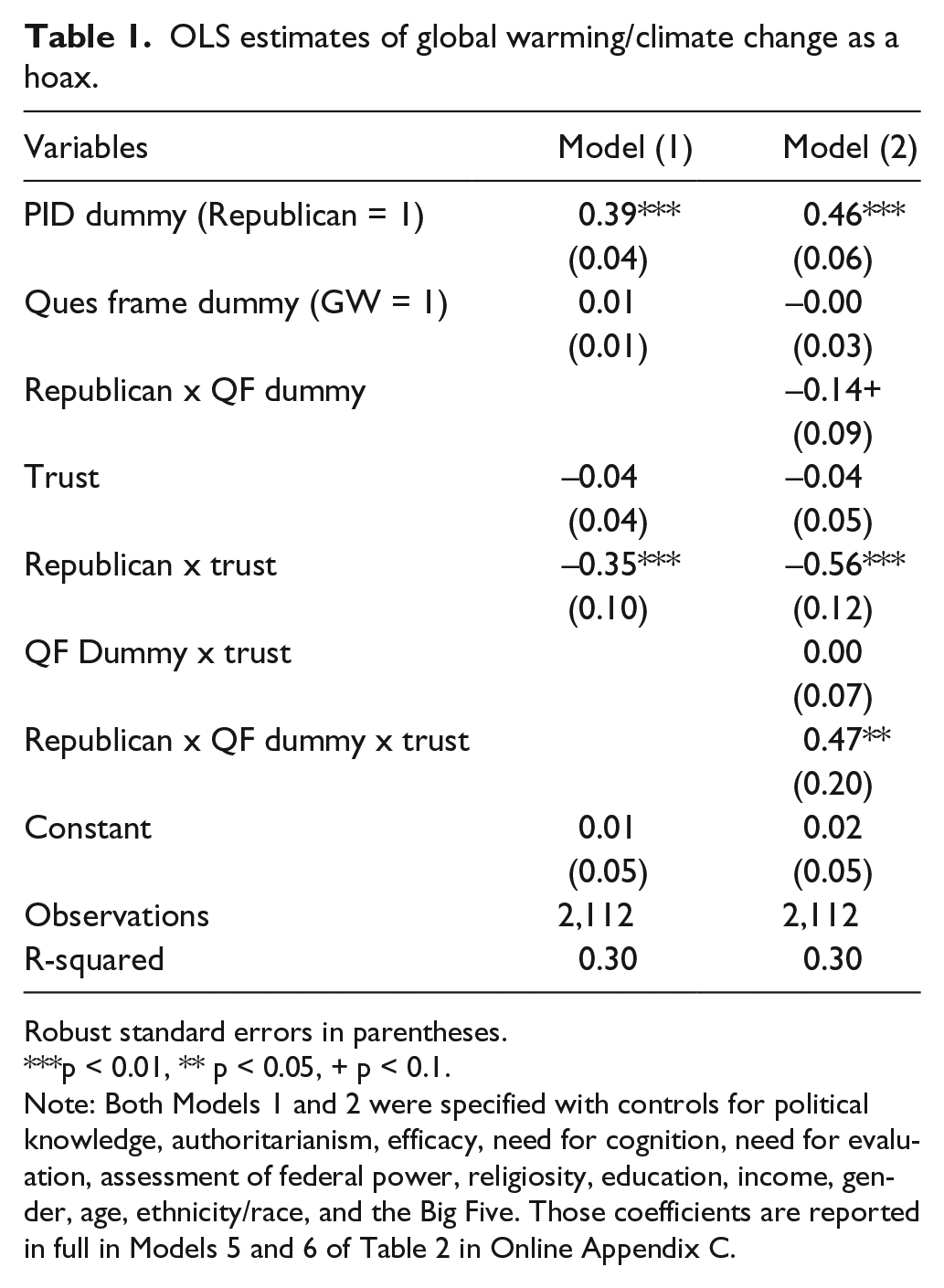
Robust standard errors in parentheses.
p < 0.01, ** p < 0.05, + p < 0.1.
Note: Both Models 1 and 2 were specified with controls for political knowledge, authoritarianism, efficacy, need for cognition, need for evaluation, assessment of federal power, religiosity, education, income, gender, age, ethnicity/race, and the Big Five. Those coefficients are reported in full in Models 5 and 6 of Table 2 in Online Appendix C.

Two-way interaction between party identification and trust.
Model 2 in Table 1 reports the test of H2 (that for Republicans, trust will have a larger negative effect on the belief that CC is a hoax than the belief that GW is a hoax. For Democrats, trust will have either a flat or negative effect on both the CC and GW question frames). The interaction between party identification, trust, and question frame is positive and statistically significant (b = 0.47, se = 0.20). The shape of the interaction confirms H2 (see Figure 2). 12 Among Democrats the trust slopes for GW and CC hoax frame are both negative and not statistically significantly different from one another (b = −0.03, se = 0.06 for the ‘trust x question’ frame interaction among Democrats). Among Republicans, the effect of trust on belief that CC is a hoax is negative and quite large (b = −0.61, se = 0.12); 13 the predicted value on the CC hoax question drops from 0.61 to near 0 when moving across the full range of the trust scale. In contrast, the trust effect on GW hoax beliefs among Republicans is negative, but not statistically significant (b = −0.13, se = 0.14). The two trust slopes are statistically significantly different, one from the another (b = 0.49, se = 0.18 for the ‘trust x question’ frame interaction among Republicans). In the case of CC, which sounds less threatening and less severe than global warming, trust mitigates hoax beliefs. In contrast, in the case of GW, where the implications of belief have much more unpleasant policy consequences, motivated reasoning ‘wins out’, and trust does not mitigate conspiracy endorsement among Republicans. 14

Three-way interaction between party identification, question frame, and trust.
To clarify these differences further, Figure 3 shows the differential (GW minus CC) between the effect of trust between the two frames across partisans. Figure 3 demonstrates a completely flat, insignificant finding for Democrats across the experimental conditions, while showing a decrease of −0.15 (se = 0.08) in endorsement among low trust Republicans when the GW frame is used instead of the CC frame. Among high trust Republicans, an increase of 0.33 (se = 0.11) in endorsement results when the GW frame is used instead of the CC frame.
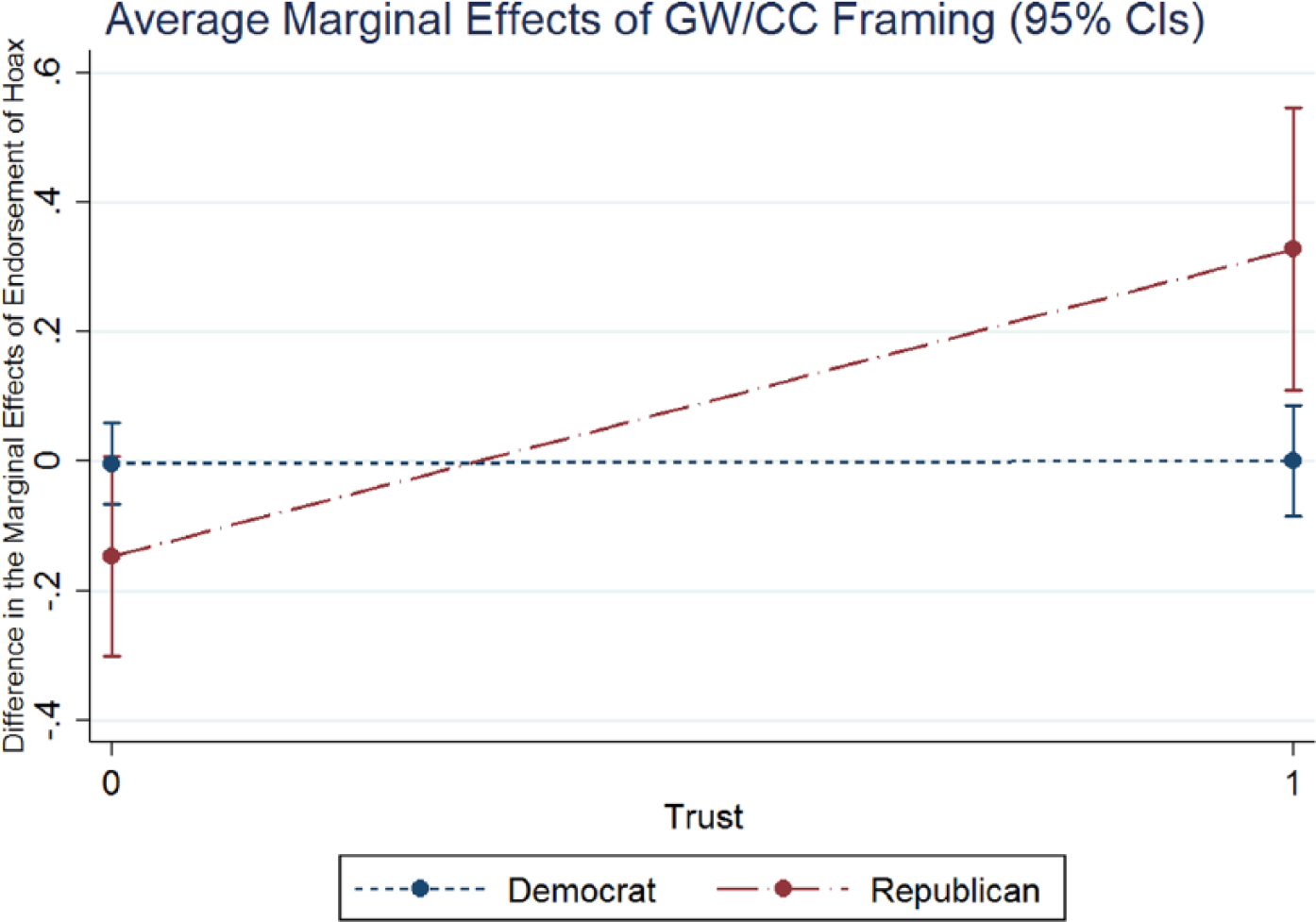
The difference in the marginal effects of the GW/CC treatment across partisans.
Discussion
To summarize, I argue that the strategic framing choices made by Republican elites rely on the motivated reasoning of their partisans to reinforce and perpetuate the belief that AGW is a hoax. Under the conditions that activate motivated reasoning, it is likely that it has become more and more difficult for Republican voters to support policies that (and candidates who) would take steps to address the AGW issue. Moreover, I find that trust moderates AGW hoax beliefs among Republicans, but only under the less identity-threatening CC frame.
With regard to CT beliefs in general, these findings raise an interesting proposition: perhaps identity threat is a key to understanding the conditions under which motivated CT belief are going to be the strongest, and when factors such as trust may mitigate such beliefs. Research on the antecedents of CT beliefs has yet to address systematically the impact of the ways in which CTs vary (e.g., the number of people involved, the time horizon for the conspiracy, whether the theorized conspiracy is with regard to a discrete event or is more wide-ranging) on the strength and persistence of endorsement (but see Grimes, 2016; and Keeley, 1999). The research reported here suggests that the degree to which a CT implicates people’s attitudes and/or identities may affect the motivation to believe the CT in general, and the ways in which variables such as trust moderate such beliefs. With regard to AGW CT beliefs in particular, as discussed more extensively above, these findings reinforce the existing evidence that partisans’ beliefs are strongly affected by elite cues on this issue – the frames that Republican elites use to talk about GW/CC matter.
The findings about trust presented here also offer a potential path to reconciling conflicting findings (e.g., Dunlap, 2014; Schuldt et al., 2011, Schuldt et al., 2015) about whether or not the CC versus GW frame conditions the effect of partisanship (Democrat versus Republican) on belief in the existence of AGW. Whereas Schuldt and colleagues (2011; 2015) found that the partisan gap in existence beliefs is larger for the GW than the CC frame, Dunlap (2014) found no impact of the GW/CC frames. None of those studies took trust into account as a potential moderator of beliefs; perhaps, if they had, their results might have been more consistent across the studies. Future research should explore whether the evidence of trust effects noted here, with regard to belief in conspiracy theories, generalize to questions about the existence of AGW that do not explicitly raise the spectre of conspiracy.
In conclusion, for those looking for ways to persuade those who believe in the extremely cynical scenario that AGW is a hoax to think otherwise, attempts to increase trust combined with strategic use of the climate change frame are likely to be most fruitful. However, given the recent notable declines in trust in our institutions and others (Hetherington and Rudolph, 2015), the prospects for increasing trust appear quite dim. Conversely, for those looking for ways to reinforce beliefs that AGW is a conspiratorial hoax and/or persuade others to follow their cause, the prescription is simpler, if not more harrowing. Hetherington and Rudolph (2015) showed that political distrust in the electorate and between partisan elites had constrained the policy options available to legislators in our polarized political environment. As such, there is no need to attack AGW head on in order to accomplish the goals of subverting pro-AGW policy attitudes in the electorate; undermining trust and facilitating partisan motivated reasoning (through the strategic use of the GW frame) should be sufficient. Furthermore, the tendency for people to seek out information that confirms their predispositions means that they rarely venture outside of their ideological echo chambers (Feldman et al., 2014). Thus, CTs (such as that AGW is a hoax) have a self-reinforcing quality. As such, much of the research on the antecedents and consequences of CT endorsement leads to the unfortunate conclusion that these beliefs are close to intractable and may only be responsive to Republican elite persuasion, and barring that, life experience and the observation of ecological tragedy.
Footnotes
Acknowledgements
I would like to thank editor Catherine DeVries for a helpful editing process, the three anonymous reviewers whose comments helped to improve this work, and my colleagues Christina Farhart, Joanne Miller, Alan Abramowitz and Matthew Hitt for their comments along the way.
Author’s note
A previous version of this paper was presented at the American Political Science Association Conference, Philadelphia, PA, in August 2016.
Declaration of conflicting interest
The author declares that there are no conflicts of interest.
Funding
This research received no specific grant from any funding agency in the public, commercial, or not-for-profit sectors.

Notes
Carnegie Corporation of New York Grant
This publication was made possible (in part) by a grant from Carnegie Corporation of New York. The statements made and views expressed are solely the responsibility of the author.
References
Supplementary Material
Please find the following supplemental material available below.
For Open Access articles published under a Creative Commons License, all supplemental material carries the same license as the article it is associated with.
For non-Open Access articles published, all supplemental material carries a non-exclusive license, and permission requests for re-use of supplemental material or any part of supplemental material shall be sent directly to the copyright owner as specified in the copyright notice associated with the article.
