




Abstract
We develop and test a theoretical account of the effect of management tenure on the strategic behavior of the chief justice of the United States. Substantial evidence from literatures on learning models and public management indicate that tenure (length of service) is positively related to management performance in public organizations. This suggests that the chief justice’s tenure in office should be positively related to efficiency in the use of the chief justice’s formal powers. We assess this hypothesis by replicating and extending Johnson et al.’s study of chief justice Burger’s conference voting behavior. The data support our management tenure hypothesis, showing that Burger used greater discretion in reserving his conference vote over time as he became more adept at discriminating between circumstances when the tactic was strategically valuable and when it was not.
Introduction
It is “standard lore” that Chief Justice Burger took advantage of conference voting procedures on the Supreme Court in order to control opinion assignments “he did not deserve” (Walsh, 2012; see also Schwartz, 1990). Justice Brennan once estimated that Burger attempted to manipulate opinion assignments at least once during every conference by passing or switching his votes after the other justices had cast theirs (Woodward and Armstrong, 1979). Thomas (1979) similarly reports that “a justice once joked that ‘on Burger’s tombstone . . . should be carved the inscription: I think I’ll pass for the moment.’”
Although the tone of historical and journalistic accounts of justice Burger’s behavior in conference voting is generally critical, Burger’s behavior is consistent with strategic models of the chief justice’s behavior. These models emphasize the chief’s prerogative to withhold conference votes in order to control opinion assignments in important cases with results that were unclear ex ante (Johnson et al., 2005). Burger’s “bad” behavior, from this point of view, merely represents a rational trade-off between the costs of upsetting his colleagues and the benefit of obtaining outcomes more in line with his own preferences (Sill et al., 2010). In this respect, Burger’s behavior is entirely consistent with rational models of when and how the chief justice exercises the powers of his office to influence the Court to reach decisions more nearly in line with his personal preferences. These expectations are generally supported by empirical analyses of chief justices’ behavior.
However, these models of the chief justice’s behavior take a narrow view of the people serving in that office, generally assuming that each chief justice engages in a consistent pattern of behavior over the course of his career (Johnson et al., 2005; Sill et al, 2010). This assumption is at odds with the substantial literature on learning models (e.g. Erev and Roth, 1998; Roth et al., 1991) and research demonstrating the important consequences of experience for the quality of managerial performance (e.g. O’Toole and Meier, 1999). Together, these literatures suggest that the chief justice’s job performance should improve over time as a result of the increased task knowledge, better understanding of rules that structure his choices and incentives, and more accurate expectations about other justices’ behavior. We therefore expect that the quality of the chief justice’s job performance is positively related to the length of his time in office.
In the case of chief justice Burger’s strategic behavior in conference voting, both learning models and public administration theory predict changes in patterns of passing over time as a function of his growing experience as chief justice. In particular, as his time on the Court increased, Burger should have applied greater discretion in reserving his conference votes as he became more adept at discriminating between circumstances when the tactic was strategically valuable and when it was not. In other words, Burger should show evidence of increasing efficiency in his conference vote “passes” over the course of his tenure in office.
We assess this expectation by replicating Johnson et al.’s (2005) study of chief justice Burger’s conference voting and extending their analysis to account for his experience in office 1 . The data show clear evidence of management tenure effects. Early in his time as chief justice, Burger was just as likely to pass when it was not strategically sensible to do so as when it was. However, as time went on, Burger became less likely to pass overall and, eventually, all but stopped withholding his votes in conference in cases that were unimportant and likely to be determined in one direction or another.
This result has important implications. First, it provides support for a model of judicial behavior that emphasizes learning and management dynamics, rather than law or justices’ political attitudes. This indicates favorable prospects for future research to apply economic, organizational, and public administration theories to the study of judicial behavior. Second, it suggests an emphasis on research about the chief justice and his role in Supreme Court decision-making. Finally, the results provide a new perspective on Warren Burger’s service as chief justice that cuts against the picture of Burger that emerges from journalistic accounts of his early years in office (e.g. Woodward and Armstrong, 1979).
Strategic behavior in conference voting and opinion assignment
Following oral arguments, Supreme Court justices confer to discuss cases and vote on their outcomes. Case discussions begin with the chief justice and proceed in order of seniority. Justices typically cast a preliminary vote on the merits of each case at the conclusion of their remarks. Thus, the chief justice usually casts the first vote, followed by the senior associate justice, and so on. After the conference vote, a justice is assigned to draft an opinion for the majority. The chief justice makes the opinion assignment when he is in the majority. When the chief is not in the majority, the senior associate justice in the majority assigns the opinion.
The literature suggests that the chief’s opinion assignments are motivated by both administrative and political considerations. On the administrative side, the chief justice’s opinion assignments are influenced by justices’ expertise and by justices’ workloads (Baum, 1997; Brenner, 1984, 1985; Brenner and Palmer. 1988; Maltzman and Wahlbeck, 1996; Maltzman et al., 2000; Spaeth, 1984). On the political side, chief justices use the power to assign opinions to influence the Court’s decisions by choosing themselves or their political allies on the Court to write (Brenner, 1973; Rohde, 1972; Rohde and Spaeth, 1976; Segal and Spaeth, 1993; Slotnick, 1978; Ulmer, 1970).
The opinion assignment process provides strategic justices with opportunities to influence legal policy and create outcomes more consistent with their preferences. The chief justice’s occasional practice of withholding his vote during the initial round of conference voting to preserve his opportunity to join a majority and control the opinion assignment is among these (Johnson et al., 2005; Sill et al., 2010). By passing, the chief can observe other justices’ votes and join a majority coalition with certainty.
If passing in conference were costless, we might expect chief justices to pass frequently. However, “passing in conference [voting] likely imposes nontrivial costs on justices who are perceived [by other justices] to manipulate conference procedures to secure assignment power” (Sill et al., 2010: 169). Thus, strategic chief justices should only pass when the utility of ensuring the right to assign an opinion outweighs its cost in lost reputation. Johnson et al. (2005), for example, find that both chief justice Burger and chief justice Rehnquist were more likely to pass, when the outcome of a case is less certain and when case salience is high.
Experience and strategic behavior in conference voting
A chief who passes too often risks his standing on the Court, and a chief who passes too little forgoes opportunities to maximize his influence over legal policy. Although those who become chief justice are generally savvy political actors, effectively managing the strategic environment within the Court may be enhanced by job experience. This view is supported by extensive literatures on learning models in several social science disciplines as well as by a large body of empirical research on experience in managerial performance by scholars of public management.
Classic learning models predict increases in productivity or reductions in costs as workers or firms acquire greater experience with a production process (Wright, 1936). Yet, learning effects are not limited to improved performance in repetitive tasks. Players in repeated strategic interactions can improve their performance over time by developing a better understanding of rules that structure their choices and incentives and about the behavior of other players (e.g. Erev and Roth, 1998; Fudenberg and Kreps, 1993; Gale et al., 1995; Roth et al., 1991; Roth and Erev, 1995; Skyrms, 2004). Political scientists have demonstrated learning effects in a variety of contexts, including: policy development and diffusion (Bennett and Howlett, 1992; Gilardi, 2010; Volden et al., 1998); foreign policy making (Levy, 1994); and government decisions for privatization (Meseguer, 2004). Scholars of public management have also shown that experience on the job brings positive effects for managerial performance in public organizations (e.g. Gonzalez, 2005; Meier and O’Toole, 2001).
There is also some evidence of a nexus between experience and job performance among Supreme Court justices. Learning dynamics on the Supreme Court are most evident in “freshman effects” in the behavior of Supreme Court justices. These indicate that jurists’ behavior early in their tenure is systematically different from later behavior (Brenner and Hagle, 1996; Hagle, 1993; Howard, 1968).
Taken together, the literature on learning models and their application to the study of those in leadership roles in public organizations and among Supreme Court justices strongly indicates that experience in office should increase the quality of the chief justice’s performance in office. Improving managerial quality should be evident in a variety of ways, including the extent to which the chief justice efficiently makes use of his institutional prerogatives to control the Court’s decision-making processes.
Johnson et al.’s (2005) analysis of strategic passing is useful for identifying management dynamics consistent with improved administration due to experience. If experience is related to improved management quality, then there should be a relationship between a chief justice’s conference voting behavior – particularly his decisions to pass or to cast his vote in the normal order – and the length of his tenure in office. As a chief justice’s tenure increases, he should become increasingly familiar with the actual costs and benefits of passing and more adept at forecasting the votes of his colleagues. Together, these learning processes should decrease the chief’s propensity to pass in circumstances that are not strategically advantageous as his time in office grows.
Assessment
We test this hypothesis by replicating and extending Johnson et al.’s (2005) model of passing in conference to account for the role of management experience in chief justice Burger’s strategic passing in conference voting. Johnson et al. (2005) analyzed data derived from the papers of justice Lewis Powell on justices’ conference votes in 1,043 Supreme Court cases decided during the 1971 through 1985 terms, chief justice Burger’s third year in office through his seventeenth and penultimate year on the high Court. Powell’s papers are useful for analyzing strategic dynamics in conference voting since he recorded both justices’ initial votes (or nonvotes) during conference discussion and their final conference votes (see also Maltzman et al., 2000). Of the 8,242 individual conference votes recorded by Powell while Burger served as chief justice that are included in Johnson et al.’s (2005) analysis of voting behavior on the Burger Court, the justices passed 246 times. Almost half of these, 122, were due to chief justice Burger. The dependent variable in the analysis is a dichotomous indicator of whether a justice “passed,” that is, declined to cast a firm vote in the initial conference discussion for each case in which he or she participated.
To assess their theory of strategic passing, Johnson et al. (2005) identify several independent variables which account for the political and legal context in which each case was decided and which are associated with the utility of passing in a given case: the ideological distance between a justice and the median member of the Court (and distance squared); justices’ uncertainty about the preferences of the other members of the Court; justices’ uncertainty about the outcome of a case; and the salience of each case. Justices’ ideologies were measured as “the percentage of time that each justice had voted in a liberal direction in the Spaeth value area of a case in terms prior to the one in which the case was decided” (Johnson et al., 2005: 361; Spaeth, 2001; see also Spaeth et al., 2015). The ideological distance between a justice and the median is the absolute difference between each justice’s measured ideology and the measured ideology of median justice. Justices’ uncertainty about one another’s preferences is measured by the mean number of cases in which other justices had participated in the same issue area. Outcome uncertainty is indicated by a dummy variable indicating when a case has been granted certiorari by a minimum winning coalition – that is, with the votes of only four justices. Case salience is indicated by the rate of amici participation standardized against the average rate of amici participation for cases in the same term (see also Gibson, 1997). Johnson et al. (2005) also identify a pair of nonstrategic variables: being a freshman justice (a dummy variable coded one for justices in their first two terms of service); and the legal complexity in a case (a factor score derived from the common variance of the number of legal issues raised in a case, the number of legal provisions at issue, and the number of opinions written by justices).
To identify strategic factors associated with differences in the chief justice’s propensity to pass in a conference vote, Johnson et al. (2005) estimated a model of justices’ withholding their votes as a function of the strategic predictors indicated above, those strategic factors interacted with a categorical variable indicating votes cast by associate justices, and the nonstrategic controls. Using the authors’ publicly available data file, we replicated their results. 2 Table 1 reports the results of this replication. Again, the results indicate that the chief justice is significantly more likely to pass in strategically advantageous situations: when he is uncertain that he will (or will not be) in the majority coalition if he votes sincerely; when the outcome of a case is uncertain; or when a case is highly salient.
Logistic regression replication of Johnson et al.’s (2005) model of passing in conference votes on the U.S. Supreme Court, 1971–1985 terms.
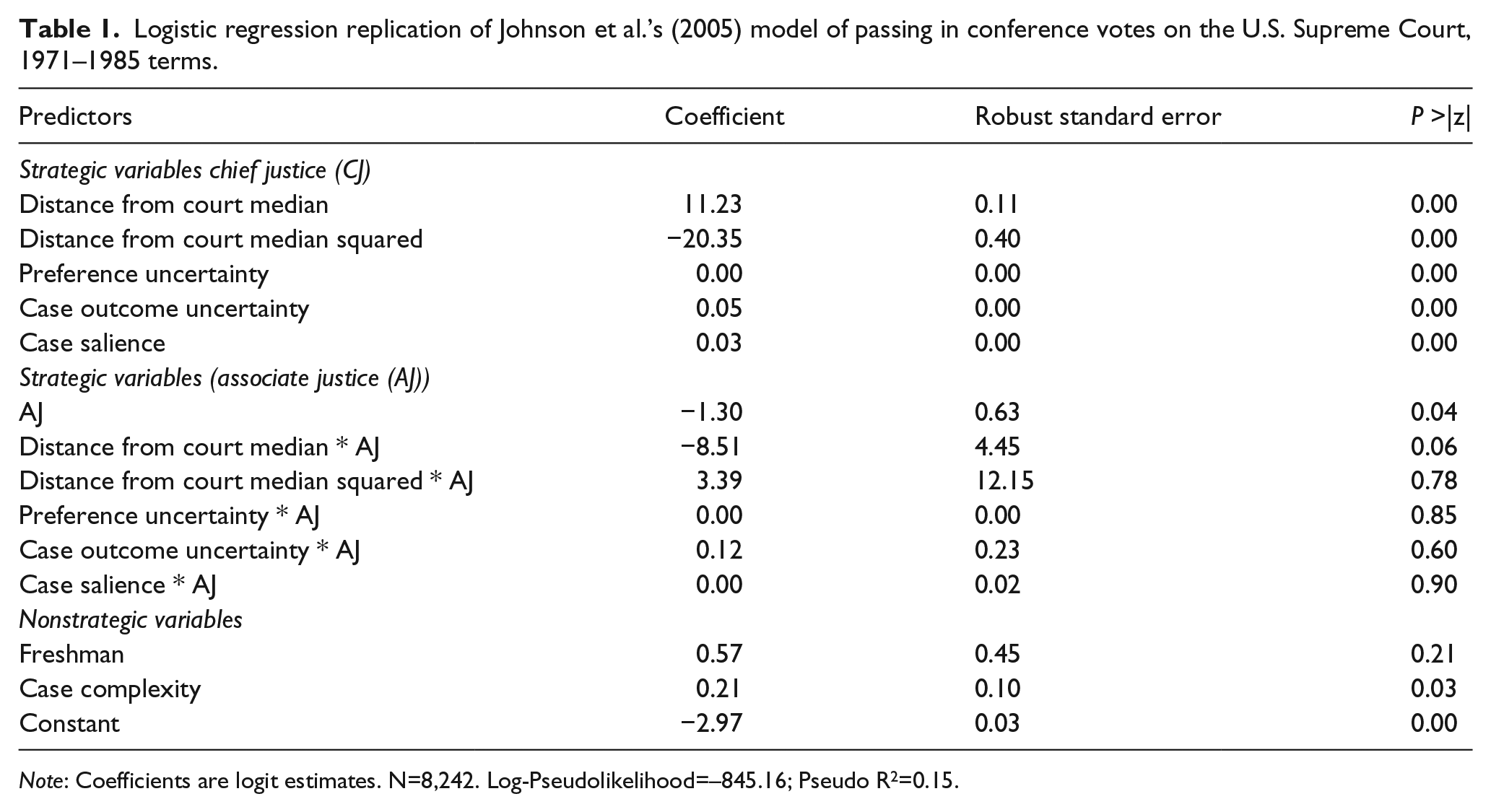
Note: Coefficients are logit estimates. N=8,242. Log-Pseudolikelihood=−845.16; Pseudo R2=0.15.
To assess whether experience in office may have had an effect on chief justice Burger’s decisions to pass in conference, we extend Johnson et al.’s (2005) model by including a count of the number of terms that chief justice Burger had previously served and interacted this indicator with the strategic variables. Results of this extended model are reported in Table 2.
Management tenure model of passing in conference votes on the U.S. Supreme Court, 1971–1985 terms.

Note: Coefficients are logit estimates. N=8242. Log-Pseudolikelihood=−833.93; Pseudo R2=0.16.
Results
Comparing the results of the original model with the extended model indicates a striking difference in the effects associated with the chief justice’s ideological position relative to the median justice on the Court. The baseline, strategic-ideology model shows a quadratic relationship between the chief’s ideological divergence from the median justice and his propensity to pass. The coefficient for ideological distance is positive and significantly different than zero; the coefficient for ideological distance squared is negative and significant. These indicate that as the chief becomes more ideologically distant from the Court’s median member, he becomes, first, increasingly likely to pass, and then increasingly unlikely to pass as that ideological distance becomes more extreme. This is consistent with the expectation that the chief justice is more likely to pass when he is less certain about his prospects for voting with a conference majority should he cast a sincere vote. Likewise, the chief is more likely to pass when he is less certain about his colleagues’ preferences, when the outcome of a case is uncertain, or when the case is more salient.
The picture of the chief justice’s strategic behavior is quite different in the management tenure model. These estimates indicate that the chief’s propensity to pass as well as the net effect of the chief’s ideological divergence from the median justice and his reaction to the uncertainty surrounding the outcome of cases, depend on the length of time he has served office. The directions of the estimated effects of ideological distance between the chief justice and the Court’s median and the square of this predictor in the management model are significant in the opposite directions compared to the strategic model. Importantly, though, the interactions between the ideological distance term and its square with the duration of the chief’s tenure in office are both significantly different from zero and have opposite signs of the uninteracted effects of ideological distance and its square. This combination of estimated effects indicates that the management model identifies strategic behavior by the chief justice that is conditional on the length of his service in office. We generate predicted probabilities of the chief justice passing in a conference vote over time for a covariate profile that closely resembles our management-based hypothesis: as a chief justice’s time in office increases, his propensity to pass in circumstances that are not strategically advantageous should decrease.
The predicted probabilities shown in Figure 1 are based on covariate profiles corresponding to a situation in which there should be little strategic value and another with greater strategic value in a chief justice passing. The “less strategic” profile represents a situation in which the chief justice is ideologically aligned with the median member of the Court, relatively certain about the preferences of other justices, and considering a less salient case. To compute this predicted probability, we set the ideological distance between the chief justice and the Court’s median to zero, preference uncertainty to one standard deviation above its mean, and case salience to one standard deviation below its mean. Conversely, the “more strategic” profile represents a situation in which the chief justice is somewhat distant from the Court’s median, relatively uncertain about the preferences of other justices, and considering a more salient case. To compute this predicted probability, we set the ideological distance between the chief justice and the Court’s median to its mean, preference uncertainty to one standard deviation below its mean and case salience to one standard deviation above its mean.

Predicted probability of chief justice Burger passing in conference votes.
We generated predicted probabilities for each of these covariate profiles for both Johnson et al.’s (2005) baseline, tenure-invariant model of strategic passing (left panel) and our management tenure model (right panel). Estimates for the “less strategic” profile are shown in black; estimates for the “more strategic” profile are shown in gray.
The baseline model of passing predicts that chief justice Burger would pass about 3.5% of the time when doing so is less strategically useful and about 17.7% of the time when it is more strategically useful. Substantively, these predictions indicate that chief justice Burger’s behavior varied as a function of the strategic context in which each case was situated and reflected sensible responses to different situations in which withholding his vote in conference might be more or less strategically useful. Predictions derived from our management tenure model also emphasize Burger’s strategic responses to changes in case context. However, our model estimates also show that his behavior varies substantially over time. In Burger’s third year in office (the first year for which the Powell data are available), our model predicts that Burger would pass about 25.8% of the time in cases matching the “less strategic” covariate profile and 15.9% of the time in the “more strategic” profile. These two estimates are not statistically distinguishable from one another. They indicate that chief justice Burger passed promiscuously early in his tenure; that is, Burger failed to cast a firm vote in about one in five cases regardless of whether the case’s context indicates greater or lesser strategic advantage in passing.
As chief justice Burger’s tenure in office extended, he became less likely to pass overall and more discriminating in withholding his vote. For Burger’s eighth year as chief justice, the management tenure model predicts that he would pass 9.9% of the time in “less strategic” circumstances. This figure declines to 3.5% in his thirteenth year in office and to 1.2% for Burger’s eighteenth and final year in office. In contrast, the management tenure model indicates that Burger’s propensity to pass when it was “more strategic” to do so remained relatively constant over time. The model predicts that Burger would pass 15.4% of the time in cases matching the “more strategic” covariate profile in his third year in office. This figure declines (insignificantly) to 11.3% by Burger’s final year in office. In essence, the management-tenure model shows that Burger had virtually stopped passing when it was not useful by the end of his tenure in office while continuing to pass at similar rates when it was strategically useful to do so.
Conclusions
In this study, we have drawn on the extensive literature on learning models and related research from public management to consider a new theoretical approach to understanding the role of the chief justice in Supreme Court decision-making. In particular, we hypothesized that as a chief justice’s time in office increases, his propensity to pass in circumstances that are not strategically advantageous should decrease. To assess this hypothesis, we replicated and extended Johnson et al.’s (2005) study of the chief justice’s passing in conference voting. We found that chief justice Burger’s propensity to pass in situations that were not strategically useful was related to the length of his tenure in office. As the length of chief justice Burger’s service increased, his use of his prerogative to pass in conference voting became more efficient. These results illustrate dynamics indicative of managment tenure effects in the unilateral choices made by the chief justice. The results provide support for our theoretical claims and demonstrate learning effects common in other public management settings on the Supreme Court of the United States.
This result provides an important perspective on the unique role of the chief justice in shaping outcomes on the Supreme Court and protecting the Court’s legitimacy (Fettig and Benesh, in press; Ura and Flink, 2016). Historians and journalists have often argued that the chief justices have played pivotal roles in the Supreme Court’s history including: John Marshall leading the Court in affirming the power of judicial review in Marbury v. Madison (1803; Knight and Epstein, 1996); Charles Evans Hughes prevailing upon Owen Roberts to abandon his opposition to the New Deal (Leuchtenberg, 2005); and Earl Warren crafting a unanimous opinion in Brown v. Board of Education (Klarman, 2007; Kluger, 2004). More recently, contemporary Supreme Court observers have praised John Roberts’s seemingly successful efforts to achieve greater consensus in Supreme Court decisions (Katyal, 2014). The findings we report here indicate that the chief justice’s ability to use his institutional prerogatives to achieve desired ends, whether that is shaping the content of decisions or securing the legitimacy and integrity of the Court as an institution, improves with time. Similarly, the Court may be most vulnerable to internal mismanagement or external threats early in a chief’s tenure.
Our results also provide some additional context for understanding Warren Burger’s legacy. Burger’s behavior as chief justice earned him a poor reputation among his colleagues “who found him to be pompous and petty” (Savage, 1995). His behavior was so egregious that it prompted several of his colleagues to violate another valued custom and complain about the chief to journalists and historians (Schwartz, 1990; Thomas, 1979; Woodward and Armstrong, 1979).
Narratives of Burger’s bad behavior contain a ring of truth. Yet, he evolved over time into a more strategic and sophisticated chief justice than when he first took office. In particular, Burger became more strategic in his use of passing in conference votes over the course of his service as chief justice. Our analysis suggests that Burger’s poor reputation is unduly influenced by his more capricious approach to conference voting in his early years on the Court and unrepresentative of his more reserved behavior in his later years of service.
Footnotes
Declaration of Conflicting Interests
The author(s) declared no potential conflicts of interest with respect to the research, authorship, and/or publication of this article.
Funding
The author(s) received no financial support for the research, authorship, and/or publication of this article.

Notes
Carnegie Corporation of New York Grant
The open access article processing charge (APC) for this article was waived due to a grant awarded to Research & Politics from Carnegie Corporation of New York under its ‘Bridging the Gap’ initiative.