




Abstract
Although many studies analyse government formation and termination, there is only scant attention to the duration of government formation processes. The few existing studies focus on the empirical evidence of parliamentary democracies in Western Europe until 1998. We present a new data set on 297 government formation processes in 27 European countries that allows us to test models explaining delays in the government formation process developed in Western Europe using new data from Central and Eastern Europe (CEE). Our results suggest that these models perform much better in the Western European heartland of coalition studies than in the context of CEE. We highlight the implications of these findings and discuss potential avenues for future research.
Keywords
In some instances, government formation is rather swift and short; in others it is characterized by lengthy negotiations and inconclusive formation attempts (De Winter and Dumont, 2008). Excessive delays in the bargaining process may weaken democratic accountability (Conrad and Golder, 2010; Martin and Vanberg, 2003) when caretaker cabinets lacking a popular mandate and having only limited policy-making capacities are in power for a long time. The government formation stage also has implications for other aspects of coalition politics (De Winter and Dumont, 2008; Martin and Vanberg, 2003), in particular for government duration (e.g. Grofman and van Roozendaal, 1994). Delays in government formation may also affect the economy by increasing investor uncertainties in foreign exchange markets (Bernhard and Leblang, 2002) and investment risks in stock markets (Bechtel, 2009).
Although many studies analyse government formation (e.g. Bäck and Dumont, 2008; Martin and Stevenson, 2001) and termination (e.g. Saalfeld, 2008), there is little research identifying the causes of long bargaining cycles. The few existing studies (Diermeier and van Roozendaal, 1998; Golder, 2010; Martin and Vanberg, 2003) focus on parliamentary democracies in Western Europe. However, as noted by Laver and Schofield (1998), a potential challenge of coalition research is to develop and test theories based on the same universe of observations. This entails an inductive element in theory-building based on data ‘which has by now been very thoroughly picked over’ (Laver and Schofield, 1998: 8).
This article uses new data from Central and Eastern Europe (CEE) to test theories explaining delays in government formation developed in Western Europe. Overall, these new data provide only limited evidence for existing approaches to explain the length of government formation processes. In particular, we find that uncertainty in the bargaining process leads to longer formation processes (Diermeier and van Roozendaal, 1998), although this effect is weaker in CEE. In contrast, we find no coherent evidence that the complexity of the bargaining situation affects the duration of government formation processes (Martin and Vanberg, 2003). Finally, bargaining uncertainty conditions the impact of complexity in the bargaining context (and vice versa) in Western Europe (Golder, 2010), while there are no such conditional effects in CEE. The implications of these findings and potential avenues for future research are discussed in the final section.
The role of uncertainty and complexity in government formation processes
From the perspective of bargaining models with incomplete information, the duration of government formation is primarily determined by the degree of uncertainty about key parameters (Diermeier and van Roozendaal, 1998). Political actors may face uncertainty about their competitors’ policy preferences, outside options, and objectives (De Winter and Dumont, 2008; Strøm, 1994). In bargaining situations where parties know little about their mutual policy preferences and office payoffs, government formation is likely to be characterized by considerable delays. Government formation in these contexts features a series of proposals and counter proposals where the negotiating parties accumulate information about their partners’ preferences and what kind of compromise is acceptable for them. The delay may also serve as a costly signal to the bargaining parties (and their rank-and-file) that other, more advantageous offers have not been acceptable for all bargaining partners. In contrast, a bargaining situation in which parties have reliable information concerning their mutual preferences and payoffs is likely to be characterized by a swift and short government formation process.
A competing theoretical perspective emphasizes the influence of the complexity of the bargaining environment on the length of inter-party negotiations (Martin and Vanberg, 2003). A complex situation would be coalition talks including numerous parties with highly heterogeneous policy profiles. Due to the ideological incompatibility, agreeing on a joint policy platform is likely to be time-consuming, resulting in a long government formation period. At the same time, the larger the number of parties, the more difficult it becomes to reach agreement on policy and the allocation of ministerial portfolios. In contrast, fewer parties – with similar policy positions – constitute a simpler bargaining situation, where negotiations should conclude swiftly and without considerable delays.
Golder (2010) combines both approaches, arguing that the effect of bargaining complexity is conditional on the level of uncertainty: while uncertainty always leads to longer government formation processes, the complexity of the bargaining situation increases the time required for government formation only in situations where the political parties involved are uncertain about their counterparts’ preferences. Specifically, assembling the required information on all potential coalition partners’ policy and office preferences will take considerably longer when more parties are involved in coalition bargaining. The effect of complexity is therefore determined by the level of uncertainty, and vice versa. This implies that the marginal effect of bargaining uncertainty depends on the level of complexity (Berry et al., 2012). While a higher level of uncertainty should always increase the duration of government formation (Golder, 2010), this effect is strongest in complex bargaining situations. These theoretical insights may be summarized as follows.
Data and methods
We use a new data set on 297 government formation processes in 27 European democracies to test these hypotheses. Specifically, we study 158 formation processes in Bulgaria, the Czech Republic, Estonia, Hungary, Latvia, Lithuania, Poland, Romania, Slovakia, and Slovenia, starting with the first fully democratically elected government. 1
Based on the ERD data set (Andersson et al., 2014) we also collect analogous data for 139 government formation processes in 17 Western European countries for the period 1990–2014. This allows us to compare the empirical results for the Western European heartland of coalition studies with new data from Central and Eastern Europe.
The operationalization of the key dependent variable closely follows that of the existing literature on bargaining duration (Diermeier and van Roozendaal, 1998; Golder, 2010). Bargaining duration is thus defined as the time period between the end of the previous and the start of the current government. For post-election governments the start of the bargaining period coincides with the date of the parliamentary election. 2 For inter-election governments the termination of the previous government – and thus the beginning of the bargaining period – is determined by any change in the government’s party composition or a change of the prime minister (Müller and Strøm, 2000: 12). Moreover, the minimum length of inter-party bargaining in situations where a new government is triggered by one or more parties leaving or joining a government is set to one day.
The empirical analyses feature an indicator variable for post-election status capturing the effect of bargaining uncertainty. Following Golder (2010), the level of bargaining complexity of each bargaining process is captured using two variables: the number of effective parliamentary parties and the ideological polarization in the legislature. 3 The former is estimated using the standard formula and seat shares as legislative weights (Laakso and Taagepera, 1979). The latter is calculated as suggested by Dalton (2008). In this context, data on the ideological positions of political parties are retrieved using the MARPOR general left–right scale (Volkens et al., 2015). 4 Finally, all empirical models feature two control variables. The first is an indicator variable for bargaining situations following early parliamentary elections, as these may be partly endogenous to the following government formation process. The second control variable is used to control for ‘majority situations’ in which a single party controls a majority of the seats in the legislature (see Golder, 2010; Martin and Vanberg, 2003) and potentially no ‘real’ inter-party bargaining occurs. 5
Given the nature of our dependent variable, the effect of all independent variables is estimated via Cox proportional-hazard models with bargaining-time as a dependent variable. Because all inter-party negotiations are eventually brought to an end and no ongoing bargaining processes are included in our sample, all observations ‘fail’ and thus no complex regime for right-censored observations needs to be devised. 6 Finally, the interpretation of proportional hazard rates – the standard coefficients in survival analysis – in the context of bargaining duration is somewhat counterintuitive. Here, negative coefficients reduce the risk that negotiations are brought to an end at any point in time, given that they are still ongoing at that time. Thus, negative coefficients denote factors that extend the bargaining duration, while positive coefficients indicate elements reducing the length of inter-party bargaining.
Empirical analysis
Figure 1 shows the distribution of our dependent variable, bargaining duration, across and within countries. On average, government formation in the Netherlands (90 days) and Austria (75 days) takes substantially longer than in Denmark (4 days), Greece (3 days), and France (2 days). There is also considerable variation within countries, with the top 5% of the bargaining processes lasting for 95 days or more. The average bargaining duration of countries in Central and Eastern Europe falls within these extremes: the average formation duration in the Czech Republic (39 days) is similar to that of Belgium (43 days), Spain (42 days), and Luxembourg (37 days). With an average of 19 days, the duration of government formation was rather short in Romania and Slovakia; this is about the same time it takes to form governments in Ireland (20 days) and Finland (18 days). The dashed lines in Figure 1 show the average length of formation processes in Western Europe and in Central and Eastern Europe. In general, bargaining duration in CEE (29 days) is similar to the average length of government formation processes in Western Europe (28 days).

Bargaining duration across and within European countries.
Figure 2 shows the relationships between uncertainty, complexity, and bargaining duration. The left panel shows the average bargaining duration for inter-election (grey bars) and post-election bargaining situations (black bars). Coalition talks after parliamentary elections in Western Europe (40 days) take on average eight times longer than negotiations in an inter-election context (five days). In Central and Eastern Europe, this difference between post-election and inter-election bargaining is substantially smaller. Here, coalition talks after elections take roughly twice as long as negotiations between elections (43 vs. 18 days). While these patterns support the claim that uncertainty affects the duration of government formation processes (Hypothesis 1), the effect is weaker in the data collected for Central and Eastern Europe.

Average bargaining duration for low and high levels of uncertainty and complexity.
The right panel in Figure 2 distinguishes low complexity (effective number of parties below mean; grey bars) from high complexity bargaining situations (effective number of parties at or above mean; black bars). There is some evidence to support the claim that government formation takes longer in complex bargaining situations (Hypothesis 2). Yet, this effect is only visible in Western Europe (22 vs. 38 days), but not in Central and Eastern Europe. Here, complexity seems to have no positive effect on delays in the government formation process (31 vs. 27 days).
Figure 3 explores the conditional effects of uncertainty and complexity on the duration of government formation processes. Again, there is mixed empirical evidence for the conditional effects (Hypotheses 3 and 4). The patterns in Western Europe corresponded to findings from earlier studies (Golder 2010): uncertainty (i.e., post-election status) increases the time it takes to form a government, but this effect is strongest in complex bargaining situations (Hypothesis 3). Vice versa, increasing complexity has little or no effect in inter-election periods (grey bars) when uncertainty is low. It is only in post-election bargaining situations (black bars) that increasing complexity leads to longer bargaining duration (Hypothesis 4). However, in the newly collected data for Central and Eastern Europe there is no consistent evidence for the conditional effect of uncertainty and complexity. Uncertainty increases bargaining duration, but this effect is similar in bargaining situations of low (21 vs. 40 days) and high complexity (16 vs. 46 days). Furthermore, complexity has almost no effect on bargaining duration. Even in high uncertainty contexts (black bars), the difference in the average bargaining duration for less (40 days) and more complex bargaining situations (46 days) is small in absolute terms and much smaller than the difference in Western Europe.
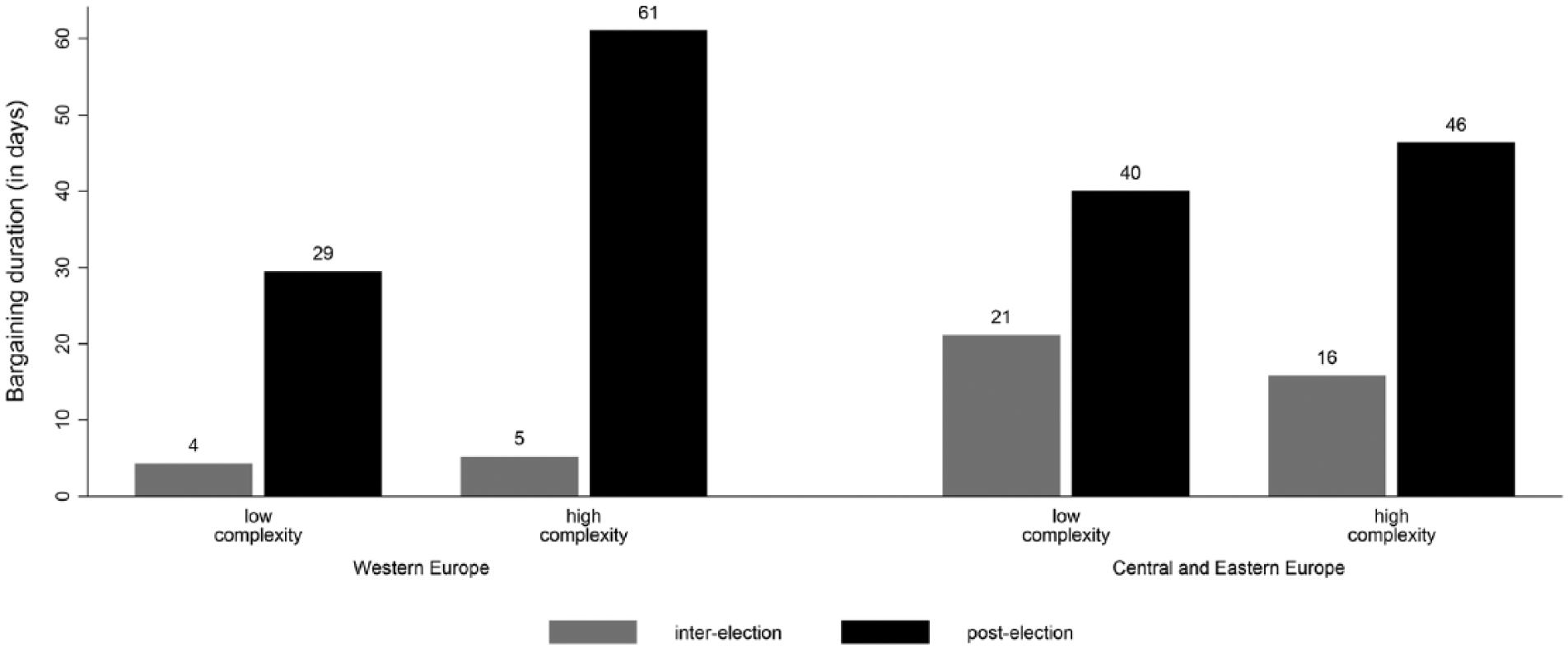
Conditional effects of uncertainty and complexity on average bargaining duration.
The same empirical patterns emerge from a multivariate analysis. Table 1 shows the results of a series of Cox proportional-hazard models using delays in government formation as the dependent variable. Models 1 and 3 include measures of uncertainty and complexity, thus testing Hypothesis 1 and 2 in the context of Western Europe and of CEE separately. Models 2 and 4 then allow the effect of complexity to vary with the observed level of bargaining uncertainty, thus testing Hypotheses 3 and 4 again separately in Western Europe and in CEE. Both a global Grambsch and Therneau (1994) test and a visual inspection of the Schoenfeld residuals indicate that some models violate the proportional hazard assumption. The corresponding p-values of the global tests are displayed at the bottom of Table 1. We test each covariate separately to identify the offending covariate and account for their time-varying effect by including interactions with the natural logarithm of analysis-time. All empirical results are robust to these alternative model specifications. 7
Determinants of bargaining duration.

Note: Cox proportional-hazard models with bargaining duration as dependent variable for Western Europe (WE) and Central and Eastern Europe (CEE). Ties handled via Breslow method. Cell entries report proportional hazard rates; positive coefficients expedite formation, negative coefficients delay formation. t statistics in parentheses. *p < 0.05, **p < 0.01, ***p < 0.001.
Corroborating Hypothesis 1, the empirical results of Models 1 and 3 indicate that post-election status significantly and substantially delays the conclusion of coalition bargaining both in Western Europe and in CEE. Yet, the effect is weaker in the latter sample. The substantial effect of post-election status is estimated via exponentiated coefficients (hazard ratios). In post-election contexts the risk of government formation is approximately 81% lower in Western Europe when compared with negotiations between elections, while the effect is only 59% in CEE. However, Models 1 and 3 provide no coherent empirical evidence on the effect of complexity on delays in government formation (Hypothesis 2). In line with previous research and the bivariate analysis in Figure 2 we find a significant negative effect of the effective number of parties in Western Europe. This effect is not robust to alternative model specifications (see Endnotes 3 and 6), however. Furthermore, the coefficient for party system polarization is close to zero and does not reach conventional levels of statistical significance. This holds for government formation processes in Western Europe (Model 1) and in Central and Eastern Europe (Model 3) alike.
Equally, Models 2 and 4 provide support for the conditional effects of complexity and uncertainty only in Western Europe, but not in CEE (Hypotheses 3 and 4). Moreover, this moderating effect is only significant for the effective number of parties, while we find no such effect for party system polarization. Figures 4 and 5 visualize the corresponding marginal effects. Figure 4 shows the marginal effect of uncertainty (post-election status) for different levels of complexity (Hypothesis 3). The results using data from Western Europe (left panel) show that uncertainty reduces the risk to end the government formation process, but this effect is strongest in complex bargaining situations. In contrast, the data from Central and Eastern Europe (right panel) provide no support for a conditional effect: uncertainty reduce the risk of terminating the government formation process, but this effect is independent of the level of complexity.

Marginal effect of uncertainty conditional on complexity (Hypothesis 3).

Marginal effect of complexity conditional on uncertainty (Hypothesis 4).
The left panel in Figure 5 shows the marginal effect of the effective number of parties on bargaining duration contingent on post-election status for government formation processes in Western Europe (Hypothesis 4). 8 In low uncertainty contexts (i.e., between elections) bargaining complexity does not significantly affect the relative risk of concluding coalition talks. In contrast, in high uncertainty settings (i.e., after legislative elections) each additional (effective) parliamentary party is associated with a 22% decrease in the hazard of finalizing coalition negotiations in Western Europe. There is no such moderating effect of bargaining uncertainty for formation processes in CEE (right panel in Figure 5). As indicated in the above bivariate analysis, the data thus supported Hypothesis 4 only in Western European, but not in Central and Eastern European democracies.
Discussion and conclusions
This article explores government formation processes in Western and in Central and Eastern Europe. Using a new data set we show that bargaining delays in Central and Eastern Europe are on average as long as those in Western Europe. Thus, in contrast to other phenomena such as government duration (e.g. Somer-Topcu and Williams, 2008), party systems in Western and Central and Eastern Europe are somewhat similar with respect to the duration of government formation processes.
Another important finding from this analysis is that existing theoretical approaches explaining delays in government formation cannot fully account for the empirical patterns observed in CEE. The perhaps most important causal factor to explain the duration of formation processes – whether the formation process takes place in the aftermath of parliamentary elections – seems to play a less decisive role in CEE. Moreover, the complexity of the bargaining situation has no direct or conditional effect on bargaining delays.
What are the implications of these findings for future research on government formation processes? There are at least two ways to respond to this question: one could challenge the underlying theoretical model or its empirical implementation. According to the former argument, uncertainty and complexity of the bargaining situation are insufficient to account for the variation in the duration of government formation processes. Even the finding that government formation takes longer in post-election contexts (Hypothesis 1) is vulnerable to alternative explanations. For example, Laver and Benoit (2015) note that the measure is somewhat endogenous because legislators bringing down a government between elections may do so having a preferred alternative already in mind.
Another line of reasoning would attribute non-findings to the empirical implementation of the theoretical models. For example, we find no evidence that ideological polarization affects the duration of government formation processes. While this non-finding is in line with the work of Diermeier and van Roozendaal (1998), it contrasts with previous research identifying a link between ideological dispersion and bargaining duration (Golder, 2010; Martin and Vanberg, 2003). We can only speculate about the reasons for these differences. They may be due to case selection or different measurement approaches. For instance, there are several polarization indices, and inferences on ideological polarization are often sensitive to the chosen polarization index (Best and Dow, 2015). Moreover, some scholars rely on party manifestos to measure party policy positions, while others use expert judgments.
More generally, both uncertainty and complexity are somewhat complex concepts that are captured using rather crude proxy measures. For example, the post-election dichotomy is a proxy measure suggesting that the bargaining structure in inter-election periods is relatively stable. However, in contexts of high turnover of the elite (Gherghina, 2015; Semenova et al., 2014) and greater party system instability and frequent party switching (Kreuzer and Pettai, 2003; Lewis, 2000; Mair, 1997; Spirova, 2007), this assumption is actually not met (see also Curini and Pinto, 2014). Similarly, the existence of communist successor parties (Druckman and Roberts, 2007) and the relatively high number of pre-electoral coalitions (Chiru, 2015; Ibenskas, 2015) render standard measures of complexity rather inefficient.
More elaborated indicators for uncertainty and complexity would also differ across coalition alternatives. While current indicators vary across government formation processes, we can shift perspectives to analyse individual bargaining attempts that include a particular set of parties (Diermeier and van Roozendaal, 1998). Factors such as ideological conflict, the number of bargaining parties, and elite turnover are captured more adequately at this lower level of analysis. For instance, parliamentary elections may result in substantial turnover of the elite at the level of the party-system, indicating high levels of bargaining uncertainty. At the same time, however, the parties actually involved in coalition bargaining may be those which did not experience any change in party leadership (because they are less likely to have incurred substantial electoral losses). We believe that this shift in perspectives is a promising avenue for future research on government formation processes.
Footnotes
Acknowledgements
This work is based on two research projects: ‘Governments in Europe’ (PI: Torbjörn Bergman) and ‘Coalition governance in Central Eastern Europe’ (PI: Wolfgang C. Müller). Previous versions have been presented at the 2015 Midwest Political Science Association (MPSA) Conference, Chicago, the 2015 European Political Science Association (EPSA) conference, Vienna, and the departmental research seminar at the Department of Government, University of Vienna. We thank all participants, and particularly Petra Schleiter and Jochen Müller, for helpful comments and suggestions.
Declaration of conflicting interest
The author(s) declared no potential conflicts of interest with respect to the research, authorship, and/or publication of this article.
Funding
The author(s) disclosed receipt of the following financial support for the research, authorship, and/or publication of this article: Both authors gratefully acknowledge financial support received from the Austrian Science Fund (FWF) (grant number P25490).
