




Abstract
Several influential scholars have argued that increases in education improve levels of democracy. However, relevant challenges to this view have also figured prominently. In this article we tackle this controversy. We examine the link between education and democracy using an expanded dataset on educational attainment that covers most of the postwar era. We find that increases in levels of education improve levels of democracy and that the democratizing effect of education is more intense in poor countries.
Education has predictable effects on individuals’ income and cognitive abilities. Increases in education are also associated with favorable social outcomes. During the 20th century, several prominent scholars linked increases in education with improvements in democracy (Dahl, 1971; Friedman, 1962; Lipset, 1959). At the individual level, a well-established connection exists between increases in education and those values presumed to foster democratic governance, although there seems to be high cross-national variance in terms of its substantive impact. Findings connecting increases in overall levels of education with increases in levels of democracy, however, appear less convincing. As Lipset (1960: 39) noted, the evidence was stronger when looking at individual behavior within countries than in cross-national analyses. More recently, Acemoglu et al. (2005) challenged the entire premise, criticized the prior empirical literature, and presented evidence showing that increases in education within countries do not improve levels of democracy.
This article takes advantage of an expanded dataset on educational attainment that covers most of the postwar era (Barro and Lee, 2013) to examine the link between education and democracy. We find that increases in levels of education improve democracy and that the democratizing effect of education is more intense in poor countries.
The link between education and democracy
The positive relationship between education and personal income is well established in economics (Card, 1999). Higher education tends to lead to higher income. It also has a favorable effect on an individual’s health (Cutler and Lleras-Muney, 2008). Many have argued that the benefits of education extend beyond the private return to the individual. For example, Moretti (2004) showed that increasing the supply of college graduates raises the income levels of others who live in the same city. Similarly, Murdock et al. (2003) showed that increasing levels of education are linked to lower crime.
Many social scientists in the 20th century believed that some degree of literacy was necessary for democracy to be sustained (Dahl, 1971; Lipset, 1959). Specifically, Friedman (1962: 86) claimed that “the gain from the education of a child accrues not only to the child or to his parents but also to other members of the society … by promoting a stable and democratic society.” Education is supposed to promote democracy by influencing the competence and cognitive orientations of individuals, and by providing experiences that instill democratic values.
We argue that increases in education favor democratization and that the effect of education on democracy is conditional on income. Prior research advances three main arguments that connect education with democracy. The first view emphasizes the connection between education and tolerance. More tolerant individuals should be more likely to favor democratic principles, such as the acceptance of the rights of the opposition and of those individuals that belong to marginalized groups. For instance, Lipset (1959) thought that education helps people understand the need for norms of tolerance. Bobo and Licari (1989) posited that education changes individuals’ cognitive styles in a way that makes people more likely to recognize the importance of extending civil liberties to those they dislike. Similarly, Golebiowska (1995) argued that higher education fosters individual value priorities that are conducive to greater openness to political diversity. Various works have found education to be an important determinant of political tolerance (Bobo and Licari, 1989; Golebiowska, 1995; Marquart-Pyatt and Paxton, 2007).
The second view emphasizes the connection between education and participation. Education provides civic skills and promotes political interests, which increase the likelihood of political participation (Brady et al., 1995). Early studies of voter turnout by Arneson (1925) and Gosnell (1927) noted that more educated individuals were more likely to cast a ballot. More recently, Glaeser et al. (2007) argued that since education is important in motivating support for groups that are primarily driven by peer persuasion rather than direct rewards, increases in education should work to favor pro-democracy groups rather than authoritarian ones. A positive association between education and political participation has been found in several works focused on the US (Brady et al., 1995; Dee, 2004) and in the comparative politics literature (Gallego, 2010; Glaeser et al., 2007).
The third perspective views increases in education as conducive to social equality. Measures of educational attainment are closely associated with income inequality. Several studies established this association: Park (1996) and De Gregorio and Lee (2002) found that the average years of education has a strong negative impact on income inequality; Boix and Stokes (2003) found that increases in economic equality (measured using farm ownership and literacy rates) increase both the chances of a democratic transition and the stability of democratic regimes.
There are also important challenges to the previous perspectives. For example, scholars have argued that democracies may be sustained by an informed elite even with low levels of tolerance among the population (Key, 1961), that increases in political participation may not favor democratic stability (Nordlinger, 1968), and that redistributive conflicts related to income inequality do not explain the emergence of many contemporary democracies (Keefer, 2009). More recently, Acemoglu et al. (2005) examined data from 104 countries from 1965 to 2000 and discovered that increases in education do not affect levels of democracy. The authors concluded that the cross-sectional relationship between education and democracy is driven by omitted factors influencing both education and democracy. Since this study, new research challenges the findings of Acemoglu et al. (2005) using a sample of fewer countries dating further in time (Murtin and Wacziarg, 2014) with alternative estimators and controls (Bobba and Coviello, 2007). However, these studies do not consider that null or weak findings may partly result from education having different effects in poor versus developed countries.
We expect that at low levels of economic development, increases in education should have a positive and significant effect on levels of democracy. The democratizing effect of increasing schooling among the population is likely to weaken as the country becomes wealthier. Our argument runs counter to the view that increases in education in modernizing nations should tend to have a destabilizing effect. It also conflicts with the view that education in authoritarian countries works as indoctrination into regime support, since this perspective expects increases in education to strengthen the authoritarian rulers.
We posit that increases in education generate changes like altering attitudes and values, strengthening the mobilization capabilities of pro-democracy groups, and lowering redistributive pressures, which operate more intensely in less developed countries. The marginal benefit of education on levels of democracy decreases with increases in the country’s income. In rich countries, the democratizing effect of education is lower because the social and economic context already favors some transformative conditions that education provides to individuals. Thus, increasing levels of education have a diminishing impact on democracy levels. This idea recognizes that the positive effect higher levels of income have in fostering democratization includes some social changes—promoting a long time perspective, exposition to cross-pressure, and political moderation—not unlike those schooling provides. As such, greater levels of wealth lead to outcomes that can be thought of as substitutes for some of the outcomes of greater education. For example, the benefit of education in terms of political tolerance is likely to decline with increases in income. In high income countries, political tolerance is partially supplied by reductions in individuals’ perceptions of insecurity. Low levels of individual intolerance are typically found where poverty rates are high (Milligan, 2012).
In addition, poor dictatorships have fewer resources to use as direct rewards to elicit the mobilization of supporters compared to rich dictatorships. Thus, following the view of Glaeser et al. (2007), increases in education should be more effective in tipping the contest between pro-democracy and pro-dictatorship groups in favor of the former at lower levels of economic development. In contrast, rich dictatorships have greater means at their disposal to buy regime stability. Lastly, the contribution of increases in educational attainment to lower redistributive pressures is likely to be lower in wealthier countries. The returns to schooling is a useful indicator of the productivity of education, and evidence indicates that the wage premium from education is typically higher in poorer and middle income countries than in wealthier OECD countries (Patrinos and Psacharopoulos, 2002).
Our expectation of the diminishing benefits of education on democracy as wealth increases aligns with Sanborn and Thyne (2014), yet we emphasize different mechanisms. The authors argued that educated individuals should be more likely to push for democracy when they face the weak opportunities for advancement offered by poor states. But this context may also contribute to lower levels of democracy. As Huntington (1968) contended, the lack of opportunities for social mobility in contexts of higher expectations generated by greater levels of education are also likely to generate political instability and military coups. In the end, both effects may cancel each other out. The second mechanism advanced by Sanborn and Thyne (2014) underlines that protesting for democratization takes considerable time and effort and, as a result of opportunity costs, educated people are more likely to expend their time and resources in such activities in poor countries. However, the fact that individuals work more hours and have longer and more costly commutes in poorer countries casts doubts on this claim. 1
The next section presents the data and statistical model we used to test the impact of education on levels of democracy and its interaction with levels of economic development.
Data and model
The cross-sectional relationship between education and democracy is strong. Countries where educational attainment is high tend to be considerably more democratic than countries where educational attainment is low. This relationship is illustrated in Figure 1, which shows the average democratic (Polity) score for countries in the top and bottom quartiles in terms of years of schooling. As the figure shows, the difference in democracy levels between both groups has been present throughout the entire postwar era, despite narrowing somewhat after the 1980s. The measure of levels of democracy comes from the Polity Scores (Polity IV Project)—we transform these to lie between 0 and 1 (with 1 corresponding to the most democratic countries). We also use the Freedom Hose index, supplemented by data from Bollen (1990) for the period prior to the 1970s, and the Unified Democracy Scores generated by Pemstein et al. (2010). The measure on educational attainment comes from Barro and Lee (2013) (the education variable captures the educational attainment of people aged 25 and older). Their work in refining and extending original UNESCO data has been characterized as the most sophisticated and ambitious (Nardulli et al., 2012). In addition, their measure is also widely used in political science and economics, which facilitates comparability with prior studies.
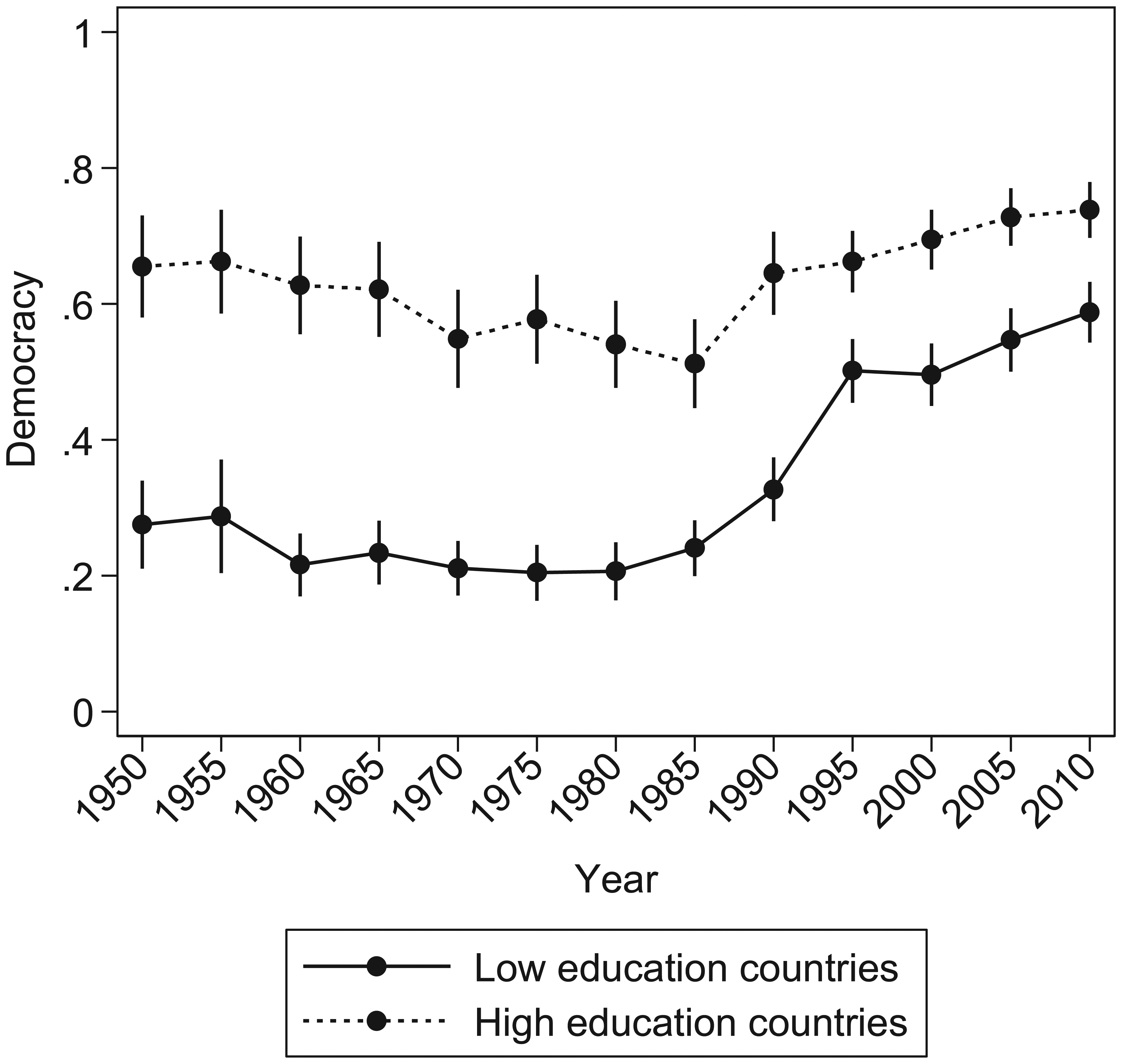
Democracy and education.
Our goal is to assess whether increases in education within countries leads to increases in democracy and whether this effect is stronger at lower levels of economic development. The data set we use is a five-year panel ranging from 1955 to 2010 (that is, t = 1955 and t-1 = 1950). It includes several more countries and covers two more decades compared to Acemoglu et al. (2005) and Bobba and Coviello’s (2007) samples. We start with the following model:

The dependent variable is the democracy score of country i in period t. On the right-hand side we include the lagged value of this variable to capture dynamic effects (i.e., persistence in democracy and the possibility of a mean-reverting tendency). Next, we have the lagged value of average years of schooling followed by the lagged value of per capita GDP. Common trends in the value of democracy for all countries are captured by the set of time effects µ t , and country fixed-effects are captured by the set of dummies δ i . Lastly, there is an error term, u it , capturing omitted factors. We then estimate a model that also includes controls for population (logged) and oil and gas rents per capita (logged) (data from Ross, 2013). Various works show a negative effect of mineral wealth on democracy (e.g., Ross, 2001) and there is a long-held view that democracies thrive best when the size of the population is small (Dahl and Tufte, 1973). Lastly, we add an interaction between education and per capita GDP.
Without country fixed-effects, inferences may be driven by omitted factors influencing both education and democracy in the long run. One issue with using a standard fixed-effect estimation, however, is that the model has a lagged dependent variable that is correlated with the error term (i.e., endogenous). In panels characterized by many countries and relatively few periods, the standard fixed-effect estimation is not consistent. To address these challenges, Acemoglu et al. (2005) used the first-difference generalized method-of-moments estimator (GMM) developed by Arellano and Bond (1991). There are, however, a series of potential problems in difference GMM that have been addressed by an alternative system estimator (system GMM)—which combines the regressions in differences (from the first-difference GMM) with the regressions in levels. 2 As Bobba and Coviello (2007) noted when challenging the findings by Acemoglu et al. (2005), democracy and education are highly persistent, which can make lagged levels weak instruments for the differences. To offset this, additional moment restrictions can improve point estimate bias. Thus, in the next section we present estimates from system GMM regressions. 3 To assess the consistency of the estimator, we test for serial correlation of residuals (AR(1) and AR(2) tests) and for overidentification (Hansen J test).
Results
The results appear in Table 1 with coefficients in bold and standard errors beneath. Tests and additional information appear at the bottom of the table.
System GMM results.

Notes: Windmeijer corrected standard errors; * significant at 10%, ** at 5%, and ***at 1%. The time effects F test gives the p-values for the joint significance of the Year dummies The values reported for AR(1) and AR(2) are the p-values for first and second order autocorrelated disturbances in the first differences equations. The values reported for the Hansen test are the p-values for the null hypothesis of instrument validity.
The results are similar regardless of the dependent variable: levels of education have a positive and significant effect on levels of democracy. 4 The results (specification i) imply that an additional year of schooling increases the “steady-state” value of democracy by 0.06, which is a rather large magnitude relative to the mean of democracy in the sample (0.53).
The following GMM models, presented in Table 2, include interactions. We interact education with three alternative variables: income per capita, a categorical variable for OECD countries, and a categorical variable indicating if the country was rich (its income falling in the upper quartile in the 1950s and 1960s).
Models with interaction effects.

Notes: Windmeijer corrected standard errors; * significant at 10%, ** at 5%, and ***at 1%. The time effects F test gives the p-values for the joint significance of the Year dummies. The values reported for AR(1) and AR(2) are the p-values for first and second order autocorrelated disturbances in the first differences equations. The values reported for the Hansen test are the p-values for the null hypothesis of instrument validity.
The results using the Polity data are consistent: the democratizing effect of education is clearly stronger at low levels of income, in non-OECD countries, and in non-rich countries. In all cases, the coefficient for the interaction variable is statistically significant and in the expected direction. Figure 2 plots the direct effect of schooling on democracy at various levels of GDP per capita (with 90% confidence intervals). The results also tell us that an additional year of schooling increases the “steady-state” value of democracy by 0.09 at low levels of income (i.e., a log of GDP per capita equal to 4) and 0.01 at high levels of income (i.e., a log of GDP per capita equal to 11).

The effect of education across income levels.
The results using the Freedom House/Bollen and the Unified Democracy Scores datasets also suggest that the democratizing effect of education is stronger at lower income levels, although the results are not as strong as with the Polity data. The coefficients for the interaction always have the correct sign. In the case of the first dataset, they are statistically significant for the two categorical indicators of wealth. When interacting education with the log of GDP per capita, the coefficient is not significant, yet plotting the results reveals differences in the effect of education between poor and rich countries. An additional year of schooling increases the “steady-state” value of democracy by 0.05 at low levels of income (i.e., a log of GDP per capita equal to 4) and 0.03 at high levels of income (i.e., a log of GDP per capita equal to 11). 5 When using the Unified Democracy Scores the interactions fail to reach statistical significance. Yet, when interacting education with the log of GDP per capita we find that an additional year of schooling increases the “steady-state” value of democracy by 0.17 at low levels of income (i.e., a log of GDP per capita equal to 4) and 0.11 at high levels of income (i.e., a log of GDP per capita equal to 11). 6
With regards to the control variables, the results support the view that oil and gas rents are problematic for democracy. However, there is no support backing the view that a smaller population is more conducive to democracy.
Conclusion
This paper revisited the link between education and democracy. Several prominent scholars have argued for a causal relationship, but the evidence appeared less than convincing. Our analysis shows that increasing levels of education among the population have a positive effect on levels of democracy. Moreover, we show that this effect is stronger among less developed countries. These findings contribute to a rich literature that seeks to understand the democratizing effects of education. It also has implications for policies designed to promote democracy through schooling. Our results show that increases in education should have the greatest impact on raising levels of democracy in places like Afghanistan, Bangladesh, Haiti, Nepal, and most of sub-Saharan Africa.
Footnotes
Acknowledgements
The authors would like to thank Pablo Pinto, Ernesto Calvo, Karen Remmer, Justin Kirkland, Jim Granato, and the anonymous reviewers for their comments. All errors and omissions are our own.
Declaration of conflicting interest
None declared.
Funding
This research received no specific grant from any funding agency in the public, commercial, or not-for-profit sectors.
