




Abstract
Political scientists are increasingly interested in the impact of religious authority on modern politics. However, little attention has been paid to the conditions under which religious leaders are more likely to speak politically. Tackling this question, this article argues that religious authorities should issue political statements at the outbreak of international crises, when secular institutions are unwilling or incapable of taking clear political positions. I test this argument focusing on the Roman Vatican through a quantitative text analysis of the papal encyclicals from 1958 until today. Latent topic models indicate that political themes systematically emerge in the papal documents and that the timing of the more political encyclicals correlate with years in which international crises break out. The findings have implications for the understanding of the modern relations between state and church and the political mobilization of religion today.
Introduction
Religious authorities are influential international actors. They possess political accountability, they exert political influence, and in some countries they even control political offices. Public consideration for religious leaders can easily surpass public attention to politicians, especially if the issues tackled by their statements have broad audiences that go beyond traditional political constituencies. Yet, little is known on when these actors speak politically and how their political pronouncements relate to the statements of secular authorities. A typical argument is that certain religious leaders have more political personalities or clearer political interests. For example, Pope Francis is often considered a more political pontiff than others before him. 1 However, to date there is no systematic evidence that either confirms or rejects this common wisdom.
Specifically, studies of the political announcements of spiritual leaders are virtually nonexistent. This research gap is puzzling, given the agreement that the positions of religious institutions have powerful effects on voters’ ideology (Harris, 1994; Inglehart and Norris, 2004). Even in the study of international relations, where morality and norms are deemed as important determinants of political preferences, analyses of the statements of spiritual leaders are de facto missing. Considering the global popularity of the church and the politically dividing topics that relate to the sphere of religion, it seems natural to ask under which conditions religious leaders are more likely to release political statements.
Tackling these questions, in this article I argue that religious authorities are more likely to issue political messages when secular institutions are unwilling or incapable to take clear political positions. In order to test my argument, I concentrate on the high-level statements of the Roman Catholic church presented by the Vatican. 2 I focus on the Vatican for the following reasons. Theoretically, the clear spiritual role of the Roman church permits to assume that its leaders are independently motivated from other political institutions. In other words, the preferences of the Roman church should be exogenous from secular political interests, because the Vatican commands that religious leaders do not enter professional politics and vice versa. 3 Empirically, studying the Vatican allows relying on a body of written documents that to date have never been studied from a rigorous political science perspective. Leveraging state-of-the-art text analysis methods, and specifically topic modelling, I present an analysis of all of the papal encyclicals since the end of World War II. My analysis identifies the political terminology that emerges in these ecclesiastic documents and indicates with precision which documents are more concentrated on political themes. Moreover, the new data allow me to trace at which points in time the church has released more politically relevant statements, thus providing evidence for the extent to which the Vatican is sensitive to the void of global action on pressing political issues.
The results indicate the scope of “politics ex cathedra”: the Vatican has dedicated roughly one third of its post-war encyclicals to the political themes of social justice, civil rights and economic development. In addition, the findings suggest that the timing of the more political encyclicals follows regular patterns, as the more political documents correlate with years in which clear international crises break out. The evidence indicates that strong political statements by this high-profile religious authority are anti-cyclical to states’ positions on political problems. Put differently, the church has historically filled a void of secular leadership incapable or unwilling to address political change. These results speak to the role of religious authorities in a politically polarized world and indicate that the Vatican’s contemporary political signals are consistent with a long tradition of engagement at the occurrence of political crises. This is contrary to the claims that some popes are more political than others and that their writings are systematically different from each other. 4
Religious authority and global governance
Since the Peace of Westphalia in 1648, sovereign nation states have been the central international decision-makers. Even today, in an interdependent world where political problems systematically jump borders and increase scale, states are the polities in charge of enacting global policies. However, states are not the only actors maneuvering the international system. As a large body of research indicates, the nation-centric understanding of international politics does not exclude the political relevance of non-state actors (Drezner, 2007). Religious authorities, together with corporations, non-governmental organizations and social movements, lack the international legal status of states, but they possess the power to tilt international politics towards their preferences. This power takes different forms. On the one hand, power is leveraging material influence and mobilizing masses (Dahl, 1957; Keohane and Nye, 1977). On the other hand, power is possessing legitimacy, which induces conformity and obedience (Barnett and Duvall, 2005; Büthe, 2004). Using both types of influence, non-governmental actors behave as lobbies to states, which are the only sovereign territorial institutions that can enact their favoured policies. However, the relationship between the political preferences of these actors and traditional governments is still a point of discussion. It is open to question whether these authorities echo states’ positions or have genuine, independent political stands. Relatedly, it is unclear when they would decide to take vocal positions on some specific political issues.
The political positioning of religious authorities is particularly puzzling due to the historical role of religion in international relations. Despite the nominal separation of state and church in the Middle Ages, the two camps have interacted substantively in modern times (Bueno De Mesquita, 2000). For example, Christian communities were involved in diplomatic affairs at the end of the 19th century with the emergence of numerous new European nation states. Furthermore, after World War II, many religious denominations embraced modern political attitudes in their practices due to several important reforms. 5 These reforms coincided with religious leaders starting to make explicit statements on government morality and political action (Stark, 2015). However, in spite of anecdotal evidence on these political stands, little light has been shed on how these positions have manifested themselves and, more importantly, how they are related to states’ positions on global politics. The answer to this question depends on how one perceives the relation between state and church. To the extent that states’ government and religious leadership are two complementary sources of political mobilization, their political force should emerge uniformly, and perhaps at the same time. To the extent that these sets of actors substitute each other, whenever one is in charge of a political issue, the other is not, and vice versa. Hence, it is up to debate whether political statements of religious authorities are either cyclical or anti-cyclical to the statements of formal political institutions.
I argue that spiritual leaders are more likely to take vocal political stands on international issues when states have difficulties or constraints in addressing them. This is due to a set of reasons that can be linked to rational choice theory and the logic of credible commitments. Firstly, spiritual leaders should be more inclined to substitute secular leaders because they are actors that want to maximize their success while minimizing their costs of action. Success corresponds to maintaining, and possibly increasing, the number of church members. Thus, maximizing success implies giving voice and anticipating the worries of the average congregant. By contrast, minimizing costs means eluding reputation loss and avoiding competition with other institutions. So, it is plausible that religious leaders want to increase the resources spent addressing a political issue that a significant number of followers deem as relevant if doing so strengthens the reputation of the church. By contrast, religious leaders should ignore political issues that are not at the heart of their audiences and that compete with other authorities in charge. If stressing an issue with clear and determinate language means marking political influence (Edelman, 1985), then religious leaders should release political statements only if this action can solidify their moral power. If public audiences are disinterested or if they are more responsive to the guide of other institutions, religious leaders are better off focusing on spiritual problems.
Secondly, spiritual leaders should be more likely to take political stands on issues that states fail to address because, like secular leaders, religious authorities are bound to credible commitments, which constrain them about which issues to pick and how to perpetrate them. Differently from secular leaders, however, religious authorities become more credible when morality becomes stronger vis-à-vis other motivations of political action (Tavits, 2007). When formal political institutions are ambiguous about a political problem, morality may matter more for the public, so the church should respond to an increased demand for moral authority with a more political position. Consequently, if secular leaders are incapable or unwilling to act on a particular issue, then the religious leader’s commitment to that issue should be even more credible.
To place this argument in a more specific context, consider the politics of international public good provision, such as security agreements or environmental cooperation. When states have the domestic political capability to push the international agenda forward, then international collective action is feasible and the state’s intention to address the public goods is credible. However, when domestic political interests are not aligned with international agreement, cooperation is unfeasible. In that instance, religious authorities are relatively more free to work on the international agenda and address the externalities of public good failure. After all, the church seeks to influence secular politics and maneuver social policies to maintain, and possible extend, public credibility and followers’ attention. Hence, it is in the church’s interest to tackle issues that affect their transnational audience, such as global injustice, international conflict and world poverty. This leads me to expect that when national governments do not take a position on pressing political issues, religious authorities substitute them in order to fill their political void. Surely political statements are also a function of the personal idiosyncrasies of the leaders in charge. For example, the leader’s place of origin and his intrinsic issue salience may matter a great deal for the framing of some topics. Nonetheless, political failures should be relevant for triggering political discussions within spiritual organizations, ceteris paribus. Thus, I expect that international crises that weaken the political power of secular institutions should drive the political statements of international spiritual authorities.
Note that my argument implies that in times of crises the church may produce political statements to influence both secular authorities and the public. The link between crises and the church’s political statements should hold whether or not people are already sensitive to political messages, as long as there is a political problem that will affect them. Also, my argument de facto predicts a negative correlation between crises and more spiritual topics. If religious authorities are a ‘thermometer’ of public opinion and if they have incentives to anticipate public concerns, they should be less interested in engaging politics when governments and people are not affected by the consequences of any crisis. This means that, while more political themes should emerge in religious communications at crucial historical moments, more spiritual themes should feature the church’s messages when the world is sufficiently governed by secular authorities, in the absence of a crisis.
Data selection, research design and method
To test my argument, I concentrate on the body of communications of the modern Roman Catholic church of the Holy See. The Catholic church represents a special international icon of religious authority. In 1870 the Papal territories were incorporated in the new Kingdom of Italy, which ended the church’s millennial temporal power. That same year corresponded to the First Vatican Council that resulted in a first breakaway with the Old Catholic Church. In 1958 the Second Vatican Council started a series of reforms that turned the Holy See into what it is today. But despite the Vatican’s specific historical developments, its relations with secular politics should be comparable with other modern religious authorities. For example, His Holiness the Dalai Lama and the Gran Imam of Egypt are considered the highest authority in Buddhist and Sunni Islam communities, respectively. 6 In this light, the Vatican’s structures and audiences resemble other religious denominations and, in principle, guarantee the external validity of investigating its messages vis-à-vis modern politics.
In order to perform a rigorous analysis of the nature and recurrence of political themes in Vatican communications, I choose a homogenous group of papal writings known as encyclicals. I focus on these texts for two reasons. First, differently from other papal documents such the apostolic letters and homilies, encyclicals are written to instruct bishops in all countries about a number of different matters. Therefore, they are quite comprehensive and their readership is universal. Moreover, while papal notes and speeches are published weekly, the pontiff defines when, and under which circumstances, encyclicals should be issued. These characteristics are useful for testing my hypothesis that global politics should be systematically addressed in papal documents at the outbreak of international crises. At the same time, because all encyclicals inevitably concern the Catholic doctrine, they should also address issues directly related to faith and preaching. This means that using the encyclicals allows me to avoid selecting on the dependent variables, i.e. contents and timing of political papal messages.
For my analyses I collect all of the encyclicals from 1958 until 2015. Starting in 1958 is determined by the fact that the Second Vatican Council radically changed the goal of these papal communications. While beforehand the papal writings were still mostly concerned with territorial relations and spiritual dogmas, after 1958 the Church revamped the purpose of encyclicals in order to discuss “the most characteristic and ultimate purpose of the teachings” of the church, in the words of Paul VI. 7 The 34 documents are all available online in multiple languages. After the Second Vatican Council, Italian became the vernacular of the Catholic Church, which means that encyclicals since then have been written in Italian and then translated in other languages. Hence, I selected the original Italian versions. 8
The analysis of the encyclicals could involve different methods, from supervised human coding to less supervised approaches. I choose to proceed with an automated content analysis. There are two reasons why automated content analysis is preferable, although not a perfect substitute, to human coding in the case of the papal texts. The first reason is one of practicality. While my text corpus is rather small, the content is lengthy: a scarce few of the 34 encyclicals are below 10 pages, while more than two thirds are more than 40 pages (the mean word count of the pre-processed documents is 32,169). A reliable human coding exercise would have required at-the-time infeasible resources, and would certainly cost months. By contrast, the automated content analysis is highly efficient, reliable and economical. Secondly, the choice of automated text analysis is supported by a small-scale validation experiment where I compared the word associations generated by the automated method with associations elicited through human input. The results, which are reported in the Appendix and are further discussed below, indicate that the automated analysis can efficiently and substantively categorize the papal communications, and human coding is neither more advantageous nor necessary.
From the range of automated content analysis models, I need a method that identifies the frequency and density of political contents. If my argument is valid, encyclicals with more politically dense topics should be issued after highly contentious moments where states fail to coordinate political action. Topic models can help distinguish political themes in the encyclicals, because they can indicate which of them are more or less “political” based on the latent topic structures. If a topic that lacks politically meaningful words dominates an encyclical, the topic model would estimate with a certain likelihood that this is not a political text. By contrast, if a topic characterized by politically meaningful words is more dominant, the topic model would indicate that this encyclical should be considered a more political text.
To conduct the core analysis of this study I rely on a simple type of unsupervised topic model that finds sets of words that characterize the documents’ latent dimensions. Following the latent Dirichlet allocation (LDA) approach (Blei et al., 2003), I assume that each topic is characterized by a distribution over words w. So, I first create the list of words w used in the set of encyclicals. I then count wij, the number of times each word j appears in each encyclical i. This creates a matrix summarizing the distribution of words, where each word in each document has a certain weight. Then, through the LDA estimation, I assess the systematic correlations of words, which means that I inductively generate topics based on a probability distribution over terms. 9 In addition, I test the data with alternative topic models that build off of the LDA tradition. In particular, the structural topic model (STM) (Lucas et al., 2015; Roberts et al., 2014), allows me to explicitly estimate the relationship between the encyclicals and information on crises.
Before moving to estimate the LDA topic model, the number of topics needs to be specified. Following my theoretical argument, I expect the encyclicals to be mainly divided between two dominant topics: a spiritual topic and political topic. This binary choice is not a classical setup for topic models, where usually multiple themes are analysed. Commonly, the number of topics is better justified through inductive topic discovery. To inductively explore the topic density in my documents, I estimate two LDA-derived measures: the “perplexity” score, where a lower value indicates better generalization performance, and the marginal likelihood, which is an auxiliary measure of model fit (Chang et al., 2009). These metrics were calculated with 20 LDA models with a number of topics (k) set from 2 through 6 that are calculated using different initialization values to ensure that my conclusions are not driven by the starting parameters. The resultant perplexity and log-likelihood values are plotted in Figure 1 for every initial set of the starting parameters (grey) and each measure’s respective mean values across all initializations (red). The plots suggest that a number of topics above 2 does not drastically improve the perplexity and log-likelihood measures, because the estimated values of neither metric critically changes moving from 2 to 6 topics. In other words, limiting the analysis to two topics should not compromise the optimality of the analysis, while it allows a more straight forward test of the theory.

Model selection: model fit metrics by different topic numbers. This figure illustrates the perplexity and marginal likelihood scores calculated for the entire corpus of encyclicals with an estimation repeated 20 times using different initializations.
This conclusion can be also drawn from the estimation of coherence and exclusivity scores (Roberts et al., 2014) of a three-topic model. Although these scores are usually employed to assess topic quality, comparing across topics may indicate whether two topics capture enough of the word variation. In fact, these dimensions provide information on the consistency and differentiation of the topics. Figure 2 shows that these scores mainly distinguish a more “political” topic (Topic 1) from the other two topics (Topic 2 and 3), which combine more spiritual words. I interpret this distance between the two clusters of topics as further evidence that a two-topic model may capture an important semantic distinction across the encyclicals.

Model selection: semantic cohesiveness and exclusivity in three-topic model. This figure plots the semantic coherence and exclusivity scores of the topics in an LDA model with three topics. On the exclusivity dimension the differences are small, which indicates that the top words for the topics can appear within top words of other topics. On the semantic coherence dimension the differences are larger, to indicate that the words that are most associated with the corresponding themes do not occur equally within the documents. This is evidence that spiritual topics are more coherent, but also that the top words of the political topic are differently consistent.
Filling a political void: the case of the papal encyclicals from 1958 until today
This article seeks to investigate whether the content of papal encyclicals is correlated with international political crises. A descriptive overview of the documents indicates that terminology tilted towards international political issues is indeed present in these texts: although the most frequent words, not surprisingly, are god (dio) and church (chiesa), which are repeated respectively 3,340 and 2,799 times, less-doctrinal words such as work (lavoro) and politics (politic-) are repeated, respectively, 833 and 440 times, making it to the top 60 words of the corpus of encyclicals. Topic models help shedding more rigorous light on this pattern.
I run the two-topic models 50 times using different random initialization values to ensure that my conclusions are not driven by the starting parameters. The LDA decomposes the words of the 34 encyclicals into two clusters and provide a list of words loading on each dimension. The two topics are not exclusive in that some words are included on both simultaneously. Nonetheless, there is a set of words that consistently load on the first topic, such as church (chiesa), Christ (cristo), faith (fede) and truth (verità). By contrast, a second separate set of words load on a topic that refers to the concepts of work (lavoro), development (sviluppo), social (social-) and men (uomini). Evidently, the first topic seems to capture the more “spiritual” papal messages, while the second topic reflects the more “political” ones.
The LDA analysis also indicates which encyclicals load most on which of the two topics in relative terms. As Figure 3 shows, roughly two thirds of the encyclicals group on the first more spiritual topic. By contrast, one third are principally marked by the words of the second more political topic. The spiritual encyclicals are concentrated on the holy spirit (spirito), the world (mondo), saints (sant-) and love (amor-), among other themes. Contrastingly, the political encyclicals place less emphasis on divinity and more on people (person-), justice (giustizia), as well as economy (economi-) and society (social-). At minimum, this is evidence that a stratum of political language distinctly appears in a significant subset of papal encyclicals across the years, and that the Vatican has systematically focused on pressing international political issues across time.
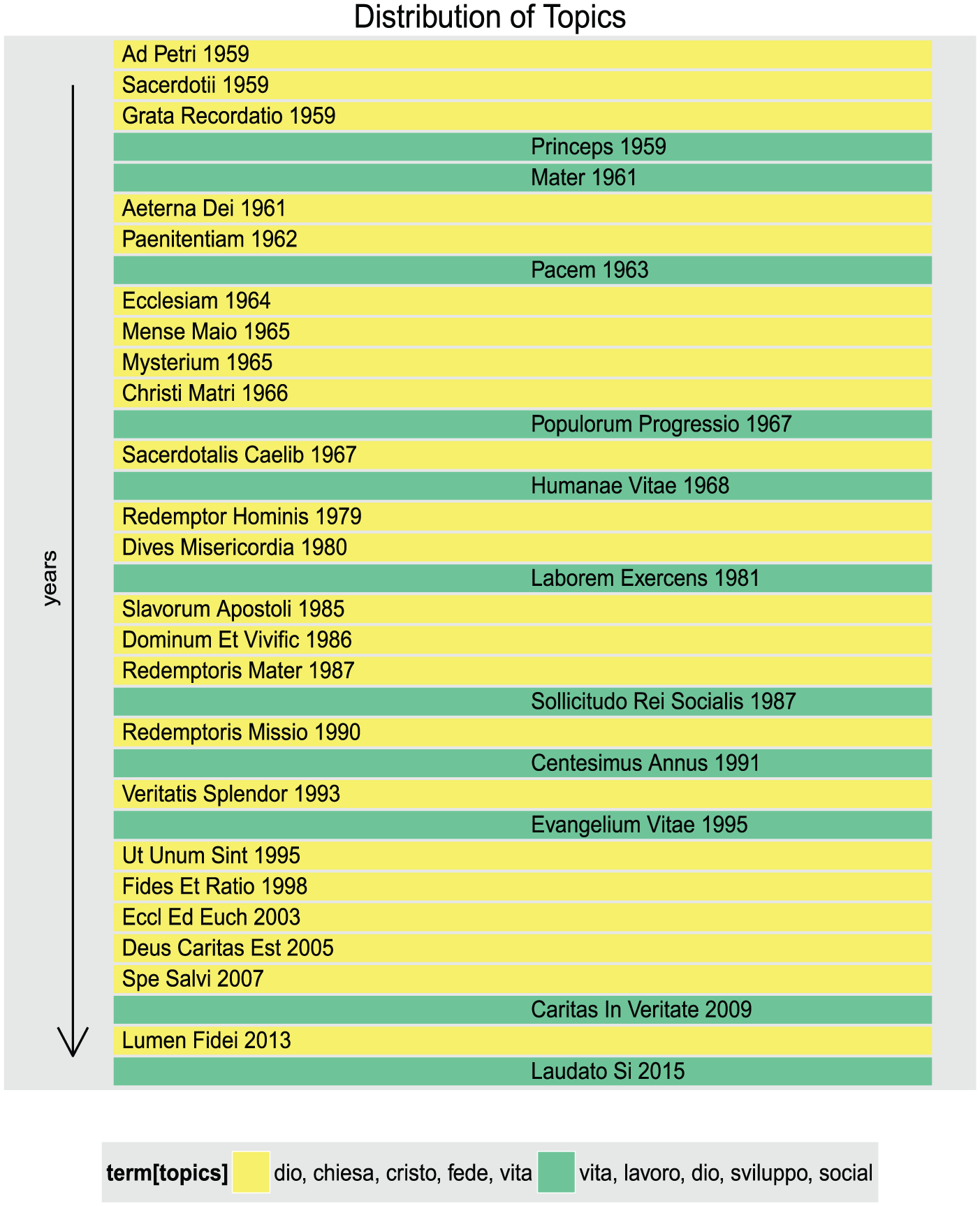
Two-topic model of post-1958 papal encyclicals. This figure illustrates the results of a two-topic LDA estimation process with 50 random initialization values and indicates the relative loadings of encyclicals on spiritual (yellow) and political (green) topics.
Note that this division of the post-1958 encyclicals is generally in line with an extensive body of historical Vatican studies. Accordingly, most political encyclicals identified through my topic analysis belong to the unofficial group of documents commonly referred to as Catholic Social Teaching. Nonetheless, the LDA is possibly more nuanced than this categorization, as I evinced with a post-estimation validation test. Following Grimmer and King (2011), I assessed the quality of the clustering of encyclicals on the two topics revealed by the LDA analysis by comparing it to a qualitative human categorization and the Catholic Social Teaching classification. 10 The differences between the LDA-based clustering and the other approaches is presented in the Appendix and shows that the LDA clustering has higher quality than these alternative clusterings of documents. Other validation tests that encompass a Wordfish scaling evaluation (Slapin and Proksch, 2008) indicate that the clustering patterns of the main LDA estimations are robust.
But is the timing of the more political encyclicals random or is it in any way related to secular politics? To provide an answer to this question, Figure 4 illustrates the schedule of a set of political encyclicals in comparison to a number of relevant international political events between 1958 and 2015. Below the plotted time line I highlight the years of the historical events, while above the line I report the encyclicals published along those years. Through this figure, it becomes clear that the political encyclicals systematically follow the historical events. More precisely, more political encyclicals are issued in the span of one to two years after the outbreak of an international episode. For example, the 1963 Pacem in Terris by John XXIII promptly followed the conflict between the White House and the Kremlin during the Cuban Missile Crisis. Not surprisingly, the encyclical indicates that conflicts “should not be resolved by recourse to arms, but rather by negotiation” (126). Similarly, the Centesimus Annus contains a message for states at the dawn of the post-Cold War era. In the 1991 encyclical, John Paul II writes that “the free market is the most efficient instrument for utilizing resources and effectively responding to needs” and the state has the duty of “directing the exercise of human rights in the economic sectors” (34, 48). Comparably, more recent encyclicals make explicit reference to the costs of mishandling the 2008 global financial crisis. In the 2009 Caritas in Veritate, Benedict XVI argues against an unregulated market economy and concludes that “in commercial relationships the principles of gratuitousness and the logic of gift as an expression of gratuitousness can and must find their place within normal economic activity” (36). Importantly for my argument, Benedict XVI also indicates regrets with the way “some states, power groups and companies hoard resources” and expresses concerns with “the development in poor countries” (49). Together with the topic models’ quantitative inference, these qualitative excerpts support the argument that the Vatican’s release of political statements follow deepening political crises and the incapabilities of states to deal with them. 11

International crises cause more political encyclicals: selected events.
The theory is further validated through a more explicit STM analysis, which permits to calculate statistical correlations between topics (the outcome variable) and external covariates at the document level of analysis. To run STM, I generated the binary variable “crisis”, which takes the value of 1 if the year in which an encyclical is published is one of crisis (t = crisis) or if the year was recently preceded by a crisis (i.e. t – 1 and t – 2). 12 The STM algorithm (Lucas et al., 2015; Roberts et al., 2014) can proceed only with a model of minimum 3 topics, so I specify k = 3. This is basically the model specified to construct Figure 2 with the additional crisis covariate. Following Figure 2, Topic 1 should represent the more political themes, while Topics 2 and 3 are more concentrated on classical doctrine. So, according to the theory, Topic 1 should be positively correlated with the crisis covariate, because the occurrence of an international crisis should lead to more political interventions by the Vatican.
I estimate the mean difference in topic proportions for the two different values of the covariate (0 for no crisis and 1 for crisis). Figure 5 presents these results with 80% confidence intervals. The point estimates with respect to Topic 1 are indeed positive and border the said level of statistical significance. This is evidence that the words captured by the topic are triggered by historical events, and particularly by the crisis of international secular power. Topic 2 also presents a positive coefficient, although the confidence interval is less reliable. More interestingly, the point estimate of Topic 3 is negative and statistically significant (even at higher levels of statistical confidence). This indicates that crises decreases the proportions of words centered on highly spiritual concepts. Thus, the effects shown with this analysis indicate that the relative portions of topics in the encyclicals are, to some extent, substitutes to each other. This is in line with the theoretical expectation.
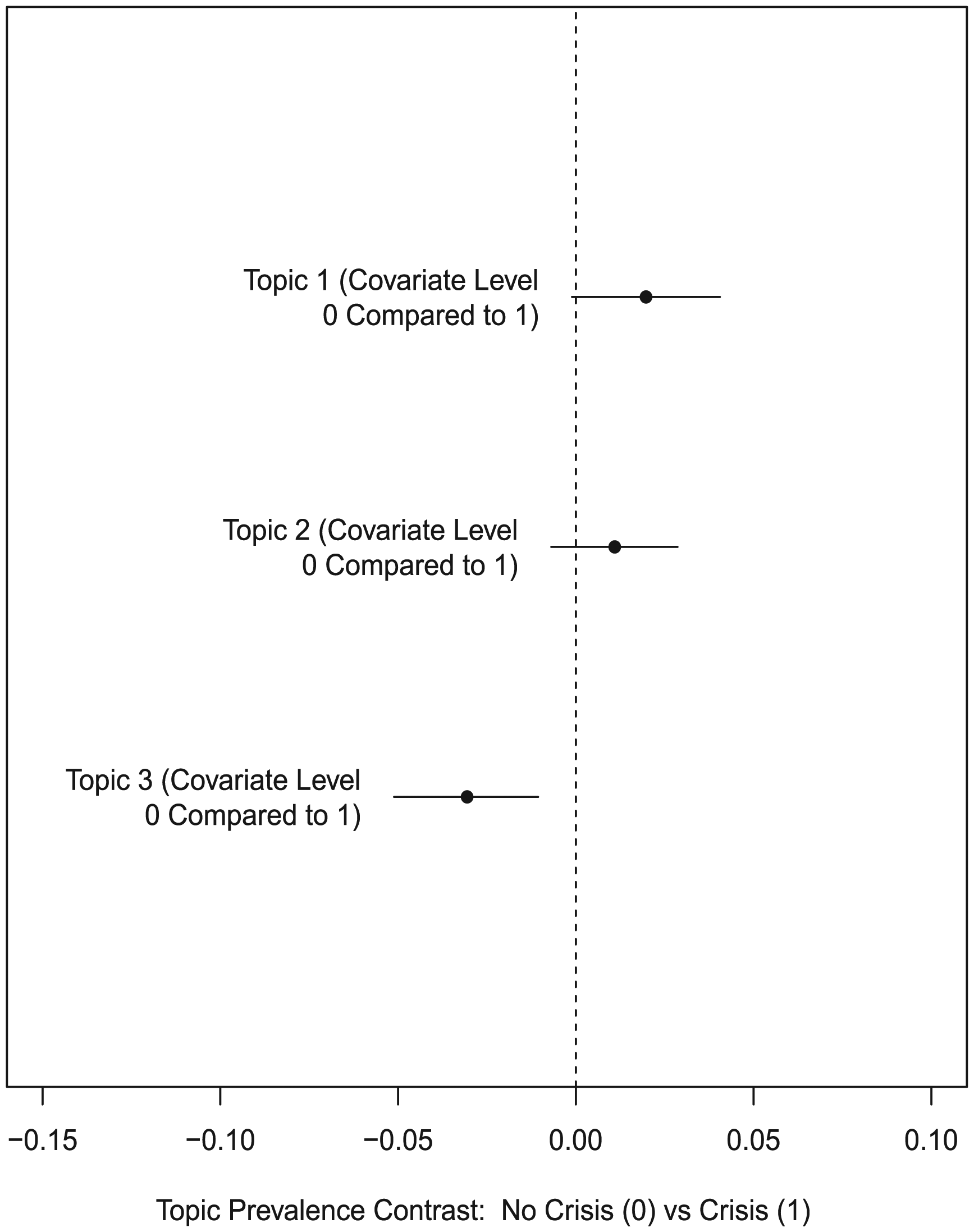
The effect of international crises on papal communications. This figure illustrates the statistical influence of crises included on the topical content of the encyclicals. The estimation is based on a STM specified with three topics (Figure 2). Each dot corresponds to the estimated coefficient, while the line corresponds to the 80% confidence interval.
It is especially important to underline that the mechanism outlined here seems to work regardless of the papacy in charge at the time of the encyclical. Of course, religious leaders give different importance to different issues and take different positions on different social policies. Nonetheless, the sensitivity of the Catholic church to international problems appears to translate into a consistent and significant political message independently on personality-based explanations. In order to illustrate this point, I explore the most recent 2015 encyclical called Laudato Si. Many have depicted this document as a political breakthrough, if not even a political manifesto. 13 In addition to its unprecedented focus on ecology and climate change, it is also the first encyclical fully written by Pope Francis, who is considered an exceptionally modern pope for reasons related to his modest practices and his attachment to the South of the world. Is his message really as different as some have pointed out? Decomposing the document in word frequencies helps answering this question. As already highlighted in the historical topic models, the 2015 encyclical is focused on political issues, as human (uman-), social (social), development (sviluppo) and politics (polit-) appear in the list of the top 15 words. However, god (dio), world (mondo) and creation (creato) appear as well and in comparable amounts.
Along these lines, Figure 6 shows the loadings of the key words that belong to the two estimated topic models. The first topic clearly captures the same spiritual theme found in the aggregated historical calculations. Consequently, the encyclical is still dominated by a thorough discussion of “universal destination” and connectivity between god and men. At the same time, the second topic is explicitly connected to my argument that the Vatican responds to the inaction of political institutions, because the encyclical recurrently points to the issues that have stalled international debates such as the United Nations negotiations on climate change. For example, highlighting the fact that international leaders have failed at properly incorporating basic adaptation strategies in the international climate regime, the encyclical says, “there is an urgent need to develop policies so that, in the next few years, the emission of carbon dioxide and other highly polluting gases can be drastically reduced, for example, substituting for fossil fuels and developing sources of renewable energy” (26). Similarly, the Laudato Si takes a position on the failures of carbon credit allocation by suggesting that “in no way does [emission trading] allow for the radical change which present circumstances require” (171). In sum, the encyclical clearly reacts to a series of international coordination failures, such as the infamous Copenhagen fiasco in 2009 and the saturated post-Kyoto Protocol negotiations after 2012. At the same time, it is built on increasingly frequent demands for political change such as the 2014 Climate People’s March, which has given momentum to this global public issue. These observations are consistent with the theoretical argument: following popular demands and reacting to the political void of incapable states, the church has systematically filled a rhetorical space for political action.

Word clouds of topics in 2015 Laudato Si. This figure illustrates the top words’ loadings estimated from the two-topic LDA model of the 2015 encyclical. Higher word font size corresponds to higher word frequency.
Conclusions
Political scientists are increasingly interested in the role of religion in international politics, and the study of religious attitudes and religious organizations is currently expanding. However, little is known of how spiritual leaders use political statements with respect to world politics. In this article I argued that religious authorities have an interest in making themselves heard on pressing global issues. I hypothesized that religious authorities should be more inclined to substitute rather than complement states’ positions on global issues, especially when such secular positions are unclear, non-credible or non-effective.
I tested my claim by studying the post-world wars encyclicals of the Roman Catholic church. The results from latent topic models indicate that the encyclicals differ between those that are more prominently spiritual and those that are more dominantly political. I find that the more political encyclicals are principally issued following moments of political instability and coordination failures. Thus, the evidence suggests that the church decides to explicitly address politics when states fail to do so. This holds across papacies and is also valid for texts that may have generally been considered exceptional, such as the 2015 climate change encyclical.
While the main lesson of this article is that the Vatican consistently exposes the problematic aspects of worldly disorders and inefficient governance through official documents, the author does not seek to argue that all Popes take the same uniform political sides. In fact, the qualitative investigation revealed some variation in the formulation of positions. For example, Jean XXIII’s Pacem in Terris and Francis’s Laudato Si seem to take more explicit stands against certain directions of action on specific topics, i.e. stopping nuclear deterrence or halting climate change with market instruments, than encyclicals such as Paul VI’s Humanae Vitae, which is still critical but more generic. These positions may vary across Popes, but my data is too limited to test any claims on ideology. Future studies may want to collect alternative data to evaluate the different sides of right- and left-leaning Popes. Additional work may also build on this contribution to test whether my argument travels other spiritual denominations beyond the Catholic church. Moreover, future research may expand on my analysis in order to explore how religious statements are connected to the observed behaviour of spiritual leaders in the international arena.
Footnotes
Appendix
Political encyclicals: illustrative excerpts. Note that words highlighted in bold refer to the themes of the corresponding crisis.

| Encyclical | Excerpts | Crisis |
|---|---|---|
| Pacem In Terris (1963) | 109. We are deeply distressed to see the enormous |
Cuban Missile Crisis (1962) |
| 110. There is a common belief that under modern conditions peace cannot be assured except on the basis of an equal balance of armaments and that this factor is the probable cause of this |
||
| 112. Hence justice, right reason, and the recognition of man’s dignity cry out insistently for |
||
| Humanae Vitae (1968) | Appeal to Public Authorities: And now We wish to speak to rulers of nations. To you most of all is committed the responsibility of safeguarding the common good. You can contribute so much to the preservation of morals. We beg of you, never allow the |
Sexual Revolution (1968) |
| Seeking True Solutions: We are fully aware of the |
||
| No one can, without being grossly unfair, make divine Providence responsible for what clearly seems to be the result of misguided governmental policies, of an insufficient sense of social justice, of a selfish accumulation of material goods, and finally of |
||
| Laborem Exercens (1981) | 1. Man’s life is built up every day from work, from work it derives its specific dignity, but at the same time work contains the unceasing measure of human toil and suffering, and also of the harm and injustice which penetrate deeply into social life within individual nations and on the international level. While it is true that man eats the bread produced by the work of his hands - and this means not only the daily bread by which his body keeps alive but also the bread of science and progress, civilization and culture - it is also a perennial truth that he eats this bread by ‘the sweat of his face’, that is to say, not only by personal effort and toil but also |
Energy Crisis (1979) |
| We are celebrating the ninetieth anniversary of the Encyclical Rerum Novarum on the eve of new developments in technological, economic and political conditions which, according to many experts, will influence |
||
| Centesimus Annus (1991) | 23. |
End of Cold War and Collapse of USSR (1989) |
| 24. The second factor in the crisis was certainly the |
||
| 47. Following |
||
| Even in countries with democratic forms of government, these rights are not always fully respected. Here we are referring not only to the scandal of abortion, but also to different aspects of a crisis within democracies themselves, which seem at times to have lost the ability to make decisions aimed at the common good. Certain demands which arise within society are sometimes not examined in accordance with criteria of justice and morality, but rather on the basis of the electoral or financial power of the groups promoting them. With time, such |
||
| Evangelium Vitae (1995) | 4. The fact that legislation in many countries, perhaps even departing from basic principles of their Constitutions, has determined not to |
Balkan War & Chechnya War (1995) |
| 27. Among the signs of hope we should also count the spread, at many levels of public opinion, of |
||
| Caritas in Veritate (2009) | 24. In our own day, the State finds itself having to address the |
Financial Crisis (2008) |
| Today, as we take to heart the lessons of the current economic crisis, which sees |
Acknowledgements
I thank Stefano Costalli, Fabio Franchino, Florian Kern, the editor and two anonymous reviewers for useful feedback. I am also grateful to Libero Genovese for multiple sorts of help. All errors are my own.
Funding
This research received no specific grant from any funding agency in the public, commercial, or not-for-profit sectors.