




Abstract
The overwhelming majority of Congresspersons engage in the acquisition of pork projects, also known as earmarks. In the aggregate, the general public overwhelming opposes pork-barrel spending, yet scholars and Members of Congress both contend that earmarked projects make for grateful constituents. This work attempts to explain this discrepancy. Using experimental data, I show that general discussions of earmarks are not universally beneficial. Recipients are only moved when they are made aware of projects in policy arenas of individual importance. Thus, pork is a nuanced policy tool that must be wielded strategically to gain electoral reward from specific subsets of a constituency.
Introduction
Scholars and Members of Congress (MCs) alike have long assumed that money brought back to a district or state in the form of earmarked projects would garner appreciation from constituents. Several polls over a number of years have revealed that, in the aggregate, earmarks do not enjoy popular support; in fact, they are deeply disdained. This raises a question: does pork behave similarly to notions of individual Member evaluation; that is, just as constituents love their Member but despise the institution of Congress, so too do constituents only cherish the projects that benefit them directly? While such a connection seems intuitive, it has never been verified empirically. This work attempts to shed light on this question by turning to experimental data to ascertain the impact of information regarding earmarks on Member support.
Voters must be able to successfully connect the actions of elected officials to specific attributable benefits, which requires “ both the knowledge and the beliefs of the voters” (Popkin, 1991: 96). Survey evidence tells us that citizens are remarkably uninformed about particularized spending. 1 Nonetheless, many scholars have maintained, implicitly or explicitly, that earmarks breed appreciative constituents and safer elections (Alvarez and Saving, 1997; Bickers and Stein, 1996; Herron and Shotts, 2006; Jacobson, 2009; Stein and Bickers, 1994, 1995) That said, this conclusion is not universally shared. For example, Sellers (1997) argues that electoral benefits from pork are conditional on Member–constituent ideological congruence, while Lee (2003) and Feldman and Jondrow (1984) contend the opposite: earmarked dollars do not lead to actualized electoral gains. While many researchers have relied on presupposed effects, none have attempted to directly ascertain the connection between pork and opinion. This work attempts to fill that gap by addressing a very basic question: given pork is disliked in the aggregate, can particularized benefits bolster Member support?
To be clear, this paper does not assert that earmarks influence electoral outcomes solely through direct awareness. To the contrary. Past studies have shown that earmarks could also work by influencing special interest contributors (Rocca and Gordon, 2013), by scaring-off potential challengers (Bickers and Stein, 1996; Lazarus et al., 2012; Stein and Bickers, 1995), or through crediting claiming via the media as an intermediary (Grimmer et al., 2012). That said, numerous scholars have asserted a direct connection between procured earmarks and member favorability (Arnold, 1990; Baron, 1990; Ferejohn, 1974; Jacobson, 2009; Mayhew, 1974; Shepsle and Weingast, 1981), while others have explored the possibility of pork bolstering awareness of the projects themselves (Stein and Bickers, 1994; 1995). Most recently, Grimmer et al. (2012) explored the role of press releases related to credit claiming for funding acquisition on MC support. Grimmer et al. found that when members credit claim through press releases they enjoy a boost in constituent support, but that this effect is conditioned on local media consumption. Grimmer et al. (2012) ultimately concluded that “ constituents may have a limited response to large new expenditures in the district” (Grimmer et al., 2012: 717), but they do not attempt to determine the effect of framing or issue salience. Grimmer et al. (2012) are not alone; despite a recent rise in the number of articles on earmarks, no work exists establishing how presentation of localized projects affects constituent appreciation of such efforts. This work investigates the consequences of bringing federal dollars home for those who are made aware.
The notion that individual projects could garner electoral support also finds a home in the economic voting literature. This theory, which dates back to The American Voter (Campbell et al., 1960), has been the subject of numerous observational (e.g. Bechtel and Hainmueller, 2011; Gomez and Wilson, 2001; 2003; Grafstein, 2009; Lewis-Beck and Stegmaier, 2000; Lewis-Beck, 1985; Romero and Stambough, 1996) and experimental studies (e.g. Sigelman et al., 1991; Sirin and Villalobos, 2011); in fact, Lewis-Beck and Stegmaier (2007) point out that there have been over 400 published works on the subject. In the present context is the idea that voters engage in pocketbook voting by basing their assessment of candidates on “their personal economic well being” (Gomez and Wilson, 2001: 899). For earmarks this would correspond to MC efforts to procure benefits that directly improve the economic conditions of those they represent. Following the public disclosure of earmark requests several years ago, scholars were quick to find numerous examples of these direct outlays: projects to improve roadways, direct grants to private businesses, workplace training programs, etc. While the investigations of pocketbook voting have sometimes met with mixed results, it is plainly apparent that pork may serve as yet another opportunity for voters to evaluate their MCs though the lens of personal economic assistance.
Issue publics
Citizens are not uniformly concerned about political issues. The notion that citizens follow certain issues with varying intensity based on individual preferences is an idea stretching back to Converse’s (1964) coining of the term “ issue public.” Generally speaking, politics is a secondary concern for most citizens. Given time and resource constraints, it is not surprising that most tend to direct their attention primarily to issues of personal importance (Krosnick, 1990).
Earmarks are not confined to a specific policy, they expand over various issue areas (Lazarus, 2009). This gives Members the opportunity to make direct appeals to a wide array of issue publics. Rocca and Gordon (2013) found in their exploration of defense earmarks, district factors (veterans in the district) and Member characteristics (Defense Subcommittee membership, Armed Services Subcommittee membership, and Military Constriction Subcommittee membership) were both significant predictors of defense earmark acquisition. Lazarus (2010) confirmed that this connection spans across a large array of issue areas. Consequently, investigations regarding the utility of earmarks should not assume all projects are viewed equally in the eyes of recipients. Rather, we should expect that constituent preferences vary according to their issue public(s), with greater attentiveness to issues of personal concern.
Hypotheses
The congressional literature suggests that those in recipient districts or states should reward the member responsible for bringing home the bacon, yet this long-held assumption has never been directly verified. Armed with the underlying theories detailed above, it is possible to derive a series of hypotheses to test this assumption. First, if extant literature is correct, then (H1) general information about earmarked dollars being secured for local benefit will increase favorable evaluations of the responsible member of Congress, ceteris paribus. Second, numerous studies have emphasized the importance of specific issues for members of corresponding issue publics, therefore (H2) particularized information about earmarked dollars that are personally relevant and secured for local benefit will increase evaluations of the responsible member of Congress, ceteris paribus. Finally, given that membership to an issue public means increased attentiveness and position strength, (H3) the effect of particularized information about earmarks that are personally relevant will be greater than the effect of general information about earmarks.
These hypotheses paint a straightforward picture: people generally like local pork projects, and they especially appreciate projects that are devoted to issues that are personally important. It should be noted that, while the aforementioned hypotheses predict that projects targeted to specific groups will win the admiration of recipients, they remain agnostic as to the impact of pork dollars for those not in the self-interested group. In other words, there are no a priori expectations for subjects who are not members of an issue public that would nonetheless benefit from the outlays.
Experimental design
Two experiments were conducted: an initial test of the hypotheses and a robustness check.
Experiment 1
For the first experiment, subjects were recruited using Amazon’s Mechanical Turk to take part in a “ political survey” in exchange for compensation. 2 The subject pool was limited to Florida residents to ensure a direct connection between the MC and the recipients, and to ease coding. 3
Subjects were randomly divided into five groups: a Senator Bill Nelson general treatment condition; a Senator Marco Rubio general treatment condition; a Senator Nelson education treatment condition; a Senator Rubio military treatment condition; or a control condition. The general conditions featured a vignette with the following language: “ [t]axpayers for Common Sense compiles a yearly list of earmarks (also known as pork projects) obtained by MCs. According to them, [Sen. Bill Nelson (FL)/Sen. Marco Rubio (FL)] secured over [$650 million/$110 million] in projects.” The Sen. Nelson education condition pool was given the same language, as well an additional sentence: “ [a]lmost $1 million of the money he brought home to Florida directly funded programs at colleges and universities.” The Sen. Rubio military condition was given the general condition language, which was followed by “[a] sizable amount of the money he brought home to Florida directly funded military defense programs and projects.” Finally, the control condition was given no text.
Following the vignettes, all subjects were asked two evaluative questions about Senators Nelson or Rubio: two 7-point questions regarding favorability and job approval, which were combined into a single measure. 4 To ascertain whether an issue is personally relevant (hypothesis 3), all subjects were asked four follow-up questions: “ [a]re you currently enrolled in a college or university,” “[a]re you or a member of your immediate family a member of the armed forces,” “[h]ow important is the issue of higher education to you personally,” and “[h]ow important is the issue of national defense to you personally?” The first pair of questions were measured as a simple binary yes or no; the second pair were measured on 5-point Likert scales ranging from “not at all important” to “extremely important,” which were collapsed into a binary variable indicating support. 5 Not surprisingly, the college enrollment and higher education measures are highly correlated (0.861, p < 0.001), and the military affiliation and defense measures were moderately correlated (0.567, p < 0.001).
Experiment 1 results
The results of the first experiment are displayed in Table 1 as an ordinary least squares (OLS) regression where the dependent variable is average of the two evaluative questions mentioned above. 6 The findings suggest a rejection of the first hypothesis: general information about earmarks does not appear to be enough to bolster MC support for either Senator. That said, the results do support hypotheses two and three: members of issue publics are especially receptive to positive information about earmarks, and this effect is greater in the particularized context compared to the general information context.
The effect of pork treatments on support for Sen. Bill Nelson (D-FL) and Sen. Marco Rubio (R-FL), MTurk.

p < 0.001, **p < 0.01, *p < 0.05. OLS regression estimates. The dependent variable is an index measuring
support for Senators Nelson and Rubio (two 7-point scale questions). Two-tailed standard errors in parentheses.
Beginning with Senator Nelson, those that received the education treatment and that self-identified as being currently enrolled in college (column 1) saw a 1.173 (p < 0.01) point increase in support for Senator Nelson, ceteris paribus. 7 However, for those who received the education treatment that were not enrolled in college or university, there was no significant change in support for the Senator. The table below also considers the education treatment’s effect on those that identified higher education as highly important (column 2). Those identifying higher education as an important issue area that were exposed to the education vignette had an even greater boost in support for the Senator: a 1.286 (p < 0.01) point gain, ceteris paribus.
Turning to Senator Rubio (columns 3 and 4), we see even stronger results. For those that were affiliated with the military and who received the military treatment, we saw a whopping 2.46 (p < 0.05) point increase in support, ceteris paribus. Unlike Nelson, however, this result was still partially felt for all respondents affiliated with the armed forces absent the military treatment. For those concerned with national defense in the military treatment, we saw a 2.04 (p < 0.001) point increase in support, ceteris paribus. Like the Nelson treatments, for those that did not identify national defense as an issue of major importance, this effect was not present.
Hypothesis 3 proposed that members of issue publics are more supportive of MCs that bring back pork dollars compared with those receiving general information about outlays. This hypothesis found strong support. For Sen. Nelson, the effect of the treatment for those in college is notably greater than those in the general condition (
Figure 1 displays the results of the first experiment visually, which is especially helpful in understanding the effect of issue–treatment interactions. The three leftmost bars in the top figure display the results for those in the general and education treatments (Sen. Nelson), while the three leftmost bars in the bottom figure display the results for the general and military affiliation treatments (Sen. Rubio). The figures also differentiate between subjects that self-identified as being enrolled in college (the second and third bar, top figure), and those responding that they or an immediate family member are in the armed forces (the second and third bar, bottom figure). The three rightmost bars show the same results while differentiating between those who identified higher education (Sen. Nelson, top figure) or national defense (Sen. Rubio, bottom figure) as an important issue. We see that exposure to the general treatment did not affect assessment of Senators Nelson or Rubio in a statistically significant way. However, for those in college, those viewing higher education as an important issue, those affiliated with the military, and those stating national defense is personally important had higher levels of support following exposure to the corresponding earmark frame.

Treatment effects on support for Senators Nelson and Rubio.
Robustness check: congressional chamber
Questions may be raised regarding the certainty and validity of the previous findings. This section tests for robustness, replicability, and applicability of the findings to members of the US House. This was achieved with an experiment conducted using Florida State University students; subjects were asked to evaluate Representative Jeff Miller (R, FL-1st) over a pair of issues areas.
This robustness check explores the same issue areas as the first experiment: higher education (by assuming the college student sample are concerned with higher education spending, and therefore members of that issue public), and military spending. Membership to the latter issue public was determined by asking survey respondents “ [a]re you or a member of your immediate family actively serving in the military?”
The treatment vignettes resemble those from the previous experiment. Subjects randomly assigned into the general frame were told that “[l]ast fiscal year US Representative Jeff Miller for Florida’s 1st District secured $21.5 million in earmarks (also known as pork projects) for his district.” Those in the particularized education frame received the same information with the addition of the following sentence: “[a] sizable amount of the money he brought home to Florida directly funded programs at institutions of higher learning.” Finally, those in the particularized military frame received the general treatment language with the following sentence added: “[a] sizable amount of the money he brought home to Florida directly funded military defense programs and projects.” Once again, the control group was given no vignette. All respondents were then asked the same pair of evaluation questions from the first study to access views about Rep. Miller’s favorability and job approval. These two responses were combined to form an overall evaluation measure. 8
The first two treatments (General and Education) mirror those of the first study with one exception: the total dollar value of the projects brought home have changed to reflect the money Miller actually returned to his district.
Those in the General treatment category are, again, expected to have a more favorable opinion of the member as compared with the control group (hypothesis one), as are those in the Education treatment (college students made aware of spending for higher education), and those with military affiliation in the Military treatment (hypothesis 2). In addition, information about particularized benefits (i.e. the Military and Education treatments) for subjects belonging to those issue publics will have higher evaluations of the MC as compared with those in the General treatment condition (hypothesis 3). 9
Results, robustness check
Table 2 reveals results akin to the first experiment. Again, contrary to the first hypothesis, simply telling respondents about earmarks did not affect support for the responsible member in a statistically significant way. However, when the college student respondents learned of earmarks going to institutions of higher learning, we saw a corresponding increase of almost a full point in support (0.85, p < 0.001), ceteris paribus, confirming the second hypothesis. Like the first experiment, for those not associated with the military, the military treatment had no statistically significant effect (0.082, p = 0.513); however, for subjects who received the military-pork treatment and who were associated with the military (i.e. Military Affiliation × Military Frame), there was a sizable increase in support equal to almost one point (0.885, p < 0.001), ceteris paribus. 10 In other words, members of the issue public were extremely appreciative of MC efforts, but those not in the issue public showed no significant change in opinion.
The effect of pork treatments on support for Rep. Miller (R, FL-1st).

p < 0.001, **p < 0.01, *p < 0.05. OLS regression estimates.
The dependent variable is an index measuring support for Rep. Miller (two 7-point scale questions). Two-tailed standard errors in parentheses.
Finally, when taken together, the education and military frames confirm the third hypothesis: allocations to issue areas seen as personally beneficial result in larger increases in support than generalized allocations. The education frame and military frame are comparable in size, and both are notably larger and statistically different from the general frame, which an F-test confirms for the education frame (
Figure 2 displays the results of Table 2 visually. Like the first experiment, members of an issue public made aware of MC efforts were indeed appreciative, but those without this affiliation (third bar) remained unmoved.
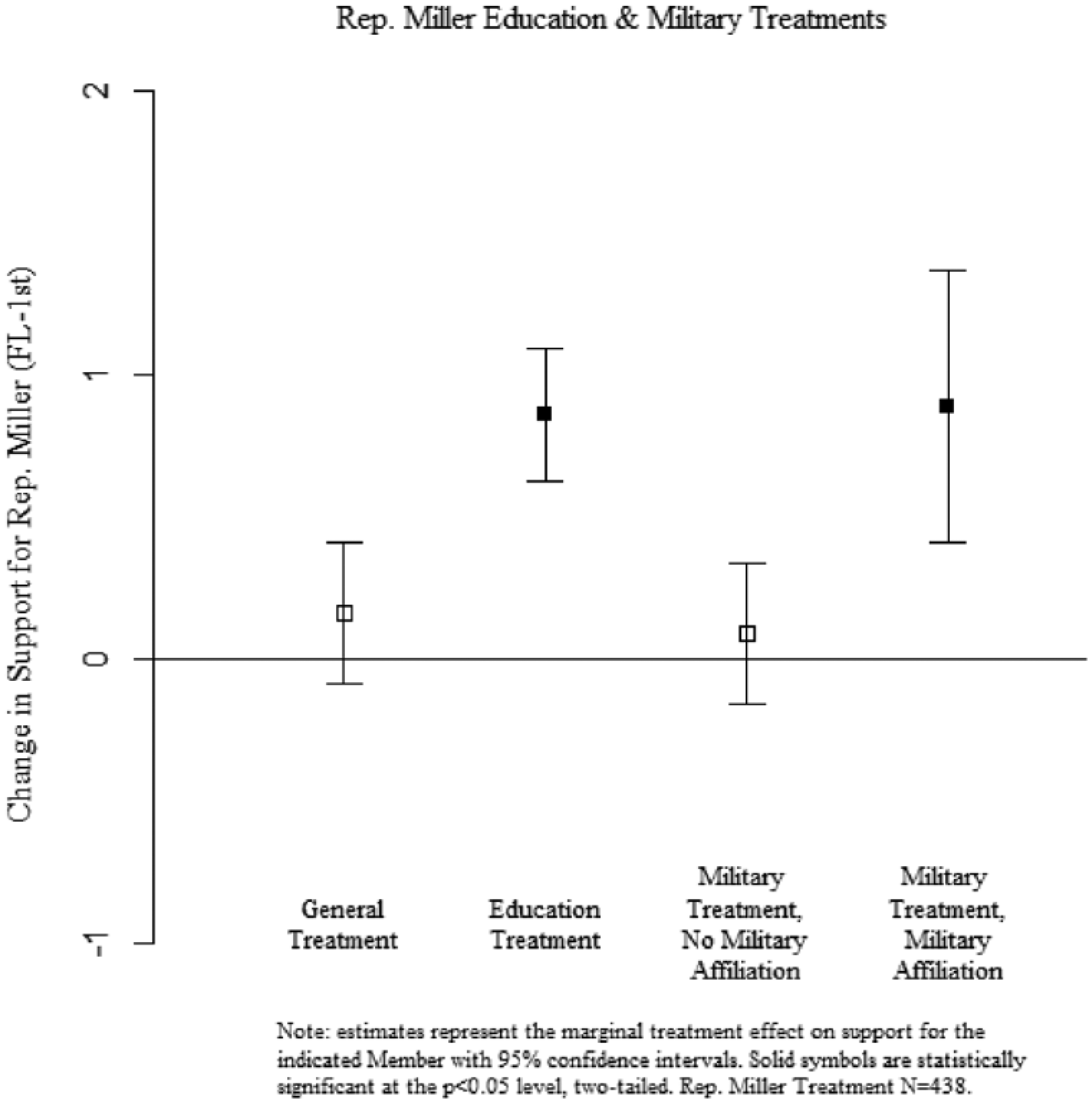
Treatment effects on support for Representative Miller.
The robustness check confirms that making recipients aware of earmarks results in favorability gains for the responsible MC, so long as the recipient is a member of the issue public affected by the earmarks. Moreover, these results appear to hold for Republicans as well as Democrats, for House members and Senators, and over varied issue publics.
Additional robustness checks
The issue of random assignment is worth a brief mention. The on-line supplemental featured on the author’s website (http://bit.ly/DesirablePork) features numerous models that regress a number of demographic control variables on the treatment and control conditions. The results provide strong support that the subjects were successfully assigned to a condition randomly.
Finally, a word on party identification. The earmarks literature has seen a growing body of evidence that has found that earmark allocations are not equally sought by both parties (Lazarus et al., 2012; Lazarus and Reilly, 2010; Levitt and Snyder, 1995; Sellers, 1997). While others have found that both parties seek earmarks to avoid being the sole target of blame (Balla et al., 2002). At the individual level it is unclear whether recipients condition their appreciation on the party of the MC securing the earmarked dollars. A robustness check was conducted on all of the presented models where respondent party identification was interacted with the treatment conditions, however, there was no statistically significant relationship found (these results are available on-line). This may suggest the gains in support are conditioned by the issue area benefited by projects rather than the party relationship between recipient and MC. Also, it should be noted that the member’s party was not explicit in the vignettes. Further research is needed to explore this possible relationship.
Conclusion
This work explored a long held assumption surrounding federal outlays; namely, that earmarks brought home to a state or district will invariably win the favor of appreciative recipients. A number of scholars have implied or directly stated that pork serves as a robust tool available to incumbents to reduce electoral uncertainty (see Jacobson, 2009; Popkin, 1991; Sellers, 1997; Stein and Bickers, 1994, 1995: for prominent examples). This conclusion has long been asserted in spite of the overwhelming aggregate disapproval of earmarks. These suppositions are based on traditional notions of representation: voters may despise the institution as whole, but they appreciate their MC. While this makes intuitive sense, such proposals have not been subjected to empirical testing. By relying on a series of experiments, this work confirms that earmarks may aid candidates, but that such gains are conditioned on the relevance of the projects to the recipients.
Ultimately the experiments presented above recast conventional views of earmarks as a universally positive benefit for MCs wishing to bolster electoral security. Rather, the ability of a MC to successfully sell earmarks to their constituents, like most political issues, is heavily dependent on the framing of the issue and the target audience. Basic factual information describing the amount of money brought home was not enough to significantly affect a change in opinion. However, when these monies were personally relevant, MCs gained significantly for their efforts. MCs looking to win appreciation should not assume that more is always better. Skilled politicians must identify which policy arenas are of particular importance to their constituents, work to secure projects in those policy realms, and ensure prominent media coverage of those efforts to enlighten the beneficiaries. 11 Scholars have recently begun to pick-up on this nuance; for example, Grimmer et al. (2012: 714-717) revealed the benefit of credit claiming pork projects. Namely, that while “ the amount of money claimed in press releases fails to substantively or significantly increase […] evaluations,” that MCs with a “ propensity to credit claim also tend to receiver higher levels of support” conditional on local media consumption. Therefore, appeals to issue publics are in the MC’s best interest to reap support from pork.
This also leaves open alternative avenues for pork to influence opinions and elections. Scholars have begun making progress in this area, such as recent research on earmarks and their effect on special interest contributions Rocca and Gordon, (2013), as well as challenger scare-off effects (Lazarus et al., 2012). What needs further exploration is how the findings of this study map on to the national media landscape. Specifically, scholars have yet to explore the impact of real world media coverage of pork and its effect on recipients. Future work should seek to use experiments and media studies to ascertain the ability of MCs to utilize pork to garner support.
Footnotes
Acknowledgements
Special thanks to Scott Clifford, Jennifer Jerit, and Cherie Maestas for their assistance in this work.
Declaration of conflicting interest
The author(s) declared no potential conflicts of interest with respect to the research, authorship, and/or publication of this article.
Funding
The author(s) received no financial support for the research, authorship, and/or publication of this article.