




Abstract
Germany’s bioethical legislation presents a puzzle: given structural factors, the country should be at the forefront of reproductive medicine, but its embryology regime remains one of the strictest in Western Europe. Past research has linked this fact to an unusual coalition of Christian and New Left groups, which both draw a connection from modern embryology to eugenics under the Nazis. In this article, the workings of this alleged alliance are demonstrated at the micro-level for the first time. The behaviour of individual MPs in a crucial free vote on pre-implantation genetic diagnosis (PGD) is modelled using data on their political, sectoral and religious affiliations. Identifying as a Catholic and membership in Christian organisations are strong predictors of resistance to PGD. Even more importantly, net of religious and professional ties, affiliation with either the Christian Democrats or the left-libertarian Green party is closely linked to restrictive bioethical preferences. The modest liberalisation in 2011 was contingent on external factors and the overwhelming support of the historically unusually large FDP delegation. With the FDP no longer represented in parliament and the Christian Democratic/New Left issue coalition even stronger than before, further liberalisation is unlikely.
Keywords
Why is Germany’s bioethics legislation so restrictive?
Germany’s restrictive bioethics legislation in general, and its very tight rules on embryology and fertilisation in particular, present a puzzle for political science. Early on, the country has enacted liberal rules in other moral policy domains, most notably the abortion law of 1975 (Richardt, 2003: 113). The full range of prenatal diagnosis is available to German women, and the 1995 amendment has de facto legalised late abortions of otherwise viable babies with genetic or other defects right up to the moment of birth (Hashiloni-Dolev, 2007: 85) Yet, paradoxically, Germany’s 1990 Embryo Protection Act (EPA, 1990) gives absolute protection to fertilised eggs (zygotes) 1 before implantation in the womb and so remains “one of the strictest laws on human embryology and fertilization in Europe” (Richardt, 2003: 112).
The country should, however, be at the forefront of assisted reproductive technology (ART) for a number of reasons: Germany is home to a flourishing pharmaceutical industry (Fink, 2008: 1644) and to one of the most generous health care systems in the world (Böhm, Landwehr, and Steiner, 2014). In combination with the dominant position of private health care providers (Böhm et al., 2014) and a marked tendency towards late parenthood (Buhr and Huinink, 2015), this should create significant political pressure for liberal rules. Moreover, while the major churches enjoy a constitutionally entrenched status in public life (Minkenberg, 2003: 202-203), less than one third of the population are (nominal) Catholics (Eicken and Schmitz-Veltin, 2010: 577) and fewer still are regular churchgoers, ruling out the most clear-cut predictor for strict regulation, a Catholic culture (Fink, 2008).
Party system factors also seem to provide little leverage in the German case. Engeli et al. (2013) argue that the presence of strong Christian Democratic parties should lead to a politicisation of moral issues that will eventually result in more liberal rules, while Fink (2008) claims that strong left parties are associated with permissive embryo research laws. In Germany, however, the then opposition parties on the left voted against the 1990 EPA bill that was introduced by the coalition of Christian Democrats (CDU and CSU) and Liberals (FDP), because they demanded even stricter rules (Rothmayr and Ramjoué, 2004: 180–183), and the basic premises of the EPA have not been politicised but rather have been treated as sacrosanct by all sides ever since.
This unexpected state of affairs, which renders Germany “an extreme outlier” (Fink, 2008: 1644) is often linked to the country’s traumatic experience with eugenics and euthanasia during the Nazi era. Germany’s historical legacy is deemed to be responsible not only for the extremely cautious stand taken by geneticists and other medical practitioners (Hashiloni-Dolev, 2007), but also for the emergence of an unusual issue coalition of Christians/Catholics on the one hand and feminists, environmentalists and disability rights activists, chiefly represented by the Green party, on the other see (Richardt, 2003: 98) and (Abels and Rothmayr, 2007: 145); see also Jelsoe et al. (2002) for a more general juxtaposition of traditional (“blue”) and modern (“green”) resistance to biotechnology.
While this explanation is plausible in principle, Germany’s New Left began to mobilise against ART on grounds of its alleged similarity with National-Socialist ideology and practice as early as 1985 (Abels and Rothmayr, 2007: 154), the supposed causal link has never been investigated at the micro-level of legislative behaviour. This article aims at closing that gap by analysing the decisions taken by MPs in a crucial free vote in 2011. It demonstrates that net of individual religious and sectoral ties, affiliation with either the Christian Democrats or the left-libertarian Green party is closely linked to restrictive bioethical preferences.
The road to the 2011 decision on pre-implantation genetic diagnosis
After the Social Democrats (SPD) and the Greens (B90/GR) took power in 1998, they remained highly suspicious of human embryology and did not pursue a liberalisation of the EPA. Even when chancellor Gerhard Schröder of the SPD lent his personal support to a lobbying campaign to legalise research on embryonic stem cells (banned under the EPA) in 2002, both SPD and B90/GR were conflicted about any changes to the law, and the Socialists (PDS, now LEFT) outright rejected the idea. After lengthy debates, a majority of MPs supported a cross-partisan amendment under which licenses for importing embryonic stem cells may be granted for fundamental research. Crucially, these licences are limited to cells harvested and frozen abroad before the amendment. 2
When the 2002 amendment was passed, lawmakers, backed-up by judicial experts, reaffirmed their view that the existing provisions of the EPA ruled out any variant of pre-implantation genetic diagnosis (PGD). PGD, i.e. genetic testing of fertilised eggs carried out before implantation in the womb in the course of in-vitro fertilisation (IVF), has been under constant development since the late 1980s. It is widely available in Belgium, the Netherlands and the UK and accessible under specific conditions in most West European countries. Very few other countries, such as Austria, Ireland and Italy, impose a complete ban.
But in 2010, in an unusual act of political entrepreneurship, the owner of a fertility clinic forced a ruling by Germany’s top criminal court that deemed the application of PGD legal in particularly severe cases unless an explicit ban was enacted, and so parliament had to revisit the EPA in 2011. Again, MPs were given a free vote on three competing drafts. The first proposed an amendment comprising an explicit and complete ban on PGD, thereby restoring the original intention of the EPA. A second upheld the ban in principle but wanted to grant an exemption to couples with a high and provable genetic risk for suffering stillbirth, miscarriages or death of the child within a year after birth. Finally, the third draft proposed “severe genetic diseases” as additional grounds for an exemption. Neither the second nor the third bill would create an entitlement to treatment, which would remain illegal in principle. Rather, women would have to apply for PGD at one of a small number of licenced centres, with separate “ethics committees” established by the federal states deciding whether the request would be granted. To the surprise of many observers, the third proposal was enacted by a slim majority.
The 2011 PGD vote is a significant juncture for a number of reasons. First, although the new rules are still very rigid, it represents a departure from the absolute protection that the 1990 EPA granted to embryos as far as medical treatment is concerned. Second, it allows a rare glimpse into the dynamics of German bioethics legislation: because the vote was recorded and additional information on the voting MPs is available from their official biographies, it can be leveraged to estimate the respective effects of religiosity, sectoral interests and party affiliation on the regulation of bioethical issues in Germany.
Party ideology, religion, interests
Legislators are often portrayed as agents trying to reconcile their own convictions with the competing demands of different principals (Baumann et al., 2015: 184–187): interest groups, voters and their parties. The latter seem to play a minor role here. German parliamentary parties are normally cohesive and disciplined, and government as well as opposition MPs are expected to vote along partisan lines. Yet, when “matters of conscience” are at stake, MPs are usually given a free vote. The 2011 vote is a particularly interesting case. Neither the government nor the powerful leaderships of the parliamentary parties had provided guidance or legislative input. Rather, the three proposals were drafted by cross-partisan groups, and debating time during the plenary sitting was allocated to these groups, and not to party caucuses as it is normally the case.
However, while partisan cues were ostensibly absent, the partisan composition of the groups behind the draft bills is revealing. The first two signatories of the complete ban proposal were Volker Kauder, the leader of the Christian Democratic caucus in the Bundestag, and Katrin Göring-Eckardt, who subsequently became front runner for the campaign and leader of the B90/GR caucus in 2013. Both politicians are known for their strong religious views, and their co-operation as well as the statements made by them and their supporters during the debate 3 suggest that the blue/green issue coalition still has some traction. The stillbirth group, on the other hand, was led by Rene Röspel (SPD) and Priska Hinz (B90/GR). Both have previously spoken out against a liberalisation of stem cell research, with Hinz representing a majority and Röspel representing a sizable minority in their respective parties. Finally, the group that supported the severe diseases rule was led by another Christian Democrat, Peter Hintze, and by Ulrike Flach of the FDP. In the past, the FDP has been the only party that has unequivocally favoured a more permissive embryology regime, while Hintze, a former protestant priest, is a proponent of liberal views on bioethical issues within the CDU. 4
More generally speaking, the expectation is that party affiliation will matter even in a free vote, either because of subtle partisan cues or because party members share common beliefs, with the FDP in favour of a liberal approach to PGD and the Bavarian Christian Democrats (CSU), which are more conservative than the mainstream CDU, firmly against. The fact that the Greens (like the CDU) were prominently involved with two proposals hints at a degree of division within the party, while the restrictive content of both bills suggests that Germany’s original New Left party is still opposed to anything related to genetics. Whether this also holds for the other leftist parties, which have adopted some of the New Left issues but are at their heart more traditional outfits, is an open question.
While partisanship mattered, it seems unlikely that MPs perceived the electorate as a relevant principal. In a poll held only days before the election, 82 per cent of the respondents said that they had paid little or no attention to the issue, and the median number of items mentioning PGD in the headline or the first few paragraphs in 40 German newspapers covered by LexisNexis during the two months before and the two months after the vote was just one per month. 5
Finally, affiliations with religious and sectoral interests should affect voting behaviour, either because MPs do indeed act as agents for these groups, or simply because they agree with their specific goals and general values. Comparative research as well as the uncompromising condemnation of PGD by Catholic church officials 6 suggests that (Catholic) religiosity in particular will be an important predictor of voting behaviour. In the 2009—2013 parliament, 42 per cent of the MPs chose not to reveal to what denomination (if any) they adhere to, 27 per cent identified as Catholics, another 27 per cent as Protestants and 4 per cent said that they follow a non-Christian faith (mostly Islam) or are non-believers. Moreover, 22 per cent mention at least one affiliation with specific Christian charities, pressure groups or other organisations in their official biography. This figure seems rather high given that in the 2012 General Social Survey (ALLBUS), just under 10 per cent of the German population rated religion and church as “very important” parts of their lives. While the median number of affiliations is zero, 5 per cent of the MPs list six to nine affiliations. To account for this skewed distribution, the square root of the number of affiliations enters the statistical model.
Links to the disability sector are rarer: 6 per cent mentioned one affiliation, while 1 per cent have two or more affiliations. Once more the square root of the count enters the model. As regards professional interest, only eight MPs list qualifying as an MD in their biographies, but 29 mention some other medical background, ranging from being trained as a nurse to non-executive directorships in large hospitals. Finally, the effect of gender on the vote obviously needs to be controlled, too.
Explaining the 2011 vote on PGD
In an unusual move, parliament decided to hold a simultaneous vote on the three bills, with MPs either casting a “yes” vote supporting a single proposal, or casting a “no” vote against all three. Because the severe diseases proposal was already supported by an absolute majority of the valid (“yes” plus “no”) votes in the first round, the second and final vote to amend the EPA followed immediately without further debate. 7 Supporters of the complete ban and the severe diseases proposals voted consistently (Table 1). The supporters of the stillbirth bill exhibited a more varied behaviour. While the alliance building went on until the eleventh hour, it had become clear in the days before the vote that this proposal commanded the least support and hence was unlikely to serve as a viable compromise between the two more extreme positions. Voting for the stillbirth bill in the first round should thus be interpreted chiefly as signalling one’s reservations regarding one of the other proposals. Accordingly, about one third of its supporters changed their vote to “yes”, while a large majority of them voted against and only less than ten per cent abstained. The analysis 8 will therefore focus on this second vote.
First and second vote on PGD.

Since the dependent variable is dichotomous, a standard logistical regression model is used to analyse the vote. The model fits the data well (pseudo-R2 (McFadden) = 0.28). From the logit coefficients in Table 2, it is easy to see that gender has no discernible effect on the vote. This is an interesting finding in itself, and it dovetails with the fact that most speakers in the debate avoided references to abortion and framed PGD as a means to help struggling couples, not as a matter of women having control over their reproductive choices.
Modeling the 2011 parliamentary vote on PGD.
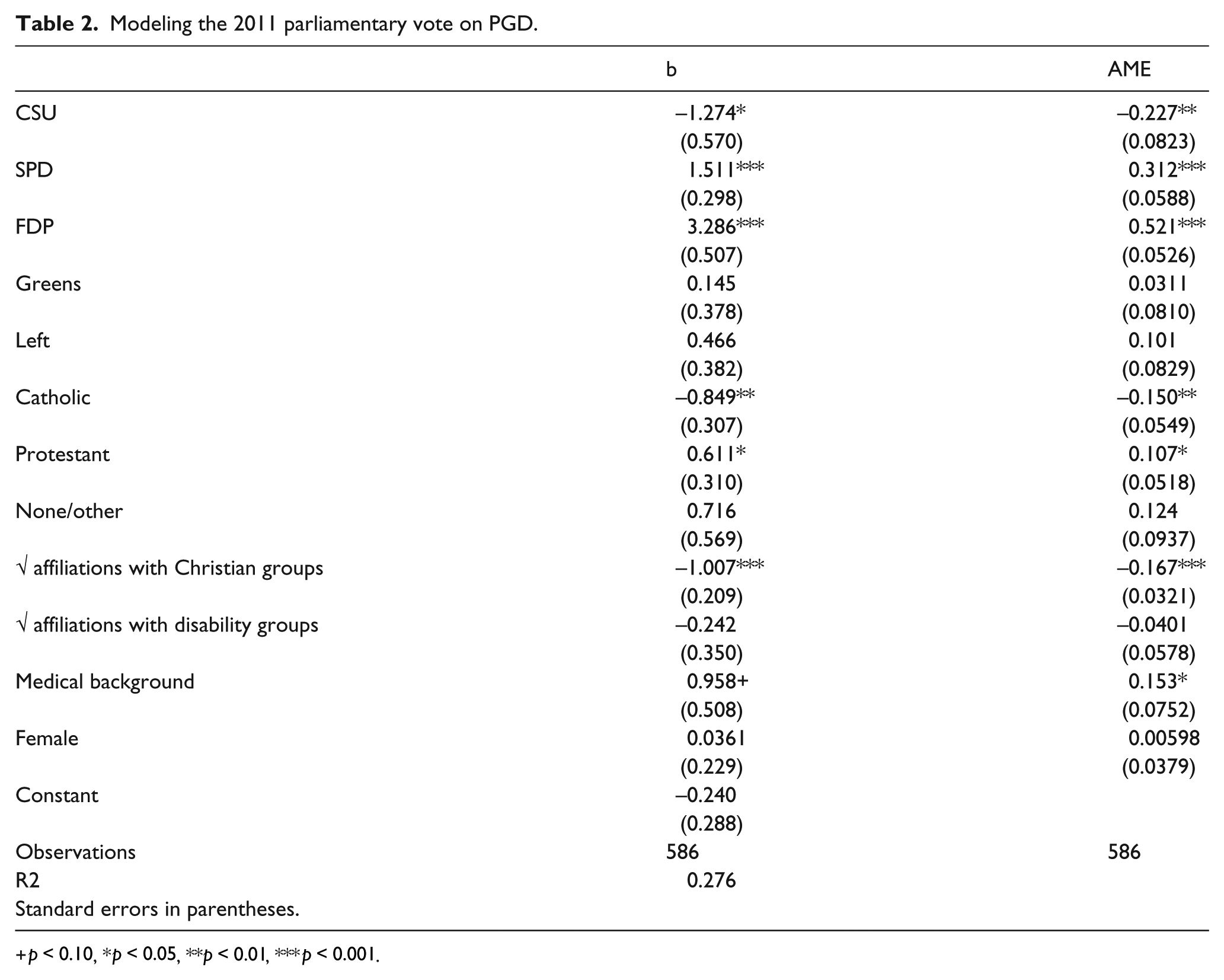
p < 0.10, *p < 0.05, **p < 0.01, ***p < 0.001.
Being affiliated with charities and advocacy groups for the disabled, on the other hand, has only a small negative effect that is not statistically significant. Again, this is plausible, because only a small number of disabilities is linked to genetic disorders, and because the various interest groups did not speak out unanimously against PGD.
The impact of all other variables is best assessed by means of looking at their average marginal effect (AME), i.e. the average change in the predicted probability of a “yes” vote as x changes from 0 to 1. A medical background clearly increases this probability, although the estimate is not very precise. The effect is significant at the 10 per cent level and on average translates into a sizable difference of 15 percentage points between MPs with and without a medical background. This finding corresponds to the cautious lobbying by the German Medical Association and the outspoken support from the professional associations of gynaecologist and obstetricians.
The effects of religiosity are strong, too. While the small “none/other” group does not differ significantly from those who chose not to reveal their denomination, Catholics are less likely to support a liberalisation, whereas Protestants appear to be even more liberal than the reference group. These differences amount to a denominational divide in parliament: Everything else being equal, the model predicts that less than half (41 per cent) of the openly Catholic MPs would support access to PGD, and hence that even this cautious liberalisation could only come about because they are a minority in parliament. On the other hand, two in three self-identifying Protestant MPs would support PGD for couples with severe genetic conditions, ceteris paribus, a number so high that even a more liberal bill along the lines of British and Belgian regulation might have found a majority in a parliament comprised only of Protestant MPs.
One must, however, also take into account the considerable effect of Christian affiliations. Even a single organisational tie reduces support for PGD by some 15 percentage points. This is enough to bring predicted support amongst self-declared Protestants down to just over 50 per cent, and to make a “yes” vote highly unlikely for Catholics. Having more ties strongly erodes Protestant support, but even in the small group of MPs with more than one affiliation, denominational differences persist (see Figure 1). Taken together, these findings imply that religiosity in general and Catholicism in particular play a more important role than sectoral ties.

Combined effect of denomination and number of Christian affiliations on the probability of “yes” vote.
Finally, in line with research on free votes in the UK (Cowley and Stuart, 2010) and other Westminster democracies (Plumb, 2014), partisan affiliation has very strong and peculiar effects. The MPs of the CDU, the major Christian Democratic party, form the reference group. The model predicts that about 40 per cent of them should support liberalisation. Predicted support is almost 23 percentage points lower amongst the MPs of their Bavarian sister party, the CSU. However, the MPs of the Greens and even those of the left are statistically indistinguishable from their CDU colleagues: predicted (and observed) support for liberalisation is only marginally higher amongst these leftist parties, once more underlining the relevance of the unusual issue coalition. Conversely, the SPD, which strongly and unconditionally opposed IVF and related technologies in the 1980s, was largely supportive of the liberalisation, and the FDP, in line with their position in previous parliaments, was almost unanimously in favour. In essence, the 2011 vote shows that net of religiosity and ties to the medical sector, bioethics legislation in Germany has a strong partisan component. But this component does not fit into the general pattern of coalition building along either the economic or the socio-cultural left—right dimension. Giving MPs a free vote did not just relieve their conscience, it also helped them overcome a legislative impasse.
Conclusion and outlook
Focusing on PGD, this article set out to answer the question of why Germany’s bioethics legislation is and remains so restrictive compared to other European countries. While couples affected by severe diseases may now put in a request for permission to have the test performed legally, citing extraordinary hardship, the 2011 decision creates no entitlement to medical services that have been available in other countries for more than three decades, and PGD remains banned in principle. The ethics committees, which will be dominated by doctors, may bring about some further de facto liberalisation, but the hurdles built into the law are high.
Christian religiosity is one part of the explanation. While Germany has no Catholic culture and features a largely secular society, Catholicism and affiliations with Christian organisations are relatively frequent amongst MPs and have a strong negative effect on their support for PGD. Yet the higher levels of religiosity in previous decades could not prevent the enactment of liberal rules on abortion, which were framed in terms of women’s rights, uniting the left, the FDP and even some Christian Democrats against religious opposition. Thus, the key factor for explaining Germany’s restrictive approach to PGD and related medical technologies is the unusual issue coalition between conservative Christian Democrats and large segments of the Green party. This ongoing alliance is the micro-level correlate of the much vaunted effect of “Germany’s traumatic past”.
More generally, while there is less agreement between Greens and Christian Democrats when it comes to other current moral policy debates (most prominently physician-assisted suicide and full legal recognition of homosexual partnerships), Green and Christian-Democratic preferences largely overlap in domains such as the regulation of GM organisms, stem cell research, germ-line therapy and ART more generally. The crucial component that brings about the blue/green alliance in German bioethical legislation, and that sets Germany apart from other West European systems, is indeed the alleged link between these new technologies and Germany’s past.
The laws on PGD and a host of related techniques are therefore not going to change soon. Even the modest steps taken in 2011 were contingent on external actors-an entrepreneurial gynaecologist and a bench of judges who forced MPs to clarify the law-and an unusual political constellation: the 2011 bill could not have been passed but for the overwhelming support of the FDP delegation, which was the largest since 1949. In the current parliament, the FDP is no longer represented, and it is far from certain that they will return in 2017. Without them, the shadow of Germany’s past will continue to shape the future of its legislation on bioethical issues.
Footnotes
Acknowledgements
The author is grateful to the editors and several anonymous reviewers for their valuable comments and suggestions, and to Anna Schley, Peter Schreiber, René Selbach and Inga Winterberg for research assistance.
Funding
This research received no specific grant from any funding agency in the public, commercial, or not-for-profit sectors.