




Abstract
The article focuses on group-based features of issue publics and advances the concept of residual group saliency as a way to organize members of issue publics. We accord veterans exemplar or prototype status, and civilians as periphery members of this issue public. As issue public exemplars, veterans anchor the “right” attitudes and behaviors for the veteran issue public, and civilians, especially those with family ties to veterans, gravitate toward those exemplar attitudes. We argue that pressure to conform to these “right” attitudes among civilians who are connected to a veteran is greater when there are more veterans in their environment. However, veterans and civilians who are not connected to a veteran are not responsive to such contextual effects, the former because they are already exemplars, and the latter because there is no motivation to evaluate the self in relation to veterans. We test and find support for these claims using data from the 2010 Cooperative Congressional Election Study. We conclude with an evaluative discussion and suggestions for future research.
Introduction
Issue publics are groups that connect the broader public to elites and policy processes, thereby helping to save democratic governance from mass political ignorance.
But who or what holds an issue public together? The “issue” in issue public does, in part, by defining the scope of salience. We explore how the “public” part also defines the contours of issue publics. Specifically, we argue that individuals express their policy attitudes as a function of social context and through a process we term “residual group saliency.”
Using survey data from a large national sample of Americans, we evaluate the attitudinal consequences of familial ties to veterans, core members of a foreign-policy issue public. Consistent with existing research, we find that veterans are more supportive of the War in Iraq than civilians (Gartner 2008; Mueller 1973), and that civilians who are related to a veteran support war more than unconnected civilians (Gartner, 2008; Lau et al., 1978).
The concept of “issue publics” motivated revisions to the view of citizens as political actors who fall short of their democratic charge (Converse, 1964; Krosnick, 1990). Not every citizen is uniformly vigilant of government on all issues all of the time. Instead we have many policy watchers who are knowledgeable about their issues (Delli Carpini and Keeter, 1996; Hutchings 2003; Price et al., 2006), who evaluate political candidates on the basis of their issue (Anand and Krosnick, 2003; Highton, 2004; Hutchings, 2003) and who participate in politics on behalf of their issue (Campbell, 2002; Price et al., 2006). Our analysis contributes to this scholarship by offering new evidence that the attitudes held by veteran-connected civilians draw them into the veteran issue public when veteran density is high, but leave them out when veteran density is low. Among civilians without veteran family ties, the density of veterans in their surroundings makes no difference because there is no residual group saliency to activate. We conclude by discussing the implications of our findings for future research.
The group component of issue publics
The core thesis of the issue public concept is that people vary in the personal importance that they attach to their policy attitudes (Converse, 1964; Krosnick, 1990). However, for issue publics to form in the first place, the importance attached to a particular issue must be shared with others. The central premise of this study is that issue importance is shared, and sharing renders issue publics subject to group dynamics.
Groups play a central role in the study of attitude formation and political behavior (Campbell, et al. 1960). They mediate our complex social environments by helping us sort more from less relevant facts, and they orient our interests in policy and candidate judgments. Thus, when we identify strongly with a group, we attach greater importance to issues that we believe may impact the status of that group (Key, 1961). Whether salience is activated because our group is in the political spotlight, or because fellow group members are highly concentrated in our local environment (Lau, 1989), groups are heuristics that help us as consumers of political information and practitioners of civic engagement.
The influential social identification model of group behavior, along with a self-categorization variant, guides our work here (Huddy, 2012). This approach posits that categorization is key to understanding group-driven behavior (Tajfel, 1981; Turner and Tajfel, 1979), and stipulates that individuals are motivated to be seen favorably, and hence intergroup relations are competitions for positive identity. One powerful insight uncovered by this model is that, even absent face-to-face contact and a common purpose, the mere perception of belonging to a group is sufficient to induce differential group member/non-member behavior (Jackson and Sullivan, 1987; Tajfel et al., 1971).
Many other insights have been produced by the social identity and self-categorization approach. Two are worth underscoring here. First, group identification is distinct from group membership. The mere presence or absence of characteristics that determine objective membership, such as job status, race, and sex, need not be accompanied by a specific feeling of attachment (Huddy, 2012: 739). Our concept of residual group saliency builds from the inverse: an individual need not be an objective member of a group in order to express attitudes consistent with the group—they need only feel a sense of closeness to the group or its members.
Second, later advances in social identity theory have emphasized the role of prototype group members in structuring intra-group dynamics. According to Hogg (2001: 187), prototypes are abstractions based on “fuzzy sets of attributes that define and prescribe attitudes, feelings, and behaviors that characterize one group and distinguish it from other groups.” Individuals use prototypes as exemplars to assess themselves and others by the extent to which they embody prototype attributes (Hogg and Hains, 1996). As Hogg (2001: 187) explains, a “prototype-based social attraction gradient” governs in-group favoritism and out-group antipathy, as well as more or less liking of in-group members. The implication for policy attitude formation in issue publics is that prototypes find expression as leaders who anchor the “correct” attitude, while followers seeking to maximize similarity between self and prototype, conform.
Political science does boast behavior models that emphasize leadership. Stimson (2004: 21) posits that those with less knowledge and interest in politics are willingly influenced by opinion leaders. In models of political mobilization, Uhlaner (1989) contends that “relational goods” incentivize individuals to behave rationally in group contexts. For Uhlaner, individuals are embedded in social environments, which include leaders who turn to loyalty appeals to persuade group members because internal cohesion translates into power outside the group (Uhlaner, 1989: 391).
The claim here is that issue publics, like groups in general, have leaders and followers. The “core” of issue publics are opinion leaders who exemplify the prototypical attitude, and have incentive to “expand the scope of conflict” (Schattschneider, 1960). Furthermore, periphery members of issue publics have incentive to conform to attitudes expressed by core members, and leader influence can extend to objective non-members who nonetheless maintain closeness to core group members in issue publics. Just as group salience and social density prods objective group members to identify with a group (i.e. Lau, 1989), so can these forces extend to residual issue public members. The more core members in the local environment, the greater the incentive for periphery members of issue publics to conform. The policy attitudes of issue public “core” members and those without primary social connections to “core” members, however, should not respond to such contextual factors, and hence neither are candidates for expanding the issue public. The former set of individuals is immune because they are already “core” members, while the latter set feels no pressure to evaluate the self against a prototype that is not salient from their perspective.
Our theory is consistent with this aspect of their theory: residual group saliency is compatible with the primacy of attitude importance stipulated for the issue public construct. Issue publics may have reference group antecedents (Krosnick, 1990: 73), but they are not bound by objective group membership. Political issues and politics need not map perfectly to social group cleavages. Although the idea that social context partially determines political attitudes is not new (Huckfeldt, 1984), the study here explicitly links context, social identity theory, and issue publics.
Next, we evaluate how family ties and the density of “core” issue public members in the local environment bind the core and residual segments of the veteran issue public together. We select the veteran issue public for analysis, in part, because foreign policy remains stereotyped as an issue that is not on most people’s radar (Almond, 1950; Converse, 1964). Second, we are also keen to stimulate conversation between literatures on the civil-military gap (Lau et al., 1978), public support for war (Gartner, 2008; Gartner and Segura, 1998) and issue public approaches that engage foreign policy attitudes (Anand and Krosnick, 2003; Claassen and Nicholson, 2013). Our effort to bridge these literatures begins with the concept of residual group saliency, a small, but critical step towards theorizing how issue publics might expand, contract, and maintain cohesion.
Methods
We analyze individual-level survey data from the pre-election wave of the 2010 Cooperative Congressional Election Study. The survey includes 55,400 respondents, with representative samples of all 435 Congressional Districts. We use a dichotomous measure of support for the Iraq War as our dependent variable. Logistic regression models control for known correlates of war support, including local war casualties, respondent partisanship, income, education, age, and sex.
Predictors of interest are respondents’ connections to veterans, congressional district veteran population density, and their interaction. Respondents are categorized for analysis in two ways. The first model estimates support for the Iraq War by comparing veterans to civilians. This model represents approaches that assume only objective group members are influenced by salience-increasing contextual variables. The second model broadens the scope of potential issue public members by comparing veterans, civilians with veterans in their immediate family, and civilians without a familial connection to veterans. This approach tests the idea that civilians living with veterans respond to contextual cues that increase the salience of the veteran issue public, not because the cues activate a veteran identity, but rather because they activate a residual form of that identity, which in turn can expand an issue public.
Our contextual measure of group saliency is the proportion of the population that claims veteran status in the respondent’s congressional district; we draw the measure from the 2009 American Community Survey. The distribution of the veteran density variable is approximately normal (min = 0.1%, max = 13.4%, mean = 7.3%, s.d. = 2.1%). We expect that higher values on this index will increase the salience of veterans for all civilian respondents, represented as an interaction term, Veteran X Vet Density. The more “core” members of the veteran issue public in the social context, the more pressure to conform to the prototypical attitude of the veteran issue public. However, not all civilian respondents are equally embedded in the veteran social context. Respondents related to veterans will be more strongly influenced by the density of “prototypes” in their context than civilians without the family connection. Evidence of this pattern would extend existing literature on the relationship between group membership and contextual effects. We capture that possibility with a pair of interaction terms in the statistical model: one for military-connected civilians (Vet connected civilian X Vet density), and another for civilians who are not connected to a military service member (Unconnected civilian X Vet density). In both cases, the baseline comparison group is veteran respondents.
Findings
The analysis begins by estimating the effect of veteran density on respondent attitudes that the War in Iraq was not a mistake. Model 1 in Table 1 indicates that veterans are distinct from non-veterans in their belief that the War in Iraq was not a mistake (β = 0.410, s.e. 0.119, p<0.01). The multiplicative interaction specified in the model is also statistically significant (β = -0.028, s.e. 0.015, p<0.1), which means that veterans are more likely than non-veterans to express such a view at the lowest values of our measure of veteran density. Just how different are veterans from non-veterans across the full range of veteran density?
Estimates of Respondent Connection to Veterans and Veteran Density on Support for the Iraq War, 2010.

Note: *p<.01; **p<0.05; ***p<.001. The reference categories are Republicans (all models), civilians (model 1), and veterans (model 2). Constant estimated, but not reported. Data are from the Cooperative Congressional Election Study 2010 common content, except for veteran density which is from the American Community Survey 2009, and war casualties which is from public records.
Figure 1 traces predicted probabilities culled from Model 1, and captures the overall low popularity of the War in Iraq among Americans by 2010. At the lowest values of veteran density the figure illustrates a probability of about 30% that veterans express support for the war (Iraq was not a mistake), while non-veterans at 22% are less likely to do so. The 8-point difference between veterans and non-veterans closes as the share of veterans in the local population increases, suggesting expansion in the veteran issue public on the matter of the War in Iraq. Importantly, it is movement among non-veterans that closes this gap, a pattern consistent with the theoretical model that specifies “core” issue public members as anchors, and residual group members as potential members whose attitudes gravitate toward those expressed by the issue public prototype.
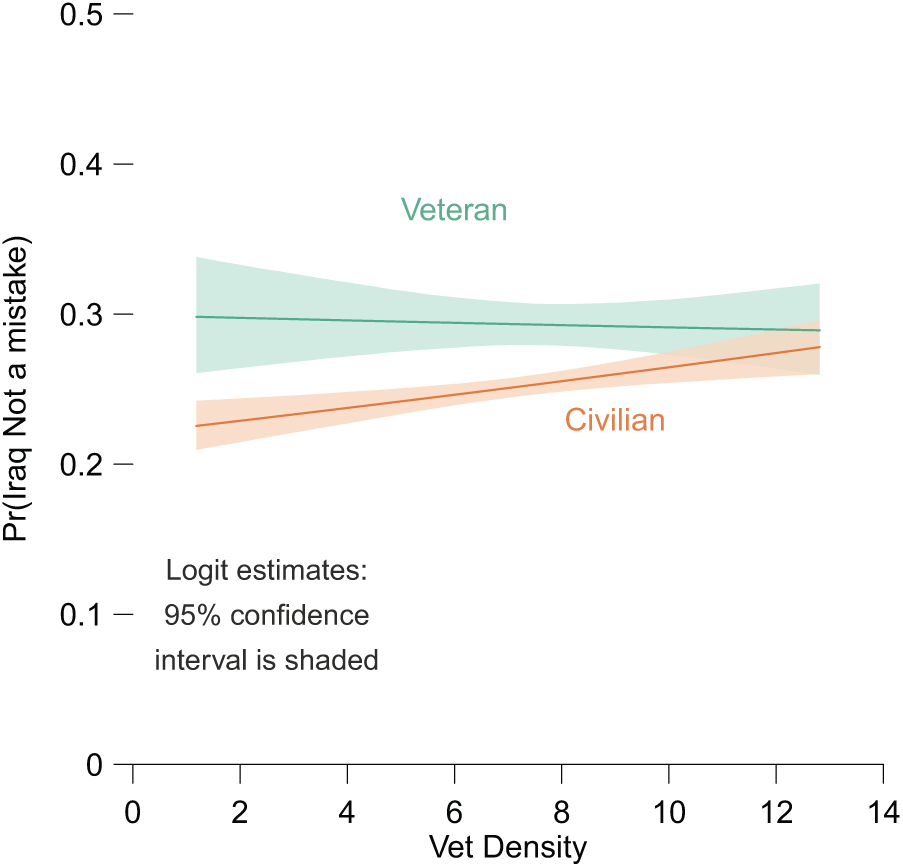
Predicted probabilities of support for the War in Iraq, by veteran status and population density.
We further explore whether this relationship between civilians and veteran density is driven by civilians who are connected to veterans. We showcase this effort with Model 2 in Table 1, which divides civilians into two groups—those with familial ties to military service members and those without—allowing the attitudes of each to be differentially influenced by veteran density as specified with separate interaction terms. The model fit to data indicates that relative to veterans, and at the lowest levels of veteran density, both connected and unconnected civilians are less likely to say that the War in Iraq was a mistake. To illustrate the magnitude of this difference and how it changes over the full range of veteran density, we turn to Figure 2.
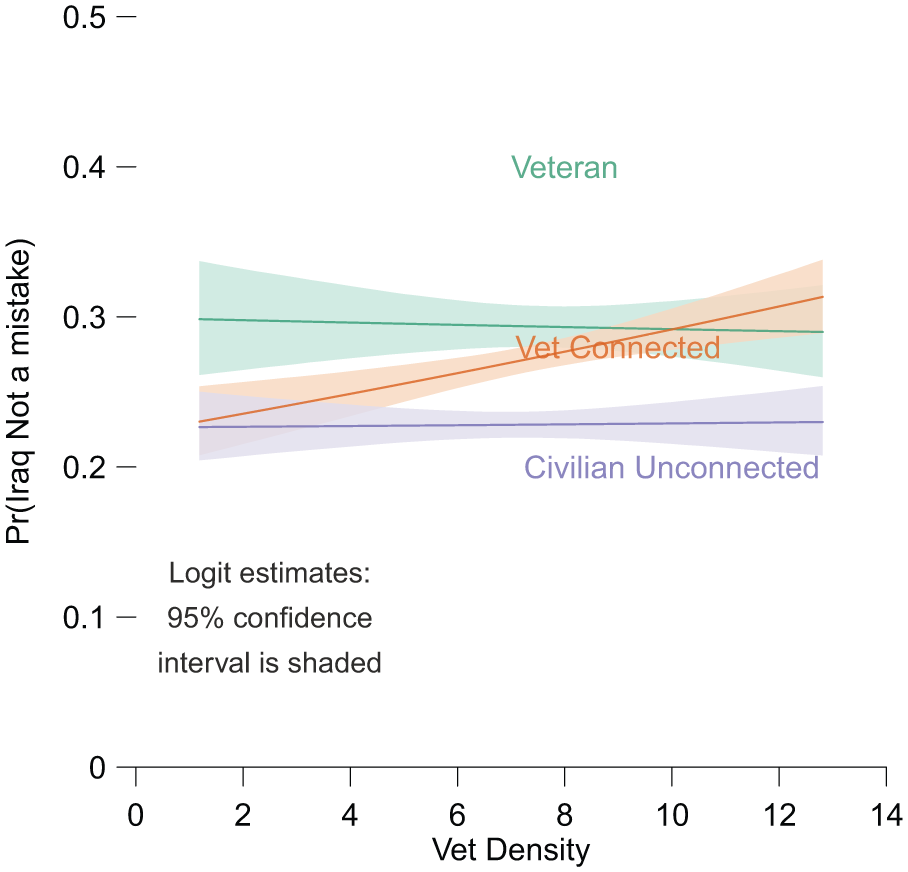
Predicted probabilities of support for the War in Iraq by veteran status, connection, and population density.
Like predictions extracted from Model 1, those from Model 2 shown in Figure 2, indicate that veterans behave as attitudinal anchors when it comes to the War in Iraq. Unlike the pattern observed in the first figure, however, this second figure shows that movement toward “prototype” attitudes is only among civilians with family ties to veterans. From the lowest to the highest observed values of veteran density, the veteran-connected in the sample are about 8 points more likely to say that the War in Iraq was not a mistake (about 23% to 31%). The difference relative to veterans across the full range of veteran density values shifts from a -7 point difference at the low end of veteran density, to a +2 point difference in congressional districts with the highest proportion of veterans. While the 95% confidence bands around the estimates overlap at extreme values of veteran density, the model estimates clear moderating effects of veteran density for the attitudes of civilians connected to veterans. These residual issue public members respond to the density of veterans in their surroundings, but their counterparts who are not connected to veterans—those without residual group salience to activate—do not.
As Table 1 shows, these key patterns are observed controlling a variety of known correlates of war attitudes. In the third column we report the analysis of model uncertainty, a strategy for assessing the extent to which statistical relationships are sensitive to model specification. Specifically, we use Bayesian Model Averaging as a tool to assess whether a variable contributes to the model’s explanatory power. Figures reported in column three correspond to P(β! = 0|Y), the posterior probability of models that exclude the variable of interest (Hoeting et al., 1999). As we might anticipate, partisan identity, sex, and various socio-economic indicators carry the day as explanatory variables of attitudes toward the Iraq War. War casualties offer little explanatory power, a finding that we address in more detail below. However, the analysis also reveals posterior probabilities of 54% and 85% for the indicators of connected civilians and unconnected civilians, respectively, as well as a 53% posterior probability for the interactive term. This is evidence that our selected specification is not “cherry picked” from a larger set of possible alternative specifications that leave out or include different variables or sets of variables. The Bayesian Information Criterion score (BIC), which penalizes models with more covariates, is lowered despite adding more variables. As a general rule, BIC reductions between 10 and 100 are “strong” evidence against the null (Raftery, Madigan, and Hoeting 1997), which here is the expectation that veteran density similarly effects veterans, veteran-connected civilians, and unconnected civilians.
Our interpretation of the analysis emphasizes group dynamics. However, the findings may reflect economic self-interest. We account for this possibility with an indicator for the 46% of sample respondents whose congressional district contains a military base. The indicator distinguishes the presence of military bases from veteran density, and controls the effect of supporting war because one’s economic status is linked to military bases, like people who live or work on base, or have business that depends on base population. Columns 1 and 2 of Table 1 show that living in a district with a base is positively associated with support for the War in Iraq, but there is high model uncertainty about this result as column three indicates (poster probability of 26%). Analysis reported in the online supplement replicates Model 2 using only the sample respondents whose congressional district does not contain a military base. We find similar results as those shown in Table 1 and Figure 2 (in fact, slightly stronger). Economic self-interest, measured through proxy of military base, has an independent association with support for the War in Iraq. However, even controlling this factor, we still observe a differential moderating impact of veteran density for civilians connected to a veteran, not veterans themselves, whose economic fortunes, one presumes, would be the most tied to war.
Evaluative discussion
The preceding analysis has investigated attitudes toward the War in Iraq in 2010. We argued that issue publics can be thought of as groups. These issue publics consist of leaders and followers, or “core” and “periphery” members. The residual group saliency argument is that military veterans, “core” members of the veteran issue public, exemplify prototypical attitudes, and residual group saliency activates a pressure to conform to prototypical attitudes among civilians with family ties to veterans. This effect is greater where there are more “core” members, but does not register for those civilians without a family tie to the military. Issue publics can grow, but the source of that growth is more available from some segments of the public than others.
The empirics we report are compatible with extant research on support for war, including the general pattern of greater support among veterans (Gartner, 2008; Mueller, 1973), and that social ties to veterans typically translates into greater support for war (Gartner, 2008; Lau et al., 1978). The qualified exception is that we find no statistical association between the number of war casualties and the view that the War in Iraq was not a mistake. This appears contrary to research that shows casualties are a major factor in determining public support for war (Gartner and Segura, 1998; Mueller, 1973). However, as Gartner and Segura (1998) point out, the impact of casualties is temporally structured, such that deaths occurring closer to the point of war initiation are weighted more than those nearer to the close of war. The combined temporal proximity of the Great Recession (2007–2009) with the temporal distance of the 2007 surges in Iraq War casualties mitigated the differential local effect of casualties.
By the time data from the survey that we analyze were collected, foreign policy issues were eclipsed on the national agenda by domestic concerns. However, just because an issue falls off the public agenda does not mean that its issue public disappears. That is the point of the issue public concept; for some Americans an issue remains important, regardless of its rise and fall on the public agenda. The study here suggests that even when the many are not attentive to an issue, the issue public itself, though they may be few, can generate issue public expansion.
This insight motivates further engagement with existing lines of inquiry. For example, we might further reconcile the findings here with research on casualties and support for war by replicating our analysis at the start and at the mid-point of the War in Iraq. For scholars of the civil-military gap, residual group saliency suggests that the division between veterans and the rest of the public need not be so stark. The concepts of prototype and periphery might help organize investigations of other attitudes and behaviors within and between veterans and their civilian counterparts. Fruitful synthesis might also be achieved with research that explores social network ties to war casualties as determinants of war attitudes and vote choice (e.g. Gartner, 2010). Just as a “prototype-based social attraction gradient” governs in-group favoritism and out-group antipathy (Hogg, 2001: 187), perhaps variation in strength of social ties structures war-related attitudes and behaviors (e.g. distinction by family, friend, co-worker or neighbor). Finally, is there an analogous “strength of weak ties” pattern (Granovetter, 1973) to issue public attitude formation and political behavior influences, in general? These questions are clearly beyond the scope of this study, but ones that are relevant to understanding issue publics and political behavior more generally. Whichever line of inquiry is further developed in research about issue publics, scholars benefit from the new theoretical and empirical grounds about the structure and dynamics of issue publics that our analysis provides.
Footnotes
Acknowledgements
The authors would like to thank the anonymous reviewers for their insightful comments and Michael T. Koch of Texas A&M University for his valuable feedback and for access to the casualty data.
Declaration of conflicting interest
The authors declare that there is no conflict of interest.
Funding
This research received no specific grant from any funding agency in the public, commercial, or not-for-profit sectors.
