




Abstract
This paper investigates the religious dimension of Republican legislators’ participation in one-minute speeches during the 104th Congress (1995–1996). Many have characterized the House Republican Conference that emerged after the 1994 elections as a highly cohesive majority party. Even in that context, however, legislators represent varied personal agendas, and in part these are informed by religion. We topically coded a subset of floor speeches to measure the extent to which variation is observed in the issues addressed by Members of Congress. The findings demonstrate that on key policy domains, such as the role of government, culture, and social welfare, speech participation varies systematically on the basis of member religion. This suggests that legislative participation is influenced by genuine personal preferences in additional to strategic political factors.
Introduction
This paper explores the representation of religious agendas by Republican members of the US House of Representatives in the 104th Congress (1995–1996). We ask: is there evidence of intra-party division, and is it informed by religion? Almost 20 years has passed since the historic midterm congressional elections of 1994 that ended four decades of uninterrupted Democratic control of the House. At the time, many observers believed that the country was at the beginning of a new era of cohesive Republican dominance (Cloud, 1994; Cooper and Young, 1997). Republicans had successfully defied the aphorism that “all politics is local” by running on a national agenda; they brought the Appropriations Committee under party control (Aldrich and Rohde, 2000); and they showed tremendous unity on the floor. We argue that while Republicans rallied around a core agenda, below the surface members pursued diverse policy agendas influenced partly by religion.
Looking back to an earlier era of Republican ascendance allows us to learn something about the current era of party politics. Studying the 104th Congress reveals that the defining features of contemporary congressional dysfunction were laid down in the early 1990s. The 104th Congress had been the most ideologically polarized and least productive to date. In part, this was owed to candidate recruitment and the movement of Evangelical Protestants and white Catholics from the Democratic Caucus into the Republican Conference. Since then, each House has been more polarized than the last, culminating in the 113th Congress (2013–2014). 1 Then as now, however, the ability of the majority party to govern was partly undone by intra-party division.
Several scholars have established systematic patterns of legislative behavior shaped by religion (Fastnow et al., 1999; Green and Guth, 1991;McTague and Pearson-Merkowitz, 2013; Oldmixon, 2005), but the importance of religious agendas may be masked by focusing on roll call voting. Following Burden (2007), we investigate representation in an area unconstrained by party leaders: floor speeches. The analysis provides a greater understanding of the roots of contemporary congressional dynamics. Moreover, it affords a greater understanding of the complexities of governance. As the recent kerfuffle over the pulled House abortion bill demonstrates (Newhauser and Fox, 2015), it is difficult for leadership to set an agenda that resonates with the entire party when it divides along religious lines. Moreover, this study provides an opportunity to consider larger issues of representation. Participation in the legislative process is uneven (Hall, 1996). Members are time constrained and have different interests. As a result they make different, purposive choices as to whether and how to participate in the policy process. The decision to participate affects the kinds of agendas that are represented in Congress. To the extent that religion informs representation, its importance in the legislative arena is more significant than legislative scholars generally recognize.
Theory
The religious context
When Republicans took over as the House majority in 1995, they moved quickly on their core agenda. Most items died in the Senate or were vetoed by the president, but the Republican Conference behaved like a unified, responsible party. Indeed, the level of party unity voting, votes on which a majority of Republicans opposed a majority of Democrats, rose to 73% of House votes. Even so, the Conference included several notable ideological policy factions. Some were animated by a strong sense that the national government was too big and that it stifled economic growth; others were deeply concerned with cultural and moral decay. Moderate elements of the Conference may have been sympathetic to the economic and cultural agendas of their colleagues, but they were less ideological on both dimensions (Koopman, 1996; Rae, 1998).
We argue that apparent party unity belied a diverse Conference, and that this diversity was owed in part to members’ personal values. Burden (2007) notes that while we often think of representatives as highly responsive to external cues, such as constituency preferences, they are often attentive to internal or introspective cues. These cues “probably do not trump partisanship on most roll call votes”, but “the conditions under which personal characteristics matter are widespread and predictable” (Burden, 2007: 16). In the same way, Hall (1996: 56) argues that in addition to pursing electoral and partisan interests, members pursue their own “personal policy interests and ideological commitments”.
We focus on religion as a source of personal values. The political significance of religion is owed to several factors. The ethno-religious approach emphasizes belonging. In belonging to a religious community, individuals are exposed to shared teachings that produce a common worldview, and the shared social status commonly experienced by many communities of believers. Together, shared values and social experiences provide a lens through which religious people view the world. To the extent that the world does not comport with their norms, religion provides the basis of political grievance and engagement Wald and Calhoun-Brown (2011). Crosscutting these traditional alignments, the religious restructuring approach emphasizes believing and behaving. Sometimes called the “New Gap”, this approach notes the diversity within religious traditions, especially on the basis of traditionalism, which is the extent to which individuals internalize the authority of religion.
In the context of the 104th Congress, the prominence of Catholics and Evangelical Protestants is especially notable. By the early 1990s, white Catholics, especially the most observant white Catholics, had been moving into the Republican camp for several years (Green, 2010; Wald and Calhoun-Brown, 2011). For their part, Evangelical Protestants firmly established themselves as a key Republican voting block in the late 1970s. They did not comprise a majority of the Conference in the 104th Congress, but evangelical groups such as The Christian Coalition provided Republican congressional candidates tremendous support in 1992 and 1994, and these were elections in which more than half of the Conference in the 104th Congress first entered Congress (Koopman, 1996; Rae, 1998).
Reflecting these mass level changes, the religious composition of House Republicans changed dramatically in the latter half of the 20th century. Guth (2014a) reports that in the 103rd Congress (1993–1994), 49.4% of House Republicans identified as Mainline Protestant. This is down from 68.8% in 83rd Congress (1953–1954). Mainline decline was accompanied by growth in the proportion of white evangelicals and white Catholics. The proportion of white evangelicals more than doubled (from 6.9% of House Republicans in the 83rd Congress to 15.2% in the 103rd Congress). In that same timeframe, the percentage of white Catholics in the Republican Conference nearly doubled (from 10.6% to 21.6%). Thus, while the post-war era Republican Conferences were dominated by Mainline Protestants, Republican Conferences in the 1990s were more pluralistic. It is because of this increased level of pluralism that we expect to find diverse policy agendas among House Republicans in the 104th Congress.
Religious agendas
The kinds of issues that comprise religiously informed policy agendas are myriad. We consider the following: cultural traditionalism, poverty and social welfare, and the role of government. These are operationalized as a count of speeches aligned with specific codes (Baumgartner and Jones, 2014).
Cultural traditionalism is central to Evangelical Protestants and Catholics. The perception among evangelicals of cultural degradation played an important role in their political mobilization. Among Catholics, cultural traditionalism has been tremendously important to the Bishops Conference, which has encouraged mass level activism among lay Catholics in support of Catholic teachings. We use the following speech topics as proxies for cultural traditionalism: Civil Rights, Minority Issues, and Civil Liberties; Immigration; Law, Crime, and Family Issues; Presidential Impeachment and Scandal
Poverty and social welfare are likely to be salient among Evangelical Protestants and Catholics alike. Catholic teaching on these kinds of issues lends itself to policy focused on alleviating the structural factors that produce poverty and injustice. This has commonly entailed support for a robust welfare state. Many evangelicals, however, oppose government expansion generally and expanding the welfare state specifically (Koopman, 1996), as it is thought to create a dependence on government and undermine virtue. While Catholics and evangelicals approach these issues differently, they were and are central to both. We use speeches on the following topics as proxies for poverty and social welfare: Health; Social Welfare; Education; Labor, Employment, and Immigration
Finally, we consider the role of government. We do not have a particular expectation for Catholics. Among evangelicals, however, the scope of government was (and is) a major flashpoint. Barker and Carman (2000) argue that Evangelical Protestants are more likely to support a limited role for government given the centrality of individual work and virtue inherent in Calvinist theology. We use the following speech topics as proxies for the role of government: National Budget and Debt; Taxation, Tax Policy, and Tax Reform; Budget Requests for Various Agencies and Independent Commissions; Intergovernmental Relations
Data
The difficulty in sussing out the influence of religion on legislative behavior is in deciding where to look. The focus on roll call voting among congressional scholars is understandable, given that this is where policy is made. It is not, however, where policy is developed, and it is also tightly controlled by the leadership. Roll call votes present members with dyadic choices that may not represent the full range of their preferences. Moreover, the concept of representation is broader than a focus on roll call analysis would suggest. MCs have myriad opportunities to act on behalf of their constituents. Sulkin (2005) and Schiller (1995), for example, have found that members actively promote their agendas via the introduction and co-sponsorship of legislation.
Echoing Burden (2007: 8), we look for personal representation “upstream in the policy process”, where members have greater agency. Specifically, we analyze one-minute speeches. Party leadership solicits speeches and distributes talking points (Harris, 2005), but rank and file members have access to the floor outside of leadership coordination efforts. While acknowledging that there are multiple avenues for personal representation, we focus on speeches because by the 104th Congress they had become an increasingly important tool among legislators, especially after cameras were placed in the chamber in 1979. Gingrich himself noted that speeches provide an opportunity to discuss complex topics (Maltzman and Sigelman, 1996). While few members are present in the chamber while one-minute speeches are delivered, “every House office is tuned in to C-SPAN to watch morning proceedings in the chamber… Members and staff watch one-minute speeches or at least monitor the subjects being discussed, along with considerable interest in which Members are speaking” (Shogan et al., 2013: 3). One-minute speeches are a vehicle through which representatives can express their legislative policy agenda to constituents and colleagues (Maltzman and Sigelman, 1996), and they may be a vehicle for shoring up electoral goals (Morris, 2001).
We identified 787 speeches delivered by Republicans during the second session of the 104th Congress (3 January 1996 to 4 October 1996). 2 The speeches were coded topically to measure the extent to which members from different religious communities articulated distinct agendas. We employ the major topic and subtopic codes and the coding guidelines of the Policy Agendas Project (Baumgartner and Jones, 2014) to classify speeches on the basis of their content. The Policy Agendas Project Codebook includes 30 major topics (e.g. Macroeconomics, Health, and Education). Within each major topic, there are more nuanced subtopic measures. For example, the major topic Macroeconomics, includes nine subtopics including: inflation, prices, and interest rates; unemployment rate; and national budget and debt. We assigned up to two major and subtopic codes for each speech. 3
Figure 1 reports the number of speeches addressing each of the Policy Agendas Project’s major topics. Because some speeches are assigned two major topic codes, the total of speech issues is 976. A total of 25% of speeches address Government Operations, which includes discussion of budget requests, appropriations for multiple departments and agencies, intergovernmental relations, government efficiency and bureaucratic oversight, congressional operations, nominations and appointments, and presidential impeachment and scandal. A total of 20% of speeches address Macroeconomics. Health is the third-most popular topic with 13% of speeches addressing a health-related policy. These include, for example, speeches on health care reform, insurance availability, and regulation of the drug industry. The remaining 40% of speeches are distributed across the remaining topics.

Count of speeches by Policy Agendas Project major topic codes.
Member religion is our primary independent variable of interest. We measure this in two ways. Drawing on the ethno-religious approach, and given the movement of Catholics and Evangelical Protestants to the Republican Party at the mass level and in Congress, we classify members by religious tradition following Steensland et al.(2000), and include two indicator variables (Catholic = 1; Evangelical Protestant = 1) in our models. Drawing on the restructuring approach, we include a measure of religious salience, which is based on whether MCs mention religion in their Congressional Directory biography. Given that “religious traditionalists usually put greater importance on the role of religion in their lives, this measure provides another partial proxy for the theological orientations that are more difficult and time- consuming to ascertain” (Guth, 2014b: 10). We also include the percentage of each congressional district classified as Catholic and Evangelical Protestant to control for district-level religion. 4
We include additional controls for member ideology, whether a member is a party leader, the safeness of the member’s district, sex, and tenure.
Member ideology
DW-NOMINATE scores were used to measure member ideology (Poole and Rosenthal, 1997). These scores range from −1 to +1, with −1 being the most liberal and +1 being the most conservative. All Republicans in the 104th Congress had NOMINATE scores in the positive, conservative range. Pearson and Dancey (2011), Maltzman and Sigelman (1996), and Morris (2001) all use ideological extremism to predict the level of speechmaking. We predict that the most conservative members of the Conference will be the most energized and most likely take to the floor.
Party leaders
Party leaders have a responsibility to promote the interests of their party (Cox and McCubbins, 1993). Thus, we include an indicator variable (party leader = 1) to control for the possibility that leaders will more likely to use the floor to that end (Maltzman and Sigelman, 1996).
Safeness
Safeness is measured as a percentage of the vote received by members in their most recent election. Safer representatives may feel less pressure from the district, and less urgency than vulnerable representatives to position-take.
Sex
Pearson and Dancey (2011) find that congresswomen are more likely to give one-minute speeches as a way to make up for their underrepresentation. We include an indicator variable (male = 1) to control for that possibility.
Tenure
We use tenure as a measure of seniority. This is the total number of consecutive years served by the member. Because more senior members have less of a need to demonstrate policy competency (Morris, 2001; Pearson and Dancey, 2011), we expect seniority to be negatively associated with speech participation.
Analysis and discussion
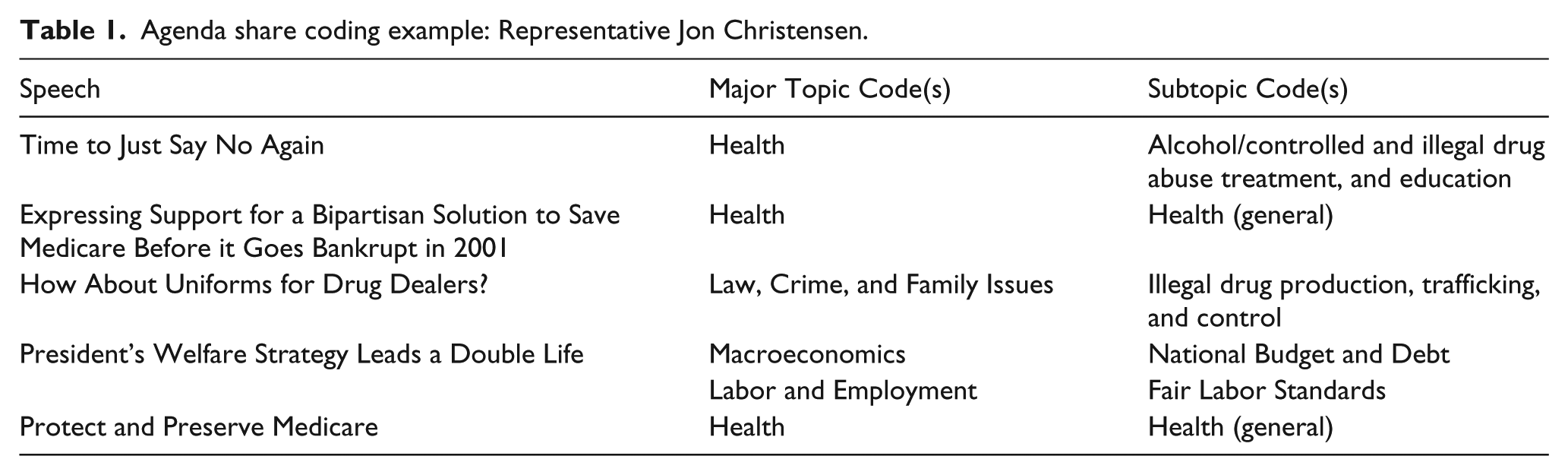
Table 1 illustrates the process by which speech variables were constructed using the speeches of Representative Jon Lynn Christensen (NE). Representative Christensen delivered five speeches; they are catalogued below. One speech addresses two issues, creating a total of six speech issues. A total of 50% of Mr Christensen’s agenda is allocated to Health while 16.67% is allocated to Law, Crime, and Family Issues, 16.67% is allocated to Macroeconomics, and another 16.67% is devoted to Labor and Employment. The subtopic-based measure of the agenda provides more specificity. A total of 33% of Mr Christenen’s agenda is focused on general Health issues. Each of the following issues is the subject of 16.75% of Mr Christensen’s attention: Alcohol/controlled and illegal drug abuse treatment, and education; Illegal drug production, trafficking, and control; National budget and debt; and Fair Labor Standards. Using the process outlined above, we count the number of speeches delivered on each topic by each member.
Agenda share coding example: Representative Jon Christensen.
Next, we subject these data to multivariate analysis. Our dataset includes 236 Republican MCs. On average, each member delivered 3.3 speeches. The standard deviation is 5.6, suggesting considerable variability in speech participation. Indeed, the modal level of participation is zero. Rep. Cass Ballanger (R-NC), at the other extreme, delivered 44 speeches. A total of 30% of the conference did not participate in speech-making. Thus, we assess the religious dimension of one-minute speeches using zero-inflated Poisson regression (Long, 1997). This two-part estimator accounts for the absence of speeches on the part of many members. The first stage is a logit model that estimates the probability of never speaking. The second stage estimates the number of speeches given (see also Branton, 2009; Rottinghaus and Bergan, 2011). Thus, we distinguish between members who never speak and members who sometimes speak. The statistically significant Vuong test indicates that the zero-inflated Poisson is superior to a standard Poisson model.
Table 2 reports the results of the count analysis. First, we ask, “which members are the most likely to participate in speech-making?”. We included ideology, tenure, sex, safeness, party leader status as covariates in the first stage model. To our surprise, the usual suspects did not consistently discriminate between participants and non-participants. Previous work suggests that we should expect significant, positive effects for ideology and party leadership, and significant, negative effects for tenure, sex, and safeness. The only significant relationships to emerge were between speech participation and ideology in the culture and social welfare models, and between speech participation and tenure in the social welfare model. Those relationships, however, are not in the expected direction.
Zero-inflated Poisson regression predicting count of one-minute speeches, 1996.

Statistical significance at the 0.10 level. *Statistical significance at the 0.05 level (two-tailed tests).
Marginal effect is average change in number of speeches associated with 1-unit change in IV.
We next consider whether religious belonging affects the substance of speech participation. The short answer is, yes and no. In the cultural model, Evangelical Protestants deliver more speeches than their colleagues. The marginal effect seems modest, but given that the modal level of participation is zero, even modest changes are notable. Catholic MCs, however, are indistinguishable from their colleagues. The lack of a significant finding among Catholics is notable given the centrality of these issues to the Bishops Conference. Lay Catholic opinion on cultural issues, however, does not clearly align with Church teachings, and our findings may reflect that. Indeed, although the relationship does not achieve conventional significance, the proportion of Catholics at the district level is negatively associated with speech participation.
On social welfare issues, we find that religious salience is negatively related to speech participation. Moreover, while Catholics are indistinguishable from their colleagues, Catholics for whom religion is salient discuss social welfare more frequently. While evangelicals are also indistinguishable from their colleagues, MCs from strongly evangelical districts discuss social welfare more frequently. These representatives may be using their speeches to represent the religious constituencies in their districts, instead of representing their personal religious agendas
Finally we note that Catholic members spoke more frequently on the role of government than their colleagues. Religious salience was also negatively related to speech participation. Evangelicals were indistinguishable from their colleagues, but MCs from strongly evangelical districts more frequently addressed the role of government. To provide context, during this timeframe there was a government shutdown and Republicans had just considered a balanced budget amendment to the constitution the previous year. Budget and tax issues, which are major components of speeches in this domain, were highly salient. There has been some debate as to whether fiscal issues were ever really a priority among evangelicals, or whether it was a priority among evangelical interest group elites looking to established common ground with establishment Republican Party elites. This finding suggests that the role of government was not a core priority among evangelical members, but that it was a priority for members representing evangelical districts.
Conclusion
The Republican Conference of the 104th Congress was a highly unified governing party. Our results do not undermine that characterization.
It is notable and important, however, that even in the context of a highly unified Conference, we find that members used speech participation to pursue their own agendas, and that these agendas were in part informed by religion. After controlling for the usual suspects, we found that Catholic members dedicated significantly more agenda space to the role of government, and Catholics for whom religion was salient devoted significantly more agenda space to social welfare. For their part, evangelicals devoted significantly more agenda space to cultural issues. Across denominations religious salience was negatively related to speech participation on social welfare and the role of government. Moreover, while speech participation provides opportunities for legislators to engage in personal representation, it also provides opportunities to represent constituency religious communities. The logic is essentially the same: legislators with limited opportunities to engage in representation using floor votes look for other outlets. Speeches provide an outlet where legislators can advertise and position-take.
We speculate that the modest impact of religion is partly the result of party messaging strategies. Leaders orchestrate speeches to promote their party’s agenda (Harris, 2005). To the extent that leaders orchestrated speeches on the key issues assessed in this paper, it may be difficult to identify personal representation. Moreover, speeches are often a tool used by members whose central issues are not on the legislative agenda (Rocca and Gordon, 2010), whereas the issues we considered were very much on the agenda. These factors makes the presence of even modest findings important.
The religious dynamic of speech participation varies, and moving forward it is important to consider whether it varies over time and by party. In the short term, however, our findings demonstrate that legislators represent diverse religious policy agendas, and that even unified parties can be disrupted by “personal representation” operating below the surface of party labels. We do not suggest Republicans experienced internecine conflict, but our findings help explain why party-line voting dropped precipitously in the short term and fully recovered in the long term. In the short term, party unity could not be sustained in the face of even marginal religious variation within the Conference, to the extent that religious variation is associated with diverse policy preferences. In the long term, that variation has diminished as the Conference proportion of Evangelical Protestants and white Catholics has increased at the expense of Mainline Protestants. The Republican Conference in the 113 Congress was as conservative and as cohesive as it has ever been, but roots of this were established 20 years ago. As the analysis demonstrates, even the most unified party can be undermined when legislators bring their personal religious values to bear on the policy process.
Footnotes
Acknowledgements
The authors thank Gina Branton, Jim Guth, Matthew Eshbaugh-Soha, and the referees for their helpful comments and Jesse Hamner for technical assistance.
Funding
This research received no specific grant from any funding agency in the public, commercial, or not-for-profit sectors.