




Abstract
At its core, Duverger’s Law, which holds that the number of viable parties in first-past-the-post systems should not exceed two, applies primarily at the district level. While the number of parties nationally may exceed two, district-level party system fragmentation should not. A growing body of research, however, shows that district-level party system fragmentation can indeed exceed two in first-past-the-post systems. This piece addresses the fundamental tension between Duverger’s Law and recent scholarship on district-level party systems. I explore whether the major alternative explanation for party system fragmentation – the social cleavage approach – can explain violations of Duverger’s Law. Testing this argument in several west European elections prior to the adoption of proportional representation, I find evidence favouring a social cleavage explanation: with the expansion of the class cleavage, the average district-level party system eventually came to violate the two-party predictions associated with Duverger’s Law. This suggests that, in defiance of Duverger, greater levels of social cleavage diversity may produce multiparty systems even in first-past-the-post systems.
Over the past few decades, party system fragmentation has increased in most advanced industrial democracies, including those democracies that do not operate under proportional representation (PR). This increase in party system fragmentation has occurred despite the fact that third parties are not winning seat shares proportional to their vote shares (Best, 2010). This finding suggests that Duverger’s ‘mechanical effect’ – or the way that electoral systems translate votes into seats – operates as theory suggests (1963; see also Cox, 1997). However, because this finding shows evidence of sustained third-party electoral fortunes (if not translated into seat shares), this suggests that the ‘psychological effect’ (whereby third-party supporters desert parties with no chance of winning seats) does not operate as it should. This stands in contrast to much of the literature holding that even if multiparty systems emerge in one election, electoral coordination should improve over time, resulting in fewer wasted votes and lower levels of party system fragmentation (e.g. Crisp et al., 2012; Lago and Martinez i Coma, 2012; Tavits and Annus, 2006).
Despite arguments showing how multiparty systems may emerge at the national level while district-level competition in first-past-the-post (FPTP) systems features only two parties (Cox, 1999), recent research shows that party system fragmentation in FPTP systems often exceeds the two-party expectations of Duverger’s Law (e.g. Diwakar, 2007; Gaines, 1999; Singer, 2013). Some have made the case that this is due in part to federalism and/or multilevel elections, which allows third parties to develop in elections at one level and subsequently enabling them to compete as third parties in future elections at another level (Chhibber and Kollman, 2004; Gaines, 1999, 2009). However, the fact remains that party system fragmentation exceeds two-party predictions in unitary systems as well (Raymond, 2013).
One is left, then, with a theoretical puzzle: if district-level party system fragmentation in some FPTP systems exceeds two-party predictions, what explains the development of these multiparty systems? Drawing from research arguing that party system fragmentation is shaped by the social cleavage structure of society (e.g. Lipset and Rokkan, 1967), I argue that even in FPTP systems, party system fragmentation at the district level may increase beyond two-party predictions when the social structure becomes sufficiently diverse to sustain multiparty systems. While some research finds cleavage diversity may produce multiparty competition (Dickson and Scheve, 2010; Stoll, 2013), few studies have examined and confirmed such arguments at the district level in elections held under FPTP rules (see Singer, 2013 for a notable exception).
One factor inhibiting analysis of the impact of social cleavages on the development of multiparty systems is that most of the countries that have developed multiparty systems also adopted PR systems around the same time. Because PR is seen as a necessary condition for social cleavages to produce multiparty systems (e.g. Clark and Golder, 2006; Duverger, 1963; Singer and Stephenson, 2009), it is difficult to tell if the prevalence of larger party systems at the district level in PR systems is attributable to cleavage diversity per se. The estimation of social cleavage effects is complicated further by the growing body of research which maintains that the choice of electoral system is endogenous to the incentives facing parties, leading party leaders to choose the electoral system that best serves their partisan interests (e.g. Boix, 1999; though see also Cusack et al., 2007). Thus, in order to determine whether an increase in cleavage diversity is sufficient to produce and sustain multiparty systems at the district level, one would need to examine the relationship between cleavage diversity and party system fragmentation under FPTP rules.
To test the social cleavage explanation for the emergence of multiparty systems, I examine the effect that the development of the class cleavage around the mid-19th and early 20th centuries in western Europe had on district-level party systems around the time that countries began adopting PR. While previous research has documented the emergence of multiparty systems prior to the adoption of PR at the national level (Shamir, 1985), it is possible that multiparty systems developed at the district level as well. If the conventional wisdom is correct (e.g. Cox, 1999), multiparty systems should not have emerged at the district level, or at least should not have developed due to the emergence of the class cleavage. If the social cleavage approach is correct, then the diversification of the social cleavage structure produced sustained multiparty systems at the district level.
Data analysis
I test the argument outlined above using data from several West European countries covering elections from the mid-to-late 19th century until the last election before the advent of the Second World War. The list of countries and elections includes Denmark (1849–1939), Germany (1874–1933), the Netherlands (1888–1937), Norway (1882–1936), Switzerland (1848–1939) and the United Kingdom (1832–1935). While only one country (Denmark) used a pure FPTP system prior to the adoption of PR with single-member districts, I am able to simulate the conditions under pure FPTP systems through the use of a few key control variables that I describe below. This allows me to determine if changes in the cleavage structure – namely, the emergence of the class cleavage – were sufficient to produce and sustain multiparty competition in defiance of Duverger’s Law.
The dependent variable measures average district-level party system fragmentation in each election using district-level data taken from Caramani (2000). 1 Specifically, I calculate the effective number of electoral parties (ENEP) in each district (Laakso and Taagepera, 1979) and use the mean for each election. 2 ENEP is an ideal measure of party system fragmentation because it weights each party’s contribution to the overall number of parties by its respective vote share. 3 Thus, ENEP values of two (reflecting two-party competition) allow for the presence of third parties failing to win meaningful vote shares; if ENEP significantly exceeds two, this would provide evidence that party system fragmentation exceeds the two-party predictions associated with Duverger’s Law. Because I calculate ENEP summing the vote shares for all of a party’s candidates instead of treating each candidate separately, this has the effect of reducing the number of parties, providing an even more conservative estimate of the number of parties.
I use mean district-level ENEP instead of treating districts as the units of analysis for two reasons. One is that both the number and boundaries of districts change over time. This complicates the analysis because the units examined are not consistent from one election to the next. Instead, using the mean allows us to avoid such issues by examining whether the average district exceeds two-party predictions. Additionally, given the time period examined here, district-level data measuring the class cleavages, as well as control variables like district magnitude, are not available. National-level data, however, are available, allowing us to examine whether changes in national-level conditions produce changes in the average district.
Figure 1 presents mean district-level party system fragmentation (ENEP) over time in each country. The data show that district-level party system fragmentation eventually exceeded two-party predictions in each country during the period under investigation. While the degree to which this was the case varies from country to country – i.e. Denmark exceeds two-party predictions prior to the adoption of PR only slightly, while others like Germany significantly exceed two throughout most of the time period – the fact remains that each country saw the development of multiparty systems at the district level prior to the adoption of PR.

Mean district-level party system fragmentation (ENEP) over time in each country.
In addition to the adoption of PR, this period also saw the development of class cleavages. As people began leaving the farms for industrial work in the cities, this allowed for the emergence of leftist parties (primarily socialist, though also Communists and a few centre-left ‘radical’ parties) representing the working classes. Prior to the emergence of these parties, party politics in most West European countries tended to focus on two major parties: conservatives and liberals. Because the class cleavage divided workers and employers in districts across the entire country, the emergence of the class cleavage allowed leftist parties to compete in districts across the entire country (Caramani, 2003, 2004). Greater contestation by leftist parties did not result in the displacement of one of the two existing parties. Instead, the development of the class cleavage sustained leftist parties, allowed them to compete alongside the existing conservative and liberal parties, thus producing greater party fragmentation as these leftist parties won more votes in more districts across the country.
To measure the class cleavage, I use Vanhanen’s (2003) Index of Occupational Diversification. This variable is created as the arithmetic mean of two variables essential to the emergence of the class cleavage: the percentage of the population living in urban areas and the percentage of the population employed in non-agricultural jobs. Lower values represent more rural farming populations, while higher values represent more urban populations involved in non-agricultural employment. As occupational diversification increases (i.e. as countries’ social structures become more urbanised and less agricultural), in turn producing class cleavages present across more of the country’s territory, leftist parties are able to compete alongside the existing parties in more districts. As this happens, party system fragmentation in the average district should increase. Because this variable is measured only once per decade, I use linear interpolation to fill in missing values. 4
Figure 2 plots occupational diversification in each country over time. Over the same period that multiparty systems began to emerge at the district level, the economies of western Europe became more diverse, producing more urban societies that increasingly divided the bourgeoisie and working classes in ways that facilitated the emergence of leftist parties to represent the working classes (whose interests did not fit neatly with those of the existing liberal and conservative parties’ social bases – the bourgeoisie and upper classes). Such a development would have been favourable to leftist parties, potentially allowing them to emerge and compete alongside the existing parties in each district without significant desertion from their supporters. This suggests that the development of these multiparty systems may be due at least in part to the emergence of the class cleavage.
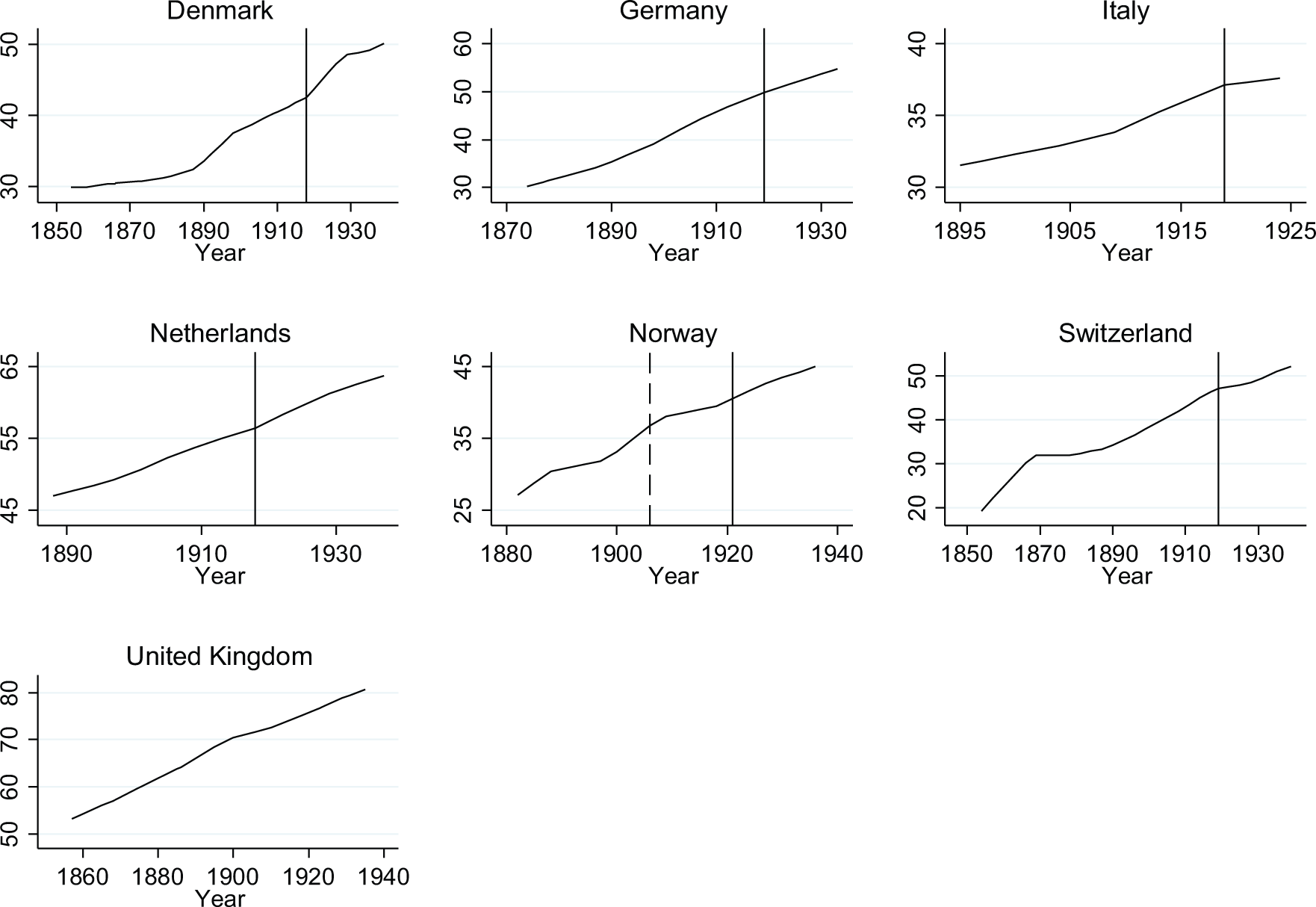
Occupational diversification over time.
In order to estimate the precise relationship between occupational diversification and district-level party system fragmentation, I include several control variables related to differences in the electoral systems of each country. Most prominent among these is a variable measuring elections held after the adoption of PR. This variable is coded one for all elections held after the adoption of PR while all other elections are coded zero.
A second variable controls for the fact that British and Swiss elections prior to the adoption of PR had district magnitudes greater than one. Because the data on the number of seats allocated to each district is not available for each election, I control for differences between elections held in single-member districts and those with district magnitudes greater than one. To do so, I include a variable coded one for elections in which mean district magnitude exceeds one, and zero otherwise, using information from Caramani (2000) regarding the use of multimember districts.
An additional control variable differentiates between elections that used plurality rules versus those using majority rules in order to estimate party system fragmentation in the simulated condition of a pure FPTP system. Because the conditions favouring strategic voting in FPTP systems largely disappear under two-round majority rules (e.g. Cox, 1997), party system fragmentation may exceed the two-party predictions associated with Duverger’s Law in elections with majority rules even if district magnitude equals one. To account for this, I include a variable coded one for majority systems and zero otherwise.
To test the argument that PR is necessary for social cleavages to produce multiparty systems (Clark and Golder, 2006; Duverger, 1963; Singer and Stephenson, 2009), I interact this variable with occupational diversification. In order to determine whether the effects of occupational diversification are conditioned by the multimember district or majority system variables as well, I interact occupational diversification with both the multimember and majority system variables. To simulate conditions in which PR had never been adopted, we need to look to the partial effect of occupational diversification (which holds PR and other institutional effects to zero). If the partial effect of occupational diversification reaches statistical significance, this would provide evidence that occupational diversification is able to produce multiparty systems.
I estimate this model using ordinary least squares linear regression. To eliminate any country-specific variance not captured by the more substantive variables included in the model, I include country dummy variables (leaving Denmark as the baseline). 5 To reduce the likelihood that the results are influenced by potentially outlying elections, I use jackknifed standard errors. An alternative means of dealing with unmeasured country-specific effects is to use a multilevel model treating elections as nested within countries. While the small number of countries requires caution in interpreting the results, I re-estimated the first model allowing for random intercepts in order to demonstrate the robustness of the first model. 6 The results of both models are presented in Table 1.
The determinants of mean district-level party system fragmentation.

p < 0.05, ** p < 0.01, one-tailed tests. n = 147. Standard errors in parentheses. Country dummies used in Model 1 are omitted.
The results in model 1 using bootstrapped standard errors show that occupational diversification is positively and significantly associated with mean district-level party system fragmentation. 7 Even after controlling for differences in electoral systems and the resulting interaction effects with occupational diversification, 8 the emergence of the class cleavage had an independent effect on mean district-level party system fragmentation. A one-unit increase in occupational diversification in FPTP systems (assuming all other variables are held to zero) is associated with an increase of effectively 0.50 parties. This finding holds when using a random intercept model, as demonstrated in Model 2. Here, the partial effect of occupational diversification remains significant and roughly the same size as Model 1: a one-unit increase in occupational diversification in FPTP systems is associated with an increase of effectively 0.48 parties.
The results demonstrate that increases in occupational diversification would have produced values of district-level party system fragmentation significantly greater than two-party predictions. This can be seen in Figure 3, which displays the predicted values of mean district-level party system fragmentation across the range of occupational diversification using the results in Model 1 (holding all other variables at zero). These predicted values begin to exceed two at the middle of the scale (occupational diversification values of 4.25). This value becomes significantly greater than two at values of 5.08 and greater. Thus, the findings demonstrate that, had each country’s economy developed enough prior to the adoption of PR, district-level multiparty systems would have emerged nationwide without the adoption of PR. Furthermore, these results suggest that the emergence of the class cleavage played a significant part in the development of multiparty systems at the district level in several West European countries independent of the choice of electoral system.

Predicted party system fragmentation across the range of occupational diversification.
Conclusion
As noted above, previous research shows that party system fragmentation in FPTP systems has at times exceeded two-party predictions even at the district level. Consistent with these recent findings, the analysis performed here suggests that, even if countries had not adopted PR (and even if they had all employed pure FPTP systems), the increase in cleavage diversity resulting from the emergence of the class cleavage may have facilitated the development of multiparty systems in western Europe. While it is difficult to generalise based on a sample that includes only one country using pure FPTP with single-member districts, these results support an understanding of party systems rooted in the social cleavage approach.
Due to the difficulty of generalising based on this sample, future research is needed to confirm these findings. First, more research is needed to understand why voters in FPTP systems vote non-tactically (or at least seemingly so). A social cleavage perspective (though one that is in keeping with an explanation found in Cox, 1997: 79) holds that voters vote non-tactically because class and other social group identities lead individuals belonging to one group to privilege their first preferences so strongly that they find parties representing other groups completely unsatisfactory. The fact that multiparty systems emerged as the class cleavage expanded supports this point: rather than desert leftist parties for the most-preferred of the remaining parties standing a better chance of winning seats, most working class voters would find liberal and conservative parties completely unacceptable representatives of their interests, and therefore would never vote tactically for either party (and likewise among most bourgeois/upper class voters). To demonstrate this point, however, further research must rule out another explanation: that voters do not desert third parties because they lack accurate information about the parties’ chances of winning (Blais and Turgeon, 2004; Clough, 2007; Cox, 1997: 79). While some recent research casts doubt on this second argument (Raymond and Tromborg, 2014), further research is needed to sort out which of these two arguments best explains non-tactical voting behaviour, even if the survey data needed to test such arguments are available only for recent elections.
Second, further research is needed to show that district-level multiparty systems emerge in districts where cleavage diversity is greatest, while two-party systems remain in less diverse districts, even in the absence of PR. Scholars should examine variation in district-level party systems in contemporary FPTP systems as part of this research. Despite the need for future research to confirm the conclusions drawn here, the findings presented above suggest that cleavage diversity is sufficient to sustain multiparty competition even in electoral systems that are less-than-favourable to the development of multiparty systems.
Footnotes
Acknowledgements
I would like to thank the Editor and three anonymous reviewers for their comments and critiques of earlier drafts of this piece. Such insights have significantly improved both the quality of the argument presented in this paper and the way in which it has been presented. All remaining errors belong to me.
Declaration of conflicting interest
The author declares that there is no conflict of interest.
Funding
This research received no specific grant from any funding agency in the public, commercial, or not-for-profit sectors.
