




Abstract
State legislatures have received considerable attention as drivers of policy outcomes, but research designs typically paint this branch of government with broad strokes. Studies that investigate the influence of party control or party strength on public policy often fail to conceptualize the upper and lower legislative chambers as unique bodies. But policy enactments at the state level depend on two chambers that are not carbon copies of one another. Using pension funding, health care and immigration reform as illustrations, this study demonstrates that altering models to include party measurements for both chambers can lead to substantively different conclusions about the effect of partisanship on policy outcomes. Further differences arise when binary measures of majority control are used instead of continuous measures of party strength. If accurate inferences are to be drawn from empirical models, these findings suggest scholars must conceptualize legislative measurement with due care.
Introduction
The legislative branch of government plays a formative policymaking role in representative democracies and their constituent jurisdictions. This is especially true in the American states. In 2014, state legislatures consisted of 7,383 seats populated with elected legislators who, supported by over 30,000 professional staff, prepared, debated and voted on thousands of bills concerning personal, business and governmental affairs.
Although state legislatures have attracted scholarly attention as an institutional driver of policy outcomes, research designs typically conceptualize the legislative branch too broadly. For example, studies aiming to define the influence of political party control or strength on policy outcomes have a tendency to treat the upper and lower chambers as if one or the other did not exist as a separate institution. In particular, many scholars explore the significance of partisanship in one chamber—often the lower house—but fail to model the other chamber, even though both bodies have an equally important role in policymaking. 1
This orientation glosses over the important difference between simple majority control and proportional party strength, and it overlooks characteristics distinct to each chamber that may be of relevance to the dependent variable in question. This mode of studying the legislative branch may cause omitted variable bias and distort the inferences drawn from statistical models. What a scholar concludes is a broad legislative influence may in reality be confined to one chamber or the other, and null effects could, in fact, result from opposing chamber influences.
Beyond model specification, empirical measurements that purport to include both chambers often suffer from conceptual shortcomings. Some studies acknowledge bicameralism by using a variable that sums partisan strength across upper and lower chambers; however, this measurement skews in favor of the larger institution—i.e. the lower house—even though the outcome under consideration is not necessarily weighted to size. 2 Averaging partisanship across chambers avoids this bias but still precludes discovery of chamber-specific influences. Several other studies measure one or both chamber’s party control relative to the executive branch by including a variable for unified or divided government, but statistically significant, unified government variables may indicate a strongly partisan legislature, a strongly partisan executive, or both.
I argue that scholars with theoretical reasons to include party control or strength as an explanatory variable should avoid one-dimensional measures and instead consider both the upper and lower houses. To that end, this study is organized into three sections. The first section outlines theoretical reasons why state legislative chambers may have heterogeneous effects on policy. The second section illustrates how various model specifications of party strength can yield more thorough, if not completely different, conclusions about legislative influence by revisiting contemporary policy studies on pension funding, health insurance coverage and immigration reform. The third section uses the same examples to illustrate that the inferences drawn from models about legislative effects on policy outcomes are different when simple majority control is modeled instead of party strength. A checklist of approaches to partisan effects in legislatures that scholars may wish to pursue is offered in conclusion.
Theoretical perspectives on chamber differences
Regardless of national or sub-national level, upper and lower chambers were formulated as connected but distinctive policymaking institutions under a philosophy of mixed government. As James Bryce notes in The American Commonwealth, bicameralism was partially a reaction to fear of a tyrannical, single legislative institution—a fear so pervasive that only four states ever experimented with a unicameral design (Bryce, 1906 [1995]). Balancing one legislative body with another of equivalent power was believed to be a proper safeguard (see also Coakley, 2014). With population-based member apportionment and shorter tenures, the lower chamber is theoretically more reflective of voter preferences. In contrast, the upper chamber’s less direct link to population and its longer tenures create a more deliberative body with lower turnover. Both chambers serve as a check on the executive and judicial branches of government but also as a check on each other.
It is thus not surprising that structural factors unique to each chamber affect the likelihood of bill passage when they are interacted with political factors (Hedlund, 1984; Rogers, 2005). Research suggests that rules governing committees and vote scheduling, which vary by chamber and are affected by party control (Cox et al., 2010), shape the legislative process within each chamber (Anzia and Jackman, 2013; Jackman, 2014; cf. Diermeier and Vlaicu, 2011). Term length and term limits, if present, also differ by chamber, increasing the chance that house and senate members of the same party may have heterogeneous policy preferences, particularly over fund appropriation (Apollonio and La Raja, 2006; Cummins, 2013; Miller et al., 2011). Greater seat competition in the lower chamber also raises the likelihood that members competing for limited party support are more likely to vote with their party.
Chamber size has implications for legislator behavior and member reliance on ideology (Kirkland, 2014). Legislatures as organizational bodies are no different than any other social network. Relative to smaller bodies, larger, more bureaucratized institutions complicate the formation of robust interpersonal relationships and thus frustrate communication. Uncertainty about their peers’ voting intentions, a lack of familiarity with procedure, and perhaps a lack of information about the content of bills under consideration—all of which are more likely in chambers with more members and higher turnover—may lead individual legislators to rely on guidance from party leadership (Uslander and Weber, 1977) or fixed heuristics like political ideology to determine their vote (cf. Wright and Schaffner, 2002). The relationship between ideology, party identification and roll-call voting varies by state. Within states, the size of the relationship can vary by chamber (Jenkins, 2006; cf. Cummins, 2013), raising the possibility that the chambers may have heterogeneous policy influences, whether measured in terms of party strength or simple majority control.
Finally, party coalitions in upper and lower chambers do not always agree with each other, even if the same party controls both houses. If, as research suggests, legislatures condition regulatory behavior on perceived reactions from other branches of government (McGrath, 2013; cf. Rudolph, 2003), it is certainly possible that elements within the legislative branch act in a similarly strategic manner. Indeed, analysis of appropriation bill support indicates that this “check” occurs between the United States House and Senate (Shepsle et al., 2009).
These otherwise disparate findings suggest that a quasi-institutionalism could exist in state legislatures whereby party control or strength within the chambers does not have a comparable influence on policy outcomes. This institutionalism is the combined result of distinctive chamber characteristics, including formal rules and norms; the role of party leadership; committee structure; membership size; and the effect of ideology (cf. Polsby, 1968; Rosenthal, 1996). It may thus result in unique influences on policy that can only be revealed with measurements that go beyond aggregate summative partisanship. I illustrate this phenomenon below.
Public policy illustrations
To explore the differential influences of legislative chamber party strength on state-level policy outcomes, I sought recent, peer-reviewed studies that included party strength as an independent variable. My objective was to replicate the published models and, leaving all other variables unchanged, vary the entry of party strength and make comparisons as appropriate. I do not wish to evaluate the theoretical or empirical approach of the scholars’ original work or the inferences drawn. Rather, I aim to determine whether the inferences derived from models using a particular measure of partisanship change when other measurements are used instead. In the following sub-sections, I discuss studies by authors who provided me with their data. 3 I present their original findings alongside my re-estimations.
Application #1: Public sector pension funding
A study by Thom (2013) sought to clarify the fiscal, political and workforce traits that affect public sector pension funding across the American states. The study’s dependent variable was each states’ pension funded ratio, calculated by dividing a pension plan’s assets by its long-term liabilities (i.e. the value of benefits promised to public employees). 4 The original study included continuous variables for Democratic partisanship in each state-year from 2000 to 2008, hypothesizing that higher Democratic partisanship should have a positive influence on pension funding.
Table 1 contains a replication of the original results and three additional model specifications.
Impact of party strength on public sector pension funding.

Model I includes the average proportion of Democratic identifiers across both chambers. Model II disaggregates partisanship and uses a separate variable for the party strength in the upper and lower chambers. Models III and IV include party strength in the lower and upper chamber only, respectively. All variables are continuous in measurement.
The original model (Model II) posited that pension funding was affected by state debt, citizen liberalism, collective bargaining and other workforce measures. But the coefficients suggested a curious relationship between party strength and pension funding: rising Democratic strength in the lower chamber had a reductive effect, while increasing Democratic strength in the upper chamber had a positive effect. Both coefficients were strongly significant and, despite high correlation (0.81), tolerance values do not suggest problematic levels of collinearity (0.22 for the upper chamber; 0.23 for the lower chamber). Since this particular funding measure is a proxy of long-term fiscal health, it is not surprising that the chamber with longer tenures and lower turnover— i.e. the upper—had a positive influence on funding, while the chamber with higher turnover and shorter electoral horizons—i.e. the lower —reflected the opposite.
When a combined measure of party strength (Model I) is used instead, the relationship between partisanship and pension funding is substantially different. Party strength in this model is not significant, and, at the same time, the coefficient for term limits now achieves a conventional level of statistical significance. In contrast to Model II, Model I’s results suggest that term limits, rather than partisanship, affect pension funding (cf. Keele et al., 2013). Importantly, policy implications also shift depending on the model specification: the problem is either partisan effects or term limits, but not both.
Model III and Model IV, which include Democratic strength in the lower or upper chambers, respectively, have slightly lower explanatory power. Both specifications also make less theoretical sense, since fiscal policy decisions are not rendered by one chamber or the other, but by both chambers in an iterative sequence. Thus, in this application, the model that makes the most theoretical sense is also the model with the strongest empirical support (Model II).
Application #2: Health insurance coverage
Cummins (2011) recently published a study that examined the effect of state-level factors on the percentage of the population living in each state that lacked health insurance coverage from 1987–2007.
Independent variables included standard demographic characteristics, the unemployment and poverty rates, medical inflation and party control of the executive and legislative branches. Cummins theorizes that stronger Democratic representation in policymaking bodies results in the enactment of policies that are aimed at reducing the uninsured population. The study concluded that, ceteris paribus, higher percentages of Democrats in state legislatures—both chambers combined—actually increased the uninsured population.
Table 2 contains four models. Model I replicates the original results and Models II–IV employ varied measures of party strength. The original study’s strength variable did not investigate whether the relationship between the percentage of Democrats in state legislatures and the uninsured population was a broad legislative phenomenon or if chamber effects differed, as they did in the pension funding illustration discussed above. Splitting the party variables (Model II) maintains the same explanatory power as the original model but produces no significant party coefficients. Once again, despite high correlation between partisanship measures (0.87), tolerance values did not suggest collinearity was a problem (0.23 for each chamber).
Impact of party strength on the uninsured population.

However, Model IV suggests that the effect of Democratic strength is not a legislative influence per se, but perhaps an upper chamber influence. Why? Speaking to partisan effects, Cummins finds separately that states with Republican control are more likely to adopt policies that expand insurance coverage than states with Democratic control; this finding reiterates Volden (2006), who found a positive link between Republican partisanship and the diffusion of Children’s Health Insurance Program reforms. Thus, if Republican strength lends itself to pro-coverage policies, it is not surprising that Democratic strength does not reduce the uninsured population. The institutional effect may be concentrated in the upper chamber for several reasons. It may be due to higher professionalization, better knowledge of the legislative process among members—who have longer tenures in office—and consequently more robust stakeholder relationships.
Application #3: state enactment of E-Verify laws
Immigration reform motivates impassioned debate and sometimes significant intergovernmental conflict. An important non-governmental actor waits on the sidelines: employers who must verify employees’ legal status. In recent years some states have enacted legislation mandating or strongly incentivizing electronic verification procedures (“E-Verify”) in addition to paper-based forms. E-Verify is viewed as a more rigorous way to determine legal employment status by checking information against federal databases. The process is also assumed to discourage the hiring of illegal immigrants.
Between 2006 and 2010, 15 states enacted E-Verify laws, prompting Newman et al. (2012) to examine the antecedents of adoption. Their analysis found that the level of campaign contributions sourced from the construction industry had a negative effect on the probability of enactment. Several other potential factors, including the unemployment rate, education, median income, citizen ideology, percent foreign-born population, and the percentage of Republicans in the state legislature had no effect.
Table 3 replicates the original results (Model I) and re-estimates the model with alternative conceptualizations of legislative partisanship. Models III and IV suggest that measuring party strength in only the lower or upper chamber, respectively, yields no related, significant findings. Of course, these particular iterations are theoretically weak; once again, E-Verify legislation needs to clear both houses.
Impact of party strength on adoption of E-Verify laws.
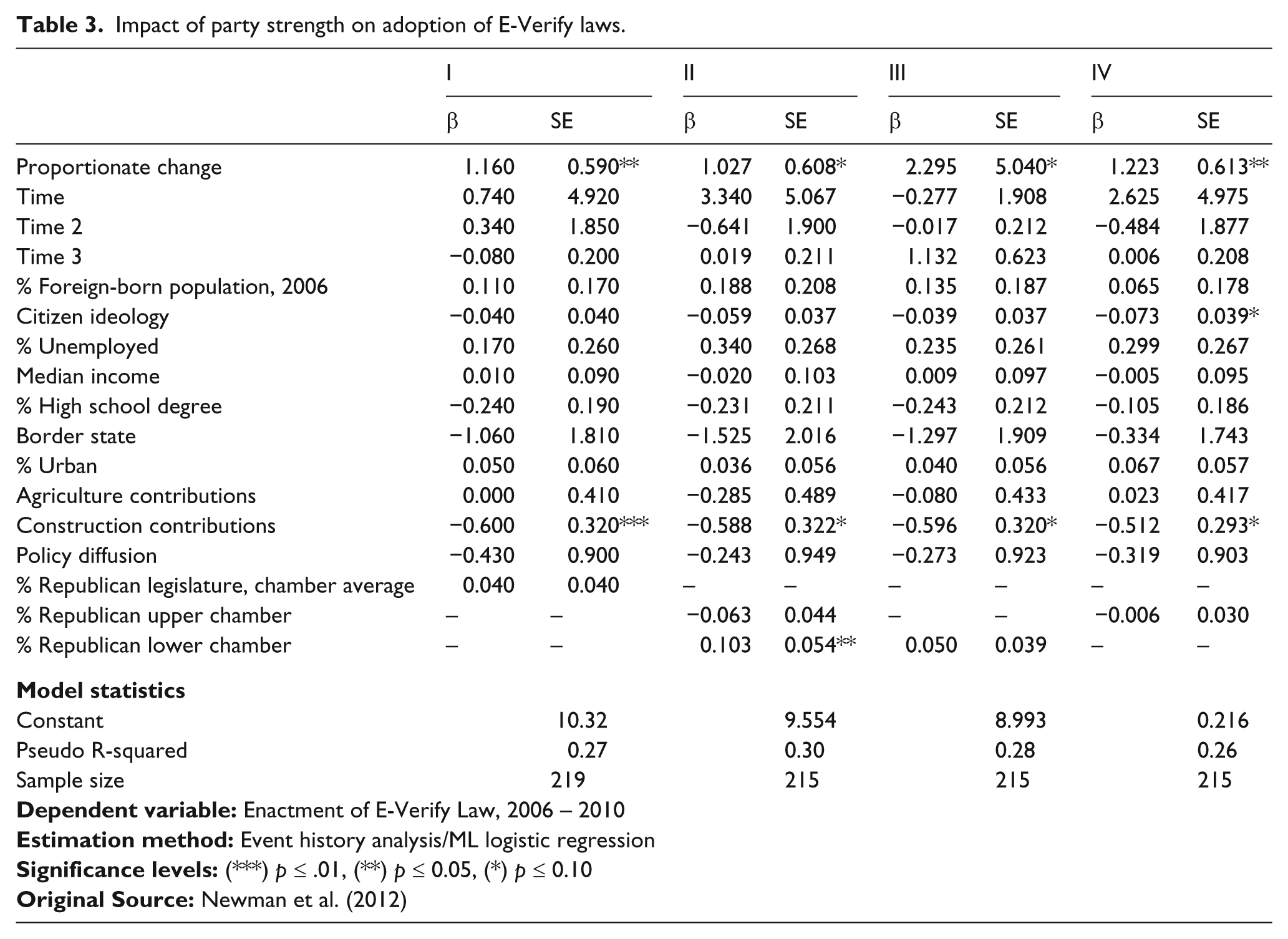
Model II employs chamber-specific party strength measures and, although it offers only a modest increase in explanatory power, the inference is substantively different, while collinearity remains a non-issue (tolerance values for upper and lower chambers are 0.22 and 0.18, respectively). The original results (Model I) found that proportionate growth in immigration increased the likelihood of E-Verify adoption, that lobbying from the construction industry had a negative effect, and that legislative partisanship had no influence on the likelihood of E-Verify adoption.
Changing the partisanship variables to include each chamber separately while leaving all other variables the same (Model II), the immigration growth and construction lobbying lose statistical significance. At the same time, Republican strength in the house is a strongly significant driver of E-Verify adoption, with no influence from the senate. 5 As with the two previous illustrations, different party strength measurements lead to substantively different narratives about the causes of policy outcomes—in this case, enactment of E-Verify laws.
Party strength versus party control
To maintain compatibility with the original studies, the preceding applications used continuous variables—e.g. proportion- or percentage-based measures—to capture party strength, rather than binary indicators of party control. The assumption in these studies is that party strength is more relevant to the underlying research question than mere party control of each chamber. This is conceptual difference raises a methodological question: Does the use of binary rather than continuous variables affect results and, by extension, the inferences scholars draw about chamber parties’ influence public policy?
To find out, I re-estimated Models I, II, III and IV for each policy illustration but replaced the continuous party strength variable with a dummy variable for simple majority control. If the party in question held >50% of seats in a chamber, the variable was coded with a “1” and a “0” otherwise. I summarize the differences in Table 4; full model replications are available upon request.
Comparing the effects of party strength and party control measures.

Some of the partisan effects inferred from party strength variables change when a binary measure of simple majority control is used instead. The most conspicuous shift in both empirical results and substantive conclusions occur in the Newman et al. (2012) study of E-Verify adoption. Using a continuous measure of Republican strength across both legislative chambers, the authors originally found no statistically significant effect. Replacing that measure with disaggregated chamber party strength measures (Table 3, Model II) suggested that perhaps there was a legislative influence, but that it was confined to the lower house. Suspected effects from increased immigration concurrently lost statistical significance in the same model.
But using separate binary indicators for a Republican majority in each chamber led to different results. With this strategy, I found that both legislative coefficients were significant (βUpper = −2.172; p = 0.02 and βLower = 1.975; p = 0.04) and the proportional immigration effect also significant (β = 1.445; p = 0.03) with improved model fit (R2 = 0.33). Once again, the implications are substantively different.
Conclusion
As key players in policymaking, state legislatures have received substantial levels of scholarly attention. Many studies that examine the effect of political parties on policy, however, model chamber effects with variables that do not sufficiently capture intra-branch nuance. For theoretical and pragmatic reasons, enhanced measurements are both warranted and necessary to improve the inferences drawn from models of the policy process. Using three illustrations, this study demonstrates that modifying the type of variable used to capture political party influence can lead to substantively conclusions about the effect of partisanship on public policy. In short, the findings support the notion that party strength and majority control within the chambers may have heterogeneous effects.
The results of this study suggest a few “best practices” for scholars to consider when conceptualizing legislative partisanship for empirical modeling. The first step is to decide whether the strength of partisanship, simple majority control, or super-majority control is most likely to affect the study’s dependent variable. Partisan strength is best measured with continuous, proportion-based measures, while chamber control can be measured with dummy variables. If neither option can be justified, scholars should pursue both and disclose any differences noted across the various specifications.
The second step is to model partisanship in both chambers and use the results as a starting point for further modifications. If both chamber coefficients are significant, scholars can end there and interpret results accordingly. If only one coefficient is non-significant, scholars must decide if, based on theory, the results make sense. Depending on the research question and dependent variable, it may be that only one chamber has an effect.
If both coefficients are non-significant, scholars must decide if their dummy variables for majority control should be replaced with continuous measures of party strength, or vice versa, and proceed accordingly. Scholars must also determine if an interaction term composed of both party control variables is warranted. This would occur in contexts in which a higher partisan concentration in one chamber raises the likelihood of a specified outcome in the other chamber. Interaction terms come with a need to grant due care to interpretation (Brambor et al., 2006) and with the possibility that adding an interaction variable will result in an over-specified model. If dummy variables for chamber control are used, however, a simple multiplicative interaction would not provide much empirical value.
The third and final step is to examine party effects in light of other relevant variables. Scholars should use model diagnostics to decide if collinearity is present and problematic. They should also consider if conceptually related variables, such as citizen ideology, government ideology or gubernatorial partisanship, will cause over-specification of states’ political environments. Indeed, one E-Verify model may have fallen victim to over-specification; there, removing citizen ideology helped a legislative coefficient achieve statistical significance (see Note 5).
Without a doubt, these practices will work better within the context of some research questions than others. Yet the overarching theme remains fixed: Policy enactments at the state level depend on two legislative chambers that are not carbon copies of one another. Proper treatment of that uniqueness in statistical modeling can only improve state politics research. At the same time, expanded consideration of differences in party influences across chambers will yield new puzzles to solve.
Footnotes
Declaration of conflicting interest
The author declares that there is no conflict of interest.
Funding
This research received no specific grant from any funding agency in the public, commercial, or not-for-profit sectors.