




Abstract
Although scarce, the literature addressing the effects of the economy on voter turnout and political attitudes has yielded mixed results. By using individual, longitudinal data from Spain—a country devastated by the Great Recession—our study illuminates how the latest economic crisis has impacted citizens’ perceptions of voting. We analyze how economic conditions and perceptions of the economy have transformed the belief that voting is a civic duty, which is one of the strongest attitudinal predictors of turnout. Our results suggest that hard times slightly weaken citizens’ sense of civic duty, particularly among the youngest. However, the adverse effects of the economic crisis are compensated by the positive effects of the electoral context, and as a consequence there is no aggregate decline in civic duty during the period examined (2010–2012).
Introduction
How has the Great Recession impacted democracy? One concern is that democratic accountability could be threatened, if bad economic conditions trigger disenchantment and abstention. Although the current situation is not so bleak, the three European countries most damaged by the latest economic crisis have recently experienced significant decreases in voter turnout rates. In the last two general elections, Spain’s turnout dropped from 74% to 69%, Italy’s from 81% to 75%, and Greece’s from as much as 71% to 63%. 1 More generally, in 2009 the European Parliament elections recorded their lowest turnout since 1979.
This recent evidence seems to align with earlier findings regarding the economy’s effect on turnout. Rosenstone (1982) argues that economic crises harm turnout, since voters facing economic difficulties are too preoccupied with their personal financial situations to visit the polls. Yet the literature devoted to examining how economic turmoil affects turnout also points to null or even positive impacts (Blais, 2000; Radcliff, 1992). To cast light on these mixed results we focus on an attitude that constitutes a necessary condition for electoral participation: the civic duty to vote.
The missing link in the rational choice equation for turnout, civic duty is an attitudinal element that helps us understand why people show up at the polls, even if the costs of voting exceed the benefits (Blais, 2000; Riker and Ordeshook, 1968). Besides being a highly relevant predictor of turnout, civic duty is also an attitude related to citizenship norms, the legitimacy of the political system, and the citizenry’s general political support and engagement, all of which are attitudinal dimensions presumably sensitive to the economy (Armingeon and Guthmann, 2012; Córdova and Seligson, 2009). It therefore makes sense to wonder whether people are less inclined to consider voting in terms of civic duty when the economic situation takes a sharp downturn.
To explore the effects of the economic crisis on civic duty, we analyze data from Spain, a country significantly hit by the debt crisis in Europe, especially in terms of its youth. We use a four-wave panel survey that allows us to track changes in Spaniards’ attitudes toward voting over a period of a year and a half (i.e., November 2010 to May 2012), during which the economy severely worsened. We examine the effects of the economic crisis through two different sets of indicators: perceptions of the economy and citizens’ personal economic and working circumstances. Ultimately, we ascertain how changes in such indicators are related to changes in individuals’ conception of voting as a civic duty.
This research contributes to the existing debate on the effects of the economy on turnout and system support in several manners. Firstly, the study focuses on an attitude that precedes and shapes the decision to vote, leaving aside other explanatory factors, such as costs, benefits, and the perceived probability of affecting the result of the elections. This means that if we find an effect of the economic crisis on the belief that voting is a duty, such effect on turnout might be even larger, via other determinants. Secondly, it uses longitudinal data, which allow us to estimate a fixed-effects model. Therefore, our results are free from omitted variable bias and make us pretty confident about the findings. Thirdly, we examine a recent and timely example of a deep crisis (Spain) for which we explore the role of a wide array of objective and subjective economic variables. Thus, we go beyond analyzing the effects of unemployment, the most studied economic variable. Fourthly, we take into account the specific effect of the electoral context. This allows us to show that the negative effect of the crisis is offset by the positive effect of the electoral context, especially among youth.
The economic crisis and attitudes toward voting
The link between the economy and turnout—more particularly, between economic downturns and attitudes related to turnout—is far from clear. While the effects of the economy on how people vote have attracted a great deal of attention, the impact on turnout itself remains much less explored (Pacek and Radcliff, 1995). Moreover, studies addressing this issue have reported inconclusive and contradictory results. Deteriorating economic conditions have been found to hamper turnout in the US (Rosenstone, 1982), but also to boost it, as long as citizens can identify whom to blame (Arcenaux, 2003). We find the same contradictions for developing countries: economic downturns have been found to boost turnout (Aguilar and Pacek, 2000; Radcliff, 1992) but also to have no impact whatsoever (Lavezzolo, 2008).
Findings on the matter also differ depending on the countries under study, whether scholars approach the issue from a macroeconomic or individual perspective, and whether they look at specific subgroups in the population. In fact, Rosenstone’s (1982) results that support the so-called ‘withdrawal hypothesis’ fail for disadvantaged social groups, which are more motivated to vote during economic crises (Southwell, 1996).
In light of the Great Recession that began in 2007, the link between the economy and electoral outcomes has been reexamined, although voter choice has received far more attention than turnout. Such continued neglect of the latter further justifies our attention to civic duty, which stands out as a chief predictor of turnout. If the latest sustained economic crisis has eroded the moral basis for voting, then turnout is bound to decrease in the future. Civic duty is the least ‘rational’ determinant of turnout, hence presumably the least sensitive to the economy. If we show that the economy is able to hamper it, the negative effects of the economy on turnout may be even larger, as economic downturns will probably also affect individuals’ resources and incentives.
In this respect, some recent studies suggest an erosion of attitudes related to system support. For instance, Stevenson and Wolfers (2011) find that the crisis has had detrimental effects on trust in public institutions, while Armingeon and Guthmann (2012) show a relationship between negative perceptions of the economic crisis and a decrease of trust in legislatures. These detrimental effects could be larger in younger democracies, and damage trust in elections and even support for representative democracy (Córdova and Seligson, 2009). The question therefore becomes whether the recent economic crisis has similar negative effects on citizens’ duty to vote.
In this regard, two theories offer different causal mechanisms to explain the link between the crisis and changes in voter attitudes (Newton and Norris, 2000). On the one hand, the socio-cultural perspective emphasizes the role of individual life situations and experiences in shaping civic mindedness and other attitudes consistent with democracy. In this model, worsened economic conditions may compel citizens to focus on personal interests instead of those of the community, thereby weakening the social value of voting as a duty. This strand of research is in line with the so-called ‘withdrawal hypothesis’ (Rosenstone, 1982). From this point of view, the economic crisis may alter the normal trajectory of life events by delaying the transition to adulthood. Thus, the emergence of new adult interests, such as politics, may be belated. In this sense, a voter’s membership in a disadvantaged group may undermine the development of a sense of civic duty.
Unemployment is by far the most analyzed aspect of economic adversity, although the evidence about its effects is mixed. More precisely, becoming unemployed has been found to be consistently, albeit weakly, related to support for social policies aimed at helping the poor (Margalit, 2013; Schlozman and Verba, 1979). If we focus more specifically on political involvement, most studies conclude that unemployment (particularly among the youth) relates to lower levels of participation, especially electoral participation, and reduces political interest and trust (Anderson, 2001; Bay and Blekesaune, 2002; De Witte, 1992). Yet this literature is far from consensual. Some studies, especially the most recent, do not seem to reach such pessimistic conclusions (Giuni and Lorenzini, 2013; Lorenzini and Giuni, 2012; Parry et al., 1992).
On the other hand, the institutional performance model suggests that perceptions of economic and political conditions connect a government’s performance to political legitimacy (Almond and Verba, 1963; Weatherford, 1992). For instance, Štulhofer and Rimac (2002) propose that social changes stemming from the economic crisis affect evaluations of economic, political, and social conditions, which in turn affect dominant social values and foster cynicism as well as opportunism. From this perspective, a worsening of the economy adversely affects the civic duty to vote out of disappointment with the system’s performance. However, it has also been found that individuals facing economic adversity who blame the government for their situation are actually more likely to vote (Arceneaux, 2003). Altogether, the impact of economic situations on citizens’ perceptions of voting is quite unclear.
The Spanish economic crisis
To understand how the economy can affect attitudinal change regarding turnout, it is necessary to control for two elements: the political context and a voter’s belonging to a disadvantaged group. As regards contextual effects, some citizens may revise their sense of duty as an election approaches, as they do with respect to trust in democracy or political institutions (Bowler and Donovan, 2002; Franklin, 2004). Indeed, general political attitudes have been shown to react more to political factors (e.g., electoral campaigns) than to economic conditions (Bratton and Mattes, 2001; Clarke et al., 1993; Evans and Whitefield, 1995). Therefore, the proximity of an upcoming election could more than offset the negative effect of the economic crisis.
In order to take into account changing elements of the political context, it is particularly interesting to adopt a longitudinal perspective to keep most elements of the political system constant. With this purpose, we examine Spain, which held a general election in November 2011 that coincided with the implementation of several austerity measures and resulted in a change in government. Spain is a relatively young democracy that still experiences changes in aspects of its political culture and is thus likely influenced by major economic changes, such as those it has endured since 2008. If economic downturns affect the attitudinal basis of turnout, then we should be able to see such influence in Spain. In this particular context, it is also important to consider the effects of age, since the Great Recession in Spain has been especially difficult for the youngest citizens.
A quick outline of the Spanish economic crisis takes us back to 2008, when the explosion of the real estate bubble prompted a collapse of housing prices. This collapse stopped housing construction and left thousands of people in the construction industry unemployed. When banks discovered that (subprime) mortgages could no longer be paid, they drastically reduced loans to businesses and individuals, which only worsened the economic situation.
Mortgages and evictions constitute significant dimensions of the economic crisis. Since 2007, more than 420,000 foreclosures and 220,000 evictions have occurred. By 2012, every 15 minutes one new Spanish family lost their home yet remained in debt for their mortgages. 2 Spanish courts evict individuals unable to fulfill their mortgages, but they must still pay off their remaining debt to the bank—interest and late fees included—since their property has suffered a substantial devaluation. This critical situation in turn triggered many protests against the Mortgage Law. In fact, a Popular Legislative Initiative requesting a payment-in-kind formula has gathered more than 1.4 million supporters. All in all, we can assume that surrendering home ownership yet maintaining a huge debt triggers a feeling of abandonment by the authorities that may jeopardize a citizen’s beliefs about her civic duties.
Although the European Central Bank approved a bailout for Spanish banks in 2012, credit has not yet flowed into individuals or enterprises. The bailout arrived in exchange for a commitment to trimming the budget deficit to 3.6% of the gross domestic product (GDP), which entailed additional welfare cutbacks. Consequently, unemployment rates jumped from 8% in 2007 to 26% in 2012. For citizens under 25 years of age, these figures are far worse: unemployment among the youngest reached 50% in 2012 and 57% in 2013. Along with Ireland, Spain holds the record of the steepest increase of youth unemployment among European Union (EU) members since the onset of the Great Recession (O’Higgins, 2012). As a social group, Spanish youth has suffered most from the crisis, particularly due to the so-called ‘labor-market duality,’ which consisted of the gap between temporary and permanent contracts that impedes newcomers from accessing steady employment (Scarpetta et al., 2010). This is important, since previous research has shown that temporary work hampers turnout (Gallego, 2007).
Despite this dire scenario, our data show a slight increase in the sense that voting is a civic duty during the year and a half under analysis. Figure 1 shows that the percentage of respondents who felt that voting is a duty increased during the period analyzed here, particularly among the youngest. However, what role did the economic crisis play in this evolution?

Aggregate evolution of the percentage of respondents considering voting (very, somewhat strongly) a duty, by age.
Research design and data collection
To test the effects of the economic crisis on perceptions of voting as a civic duty, we used the study Centro de Investigaciones Sociológicas (CIS) 2855, an online panel survey conducted in four waves during a period of 18 months in November 2010, May 2011, November 2011, and May 2012. 3 Respondents were selected from an online survey pool set up by the active recruitment of potential respondents active in mainstream commercial websites in Spain. 4 The sample consists of Spanish citizens between the ages of 16 and 45 years with Internet access, since the survey was designed to examine attitudinal change among young people who are theoretically open to social change.
We ran two fixed-effects linear estimations. 5 Fixed-effects estimations aim to neutralize the impact of all time-invariant individual characteristics by producing unbiased coefficients due to omitted time-invariant characteristics (e.g., gender, previous socialization, education). Among the advantages of the estimation method, the large quantity of observations increased the degrees of freedom, reduced collinearity among the explanatory variables, and improved the efficiency of the estimates. Note that this constitutes a major contribution to the existing literature on the effects of the economic crisis. The use of longitudinal data and fixed-effects models allows us to be more confident about our causal claims.
We use Blais and Achen’s (2012) operationalization to assess perception of voting as a civic duty, which yields a four-category variable ranging from 0 (i.e., not dutiful at all) to 3 (i.e., very dutiful). 6 All independent variables in our models are recoded to range from 0 to 1. Thus, their coefficients can be interpreted in terms of the effect on duty across time as individuals move from its minimum to maximum value. 7 Hence, a coefficient for a dichotomous item appears as the effect of acquiring that condition during the time span covered by our data on the evolution of civic duty.
In our first estimation, we consider the objective and subjective effects of the crisis. As objective indicators of economic conditions we consider variations in the employed/unemployed status, in income, type of work (e.g., temporary, permanent), and mortgage (e.g., with or without). The subjective economic variables gather several perceptions of the economic situation, for which we create a scale that combines three questions about perceptions of the economy. The first asks for a general evaluation of the Spanish economic situation, the answers to which range from ‘very bad’ to ‘very good’; the second asks for an evaluation compared to a year ago, for which possible answers are ‘worse,’ ‘the same,’ and ‘better.’ For the third question, the respondents are asked to evaluate the likely evolution of the economic situation by the same time next year. All questions are recoded to range between 0 and 1, then added (Cronbach’s alpha of 0.63) and rescaled again to range from 0 to 1. A fourth subjective indicator refers to the evaluation of one’s personal economic condition compared to a year ago. The answers (worse, same, better) have also been recoded to range from 0 to 1; the lowest value indicating a negative evaluation. For more details on the descriptive statistics of these variables, see the appendix.
The second estimation adds period effects operationalized by means of dummy variables, leaving Wave 1 as the reference category. Wave dummies should then be interpreted as the average increase in the level of the dependent variable compared to Wave 1, everything else being equal. This is aimed to take the political context into account, and more specifically the electoral campaign held during Wave 3 fieldwork. This is consistent with two-way fixed-effect panel model specifications, which seek to account for unobserved heterogeneity across both time and individuals.
Finally, both the first and the last estimation account for youth vulnerability by interacting the independent variables with the age of the respondent. For this purpose, age is rescaled so that its minimum value (i.e., 16 years old) takes the value of 0 and its maximum (i.e., 45 years old) the value of 29. This way, the interpretation of interaction effects becomes simpler, since any main effect will point to the impact of an independent variable when age is at its minimum value (i.e., 16 years old).
Results
Table 1 presents the results of the two fixed-effects linear estimations of changes in perceiving voting as a civic duty. The first specification analyzes the impact of the variables conditional on age. The main effects of unemployment, permanent worker, and mortgage indicate the impact of becoming unemployed, permanently employed, or obtaining a mortgage during this period on the evolution of the belief that voting is a civic duty, among respondents 16 years of age. The coefficient for income identifies the effect of moving from the lowest monthly income category (i.e., less than €300) to the maximum (i.e., more than €6000) for younger respondents; as one gets richer (poorer) one’s sense of duty becomes stronger (weaker). Becoming unemployed does not significantly weaken sense of civic duty, neither among the youngest respondents nor among the eldest (see the non-significant interaction coefficient). Similarly, losing or gaining permanent employment does not have any effect. Contrarily, obtaining a mortgage is a sign of status and maturity that significantly improves citizens’ sense of civic duty. 8
Fixed-effect linear estimations of the evolution of duty to vote (November 2010–May 2012).

Notes. sigma_u: standard deviation of residuals within groups (individuals); sigma_e: standard deviation of residuals (overall error term); rho: % of the variance due to differences across panels, in this case, individuals.
p < 0.001; ** p < 0.05; * p < 0.1.
The interaction coefficients for income and mortgage status confirm that the effects of these variables on perceptions of voting as a civic duty are stronger for the youngest respondents. Hence, a salary reduction or changes regarding mortgages strike harder among the youngest. By contrast, both the scale aimed to assess the evolution of individuals’ perceptions of the economy and the indicator that gauges the evaluation of the personal economic situation revealed that these factors play no role among any respondents, regardless of their age.
Model 2 adds period effects to the previous estimation in order to tap the influence of context. The estimation finds similar effects for the objective variables and their interactions with age. The main effect of age is now not significant, as its variation within individuals is almost completely captured by the time trend. 9 Also, the effect of mortgage and its interaction with age is only significant at 90%, which indicates that time dummies also partly capture the effect of economic downturn. The main effects for the wave dummies indicate a positive impact, which is significant, and follow an increasing trend over time. The interaction terms show that the positive effects of an election (Wave 3) and its aftermath (Wave 4) are less strong as age increases. There is, therefore, a period effect caused by the election held in November 2011, which occurred one week after Wave 3 was conducted. Interestingly, this effect has not decayed 6 months after the election. The magnitude of the period effects is so important that it offsets the negative effects of a worsened economic situation or working status among the youngest respondents.
Regarding the relevance of these independent variables, the F-test rejects the possibility that all coefficients are equal to zero in both models. Additional joint significant tests (not shown) tested the significance of the indicators of objective economic and working conditions, perceptions of the economy, wave dummies, and the interactions in the models. The results of these successive Wald tests reject the possibility that the effects of objective indicators and all interactions are jointly zero. They also point to the significance of time effects, thus justifying the inclusion of year dummies, although they also confirm that the coefficients for the subjective perceptions of the economy and their interactions with age are together not different from zero.
Figures 2 and 3 depict the predicted effect of changes in income or mortgage on sense of civic duty, on the basis of Model 1. An improvement or deterioration of income significantly affects the perception of voting as a civic duty only for those under 27 years of age. After that age, the effect is indistinguishable from zero. As for mortgages, their effect disappears after 21 years of age. 10 These age markers are generally in line with socialization theories, which hold that most political attitudes develop and crystallize before a person reaches 25 years of age (Newcomb et al., 1967). Hence, poor economic conditions can jeopardize attitudes toward democracy, including the feeling that voting is a duty, but only among those whose attitudes are still under formation: the youngest. Reversely, the positive effects of getting socially integrated by means of gaining purchasing power or the status of homeowner play a role exclusively among the youngest.

Average marginal effects of (reduced/increased) income on the evolution of the duty to vote, by age.

Average marginal effects of getting a mortgage on the evolution of the duty to vote, by age.
Conclusion
Past research on the effects of the economy on elections focused mainly on the US, on votes (i.e., not turnout), and on the aggregate instead of the individual level. They also failed to take into account the effects of the political context. The few studies that have incorporated some of these elements have challenged Rosenstone’s (1982) pessimistic findings about the negative effects of economic downturns on turnout.
In addressing the effects of the latest economic crisis on turnout, our research brings about several novel aspects of the topic. Firstly, we focus on a moral attitude that precedes and anchors electoral behavior, taking a step back in the causal chain that explains the vote. In this sense, our results are worrisome as they suggest that the negative influence of the crisis on turnout may perpetuate the future through its impact on duty, even when the crisis is over. Furthermore, as the vote is also affected by other ‘rational’ variables presumably more sensitive to economic conditions—such as resources and incentives—the final effect of the crisis on turnout may be even greater.
Secondly, we go beyond testing the effects of unemployment, addressing two mechanisms by which an economic crisis may demean the civic duty to vote: worsened personal economic circumstances and perceptions of the economy. Thirdly, by focusing on a country within the series of especially hit by the economic crisis, we are able to take a longitudinal perspective, and to estimate the effects of the electoral context.
Finally, we contribute to the existing literature about the effects of the economy on attitudes related to political engagement and support with an innovative research design. In our study, based on panel data, we used linear fixed-effects models to measure the effects of the crisis on the perception of voting as a civic duty. We found no effects of subjective perceptions of the economy, of becoming unemployed or a temporary worker. Nevertheless, we detect a significant relationship between changes in income and mortgages and the belief that voting is a civic duty. These relationships, however, only emerge among the youngest citizens.
To sum up, the effect of economic crisis in the evolution of the civic duty to vote is quite modest and confined to the youngest segment of the population. Moreover, this small negative effect is completely offset by other factors, the most obvious being the presence of an election. Such a finding bodes well in the sense that adhesion to civic responsibilities survives even in a country experiencing very hard times. Nevertheless, it remains to be seen whether, in the long term, a severe economic crisis could amplify and crystallize the adverse results found among the youngest and thereby bring Rosenstone’s (1982) findings back to life.
Footnotes
Appendix
Summary of the descriptive statistics for the variables involved in the analyses.
| Variable | Mean | Std. dev. (between/within) | Min | Max | % Individuals that change across the study |
|---|---|---|---|---|---|
|
|
1.31 | 1.14/.64 | 0 | 3 | 53.4% |
|
|
15.9 | 7.35/.49 | 0 | 29.5 | 100% |
|
|
.32 | .18/.10 | 0 | 1 | 70% |
|
|
.20 | .35/.21 | 0 | 1 | 17.8% |
|
|
.40 | .45/.19 | 0 | 1 | 14.7% |
|
|
.45 | .48/.14 | 0 | 1 | 8.4% |
|
|
.28 | .18 /.14 | 0 | 1 | 100% |
|
|
.34 | .27/.22 | 0 | 1 | 56% |
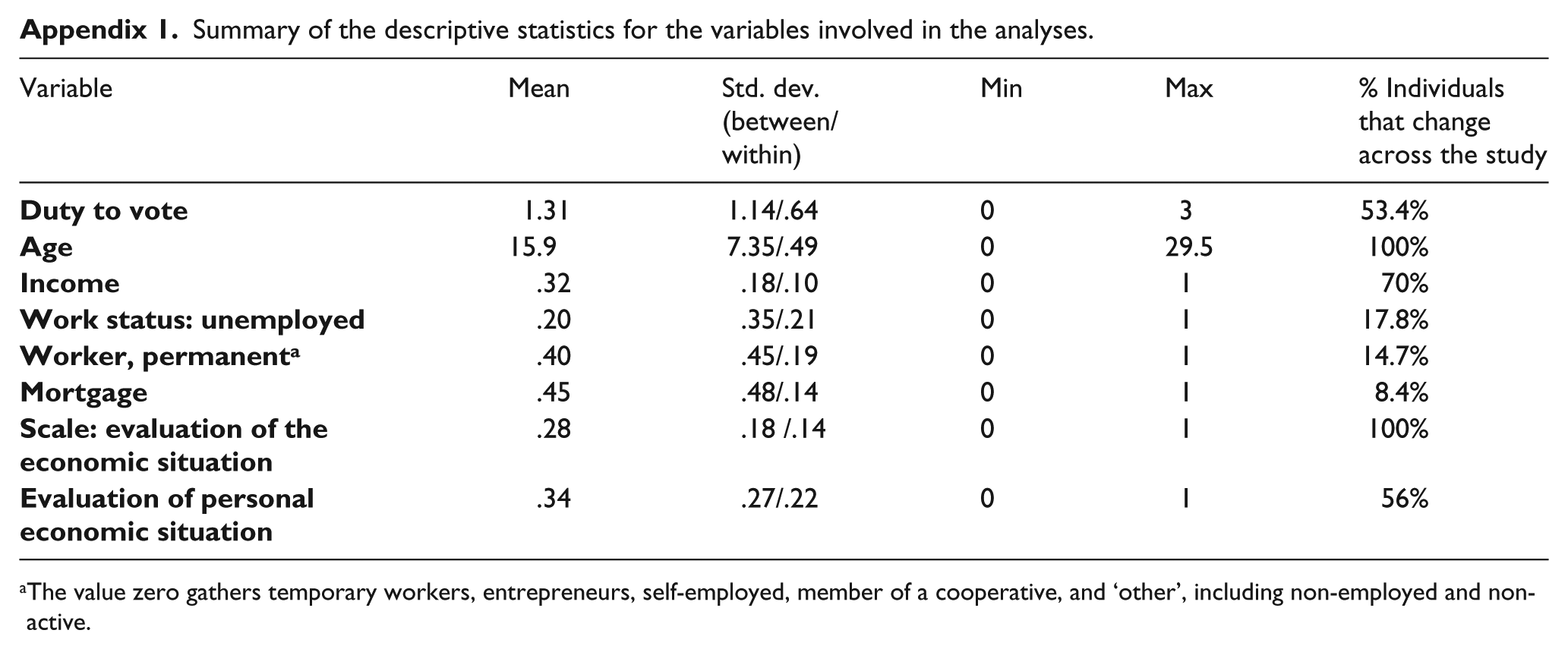
The value zero gathers temporary workers, entrepreneurs, self-employed, member of a cooperative, and ‘other’, including non-employed and non-active.
Declaration of conflicting interest
The authors declare that there is no conflict of interest.
Funding
This research has benefited from a grant of the Spanish Ministry of Science and Innovation (CSO2010-18534).