




Abstract
We ask if the public speech of political leaders is diagnostic of their private beliefs, and investigate through content analysis of the rhetoric of Saddam Hussein, the former president of Iraq. We collected Saddam’s public speeches and interviews on international affairs from 1977–2000, producing a data set of 330,000 words. From transcripts of Saddam speaking in private, we garnered a comparison corpus of 58,000 words. These text-sets were processed to locate markers of conflict, control and complexity. We find that Saddam’s hostile, conflict-oriented worldview and his perception of himself as a significant political actor was consistent across public and private domains. The major difference between these spheres was his more complex private view of international affairs compared to his more definitive public stance. Our evidence supports the notion that private beliefs can be inferred from the public speech of political leaders.
After the invasion of Iraq in 2003, US forces made a startling discovery: President Saddam Hussein had made thousands of audio recordings of his private meetings and telephone conversations with Iraqi officials (Rubin, 2011, Woods and Stout, 2010). Saddam discussed his views of the US, Israel, Iran and other national security issues in transcripts now available to researchers. While Saddam spoke extensively in public speeches during his decades in power, there had few means by which to judge whether these were merely manipulative communications – until now.
Using automated content analysis, we compared Saddam’s public and private speech by looking for markers of conflict, control and complexity as identified in well-established coding schemes. We collected Saddam’s public speeches and interviews on international affairs from 1977–2000, which produced a data set of 330,000 words. From the captured transcripts, we garner a set of private text (58,000 words) to compare to this public corpus. We thus provide the most empirically rich analysis of Saddam’s public belief system yet generated, and the first content analysis-based account of his private beliefs.
First, we briefly explore the issue of public and private political selves. Then, we explain our content analysis procedures and the corpus of Saddam’s speech to which we apply them. We give an analysis of Saddam’s worldview in public and private, with reference to general international political life and to his great enemies: the US, Iran and Israel. We end with thoughts on the implications of our study.
Public and private beliefs
Politicians give many speeches and interviews that are instantly available on the Internet, and desktop computers can process them in innovative ways, transforming the words into data (Laver et al., 2003; Schafer and Young, 1998). Researchers have taken advantage of this possibility with multiple studies in which public speech is hypothesized to be revelatory of political worldviews, which are in turn hypothesized to shape the actions of important political actors (Hermann, 2005; Suedfeld, 2010; Schafer and Walker, 2006). A criticism of this approach is that public speech is manipulative and strategic. Politicians say one thing in public and another in private. If public presentations differ from private realities, and if private realities drive behavior, then the value of analyzing public speech is limited (Marfleet, 2000; Renshon, 2009).
The concern is especially apposite when dealing with distinctive personalities at the apex of repressive regimes. Leaders of rogue regimes are disproportionately involved in conflict and disproportionately difficult to understand (Londono, 2013). Closed regimes give us public speech, but little information on private deliberations. The question of whether we can believe what dictators say in public has been a key problem in US foreign policy for many years.
For several decades it was Saddam Hussein of Iraq who caused this question to be raised most urgently. The progenitor of a rolling series of wars, Saddam harbored unclear intentions derived from opaque motives (Duelfer and Dyson, 2011). The closed nature of his regime revealed little knowledge of his private reckoning. The world community often had just the public face of the regime to use in predicting likely behavior.
Psychology gives us two broad views on public versus private beliefs: intra-situational consistency and impression management (Tetlock and Manstead, 1985). If the intra-situational consistency position is correct, then political figures reveal their sincere beliefs in all contexts, and these beliefs are stable across time, topic and audience. If the impression management hypothesis is accurate, speech is calibrated to achieve some strategic end. Revealed beliefs of the political figure will vary across time, topic, and audience (Goffman, 1959; Snyder, 1987). These are ideal types, with the reality probably somewhere in between. Whether public speech reveals private beliefs is ultimately an empirical question.
The question is hard to test, though. Politicians speak a lot in public, but we have few records of their private speech. Adolf Hitler had his dinnertime conversations, which ranged across politics, history, and the arts, transcribed by aides during the period 1941–1944 (Trevor-Roper, 1953). John F Kennedy and Lyndon B Johnson had taping systems installed in the White House and the transcripts of these recordings provide valuable insights into Kennedy’s deliberations during the Cuban Missile Crisis (May and Zelikow, 2002; Renshon, 2009) and Johnson’s methods of persuasion (Beschloss, 1998). Infamously, Richard M Nixon kept tapes that showed his involvement in the cover-up of the break-in at the Watergate complex (Kutler, 1998). His national security advisor, Henry Kissinger, recorded his telephone calls as he practiced high-level personal diplomacy (Burr, 1999).
Following the Nixon catastrophe few Western politicians have, to our knowledge, thought it wise to install taping systems. The Iraqi president from 1977–2003 had no such inhibitions. After the collapse of the Saddam regime, US forces discovered a vast trove of recordings and transcripts. Archivists translated, transcribed, and categorized the recordings (Woods et al., 2011). Approximately 2,300 separate tapes feature Saddam as a primary participant, and most of these are records of Revolutionary Command Council, Council of Ministers or ad hoc National Security group meetings. Whilst the tapes cover the vast majority of the years Saddam held office, the distribution is uneven, with – unfortunately – very few in 2002–2003 as the regime prepared for its final confrontation with the US.
Why would a leader as paranoid and secretive as Saddam make the tapes? It was important to him to have records of what his ministers had promised. In the highly centralized Ba’ath system Saddam and his closest aides made decisions on an extremely wide range of topics and he wanted some way to keep track of their discussions. In January 1981 Saddam was at the end of a particularly frustrating series of telephone calls with his general staff, and became exasperated at the confusion. ‘From now on let us record all telephone calls’, he ordered (Woods et al., 2011: 7). On the tapes, Saddam speaks candidly on sensitive subjects – he did not expect the records to become publicly available (Woods et al., 2011: 8).
The captured tapes have been exploited in a fascinating series of qualitative studies, investigating Saddam’s private deliberations on nuclear weapons (Brands and Palkki, 2011), his strategy in the first Gulf War (Woods, 2008), his strategic view of the United States (Brands and Palkki, 2012) and his conduct of internal Iraqi affairs (Sassoon, 2012).
Some initial conclusions have been offered on the public/private question. David Palkki, acting director at the Conflict Records Research Center in Washington DC, which holds the Saddam tapes, finds that ‘when it came to his worldview, what Saddam said in public was very similar to what he said in private. Although Americans often discount what dictators say in public, Saddam was generally sincere in his public rhetoric’ (Palkki, 2011: see also Brands 2011a, 2011b). This is an impression that we test systematically in this paper.
Private text
Our main source of private text is the volume The Saddam Tapes, containing more than 300 pages of transcripts of meetings where Saddam was a primary participant. The editors of the volume cut some passages from the published transcripts: ‘In theory, the less excised from a transcript, the better the reader can understand the context of the conversation. In practice, many of the translations contain rambling, tangential discussions or otherwise distracting and relatively unimportant material’ (Woods et al., 2011: xi). The editors selected transcripts that related to major national security matters; in particular, the US, Israel, the Iran–Iraq war, the first Persian Gulf War and the sanctions regime of the United Nations. These sampling decisions are consistent with our research aims.
To supplement this material, one of the present authors made a research visit to the Conflict Records Research Center, at the National Defense University, to work with the full volume of records. Additional material featuring Saddam speaking on topics of interest was collected. We rendered all of this material into electronic form and thereby constructed a database of Saddam’s private speech, totaling 58,000 words.
Public text
We constructed a corpus of 330,000 words spoken in public by Saddam from 1977–2000 on international relations and security topics. The major source for this text was the Foreign Broadcast Information Service (FBIS), maintained by the US State Department as, essentially, a pre-internet method of monitoring foreign news services. FBIS carried major addresses and interviews given by Saddam until its discontinuation in 1995. It is archived on micro-fiche in most university libraries. We supplemented the FBIS material with speeches collected from internet archival sources from 1995–2000, thus matching the time period covered by the private text.
Content analysis procedures
We applied a quantitative content analysis to Saddam’s public and private speech. The underlying assumption was that the words people speak are related to the thoughts they have, and the thoughts they have are related to how they behave (Suedfeld et al., 2005: 246). We used variables derived from two content analysis schemes: the ‘Leadership Trait Analysis’ approach developed by Margaret G Hermann (Hermann, 2005) and the ‘Verbs in Context System’ for operational code analysis developed by Stephen G Walker and Mark Schafer (Schafer and Walker, 2006). Both schemes have been automated for use with the content analysis software engine Profiler Plus. 1 Automated coding removes the possibility of human variability in coding decisions and so eliminates inter-rater reliability concerns.
Variables
We used four variables that capture key elements of a political figure’s worldview. These beliefs and personality traits have proven especially fecund in previous analyses and bear upon central issues of an actor’s strategic approach to international politics.
Image of other is a variable from the operational code scheme (termed the first philosophical belief in that research program). The focus is the hostility or friendliness of both political life in general and of specific actors within the political universe. The variable represents the optimism or pessimism of the agent about their environment, and has been likened to the idealism/realism split in international relations theory (George, 1969; Walker and Schafer, 2007). Scores on this variable are created by coding verbs in the agent’s speech referring to actions taken by others as either hostile and threatening, or friendly and cooperative. Calculating the balance between the types of verbs produces a scale where lower scores indicate a more hostile view of the other.
Image of self, also drawn from the operational code scheme (termed the first instrumental belief), is the counterpoint to image of other, and measures whether the agent sees their own behavior as hostile or cooperative. The focus is on verbs describing actions taken by the individual and their state and, again, lower scores indicate more hostile dispositions.
Belief in ability to control events represents the degree to which the leader under evaluation sees themself and the state they lead as an influential actor in world politics. Leaders who score higher on this measure see the world as more malleable and so tend to discount barriers to the achievement of goals. They have been found to prefer proactive policies in service of ambitious goals (Dyson, 2006). Leaders who score lower perceive material, historical and social forces as determinate. These individuals tend to be reactive and risk averse. The belief in ability to control events score is created by identifying verbs in the individual’s speech related to action taken by the leader or their state as a percentage of the total verbs in a text sample. Higher scores indicate greater perception of control.
Conceptual complexity refers to the sophistication of a leader’s cognitive architecture (Suedfeld, 1992). Individuals higher in complexity have a differentiated view of the world, with multiple schemata at different levels of generality that are integrated into a complex information processing system. These individuals prefer inductive information processing, tend to require more information prior to making a decision, and often revisit previous decisions and the premises upon which they were made. Individuals who score lower on this measure, in contrast, tend toward more definitive, black-and-white cognitive styles. These leaders rely heavily on a few core beliefs and principles at a high level of generality and process incoming information deductively, selectively perceiving or modifying new information so that it remains consistent with their existing cognitive predispositions. Lower complexity leaders have a tendency to divide the outside world into relatively straightforward categories – such as friend and enemy, good and evil – and rarely revisit past decisions (Hermann, 2005; Preston, 2001). The coding engine tags words related to higher complexity (i.e., approximately, possibility, trend) and low complexity (absolutely, certainly, definitely) and reports the balance. Higher scores indicate more complex worldviews.
Results
For ease of interpretation, we normalized Saddam’s scores to a separately constructed reference group of world political leaders with a mean of 0.50 and a standard deviation of 0.10, and plotted the results graphically, as shown in Figures 1–4 (see Appendix for raw scores for Saddam and reference group). 2 Examining Saddam’s overall worldview (all material on all topics coded), we see congruence between private and public beliefs on each element other than conceptual complexity (see Figure 1). Saddam held a resolutely hostile image of the political universe (image of other) and a preference for non-cooperative strategies (image of self). He exhibited public confidence in his ability to shape events, and this was even more pronounced in private. He exhibited higher complexity in private than in public, crossing the boundary between low and high as established by the world leader reference group.
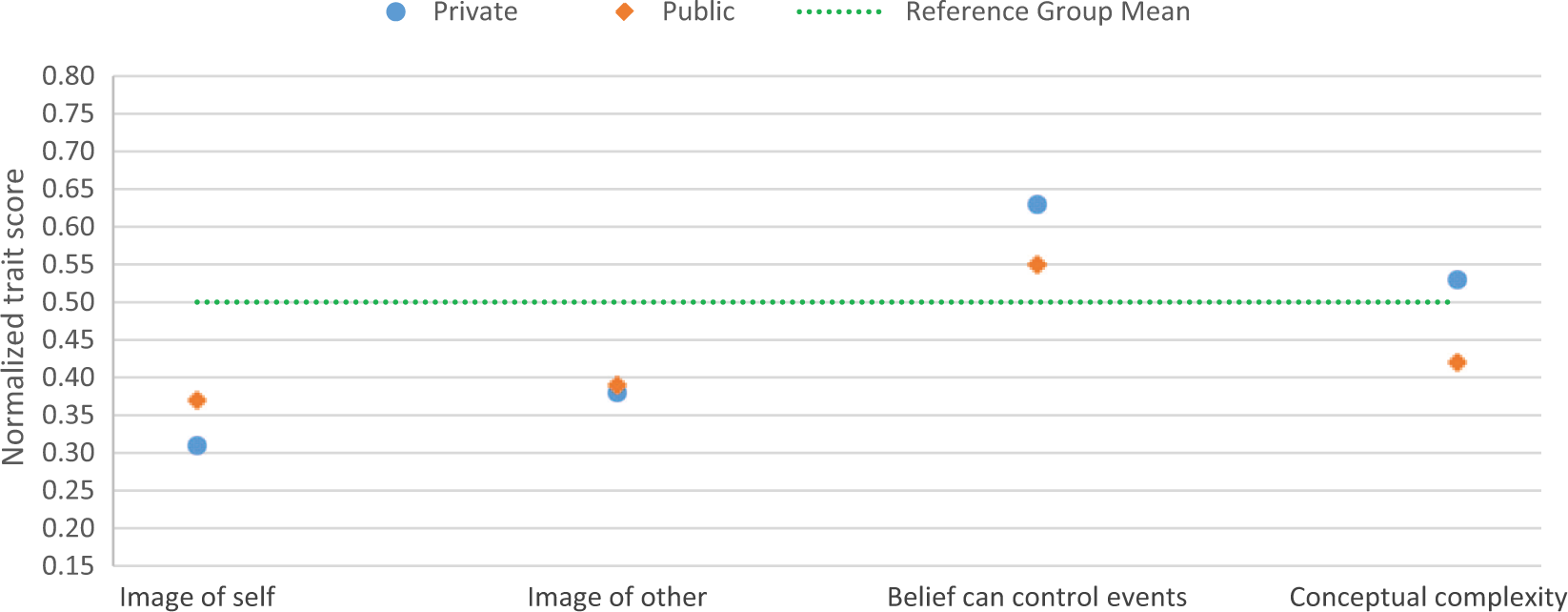
Saddam’s Worldview.

Saddam’s view of the US.

Saddam’s view of Iran.

Saddam’s view of Israel.
We separated material where Saddam was speaking about his three great enemies, the US (Figure 2), Iran (Figure 3) and Israel (Figure 4). His beliefs about these states are strikingly similar to his overall worldview: hostile images of self and other, high perceptions of control, and variable levels of complexity. There are, however, some notable differences. Saddam’s most hostile beliefs concern Israel, and he privately perceived lower ability to influence their actions, whilst expressing a greater perceived control in public – perhaps evidence of an impression management strategy.
Saddam’s beliefs concerning the United States are particularly interesting. He described the US as more hostile when speaking in public than when discussing policy in private (image of other). Conversely, he portrayed Iraq’s actions in public as less conflict-oriented than when strategizing privately (image of self). Saddam displayed a higher level of conceptual complexity when speaking about the United States to colleagues in private settings, and talked about the US in more definitive terms in public. Other than complexity, though, these are differences of degree rather than kind: Saddam maintained hostile views of the US in both public and private (see Brands and Palkki, 2012, for a detailed discussion of Saddam’s view of the US).
Inferring private beliefs from public speech
These data give us two ways to summarize the public/private congruence in Saddam’s worldview. First, does Saddam’s placement relative to the reference group vary depending upon the setting of his comments? For example, if he scores as having a hostile worldview in public, do his private comments reveal similar hostility? Second, how great is the quantitative distance between his public and private scores, regardless of ‘high’ or ‘low’ categorizations?
Considering the four elements of Saddam’s worldview across the four readings of it (overall, US, Iran and Israel) gives us sixteen comparisons of public/private beliefs. In thirteen of the sixteen public/private dyads, Saddam’s relationship to the reference group mean (above or below) is consistent from public to private. In terms of quantitative distance between the public and private scores, thirteen of the sixteen dyads maintain a one standard deviation or less distance. 3
In the case of Saddam, then, we see a similar political actor in public and private most of the time. Researchers armed with content analysis technologies now have some evidence showing that beliefs revealed publicly match those concealed privately (see also Renshon, 2009). Saddam is revealed as showing broad intrapsychic consistency – he was largely the same political actor speaking in private to his colleagues as in public before a crowd. 4 Some evidence of impression management is apparent, perhaps for political advantage or as an artifact of the different audience setting. Saddam’s higher complexity when speaking in private is the prime example of this in our study.
Of course, impression management may take place both in front of a crowd and behind closed doors: Saddam may have been performing for his advisers in private and for a crowd in public. This would suggest that a third set of data, perhaps diary entries or similarly intimate materials, would be needed to capture the ‘true’ private Saddam. This is a question of how we define ‘private’. Our argument is that we see Saddam displaying broadly the same political worldview in public rhetorical and private policy making settings, with the exceptions noted above.
Comparing public and private worldviews is not, of course, the same as being able to predict the actions of political leaders. These are baseline propensities Saddam exhibited when thinking about the world, and diagnosing a worldview is far from foreseeing an action on a specific date directed at a specific target. Worldviews of political actors interact with an array of other factors both internal and external to the state in producing action. One can, for example, hold a hostile belief toward a state but have no intention of acting upon it, for prudential reasons.
We need additional investigations focused upon the small population of political actors for whom we have transcripts of private deliberations: Hitler, Kennedy, Johnson, Nixon and Kissinger. We believe that students investigating how politicians seek to shape public opinion will find much to mull over in the findings that public speech is sincere and predictive of private beliefs rather than manipulative in nature. Finally, we hope that more leaders in both democratic and authoritarian political systems follow Saddam’s example of recording their deliberations for posterity so that we can continue to judge the sincerity of political leaders when they speak in public.
Footnotes
Raw trait scores for Saddam and reference group.
| 110 world political leaders | Private Saddam all topics | Public Saddam all topics | Private Saddam on US | Public Saddam on US | Private Saddam on Iran | Public Saddam on Iran | Private Saddam on Israel | Public Saddam on Israel | |
|---|---|---|---|---|---|---|---|---|---|
| Belief in ability to control events | 0.34/sd = 0.04 | 0.39/1.25 | 0.36/0.50 | 0.39/1.25 | 0.37/0.75 | 0.43/2.25 | 0.38/1.00 | 0.31/−0.75 | 0.35/0.25 |
| Conceptual complexity | 0.65/sd = 0.04 | 0.66/0.25 | 0.62/−0.75 | 0.71/1.50 | 0.63/−0.50 | 0.65/0 | 0.62/−0.75 | 0.63/−0.50 | 0.62/−0.75 |
| Image of other | 0.34/sd = 0.19 | 0.11/−1.21 | 0.14/−1.05 | 0.19/−0.79 | −0.06/−2.105 | −0.06/−2.105 | 0.07/−1.42 | −0.1/−2.315 | −0.07/−2.16 |
| Image of self | 0.54/sd = 0.15 | 0.26/−1.87 | 0.35/−1.27 | −0.14/−4.53 | 0.37/−1.13 | 0.18/−2.40 | 0.33/−1.40 | 0.21/−2.20 | 0.18/−2.40 |
| Word count | 57,983 | 330,062 | 7023 | 55,279 | 7620 | 142,836 | 4985 | 16,509 |

NOTE: Entries in Saddam cells are raw score/z-score. Word counts for the country files do not sum to the word counts for the ‘total’ files because Saddam spoke about international topics other than the US, Iran and Israel in material included in the ‘total’ files. Data on 110 world political leaders in the first column were provided by Social Science Automation. The cells in this column show mean/standard deviation.
Declaration of conflicting interest
The authors declare that there is no conflict of interest.
Funding
This research received no specific grant from any funding agency in the public, commercial, or not-for-profit sectors.