




Abstract
A partisan disparity in women representatives in the US House emerged in the 1980s and has continued to grow in magnitude. We show that this pattern closely mirrors the emergence of a partisan disparity in the proportion of women in the US public with the typical characteristics of high-level officeholders. Our analysis indicates that the proportion of women in the Democratic pool of potential candidates is now two to three times larger than in the Republican pool of potential candidates. Given the current association of party identification with gender and other characteristics, this gap is more likely to increase than decrease over the coming decade, with potential consequences for the descriptive and substantive representation of women in American politics.
Keywords
The diversity of the 113th US Congress’s freshman class received immediate attention (Parker, 2013; Sands, 2013). Twenty-four women were newly elected to Congress in 2012, bringing women’s representation to a record 18%. 1 But this number masks a striking partisan disparity: 20 of the 24 new women members of Congress are Democrats, highlighting a trend that extends across many offices, with 76% of all women in Congress and 64% of all women in US state legislatures in 2013 holding office as Democrats (CAWP, 2013a, 2013b). While this party gap has been noted before (Elder, 2008, 2012; Palmer and Simon, 2001; Sanbonmatsu, 2006), questions remain about when and why it emerged, and whether it is likely to persist in the future.
In this research note, we begin with the previously documented fact that a partisan disparity in women representatives in the US House emerged in the 1980s and has continued to grow in magnitude (Elder, 2008). We propose an explanation for this gap by demonstrating that this pattern closely mirrors the contemporaneous emergence of a partisan disparity in the proportion of women among the American public with the typical characteristics of newly elected high-level officeholders: highly educated individuals in their late 40s, employed in fields with high occupational prestige (Carnes, 2012). To estimate the historical gender composition of this small and particular set of citizens from survey data, we use a nonparametric regression approach that has not previously been applied in this area of research. Our analysis indicates that the proportion of women in the Democratic pool of potential candidates is now two to three times larger than that in the Republican pool. The relationship between party identification, gender, and social and demographic characteristics suggests this gap is more likely to increase than decrease over the coming decade. Given previous findings, such trends can be expected to reshape the bills proposed and passed by each party’s legislators (Carroll, 2001; Swers, 2002, 2013; Thomas, 1994) and influence public opinion of the parties as each party draws on the officials in their caucus to reach out to voters (Swers, 2013).
The partisan gender gap in elected offices
The body of research on the party gap in US women’s descriptive representation has considered both the demand for and supply of women candidates. On the demand side, some have proposed that differences in party elite ideologies may contribute to the gap in women’s officeholding in these parties (Elder, 2012). Growing distinctions between the parties on issues of gender – exemplified by party statements on women’s role in society and policy stances affecting women’s ability to work outside the home (Sanbonmatsu, 2002a; Wolbrecht, 2000) –may signal that Republican elites are less likely than Democratic elites to encourage women to seek public office (Fox and Lawless, 2010). The prevalence of the Christian Right in the Republican party also hinders the demand for Republican women candidates, while the support of women’s groups particularly enhances Democratic women’s representation (Elder, 2012). These findings are consistent with research demonstrating that internationally, leftist parties typically run more women candidates than rightist parties, due in part to the egalitarian ideology more common in left-wing parties (Caul, 1999; Lovenduski and Norris, 1993). Furthermore, at least in advanced democracies, populations with more egalitarian cultures and greater openness to women’s leadership – views more common among left than right party identifiers – are more likely to elect women to political office (Inglehart and Norris, 2003; Matland, 1998).
Our analysis focuses on the supply of Democratic and Republican women candidates. Since 1980, women have demonstrated a preference for the Democratic party, supporting Democratic candidates and identifying as Democrats at higher rates than men (Box-Steffensmeier et al., 2004; CAWP, 2008). This gender gap may influence the supply of women candidates available to each party, because women’s presence as party activists is positively correlated with their presence as elected officials in a number of nations (Caul, 1999; Sainsbury 1993). However, the differences in party identification by gender in the American public at large are insufficient to explain a much larger gap between Democratic and Republican women’s representation in political office. Thus, some have turned to narrower measures of the supply of political candidates to explain the party gap among female officeholders.
Several studies have focused on the supply of working women in the electorate and suggested that pools of women candidates differ by party. Women’s presence in the labor force has a greater effect on women’s representation as Democratic than Republican state legislators (Elder, 2012; Sanbonmatsu, 2002c), likely because, as a 2001 survey reveals, a larger proportion of women in education, law, and activism professions are Democrats than Republicans (Lawless and Fox, 2010). 2 Focusing on the supply of candidates with political experience, Elder (2008) also notes that there are significantly more Democratic than Republican women state legislators. Although adherence to traditional gender roles has waned among both Republican and Democratic women (Sanbonmatsu, 2002a), any remaining differences in views about women’s role in society between women partisans may contribute to these differences in labor force patterns and influence the supply of women potential candidates. The relative prevalence of women among partisans matters, not because parties could not identify a sufficient number of women candidates if gender balance were prioritized in candidate selection, but because without such efforts the gender composition of representatives will reflect the populations from which successful candidates are drawn.
We develop a measure of the supply of women candidates that goes beyond those considered in previous work in several ways. First, we focus our attention not on all women in the workforce, but specifically on women with high educational attainment working in the kinds of occupations that one typically finds on a congressional candidate’s resumé. 3 Second, we focus on strong partisans, to address the fact that even a well-educated person in a prestigious occupation is unlikely to run if they do not have a clear preference between the two parties. Existing studies that examine the supply of women in the candidate pool note that political activism is an important determinant of recruitment to candidacy (e.g. Lawless and Fox, 2010), but do not construct their sample of the candidate pool based on strength of party identification. Third, we examine the distribution of men and women among individuals with these elite, partisan characteristics, recognizing that men and women may be distributed differently by party within this subset than they are in the broader population. Finally, and most importantly, we estimate the gender composition of this pool of potential candidates over a period of four decades by drawing on the General Social Survey, a long-running, nationally representative survey. This enables us to explain past changes in women’s office holding by party and make projections into the near future. Existing studies have provided helpful detail regarding women’s presence in key feeder professions for political candidacy, but such nuance comes at the cost of being able to look back in time and examine the relationship between the supply of women candidates and their election to public office as it emerged through US political history and is likely to proceed going forward. Previous research has indicated that more women Democrats than Republicans are state legislators, educators, lawyers, and activists (Elder, 2008; Lawless and Fox, 2010). Our analysis pinpoints the moment in history when this party gap emerged and highlights that it exists in a broader population than these previous studies have indicated.
Data and method
To estimate how the pool of potential candidates has evolved in terms of gender composition, we used the cumulative file of the General Social Survey (GSS) from 1972 to 2010. The GSS is the largest survey over this period that includes self-reported party identification as well as age, birth year, education, work status and occupational prestige. 4 Our aim was to estimate how the gender composition of the pool of potential candidates for each party evolved over time, as birth cohorts with varying profiles of education, occupation and partisanship by gender passed through the ages that are typical of new members of Congress. New representatives are typically between 35 and 60, have college and usually some post-graduate education, are employed in a high status occupation and are strong partisans (Manning, 2011; McCarty et al., 2006).
Unfortunately we cannot estimate the gender composition of the candidate pool simply by looking at the gender composition of individuals who meet all of these criteria. In the entire GSS time series, out of roughly 55,000 respondents, only 482 were strong partisans, aged 35-60, with 16 or more years of education and jobs in the top 10% of occupational prestige. 5 Thus, simple cross-tabulation is not an attractive approach to estimate how gender balance has evolved by birth cohort for Democratic versus Republican identifiers.
Instead, we propose a new method to estimate the gender composition of the pool of candidates. We fit regression models with gender of the GSS respondent as the dependent variable. This kind of specification is unusual, but appropriate here because we want to estimate a conditional probability without any claim as to the underlying process that generated the relationships in the data. 6 We aim to estimate the probability of a citizen being female, conditional on that citizen having the demographic and political characteristics typical of new representatives. By using regression modeling to estimate these conditional probabilities, we can leverage the gender composition of individuals who have most of the attributes we are interested in order to help estimate the gender composition of individuals who have all of these attributes.
A potential disadvantage is that our regression model might assume too much, imposing relationships on the data that lead to misleading inferences about the peculiar group of individuals that we are interested in. We address this risk by constructing our estimates using the nonparametric method of local logistic regression (Wasserman, 2006: 96–99), which assumes that the log-odds of being female vary linearly as a function of birth cohort, age, occupational prestige and education, but only for values of these variables near the values of interest. The local regression is achieved by means of kernel weighting that puts more weight on respondents whose characteristics more closely resemble those for whom we want to estimate composition by gender. In the supplemental appendix, we provide the exact GSS question wordings and our variable codings, an explanation of why local logistic regression is superior to GLM and GAM regressions in this application, an explanation of how we used cross-validation to choose kernel bandwidths, and a relatively imprecise analysis of the same data using cross-tabulation. Using our approach, we can estimate the proportion of women among Americans with the typical (non-gender) characteristics of a potential candidate for the US House at a given point in time. The analysis we present focuses on 48 year-old, employed strong partisans with 18 years of education at the 97.5 percentile of occupational prestige. The relevant features of the trends we estimate are, however, robust to moderately changing these values.
We also computed local logistic regression estimates of the rate at which each party elected women to the US House over the same period, 1972–2012. We constructed data on turnover in House seats from the cumulative ICPSR code file for the roll call database maintained by Keith Poole. 7 From these data, we found the number of new members of Congress across all states in each year, indicating the number of turnover and seat creation events. 8 We constructed a list of every woman who has ever served in the House and linked this to the ICPSR code file to determine when each woman was initially elected. This yielded a data set of 1501 newly elected members of Congress over 21 elections, with the year, party and gender for each. For both local logistic regression analyses – on the pool of potential candidates and on the newly elected representatives – we calculate 95% pointwise confidence bands around our estimates via 1000 bootstrap replications.
Results
Figure 1 shows the evolution of gender composition within the estimated pool of potential candidates and the evolution of gender composition of newly elected members of Congress, for Democrats and Republicans. While the trends are not identical, they are strikingly similar in several respects.
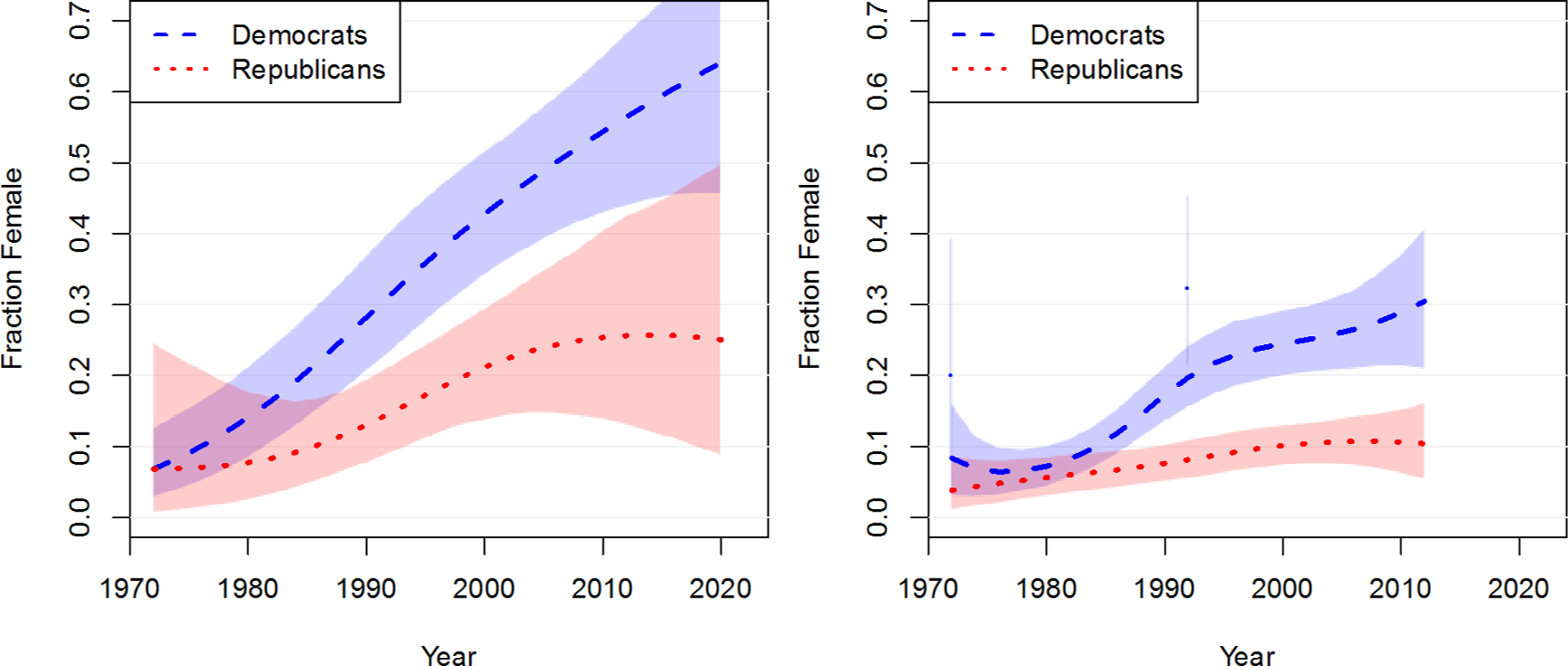
Evolution of gender composition in the estimated pool of candidates (left panel) versus estimated trend for newly elected US House representatives (right panel). Confidence bands (shaded region) are based on 1000 bootstrap replications. In 1972 and 1992 (plotted outliers with 95% intervals, right panel), the proportion of women among newly elected Democratic candidates was significantly above the estimated trend.
In the early 1970s, the proportion of women in the pool of potential candidates for each party was similar, less than 10% of the total pool for each party. Women’s presence in the pool of candidates increased as they entered feeder professions in higher numbers, but unequally between the parties. By 1990 there were twice as many women in the Democratic pool of candidates as the Republican pool, a difference maintained over the subsequent two decades as both pools of candidates gained more women proportionately. In 2012, the model estimates that women composed 56% of the Democratic pool and 26% of the Republican pool. Our model-based extrapolations become very uncertain by 2020, but the evidence based on GSS respondents currently younger than our target age of 48 indicates that the partisan gender gap is increasing rather than decreasing in younger cohorts.
The proportion of women among newly elected representatives has followed a similar pattern. A gap between the two parties appeared around 1980, reached a 2:1 ratio around 1990, and has continued to drift upward subsequently. The 2012 estimates are 30% for Democrats and 11% for Republicans, similar to actual figures in that election of 31% (16 out of 52) and 9% (3 out of 35), respectively. While these new representative rates follow the same historical patterns of growth among Democrats and stagnation among Republicans, they are consistently and substantially lower than our estimates of the proportion of women in the pool of candidates.
Note also that 1992–the ‘Year of the Woman’ (Berch, 1996; Cook et al., 1994; Dolan, 1998) – is the only recent year where the proportion of women elected matched the absolute level of women in our estimated pool of candidates. The new Democratic cohorts elected in 1972 and 1992 are outliers in the sense that our estimated trend in the rate at which women are elected is outside the 95% confidence interval based on those elections alone. However, since there are 42 party-election-years in the data, two such outliers is what we would expect to see by chance. Thus, there is a limit to how strongly we should interpret these years in terms of the underlying processes that generate new congressional cohorts, even though they are noteworthy in terms of their outcomes.
Discussion and conclusion
The gender composition of our estimated pool of candidates for Democrats and Republicans closely matches the historical trends in women’s emergence in the US House. While this does not necessarily imply that this diverging supply of women is the only explanation for the diverging proportions of women among Democratic and Republican members of Congress, it does provide a straightforward explanation for this aspect of the historical trends.
One striking pattern in these estimates is that the proportion of women in the potential Republican candidate pool seems to have plateaued. Given that the partisan gap among newly elected women representatives is already approaching three to one, this indicates the possibility of an increasingly stark discrepancy between the parties, with a Democratic caucus approaching gender parity and a Republican caucus that remains overwhelmingly male.
Because research indicates that women’s presence in office affects policymaking and voters in a variety of ways (e.g. Atkeson, 2003; Carroll, 2001; Osborn, 2012; Swers, 2002, 2013; Thomas, 1994), this growing distinction between the parties may have significant effects on the parties’ platforms, legislative priorities and appeals to the electorate. For example, our research suggests that the Republican Party’s increasing desire to ‘develop a surrogate list of women’ to reach out to voters, and to focus on ‘encouraging and championing [women’s] desire to seek elective office’ (Republican National Committee, 2013: 20–21) may be hindered by the supply of Republican women with the typical characteristics of political candidates. The additional effort needed to identify women in a pool where they are substantially outnumbered by men may limit the extent to which the Republican party draws on even the supply of women partisans currently available. Thus our findings highlight the need for continuing research examining the causes of this party gap.
To the extent that this gap is driven by differing gender norms among Republicans and Democrats – whether due to women’s selection of a party that matches their gender views, or women’s shifting of their gender role beliefs to match those of the party with which they affiliate – the supply of women candidates from within the Republican electorate may expand only following extensive changes in the ideology of the Republican party more broadly. Studies have revealed shifts of this nature occurring internationally, with more egalitarian gender norms expanding beyond leftist parties over time (Lovenduski and Norris, 1993; Matland and Studlar, 1996). In the US, however, time trends in responses to GSS questions about gender roles are ambiguous as to whether the differences between Democratic and Republican partisans are narrowing or not since the 1980s. 9 In fact, polarization of US parties on these issues may prevent the spread of egalitarianism across parties from occurring in the same way as in other nations. While positions on social and cultural issues such as gender equity were previously minimally correlated with party identification in the US in the 1980s and 1990s, Democratic and Republican elites polarized on these issues, and they became part of the profile of disagreements distinguishing the parties (Adams, 1997; Wolbrecht, 2000). Since this time, Democratic and Republican elites have continued to polarize on these and related social issues (Hetherington, 2010) and their views have extended to many mass party identifiers (Layman and Carsey, 2002). Thus while further liberalizing of gender views in the US could bring American women’s political representation closer to women’s representation in other advanced democracies by expanding the supply of women in the pool of candidates, polarization and conflict extension may limit this movement within the Republican party, leading to growth rather than narrowing of the party gap in the supply of women potential candidates in the US.
The other prominent disparity in these estimates is between the gender composition of high education, high prestige, middle aged partisans and the gender composition of those who are actually elected. 10 Although women now comprise a majority of those in our estimated pool of Democratic potential candidates, and a significant minority of Republican potential candidates, women’s representation as members of Congress remains far lower. While a qualification gap between men and women may have been important before the post Title IX generation of women hit middle age in the 1990s, it cannot easily explain the difference in levels between the two plots in Figure 1. Many studies demonstrate similarities in the qualifications and campaign competencies of men and women candidates (Burrell, 1994; Carroll, 1994; Gaddie and Bullock III, 1995; Werner, 1997). Instead, the gap may be driven by factors like differential recruitment (Crowder-Meyer, 2013; Fox and Lawless, 2010; Sanbonmatsu, 2002c, 2006; Stambough and O’Regan, 2007), ambition (Lawless and Fox, 2010), voter biases or stereotypes (Fulton, 2012; Sanbonmatsu, 2002b; though see Brooks, 2013; Dolan, 2013), or some other force driving down the proportion of eligible women actually running for and taking office. Whatever factors explain the difference between the two plots may also affect women in the two parties differently – particularly if different gender norms among Republicans and Democrats depress Republican women’s political ambition, recruitment by elites, or votes from the electorate. So, while our projections indicate that the partisan gender gap in the US House is more likely to widen than not, changes in these other factors could reshape this gap in the future.
Previous studies demonstrating single digit gender gaps in US party identification have not been able to explain the much larger gap when it comes to US elected officials. But representatives do not emerge from the public at large: they are disproportionately individuals with high education, high occupational prestige, and clear partisan preferences. By estimating the gender composition of this select group by partisanship, we find that the partisan gender gap is much larger among the kinds of citizens who tend to become representatives and that the emergence of this gap was contemporaneous with the historical emergence of a partisan gender gap in the US House. Given the current associations between gender, partisanship, and other attributes among the public, the data suggest that future generational replacement may exacerbate the already significant gap in women’s descriptive representation between the parties, potentially reshaping the behavior of each party’s elected officials, the quality of representation available to diverse members of the public, and opinions of the public toward the Republican and Democratic parties.
Footnotes
Acknowledgements
The authors thank Nicholas Carnes for comments on an early draft.
Declaration of conflicting interest
The authors declare that there is no conflict of interest.
Funding
This research received no specific grant from any funding agency in the public, commercial, or not-for-profit sectors.
