




Abstract
Unmanned aerial vehicles, also known as drones, have become a central feature of American foreign policy, with over 400 strikes in Pakistan, Somalia, and Yemen in the last decade. Despite criticisms that have arisen about ethics and legality of this policy, polls have registered high levels of public support for drone strikes. This article shows that the standard formulation of poll questions takes as a given the government’s controversial claims about combatant status and source of legal authorization. I conduct a survey experiment that evaluates how varying the terms of the debate –in particular whether the strikes are compatible with international humanitarian law (IHL) and have legal authorization – affects public support for the drone policy. Treatments that incorporated contested assumptions about IHL meaningfully decreased public support while the public was less moved by questions about domestic or international legal authorization.
The use of unmanned aerial vehicles, also known as drones, 1 has become a central feature of American counterterrorism policy (Singer, 2013). Between 2004–2008, the United States conducted about 50 drone strikes outside the context of the armed conflict in Iraq and Afghanistan, escalating to more than 400 between 2009–2013. 2 President Barack Obama admitted in May 2013 that the United States had come to see armed drones ‘as a cure-all for terrorism’ because they were low risk and politically advantageous in terms of ‘shielding the government’ from the criticisms ‘that a troop deployment invites’ (quoted in Koebler, 2013). While a number of criticisms have arisen from non-governmental and international organizations that question the legality of strikes (Amnesty International, 2013; United Nations, 2013), Obama was correct to imply that the policy has been inoculated from criticism among the broader public, because support for drone strikes has generally remained high (Pew, 2013).
I argue that these criticisms have tended not to translate into lower levels of support for drone strikes because contemporary polling has restricted the frame of reference for how individuals evaluate the policy. Collecting all available polls on support for drone strikes, I show that the typical question formulation accepts as uncontroversial two main claims the government has made: that the strikes are compatible with international humanitarian law (distinction and proportionality) and have legal authorization (domestic and international). I then carry out an experiment that manipulates these two claims and evaluate the impact on public support for the government’s drone policy. I show that by taking a position on contested features of a program, surveys have constrained the terms of debate about the use of drones for counterterrorism and inflated support for the policy. This argument is less about question wording –for example, increasing support by framing a policy in favorable or unfavorable terms – than about disputed assumptions embedded in questions (Kinder and Sanders, 1990).
Despite becoming a centerpiece of American foreign policy in general and counterterrorism policy in particular, the analysis of drones has generally been journalistic in nature, focusing on either the technology (Singer, 2009) or the bureaucratic basis by which the United States came to rely more on drone strikes than detention of terrorists (Mazzetti, 2013), or on legal or ethical debates about using droes for counterterrorism (e.g., Finkelstein et al., 2012; Strawser, 2013). The literature has tended to sidestep important questions about the determinants of public support for drone strikes, in particular whether the legal and ethical concerns that have been raised about drone strikes affect public attitudes. 3 Research demonstrates that leaders are attentive to public attitudes when making decisions about the use of force (e.g., Holsti, 2004). Insofar as public support acts as the basis for legitimate policies, understanding the basis for that support, and the conditions under which individuals would be more critical, sheds light on the sustainability of the current reliance on drones.
Debating drones in combat
Defending its use of drones to ‘relentlessly target al-Qaeda leadership’ (Obama, 2013), the government has made two main sets of claims: first, that strikes are fully compatible with international humanitarian law (IHL) – in particular, the principles of distinction and proportionality dealing with the protection of civilians in the context of conflict – and, second, that they are authorized under both domestic and international law (Koh, 2010). Neither set of claims has passed unscathed. First, critics argue that drone strikes have violated the IHL principle of distinction (Kreps and Kaag, 2012), which requires, according to Article 48 of the Protocol Additional to the Geneva Convention (AP 1, 1977), that ‘the Parties to the conflict shall at all times distinguish between the civilian population and combatants…and accordingly shall direct their operations only against military objectives’. 4 Critics suggest that the government’s target list includes people who do not ‘take a direct part in hostilities’, with particular censure reserved for signature strikes (Stanford–NYU, 2012), status-based targeting in which the government strikes individuals based on their demographic characteristics or patterns of behavior – for example, that they are consorting with militants or congregating with an elder in the community – even when their identities are unknown (Ackerman, S., 2013).
Even if the targets were legal under IHL, many of the strikes raise concerns about proportionality, because they have killed not just their intended target but also a number of civilians. Article 51 (5) (b) proscribes attacks that cause civilian damage ‘excessive in relation to the concrete and direct military advantage anticipated’ (AP 1, 1977). Critics suggest that drone strikes are not compatible with the principle of proportionality because strikes often occur in areas where a large number of civilians are present – for example, funerals, meetings of elders, and community meetings (Stanford–NYU 2012) – thereby also killing a number of civilians other than the intended target. Taken together, the IHL-related criticisms seek to correct government claims that strikes have primarily killed suspected high-level terrorists, countering that just 8% of the 500 ‘…militants’ killed between 2008-2010 were either “top-tier militant targets” or “mid-to-high-level organizers”’ (Heller, forthcoming).
A second major line of criticism about the United States’ drone policy relates to the recourse to force: whether the strikes have been authorized by domestic or international law. The United States Congress authorized the use of military force after 9/11, allowing the president to target those who ‘planned, authorized, committed, or aided the terrorist attacks’ of 9/11 − which is interpreted to mean Al-Qaeda – but some critics question whether the drone strikes are justified under the post-9/11 authorization. According to Bruce Ackerman (Ackerman, B., 2012), the move to target ‘suspicious behavior’ by groups such as Al-Qaeda in the Arabian Peninsula (AQAP, which operates in Somalia and Yemen) would require additional congressional authorization. Critics make an analogous argument about drone strikes lacking international legal authorization. While the United States may have been on solid international legal footing by attacking Afghanistan after 9/11, O’Connell (2013) suggests that ‘in the areas where the US is not involved in armed conflict, it cannot lawfully resort to military force’, including in Pakistan, Yemen, and Somalia.
The role of public opinion polls in debates about drones
Despite criticisms about whether drone strikes comply with international humanitarian law or have appropriate legal authorization, key entities in the marketplace of ideas have generally appropriated many of the government’s assumptions in the coverage of the United States’ drone policy. Scholars have shown that the media have generally been uncritical of the government’s drone policy, especially until about 2012 (McKelvey, 2013). Public opinion polls are a more subtle, often overlooked voice that could also shape the debate. Polls are important insofar as they ‘play a significant role in constructing an understanding of what people think and what they want’ (Lewis, 2001: 3). Individuals, as Zaller and Feldman note (1999: 79), ‘carry around in their heads a mix of only partially consistent ideas and considerations. When questioned, they call to mind…an oversample of ideas made salient by the questionnaire’.
The assumptions embedded in polls can therefore affect attitudes, according to Kinder and Sanders (1990: 74), who argue that ‘policy descriptions actually used within the survey affect the expression of opinion’. Based on the particular policy features they highlight or minimize, polls can affect individual responses. Building on this argument, I suggest that in the context of drones, polls have appropriated a viewpoint that mimics the government’s position, sidestepping controversial features that might prompt higher levels of opposition and lower levels of support. This claim is not about wording effects, per se, but about the way surveys appropriate a particular viewpoint that increases the likelihood that a larger proportion of the public will support the policy.
An assessment of all available polls on drones (2011–2013) suggests that most polls take as a given the two controversial aspects of the drone program discussed earlier. First, polls incorporate the debatable assertion that drone strikes target high-level terrorists, sidestepping the questions about whether intended targets are actually terrorists (distinction) and about the amount of collateral civilian damage (proportionality). A typical formulation is the following from NBC/WSJ: ‘Do you favor or oppose the use of unmanned aircraft, also known as drones, to kill suspected members of Al Qaeda and other terrorists?’ The Economist/YouGov poll asks whether individuals approve of ‘using drones to kill high-level terrorism suspects overseas?’ Gallup queries whether individuals support using drones to ‘launch airstrikes in other countries against suspected terrorists?’ Second, polls are silent on the question of authorization despite criticisms that have arisen about whether drone strikes outside active conflict zones such as Afghanistan are authorized under domestic or international law.
As Table 1 shows, in three years of polling, individuals have consistently registered high levels of support for drone strikes. By taking at face-value the government’s assertions that those being struck are terrorists and taking its legal authority as a given, however, it is likely that polls overstate levels of support for the United States’ drone policy. In turn, the public’s enthusiasm has become part of the political narrative and shaped the boundaries of the conversation (Mutz, 1998) about drones. Poll data reverberates through media outlets trumpeting that ‘The American Public Loves Drones’ (Cillizza, 2013) or the ‘American Public Has Few Qualms with Drone Strikes, Poll Finds’ (LaFranchi, 2013).
Public opinion data on support for drone strikes, 2011–2013.

Note: Some of the totals may not add up to 100% because of rounding.
Poll had a residual ‘Depends’ or ‘Neither’ answer category, which is excluded from the results presented.
Whether the public actually has qualms about the policy is rarely broached in survey questions. Polls do not raise the question of legal authorization. A few polls do query individuals about combatant status and hint at individuals’ concern with whether drones are harming civilians, as shown in Table 2. Given that individuals could harbor reservations about harm to civilians but nonetheless support drone strikes, these questions are not well-suited to understanding how the legal circumstances underlying drone strikes affect the public’s support for the policy.
Concern with the possibility that drones are harming civilians.

Note: Some of the totals may not add up to 100% because of rounding.
Where polls have asked the type of question that queries support for drone strikes conditional on legal considerations such as how strikes affect civilians, the questions are not randomized but asked sequentially (Table 3). By not randomly assigning respondents to various treatments, individuals may be anchored to their initial responses and may not be evaluating the propositions independently (Feldman and Lynch, 1998). Such questions therefore make it difficult to isolate the effect of legal considerations such as combatant status on public support, since there is no randomized baseline against which to compare it.
Support for drone strikes in the following circumstances.

Source: YouGov/Economist, 28 October 2013.
Experimental design
The previous section argues that public opinion polls on drones have presented as uncontroversial two main assumptions about the United States drone policy, first that the policy adheres to IHL and, second, that it has legal authorization. To assess the effect of these assumptions on public support for drone strikes, I carried out an experiment with a 3x3 factorial design, varying IHL compliance (distinction and proportionality) and legal authorization (domestic and international). Appendix A includes details of the experimental conditions and text.
The control scenario employed a typical formulation from a public opinion poll about drone strikes, whether individuals support drones ‘to kill suspected members of Al Qaeda and other terrorists’, with response items the same as those of a typical poll question (support or oppose). The first set of experimental manipulations involved aspects of the program related to IHL. The distinction treatment suggested that strikes target ‘individuals who appear to behave in similar ways as terrorists – for example, going to a meeting with community elders – but who may not be confirmed terrorists’. The proportionality treatment suggested that, ‘in addition to the intended targets, these strikes have often caused a number of civilian casualties’. The second set of experimental manipulations dealt with the source of legal authority, with one treatment suggesting that ‘strikes where Congress has not authorized the use of US military force or issued a declaration of war may be a violation of domestic law’ and another that ‘strikes in areas where the US is not involved in armed conflict may be a violation of international law’.
One critique of this experimental design might be that it results in a bias in favor of the argument, with the treatments acting as negative information that dampens individual support. If existing research is any guide, however, Americans tend to exhibit distinctly realist preferences in foreign policy (Drezner, 2008), which would suggest that individuals may not automatically construe information about the legality of particular foreign policy actions as negative (comparing treatments with control). In any case, the design makes it possible to determine the dimension or combination of criticisms that resonate most among the public (comparing across treatments). This has important implications for NGOs and IOs that have sought to challenge American drone policy by exposing different features of the policy.
Subjects were recruited via the Internet, with 943 individuals randomly assigned into one of nine conditions (about 100 per condition). Because Internet samples are not generally nationally representative, I compared the demographic data with the population at large, using American National Election Studies 2008 survey data as the benchmark, and created post-stratification weights to correct for overrepresentation of certain groups (Lohr, 2008). As Appendix B illustrates, the main discrepancies in terms of representativeness between the internet sample and population came from age and gender, so the analysis is based on post-stratification weights for each of these categories.
Experimental results
The experimental results lend support to the overall claim: survey questions that bracket controversial aspects of the drone program, taking as a given the government’s position, strongly influence support for the program. Table 4 shows the percentage of respondents who supported drone strikes across treatment groups. While all of the treatment effects were negative, as expected, some did not reach conventional levels of significance, discussed next. 7
Approval rates by treatment group.

In particular, the respondents did not appear to be as moved by concerns about the recourse to force; that is, whether the strikes had domestic or international authorization. The favorability of the drone program diminished considerably, however, when controversial features related to IHL – the principles of distinction and proportionality – were introduced into survey questions. Although the treatments did not explicitly mention international law, but rather the principles of protecting non-combatants that underlie it, previous research suggests that explicit references to violations of international law would further dampen support (Walsh, 2013). Even when the distinction and proportionality treatments interacted with either the domestic or international legal authorization treatments, the mention of harming civilians dampened support for drone strikes. The clearest and most consistent effects were apparent in the isolated IHL treatments, however, suggesting that two cues – for example a violation of proportionality and lacking domestic authorization – may actually complicate the story and dilute the effect of a particular violation of IHL. Figure 1 summarizes the treatment effects relative to the control group.
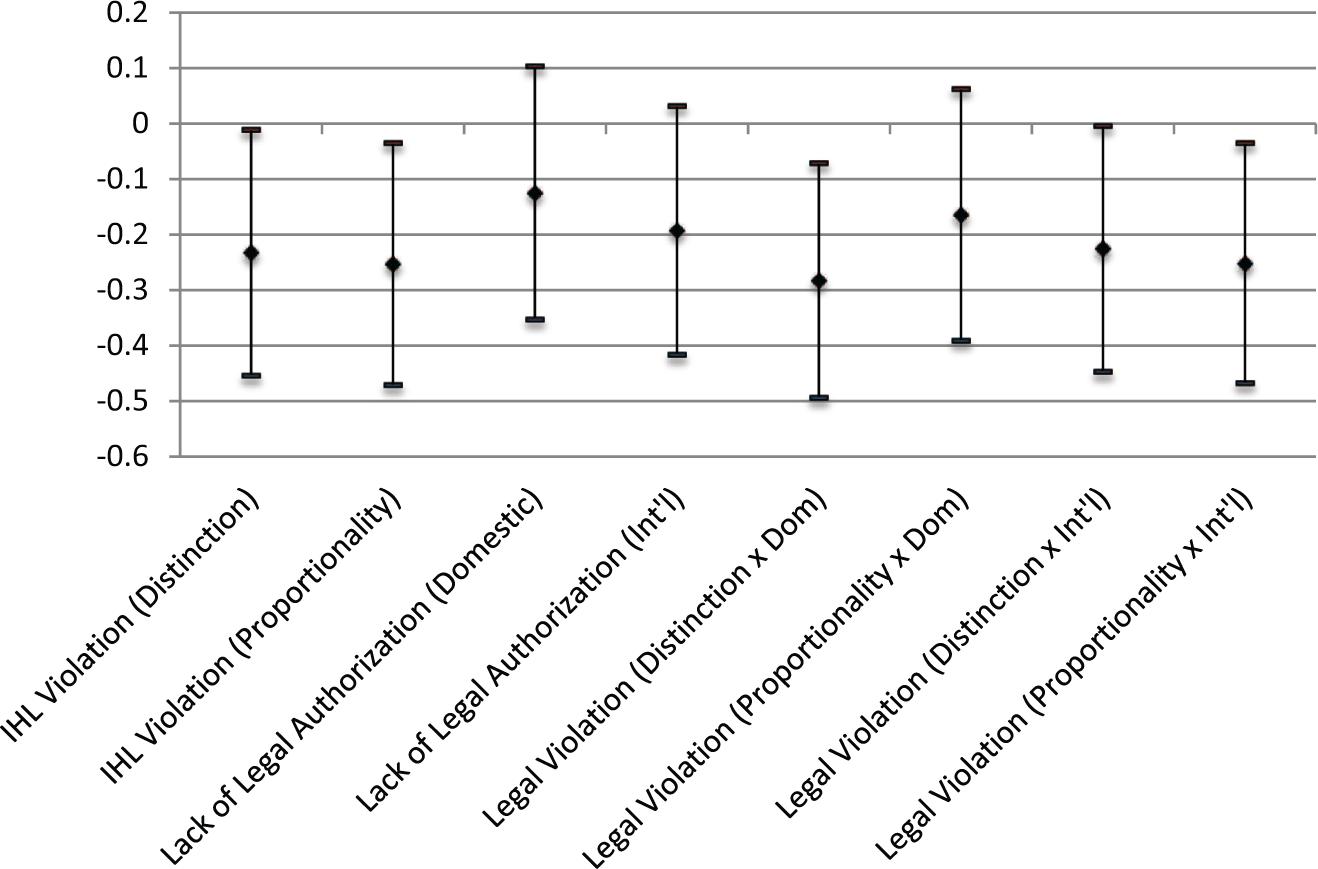
Support for drone strikes by experimental condition.
That some legal treatments affected individuals’ support for drone strikes but not others suggests the following. First, it responds to potential criticism about the design of the instrument necessarily producing lower levels of support, since questions about the legality of the program act as negative information. Indeed, only the IHL-based treatments have that effect. Second, the concern with IHL, rather than with the recourse to force, offers some nuance to previous work finding that ‘legal commitments have a discernible impact on public support’ (Wallace, 2013: 105), because it appears that the public is more concerned with certain types of legal commitments—in this case, whether civilians are in harm’s way once conflict begins – rather than with whether the use of drone strikes is legally permitted in the first place. Third, these results suggest that IOs and NGOs that advocate against drone strikes would be well-served not to combine transgressions, which generally do not produce marginal consequences and if anything produce more muted effects, but rather focus on particular violations of IHL to isolate the concerns that resonate most with individuals.
Beyond the treatments, I also controlled for demographic factors such as gender, age, education, and political party identification, as well as views of international institutions, the use of force and the rule of law (see Appendix C for questions and coding). The results shown in Appendix D suggest that the treatment effects remain significant, and in some cases increase in significance, when controlling for these demographic and policy-relevant preferences, while also pointing to other factors that affect individual propensities to support drone strikes. Individuals who are hawkish and willing to give up some freedom in order to reduce the threat of terrorism are more likely, on average, to support drone strikes, while other factors did not have a significant effect on support. Since strong preferences on policy issues can moderate treatment effects (Chaudoin, 2014), I also interacted the treatment indicators with potential policy-relevant factors such as attitudes about international institutions, the use of force and the rule of law. As Appendix E shows, interactions between the relevant political preferences did not meaningfully moderate the treatment effects.
Conclusions
This study focused on how public opinion polls on drones mimic the government’s position on two debatable aspects of the drone policy: compatibility with international humanitarian law (distinction and proportionality) and source of legal authorization (domestic and international). Observational data on support for drone strikes show that polls have not taken into account some of the more nettlesome aspects of the use of drones; and experimental evidence evaluated the effect on public attitudes. Taken together, the research suggests that by sidestepping how drones affect non-combatants, polls constrain the ideological space of the drone debate and contribute to the prevailing view that drone strikes enjoy high levels of support. Polls thereby perpetuate the status quo on drones insofar as they establish a set of political incentives for decision makers: both directly as a barometer through which leaders gauge the national mood (Stimson et al., 1995) and indirectly as polls enter into the political discourse as a media story (Mutz, 1998).
While this analysis has offered one particular theoretical and empirical take on public opinion and drones, additional study is warranted. For example, for the purposes of external validity, this analysis used drones as the vehicle for carrying out the policy of targeted killing, since the United States has conducted almost of its armed counterterrorism strikes with drones (the Osama Bin Laden raid notwithstanding). A follow-up study might consider disaggregating the technology and the policy to evaluate if arguments about legality within the conduct of war and authorization to conduct the strikes resonate differently depending upon whether strikes are carried out by drones, manned platforms, or ground troops. Does replacing drones with a manned aircraft or ground troops to conduct lethal counterterrorism operations – including the attendant risks – make the legal concerns more or less salient or have no effect when compared to drones? Furthermore, this study addressed two sets of implicit judgments embedded in poll questions about drones, but these may not be the only omissions. Are there implicit assumptions embedded in such questions about the effectiveness of drone attacks – for example, whether they have disrupted terrorist attacks against the United States or its interests abroad, or provided a disincentive for certain terrorist activities? Introducing these other contested assumptions could also affect support. Despite more research being needed, this study provides an important step in terms of better understanding public attitudes about a prominent feature of current American foreign policy.
Footnotes
Acknowledgements
I would like to thank Stephen Chaudoin, Gustavo Flores-Macias, Michael Horowitz, Adam Levine, Jens Ohlin, Geoff Wallace, and Micah Zenko for helpful feedback on different aspects of this research. I am also grateful for comments from seminar participants at Stanford’s Center for International Security and Cooperation, Cornell Law School’s International Law-International Relations Colloquium and the University of Texas-Austin’s Robert Strauss Center for International Security and Law. For support, I thank the Council on Foreign Relations and the Stanton Foundation.
Declaration of conflicting interests
The author declares that there is no conflict of interest.
Funding
This research received no specific grant from any funding agency in the public, commercial, or not-for-profit sectors.
Supplementary material
The online Appendices are available at: http://rap.sagepub.com/content/by/supplemental-data. The complete data sets of this article are available at: 