



Abstract
This paper renews the argument for the Anthropocene as a formal unit of geological time by reassessing the so-called Great Acceleration. In March 2024, the Subcommission on Quaternary Stratigraphy rejected a proposal to formalise the Anthropocene at series/epoch level, with a base in 1952 CE. I show that there is still a strong case for amending the Geological Time Scale to reflect the recent departure of the Earth System from the Holocene envelope of variability. That departure has taken place since the mid-20th century, and has been made up of a cluster of interlinked economic and Earth System transformations: the ‘Great Acceleration’. The Great Acceleration emerged within a specific long-term historical context. Over the past five centuries, the global economy has increasingly been structured as a single worldwide system, based on a division of production between wealthier ‘core’ and poorer ‘peripheral’ zones. The development of the modern world-system is the larger event that has terminated the Holocene epoch. I analyse the dynamics of the world-system via an assessment of one of its constituent phases: the Industrial Revolution, circa 1760–1830. The Great Acceleration itself is most closely associated with a phase of the modern world-system lasting circa 1945–1973. That broader context clarifies the geopolitical and economic drivers of recent Earth System changes and their stratigraphic signatures.
Keywords
Introduction
What next for the Anthropocene as a stratigraphic concept? In October 2023, the Anthropocene Working Group of the International Commission on Stratigraphy (AWG) released a proposal to formalise the Anthropocene as a chronostratigraphic unit of the Geological Time Scale, at series/epoch level (Waters et al., 2024a, 2024b, 2024c). The group proposed dating the beginning of the Anthropocene to 1952 CE. The base of the epoch would be defined with reference to the deposition of 239+240Pu in the annually laminated sediments of Crawford Lake, a meromictic lake in a limestone sinkhole on the outskirts of the Greater Toronto metropolitan area (McCarthy et al., 2025; Waters et al., 2023, 2024c).
The AWG’s proposal was rejected by the Subcommission on Quaternary Stratigraphy (SQS) in early March 2024 (Zhong, 2024). That decision was ratified by the subcommission’s parent body later the same month (International Union of Geological Sciences, 2024).
The Anthropocene sensu Waters et al. (2024a) is founded on the idea of the ‘Great Acceleration’. That is the name given by the AWG and associated researchers (Hibbard et al., 2007; Steffen et al., 2007) to the interval beginning in 1950, in a substantial body of work including a keystone paper by Steffen et al. (2015). During the Great Acceleration, the makeup and functioning of the Earth System has altered in ways that have carried it outside the parameters of Holocene variability. That departure from the range of variability of the Holocene constitutes—for the AWG, although not for the SQS—the onset of the Anthropocene.
This paper sets out a framework for rethinking the Great Acceleration. That novel framework acknowledges and overcomes the most plausible objection to formalising the Anthropocene as an epoch of geological time: that the stratigraphic record of the 20th century has too little meaningful connection to the real economic and geopolitical drivers of recent Earth System change. I argue that the departure of the Earth System from the Holocene envelope of variability in the mid-20th century should be seen as part of a constellation of historical developments, taking decisive shape in the 15th–16th centuries, that make up the ‘modern world-system’. The phenomenon that has terminated the Holocene epoch is the global spread, from circa 1500 onwards, of a broadly capitalist economic system with its nucleus in the Atlantic basin (Arrighi, 2010; Inikori, 2007; Marks, 2007; Moore, 2007b, 2015; Wallerstein, 2011b).
The rest of this paper is in six parts. Section 1 assesses the debate so far about the ratification of the Anthropocene as a geological time unit, and about the Great Acceleration. Section 2 looks more closely at the first and fastest phase of the Great Acceleration, between 1945 and 1973. Section 3 is an introduction to the history of the modern world-system. Section 4 is the main part of the paper. It reconsiders a foundational theme in the debate about the Anthropocene: the British Industrial Revolution. I show how the Industrial Revolution made up part of the world-system’s evolution, and I use it to illustrate the world-system’s overall dynamics. Britain’s early industrialisation was not confined by national borders. On the contrary, it involved a global reconfiguration of resource flows. Section 5 enumerates four implications for the Great Acceleration itself: (i) it is part of an economic system that has persisted for the past half-millennium; (ii) it is one of many relatively distinct phases in the development of the international economy; (iii) ‘globalisation’ long preceded the Great Acceleration; and (iv) the relationship between rich and poor regions of the world plays a critical role in bringing about global change. Section 6 concludes.
The formalisation controversy
When the Subcommission on Quaternary Stratigraphy turned down the Anthropocene Working Group’s proposed addition to the Geological Time Scale, the validity of the empirical research into the varved succession at Crawford Lake (McCarthy et al., 2025) was not called into question. Nor was the AWG’s contention that stratigraphically significant change in the Earth System took place in the mid-20th century. Instead, the geological formalisation of the Anthropocene was denied on more fundamental conceptual grounds.
For the majority of the AWG’s membership, the Anthropocene reflects the fact that contemporary stratigraphic conditions have passed outside the Holocene envelope of variability. In the words of their proposal for formalisation, ‘the Holocene Series/Epoch is no longer an adequate descriptor of the state of the Earth System. Though undoubtedly very short in a geological context, the Anthropocene is already geologically distinct from the Holocene’ (Waters et al., 2024a: 6). This conceptualisation of the Anthropocene (introduced in Crutzen, 2002) underpinned the work of the AWG throughout the group’s existence. AWG papers pressed the point that the Anthropocene should be understood simply as an epoch of Earth history that differs from the preceding Holocene epoch. It follows that to locate the Holocene/Anthropocene boundary in the mid-20th century is not at all to downplay the longstanding, widespread and significant human impacts on the Earth System before and during the Holocene itself (e.g. Waters et al., 2016; Zalasiewicz et al., 2021, 2024). As an early paper explained: we do not believe that it is necessary to seek a ‘boundary stratigraphic marker’ that reflects the time ‘since anthropogenic change began.’ The issue here is not the presence or absence of human traces in strata. It is whether Earth’s stratigraphic record—and the processes that shape it—have changed sufficiently to make a new [chronostratigraphic] unit justifiable and useful. (Zalasiewicz et al., 2012)
Again: The Anthropocene, we stress, is not synonymous with anthropogenic activity. [. . .] Had the post-mid-20th century changes we associate with the Anthropocene been produced not by human actions but by, say, volcanoes or a meteorite strike, then the justification and meaning of the Anthropocene both in [Earth System science] terms and stratigraphically would also have remained similarly valid. The Anthropocene as an ESS and a chronostratigraphic unit recognizes dramatic changes to the Earth System, using the same criteria that delineates any other previous epoch—it just so happens that the cause is humans this time, rather than some other forcing factor. (Zalasiewicz et al., 2019: 325)
And again: This chronostratigraphic Anthropocene concept, based upon a global response to focused human transformation of the planet, emphatically does not record the first human impact, nor does it preclude or diminish in importance the long human record of influence extending back millennia. (Waters et al., 2022: 22).
Notwithstanding the AWG’s position, their proposal to formalise the Anthropocene was criticised on the grounds that the proposed base of the new epoch did not correspond to the first human impacts on the Earth system. A former member of the group lambasted the AWG for ‘claiming that the age of human-caused planetary change began in 1950’ and ‘choosing to systematically ignore the overwhelming evidence of Earth’s long-term anthropogenic transformation’—a transformation culminating in ‘five centuries of European colonialism’ (Ellis, 2023). Explaining the case against the proposal made by Waters et al. (2024a, 2024b, 2024c), the International Union of Geological Sciences asserted that: anthropogenic effects on the Earth’s environmental and climate systems long predate the mid 20th century [. . .] hence the Anthropocene has much deeper roots in geological time. [. . .] [T]he human effects on global systems are time-transgressive and are also spatially and temporally variable, so that their onset cannot be adequately represented by an isochronous horizon as reflecting a single point in time. (International Union of Geological Sciences, 2024)
Members of SQS opposed to the proposal were quoted as saying that ‘it suggests that all of a sudden, within my lifetime, the changes that are affecting the planet suddenly appeared. [. . .] But humans have in fact been influencing the natural environment for 40,000 years’ (Sullivan, 2024); and that ‘human impact goes much deeper into geological time [than 1952] [. . .] if we ignore that, we are ignoring the true impact, the real impact, that humans have on our planet’ (Zhong, 2024).
These criticisms do not address the content of the AWG’s proposal (Chakraborty, 2025). The Anthropocene epoch, as defined by the AWG, reflects a geologically relevant state shift in the Earth System, not the beginning of human influence on the natural world. It is a novel chapter of geological time, succeeding to the Holocene. It bears little relation to the idea of a diachronous ‘age of humans’, given that profound anthropogenic influence on global ecology is evident long before the beginning of the Holocene (Svenning et al., 2024). The version of the Anthropocene actually proposed by the AWG is defined by physical effects on Earth’s makeup and functioning as recorded by signals in the geologic record. The version rejected by many of its critics is defined instead by causal mechanisms. The two are radically different concepts that share the same name (Turner et al., 2024). There is much evidence that the proposals offered in Waters et al. (2024a) fell victim, at least in part, to misinterpretation.
The AWG made a compelling case for a reform of the Geological Time Scale. The time scale will better reflect current geological reality if a new epoch is added to indicate the recent termination of the Holocene’s relative climatic and biogeographic stability (see Zalasiewicz et al., 2024: 75). Assessments of the ‘Great Acceleration’ have explored in detail the dramatic adjustments to the Earth System that took place from the mid-20th century onwards. They include escalating concentrations of atmospheric CO2, CH4, and N2O, with associated global heating, polar ice loss, sea level rise, and ocean acidification; sharp increases in species extinction and translocation, plastic deposition, sediment flux, and the abundance of reactive nitrogen and phosphorus; loss of tropical forest cover; and spikes in the deposition of radionuclides, fly ash (spheroidal carbonaceous particles), and persistent organic pollutants. Those Earth System changes reflect rapid growth in the human population, gross world product, energy consumption, water use, and a cluster of other, related indicators (Head et al., 2022; McNeill, 2000; McNeill and Engelke, 2014; Steffen et al., 2004, 2007: 131–34 et passim, 2015; Syvitski et al., 2020; Waters et al., 2022, 2024b).
Unwary formulations in parts of the Great Acceleration literature—especially some invocations of ‘the human enterprise’ in Steffen et al. (2007)—became lightning rods for a widespread objection that research on the Anthropocene in the natural sciences treats humankind as a single, undifferentiated collective actor, thereby obscuring social and political realities (Bonneuil, 2015; Malm and Hornborg, 2014). Those accusations were certainly overstated (Angus, 2016: 224–232). The fullest and most important formulation of the Great Acceleration thesis, by Steffen et al. (2015), tried to counter them by distinguishing between socio-economic trends in the wealthiest countries, trends in the then-emerging economic powers, and trends in the rest of the world.
Notwithstanding all the AWG’s clear-sighted analysis, however, there were always certain limitations in the group’s account of the Holocene/Anthropocene transition. AWG publications provided authoritative assessments of the relevant stratigraphic phenomena, but made some flawed claims about the causal mechanisms behind those phenomena. Even Steffen et al. (2015) offered a very insufficient account of 20th-century political economy and its longer-term contexts. In particular, (a) a crucial socio-economic break-point in the early 1970s was overlooked; (b) ‘globalisation’ was taken to reach new heights in the early Great Acceleration, when by objective measures it did not; and (c) the active role of the underdeveloped world in the Great Acceleration was denied. Section 2 of this paper discusses issues (a) and (b) in detail, while section 3 is concerned with issue (c).
Again, the criticisms levelled against the work of the AWG have often misrepresented that work. The publicly stated objections to the formalisation of the Anthropocene within the Geological Time Scale rested on the muddled assumption that the Anthropocene is supposed to cover the entire interval of anthropogenic impacts on the Earth System. But a different objection would have been better justified: that the literature underpinning the proposal for formalisation made by Waters et al. (2024a, 2024b, 2024c) misdescribed some of the geopolitical and economic conditions of the Great Acceleration, meaning that the case for the Anthropocene series/epoch was not yet backed up by a sufficiently exact account of the factors that lay behind the rising population, energy consumption, and industrial output observed in the mid-20th century.
The aim of this paper is to start filling in those gaps in the AWG’s monumental project. The impasse of March 2024 is also an opportunity for a fresh start. The refusal—for now—of stratigraphic formalisation should not halt attempts to understand the current crisis of the Earth System within the sweep of geological time. Here, I offer a reconsideration of the 20th-century transition between epochs. I show how the chemical, biological, and lithic changes associated with the Anthropocene’s proposed Global Boundary Stratotype Section and Point (GSSP) at Crawford Lake can be fitted into a larger story about socio-economic and ecological change.
The Great Acceleration did not begin in the most developed parts of the world and only later diffuse to poorer countries. Nor is it usefully understood as a manifestation of the ‘human enterprise’ in general. Instead, it is part of a specific historical phenomenon. That phenomenon is the modern world-system. The proposed mid-20th century GSSP for the Anthropocene series/epoch marks the point at which a complex of interrelated global changes, which had unfolded over the previous 500 years, brought a definitive end to the Earth’s Holocene conditions.
The Great Acceleration and the ‘golden age of capitalism’
Steffen et al. (2007, 2015) defined the Great Acceleration as the entire period from 1950 until the time of writing. Later essays by AWG members identified the Great Acceleration more ambiguously with ‘the decades following 1950’ (Head et al., 2022: 362), or referred to ‘geological signals focused on the mid-20th century’ (Waters et al., 2022: 13). The name ‘Great Acceleration’ could easily be taken to imply a continuing increase in the rate at which the world economy, and its aggregate resource base, has expanded. A closer look, however, reveals a different picture, with the relative growth of many indicators slowing in the 1970s (Head et al., 2022) and with numerous examples of pollution signals showing downturns from the 1960s onwards (Waters et al., 2022).
Figure 1 shows the change in global Gross Domestic Product over the 60 years to 2021. Growth rates were highest—usually above 5% annually—in the 1960s. Since then, the world economy has continued to develop, but relative to its existing size it has done so at an appreciably slower and notably more uneven rate. Global growth has certainly not ‘accelerated’.
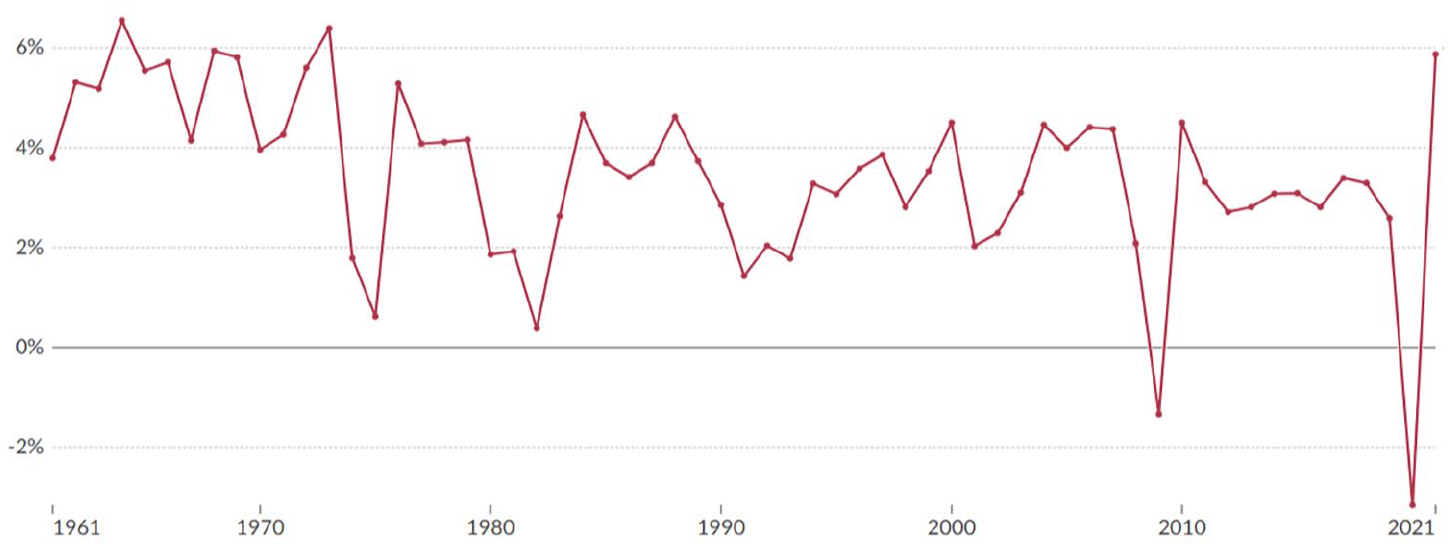
Annual growth of global Gross Domestic Product, 1961–2021. World Bank, 2023, from OurWorldInData.org/economic-growth.
The most dramatic pulse of acceleration in the global economy ever recorded took place in the immediate post-war decades. It came to an end in the early 1970s. The name ‘Great Acceleration’ was coined in 2005 (Steffen et al., 2015: 82). Well before then, however, students of political economy had isolated the period from 1945 or 1950 until (usually) 1973 as an era of uniquely fast growth: it had come to be called the ‘golden age of capitalism’ (e.g. Minsky, 1983: 268). This first and most dynamic stage of the Great Acceleration, 1945–1973, was the real point of origin of the geological Anthropocene. Where, why, and how did that time-bounded period of exceptionally rapid growth come about? Addressing that question is the way to make sense of the signals that define the Anthropocene as a stratigraphic unit.
Figure 2 shows how aggregate global growth during the ‘golden age’ can be decomposed into distinct national experiences. The United States was the ‘colossus’ of the world economy throughout this period: in the late 1940s it had 7% of the world’s population and produced half of its manufacturing output, including 57% of the world’s steel, 62% of its oil, and 80% of its automobiles (Patterson, 1996: 61). The United States’ exceptional productivity growth was kindled by World War II and sustained through the following three decades. It was here that the frontier of economic innovation advanced, as the new technologies developed since the late 19th century—electricity, the internal combustion engine, plastics, and assembly line manufacturing, alongside breakthroughs in oil, machine tools, and standardisation—were converted into broad gains in living standards (Gordon, 2016).
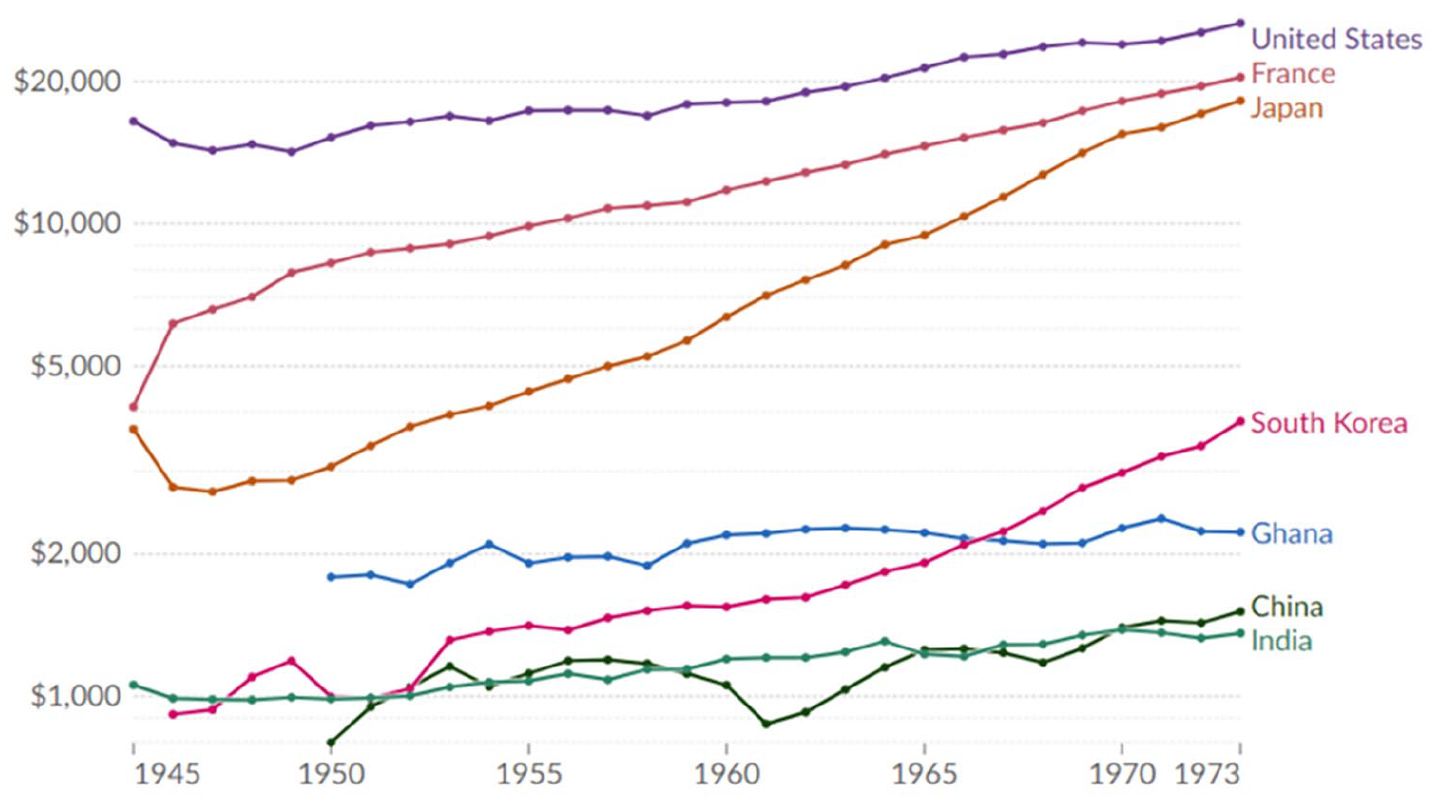
Gross domestic product per capita, selected countries, 1945–1973. 2011 international dollars, log scale. Maddison Project Database, 2020, from OurWorldInData.org/economic-growth.
In Europe, economic acceleration began with rapid rebuilding after World War II. At the war’s end, the GDP of France was the same as it had been in 1891; that of West Germany, the same as in 1908; that of Italy, the same as in 1909. But in 1949–51, each country regained its maximum pre-war GDP level (Crafts and Toniolo, 1996: 4). Thereafter Western Europe and the other Anglophone settler nations grew even faster than the United States in the 1950s and 1960s, from a lower base, as the transfer of technology enabled convergence towards American standards (Vonyo, 2008), and the Bretton Woods system of stabilised exchange rates exemplified the successful management of international capitalism (Glyn et al., 1992). At the same time, Japan secured its place in the club of advanced capitalist countries. In 1955–70 its per capita GDP grew at 9.4% annually, powered by intensive domestic capital investment (Fukao and Settsu, 2021). By the end of the ‘golden age’ some other East Asian economies, such as South Korea, were following the Japanese path.
The United States exerted a degree of geopolitical dominance during this period that matched its status as an economic powerhouse (Mann, 2013). A US-centred international order was contested, but also in fundamental respects stabilised, by the Communist states that controlled a minority share of the world economy (Hobsbawm, 1994: 225–244). The Soviet Union achieved impressive growth by directing investment into heavy industry, especially during the 1950s (Allen, 2001).
At the same time, there was significant economic advance in the poorest parts of the world. This development took a distinctive form. Steffen et al. (2015: 83) refer to a ‘rapidly increasing degree of globalisation and connectivity’ during the Great Acceleration. Syvitski et al. (2020: 4) write that ‘societies became more economically interdependent’ after 1950. That thesis, however, is not borne out by the data. There was a boom in the total volume of trade in the three postwar decades, but that boom was due to growth in overall economic production, and not to any novel openness to trade.
World trade in 1973 was equal to 541.3% of its real-terms value in 1950 (Federico and Tena-Junguito, 2017: 608). Historical changes in the flow of trade-embedded resources are difficult to measure directly (Brolin and Kander, 2022: 95), but this increase in the value of international trade implies a large rise in the physical volume of goods flowing between bioregions. It thus constitutes strong support for the Great Acceleration hypothesis. However, world exports as a proportion of global GDP were significantly lower between 1945 and 1973 than they had been in the early 20th century, before the outbreak of World War I (Chase-Dunn et al., 2000; Jacks and Tang, 2021: 486; Klasing and Milionis, 2014: 192). Only from the later 1970s did the ratio of exports to total economic activity reach unprecedented new heights (Federico and Tena-Junguito, 2017).
The lower share of production for export during the ‘golden age’ was connected to deliberate attempts by many polities, especially former subjects of empire, to pursue a domestically oriented path to modernisation, and to enhance their economic self-reliance. National liberation movements drove out European colonial powers. Independence from Britain in India (1947) and Ghana (1957) began waves of decolonisation in Asia and sub-Saharan Africa respectively. With some exceptions—for instance, Thailand, the Philippines, and Malaya remained oriented to world markets (Huff, 2021: 194)—South and Southeast Asia, Africa, and Latin America now pursued strategies of state-led import substitution industrialisation, protecting their internal development with tariff barriers (Findlay and O’Rourke, 2007: 481–489; Mann, 2013: 13–30).
The ‘golden age’ was characterised by cheap oil and a long upswing in the price of agricultural commodities and metals, to the benefit of exporters in the developing world (Erten and Ocampo, 2013). In the early 1970s those trends reversed. Productivity growth in the core became sluggish (Glyn et al., 1992), the Bretton Woods system failed in 1969–71, and in 1973 threats by oil-producing states to withhold exports sparked a panic that abruptly quadrupled oil prices (Mitchell, 2013). In the advanced capitalist countries, there ensued a long interval of reduced business profits and slower wage growth (Brenner, 2006). Meanwhile, much of the poor world experienced deindustrialisation and the decay of state capacity; the developmental optimism of the 1950s and 60s was dimmed by conflict, insolvency, and environmental degradation (Oks and Williams, 2022). The slowdown was not uniform. China is the major exception: extremely poor throughout the postwar decades, its subsequent economic boom, running from 1978 until recent years, dwarfed any other national experience. But as Figure 1 shows, even the development successes of China and some others—Malaysia, Vietnam, Poland—in the late 20th century did not return global growth to its postwar heights.
Taken as a whole, this record does not invalidate the story of the Great Acceleration as told in Steffen et al. (2015). However, it does complicate that story. Economic growth has not always gone hand in hand with an ‘increasing degree of globalisation’ (Steffen et al., 2015: 83). More broadly, a state shift in the Earth System away from Holocene conditions continues to unfold, but this shift should not be understood as a uniform trend commencing around 1750 and increasing at an approximately constant exponential rate from the mid-20th century onwards. Instead, Figure 3 illustrates the more uneven and contingent course that events have really taken (see also McNeill, 2000).
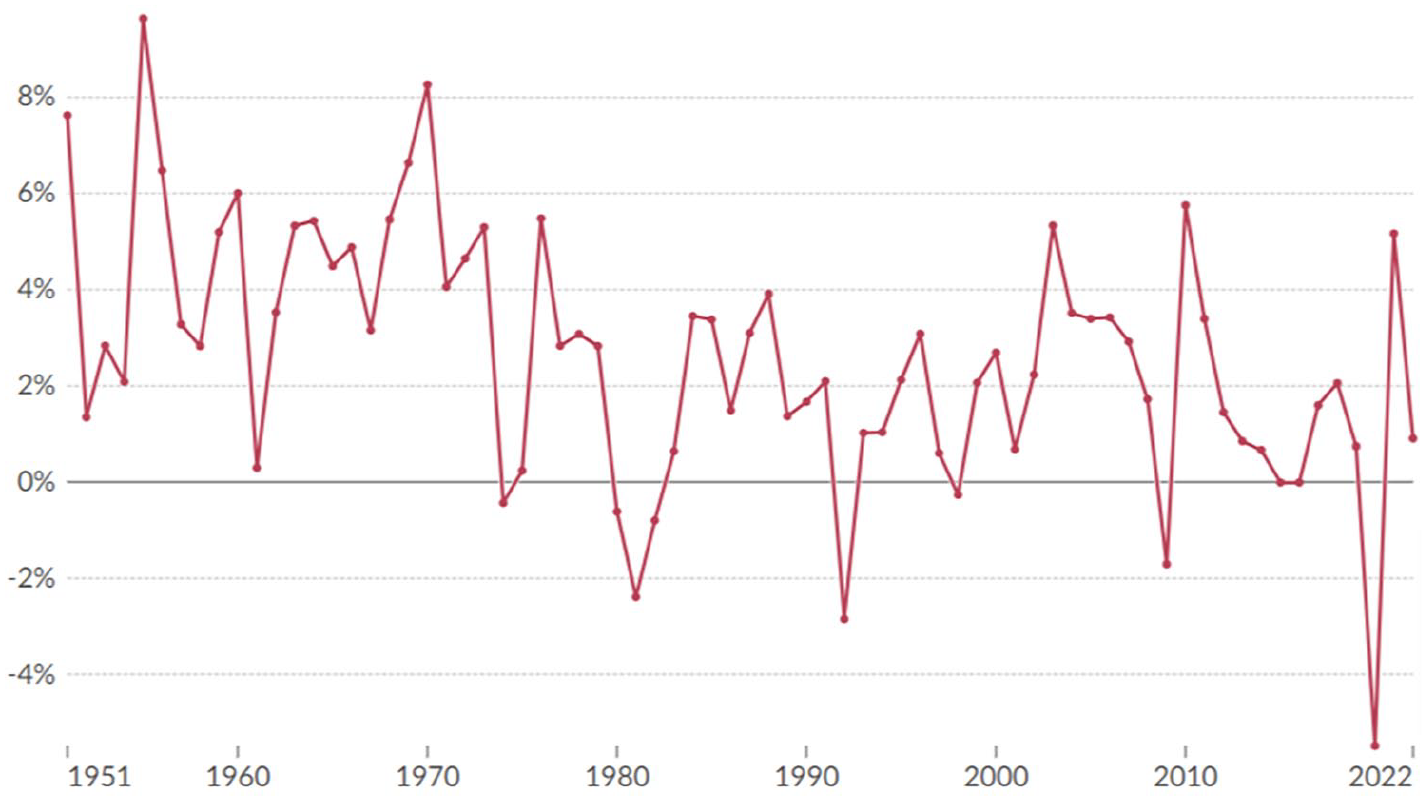
Annual percentage change in global CO₂ emissions from fossil fuels and industry, 1951–2022. Global Carbon Budget, 2023, from OurWorldInData.org/co2-and-greenhouse-gas-emissions.
On the one hand, CO2 emissions from fossil fuels and industry more than doubled in the 40 years after 1973. On the other hand, the rate of increase in CO2 emissions slowed from the peak it had reached in the preceding decades of more nationally oriented and state-led economic development. ‘The Great Acceleration’ may not be the most apposite name for this complex of phenomena, as acknowledged by Head et al. (2022). In the same year that the term was first published (Hibbard et al., 2007), Robert Marks described the ‘rapid industrial and population growth in the twentieth century’ that marked a break with ‘the rhythms and constraints of the biological old regime’ as ‘The Great Departure’ (Marks, 2007: 155–156). That is a more straightforward name for the Earth System’s 20th-century exodus from Holocene conditions. It could perhaps be more widely used.
To better understand the birth of the Anthropocene, it is essential to explain the specific socio-economic trends that drove the Earth System outside the envelope of Holocene variability in the mid-20th century. The Great Acceleration—or the Great Departure—and the ‘golden age of capitalism’ must be set in an objective historical context.
The modern world-system
Steffen et al. (2015: 91) argue that ‘the Great Acceleration has, until very recently, been almost entirely driven by a small fraction of the human population, those in developed countries’. They are right to highlight the importance of ‘equity issues’ in the Great Acceleration. Nonetheless, this assertion is misleading. On the contrary, regionally differentiated participation in production was a key to global development, both during the Great Acceleration and long before.
The theory of change expressed in Steffen et al. (2015) attributes historical agency only to the developed countries, where GDP growth is concentrated. On this view, the Great Acceleration is driven by consumption in the rich world. The power to contribute to global change gradually diffuses out to other parts of the world as those other regions follow in the footsteps of the leading nations and become richer in their turn. An alternative to this model is a world-systems interpretation of global history. In direct contrast to Steffen et al. (2015), world-systems analysis seeks explanations for historical development in the dynamics of the world market as a whole. It downplays—perhaps sometimes to a fault—the importance of factors that are internal to individual countries. Instead, it explains the broad contours of economic development by reference to international relationships of trade and production.
A world-system is at root ‘an entity differentiated according to the distribution of productive tasks’ (Hopkins and Wallerstein, 2016a: 103). It is an economic order bound together by ‘commodity chains’, or ‘value chains’. These are the series of linkages between raw materials, machinery, labour power, credit services, consumers, and the other ingredients of a saleable commodity that might stretch across distant geographical zones. Those zones make up a spectrum of ‘core’ and ‘peripheral’ regions. ‘Core’ regions house productive processes that secure a large share of the total profit generated by commodity chains: typically, high-value manufacturing and services. ‘Peripheral’ regions are the sites of processes that yield a disproportionately small share of profits from commodity chains: processes that might in different eras include agriculture, logging, labour coercion, mining, low-cost manufacturing, and so on (Wallerstein, 2011a: 28–33).
Being a peripheral part of the world-system does not mean being only lightly affected by that system, or making only a minor contribution to the system’s operation. Far from it. The incorporation of a given region into a subordinate position in the world-system involves ‘a definite break in the area’s history, a period of extensive, basic structural change’ (Hopkins and Wallerstein, 2016b: 180). ‘Peripheralization’ is typically a violent and destructive process for human populations and physical environments.
In the mid-20th century, for instance, the core of the world-system was made up of Western Europe, the Anglophone settler nations, and Japan. Within this core, the United States played the role of a ‘hegemon’. That is, it dominated even the other core capitalist states as a supplier to them of advanced manufactured goods and commercial and financial services (Hopkins and Wallerstein, 2016a: 107). The bulk of the global periphery consisted of regions of South and Southeast Asia, the Middle East, Africa, and South America that had previously undergone colonisation by the powers of the capitalist core. In 1952, the year of the proposed base of the Anthropocene epoch, imports and exports between ‘industrial’ and ‘non-industrial’ regions of the globe were 26.5% of world trade by value. Primary products such as petroleum, copper, tin, iron ore, rubber, vegetable oils, cotton, jute, sugar, fruits, coffee, and cocoa flowed from the periphery into the core, balanced by inflows of manufactured goods (General Agreement on Tariffs and Trade, 1955: 4–49). By producing these commodities for the global core at low wages, and purchasing manufactures in exchange, the labour force of the poor world played an important role in the global economy.
The developmentalist, autarkic projects of import substitution industrialisation pursued in the periphery in the 1950s and 1960s can be understood more clearly in this light. They were deliberate attempts to rebalance the world-systemic division of labour and escape peripheralised status. By the 1980s, however, those attempts had largely failed or been defeated (Davis, 2006: 151–163). The global south remained specialised in agriculture and raw materials production.
The defining contention of world-systems analysis is that cores and peripheries ‘form and develop always and only in relation to one another’ (Hopkins and Wallerstein, 2016a: 89). The system is powered by unequal exchange between core and peripheral regions. Proponents of world-systems analysis criticise the view that underpins Steffen et al. (2015). On this rejected view, capitalist development is understood to have taken place (or to be taking place) largely in advanced countries (what we call the core) and to have taken place very little, if at all, in other areas (what we call the periphery), which is why the core is ‘developed’ and the periphery ‘backward,’ or undeveloped, or even underdeveloped, in comparison with the core. (Hopkins and Wallerstein, 2016b: 175)
For world-systems theory, by contrast, it is not the case that the core regions are the engine room of global development. Nor are the peripheries simply laggards following the same path previously travelled in the core. Instead, it is the mutual interactions between core and periphery, and periphery and core, that explain the system’s evolution. ‘The most advanced are dependent on the most backward and vice versa: development is the reverse side of underdevelopment’ (Braudel, 1984: 70).
World-systems theory helps give shape to narratives of global history. The modern world-system—the system of which the Great Acceleration and the present-day global economy constitute parts—may be said to have emerged in the 15th and 16th centuries (Arrighi, 2010; Marks, 2007; Wallerstein, 2011b). In that phase the system’s arena was the ‘world economy of the European maritime states’ (Hobsbawm, 1969: 35): the European powers themselves (at first especially Portugal and Spain), their empires, and their closest trading partners. The distinctively capitalist social relations of western and central Europe incited restless expansion into new peripheries, and accelerated the ecological transformations that came with that expansion (Moore, 2007a). European colonisers invaded and peripheralised very large regions of the Americas, and geographically smaller but economically significant territories in and around the Indian Ocean.
Those events have played a part in debates about the Anthropocene series/epoch. Transatlantic conquest transformed both the Americas themselves and Afro-Eurasia (Crosby, 2004; Mann, 2011). The exchange of species across the Atlantic and Pacific created new biostratigraphic assemblage zones that contextualise Anthropocene chronostratigraphy (Barnosky, 2014: 155–157; Barnosky et al., 2014). Population collapse in the Americas led to reafforestation, and may have temporarily reduced atmospheric CO2. Lewis and Maslin (2015) propose that an Anthropocene GSSP could be associated with the CO2 minimum of 1610. Lewis and Maslin’s dating of the new epoch is intended to acknowledge the ‘five centuries of European colonialism’ that, in the view of Ellis (2023), are occluded by the Anthropocene sensu Waters et al. (2024a). My argument in this paper is for a different approach. The events associated with European colonisation of the Americas on the one hand, and the Great Acceleration on the other, should not be thought of as rival candidates for defining the Anthropocene. Instead, they should be seen as complementary. They are two related phases of one larger whole: the modern world-system itself.
The empirical basis of this argument is not self-evident. The European and colonial economy of the early 16th century was in many ways profoundly unlike that of the Great Acceleration. Its remote-looking features include the relatively low and stationary level of production technology; the role of sugar and silver bullion as the leading transoceanic trade commodities; the pre-eminence within the system of the Iberian Peninsula; and the fact that several of the world’s leading socio-economic powers—the four great agrarian Asian empires, Ottoman, Safavid, Mughal, and Ming—remained outside the European system (Frank, 1998; Marks, 2007). And after all, complex societies with cities and intensive agriculture, bringing about widespread environmental changes, have existed for thousands of years, since long before 1500 CE (Stephens et al., 2019).
Given those facts, it might seem as if there is no categorical difference between the Portuguese empire of the 16th century CE on the one hand, and much earlier societies—for instance, the Roman empire of the second century CE—on the other hand. What, then, is special about the period circa 1450–1530? What does the era of sugar, caravels, and porcelain have in common with the era of oil tankers, US dollars, and automotive factories? What is it that they share (and that the Roman empire lacks) which makes them both part of a single 500-year-old ‘system’?
A simple answer is that the international economic order that emerged around 1500 is the one that has lasted to the present day. Historians of the modern world-system acknowledge ‘systemic ruptures’, ‘paradigm shifts’, and ‘fundamental reorganizations’ between its successive cyclical phases (Arrighi, 2010: 375). Yet the system as a whole has never experienced a hiatus or abolition, and it has maintained a uniquely capitalist form of organisation throughout. Many earlier, essentially pre-capitalist ‘world-systems’ existed, but they all came to an end. The most striking example is a 13th-century CE world-system of trans-Eurasian trade, which had its gravitational centre in China. It was debilitated in the 14th century by the Black Death and the fall of China’s Yuan dynasty (Abu-Lughod, 1993). The ‘modern’ world-system, in contrast, endures. Since the late 19th or early 20th century, it has achieved effectively complete global coverage.
To see this system’s continuity, we can look to the British Industrial Revolution. The Industrial Revolution recognisably evolved out of the post-feudal European and colonial interstate structure. It recognisably evolved into the high tech capitalism of the 20th century. Britain’s industrialisation relied upon the pre-existence of the modern world-system, and it cast the system into something resembling its 20th-century form. By the early 19th century, the four remote-looking features of the system highlighted above—its limited productivity, focus on sugar and silver, Iberian domination, and inferiority to outside powers—had all been modernised. Technological advance within the global economy now appeared to be self-augmenting. The leading transoceanic trade commodities were now industrial manufactures, in the form of textiles and metalwares. World trade was headquartered in the Anglophone North Atlantic (Britain and the United States), not Spain and Portugal. The geopolitical subordination of Asia was well underway. The richest parts of the world in 1820 were, with few exceptions, also the richest in 1970 (Maddison, 1995).
Analysing the British Industrial Revolution as a part of the modern world-system thus provides a way to grasp many of that system’s essential dynamics—dynamics that subsequently gave rise to the ‘golden age of capitalism’ and the Great Acceleration. In order thoroughly to contextualise the Great Acceleration and the Earth System’s transition out of the Holocene, one would have to narrate the entire story of the modern world-system before 1950. However, the Industrial Revolution is so significant a turning point in the system’s evolution, and it exemplifies so many of the system’s workings, that it can illustrate the development of the modern world-system as a whole. Unfolding close to the chronological mid-point of the system to date, it shows how the core-and-periphery structure of the Great Acceleration was rooted in the specific events of the preceding centuries.
The British Industrial Revolution, global trade, and the world-system
The Industrial Revolution and the Anthropocene debate
The Industrial Revolution was the first proposed starting point for the Anthropocene epoch (Crutzen, 2002; Steffen et al., 2011; Zalasiewicz et al., 2008). In the following years, however, attention turned instead to the mid-20th century (Zalasiewicz et al., 2015). No longer a rival candidate for the start of the Anthropocene, the Industrial Revolution may now instead be seen in historical connection to the Great Acceleration. Both the Industrial Revolution and the Great Acceleration are aspects of the modern world-system. They are both part of the complex of developments that ultimately terminated the Holocene’s relative stability.
This interpretation differs fundamentally from a standard view of the Industrial Revolution in discussions of Anthropocene stratigraphy. In a key paper assessing the Industrial Revolution’s suitability as the source of a GSSP, Waters et al. (2014: 9) argue that ‘the onset of the Industrial Revolution is diachronous, not reaching many developing countries until the middle of the twentieth century’. This view is given memorable expression by a diagram in that paper reproduced here as Figure 4. Waters et al. (2014: 10) describe the Industrial Revolution as ‘a subjective event, here interpreted as the widespread growth of mechanization in respect to manufacturing, transport and innovation’. On the basis of that definition, they represent the Industrial Revolution as diffusing outwards from a point of origin in Great Britain, to affect various other parts of the world only much later, over the course of the 19th and 20th centuries.
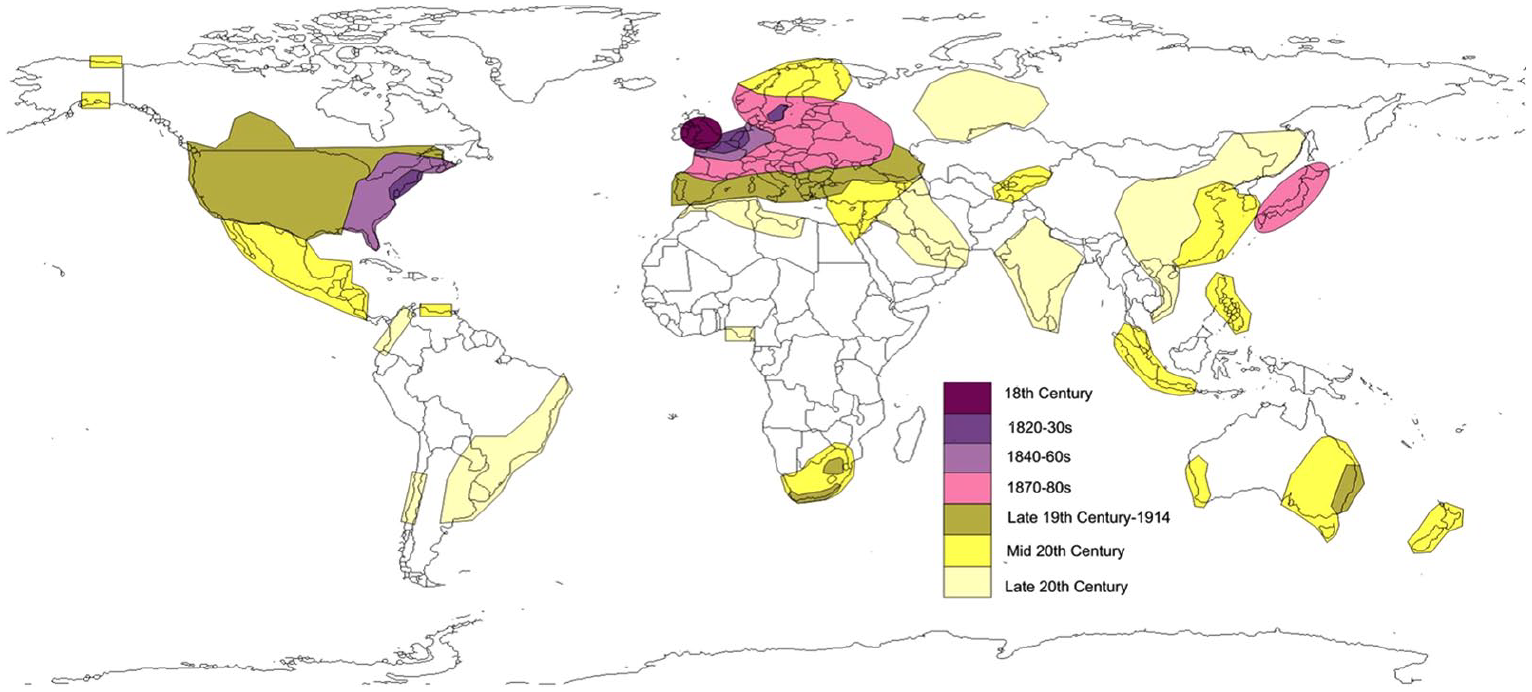
‘Map showing the approximate age for the beginning of the Industrial Revolution and subsequent industrialization across the planet’, as published in Waters et al. (2014).
Other Earth scientists similarly argue that setting the base of the Anthropocene around 1800 ‘would have little meaning (or relevance) to those regions of Africa or Asia where an increase in the pace of economic development did not occur until at least a century later’ (Gibbard and Walker, 2014: 34). The same argument against defining the Anthropocene in this way is made by scholars in other disciplines too: ‘The Industrial Revolution was in no sense a unitary, synchronous global process. Using a northern European, and especially a British historical event to typify a global transition stands as rather clear example of Eurocentrism’ (Morrison, 2018: 7; see also Simpson, 2020). (For alternative analyses of the Industrial Revolution in the context of the Anthropocene, sharing more in common with the one presented here, see Bonneuil and Fressoz (2016: 228–235) and Lewis and Maslin (2018: 191–209).)
The standard stratigraphic view of the Industrial Revolution exactly parallels the view of the Great Acceleration presented in Steffen et al. (2015). Just as Steffen et al. (2015: 91) contend that ‘the Great Acceleration has, until very recently, been almost entirely driven by a small fraction of the human population, those in developed countries’, so Waters et al. (2014: 9) regard the Industrial Revolution as involving only centres of mechanised manufacturing. But from a world-systems perspective, both views are equally faulty. For world-systems analysis, global economic development has been driven by interactions between core and peripheral zones in the world market, and not by the core alone. Regionally differentiated participation in economic production is the motor of change in the world-system.
It is not the case that regions were only ‘reach[ed]’ by industrialisation when they themselves became locations for industrial manufacturing (Waters et al., 2014: 9). Machine technology was just one aspect of altering relations of production. That means that the idea that the Industrial Revolution diffused outwards from Britain is much too simple: it misrepresents the real nature of the change. On the contrary, both human societies and natural environments were transformed by industrialism in many parts of the world at a much earlier stage. Distant regions became exporters of raw materials, food, or labour to production centres overseas, and importers of manufactured goods. Early industrial Britain was fed by a global trade in commodities with a substantial ecological footprint, such as cotton, iron, timber, potash, and sugar. The ‘classic’ period of the Industrial Revolution, circa 1760–1830 (Ashton, 1997), did not witness stratigraphic changes that provide a suitable GSSP for the Anthropocene series/epoch. However, the Industrial Revolution does demonstrate that the world economy was already ‘globalised’ in important respects long before the Great Acceleration, and it exemplifies economic and social dynamics that remained important in the period after 1945.
Britain in the 18th-century world-system
In one sense the British Industrial Revolution was precisely that: uniquely British. No other country experienced a comparable development of large-scale industry during the ‘classic’ period before 1830 (Griffin, 2018: 124–142). Contemporary visitors from overseas were impressed by the singular character of Great Britain’s economy and society: its wealth, dynamism, and avariciousness; its awe-inspiring mechanised industry; its inequality and squalor (Hobsbawm, 1969: 23–27; Jones, 2002; Riello and O’Brien, 2009). Britain was the portal through which the world economy passed into a new age of self-sustaining, exponential economic growth (Koyama and Rubin, 2022).
Many of the enabling conditions of the Industrial Revolution were internal to lowland Britain. Important studies have highlighted England’s, and later Britain’s, enlightened culture of ‘useful knowledge’, which encouraged the deployment of technology to create new wealth (Mokyr, 2011); its relatively high-wage economy, incentivising labour-saving innovation (Allen, 2009); the institutions established by the revolution of 1688, which favoured the property claims of commercial farmers, merchants, and manufacturers (Acemoglu and Robinson, 2012); its deep pool of skilled labour in mechanical and metalworking crafts (Kelly et al., 2023); and, perhaps most fundamentally, its highly productive agriculture and accessible coal reserves (Wrigley, 2016). These peculiarities give some credence to the assertion that the Industrial Revolution itself was ‘a northern European and especially British historical event’ (Morrison, 2018: 7).
In fact, however, the Industrial Revolution was never an exclusively national phenomenon. It did not start within the confines of Britain and then diffuse further afield. Britain first became the world’s leading commercial power: it seized the pivotal role in a transoceanic trade system that had already existed for centuries. Only later did it become the workshop of the world.
The long-distance exchange of goods and resources was indispensable to Britain’s emergence as the world’s leading manufacturing centre. In the words of a contemporary observer, Anna Letitia Barbauld: There is not a single manufacture of Great Britain which does not require, in some part or other of its process, productions from the different parts of the globe, oils, drugs, varnish, quicksilver, and the like; it requires, therefore, ships and a friendly intercourse with foreign nations to transport commodities, and exchange productions. We could not be a manufacturing, unless we were also a commercial nation. (Barbauld, 1793: 104)
Barbauld’s invocation of ‘friendly’ international relations is tendentious. Colonial extraction, and the trafficking and exploitation of enslaved workers, went hand in hand with voluntary commerce to secure the raw materials and foreign labour inputs that enabled Britain to become ‘a manufacturing nation’. However, she was right to emphasise the significance of natural ‘productions from the different parts of the globe’, long-distance shipping, and commercial exchange as prerequisites of British industrialisation. Accordingly, references to ‘the European, Asian, African, American and Imperial dimensions of the British Industrial Revolution’ (O’Brien, 2022: 130) are well justified even if they might sound paradoxical.
In the 18th century, Britain developed into an archetypal core region within the world division of production. Britain could already be called ‘the world’s premier commercial and naval power’, supplanting the Dutch Republic, by the end of the War of the Spanish Succession in 1714 (Anderson, 1987: 32). The Seven Years War of 1756–63 was an inflection point in which Britain achieved general naval supremacy, decisively unseating France as the dominant colonial power in North America, the Caribbean, and India, and even briefly seizing the two great commercial and military redoubts of the Spanish empire, Havana and Manila (Pocock, 2002). As a letter writer noted drily at the time, this course of events is easily imagined in triumphalist terms: ‘What lectures will be read to poor children on this era! Europe taught to tremble, the great King [Louis XV of France] humbled, the treasures of Peru diverted into the Thames, Asia subdued by the gigantic [Robert] Clive!’ (Walpole, 1974: 188).
Her subsequent victory in the Revolutionary and Napoleonic Wars of 1792–1815 meant that Britain was no longer merely the first among equals of the European powers. For the next decades Britain took on a hegemonic role in the world-system. She dominated the rest of the global core in something like the way that the United States did during its hegemony in the ‘golden age of capitalism’ (Arrighi, 1999; Hopkins and Wallerstein, 2016a: 107). By 1830 Britain ruled over a colonial population of some 189 million (Zahedieh, 2014: 398).
The British empire before 1830 was aristocratic, militaristic, and authoritarian in temper. It was oriented more towards the extraction of revenues from colonial populations than the promotion of profitable free trade (Bayly, 1989). Nonetheless, the state’s heavy expenditure on the Royal Navy and allied mercenaries imposed the conditions of external security and inter-regional hierarchy within which the Industrial Revolution could take place (O’Brien, 2022).
The displacement of the land constraint
International trade’s most fundamental contribution to British industrialisation was not that it encouraged manufacturing innovation and investment, nor that it provided revenue to merchants and capitalists, although it did both of those things. Instead, trade was a precondition of the course taken by the Industrial Revolution because it enabled Britain’s ecological footprint to expand. Inward flows of environmental resources from peripheral zones of the world-system displaced biophysical constraints that threatened to impose a ceiling on industrial production (Hornborg, 2006, 2020: 188; Pomeranz, 2000; Thomas, 1985). This the most fundamental respect in which the diffusionist model of the Industrial Revolution endorsed by Waters et al. (2014) fails to capture the real course of events. The Industrial Revolution relied upon the commodity chains that already linked the world-system together.
In pre-industrial economies, land availability restricted economic activity in an elemental way. The land was the source of virtually all economic inputs: food for the population, fodder for working animals, textiles for clothing, firewood for heating, timber for construction, and so on. In the view of 18th-century thinkers, informed by long experience, each nation’s finite surface area ultimately set upper limits to economic growth (Wrigley, 1987, 2016). However, fossil fuels and international trade permitted escape from those limits. Coal was a substitute for woodland as a fuel source for industrial heat, domestic warmth, and, eventually, mechanical power. 18th-century Britain innovated radically in mining and steam technology, achieving self-sufficiency in coal with no increase in real prices throughout the Industrial Revolution (Flinn, 1984). The supply of other land-demanding inputs, above and beyond domestic availability, depended on overseas trade.
Jones (1987: 77–84) distinguishes ‘four main ecological zones’ in the periphery of the early modern world-system. Britain exploited each one. The boreal woodlands in the hinterland of the Baltic Sea as far east as the Urals, and in Scandinavia, supplied iron, grain, timber, hemp, flax, tallow, and tar. Temperate North America supplied timber and grain. The tropics and subtropics, primarily the Caribbean, supplied cotton, sugar, indigo, and tobacco. The ocean yielded fish, including cod from the Grand Banks, and whale oil from both the north Atlantic and the southern hemisphere.
Cotton was Britain’s most advanced and rapidly growing industrial sector, making up some 22% of total value added in the British economy by the early 1830s (Beckert, 2015: 73). No cotton could be grown domestically. In 1832 Britain imported 130,106 tonnes of raw cotton, grown on some 529,200–734,100 hectares of the US, East Indies, Brazil, and Egypt (Theodoridis et al., 2018: 342). To substitute for those imports with fibre from British sheep would have required approximately 9.3 m ha of pasturage (Pomeranz, 2000: 276). Britain’s timber imports in 1832 were harvested from 278,900 to 348,600 ha of overseas woodland. But they were dwarfed by another forest product, potash, which consumed the equivalent of 5–6.25m ha managed on a sustainable-yield basis (Theodoridis et al., 2018: 342). Between the late 1760s and the early 1790s, England—previously a net agricultural exporter—became consistently an importer of grain (Turner, 1980: 130). By 1832 British imports of wheat, butter, sugar, and a miscellany of other food and non-food items such as coffee, dyestuffs, silk, tallow, spices, tobacco, and wine were equivalent to some 1.78–2.37m foreign ha (Theodoridis et al., 2018: 342). In effect, Britain industrialised by importing a vast area of virtual land, of so-called ‘ghost acres’ (Borgstrom, 1972: 75).
Theodoridis et al. (2018: 349) conclude that ‘the presence of an empire, along with its coercive institutions built on colonialism and slavery, was necessary to support this massive flow of resources, and our data underline the profound ecological transformation of the British economy, both in overcoming the land constraint and also in its relationship with both suppliers of raw materials and consumers abroad’. Empire and unequal exchange allowed the resource demands of the early 1830s to be multiplied several times over in subsequent decades (Theodoridis et al., 2018: 344, 345). Continued economic development required ever-growing flows of goods through the world-system. Land-demanding raw materials from the global periphery and semi-periphery, alongside domestic coal extraction, created the ecological niche within which the Industrial Revolution could evolve.
Long-distance trade in the Industrial Revolution
This mass importation of land-intensive goods, which displaced the ecological constraint on production, was only possible as an integrated part of a much more extensive, complex, and multidirectional global trade network. The ratio of imports to total British national income rose from approximately 0.08 to 0.3 between 1700 and 1900 (Harley, 2004: 193). Those imports had to be paid for. The solution was vigorous export-oriented manufacturing: manufactured goods made up 85% of Britain’s exports during the Industrial Revolution (Mokyr, 2011: 168).
Overseas markets stimulated the two main ‘revolutionary’ sectors of the British economy, cotton and iron (Inikori, 2002: 427–457 et passim). They provided a substantial fraction of the profits that incentivised those sectors to innovate in technology and workplace organisation, letting them pioneer the new ways of working that subsequently spread to the rest of the economy. Exports as a share of industrial output grew almost uninterruptedly from the early 18th century to the mid-19th (Cuenca Esteban, 1997). Overall, at least half of the massive increase in Britain’s industrial production between the Glorious Revolution in 1688 and the end of the Napoleonic Wars in 1815 was made up of products for sale overseas (O’Brien, 2022: 136). And as Britain’s trade grew, long-distance trade grew fastest. 85% of England and Wales’ exports (mostly woollens) went to Europe in 1700, but by the 1820s Britain relied on Europe for only 35% of its export market, with 41% of sales in the Americas and 11% in Asia (Zahedieh, 2014: 411–413).
Again, cotton was to the fore. It was Britain’s leading export commodity as well as the vanguard of factory production: cotton goods made up 6% of British exports in 1784–86, and 47.8% in 1824–26 (Findlay and O’Rourke, 2007: table 6.2). The changing intercontinental market in cotton between the late 18th century and early 19th century illustrates the multipolar trade networks that enabled the Industrial Revolution.
In the 18th century, Indian fabrics were the most prestigious consumer textiles in the world market. The goal of British cloth manufacturers was to emulate them, and to compete with Indian producers (Berg, 2015; Raman, 2022). Cottons comprised 58% of the commodities that Britain sold to African consumers in the 1790s, and the majority of those cottons were re-exports of Indian-made products (Riello, 2022: 97–98). In West Africa, British traders exchanged cottons, alongside other textiles, metalwares, guns, tobacco, and alcohol, for the estimated 385,928 enslaved workers whom they transported across the Atlantic over the course of the 1790s (SlaveVoyages, 2023). The bulk of the captives were taken to the Caribbean. That region, especially Barbados, dominated the supply of raw cotton to Britain’s own textile manufacturers. However, competition for agricultural land with sugar plantations was restricting the growth of Caribbean cotton farming.
In the course of the 1790s, Britain began to overcome this obstacle through the take-off of cotton export agriculture in the United States, initially in South Carolina and Georgia. The result was that by 1830, US cotton farming employed a million mostly enslaved workers and constituted the basis of the British supply chain (Beckert, 2015: 85–121). Cheap American cotton, combined with novel high-productivity British manufacturing, completed a momentous reversal of global trade flows. By the 1830s, Lancashire cottons could be exported competitively into India itself (Broadberry and Gupta, 2009). In this way, the Atlantic and Indian Ocean trade worlds were linked together by the intricate movements of cotton commodities and revenues.
Similarly, iron connected the Atlantic to the Baltic, and thence to the Eurasian interior. The land embodied in commodities exported from the Baltic Sea through the Danish Sound, mainly to Britain and the Netherlands, doubled to over 3 m ha per year between 1760 and 1785. Iron smelted with charcoal preponderated, followed by potash and grain (Theodoridis et al., 2020). High-quality Swedish bar iron was then used in Britain to manufacture metalwares for export to the Caribbean and North America (Thomas, 1980). Potash, used as an industrial alkali, came from the Baltic, or via the White Sea and the far north, in the 17th and earlier 18th centuries, before much larger quantities were produced by the burning of old-growth North American forests in the later 18th and 19th centuries (Warde, 2018).
The internationalisation of the economy shaped Britain’s finances. State revenues depended increasingly upon trade. Taxes on traded goods—sugar, tobacco, tea, coffee, wine, spirits—provided a majority of the income from indirect taxation in the early 19th century (Dal Bó et al., 2022). Rönnbäck (2018) estimates the value of the commodity chains rooted in Atlantic slavery. These included profits from the slave trade itself; from producing sugar, cotton, and tobacco on plantations in the Americas; from the trading and processing of those slave-produced commodities; and from sales back into African and slave-plantation markets. In the first decade of the 19th century, they added up to 10.8% of British GDP. The slave trade, centred on Liverpool, drove the development of marine insurance, and of the sophisticated regional credit networks in northern England that then provided finance for domestic manufacturing (Berg and Hudson, 2023: 165–186). More generally, with their cosmopolitan populations and vivid class antagonisms, Liverpool and the other major North Atlantic ports—London, Glasgow, Bristol, Boston, New York, Philadelphia—were the crucibles of distinctively modern social relations (Rediker, 1987). Wealth was re-invested overseas: at the turn of the century, a commentator remarked on how ‘from the steel-mines of Carinthia to the looms of Bengal, British capital is, in various instances, engaged in animating foreign industry’ (Beeke, 1799: 34).
Britain’s ‘outstanding record of competitive success in overseas trade’ during the Industrial Revolution has been acknowledged ever since the period itself (Riello and O’Brien, 2009: 18). In Hobsbawm’s (1969: 54) resonant, if contentious, summation, ‘our industrial economy grew out of our commerce, and especially our commerce with the underdeveloped world’.
Consequences in the periphery
The map of industrial diffusion in Waters et al. (2014; Figure 4), as idealised through the growth of mechanisation, represents the Industrial Revolution as ‘reaching’ India only in the late 20th century, and modern Bangladesh, the Caribbean, and most of West Africa not at all. As peripheralised regions of the modern world-system, however, they had been deeply affected by Britain’s Industrial Revolution at a much earlier date.
Beckert (2015) quotes a manuscript of 1800 by the British commercial resident in Dhaka, the longstanding heartland of fine muslin production: The value of cloth exports there had fallen by 50 percent between 1747 and 1797. Spinners especially had been hurt by British competition, and as a result a great number, he reported, ‘died of famine.’ The people of the once thriving manufacturing city had been ‘reduced and impoverished,’ its houses ‘ruined and abandoned,’ and its commercial history become ‘a melancholy retrospect.’ The ‘ancient celebrity’ and ‘great wealth’ of Dhaka were all but gone. (Beckert, 2015: 75).
From the 1810s there was ‘sustained economic regression in Bengal, South India, Gujarat and other regions’, the old sites of export-oriented handicraft textile manufacture: the subcontinent underwent ‘a dramatic de-commercialization’ (Parthasarathi, 2011: 265–266). The goal of colonial policy was to turn India into a supplier of raw materials and an importer of British manufactures, through asymmetrical tariffs, the suppression of Indian armaments and metalwares production, and restrictions on Indians’ acquisition of technical knowledge and skills (Parthasarathi, 2011: 251–258).
Such deindustrialisation under pressure of competition with more modern and efficient British manufacturing was widespread in the early 19th century. Russia’s export industry in charcoal-smelted iron collapsed in the face of British coke-smelted iron. West African iron smelting and blacksmithing withered for the same reason. Instead, the region began to develop a cash-crop agriculture, exporting palm oil as an industrial lubricant. The Ottoman empire’s industrial sector peaked in the 1780s and then dwindled, notwithstanding a much-analysed attempt at state-led industrialisation in Egypt in the 1820s and 1830s, snuffed out partly by coercive British diplomacy (Beckert, 2015: 165–169; Wallerstein, 2011c: 146–152). In the near periphery, Ireland became increasingly specialised in agricultural exports across the Irish Sea as its industries—woollens, leather, papermaking, lace-making—lost out to British rivals. The Scottish Highlands similarly saw the collapse of domestic textile manufactures, a destructive boom and bust in the kelping industry, and a notorious era of specialisation in sheep farming and forced out-migration, the ‘Clearances’ (Richards, 1993).
Before 1640 the West African heartland—the region from Sierra Leone to the Bight of Biafra—was a relatively urbanised and commercially developed zone of the Atlantic basin, practically untouched by transatlantic slave trading (Inikori, 2014). Thereafter it descended in the hierarchy of the world-system. On the Gold Coast, ‘urban development was reversed, as was the division of labour between town and country’ (Inikori, 2014: 80). West Africa’s economy and society became dominated by the supply of coerced labour for commodity production in the Americas. 18th-century states in the region—Asante, Segou, Dahomey—were more warlike than their 17th-century predecessors, and refugeeism increased (Manning, 2021: 255–256). Between 1640 and 1807, British traders embarked some 2.46 million slaves from the West African heartland, out of a total of 5.49 million embarked from the region in the transatlantic trade between 1640 and 1850. Most (1.29 million) of those British embarkations took place in the period 1760–1807, of which 86% were destined for British holdings in the Caribbean (SlaveVoyages, 2023). The connections between British industry, especially cotton, and slavery remained tight after 1807. The Industrial Revolution has been held ‘largely responsible’ for the persistence of slavery in the independent United States (Mokyr, 2011: 162).
Britain’s sugar colonies in the Caribbean underwent their own distinctive pattern of agro-industrial development. Slave plantations were technology- and capital-intensive. As the leading economic historians of slavery observe, the ‘planters of the British Caribbean were responsible for some of the earliest large-scale integrated businesses in the Western world’ (Berg and Hudson, 2023: 90). Windmills were built in 18th-century Barbados ‘at a density unknown in Britain’ to process sugar, and from 1803 to 1830, James Watt and Matthew Boulton’s firm exported 132 steam engines to the sugar plantations (Berg and Hudson, 2023: 81). With their thousands-strong workforces and advanced business accounting techniques, Caribbean plantations ‘presaged later developments in the industrializing economies of nineteenth-century metropoles’ (Berg and Hudson, 2023: 94–95).
The environmental, as well as the social, effects of the Industrial Revolution were felt through much of the Americas. The ecology of the Caribbean was permanently transformed by sugar plantations, which brought with them a chaos of deforestation, soil erosion, species introductions (especially of invasive grasses and ants), and extinctions (especially of endemic parrot and rodent species; Watts, 1987: 434–443). North American forests were the leading source of potash, and in 1810 Britain consumed an enormous 26 million m3 of wood in the form of ash (Warde, 2018: 74). In the southern United States, cotton plantations wore out the soil, driving the planters westward onto new lands (Beckert, 2015: 103). Tobacco, similarly, was notorious as ‘a sponge for nitrogen and potassium’ in the soil (Mann, 2011: 91). Tobacco is not in itself an industrial input, but it illustrates the indirect processes through which global trade facilitated industrialisation: in the early 1770s, Britain re-exported 85% of its tobacco imports ‘in exchange for land-saving imports such as grain, flax, iron, hemp and timber’ (Zahedieh, 2014: 407).
These developments are examples of what McNeill (2019) calls the Industrial Revolution’s ‘ecological teleconnections’, long-distance linkages between industrial production and environmental impacts. British industrialism was not by any means the beginning of ecological transformation in the periphery of the world-system. The sugar production complex in northeastern Brazil, for instance, had devoured Atlantic rain forest on a grand scale between 1550 and 1750 (Moore, 2007b: 227–273). By the 1830s, however, the world-system that now centred on Britain spread to the remotest parts of the world. So distant a region as South Australia had become a resource periphery ‘geared almost exclusively to primary production’ of wool, wheat, and copper, and dependent on imported British manufactures (Richards, 1993: 222). The classic ‘British’ Industrial Revolution of 1760–1830 was a global phenomenon.
Implications for the Great Acceleration
The Industrial Revolution exemplifies the dynamics of the modern world-system: dynamics that later, in the 20th century, forced the Earth outside the confines of the Holocene. To place the Holocene/Anthropocene boundary in 1952, as proposed by Waters et al. (2024a, 2024b, 2024c), need by no means obfuscate the preceding ‘five centuries of European colonialism’, as Ellis (2023) feared. Instead, the proposed Anthropocene GSSP at Crawford Lake can be seen in its world-systemic context. With a portrait of the world-system around 1800 in mind, it is possible to draw out four key lessons for the Great Acceleration of the mid-20th century.
The Great Acceleration was part of the world-system’s evolution
The socio-economic and Earth System trends of the Great Acceleration were the product of specific, long-term developments in the global economy. In the mid-20th century, worldwide production and trade was dominated by North Atlantic capitalist economies, pre-eminently the United States (Gordon, 2016; Mann, 2013; Vonyo, 2008). The blueprint for that geopolitical arrangement emerged in the 15th and 16th centuries, with the establishment of Portuguese and Spanish empires in the Atlantic and Indian Ocean basins (Arrighi, 2010; Marks, 2007; Moore, 2007b; Wallerstein, 2011b). Life around 1500 might look alien compared to the present day, but the world-system that first took shape in that era has evolved and persisted continuously up to the present, without undergoing the kind of fundamental breakdown or collapse experienced by previous interstate systems (Abu-Lughod, 1993). The classic period of Britain’s Industrial Revolution makes this continuity visible. Looking backwards, British industrialism was underpinned by colonial acquisitions and transoceanic trade networks that pre-existed the 18th century (O’Brien, 2022). Looking forwards, the Industrial Revolution fostered a self-reinforcing process of technological advance, and a global economic hierarchy, that endured into the Great Acceleration (Koyama and Rubin, 2022; Maddison, 1995; Mokyr, 2011).
In the terms proposed by Waters et al. (2022: 2), the development of the modern world-system may be thought of as a type 1 geological event: a global, geologically brief ‘happening in time [. . .] a change of state in one or more subsystems of the Earth System to something outside the previous norm’. The expansion of the world-system since the 15th century constitutes the end-Holocene event, analogous to the end-Cretaceous event or end-Paleocene event earlier in geologic time.
The post-World War II interval should be situated in this concrete historical context, in order to understand the socio-economic factors that drove the Earth System trends of the Great Acceleration. The proposed Anthropocene GSSP itself represents an ‘instant of geologic time’, in line with standard stratigraphic practice (International Commission on Stratigraphy, no date: Section 9.H), but the broader process terminating the Holocene series/epoch unfolded over several centuries. This centuries-long context is the most illuminating one in which to set the Great Acceleration. To expand that context by an order of magnitude and treat the Great Acceleration as a product of the millennia-long advance of ‘the human enterprise’ (Steffen et al., 2007) risks obscuring its distinct causal mechanisms through excessive generalisation (Malm and Hornborg, 2014).
Many different years in the period after 1500 have been singled out as competing candidates for the starting date of the Anthropocene. They include 1610, on the basis of transoceanic species exchange and a CO2 minimum (Lewis and Maslin, 2015); 1784, to mark innovation in steam engine technology (Crutzen, 2002); 1800, as representative of the Industrial Revolution more broadly (Steffen et al., 2011; Zalasiewicz et al., 2008); 1815, making use of the stratigraphic markers associated with the eruption of Mount Tambora (Zalasiewicz et al., 2008); 1863, a significant date in the emergence of global metropolises (Williams et al., 2014); 1945, the year of the Trinity nuclear test (Zalasiewicz et al., 2015); 1952, at the base of the Great Acceleration’s stratigraphic expression (Waters et al., 2024a); and 1964, the year of peak 14C atmospheric fallout from nuclear weapons testing (Lewis and Maslin, 2015). But the phenomena highlighted by each of these candidates are interlinked. These proposals, which ostensibly express rival conceptualisations of the Anthropocene, all in fact highlight different facets of a single modern world-system. The AWG’s proposed GSSP (Waters et al., 2024a) is not guilty of expressing a short-termist perspective (contra Ellis, 2023), because the stratigraphy beneath Crawford Lake can serve as a reference marker for the whole suite of changes terminating the Holocene. The parable of the blind men and the elephant is germane.
The world-system has experienced multiple phases of development
The evolution of the modern world-system has been continuous, but not uniform. The centuries-long process bringing the Holocene to an end requires analytical segmentation. This is true even of the Great Acceleration itself. Early accounts (Steffen et al., 2007, 2015) conflated two distinct phases of economic growth in the period since 1945 (Figures 1 and 3). A phase of real acceleration in global GDP growth—the ‘golden age of capitalism’, characterised by US hegemony, full employment in the capitalist core, cheap oil, and tariff-protected industrial development in the global periphery—has been followed by a phase of more pronounced economic cycles and increasing multipolarity since the long boom ended in the early 1970s (Brenner, 2006). To some extent, the stratigraphic signatures of these two phases are distinct, for instance in that the 239+240Pu fallout spike is an artefact of the strategic rivalry between the United States and the Soviet Union that provided the basis of the international order after World War II (De Groot, 2005).
Likewise, the earlier history of the modern world-system can be organised, at least for the sake of interpretation, into distinct phases. This paper has concentrated on the ‘classic’ period of Industrial Revolution, circa 1760–1830 (Ashton, 1997). Three main phases of the system might be distinguished in between the first Industrial Revolution and the Great Acceleration. First, the heyday of British liberal industrial capitalism circa 1830–1873 (Arrighi, 1999), an era described by Anderson (1987: 33) as ‘a quite new form of world economy, in which British manufacturers possessed overwhelming preponderance amid generalized international free trade’. Britain’s share of world manufactures peaked at 32% in 1870 (Thomas, 1985: 748), while railways and steam shipping made global trade faster and cheaper. Second, the ‘high imperial’ phase of the early 1870s–1914, when production in the global core was distinguished by the rise of scientific industry (steel, electricity, oil) and large industrial corporations, especially in the United States and Germany. This was a phase of colonial expansion, ‘globalisation’, and especially stark predation by the core upon the periphery. Europe and the Anglophone colonies accounted for 89.8% of all industrial output in 1913 (Findlay and O’Rourke, 2007: 324), while parts of China, South Asia, Africa, and Brazil underwent a series of immense climate-related famines (Davis, 2002). And third, the world crisis of 1914–1945, when empire fought empire to the point of destruction (Overy, 2021).
Just as with units of the Geological Time Scale, the delimitations between phases of the world-system’s evolution are sometimes abrupt and clear-cut—for example, the Cretaceous–Paleogene boundary or the summer of 1914—but often more gradual and imprecise, as in the case of the Oligocene–Miocene boundary or the economic changes of the 1870s. In both cases, however, making demarcations is indispensable. The fact that the world-system has passed through numerous relatively distinct phases shows that its development has been contingent rather than foreordained. The termination of the Holocene is not an inevitable consequence of anthropogenic impacts on the natural world, but a singular turning point in a long history of human interactions with the Earth (Davies, 2016).
Globalisation preceded the Great Acceleration
Steffen et al. (2015: 83) assert that there was a ‘rapidly increasing degree of globalisation’ during the Great Acceleration, but in fact exports made up a significantly lower share of global GDP in 1945–1973 than in 1900–1913 (Chase-Dunn et al., 2000; Federico and Tena-Junguito, 2017; Jacks and Tang, 2021; Klasing and Milionis, 2014). The total value of world trade increased more than fivefold between 1950 and 1973 (Federico and Tena-Junguito, 2017), and growing absolute trade volumes had major Earth System consequences such as a rapid increase in the translocation of biological species beginning around 1950 (Seebens et al., 2017). However, the explanation for this postwar trade boom lies in rising global economic production, not in novel openness to trade.
The ‘golden age of capitalism’ was characterised by programmes of import substitution industrialisation in the global periphery, rather than by a focus on production for world markets (Oks and Williams, 2022). World-spanning trade networks and long-distance exchanges of ecological resources had existed for centuries before the Great Acceleration. Transfers of biota and precious metals between Afro-Eurasia and the Americas were key phenomena of the 15th- and 16th-century world economy (Crosby, 2004; Mann, 2011). The course of the Industrial Revolution was made possible by Britain’s central place in transoceanic trade networks. Trade in land-demanding inputs such as cotton, iron, sugar, potash, and timber displaced the ‘land constraint’ on production, making possible the continued growth of the British economy (Pomeranz, 2000; Theodoridis et al., 2018; Wrigley, 2016), and overseas markets stimulated manufacturing (Berg and Hudson, 2023; Inikori, 2002; Riello, 2022).
The Great Acceleration did not see the beginning of a globalised international economy, just a boom period within a world-system that had long since partitioned the Earth into a spectrum of core and peripheral regions. A strong version of this argument is the claim that there was probably ‘no linear trend to “internationalization”’ from 1500 to 1975, ‘since the situation was highly “internationalized” from the outset’ (Hopkins and Wallerstein, 2016a: 105). That is probably an exaggeration, but even on a sceptical view, globalisation was a 19th-century phenomenon. Falling transport costs and the breakdown of trade barriers made the prices of bulk commodities in different parts of the world converge from the 1820s onwards (Chilosi and Federico, 2015; Inikori, 2007; O’Rourke and Williamson, 2002). By no later than the early 20th century, the major inhabited regions of the Earth made up a single integrated network, connected by commerce: events in any one region could affect the rest of the system.
The periphery contributes to global change
Waters et al. (2014: 9) argue that ‘the onset of the Industrial Revolution is diachronous, not reaching many developing countries until the middle of the twentieth century.’ Steffen et al. (2015: 91) argue that ‘the Great Acceleration has, until very recently, been almost entirely driven by a small fraction of the human population, those in developed countries’. They are right to say that global expansion of large-scale mechanised manufacturing is diachronous and that social inequality is a crucial factor in global change, but they are mistaken in restricting historical agency to the developed world. A central insight of world-systems theory is that both rich and poor regions play an active part in the world market, which is structured by the division of production between its core and peripheral regions (Hopkins and Wallerstein, 2016a; Wallerstein, 2011a). In the case of the Industrial Revolution, for instance, enslaved African workers in the Americas were essential producers of a major ecological and trade resource, sugar, and the lynchpin industrial input, raw cotton, while Caribbean sugar plantations pioneered large-scale agro-industrial production (Beckert, 2015; Berg and Hudson, 2023; Rönnbäck, 2018).
More generally, it is not the case that the poorer regions of the planet are outside the system, stranded, inert, or backward, while the capitalist core acts as the motor of global development. In the various phases of the world-system, the periphery has been a source of cheap labour power, agricultural resources, metals, fossil fuels, low-value manufactured commodities, waste-processing services, and many other inputs. Exchange relations bind the global order together, and human societies and ecosystems in both the core and the periphery are shaped by the world-system at all stages of its development.
Conclusion
The way in which the SQS and the International Union of Geological Sciences reached their decision to reject the stratigraphic formalisation of the Anthropocene caused considerable disquiet (Carrington, 2024; Ly, 2024; Zhong, 2024). The arguments for a reform of the uppermost part of the Geological Time Scale, to reflect the recent state shift of the Earth System and its accompanying geological signature, remain compelling. Those arguments can be strengthened by marrying the stratigraphic analysis of the Great Acceleration Event Array (Waters et al., 2022) to a more rigorous and detailed account of the geopolitical and economic sources of Earth System change in the mid-20th century and beyond. This paper begins that enterprise by identifying the Great Acceleration as a historical phase of the modern world-system, and by showing how the Industrial Revolution illustrates the structure and workings of that system as a whole. Much further work will be needed to elucidate the specific political economy of the Great Acceleration itself, and thereby to give a causal explanation of the stratigraphic signals so carefully enumerated by the AWG.
The refusal—or at least postponement—of formalisation by no means invalidates the stratigraphic conception of the Anthropocene series/epoch. A recent paper by AWG members reflected on the meaning of the word ‘Anthropocene’ within geology. Zalasiewicz et al. (2024: 75) wrote that its ‘stability will only be guaranteed [. . .] upon approval and ratification of the formal AWG proposal’. The debates of March 2024 suggest a more complicated picture. Even official ratification would not by itself guarantee the stability of the word’s meaning. Its meaning will remain disputed for as long as fundamentally different conceptualisations of the Anthropocene—does it refer to recent ‘dramatic changes to the Earth System’ (Zalasiewicz et al., 2019: 325), or to the beginning of ‘human effects on global systems’ (International Union of Geological Sciences, 2024)?—continue to circulate.
Perhaps, however, enquiries into the stratigraphic Anthropocene can have other goals than formalisation. An early AWG paper suggested as much when it defined the group’s ambition: It is to more clearly understand the role of human action in shaping Earth processes on a long-term time scale and, more narrowly, to establish whether there is justification and utility in formalizing the Anthropocene within the Geological Time Scale. (Zalasiewicz et al., 2012)
The AWG has now given an affirmative answer to the second and narrower of those enquiries. But not everything depends upon an official endorsement of that answer. The first, broader aspiration—‘to more clearly understand the role of human action in shaping Earth processes on a long-term time scale’—still stands.
Footnotes

Funding
The author received no financial support for the research, authorship, and/or publication of this article.
Declaration of conflicting interests
The author declared no potential conflicts of interest with respect to the research, authorship, and/or publication of this article.