




Abstract
The emergence of cascaded risks we face at the Anthropocene raises new problems and demands for action. Climate change can be seen as the most critical world risk: it reflects the effect of human actions that promote several risks, it potentiates disasters and catastrophes caused by natural phenomena, and it can, ultimately, threaten human survival on the planet. Risks in the Anthropocene are a matter of governance and local actions. A reflexive analysis, in the context of the so-called risk societies, and of resilient local communities to cope with the impact of risks of climate change is carried out. A Resilience Integrated Model of Climate and Economy (RIMCE) is proposed. The model is based on the idea of a social economic view, which involves nation-states that focus on local communities, citizen responsibility, rights, and behavior, materialized through networks of social capital and solidarity. This local cooperation to cope with climate crises, is the motivation for a new tax, the resilience social tax. With this reflection, we hope to contribute to the understanding of the economic ties attached to anthropogenic risks, proposing criteria to change behaviors, and advocating public participation in defining local actions to restore the optimal operating conditions of the Earth System.
Introduction
The Anthropocene concept is a broad issue and not just about climate change. However, it is mostly about the risks that ensue. Most of these, are related to socio-economic choices, which show the inability of governance to reduce vulnerabilities and to warrant adequate basic infrastructures to face human-made risks.
Indeed, the continuous changes in the physical environment introduce imbalances in the Earth System and in the relationship between species as the pandemic that we were going through, has so well demonstrated. The scientific community has been expressing its concern about global climate change for several decades, through academic papers, Intergovernmental Panel on Climate Change (IPCC, 2021) reports, and media opinion articles.
Despite the difficulty in grasping all effects of human actions, climate change is unequivocally a problem of global “common good,” dealt with in the context of international negotiations between countries.
However, it has not been easy for governments, at their different levels, to address the matter, given the complexity and uncertainty of the amplitude of its effects, and the nature of general and specific changes required to keep the planet habitable. It is even harder when effective sustainability transition measures require changes in patterns of production, consumption, and citizen behavior, most particularly when these affect and go against the logic and dynamics of the expansionist neoliberal capital.
Moreover, of course, there is a clear difference between the global view of risks and the national and local point of view. This is logical, given that each country has its own historical, cultural, political, economic, structural, and environmental reality. Some countries have not been affected by extreme weather events yet, and, naturally, see the problem rather abstractly. Likewise, the economic crisis that broke out with the pandemic is an example of a global event that manifested itself with different intensity in each country.
The economic dimension is crucial for a sustainable transition. Solutions lie in the category of what we, authors, call “science time,” as it involves a set of scientific-oriented solutions, in interaction with economics and politics, not dissociated from public opinion in the design of solutions for local sustainable development strategies. In this context, the dissemination of scientific information is seen as a right of citizens that contributes to well-informed actions, decisions, and oriented solutions based on reflexive thinking about the ensuing economic and political implications.
The call for a new international climate law must consider that most environmental changes and “distribution of common evils” happen at a local level, in communities. 1 Therefore, cities and municipalities emerge as the fundamental arenas of resilient thinking and action, presupposing negotiation boundaries for sustainable policy transitions and development. Communities play, through their knowledge of the specific problems and needs, a crucial role in guiding central governmental efforts and policies when these exist and in replacing the central government institutions when they fail to design concrete strategies.
Risks in the anthropocene
Climate change, global warming, and associated risks have moved to the center of public debate, often referred to as the greatest challenge of the 21st and 22nd centuries. Currently, this is mentioned, daily in the national and international media (Giddens, 1994, 1998, 2009).
The idea of “Anthropocene” has become the main conceptual instrument for understanding the historical change, in which the human species ceases to live by appropriating a relatively small fraction of the natural flows of matter and energy of the planet. In addition, becomes a global agent with a central role in ecology, equivalent to a geological force (Crutzen, 2002; Crutzen and Stoermere, 2000).
Although the Anthropocene can be also identified in the sedimentary layers where the human footprint is visible, it is, in fact, a multidimensional problem, not reducible to the classical geological strata and slowly evolving process.
The use of fossil fuels, related to the Great Acceleration historic period, was, in fact, the determining factor that made possible the rupture of the scales that previously bound the space of human presence on the planet, during the Holocene. However, the impact of the growth and the planetary distribution of the human population must not be framed, as a regular, homogeneous, and merely cumulative and biological process. It caused radical changes in the socioeconomic, technological, cultural, and environmental spheres (Gonçalves, 2022).
The expression “Planetary Boundaries” is used to identify the main bio-geophysical processes of the Earth System in which its capacity for self-regulation is already compromised by human action, since the onset of the economic model of the Industrial Revolution. Nine categories of multiple parameters and associated risks beyond a certain range of values are identified (Rockström et al., 2009): 1. Climate change; 2. Ocean acidification; 3. Decrease or depletion of the stratospheric ozone layer; 4. Atmospheric charge of aerosols; 5. Interference in the global cycles of phosphorus and nitrogen; 6. Rate of loss of biodiversity; 7. Global freshwater use; 8. Land System Change; 9. Chemical pollution. All those are potential risks as they have physical and social impacts. The Planetary Boundaries provide a natural set of parameters to drive the Earth System, whose behavior can be modeled through the Anthropocene equation (see also: Barbosa et al., 2020; Bernardini et al., 2022; Bertolami, 2022a, 2022b; Bertolami and Francisco, 2018, 2019; and references therein).
The World Economic Forum’s 2020 Global Risks Report considered climate change along with infectious diseases and pandemics, like COVID-19, as among the top 10 risks in terms of impact over the next 10 years, and in five categories—economic, environmental, geopolitical, societal, and technological. The loss of biodiversity and climate disasters, top the list of risks, which warns us that the failure of climate action is the most severe risk of the decade. Environmental risk is most likely to manifest itself in several areas. The deterioration of the planet’s habitability conditions is at the top of global concerns.
On the other hand, human activities that contribute to global warming are a consequence of production activities and economic developments that require high-density sources of energy and manifest themselves through local processes (Wilbanks and Kates, 1999). More specifically, climate change arises from the growth of emissions of greenhouse gases in activities ranging from the production and burning of fossil fuels, in electricity generation and transport, through deforestation, agriculture, fisheries, and solid waste disposal, likewise to the destruction of the ozone layer through the emission of chlorofluorocarbons (CFCs).
The relationship between ecological and social systems, which was stable during the Holocene, is now being disrupted (Waters et al., 2016). Problems of Nature are problems in our relationship with Nature, so they are social problems (Beck, 2000).
Furthermore, in the age of reflexive modernity 2 (Beck et al., 1997), an important issue concerns literacy and cognition—people may have access to a great amount of information but have little knowledge about the subjects they can access, leading to the cognitive vulnerabilities of today’s societies. Paradoxically, one of the risks of the so-called reflexive societies is related to the lack of trustful information, and lack of understanding in making decisions, thus, implying, the need to reduce the knowledge gap between those who disseminate the information and the public receptors (Gonçalves, 1996, 2004, 2009; Gonçalves and Jesuíno, 2003).
Moreover, while debating the climate crisis, experts address the ensuing erosion of social cohesion and related issues like the deterioration of mental health arising from the impact of traumatic events such as natural phenomena, infectious diseases, pandemics, wars, terrorism, unemployment, climate migrations, etc. That takes place, as most of the concern is centered on the economic crisis, or, more specifically, on economic growth. Indeed, the economic stagnation, unemployment, increase in social inequalities, and the crises, unleashed by the SARS CoV-2 pandemic, have uncovered the direct connection of social disruption associated with economic growth in the context of the neoliberal market economy (Žižek, 2020, 2021). Furthermore, digital inequality and the collapse of social security systems are deepened by neoliberal policies that do not address social inequalities.
Studies indicate that local governments that rule most of the world’s population living in developing countries have a limited capacity to deal with environmental hazards, including modest adaptive means to face climate variability and climate change (Bartlett et al., 2009; Satterthwaite, 2008). Moreover, the inequalities in the burden are quite unbalanced: the less responsible for causing climate change are the worst hit.
Risk assessment and mitigation strategies must be drawn to face the profound transformations that we are witnessing—changes in the climate, loss of biodiversity, destruction of ecosystems, pollution, and so on. The magnitude of the problem gives rise to a growing consensus about the need for urgent governance measures to reduce several structural vulnerabilities and avoid new ones. Solutions ask necessarily for public access to credible information and public participation to help in the decision-making processes (Bertolami, 2018; Gonçalves, 2018; Gonçalves and Bertolami, 2021b, 2021c). Furthermore, the articulation of strategies is only effective when power relations understand the role of the public without perceiving it as a challenge.
For an effective perception of the human impact on climate change and other disasters, such as the COVID-19 pandemic, it is necessary to have a framework where the socioeconomic, cultural, and political levels are regarded as components of an integrated answer to disasters given that they are events involving social disruption and human suffering (Gonçalves and Bertolami, 2021a, 2021c).
Thus, providing information about disasters is an essential part of the hazard and disaster models (Gonçalves and Possolo, 2011) needed to shape the mitigation strategies. This should involve a whole network of actors (Latour, 2011, 2017; Law and Hassard, 1999), from scientists, stakeholders, policymakers, and the public (Gonçalves, 2018). For sure, this goes within and beyond global Environmental Agreements.
Political will must redraw economic thinking to bring income rights to the challenges ahead. Social safety nets and associated policy measures ask for accountability and public confidence about the answers to risks (Gonçalves, 2015, 2018).
We are clearly at a point of intersection of ethical, political, economic, technological development, and social change dimensions, which demand a high sense of responsibility (Flusser, 2011; Jonas, 1997; Mendes, 2016). It is the time of “real politics” in which decisions are eminently about solidarity; a dimension both political and ethical (Žižek, 2021).
Climate emergency—Actori incumbit onus probandi!
The effects of climate change can no longer be dismissed. Crises arising from climatic abnormal events will occur at all levels of production and distribution of goods and, above all, in the consumption patterns.
The climate crisis will presumably be so profound that replacing the productive flows will not be possible. Even the most moderate predictions foresee serious impacts on production, human life, and the environment (Stern, 2006; Stern et al., 2006).
It is expected an increase the world average temperature by 2°C, and in the long term by more than 5°C (with a 50% probability)—this variation is equivalent to the temperature change since the last ice age. This huge temperature variation will deeply affect the human and physical geography of the world. It may imply the disruption of the main regulatory ecosystems of the Earth System and jeopardize the very continuity of human civilization (Lade et al., 2019; Steffen et al., 2020).
All nations will be affected. The poorest and the most vulnerable will be the hardest hit, precisely those who have contributed the least to the disaster.
In cities, the negative impact on urban infrastructure, water availability, sewage treatment and collection, energy, housing, transport systems, and urban mobility will be profound. Climate-related migrations will add to the already existing ones due to economic inequalities, amplifying the uneven territorial distribution, and overloading coastal areas, whose populations are already at risk from the rise of water levels Gonçalves, 2022).
Ignoring the effects of climate change will block development. Therefore, a robust effort must be made to adaptation, so that the economy and society are not globally disrupted. Development must be achieved through low emissions of greenhouse gas emissions (GHGs). This will cost hundreds of billions of dollars, given that CO2 emission levels are currently at 430 ppm and growing at a rate of 2 ppm/year. These investments over the next 10–20 years will profoundly affect climate in the second half of the 21st century and beyond.
Even though the impact of climate catastrophic events occurs at the community’s level, these are still closely attached to the centrality of the State and global rules (Ewald, 1986). Neocapitalism’s forms of production are completely oblivious to the role that communities can play, not recognizing their ability to find solutions.
Given that this will destabilize or even disrupt the status quo we live in, a plan to reshape social cohesion is urgently needed. This disruption must be seen as an opportunity for action (Gonçalves, 2022). The challenge is on the decentralization of decisions and solutions to strengthen community practices where individual responsibility is aligned with the common good.
Developing countries must carry out significant adjustments. The carbon market could be very efficient in achieving this goal. It does involve hundreds of billions of dollars a year, in investment, in clean technologies, and would generate a great number of jobs. However, this strategy should not mean choosing either to cut the emission of these gases or choosing development. What should be strived, for is that the balance leans toward development in a broad human sense and not toward growth from the strictly economic point of view.
Emissions can be reduced by energy efficiency, shifting in demand, and adopting clean technology for energy, heating, and transport. The energy sector must cut its carbon emission by 60% by 2050 to reach the 550 ppm target. However, with radical changes, fossil and carbon-emitting energy are expected to continue to be more than half of the energy sources, particularly in fast-growing countries.
Hence the need to capture and store carbon, not only in the energy sector; deforestation must stop; agriculture and industry must go through serious rethinking and control by governance measures imposed by local communities.
Local communities arise as a fundamental space for proposing and accomplishing solutions. Large urban centers are relevant contributors to greenhouse gas emissions (GHGs), being engines of national and global economies due to the industries, infrastructures, and population they concentrate on. Thus, it is practically impossible to conceive any mitigating response or adaptative action without considering action at all local scales (cities, urbanizations, local governments, and communities).
Empirical evidence shows that local governments are essential to implement policies related to climate change (Martins and da Costa, 2011), as they are close to where most of the impacts are expected to occur and have the potential to undertake both mitigation and adaptation measures framed within a resilience perspective.
In general, the response given by local governments focuses on reducing greenhouse gas emissions (mitigation) and reducing the impact of climate change through adjustments in social and natural systems (adaptation). However, adaptation cannot be separated from resilience, 3 which tends to offer local improvement in adaptation measures, in addition to reducing the vulnerability to climate variability (Gonçalves, 2022).
Cutter et al. (2003, 2008), in the context of the Disaster Resilience of Place (DROP) model, highlighted the urgency for a greater relationship between vulnerabilities and resilience in local communities. This allows for mitigation and adaptation measures that open a framework of resilience. In this respect, urban areas are the setup where poverty levels and population growth rates are higher and demand for sharper adaptation plans to risks arising from climate change and other anthropic and “natural” risks (Gonçalves, 2022).
Risks will be significantly reduced if CO2 concentration is maintained at 450–550 ppm range. This implies a reduction of at least 25% by 2050. Stabilizing at current levels would require an 80% reduction. To meet the target of 500–550 ppm, one should invest 1%–2% of the world’s gross domestic product (GDP) per year (Stern, 2006; Stern et al., 2006). This scenario cannot be met without technological innovation and robust active measures. Developed countries must cut their emissions by 60%–80% by 2050 and this must be integrated as resilience measures for the communities.
If emissions continue at this rate, by 2035 the concentration of GHGs will double concerning values before the Industrial Revolution, and at the local level, the risks to communities will be catastrophic. We are witnessing this dramatic impact everywhere and more recently, for instance, in Pakistan. The change in the patterns of the monsoons has been identified long ago as a direct result of climate change.
The emergence of climate change is vociferous evidence that the economic model followed until now is dysfunctional. Besides damaging the natural balance of the Earth System, it boots social inequalities.
Economic models and measures
Neoliberalism has placed a mantle of destruction over the economic and political development of countries around the world. It established financial mechanisms over an increasingly complex structure of production, consumption, and reproduction.
The financial system has deeply unbalanced the relationship between humankind and Nature. The mechanisms of sociability, production, wealth, and life itself are obstructed in this crisis. The capitalist relations that were thought by, some, as a source of rationality to the wealth flow, have been replaced by the logic of short-term profit.
The crisis of neoliberalism is evident through the financial crises it regularly ensues. More recently, it arose through the effects of a deadly virus—the coronavirus—and the economic setback it has caused. But the crisis is visible through other emergencies, such as climate change (Žižek, 2020, 2021).
According to Stern’s Report (2006), 4 climate change is the biggest market failure ever and it must be attacked on several fronts: taxing carbon, through fees on trade and regulation; development and innovation in low-carbon technologies; removing barriers to energy efficiency; and through information and education. Of course, the Stern Report reflects one of the mainstream economic thinking, and clearly, the market failure statement is somewhat short in characterizing climate change. Climate change is the result of a voracious globalization process encompassing large-scale and intensive capital activities. In our view, one should add to the boosting the responsibility of the individuals.
The effort must be collective and worldwide. Some examples are in order; the European Union, California, and China have ambitious policies. The United Nations Framework Convention on Climate Change (UNFCCC) and the Kyoto Protocol are advancing toward generalizing these goals. The efforts of individual countries are relevant although insufficient.
On the other side, the economist William Nordhaus in his DICE model 5 (Dynamic Integrated Model of Climate and the Economy), developed in the early 1990s, uses a simple dynamic representation of the scientific and economic links among population, technological change, GHG emissions, climate change, and damages.
DICE calculates the paths of capital investment and reductions in GHG emissions that maximize a social welfare function, where the latter is the discounted sum of the population-weighted needs of consumption per capita.
The “optimal carbon price,” or tax, is the price on carbon emissions that balances the incremental costs of reducing carbon emissions with the incremental benefits of reducing damage to the climate. In an uncontrolled regime, the social cost of carbon will exceed the (zero) carbon price. In an optimal regime, the carbon tax will equal the social cost of carbon. The “emissions reduction rate” is relative to a no-control baseline.
In the context of the prevailing economic thinking, the social carbon tax proposed by Nordhaus’s model is too generic to solve the problems arising from climate change. Indeed, from our point of view, those issues are fundamentally social problems that cannot addressed through a tax related to CO2 emissions, as considered in the DICE model.
The DICE model does not answer issues like how much and how fast should greenhouse-gas emissions be reduced. How should nations balance the costs of reductions against the damages and dangers of climate change? The Stern Report, on the other hand, addresses these questions clearly and unambiguously: urgent, sharp, and immediate reductions in GHG emissions are required, so to provide decisive answers instead of the dreaded conjectures, contingencies, and qualifications.
However, a closer look reveals that there is indeed another side to these solutions. The radical revision of Stern on the economics of climate change does not arise from any new economics, science, or modeling. Rather, it depends decisively on the assumption of a near-zero-time discount rate combined with a specific utility function. The Stern Review’s unambiguous conclusion is that immediate action cannot compete with activities that are consistent with today’s marketplace real interest rates and savings rates. Hence, the central questions about global warming policy, how much, how fast, and how costly, remain open. Stern’s Review informs but does not answer these fundamental questions (Stern, 2006; Stern et al., 2006).
Nevertheless, one of the main conclusions of the Stern Report is that with an investment of about 1% of the World GDP, in 2006 numbers (2% in 2008), it would be possible to avoid the loss of 20% of the same GDP in a simulation period of 50 years. This conclusion of the Report is quite relevant to our reflection: the benefits of taking strong, immediate action to address climate change far outweigh the costs of doing nothing. Of course, the matter goes much beyond the strictly economic analysis. We simply cannot endanger the habitability conditions of the future generations. We have the moral duty to engender all possible actions to avoid any further deterioration of the living conditions on the planet.
To summarize, the key elements of DICE and Stern’s Review are the carbon social tax and carbon trading which favors those who emit little and boost non-polluting technological innovation.
The different views of Stern and Nordhaus are at the heart of how, in the view of economists, one should address the climate change problem. We emphasize the issue of adaptation, mentioned in Stern’s Report (Stern, 2006), which stresses the importance of international funds, to develop new crops that are more resistant to droughts and floods, and to avoid the risk of hunger, particularly in the most vulnerable countries and communities.
Carbon social tax, carbon trading, and discount rate
Carbon Tax or Carbon Emission Tax is a tax levied upon the carbon content of fuels. It is a form of carbon pricing. Carbon is present in all hydrocarbon fuels (coal, oil, and natural gas) and is released as carbon dioxide when they are burned. On the other hand, non-combustion energies, such as wind, solar, hydraulic, and nuclear sources, do not convert energy through combustion. Carbon dioxide is a greenhouse gas; therefore, it is closely related to the carbon content of the respective fuels, meaning that a tax on these emissions may be levied to tax the carbon content of the fuel combustion and production. 6
The generation of carbon credits to pay for the sequestration or reduction of GHG emissions is a form of payment for environmental services. It has quickly expanded and is generating wealth through the payment of carbon credits since it was adopted after the Kyoto Protocol. Nevertheless, evidence shows that carbon credits end up favoring the market rather than the environment, and some think that carbon certificates are a form to authorize developed countries the right to emit GHGs.
Buying carbon credits on the market roughly corresponds to getting a permit to emit GHGs. The price of this permit, traded in the market, is more advantageous than paying the fine that the issuer should reimburse for emitting GHGs. Hence, for an emitter, buying carbon credits on the market, means in practice, getting a discount on the fine to be paid.
International agreements such as the Kyoto Protocol determine the maximum amount of GHGs that developed countries can emit. Countries, in turn, create laws that restrict GHG restrictions. Therefore, countries that do not meet the carbon emission targets are led to buy carbon credits.
Carbon taxes could offer, in principle, a way of reducing GHG emissions. From an economic perspective, carbon taxes are a type of Pigouvian tax; it is applied to a market activity that generates negative externalities, that is, it pays for the adverse side effects to society that cannot be embedded in the final price of goods.
However, carbon taxes can disproportionately affect low-income groups directly or indirectly, meaning that the regressive impact of carbon taxes asks for tax revenues to compensate low-income groups.
In any case, it is still to be proven that the carbon credit has a beneficial impact on climate change and on creating innovative technologies.
More recently, the economist Piketty (2013) discusses the differences in approach between Nordhaus and Stern. In Nordhaus’s approach, the cost-benefit analysis uses a high discount rate in the present that will weigh heavily on future benefits, thus giving little weight to the interests of future generations, based on the assumption that people in the future will be smarter, richer and will work out a solution (which is supposed to exist). In contrast, Stern uses a low discount rate and asks the present generation to make sacrifices for the sake of future generations. Piketty regards Stern’s approach as a more effective one. His work shows that, in developed countries, the rate of income accumulation is higher than the rate of economic growth. And that such a tendency is a threat to democracy and must be counterbalanced through the taxation of fortunes and a discount rate (Piketty and Saez, 2013), and he considers that a discount rate should weigh people’s benefits in the future against the costs of borne by people in the present.
The discount rate, in Piketty’s vision, that weighs future people’s benefits against costs borne by present people, seems to be the key to the action on climate change. However, the uncertainty in Piketty’s view is that no one knows how these challenges will be met and how governments should act “in preventing the degradation of our natural capital in the years ahead” (Piketty, 2013). Pay now or later? What should be the level of commitment? Piketty’s question is whether one knows what intensity should be invested to address the climate change challenge. Should one consider that quick progress in renewable energy can be achieved? Instead, should one impose limits on carbon consumption now?
Piketty, also, stresses the importance of literacy, arguing that it is urgent: “to increase our educational capital and prevent the degradation of our natural capital. This is a far more serious and difficult challenge because climate change cannot be eliminated at the stroke of a pen (or with a tax on capital)” (Piketty, 2013). We add that enlightenment is the most effective form of empowerment.
It is interesting to refer to another point of view, namely the one from Yannic Rehm (2021). In his Master thesis, (Rehm, 2021)—in which Thomas Piketty was a referee—he highlights the role of wealthy holders when it comes to equitably targeting emissions with policy measures, in France and Germany. He has found that wealth-related emissions are even more concentrated at the very top than wealth itself. The emissions of the average top 10% wealthier holders exceed the total emissions (including direct and indirect emissions from consumption) of the average adult at the bottom 50%. All emissions considered the life of the average top 10% wealthier holders is 3–5 times more carbon-intensive than the average adult at the bottom 50%. Here, he presented a proposal for a per-ton tax on carbon that is closely related to a progressive tax on net wealth. However, he recommends: (a) that more studies are carried out for a wider distribution of wealth that is extended to more countries and for longer periods; (b) behavioral responses, incidence, and the already existent carbon taxes should be considered before actually proposing the implementation of the tax on carbon for the wealthier; and (c) the theoretical framework of optimal capital taxation needs to be extended to include the mechanisms and trade-offs relevant for taxing wealth-related emissions. Rehm advises that the most important is to understand the channels through which investor behavior translates into real-world changes in the carbon intensity of the production processes.
Resilience integrated model of climate and economy (RIMCE)
The proposal we presented here assumes that the community’s adaptation must materialize through levels of structural functioning that guarantee the quality of life and well-being of the community members. The relevant indicators of this common good are related to resilience features integrated into economic choices. Our proposal also considers the importance of literacy in preventing the degradation of natural capital. It is based on the awareness of citizens, and the investment in social networks, the social capital, for a resilient community to face the impact of climate change, and social inequalities. Social capital encompasses social support, social participation, and community bonds (Gonçalves, 2015; Norris et al., 2008). Social capital within communities across countries is a reliable indicator of economic development and social well-being (Krishna and Shrader, 2002).
Deep changes are necessary to replace the current neo-liberal market system, and to build up trust and global solidarity, and sharing knowledge and experiences. The first attempt to model a global organization of this kind was the World Health Organization (WHO). This has two dimensions: a local and a global one.
Local governments are, by the nature of their task, already involved in sustainable development actions through the implementation of Agenda 21. Local governments are facilitators of action, putting pressure on national governments and developing small-scale demonstration projects. When successful these can be replicated and disseminated to other contexts and levels of governance.
More executive power should be transferred to local communities in a wide range of matters. In general, the transfer of power from central governments does boost citizen’s participation in formulating public policies and actions on the ground. This, of course, empowers populations.
Synergies between several actors, from science, technology, and wider public participation, in policies aimed to face the implications of climate change, potentiate resilience, and the sustainable development of communities (Gonçalves, 2015, 2018, 2022). This is more evident at a local level and serves as an opportunity for local governments to promote socio-political and technological innovations. These can have, of course, a local effect on the means of production and consumption (Henry et al., 2020), and thus in changing behaviors.
Communities have a set of adaptative capacities (Gonçalves, 2015; Norris et al., 2008): they create a network of resilience with resources and concrete capabilities that can be extended through knowledge and experience. In this respect, it is impossible not to see the weaknesses uncovered by the pandemic (Negri, 2020; Žižek, 2020, 2021), which put us under a global threat that could be faced only through a concerted global action.
Community’s actions create opportunities for setting up adaptive competencies at various levels: they stimulate critical thinking, problem-solving skills; flexibility, and creativity; promote collective efficiency; empowerment; and economic and political partnerships; boost community health and resources, as employment (Norris et al., 2008). Moreover, communities also learn, through knowledge and experience, to prevent risks and to be precautionary, 7 when risk impact is not yet known, calling for accountability of those who influence decision-makers (Ewald, 1997; Gonçalves, 2015; Kourilsky and Viney, 2000).
Given the uncertainty and the unpredictability of some potential hazards that turn into risks and disasters, or even catastrophes, amplified by climate change, it is important to understand the skills needed to make communities adaptable to unexpected events (Gonçalves, 2013, 2015; Sherrieb et al., 2010). Communities should be able to mitigate and adapt to all potential hazards.
Adaptive capacities are not specific strategies to face specific threats but are rather a part of the social and economic fabric of the community (Sherrieb et al., 2010). To build up collective resilience, local governments must reduce risk and inequalities, engage local people in mitigation, create organizational links, and boost social support (Gonçalves, 2015). Literacy must be built on designing resilience at several levels, namely in what concerns emergency plans, and planning for not having a plan. These features demand flexibility, decision-making skills, and trusted sources of information to face the unknown (Gonçalves, 2022).
Hence, we enlarge the concept of community resilience, not only as a process of building a network for adaptation but also as a set of capacities to prevent putative adversities. It changes the core of the concept, as it relates to pre-events and peri-event actions, and not only to post-event recovery capabilities (Gonçalves, 2012, 2022). Thus, preventive capacities influence resilience, which in turn, safeguard healthy communities through the behavior of their population. Therefore, network resources, economic and social capital, information, and communication define and shape the capabilities of a resilient community (Gonçalves, 2015, 2022).
As in several areas of public management, among the necessary measures to be adopted, one finds the process of social learning. Effective actions depend not only on political will but, above all, on knowledge and action methodologies that address the multidisciplinary nature of the problems. Therefore, with the involvement in studies of local administration and management, actions must boost resilient behavior (Gonçalves, 2013, 2022). Many of these actions are based on current and widely known practices of risk management. However, these must consider the coupled human-environment system and must be imposed in terms of concrete policies, given the high levels of uncertainty and complexity of the challenges (Kasperson, 2009; Klinenberg, 2002).
The key is to consider a coupled human-environment system analysis. That analysis is affected by the way the coupled system is conceptualized and bounded for study and political measures. Moreover, given the complexity and nonlinearity of the coupled system, its precise character is the setup of resilience (Gonçalves, 2013, 2022).
Thus, the right to a healthy environment, a somewhat diffuse collective right, merges with the right to sustainable development. Everyone has the right to conditions that ensure the dignity of life and enable a sustainable relationship with the economy, Nature, and the well-being of families in their communities.
Resilience social tax
Environmental services benefit life, protect biodiversity, prevent soil degradation, regulate water functions feed wildfires, and so on. Although essential for the functioning of the planet and, consequently, to our lives, their degradation is not at all included in the pricing of products in our economy. However, they must be attributed a value, to induce responsible and environmentally oriented behavior. Thus, environmental services must be endowed with a visible economic and social function.
Ecosystems, such as native forests and marine ecosystems, until today are valued only by the products they generate. However, they provide as mentioned above an invaluable set of services that must also be considered in their preservation.
Our main proposal is to endow the environmental services with social and economic value through the adoption of a new social tax—the resilience social tax (Bertolami, 2022b). The capital accumulated by this new revenue must be used for protecting the environmental services and for implementing mitigation and adaptation measures to face climate change consequences. The resilient social tax is a way to promote awareness and responsibility of economic agents and communities. Its priority is to provide means to address the most obvious vulnerabilities to climate change of a given community.
How does the resilient social tax compare to the carbon social tax? Primarily, the latter is associated with fossil fuels, while the former must be attached to any economic activity that harms the functioning of the Earth System (see Figure 1). Furthermore, the revenue of the resilient social tax must be used to concrete actions designed to restore the ecosystems and to contribute to the resilience of communities.
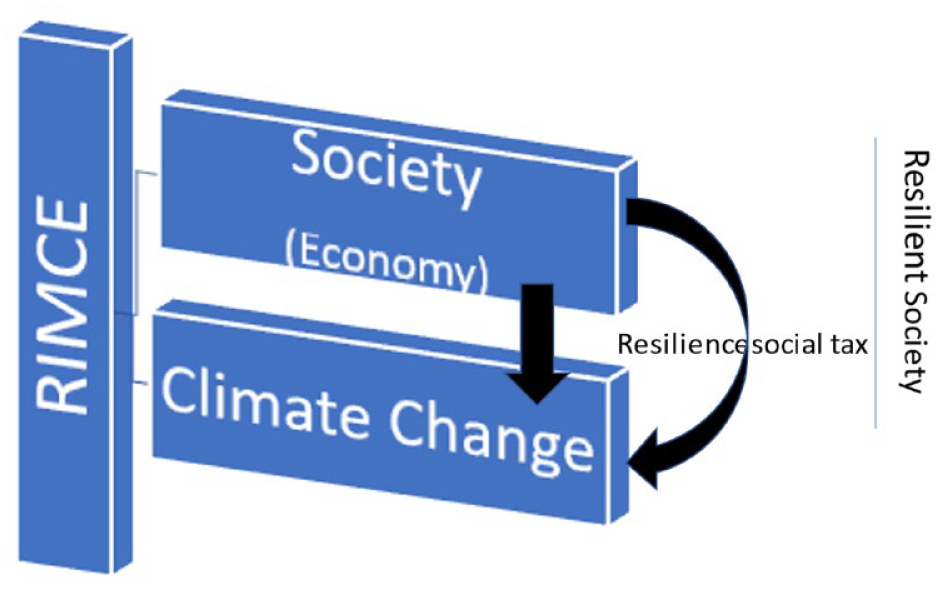
Resilience social tax, in the context of the RIMCE model, created by the authors of this work. Internal arrows represent crucial relationships. The external arrow represents the social taxes.
As a new path for the economy and society must be drawn, the social resilience tax endows the ecosystems with an economic and political dimension. The resilience social tax provides a basis for wellness indicators anchored on quality of life. It reinforces the Welfare State through human and citizenship rights, being thus beyond the non-neoliberal paradigm. (Gonçalves, 2022; Gonçalves and Bertolami, 2021c).
It should be considered that economic activities are associated with risky decisions that have an impact on the Earth System; like a world war, their implications create economic and social imbalance. However, being by its very nature, a global problem that goes beyond carbon taxes and international order, it requires local actions. In turn, states and governments are bound to a legal framework that must support political decisions in what concerns wellness factors within communities.
What must be urgently implemented is the materialization of the common good. The proposed social tax is a step toward the reappropriation of the social struggles for the common interest, charged with a high degree of anti-capitalist reform. This will lead us away from the purely economic approaches, as the emphasis is on rebuilding the social tissue, through changes in behavior, with an impact on the ecosystems and Earth System restoration. The target is consumption, which must be reduced to the minimum necessary to ensure a habitable, healthy, and systemically balanced planet. Social activity in terms of production and consumption and lifestyles must change at all dimensions of society.
Consumption, which leaves an identifiable ecological footprint, must be “fine-tuned” to what is necessary for people. Any excess must be taxed, proportionally to the damage on the environment and disruption of the Earth System equilibrium. This includes, for instance, large-scale production, extensive agriculture activities, excessive fishing and practices that cause collateral death of non-edible species, polluted urban centers due to their high CO2 footprint, and so on.
As we have reached by now an unprecedented degree of environmental degradation, the cost of environmental services must be part of the cost of products with a high environmental impact, the social resilience tax that we propose in the context of RIMCE, aims to be part of a new economic model and calls for political accountability, citizen responsibility and participation. The objective is to replace the ideology of economic growth with a new framework based on the well-being of the communities. The hope is to provide means to repair the dysfunctionality of the consumption societies. Thus, scientific knowledge is a way to guide decision-making regarding acceptable risks, both for governments and for citizens.
To empower local communities with financial means to implement mitigation and adaptation strategies financed by the funds of the resilience tax constitutes our main proposal. These prevent governance centralization and answer the fundamental question: who will pay the bill? The answer is that the bill has to be paid by citizens, sparing the most vulnerable, as their consumption profile is more modest and less aggressive to the environment, due precisely to their structural economic vulnerability. The community, requiring public participation for its definition, will set the resilience tax. The burden should be heavier on institutions and citizens that most contribute to the degradation of the environment.
More than laws and regulations that, historically, have proved to be insufficient to face the voracity of the market economy, it is mandatory to assign a price to environmental services by crossing bottom-up and top-down actions and measures that can be regulated. Payments for environmental services must be framed by regulatory mechanisms that reward those who protect Nature and keep environmental services working for the common good. It constitutes a way of pricing Nature’s products and services and thus promotes a new market logic that protects natural resources, as they are finite and sensitive.
The Resilience Integrated Model of Climate and Economy (RIMCE) can be coupled with other forms of decentralized governance proposals such as the Digital Contract for Earth System Restoration (Bertolami, 2018; Bertolami and Francisco, 2019), that calls for a bottom-up process of strengthening the resilience and participation of communities based on an informed decision about risks. The Digital Contract (DC) model for restoring ecosystems is strongly based on a solid body of evidence, showing that human activities are driving the Earth System toward a new state, usually referred to as Hothouse Earth, where its average temperature is necessarily higher than the present one. This has an irreversible impact on the regulatory ecosystems of the planet and the future of humankind. (Bertolami and Francisco, 2022).
A Block Chain Governance—a list of connected digital records, linked through a cryptographic key (Narayanan et al., 2016), is suggested for this purpose (Bertolami and Francisco, 2022). The model allows for decentralized forms of ruling using elements that are somewhat different from the ones that characterize representative democracies and direct democracies as these still require centralized forms of State, leadership, and governmental institutions. In the open governance of the Earth System proposed by the DC model, the decisions concerning the blockchain evolution result from a consultation of community members. (Bertolami and Francisco, 2022).
The resilience social tax is conceived as a direct payment for the damage caused to the environment and ecosystems, being hence for the benefit of all. Applied at the local community level, managed by local authorities, although in articulation with the central government and with international legislation. For instance, community activities that emit CO2 must be charged but the ones that do not emit and or reduce emissions should acquire credits, that can be used for preserving ecosystems and the environment. The revenue could also be used for training workers in green industries, etc. (Bertolami, 2022a, 2022b; Bertolami and Francisco, 2022). As discussed in Bertolami (2022a), as the less privileged classes are the most badly hit by climate change, the resilience social tax upon consumption can be used to strengthen the resilience capability of that social group. In this sense, the resilience social tax is also an instrument to fight social inequalities.
As a proposal that involves the municipalities, it will also seek to increase the indicators of well-being, reduce poverty, and promote professional and social inclusion within a new kind of sustainable development.
Moreover, besides, providing means to reduce risks, the social resilience tax would supply the communities with the financial funds for mitigation and adaptation, providing means to face the harmful impact of climate change framed by the resilience paradigm. Despite the different conditions of various states and communities, common and integrated political actions are required to implement our proposal at the local level and to allow for its spreading.
Conclusions
We have reached the extreme limit of dysfunctionality of the neoliberal policies. Climate change and social inequalities are so visible that a new social order is urgently needed. Common interests and human rights are continuously being eroded.
It is critical to consider global climate change at short and long-term levels of decision. The required measures involve various policies, spheres of government, and articulated actions to reduce vulnerability to climatic events and to restore the Earth System equilibrium for humans and all species. Mitigation and adaptation measures, mediated by dimensions of resilience are urgently needed, to implement concrete local governance actions.
Studies are needed to identify vulnerable populations, their dimensions, and the resilience strength to be built up. It is necessary to keep in mind that being resilient does not mean being vulnerable, and the reverse is true. Scars of the COVID-19 pandemic, such as deterioration of mental health and erosion of social cohesion associated with the deepening of social inequalities cannot delay action to face the hazards of climate change. The social resilience tax proposed in this work can provide the means to tackle all these issues.
Well-being indicators, that should be redefined, refer, broadly speaking, to the foresight on the quality of the community adaptation. We think that our model should be considered to face crises and to answer to disaster and the ensuing recovery. The connection to well-being unequivocally places the dimension of community resilience in the domain of policymaking, economy, and lifestyle, both at the local and central levels. This is the most effective way to oversee the quality of life and health after major crises and disasters.
The resilience tax must also be seen concerning environmental justice, that is, payment for environmental services, which originates from the harmful effects of the irrational use of natural resources, and the unequal distribution of benefits. Above all, there must be no deepening of social inequality generated by the environmental crises, which are underway. It is our responsibility to endow future generations with instruments to cope with the challenges ahead. In our view, the resilience social tax is the best way forward to provide the means to fix and mitigate the greatest challenges of our time—climate change and social inequalities.
Footnotes
Acknowledgements
The authors are grateful to João Ribeiro Mendes, for promoting venues of discussion for our work, namely through participation in the Green Marble 2022 event.
Funding
The author(s) disclosed receipt of the following financial support for the research, authorship, and/or publication of this article: This work was carried out within the scope of the project “Climactic – Citizenship for Climate – Building Bridges between Citizenship and Science for Climate Adaptation,” with reference NORTE-01-0145-FEDER-000071, supported by Norte Portugal Regional Operational Program (NORTE 2020), under the PORTUGAL 2020 Partnership Agreement, through the European Regional Development Fund (ERDF). This work, funded by the aforementioned entity.
