




Abstract
Humans have appropriated modern (food and biomass) and ancient (fossil fuels) biological productivity in unprecedented quantities over the last century, generating the biodiversity and climate ‘crises’ respectively. While the energy sector is gradually addressing the underlying cause of climate change, transitioning from biological to physical sources of energy, the biodiversity and conservation community seems more focussed on treating the symptoms of human exploitation of biological systems. Here, I argue that the biodiversity crisis can only be addressed by an equivalent technological transition to our food systems. Developing three scenarios for future technological and agricultural developments, I illustrate how using renewable physical sources of energy to culture animal products, microbes and carbohydrates will enable humanity to circumvent the inefficiencies of photosynthesis and the conversion of photosynthetic materials into animal products, thus releasing over 80% of agricultural and grazing land ‘back to nature’. However, new political will, governance structures and economic incentives are required to make it a reality.
Keywords
Humans are sun-dependent animals. Photosynthetic plants convert solar energy into energy stored within biological molecules. We then derive our bodily materials and energy by metabolising this plant-based productivity and from exploiting the food chains (animals, fungi and bacteria) that are built upon photosynthetic production. Over recent millennia, people have accessed additional energy by harnessing beasts of burden, developing agriculture to increase the fraction of primary production that can be consumed or otherwise used by people, and controlling fire (Syvitski et al., 2020), but these still relied on releasing energy which has ultimately been fixed by photosynthesis. Together they represent an increased appropriation of primary plant production by people. This has largely been achieved by land-use change and intensification in terrestrial agro-ecosystems and by increased exploitation of marine systems, the processes that are usually regarded as the most important drivers of biodiversity loss (IPBES, 2019; Newbold et al., 2015). Thus, increased appropriation of biological resources by the world’s burgeoning human population and its increased per capita consumption is generating the ‘biodiversity crisis’.
The expanding use of fossil fuels as an energy source over the last 170 years also relies on photosynthesis, but in this case photosynthesis that took place millions of years ago. Reconversion of ancient photosynthetic products (fossil fuels) back into CO2 is the primary contributor to anthropogenic climate change (IPCC, 2021), generating the ‘climate crisis’. Thus, the two key Anthropocene environmental challenges we face stem from the (‘over’) exploitation of photosynthetic-derived resources to release energy.
Humanity is addressing the ‘climate crisis’. Since the first Intergovernmental Panel on Climate Change (IPCC) report was published in 1990, we have initiated a transition from relying on the biological system (ancient photosynthesis) to harness the power of physics directly, increasingly relying on nuclear (fission to date), gravitational (hydro, tidal), geological and solar energies (photovoltaic, solar water heating, wind; not counting biomass which relies on recent photosynthesis and thereby ‘consumes’ additional land). This has been possible because the chain of cause and effect underpinning climate change is ‘simple’ physics, the technologies required to undertake the transition were at least partly developed, and the scientific consensus (from the IPCC) was aligned with the United Nations Framework Convention on Climate Change (UNFCCC, Table 1). The ongoing transition often seems painfully slow, impossibly difficult at times, and there is a very long way to go. Nonetheless, we are collectively moving towards replacing photosynthesis-derived sources of energy that generate greenhouse gasses by physical sources that do not, on a time scale of about a century.
Comparability of climate change and biodiversity change as issues to be addressed in the 1990s and 2020s respectively.
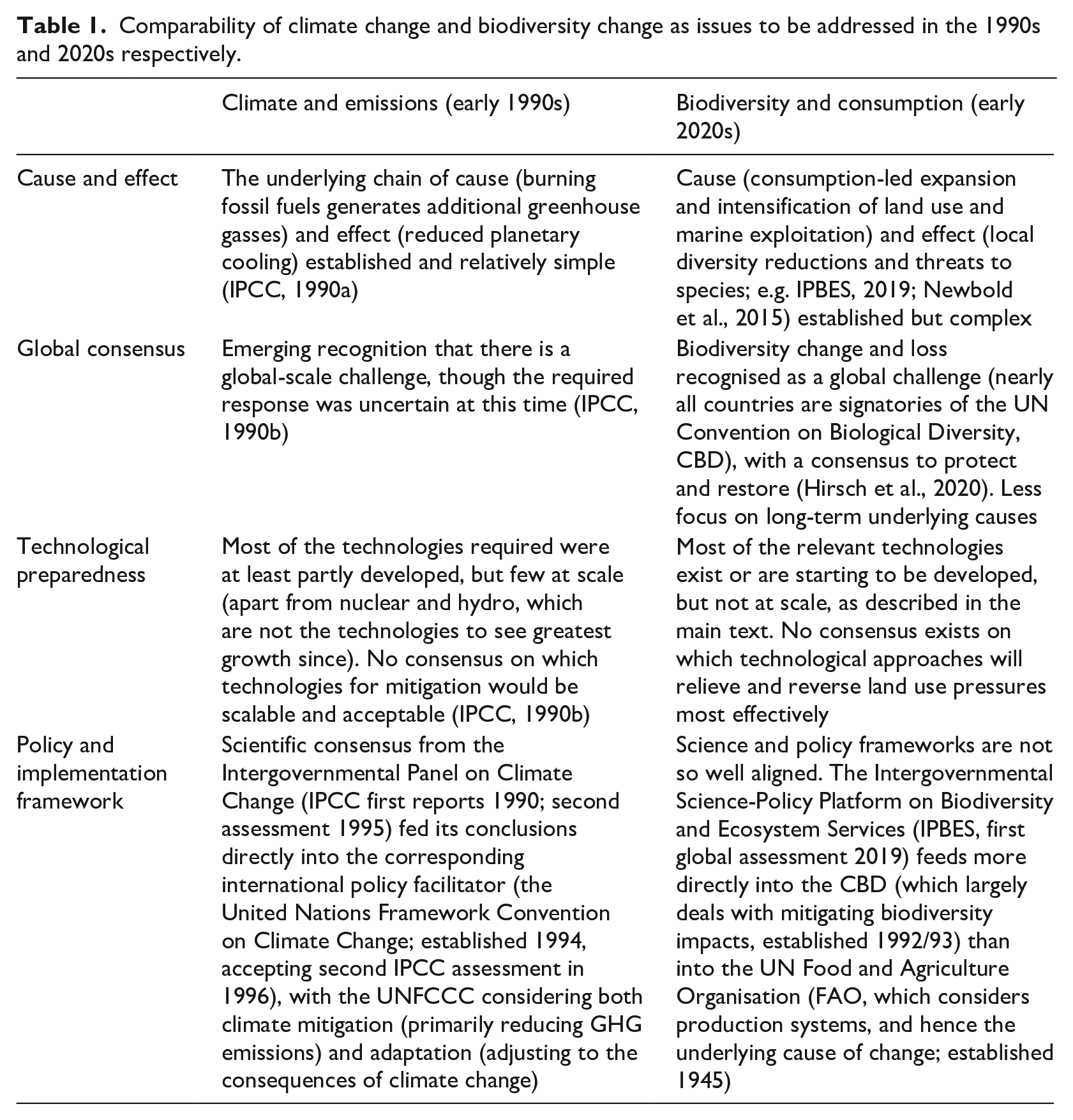
In contrast, existing approaches to address the ‘biodiversity crisis’ typically focus on the symptoms of change more than the underlying causes. Conservationists discuss, for example, the relative merits of setting aside strictly protected areas for biodiversity (land sparing) versus maintaining wildlife-friendly farmland (land sharing), making space for biodiversity and the provision of ecosystem services everywhere (Kremen and Merenlender, 2018; Phalan et al., 2011). Such debates are valuable and do make important contributions to conservation, but setting-aside areas for conservation and de-intensifying agriculture (‘wildlife-friendly farming’) in some parts of the world can potentially result in increased land conversion and/or intensification in others (‘leakage’), via global markets. As global-scale demand for agricultural products continues to increase, it has to be produced somewhere, and it is still likely to impact biodiversity wherever and however that production takes place. While humans continue to appropriate roughly a quarter of the Earth’s annual photosynthesis, set to rise to between 27% and 44% by 2050 (depending on the development storyline; Krausmann et al., 2013; Zhou et al., 2018), conservation reality is more about rearranging where and which organisms survive than influencing the total amount of ‘non-domestic’ biological life that exists. The more photosynthetic products we appropriate (cause), the less is ‘left over’ for biodiversity (effect). Some 30%–62% more food may be required by 2050 (relative to 2010; van Dijk et al., 2021), so environmental pressures associated with food production and harvesting are likely to remain high or increase.
Breaking the link between total consumption and impact requires the development and deployment of new technologies. This can be addressed in a manner that is comparable to how we are tackling the climate crisis. The situation for biodiversity is not dissimilar to that for climate change 30 years ago (Table 1). The challenge is quite well understood, many members of the public and governments are motivated to protect biodiversity, and nascent technologies are emerging that could reduce human reliance on products derived from photosynthesis. But, in this instance, the science and policy frameworks are not so well aligned. The Intergovernmental Science-Policy Platform on Biodiversity and Ecosystem Services (IPBES) has only been established recently and appears to influence the UN Convention on Biological Diversity (CBD), whose focus is biodiversity and ecosystem services, more than the UN Food and Agriculture Organisation (FAO), which considers production systems and hence the underlying causes of consumption-driven change.
Humans could obtain most of our biological food energy by harnessing physical and chemical sources of energy, but it requires concerted international consensus, governance structures and policies to make it happen.
Options and scenarios for the future
There are plenty of good suggestions to ‘save’ the biological world – eat less meat, reduce waste, recycle more, share food more equitably and so on – aiming to minimise the area and overall intensity of production as well as to improve human wellbeing. These all demand attention in coming decades, but none of them addresses the underlying longer-term issue. Our food and fibre supply is reliant on longstanding biological processes, and the chief means of increasing production continue to be to increase the area of farmland or the intensity of production systems. Global demand for animal products continues to increase: ‘global meat consumption increased by 58% over the 20 years to 2018 [with] population growth account[ing] for 54% of this increase and per person consumption . . . for the remainder’ (Whitnall and Pitts, 2019). This is the Anthropocene context that the conservation movement has, understandably, been unable to address. An alternative vision is to imagine that the bulk of food energy consumed by humans towards the latter stages of the 22nd century will be derived from physical sources of energy rather than via plant photosynthesis.
To this end, I have developed three scenarios, which are presented for illustration. They indicate the scale of possible land ‘gains’ (i.e. land no longer needed for food production), rather than the likelihood that different specific elements of each scenario be adopted. The focus is on medium- to longer-term options, not the regulatory, governance, technological, market and social influences which will influence actual speeds and patterns of development (see ‘Enabling the transition’ section, below). In these scenarios, there is no suggestion that consumers should ‘go without’, become vegan, eliminate waste or undertake a completely equitable redistribution of resources (desirable as this might be). The scenarios are based on consumers being able to consume meat, dairy and other agricultural products freely, but with the means of production changed. I have attempted to be realistic, and have assumed that technological gains and roll-out will be successive (as opposed to transitioning immediately to the theoretically most efficient possible systems). The underlying premise is to evaluate the extent to which it would be possible to reduce the area of land used (directly and indirectly) for human food production to provide space for biodiversity, to minimise cruelty to domestic animals and to minimise the release of pesticides and other agricultural chemicals into the environment.
Each scenario is successive, starting with a baseline of current land use, values for which are taken from Worldbank (2018) and Ritchie (2020). Land devoted to ‘livestock’ includes the area used to produce crop plants (~40% of existing cropland) that are fed to livestock (such as soy production fed to barn and stockyard animals) as well as the area of grazing lands. The area of ‘crops’ in Table 2 refers to crops consumed by people directly. The ‘plus’ in Table 2 highlights that the scenario for ‘plus Component 2’ builds on rather than replaces Component 1, and the term ‘Component’ is used because it is likely that elements of each of the three approaches will develop in parallel (e.g. elements of components 2 and 3 already exist), and will not be strictly sequential. The scenarios only consider the terrestrial environment, although a similar logic could be applied to the use of marine and freshwater resources.
Scenarios for the earth land surface associated with three major potential transitions in the food production system. Current values from Worldbank (2018) and Ritchie (2020). Scenario values are based on the literature cited in the main text, with scenario assumptions developed here.
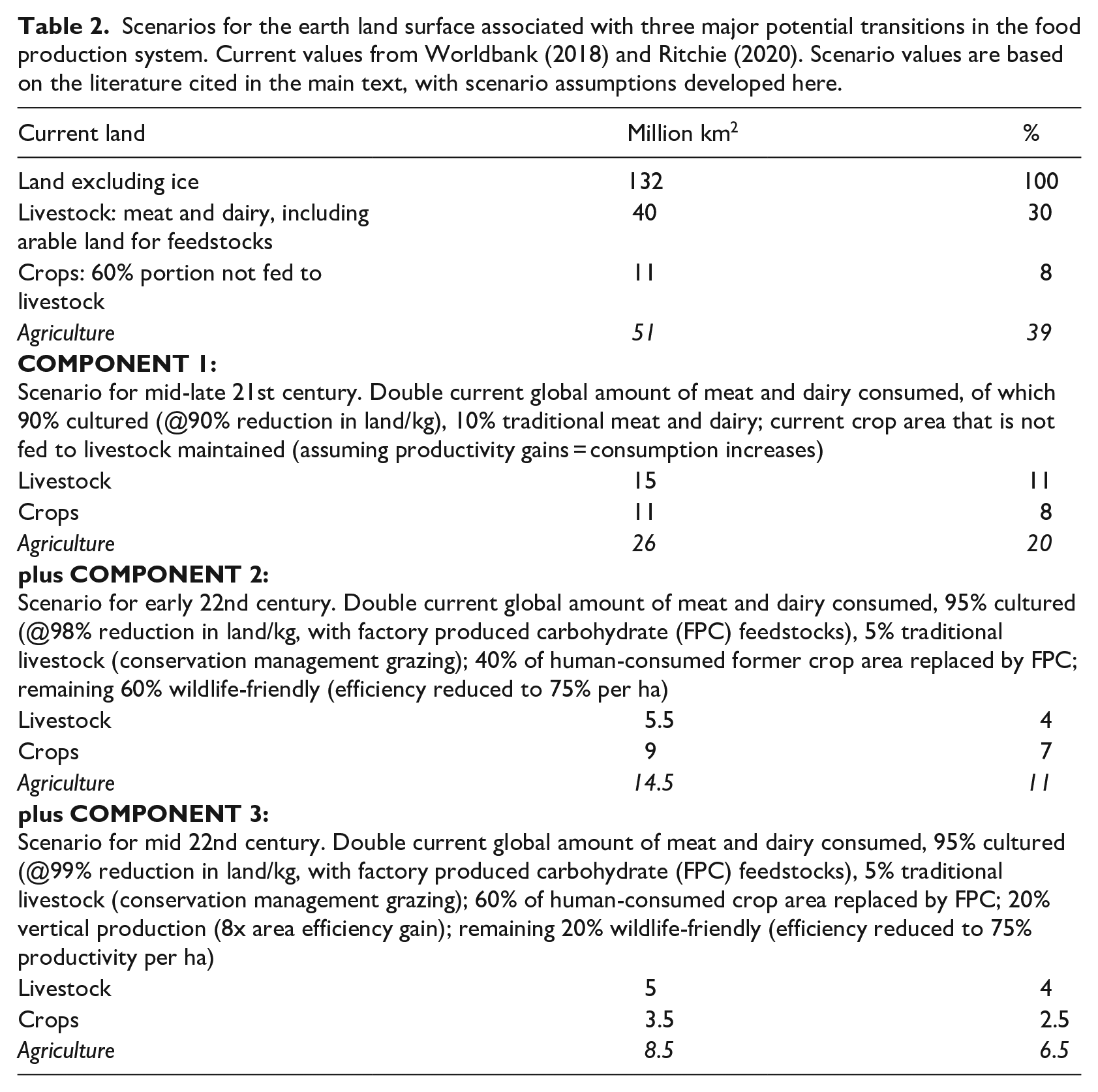
Factory-produced ‘cultured’ meats are already under development, in which tissue cultures are used to produce meat products, achieving multiple potential environmental benefits. One set of calculations suggested that cultured meat could have ‘78–96% lower GHG emissions, 99% lower land use, and 82–96% lower water use depending on the product compared’ (Tuomisto and de Mattos, 2011). Feedstocks are still required, but well-insulated buildings with stable temperatures maintained by renewable energy will prevent energetic waste, unwanted body parts (e.g. bones, guts) are not produced, and recycling of nutrients in mediums can be controlled. Many further technical, biological and social developments are required to achieve this at scale (Choudhury et al., 2020; Chriki and Hocquette, 2020; Ho et al., 2021; Thorrez and Vandenburgh, 2019), but the approach has great potential. Suppose that global meat and dairy consumption were to double (relative to 2020), that there was a 90% reduction in the area required (rather than the 99% suggested by Tuomisto and de Mattos, 2011) per kg of meat/dairy produced, and that 10% of meat and dairy continued to be produced conventionally. For this scenario, the global area of land required for agriculture could potentially halve (Table 2, Component 1). This could potentially be achieved during the second half of the present century.
The logic for the calculations in Component 1 are as follows. This scenario is for meat consumption to continue to increase globally as a result of continued population growth and increased per capita meat consumption. The Organisation for Economic Co-operation Development (OECD) and the Food and Agricultural Organization (FAO) of the United Nations estimate that meat consumption will ‘increase by 14% by 2030 compared to the base period average of 2018–2020’ (OECD and FAO, 2021). This and the other two scenarios represent a future in which overall consumption of meat and dairy consumption doubles (notionally by mid-late 21st century and then stabilises), relative to 2020. In other words, it illustrates how substantial area efficiencies can be achieved without the need for consumers to eat less meat and dairy. Doubling consumption to late 21st century is a reasonable guestimate. The two main alternatives to achieve an equivalent reduction in land use would be (a) for total global meat and dairy consumption to be reduced by approximately two-thirds, which is contrary to the existing global trends and seems unrealistic, or (b) universal intensification of meat and dairy production systems (caged/stockyard animals to which crops are fed, the existing system that uses least land per kg of product), but this runs counter to aspirations to improve animal welfare and would not save as much land.
Tuomisto and de Mattos (2011) estimate that optimised cultured meat could achieve a 99% reduction in land area required per kg of meat. However, this may not be realistic, at least initially. For scenario Component 1, I assume, therefore, that ‘only’ 90% gains will have been achieved by mid-late 21st century because feedstocks and other production systems may not have been fully developed or optimised by then. Given existing consumer preferences (which may change) for recognisable joints/cuts of meat, which cultured meat companies are not currently replicating (Purdy, 2020; Shapiro, 2018), and because there are multiple technical challenges to overcome to achieve affordable, scaled-up production systems (Thorrez and Vandenburgh, 2019), Component 1 assumes that 10% of meat and dairy calorific consumption continues to be derived from (previously) living animals on this time scale. By referring to the mid-late 21st century, I mean that this scenario might be achieved at some point during this period (not by 2050). The scenario also assumes that ongoing productivity gains in crops that are directly consumed by people meet increased future demand (e.g. by fertilising farmland that is currently relatively unproductive).
Factory production systems have multiple additional benefits. For example, the range of products that could eventually be generated is enormous, and from a much wider range of terrestrial and marine species than currently consumed. Hence, it is a way of increasing rather than decreasing culinary diversity relative to the present day. It circumvents animal welfare issues associated with both terrestrial and aquatic production systems (noting that ~70% of aquatic animal production is already sourced from aquaculture; Hua et al., 2019), and it avoids issues associated with faecal and bacterial contamination of traditionally slaughtered meats. Component 1 is the most important part of the transition because meat production uses the greatest area of land per unit of consumption and it would have the greatest greenhouse gas co-benefits (preventing methane emissions from ungulates and increasing CO2 uptake associated with revegetation). Furthermore, although the focus here is on land area, any land no longer used for livestock production can be spared from agricultural chemicals (veterinary drugs and pasture fertilisers) and other biodiversity-reducing interventions (e.g. cultivation to sow productive grass monocultures). In contrast, chemicals and processes used in cultured production systems can be more strictly controlled, regulated and monitored.
(2a) Factory-based microbial production and biochemical conversion are already widely used in the pharmaceutical and food sectors – antibiotics, brewing and cheese for example – and these technologies can be transferred ‘relatively easily’ to produce carbohydrates and protein. Leger et al. (2021) calculated that a photovoltaic-driven (involving capturing atmospheric CO2 and electrolysis of water) microbial protein-production system would only require around 7% of the land area, compared to soybeans, the staple which has the highest protein yields. (2b) Sugars and simple carbohydrates (molecules constructed of carbon, oxygen and hydrogen atoms) can also be produced by purely physical and chemical processes, using atmospheric CO2, desalinated H2O and energy generated by renewable sources (Dinger and Platt, 2020). There is no particular reason why it would be more difficult to scale up these processes than other existing organic chemistry production systems, a market worth $8.6 billion in 2017 and expected to grow to around $16 billion by 2025 (Fiormarkets, 2019). The two processes can be combined, producing precursor biological molecules in cell cultures and then modifying them chemically, as currently practiced in semi-synthetic antibiotic production. In time, the complexity of organic ingredients produced in this way could grow, for example to produce the chemical equivalent of vegetable oils.
Thus, the metabolic energy humans currently obtain from ‘staples’ (rice, wheat, etc.) can be supplied without the need for photosynthesis, releasing more land, including land that is currently under intensive cereal cultivation (Table 2). For this scenario, notionally around 100 years from now, cultured meat and dairy production systems are projected to increase to 95% (as opposed to 90% in Component 1) of total consumption, associated with consumer acceptance (globally) and technological improvements generating ever-more realistic and varied meat and dairy products. The area efficiencies (kg of product per unit area) are assumed to reach 98% (vs 90% for Component 1), a state of development that would be linked to increased industrial optimisation and carbohydrate feedstocks, increasingly derived from microbial and chemically-fixed CO2 rather than plant growth (Dinger and Platt, 2020; Tuomisto and de Mattos, 2011) as well as from industrialised microbial protein production systems (Leger et al., 2021). Similar carbohydrate and protein products could be fed to pets. With these efficiency gains, this scenario envisages that most remaining livestock (5% of meat and dairy calories) are associated with conservation grazing, with a focus of maintaining biodiversity in areas lacking large wild herbivores, and on livestock welfare.
For this scenario, it is presumed that 40% of the crops that are consumed by people directly, especially simple sugars and other carbohydrates, would be replaced by factory produced carbohydrate (FPC) feedstocks (Dinger and Platt, 2020). For example, pasta and flour (with trace wholegrain additions for taste, nutrition and appearance) could realistically be produced in this way in the next few decades.
Cultured animal products combined with factory-produced feedstocks (for humans and domestic animals) would so reduce pressure on the land that de-intensification of remaining farming practices would be feasible. For this scenario, it is, therefore, assumed that all remaining cropland will become ‘wildlife-friendly’, minimising chemical releases into the environment. To account for this, I have assumed that such farmland will only achieve 75% productivity per hectare, based on the present-day productivity of organic farmland relative to intensive farmland (Alvarez, 2021; Meemken and Qaim, 2018). In combination, the total area of farmland would be reduced from the current ~39% of the land surface to ~11% and there would be minimal release of agricultural chemicals into the environment on the remaining 11%.
Scenario Component 3 envisions incremental increases in the previously described processes, as well as the expansion of vertical farming. It is assumed that the hypothesised 99% reduction in the area required to produce a calorie of meat or dairy product (Tuomisto and de Mattos, 2011) is actually achieved by the mid-22nd century, and that 60% (vs 40% for Component 2) of plant-replacement carbohydrates and proteins are derived from microbial and chemical production systems. The remaining 40%, in this scenario, would be split between 20% non-intensive production in fields/gardens and 20% vertical production. For the latter, I have guestimated an eight-fold efficiency gain, given year-round production, optimised light (wavelength and intensity) energy use and vertical stacking. The area gain could be higher. This scenario also assumes that all remaining land-based farming (conservation grazing, low intensity croplands) would receive minimal or zero chemical inputs, and hence the gains in reduced environmental pollution would be even greater than the land area savings.
In combination, this scenario would reduce agricultural and food production systems (including the area for sustainable energy production to fuel it) to roughly 6.5% of the land surface (Table 2), one-sixth of the current area, despite feeding an increased human population. By the middle of the next century, continued growing of plants outside may largely be cultural rather than required to meet nutritional needs. Likewise, domestic animal grazing might be deployed primarily for cultural reasons, including as pets and conservation grazing management (replacing megafauna where desired). Whether we continue to kill any of these animals for food remains to be seen.
Enabling the transition
The still-growing human population (passing 8 billion in 2023, 10 billion expected mid-century) and additional per capita consumption that is required (720–811 million people remain undernourished; FAO, 2021a) will maintain and potentially increase human-generated pressure on the Earth’s ecosystems. The only genuinely transformative approach to maintain and restore ecosystems and biodiversity at a global scale is to revolutionise the processes by which human food is produced. Taking Components 1, 2 and 3 together, there is potential to release over 80% of pastoral and crop lands for other uses. As with the transition to renewable energy, exactly which processes and products are developed, and when, will depend on a series of technical, economic and social issues, and hence the three components described here represent a framework towards a sustainable production system, rather than a specific blueprint.
A common concern is whether these new developments would concentrate ownership and influence. Since sustainable energy production is expected to be more widely distributed than fossil-fuelled power stations, and industrialised food production systems can be modest in size (e.g. artisanal cheese making and the growth of craft micro-breweries), there is no particular reason to suppose that the developments discussed here are any more or less likely to place power in the hands of the few than the ongoing development of intensive agriculture, large agribusinesses, food distributors and retailers that already exist. I would argue that the power of large and transnational companies, relative to smaller companies, consumers and nation states, is orthogonal to this debate. It is appropriate for states to regulate matters on behalf of all of their citizens, but this applies to all areas of commerce and consumption, not just food production. It is a broader issue.
It is important to emphasise, as a caveat, that the focus here is on longer-term developments that would address the fundamental underpinning drivers of human impacts on ecosystems and their effects on biodiversity, not the ‘101 good things’ we should get on with immediately. Avoiding waste, reducing per capita meat consumption in some societies, developing increasingly productive organic and other farming options and sharing food more equitably are all desirable goals. Saving threatened species and ecosystems in protected areas and minimising harms to species in farmed landscapes are also laudable. All of these actions can help to minimise perturbation of the biosphere by humans in the coming decades and maximise human benefits from the food that we do produce. But total food demand scales with the total global population size, so the food still needs to be produced somewhere. None of these other options would enable us to release five-sixths of existing agricultural land ‘back to nature’ (or to different human uses). Universal vegan diets would come closest, but there is no sign that this is socially feasible for the entire human population in the near future. If we wish to address the underlying causes of what has been termed the ‘biodiversity crisis’, we need to convert energy from clean and renewable sources into chemical, plant and animal products, from which humans then derive their metabolic energy, hence breaking our reliance on photosynthetic products.
An additional consideration is over the safety and health benefits of products, where perceptions of safety are as relevant as actual safety. Since the cultured animal cells, for example, are genetically identical to those in living animals (without the faecal contamination associated with the slaughter of live animals), the risks to health are likely to be similar or reduced compared to present-day products (Purdy, 2020; Shapiro, 2018). Sucrose produced by chemical production systems is chemically identical to that produced from plants (Dinger and Platt, 2020). Hence, the class ‘factory-produced food’ or ‘cultured food’ is not the health issue – much of our food already comes from factories even if it was initially grown or produced in a field or in a shed. The issue is ‘what is each product?’ and ‘how does that product affect human health in different quantities over different times?’ This is about ongoing regulation to ensure food safety.
Another caveat is the practicality of developing these approaches. Given the time scale considered here, I presume that the social, technological and other constraints (e.g. Choudhury et al., 2020; Chriki and Hocquette, 2020; Ho et al., 2021; Thorrez and Vandenburgh, 2019) can eventually be circumvented. I am not so concerned whether a particular technology can be achieved at scale by 2050 or 2090, but whether it is likely to be achieved in the fullness of time. While some emerging technologies will certainly fail (technically or economically), it seems unlikely that the underpinning proposition – to culture animal cells, microbes and carbohydrates using clean energy inputs – will prove impossible as a whole.
The proposed system could support the future human population on less than 10% of the Earth’s land area, with comparable reductions in exploitation levels possible for marine systems. Reduced pressure on the land would enable the remaining crop and grazing lands to be ‘wildlife-friendly’ and ‘chemical-free’, which is not possible at a global scale at present because of the reduced productivity of such systems. For example, organic farming productivity is, on average, around 20%–25% lower than conventional agriculture (Alvarez, 2021; Meemken and Qaim, 2018). If these past studies are representative, scaling organic farming up globally would require an extra ~10 million km2 of farmland to produce current quantities of food, thereby reducing rather than increasing global biodiversity.
Once most of our food is produced in factories, former farmland could be available for ‘re-wilding’, carbon sequestration and recreational uses, including community vegetable and fruit gardens. This will not remove human impacts on the Earth, and nutrients and physical materials will still need to be obtained. Nonetheless, this potentially zero-cruelty food system would not compromise diets, would remove pesticides from most of the world, could (should) be designed to ensure that everyone is affordably well-fed, and could realistically lead towards centuries of recovering biodiversity rather than a future of seemingly inevitable over-exploitation.
This transition is feasible as soon as renewable energy derived from physical processes is in plentiful supply. Component 1 can commence at once because of the greenhouse gas savings associated with no longer keeping large numbers of ruminant animals (cattle, buffalo, yak, sheep, goats, camelids, etc.). There will be many technological, economic, social and political challenges along the way (e.g. Thorrez and Vandenburgh, 2019). Substantial investment is needed to overcome this ‘activation energy’, some of which is already taking place (e.g. Tasgal, 2019; Turi, 2021). There was approximately $1.2 billion of Venture Capital investment in cultured meat in 2021 (Turi, 2021), for example. However, few if any of the products are economically competitive yet. Cultured meats are not economically competitive by orders of magnitude (Vergeer et al., 2021), generating sugar by purely chemical means would cost about three times more than obtaining sugar from plants (Dinger and Platt, 2020), and the production costs of vertical farms are about five times higher than conventional outdoor production (but only a third more than glasshouse production; Tasgal, 2019). Progress has been impressive over the last 20 years, costs will come down, and products will improve, but prices are still too high to transition from niche market to global norm, the scale required to reverse recent biodiversity trends. However, the environmental externalities are not included in these calculations. Dinger and Platt (2020) concluded that chemical production of sugar is already competitive with traditional plant-based sugar production once externalities (including environmental impacts) are costed in. Furthermore, traditional farm production is subsidised in most countries (OECD, 2022), reducing the prices of conventional products. It is not a level playing field.
This has also been true for the energy transition, which benefited from sufficient private and public investment and regulatory support to enable renewable energy sources to become profitable (despite continuing subsidies of fossil fuels and biomass that still exceed those for clean energy; Reality Check Team, 2021; UNDP, 2021). Ultimately, the multifarious environmental, social and economic externalities of climate change (i.e. the perception that there is a ‘climate crisis’) led to sufficient targets, regulations, legislation and financial inducements to enable new technologies that have lower (different) externalities to be adopted. Three decades after the first IPCC reports, most countries are signatories to the UNFCCC (UN Framework Convention on Climate Change) Paris Agreement and have set or are developing individual near-term emissions targets, and many are working towards net zero. It is far from perfect, but few now doubt that the transition is underway.
Policy responses to biodiversity change and loss requires a similar consideration of the externalities of alternative production systems. At present, this transition is largely in the hands of small groups of researchers, start-ups and investors, rather than guided by broader societal, national and international policies to help determine desired directions and rates of change. In contrast, around $540 billion globally is provided in government subsidies to farmers each year (cf. the $1.2 billion investment in cultured meats) for activities that often contribute to environmental degradation and negative climate change impacts, and that rarely achieve the desired progress towards Sustainable Development Goals (FAO, 2021b). This existing multi-party UN-level concern is understandably focussed on the near-future, with a focus on the 2030 Agenda for Sustainable Development, just as the CBD is establishing biodiversity Action Targets for 2030. In contrast, the longer-term dependency of the world’s environmental and biodiversity trends on the human photosynthesis-derived food system are not being addressed or financed adequately. New political will, governance structures (additional cross-UN collaborations) and economic incentives are required to realise the changes described above. A starting place might be to establish a joint process through the UN Convention on Biological Diversity and UN Food and Agriculture Organisation, which could oversee a revolution in our food production systems in the same way that the UNFCCC is helping steer the transformation of our energy systems. Ultimately, progress towards these food transitions and concomitant benefits for biodiversity will depend on citizen acceptance and enthusiasm, as well as affordability, and hence a process of both top-down and bottom-up engagement should be encouraged throughout the process.
Footnotes
Acknowledgements
I thank members of the Leverhulme Centre for Anthropocene Biodiversity for discussing these ideas, and two anonymous referees for their constructive suggestions.
Declaration of conflicting interests
The author(s) declared no potential conflicts of interest with respect to the research, authorship, and/or publication of this article.
Funding
The author disclosed receipt of the following financial support for the research, authorship, and/or publication of this article: This work was supported by a Leverhulme Trust Research Centre Grant (RC-2018-021).
