




Abstract
The article offers a discursive complement to an audiovisual artwork created by the authors for the cultural program Mississippi. An Anthropocene River. It explores philosophical, technological, and political aspects of the modernization process that reshaped the landscape of the Tennessee Valley for the generation of hydroelectric power in the 1930s, laying the groundwork for the region’s integration to the continentalscale Manhattan Project in the following decade. Government management of scientific research and industrial production for military imperatives is identified as the origin of a characteristic Anthropocene mode of production which subsequently spread around the world, contributing decisively to the Great Acceleration of the global economy in the 1950s. Cast in the form of a “field guide” and addressed to a broad audience, the article suggests that sustained attention to anthropogenic patterns in any modernized landscape will reveal parallel developments of this mode of production.
Keywords
Can artists contribute to the definition of the Anthropocene? As participants in the interdisciplinary project Mississippi. An Anthropocene River, we sought to identify the threshold of a new geological epoch at our field research site, located near the confluence of the Ohio and Mississippi rivers. We believed that our expressive techniques, in combination with an artistic sensibility to social life in the present, would allow us to discover something fundamental about the origins of the new epoch. The resulting work is the video Born Secret (Cash for Kryptonite), which can be freely viewed on the Internet (Bolen et al., 2019).
The video opens with two factories on either side of the Ohio River, both involved in uranium enrichment, and both stuck in the long slow process of closing down. We opened our eyes, we found these two remnants of the Cold War nuclear complex, and we gradually came to identify them as regional agencies within a larger process of Earth system transformation. By literally following the electric power lines of the plants, we confirmed that they were linked to institutions of national and global significance. These institutions are the Tennessee Valley Authority, a river-basin development agency of the Depression Era, and Oak Ridge Laboratory, a central component of the Manhattan Project. The larger process of planetary change has been characterized by Earth system scientists as the “Great Acceleration” (Steffen et al., 2015).
As we filmed, we plunged deeper into regional history. We realized that Oak Ridge, like the uranium enrichment facilities on the banks of the Ohio, owed its location to the prior construction of hydroelectric dams in the Tennessee Valley. This earlier period of electric power development had been crucial for the industrial production of plutonium-239, whose persistent stratigraphic signal—fine layers of radionuclides deposited on lake beds, polar ice, ocean floors, and in corals (Waters et al., 2019)—is now used to mark the threshold of the Anthropocene. Slowly we came to understand that the Anthropocene epoch, conceived as an ongoing state change in the Earth system, has its own mode of production, which has never been adequately discussed, not even in a book like The Great Acceleration: An Environmental History of the Anthropocene since 1945 (McNeill and Engelke, 2016). What we call “the Anthropocene mode of production” refers to the governmental coordination of scientific research and industrial development for military and economic ends. This coordinated process of technoscientific development is exemplified by the Manhattan Project and its Cold War extensions.
To describe the systemic character of successive periods of capitalist industrial expansion, scholars of innovation speak of “techno-economic paradigms” (Freeman and Louçã, 2002; Perez, 1983). A techno-economic paradigm is constituted when particular forms of production and consumption cohere into a relatively stable and socially embedded pattern of economic growth over a limited period of time, typically 50–60 years. Such a paradigm—or what we prefer to call a mode of production—first emerges in response to a major crisis: for example, the Great Depression, followed by the Second World War. It then expands from its initial sites of origin to saturate the entire world economy. In our case this consolidation phase, popularly known as the “postwar boom,” coincides with the takeoff of the Great Acceleration. The installations we filmed—both the hydroelectric dams and the nuclear weapons plants—thus appear as foundational components of the mode of production that provoked the state change of the Anthropocene.
As artists, our work was not only to analyze, but above all to register a shift in social sensibilities. We found that the Anthropocene mode of production is associated with a certain feeling, which remains quite palpable today: an exhilarating but troubling feeling, wildly expansive yet weirdly claustrophobic, threatening too. The feeling is generated by a peculiarly American obsession: the quest for super powers. This popular desire appears to be directly related to the historical developments of energy infrastructure, culminating in the postwar nuclear era with its many anxieties. We were struck at the outset of our journey by a metaphor that some local inhabitants had inscribed in their home town of Metropolis, Illinois, where the first of the uranium enrichment facilities is located. It’s the metaphor of kryptonite, the mysterious green stone from Superman’s home planet. This radioactive element is what gave Superman his powers, but now sickens and debilitates him at any moment of intimate contact. In our work, kryptonite symbolizes the academic-military-industrial complex at the origin of the Anthropocene. Its affective tone—mysterious, exhilarating, oppressive—has everything to do with the encrypted origins of atomic science, which, according to official US legal doctrine, was classified at inception, or “born secret” (DeVolpi et al., 1981).
The inhabitants of Metropolis decided long ago to play the role of Superman for passing tourists, and their antics on the street caught our attention. This once-a-year stunt is their claim to fame, and they know full well that with a uranium-processing operation in their town, they are subject to all the ironies of kryptonite. So that was no big secret. We laughed at the joke—after all, it was on them. But it left us with a sneaking feeling: Were we somehow part of this absurd performance? Was Superman part of our own desire? Had something mysterious been encrypted in our daily lives? Did we too suffer from a lingering weakness? In a widely read book, political scientist Winner (1989) wrote that the “inherently political technology” of nuclear power requires “authoritarian management and extremely tight security (p. 175).” We believe that the military secrecy surrounding early atomic science has been a key factor in the subsequent development of authoritarian tendencies in US society. We will return to these questions at the end of the text.
Just as the video is an observation from the field, what follows is a collection of annotated working notes, devoted to various stages in the genealogy of the Anthropocene mode of production. The aim is to specify discursively what the video evokes artistically. Together, video and text compose a field guide to a complex institutional ecology that generates both human affects and Earth system effects. We offer this guide not only as a finished artifact, but also as an activity involving direct experience, artistic interpretation, and analytic reflection. Such an activity is a way to carry out the micro-macro “scaling” called for in an insightful article by Coen (2016). What we hope to reveal through this traversal of scales is the intimacy of earth-transforming infrastructure (Wilson, 2016).
TVA
The Tennessee Valley Authority was the dreamship of the New Deal during the Great Depression of the 1930s. It grew up around a massive white elephant: Wilson Dam in Muscle Shoals, Alabama, built to supply electricity for the production of explosives, but left unfinished at the close of World War I. In the early 1920s, Henry Ford wanted to buy it cheap from the government to create a new Detroit of the South. However, a group of Progressive politicians around Senator George Norris of Nebraska blocked the industrialist’s plan and began reimagining Wilson Dam as the centerpiece of a federally mandated river-basin development agency (Hudson, 1962). This agency would control floods, improve navigation, produce hydroelectric power, stimulate local industry, and help pull marginalized communities out of ignorance and poverty. Norris introduced legislation for the project in the Congress of 1931, but it was vetoed by Herbert Hoover as socialistic. That bitter defeat saved a golden opportunity for the New Deal.
As a conservationist preoccupied by soil erosion and the Dust Bowl, the incoming president Franklin Delano Roosevelt embraced and amplified the Norris bill. For him it was the chance to launch a large-scale experiment in Progressive regional management: “a corporation clothed with the power of Government but possessed of the flexibility and initiative of a private enterprise,” as he put it in his initial request to Congress (Roosevelt, 1933). Like the Civilian Conservation Corps, TVA was part of the Roosevelt administration’s attempts to confront the ecological crisis of the Thirties (Black, 2005). To be sure, these aspirations were contradictory, oscillating between a vision of rural modernization in harmony with nature, and a more aggressive push for rapid economic development. As Hargrove (1994) points out, these contradictory goals helped foster the organizational myth of “an electric valley in which technology would produce a good life for all people”—a principle of hope that would empower creative experimentation in the early years, before leading to administrative overreach and organizational failure in subsequent decades (p. 8).
The TVA Act was signed into law in 1933. To direct the newly created agency, FDR chose Arthur E. Morgan, a self-taught utopian engineer with an extensive civil-engineering career in hydrology, who had also served as the president of Antioch University for almost two decades. Morgan was a community-building visionary who assembled a large and talented workforce to build dams for TVA’s mission of “multipurpose river-basin development” (Clapp, 1956: 7–11). The concept included not only navigation improvements for regional commerce but also flood control and hydropower generation, as well as fertilizer production, forestry and soil conservation, irrigation, recreation, and public education. In just 5 years Morgan laid the organizational foundation for an innovative public utility that was able to communicate a high sense of mission and deliver concrete results on the ground, while simultaneously engaging in radical social experimentation (see the surprisingly sympathetic portrait in Scott, 2006). In addition to Arthur Morgan, Roosevelt named two other directors. One was Harcourt Morgan (no relation), a Tennessee native possessed of the notion that nature and humanity shared a “common mooring” (Keep, 2015). He would handle the agricultural side of TVA’s program. The other was David Lilienthal, a Progressive lawyer who had gained youthful fame for his successful prosecution of price-gouging by private utilities. Lilienthal’s early work at TVA would be devoted to carving out a legal and commercial space for publicly owned power production.
The concept of multipurpose river-basin development that shaped the Tennessee Valley Authority had its roots in the thinking of conservationists like Gifford Pinchot and WJ McGee. These early 20th century figures were resource managers: they sought to overcome rampant waste in the commercial exploitation of nature. As governor of Pennsylvania in the 1920s, Pinchot tried to gain public control over large-scale utilities. At the time, private enterprises were increasing efficiency by replacing scattered local generators with much larger hydroelectric and coal-fired systems, known as “giant power.” These would be hooked into high-voltage interstate transmission lines operating as common carriers on a new and far larger scale: nothing less than “superpower.” Pinchot championed giant power for its efficiency gains, but sought to regulate for public benefit the emerging corporate superpower networks whose development had been spurred by the industrial demands of the First World War (Boeckel, 1926; Christie, 1972). The giant power/superpower ideal would be realized in full by TVA, which rapidly constructed its own network of hydroelectric dams and long-distance transmission lines (Figure 1).
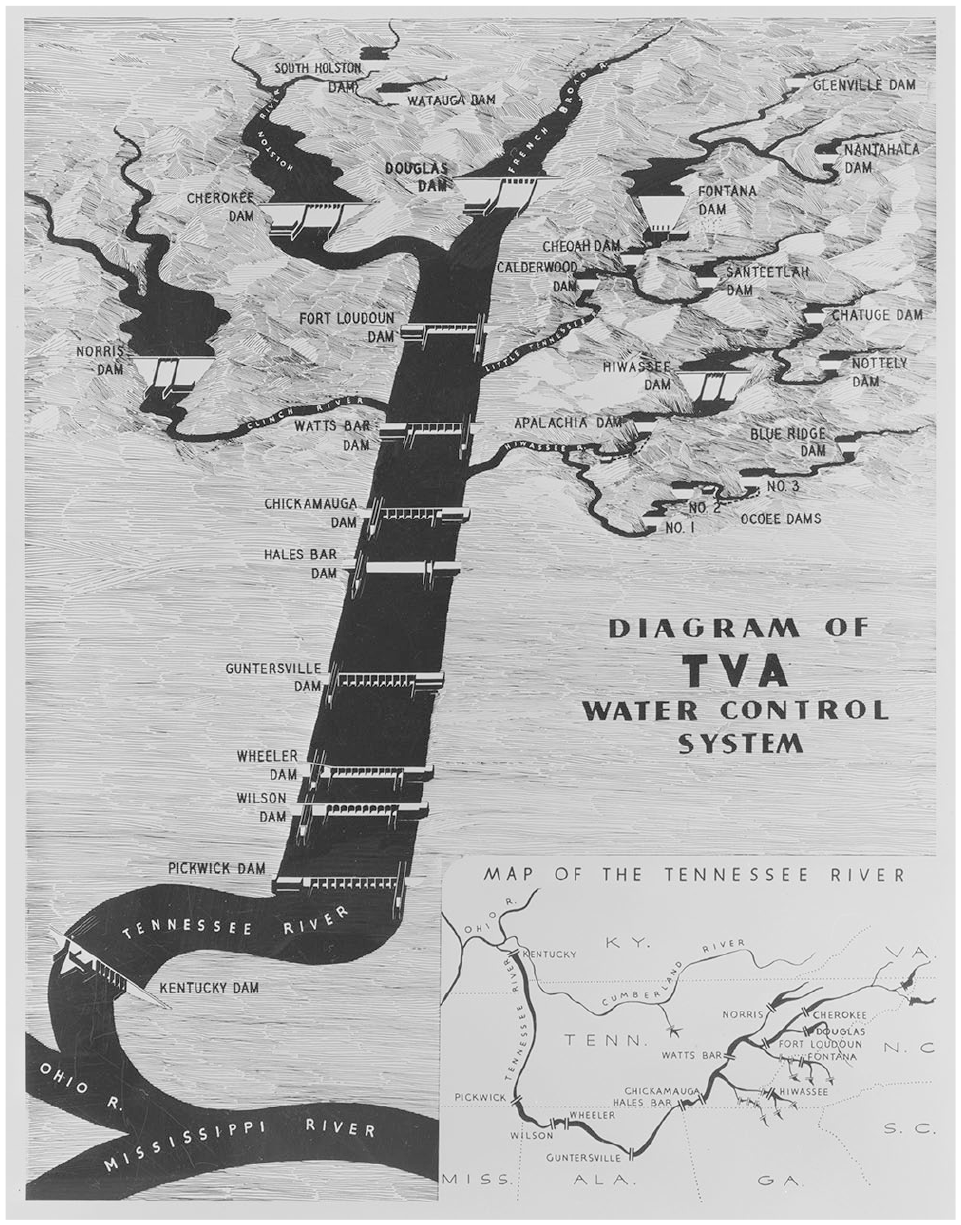
TVA water control diagram, author and date unknown (1933–1945).
But that was only one dimension of the project. TVA’s panoply of missions embodied McGee’s idea that humanity, having emerged directly from nature, was now in a position to perfect it through the application of science. In the early years of the 20th century, McGee had come to understand large-scale hydrological projects as both a remaking of the earth and a collective self-transformation through engineering: a veritable terraforming of humanity, guided by the unitary disciplines of geology and anthropology (Schmidt, 2017: 43–67). These ideas were current at the Cosmos Club in Washington D.C., founded in 1878 by McGee’s friend and mentor, John Wesley Powell. McGee (1908) himself listed navigation, irrigation, power production, and land reclamation as the tasks of the Inland Waterways Commission, of which he was secretary and vice chair. The Commission marked the first, albeit abortive attempt at federal river basin planning, to be carried out by the agency of “the People,” as McGee would constantly proclaim. Yet it was only in the 1930s, under the pressure of the ecological crisis, that the US developmental state gained the powers to engage in what another Cosmos Club member, Otis Mason, called “technogeography”: a coevolutionary process in which humanity’s agency became equal to that of the great forces of nature. In this highly energetic conception of a “common mooring,” the trend toward technogeography was to culminate in global unification: “The end is hastening, however, when the false and unnatural political boundaries will be swept away or ignored, the non-progressive races extinguished or driven to the suburbs, the play of world-wide action left unincumbered (sic), the flow of world-embracing commerce unimpeded, and every desire of man will be gratified” (Mason, 1894). Today, that sentence seems to foreshadow the Great Acceleration.
In the US, the Flood Control Act of 1936 unleashed half a century of continuous hydrological engineering carried out by the Army Corps of Engineers and the Bureau of Reclamation. Often in competition with each other, the two agencies transformed vast watersheds, encasing entire river systems in straightjackets of cement (Reisner, 1993). In the early years—while there were still free-flowing stretches of the Tennessee—TVA appeared as a maverick third force, able to translate its earth-making feats into a full-fledged social ideology, which it also codified through extensive technical documentation. In 1936 it published a unified plan for the development of the Valley (Tennessee Valley Authority, 1936). By 1940 it had already built half a dozen hydroelectric dams. These lay at the center of a publicly managed “superpower” network promoting local industry and rural access to electricity. TVA also reached out to the population with navigation improvements, fertilizer production, and erosion and insect-control programs, while building workers’ communities alongside the new dams. “There is almost nothing, however fantastic, that (given competent organization) a team of engineers, scientists, and administrators cannot do today. Impossible things can be done, are being done in this mid-20th century,” wrote Lilienthal (1944) a few years later (p. 3).
Morgan had assembled the team, laying the foundations for what was to come. But in 1938 he lost a fierce internal debate over his vision for the future, and Lilienthal, who had successfully imposed his superpower network on the local electrical monopolies, became the effective director of the agency. This set the stage for a mid-20th century transformation that would only be partially known to those who carried it out. The utopian aspirations surrounding FDR’s principle of hope morphed into something a lot more complicated—and a lot murkier—as TVA became a powerhouse of the US war machine in the 1940s.
Oak Ridge
Just south of TVA’s administrative seat in Knoxville, Tennessee, lay a large industrial suburb: Alcoa, the company town of the leading US aluminum producer. Its demand for electricity surged after Roosevelt announced his 1940 plan to produce 50,000 bombers for the coming war. TVA drew back from fertilizer production and contributed military-grade nitrates to the war effort, along with considerable expertise in survey mapping. But its main objective was to increase hydropower output for Alcoa. The agency built Fontana, Cherokee, and Douglas dams at unprecedented speeds, before pouring the final concrete into Kentucky Dam in 1944. In parallel, the tightly guarded federal project at Oak Ridge began rivaling Alcoa in its demand for electricity.
Land had been taken from rural inhabitants by eminent domain and cleared for new facilities, including high-tension lines from TVA. Top-secret work was underway on industrial-scale uranium enrichment, and an atomic pile had been assembled for the experimental production of plutonium (Johnson and Schaffer, 1994: 1–28). Soon the Oak Ridge operation outstripped the capacities of TVA hydropower and forced new investment in coal-fired generators, a process that would continue after the war (Droze, 1983). In the meantime a parallel site had been created half a continent away, at Hanford in the Columbia river basin, where electricity flowed in from the nearby Grand Coulee Dam, built in the 1930s by the Bureau of Reclamation as the centerpiece of a vast irrigation scheme that would make the desert bloom (White, 1995: 81–88). On the banks of the Columbia, the Manhattan Project again drew on hydroelectric power furnished by a federal river-basin development agency. Hanford’s full-scale plutonium production reactors were supplied with enriched uranium from Oak Ridge. Thus in the early 1940s the two emblematic river-basin development schemes of the Depression era became part of a single “centrally controlled and coordinated production system” on a hitherto unprecedented scale (Hughes, 2004: 383). The terraforming projects of the early 20th century were now fueling the search for a quasi-cosmic form of energy—a new “superpower.” Yet this energy was not to be distributed through a network. Instead it was to be released in the overwhelming flash of a bomb. And despite the industrial scale of production, the new superpower remained a strictly guarded secret of war. According to the legal doctrine forged just after the end of hostilities, all scientific knowledge pertaining to nuclear weapons was “restricted information.” It was literally “born secret,” classified at inception (DeVolpi et al., 1981; US Congress, 1946: Section 10).
TVA’s contribution to the war effort is usually glossed over by historians in very general terms, so as not to spoil the idealism of the early years. But the existence and cost of the federal superpower network had to be justified from time to time. In 1956 a note went into the Congressional Record, defending the agency from the attacks of private interest groups who saw it as unfair competition in the private electricity markets. By contrast, the note stressed the agency’s patriotic missions: During World War II, from 1939 to 1945, TVA raised power production from 2 billion kWh to 12 billion kWh by rapid construction of dams and hydro plants. During the war three-fourths of TVA’s power was used for war purposes—to produce aluminum for airplanes, chemicals for munitions, fissionable materials for the atomic bomb, and other war materials (Gore, 1956: 15579).
It’s sobering to realize that even as this destructive output was reaching its wartime height under conditions of extreme secrecy, Lilienthal published his rhetorical masterpiece on the virtues of grassroots participation, entitled TVA: Democracy on the March (1944). Reissued in paperback and translated into 15 languages, the book was the centerpiece of TVA’s subsequent rise as the US flagship of international development. Yet this peacetime aura, celebrated in dam-building campaigns around the world, encrypted a military will to power. At its productive core, the TVA myth itself was “born secret.”
At the close of the war, after Hiroshima and Nagasaki, Lilienthal served as co-chair of the commission that produced the Acheson-Lilienthal Report on the International Control of Atomic Energy. Based on a first draft by J. Robert Oppenheimer, the Manhattan Project’s lead physicist, the report recommended the creation of an international agency, the International Atomic Development Authority, which would place global uranium supplies under independent scientific control to encourage peaceful uses while blocking any military deployment of atomic weaponry (Barnard et al., 1946). This was a proposal for a limited renunciation of national sovereignty. “Many have said that without World Government there could be no permanent peace, and without peace there would be atomic warfare,” wrote Oppenheimer (1946). “I think one must agree with this” (p. 85).
Oppenheimer’s core ideas came from the Danish physicist Niels Bohr, who traveled to Los Alamos not to help build the bomb (the work was mostly done when he arrived) but instead, to raise questions about the role of knowledge in the postwar period and about the possibility of what he called an “open world” (Bohr, 1950; Sherwin, 1988). Bohr’s far-reaching goal was to transform the scientific community by giving it a limited but radical sovereignty: control over atomic power. This was a radical intervention in the politics of knowledge. The Bohr/Oppenheimer proposal was rapidly shelved as antagonisms toward the USSR intensified; but nonetheless, Lilienthal was named first director of the US Atomic Energy Commission in 1946. From that position he argued against military control and resisted the development of the H-Bomb (known at the time as “the Super”) while continuing to deliver impassioned public speeches about the impossibility of keeping scientific knowledge secret. Lilienthal consistently stressed the need for democratic participation from the citizenry to set a course for future technoscientific development (Neuse, 1996: 167–244).
Though overshadowed by the rise of McCarthyism, this period saw the most intense debates in world history over the social responsibility of science and the uses and abuses of state secrecy. Lilienthal’s later prestige in the international development arena derived largely from the principled liberal positions he took at this time. But he could not change a thing. In a 1948 interview with the poet-statesman Archibald MacLeish, he described the trap that the atomic bomb had set for the society that invented it—a trap whose effects still prevail: “Secrecy on one side, a good deal of it necessary secrecy. And on the other side loyal and patriotic acceptance of secrecy. And the end result is one of the worst things that can happen to a self-governing nation—acquiescence in ignorance. . . It’s a kind of suicide, isn’t it?” (MacLeish, 1948: 115).
The director of the TVA can be critiqued for many things—not least, for being dazzled by his own rhetoric. Yet it’s impressive that in a discussion of overwhelmingly powerful atomic weapons, what he feared most was not an attack by a foreign state, but instead, the suicide of a democracy.
Faustian Bargain
In the postwar era, TVA became an oft-touted model for global economic expansion. At the Yalta Conference in 1945, Roosevelt spoke of a “TVA for Europe,” anticipating what later became the Marshall Plan (US Department of State, 1955: 719). In Japan and its prewar colony of Manchukuo, hydropower development had been inspired by TVA before and during the war; such projects were pursued even more intensively under direct American guidance in the postwar period (Jacoby, 2019). Underdeveloped countries such as India sought TVA assistance for dam-building programs like the one in the Damodar Valley west of Calcutta, carried out from 1949 to 1959 with funding from the World Bank (Tennessee Valley Authority, 1952). Similar projects were also completed in Latin America, Africa, and the Middle East. The control of rivers, and the transformation of their flow into electric current, were perceived as the indispensable basis for industrial modernization. And the model of a semi-autonomous agency able to interface with a wide variety of organizational scales fit perfectly within the labyrinth of the new international institutions, which could only work through the intermediary of local governments and corporate contractors (Selcer, 2018: 87–90).
On the ideological level, TVA’s educational and rural-development missions seemed tailor-made for the Third World. The universality of science and the quest for world peace provided a common language, bolstered by a shared aspiration to prosperity. To be sure, as Lagendijk (2019) has indicated, TVA’s expertise gradually merged into a post-colonial context with no single center of authority. And as Chatterjee (2020) points out in an important article, the “Asian Anthropocene” of the 1950s cannot be ascribed to the global spread of private capitalist industry, but rather to a form of state-led “fossil developmentalism” that absorbed, transformed, and intensified TVA’s relatively modest achievements in the realm of public power provision. As the 1950s wore on, the indicators of fertilizer and petroleum use, population growth, the production of novel substances, and the level of carbon dioxide in the atmosphere all started climbing exponentially. The Great Acceleration had begun.
Lilienthal himself was pushed out of the AEC in 1950, but after a few years he reappeared as an international development consultant, backed by the Wall Street investment firm Lazard Freres. While remaining in the limelight as a public orator, he worked in the shadows with the Shah of Iran on Dez Dam; and even worse, he lent his prestige to the Johnson administration’s Mekong Committee plan, which was supposed to bring flood control, electric power, and prosperity to Vietnamese peasants. This was the era when the State Department and the military reorganized the international economy for the needs of US corporations. A development consultant trained at the heart of the US military-industrial complex and backed by a New York-based investment bank was the perfect man to carry the TVA message to the non-communist world (Ekbladh, 2002).
The notion of a “Faustian bargain” between atomic scientists and a power-hungry public was coined by the physicist Alvin M. Weinberg, the director of Oak Ridge Laboratory. As he wrote: “We nuclear people have made a Faustian bargain with society. On the one hand. . . we offer energy that is cheaper than energy from fossil fuel. Moreover, this source of energy, when properly handled, is almost nonpolluting. . .. But the price that we demand of society for this magical energy source is both a vigilance and a longevity of our social institutions that we are quite unaccustomed to” (Weinberg, 1972). The metaphor of the Faustian bargain, derived from the German literary genius Johann Wolfgang von Goethe, has cast an ominous shadow over industrial modernization processes since the 19th century—and it’s notable that Weinberg, a much-respected government science manager, identified himself not with the idealistic Faust, but instead with the technological devil Mephistopheles. The literary critic Berman (1988) expands on this ambiguity in his book All That Is Solid Melts Into Air, where he identifies David Lilienthal as one of the archetypal “Faustian developers” of the mid-20th century, alongside such figures as Robert Moses, Hyman Rickover, Robert McNamara, Jean Monnet, and Weinberg himself (p. 75). In Berman’s view these highly educated men were the liberal veneer, the well-spoken individuals at the helm, whose dirty work—whether immense terraforming projects or the redesign of entire populations—was always done by some superpowered Mephistopheles in the background.
Liberal idealism was a tool of power in the modernization campaigns of the 1950s, when the techno-economic paradigm that had first emerged in the US began spreading outward into the world. As the international relations scholar Cox (1987) has demonstrated, US hegemony was not primarily imposed by force, but instead through the prestige of a superior production process. In the decade of the Great Acceleration, the corporate engineering firms whose capacities had expanded dramatically during the war grew once again by orders of magnitude. Lilienthal (1952), the former trust-buster, wrote an apology of big business. And the superpower infrastructure of the American state kept the pace. The quote about TVA in the Congressional Record (Gore, 1956) continues: Beginning with the hostilities in Korea in 1951, an even vaster expansion of power has been demanded and met. Since 1951, TVA’s power output has been multiplied three times, from 18 billion kWh to 57 billion kWh. More than half TVA’s power sales—56% in 1956—goes to the Atomic Energy Commission’s huge plants and to other Federal defense installations. Between 1950 and 1956, these federal agencies multiplied their demand for TVA power 15 times—from 2 billion kWh to more than 30 billion kWh.
It’s staggering to read these figures: TVA’s federal power contracts grew fifteen-fold after WWII. But the early 1950s is the period when the experimental Manhattan Project was redeployed as a continental-scale production grid for the Cold War nuclear arsenal. What we found along the Ohio River were two pieces of this continental puzzle: the Honeywell plant in Metropolis, Ilinois, which transformed raw yellowcake into uranium hexafluoride gas; and the Paducah Gaseous Diffusion Plant across the river in Kentucky, which enriched the “hex” using nickle-coated filters. Power was initially supplied by the hydroelectric turbines of Kentucky Dam and a coalition of private utilities, but it was far from sufficient for the task. TVA reached out from Tennessee to fill the gap, building the coal-fired Joppa Steam Plant and the giant Shawnee Fossil Plant to supply the Paducah operation (George et al., 1956). The two uranium-processing facilities were a direct extension of the Oak Ridge complex to the surrounding territory.
These were the factories we saw with our own eyes, the signs of a larger pattern imposing itself on the landscape. The uranium went on from Paducah for further enrichment at the Portsmouth facility in Piketon, Ohio, and at the K-25 plant in Oak Ridge. It was then moved to production reactors and transmuted into plutonium-239 (US Department of Energy, 1997: 11–28). That material became part of the nuclear triggers used to detonate hydrogen bombs during the period of atmospheric testing, from 1952 to 1963. During that fateful decade a fine layer of radionuclides was deposited across the earth, remaining detectable today in a wide variety of sedimentary layers.
When you go to the Paducah plant—or any other piece of the Cold War nuclear weapons complex—you’re looking at one of the places that actually produced the geochemical signal that is now being used to date the Anthropocene. That signal is a geological marker, the material trace of bygone events. Yet what persists, long after the end of the Cold War, is the world that began emerging at that geological date, in the form of an ever-expanding pattern that has gradually imposed itself on global landscapes. It’s a pattern of accelerated technological growth, where the state helps turn scientific invention into corporate output for strategic and military ends. What’s historically new here is not only the science, or the technology. Rather, it is the capacity of state administrations to coordinate the relations between science and industry, creating powerful teams, the kind that Lilienthal said could do “impossible things.” This organizational capacity of the wartime state, absorbed and perfected by global-scale corporations, lies at the origin of the Anthropocene mode of production. And it has effectively done something that was formerly considered impossible. It has disrupted the earth’s biogeochemical cycles, to the point where it is now threatening what Earth system scientists call the “safe operating space for humanity” (Rockström et al., 2009). This is why we end the video where it began, with the metaphor of the green stone. The debilitating weakness of ecological collapse now threatens to reduce our technological superpowers to nothingness. To that extent, it’s sad to say, the kryptonite joke is definitely on us.
Takeaways
Born Secret conveys three main ideas. The first one is simple. The Anthropocene is not somewhere else, in a cloud of abstraction. If you look with your own eyes, it’s right here, as a mode of production. On one level, it’s an historical mode of production, because almost everything about the contemporary world still bears the historical imprint of WWII and the Cold War. But even more, it’s an actual mode of production, because the Great Acceleration continues. The fastest growing economy and largest CO2 emitter today is China, where relations between the state, the corporations, and the military are tightly engineered. Such integration is also practiced with a neoliberal twist in the US, the EU, Russia, India, Brazil, Japan, and South Korea, among others. State orchestration of technoscientific production is a central fact of popular desire, and of global political ecology. It’s visible everywhere—if you learn how to see it, how to explain it, and how to link it to other phenomena, both social and natural. Wherever you might happen to be, you can write a field guide to the Anthropocene.
The second idea is the continuing relevance of the Faustian bargain. Technology cannot simply be wished away, and where climate change is concerned, the best that can be expected over the next decade is a 50% reduction in the fossil-fuel use. Such reductions—considered “impossible things”—will themselves require new science and new technology; and various forms of carbon capture or other geoengineering techniques are also likely to prove necessary. As scholars like Paul Edwards and Joseph Masco have pointed out, the concepts and instruments that allow us to perceive climate change have in many cases emerged directly from military research into the atmospheric effects of atomic weapons (Edwards, 2012; Masco, 2010). Meanwhile, nuclear power itself is also making a comeback, particularly in the US where several companies are currently prototyping new reactor models. Actually bargaining over what happens—when, where, how, and for whom—is the most significant thing for the future. Bohr, Oppenheimer, and Lilienthal made this attempt in the late 1940s, and though they did not succeed in imposing their concept of an “open world,” they nonetheless contributed to the ethos of scientific internationalism. Don’t we need to go much further, to meet the challenges of the Anthropocene? Can high-consumption nations renounce some energy sovereignty? How much world government is needed to face climate change?
The third idea flows directly from the second one. It concerns the mysterious weakness of democracy. The source of this debilitating feeling was perfectly diagnosed by Lilienthal: “acquiescence in ignorance.” That means ignorance of the current and future course of technoscientific development—a current in which we all swim, like fish in the waters of a hydroelectric dam (Figure 2). Is it really worth trading our capacities of critical action for a tarnished simulacrum of yesterday’s superpowers? That’s the suicidal version of the Faustian bargain, which we evoke in our subtitle, “cash for kryptonite.”
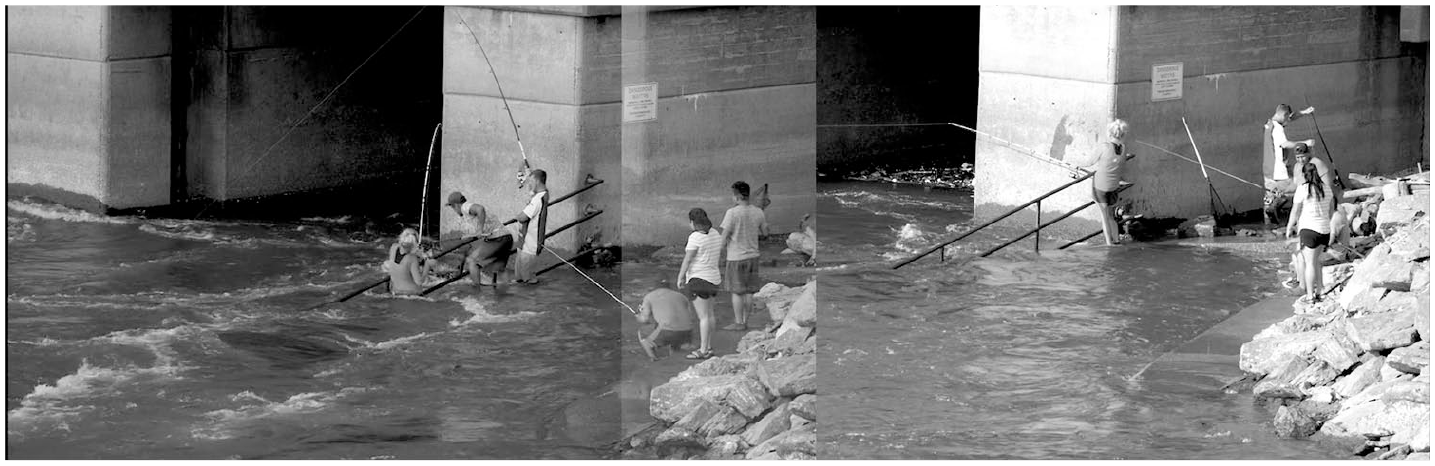
Video still, Born Secret (2019).
In our time, ignorance is no longer enforced by security clearances, loyalty oaths, and FBI investigations. Instead it is imposed by the seductive noise of personally targeted but fundamentally meaningless media messages. The waking dream of the entertainment world is that anything is possible, that power has no consequences. And the result of ignoring your own society’s Mephistopholean power is a simple refusal to plan anything, to advocate for anything, while the planning continues right here and now, the orders are given and obeyed, and the world is transformed. Acquiescence to the dictates of the Anthropocene mode of production is the underlying formula of the new authoritarianism, with its nostalgia for the American greatness of the 1950s. We believe that a radically critical inquiry into all aspects of this mode of production is necessary, overdue, and urgent, in order to influence the changes that are already taking place.
There is much to learn, but you can start by just opening your own eyes and tracing out the patterns inscribed in your own local landscape, wherever you live on the face of the earth. The activity of this “field guide” is yours to take away.
Footnotes
Declaration of conflicting interests
The author(s) declared no potential conflicts of interest with respect to the research, authorship, and/or publication of this article.
Funding
The author(s) received no financial support for the research, authorship, and/or publication of this article.
