




Abstract
Since the late 1970s, over 140 global environmental assessments (GEAs) have been completed. But are they any longer fit for purpose? Some believe not. Compelling arguments have been advanced for a new assessment paradigm, one more focussed on problem-solving than problem-identification. If translated into new assessment practices, this envisaged paradigm could prevail for the next several decades, just as the current one has since the late 1970s. In this paper, it is contended that the arguments for GEAs 2.0 are, in fact, insufficiently bold. Solutions-orientated assessments, often associated with a ‘policy turn’ by their advocates, are undoubtedly necessary. But without a ‘politics turn’ they will be profoundly insufficient: policy options would be detached from the diverse socio-economic explanations and ‘deep hermeneutics’ of value that ultimately give them meaning, especially given the very high stakes now attached to managing human impacts on a fast-changing planet. Here we make the case for GEAs 3.0, where two paradigmatic steps forward are taken at once rather than just one. The second step involves the introduction of political reasoning and structured normative debate about existential alternatives, a pre-requisite to strategic decision-making and its operational expression. Possible objections to this second step are addressed and rebutted. Even so, the case for politically-overt GEAs faces formidable difficulties of implementation. However, we consider these challenges less a sign of our undue idealism and more an indication of the urgent need to mitigate, if not overcome them. In a world of ‘wicked problems’ we need ‘wicked assessments’ adequate to them, preparatory to so-called ‘clumsy solutions’. This paper is intended to inspire more far-reaching debate about the future of GEAs and, by implication, about the roles social science and the humanities might usefully play in addressing global environmental change.
Keywords
Introduction
This paper proposes a fundamental change to the means and ends of global environmental assessments (GEAs). It does so at a time when their format and purpose is being constructively questioned by some. GEAs are an established feature of the interface between the domains of science, government and society. They present cutting-edge knowledge about one or other aspect of the world’s spatially varied yet tele-connected physical geography, as it affects and is influenced by human action. When the OECD commissioned the first one over forty years ago (the 1977 assessment of Long Range Transport of Air Pollutants – LRTAP, for short), few would have anticipated how numerous and prominent assessments would become. There have been over 140 so far, with more in the pipeline (notably the sixth assessment report of the Intergovernmental Panel on Climate Change [IPCC], at the time of writing). Their proliferation reflects the escalating scale, scope and magnitude of people’s impacts on the Earth.
While the details matter – different GEAs are most certainly not derived from an original blue-print created in the 1970s – the majority of assessments have a family resemblance. The most recent ones may share somewhat less metaphorical DNA with their older siblings but, even so, a particular conceptual frame has served to define the means and ends of GEAs for more than 40 years. This frame conceives of GEAs as a bridge between two worlds. On the one side, there is the world of experts who, operating in various geoscientific disciplines (for the most part), seek to understand a planet undergoing anthropogenic forcing. These experts represent these biophysical realities to non-experts who occupy the worlds of politics, commerce and civil society. They do so guided by epistemic values such as truth, logical consistency and integrity. The non-experts, most especially those in government, then determine whether and how to act on the implications of these realities. So it is that GEAs link cognition and action, knowledge and values, is and ought, yet without collapsing the distinctions between them. They seek to inform, but not determine the nature of, various debates and actions designed to tackle the environmental problems and challenges that GEAs identify. The IPCC’s aim to be ‘policy relevant but policy neutral’ captures this delicate balance of separation and connection well.
For reasons to be explained in this paper, the current GEA ‘paradigm’ is seen as no longer fit for purpose by several well-informed commentators (e.g. Hallegatte et al., 2016). The mechanisms and goals of GEAs, it is argued, must evolve to suit the demands of a context that is significantly different from the one that shaped the conceptual frame just described. The most detailed proposals for GEAs 2.0 have come from Martin Kowarsch and various co-authors. 1 They suggest that a three-fold turn towards ‘problem-solutions’, ‘stakeholder engagement’ and ‘policy-advice’ is both necessary and timely. Importantly, GEAs 2.0 will allow the expert community to address evaluative questions, such as ‘who should act, why, when and how?’ rather than just scientific questions regarding cause, effect, risk, socio-environmental possibilities and future probabilities.
However, we will suggest that this proposed turn – already evident in some GEAs (such as recent IPCC periodic and special assessments) – is insufficient. The critique of GEAs 1.0, though valid, needs to go further. To date, it entails an infeasible and unwelcome bracketing of political worldviews (that are deeply evaluative of the present) and associated socio-economic frameworks of description and explanation. The wider context, we maintain, requires an explicit consideration of them in future assessment processes and outcomes. These worldviews and frameworks are value-based ‘packages’ of axioms, categories, reasons, justifications and criticisms that, using evidence, address the venerable question ‘how should we live?’. Philosophers sometimes call them ‘comprehensive doctrines’ that marry cognitive and normative issues together in distinctive ways that are more or less coherent. An example familiar to many readers is Catholicism, the religious faith that animated the arguments of the Papal encyclical (Laudato si) of 2015. Political worldviews and associated explanatory frameworks give explicit and considered meaning to the menu of problems and possible solutions that Kowarsch and others envisage in their arguments for a new assessment paradigm.
Future GEAs, as we conceive them, could not only highlight a wide spectrum of these worldviews and frameworks on the global stage. They could also do so in a way that facilitates a reasoned defence of, and dialogue between, the ‘best’ versions of each of them. Environmental social science and humanities (hereafter ESSH 2 ) will have a key role to play in GEAs 3.0, more than in recent arguments for GEA reform. They can help to represent, in a sophisticated yet public fashion, various hegemonic and minority worldviews. They can thereby situate the knowledge produced by the geosciences, and that pertaining to the proposed ‘solution-stakeholder-policy turn’ (GEAs 2.0), in the ‘deep hermeneutics’ necessary for them to make proper sense. If future GEAs are to help humanity navigate through a very challenging post-Holocene future, they must take two steps forward not just one. A new assessment paradigm, we will show, should include but go beyond the timely proposals of Kowarsch and fellow-travellers if it’s to truly respond to the ‘wicked’ realities of our future Earth. GEAs will still act as bridges, but in ways very different to the present. They could thereby, however modestly, affect the context that helps to justify their character and very existence.
The paper has six main parts and is structured as follows. First, we offer a brief history of GEAs and then seek to characterise the key elements of the current paradigm in both an intellectual and practical sense. Secondly, in the paper’s longest section, we consider recent calls for a paradigm shift, focussing particularly on the most elaborate and well justified ones. Third, we evaluate these otherwise welcome proposals for change and identify key ingredients that are missing. Fourth, we then make a positive case for GEAs 3.0, one that is fully responsive to the context that gives assessments their meaning. Fifth, the case complete, we summarise the character and goals of ‘political assessments’, while clarifying some key points. We follow with some suggestions about future work programmes and some reflections on the difficulties of operationalising any new paradigm, while refuting any charge that this paper is an exercise in fruitless idealism. At the least, we hope the argument presented here incites a wider and more searching debate about the future of GEAs.
Global environmental assessments: The story so far
A brief history of GEAs
GEAs are ‘large-scale, highly deliberative processes where experts are convened to distil, synthesise, interpret and organise existing scientific knowledge (on environmental issues) to inform decision-making’ (Jabbour and Flachsland, 2017: 193). As noted in the introduction, dozens have been completed, others are currently underway and many more are planned in the future. In short, GEAs are here to stay: there is an ongoing need and demand for them.
This is not the place to recount their history in fine detail (see Appendix 1 for a complete list of GEAs since 1977). It is sufficient here to highlight the following. In the decade after the LRTAP, there was an initial trickle of GEAs. However, after 1987 – the year the Bruntland Commission’s Our Common Future was published – the trickle became a steady stream: every 12 months thereafter at least one GEA was completed, while others were initiated. This increase in GEA frequency arguably resulted from three things. First, already identified transnational environmental problems – such as ozone layer depletion – required ongoing monitoring, while the effectiveness of new accords such as the Montreal Protocol needed to be assessed periodically. Secondly, geoscientists across a range of disciplines adduced ever more evidence that human activities were significantly impacting upon the hydrosphere, biosphere, atmosphere, pedosphere and cryosphere. In part, this was because of significant improvements in Earth observation systems in the 1980s and 1990s. What is more, these researchers began to coordinate their inquiries internationally via new platforms, such as the International Geosphere-Biosphere Program (1987–2015). Third, there was a growing awareness that formal mechanisms were required to allow geoscientists to collectively report their research findings to governments and citizens. Without such mechanisms, it was difficult to bridge the gap between universities (where most geoscientists worked) and the wider society. The United Nations Earth Summit, in 1992, spurred further transnational political action which depended on a supply of systematised scientific information about a changing planet.
Track forward to the present. About 44 years after the LRTAP, we have a situation where most GEAs are recurrent, most are sponsored by intergovernmental bodies or programmes of various kinds (often via the United Nations), most are in some way linked to multilateral agreements and goals, and many are products of a bespoke boundary organisation (e.g. the Intergovernmental Platform on Biodiversity and Ecosystem Services [IPBES 3 ], launched in 2012). Over half of all GEAs have been commissioned or completed in the last decade. This fact attests to a sharp increase in both supply and demand (to use an economic metaphor). Geoscientists now continuously have important research findings to share about ‘the Earth System’, including regional level changes to it. Many feel a keen responsibility to communicate their research beyond academia – particularly if it has serious economic, public health and other implications. Many of these implications are now being formally assessed by social scientists, as is evident in Working Group III of the IPCC. Meanwhile, many governments recognise the very high stakes of failing to know about, or not acting to ameliorate, large-scale environmental problems resulting from human action. Increasingly, these governments hail from the poorer parts of the world that are, or will be, worst affected by these problems.
Key characteristics of GEAs 1.0
What key characteristics do otherwise different GEAs share? Here (i) we reflect on our own analysis of a sample of GEAs 4 going back some years and (ii) we gloss from the most systematic examination of GEAs ever conducted (via the Mercator Institute in Berlin: Kowarsch et al. 2014) and from papers assembled in a special issue of the journal Environmental Science & Policy (2017, issue 2) devoted to taking stock of GEAs. There are eight things to say.
First, assessments are second-order activities in an epistemic sense. Essentially, they survey the independently produced first-order knowledge-base across multiple disciplines. There’s some global oversight to that base, courtesy of the research and innovation platform Future Earth (launched in 2015; prior to it the Earth System Science Partnership [2002–2012] was in place) – but most of it is steered in other ways for other reasons. Second, in tone if not always in content, assessments have so far largely been ‘scientific’. This means that they are based primarily on geoscientific publications or, where social scientific research is assessed too, the language is studiously non-political in the main. This is evident in IPCC Working Group III reports, where ‘human dimensions’ like energy systems and consumption patterns are discussed in cool, analytical prose. This reflects the particular kind of social science used to underpin discussion of these dimensions (e.g. economics). More fundamentally, it reflects a desire to deliver ostensibly ‘objective’ or ‘impartial’ insights about the present and about possible futures. Third, assessments are increasingly large and complex. Thousands of research publications are usually surveyed, with peer review serving as quality control. GEAs involve very extensive reading and synthesis so as to present the proverbial ‘state-of-the-art’. For instance, the 2017 IPBES special assessment of pollinators is 800 pages long. Its bibliography is simply immense and ranges far beyond agro-ecology. Likewise, the 2019 assessment produced under the auspices of the UN Office for Disaster Risk Reduction is a 500 page document with a 17 page, single-spaced reference list. Yet even these pale in comparison with the IPCC’s multi-volume climate assessments produced by its three working groups.
Fourthly, GEAs are typically very time-consuming to complete. They often involve hundreds, even thousands of experts – consultants, contributing authors, coordinating authors, lead authors, external reviewers, and so on. By contrast, the 1977 LRTAP involved just 80 people, at the time a large number. Fifth, GEAs are also typically expensive – IPBES’s current budget is around 8 million USD per annum, and has cost an estimated 31 million USD so far (this figure does not, to our knowledge, include salary and overheads for most of the unpaid work of many university academics). Sixth, GEAs also have more-or-else elaborate procedures to ensure that the most appropriate research is surveyed, that the ‘right’ experts are being used, and that they behave professionally. The importance of all this was revealed in the so-called ‘climategate’ scandal that engulfed the IPCC in 2009 to 2010: suggestions of impropriety and lack of sufficient rigour damaged the Panel’s reputation in many quarters (even though those accused of misconduct were largely cleared by several inquiry panels).
Seventh, GEAs are founded on expert consensus about what the first-order knowledge base is telling us. Where uncertainties or disagreements in the knowledge base exist, assessors deliberate in order to arrive at an agreed position. Minority reports are not permitted and assessments read as cohesive documents. Finally, even where GEAs involve direct discussion of policy and normative issues (as they increasingly do – see the next section), they avoid ‘crossing the line’ and advocating or prescribing courses of future action to tackle problems of people and planet. This is reflected in the way GEAs are communicated to governments and others. The messaging of reports is scrutinised carefully, as with the line-by-line summaries for policy makers of the IPCC. Nothing, really, is left to chance. Messaging via carefully worded digests, press releases and the like is the key way assessors send traffic over the metaphorical bridge connecting them to governments and society. To-date, most assessment teams have been very determined not to be perceived as making value-based or value-loaded statements of their own.
To summarise, GEAs have become highly elaborate undertakings. Whatever the GEA in question, the assessment processes and outcomes are impressive by any standards. GEAs are arguably the most systematic and rigorous mechanism that we have at the science-government-society interface. They yield high quality outcomes in an epistemic sense (i.e. detailed reports of analytical sophistication). But are they any longer fit for purpose? Some think not, and for good reason.
Global environmental assessments 2.0: The search for solutions to pressing anthropogenic problems
Changing GEAs in a changing context
A number of well-informed observers and participants have argued that GEAs need to change (e.g. Kowarsch et al., 2017). We will come to the proposed alterations presently. Indeed, change is already afoot in several recent assessments (e.g. those by the IPBES) by virtue of pressures emanating from their operating environment. These pressures point to a gap between what GEAs typically deliver and what is now required from the expert communities tasked with undertaking them. What is the nature of this gap? Where the existing GEA paradigm is founded on problem-identification and tracking, there is a fast-growing demand for information and proposals pertaining to (i) ameliorating problems and (ii) mitigating their impact on people and the environment. The demand arises for at least three powerful reasons.
Firstly, during the four decades when GEAs have grown in number and frequency, the environmental challenges they identify have multiplied in complexity, scale, scope and intensity. Humans, albeit unevenly across the globe, are transforming the planetary environment so much that many geoscientists believe Earth System change is on the horizon, not ‘merely’ worldwide perturbations within Holocene boundary conditions (Lenton et al., 2019). Indeed, the ‘anthroposphere’ is now seen as part of this evolving Earth System (Lade et al., 2019). Secondly, this state of affairs has arisen despite the messages contained in numerous GEAs. The critic Naomi Klein (2015) famously declared that ‘this changes everything’ – ‘this’ being the geoscientific evidence whose troubling implications should, she believes, be acted on decisively by world leaders. Yet the evidence – sifted, sorted and synthesised in numerous GEAs – has so far been insufficient to change much at all in the arenas of government, business and civil society. There are missing links in knowledge-action, is-ought chains: this is why economist Nicholas Stern (2015) dolefully asks Why Are We Waiting? in his book about anthropogenic climate change. While geoscience does not mandate specific responses, it does suggest some sort of serious response is required. Thirdly, though, political action is not entirely absent. The world’s governments have agreed to various goals designed to reduce the human impact on the biosphere, atmosphere, hydrosphere, cryosphere and pedosphere. Indeed, the environment is, after trade, now the second most common area of international rule-making and target-setting. Accordingly, some GEAs are already moving in lock-step with things like the Paris Accord by (i) providing evidence on whether nations are fulfilling their declared commitments and by (ii) projecting future socio-ecological scenarios relating to weak, moderate and high policy success.
To summarise, in light of the demands of a world much changed since 1977, ‘the GEA enterprise now finds itself at a crossroads’ (Jabbour and Flachsland, 2017: 194). As the introduction to a recent journal collection about GEAs puts it, ‘. . . contemporary assessments have been undergoing a transformational shift . . . towards . . . analysing the suitability of specific response options and policy pathways that range from technologies and behavioural changes to . . . regulatory measures and market-based instruments’ (Kowarsch and Jabbour, 2017: 188). Beck and Mahony (2018: 1) see the IPCC as being at the forefront of this. ‘We are arguably of the cusp’, they observe, ‘of a fundamental realignment of . . . climate science and policy, crystallising the move from . . . science as herald of societal problems …. to a “solution- and future-orientated” regulatory science’. Indeed, current IPCC chair, Hoesung Lee, has explicitly called for such a realignment. Meanwhile, a number of commentators have lamented the relative lack of decision-support knowledge in IPBES’s first global assessment published in 2019 (e.g. Stokstad, 2019). The report’s largely grim message about humanity’s assault on the living world is not – despite the Panel’s remit – matched by a menu of detailed proposals for halting the assault. Such a menu is much-needed in the eyes of some.
Several commentators have made broad normative claims about the future direction of travel for GEAs (e.g. Beck et al., 2014; Carraro, et al., 2015; Hallegatte and Mach 2016; Hulme, 2016; Hulme et al., 2010). However, few have yet to provide a developed template that might lend a foundational shift broad cohesion within various existing GEAs or new ones in the future. 5 By far the most detailed proposals for change have appeared in a major report about GEAs, produced under UNEP auspices (Kowarsch et al., 2014), and a set of journal papers authored by a mixture of analysts (Edenhofer and Kowarsch, 2015; Kowarsch et al., 2016, 2017 [the second and third also present Supplementary Online Information]). Kowarsch is a constant and significant intellectual presence in these publications. 6 He heads a working group at the Mercator Research Institute on the Global Commons and Climate Change (MCC) in Berlin. With his collaborators, he has stood back from the finer details of current assessments and sought to devise a new model for future GEAs. However, only by reading several publications and joining the dots between them is the logic and content of this model fully revealed. While the 150-page Future of Global Environmental Assessment Making (FOGEAM) report of 2014 presents much of the case for change, the three papers cited above offer a more complete yet usefully succinct account. In addition, they focus primarily on the rationale for change, and less on the specifics of delivering it, practically-speaking. Consistent with the aims of this paper, we therefore focus on the articles here (though strongly recommend that interested readers read them in conjunction with the FOGEAM document).
A broader rationale for GEAs 2.0: Beyond ‘usefulness’
Unlike several other calls for more decision-relevant GEAs, Kowarsch et al. (2016) look beyond the three conventional justificatory reasons cited in the previous sub-section. In their paper ‘Scientific assessments to facilitate deliberative policy learning’, they point to another key aspect of the context that GEAs can, and should now, respond to. As they see it, the large spatio-temporal scale, magnitude and sheer complexity of humanity’s impacts on the Earth require wide and substantive consultation and deliberation about potential actions to reduce those impacts. The impacts are pervasive and hard to manage to everyone’s satisfaction (including unborn generations). In other words, GEAs must do more than serve the immediate policy requirements of incumbent governments worldwide. They must also go beyond synthesising knowledge produced by certified experts and open themselves up both epistemically and normatively.
Kowarsch et al. offer three important reasons why satisfying this inclusive, democratic requirement matters. First, contemporary governments, often tied to short electoral cycles, cannot adequately represent the world’s peoples and nor, conversely, can aggregated voter preferences serve as an adequate proxy for reasoned debate about what policies people want. Given the uncertainties attached to the eventual impacts of any major policy changes among nations, full consultation about, and wide ‘ownership’ of, policy shifts is essential. All affected people have a right to be heard. Second, consultation is likely to lead to mutual learning about feasible and desirable solutions (be they stratospheric aerosol injection, prohibitions on coal mining, large government subsidies for biofuel plantations, fostering new consumption habits, etc.). The learning pertains to both knowledge (‘know what’ and ‘know how’, which are multifarious and not the preserve of certified experts) and people’s diverse values (what matters to them today and tomorrow). More effective government, business and citizen actions may then emerge out of an extended learning process. Third, future actions to tackle global environmental change, especially if they are contentious in the eyes of many citizens or countries, will be more acceptable if their advocates are obliged to give public reasons in order to justify them.
We can summarise these three rationales for multi-stakeholder, action-focussed GEAs as pertaining to consequentiality and rights, to optimal solutions and to legitimacy. Note that even though many countries are autocracies, the democratic argument of Kowarsch et al. necessarily holds globally. This is because even autocracies, and many of their disenfranchised citizens, would expect to be consulted about the potential actions of other countries if those actions were likely to have a tangible transnational effect on the physical environment.
A vision for GEAs 2.0
Unlike in GEAs 1.0, Kowarsch et al. thus locate a democratic imperative at the heart of future GEAs, as well as a collective learning one useful for action. This goes well beyond the ‘truth to power’ imperative that has animated most assessments since 1977. But how would future GEAs actualise this new imperative? Here we turn to programmatic papers in Nature Climate Change (Kowarsch et al., 2017) and Environmental Science & Policy (Edenhofer and Kowarsch, 2015). In both, proposals for GEAs as ‘cartographers of the solution-space’ are presented. The former article is entitled ‘A road map for global environmental assessments’. The authors identify a trio of profound challenges that solution-oriented GEAs must address. The first is the multi-dimensional effects of any policies designed to achieve present or future politically-determined goals (such as keeping global mean atmospheric temperature well below 2°C warming by 2100). As Kowarsch et al. put it, ‘Decision makers are lacking sufficient knowledge about the direct effects, co-benefits and adverse unintended consequences of . . . policies across various dimensions, including multiple policy fields, governance levels, socioeconomic contexts and time scales’ (2017: 379; see also Hallegatte et al. 2016). Much of this necessary but missing knowledge would, they note, hail from the ESSH. 7
The second challenge for future GEAs is ‘accommodating divergent normative viewpoints’ (Kowarsch et al., 2017: 380). Normative viewpoints are value-based judgements about how the world is and how it should be in the future. Kowarsch et al. recognise that, like any issue, the question of global environmental change (and its regional and local forms) is not answerable by facts alone. This is because majority and minority values – culturally created, instituted and expressed (e.g. via commodity exchanges) – differentially condition what facts are seen to matter and how. They also condition how the ‘problem’ of global change is perceived and what ‘solutions’ seem reasonable, affordable, effective, moral, fair or risky. In their Nature Climate Change ‘road map’, Kowarsch et al. envisage future GEAs comparing and contrasting value-based perspectives on different policy pathways and packages (Kowarsch et al., 2017: 380–381). If undertaken honestly, rigorously and even-handedly, the authors believe this process will avoid powerful social interest groups promoting narrow policy options via assessments (aka ‘stealth advocacy’), while also circumventing the sort of unhelpful polarisation all too often found in policy debates today.
The third and final challenge for future GEAs, as Kowarsch et al. see it, is to reach far and wide in the process of stakeholder engagement, targeting new groups (e.g. the Cities Climate Leadership Group, indigenous peoples’ organisations or the World Business Council for Sustainable Development) and enabling meaningful exchange. By going well beyond government officials and departments, the aim is to indirectly influence policy decisions by first directly enriching policy discourse through a fulsome engagement with diverse actors and constituencies. 8 This discourse would have descriptive, explanatory and evaluative elements, contain evidence and argument, but be irreducible to consensus position on ‘the right solutions’. GEAs 2.0 would catalyse dialogue and learning between stakeholders who may be politically opposed, while allowing social scientists and humanists to learn from all those affected by global environmental change. In turn, these lessons would open-up technical and research possibilities for geoscientists as they consider what measures and evidence best suit an array of policy options. There would thus, via GEAs, be a feedback loop between experts and a plethora of actors outside the formal political sphere, as well as within it.
Characterising the new paradigm: The pragmatic-enlightened model
In sum, Kowarsch et al. propose a major change to both the process and outcomes of GEAs. Let us consider, finally, how the proposals might be codified or expressed paradigmatically. In their paper ‘Cartography of pathways’, Edenhofer and Kowarsch (2015) helpfully characterise them as the ‘pragmatic-enlightened model’ (PEM) of assessment. 9 Inspired by American philosophers John Dewey (1859–1952) and Hilary Putnam (1926–2016), the model centres on the interdependencies between policy objectives, means and consequences; and it provides a structured approach to exploring the ‘is’ and ‘ought’ dimensions of these interdependencies. In other words, it formalises the three aspects of the argument made in the Nature Climate Change paper, as follows: (i) Policy goals, which are value-based and informed by evidence of what is actual and possible, may require means that are problematic on economic, moral or other grounds; even those means that, after due consideration, are deemed by many as legitimate or necessary may in time yield consequences that not only call their suitability into question but may give serious pause for thought about intended policy goals; (ii) In the case of goals, means and ends there will be numerous legitimate perspectives on their validity or appropriateness in any given case because values vary culturally and geographically (e.g., the meaning of elemental evaluative terms like ‘efficiency’ or ‘fairness’ are deeply conditioned by values and norms which, in turn, affects what evidence is indicative of policy success); (iii) Achieving a full understanding of the cognitive and normative aspects of goals, means and consequences requires iterative consultation with a range of interested and affected constituencies who may alter their views in light of experience, evidence and debate. Following Dewey (1986: 105–122), Edenhofer and Kowarsch (2015: 58) propose a generic five-stage process of interactive learning about goals-means-outcomes for any given problem at whatever scale. The process is represented, in simple terms, in Figure 1. Following Putnam (2004), they maintain that facts and values are necessarily related, albeit not reducible to each other.
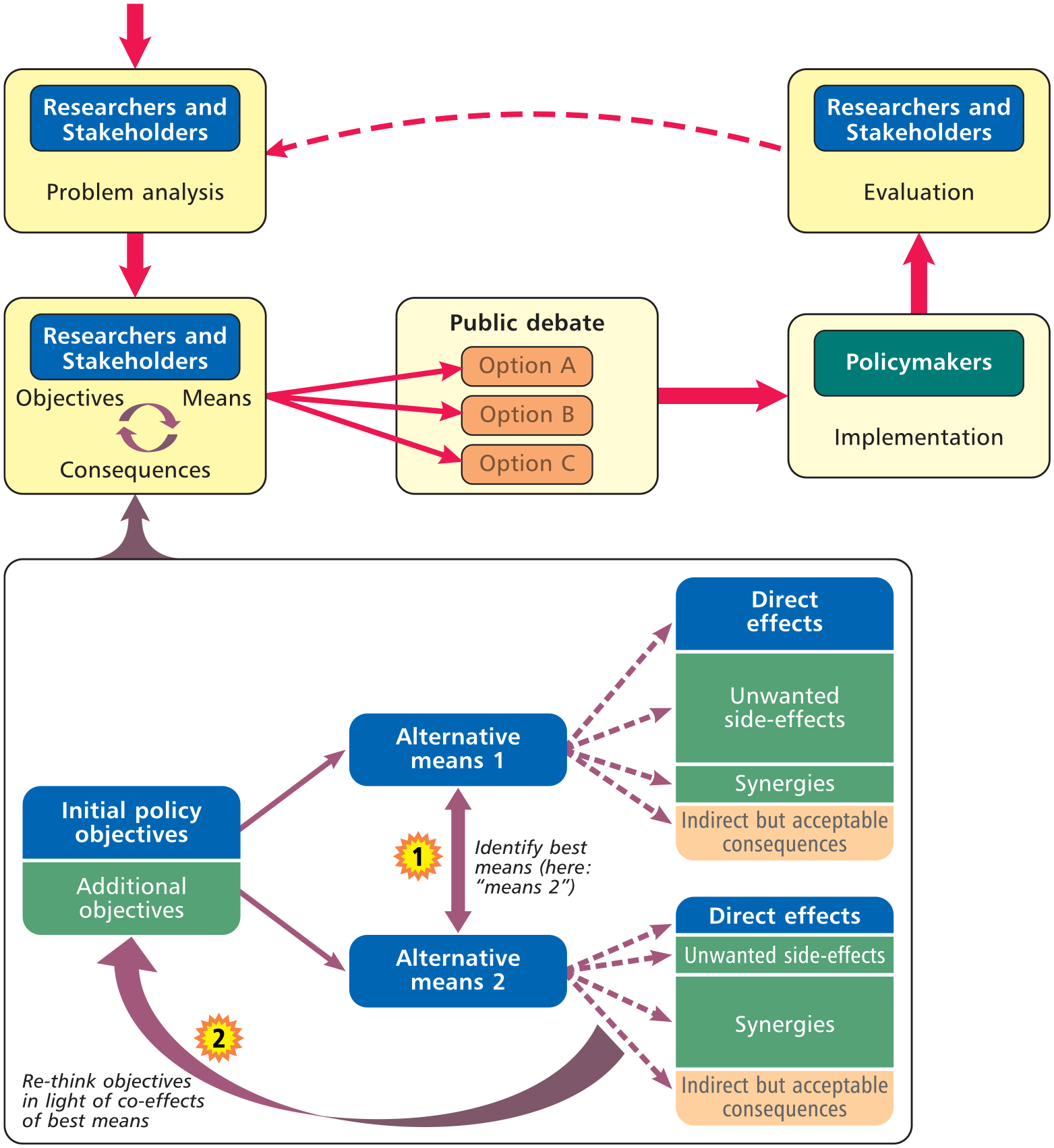
Solutions-oriented global environmental assessments, after Edenhofer and Kowarsch (2015). An evaluation of means-end-consequences links of possible solution pathways is undertaken by assessors, in dialogue with stakeholders and with a view to influencing the wider policy discourse about how to respond to global environmental change. The bottom box enlarges the one to which it points above.
To illustrate the model, Edenhofer and Kowarsch take the hypothetical case of a major global turn to biofuels as an alternative to fossil fuels (2015: 59). The question is: should this turn occur and, if so, precisely where, when and to what extent? One knock-on effect of this energy and climate policy concerns food security because biofuels require productive land (it thus becomes an ‘agricultural issue’, indirectly); loss of land to biofuels incites normative disputes because of diverse valuations of forest, farm land, and ‘wild nature’ (e.g. will biofuel forests be sufficiently biodiverse?); to understand these valuations and whether food security, biodiversity goals and biofuel expansion can be reconciled, very wide stakeholder engagement is necessary to yield information, argument and sentiment about the kaleidoscopic objectives-means-consequences entanglements in question; the fruits of this engagement may then rebound on those involved, changing their values and feelings about the biofuels issue. All this would have to be multi-scalar in both analytical and process terms. For instance, key regions whose mis/management has global affects – such as the Amazon Basin – would need to be properly included. Indeed, the world’s increasingly polycentric, multi-level and fragmented governance architecture needs somehow to be accounted for in ostensibly ‘global’ assessments that explore solutions like biofuels.
In this exceedingly complex, and potentially fraught, ‘solution space’, Edenhofer and Kowarsch see the research community – spanning STEM, social science and the humanities – playing a pivotal role. The community can avoid being prescriptive yet make GEAs deeply relevant to action, as well as democratically inclusive. GEAs become ‘cartographic’ in a broad action-guiding sense, leaving authorised decision makers to ‘navigate’ the complexities and uncertainties of the multidimensional solution landscape. They would helpfully react back on the research base, inspiring more first-order inquiry into policy options, methods of stakeholder engagement, and so on.
Is radical reform sufficient without fundamental change? The short-circuiting of socio-economic analysis and politics in arguments for GEAs 2.0
From 1.0 to 2.0: Differences, continuities and strengths
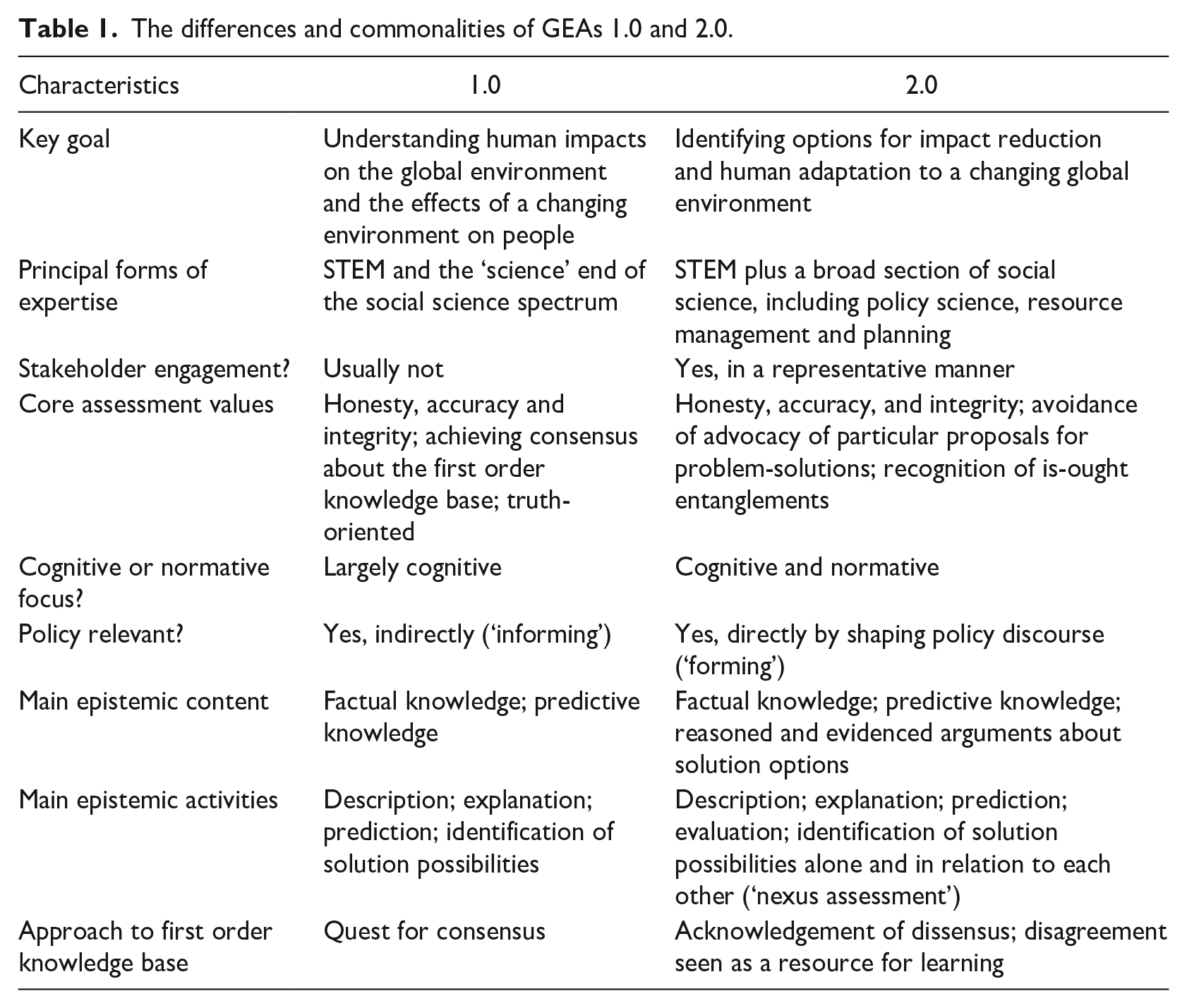
Clearly, the proposals for GEAs 2.0 are far reaching. They aim to significantly reformat GEAs. But this is nothing less than the context in which they will operate demands. Unlike, GEAs 1.0, their proposed successors would broach normative questions explicitly, would not require consensus statements about the first-order knowledge base, would draw-in broader social science and the humanities (well beyond disciplines like economics), would recognise that ‘environmental’ issues are entangled with non-environmental ones, 10 would be wide-open to non-academic actors (not only to governments), would introduce arguments and justifications (giving them parity of esteem with factual knowledge), and would seek to build understanding of solutions that might be deemed necessary, possible or desirable. Yet assessment 2.0 would retain some key elements of the current paradigm. One is the relative independence of assessors, working as most do in universities where academic freedom remains a core principle of professional practice across the disciplines. Another is the valorisation of integrity, rigour and ‘objectivity’ as assessors go about their work. Through this overall mixture of change and continuity (see Table 1), assessment 2.0 would be akin to what Pielke (2007), in his highly cited book about the science-policy interface, calls ‘honest brokering’ of alternative courses of possible action. GEAs would not so much speak ‘truth to power’ as identify actionable options from, by and for society at large.
The differences and commonalities of GEAs 1.0 and 2.0.
Operating thus, GEAs 2.0 could be a force for good in the world. Yet some would no doubt oppose the arguments of Kowarsch and colleagues on principle – for instance, on the grounds that ‘experts’ are not supposed to shape policy and practice. Meanwhile, those who are highly supportive (like ourselves) cannot afford to be naïve. Translating the proposals for GEAs 2.0 into practice will be exceedingly challenging. On the one hand, there are issues of both resourcing and organising solution-oriented GEAs. With far more actors involved, the monetary and time costs will sky-rocket; with a far larger body of information (and now argument) to master, enlarged assessment teams spanning academia’s ‘three cultures’ (Kagan, 2009) will have their work cut-out to perform their designated role. On the other hand, by entering the terrain of problem-solutions in general, and policy options specifically, future GEAs could become lightning-rods for polarisation between nations, economic interest groups and identity- or belief-based constituencies. Far from fostering debate and being seen as democratically inclusive, GEAs 2.0 could be accused by some of bias or exclusion at the level of both process (whose published works are surveyed, which stakeholder voices are heard?) and outcome (are some solutions left out of reports and, if so, why?).
In addition, we have the benefit of past experience. The International Assessment of Agricultural Knowledge, Science and Technology for Development (IAASTD) ran from 2003 to 2008, with its several reports appearing in 2009. It was atypical of GEAs 1.0 and foreshadowed by a decade the arguments of Kowarsch and others. It directly broached policy questions, engaged normative debates about ‘development’, and involved wide stakeholder engagement. As detailed post hoc analyses have revealed (Feldman and Biggs, 2012; Scoones, 2009), there was considerable disagreement within the assessment team, and between it and the sponsors of the IAAST (such as the World Bank). Indeed, the reports seem to have been ignored by many sponsors, despite it costing over US15$ to complete them. This is because the Assessment’s attempts to open up thinking about the future of agriculture challenged prevailing wisdom in capitalist countries such as America. For instance, the commercial interests of large agro-foods corporations were challenged by the ideas of some assessors and stakeholders.
Yet, while it is very important to acknowledge the formidable difficulties of translating the proposals discussed above into assessments that are effective, we want to suggest that the vision for GEAs 2.0 does not, in fact, go far enough. Whether arguing for more radical change makes us hopeless idealists, even fantasists, is a question we address near the end of this paper. For now, let us explore the crucial absences in the arguments of Kowarsch et al. One is analytical, the other evaluative. They amount to the proverbial elephants in the room or, to use yet another metaphor, the subterranean geology beneath the ‘map of the solution space’ that GEAs 2.0 are intended to plot.
Beyond 2.0: What are the missing ‘human dimensions’?
Global environmental change is, as Kowarsch et al. rightly recognise, a social as much as a biophysical phenomenon. Humans are (i) the drivers of, (ii) involuntarily affected by, (iii) can adapt to and also (iv) consciously alter the future trajectory of Earth system change, with huge implications for our descendants. But these four social dimensions, which link understanding with action, are themselves multidimensional in ways that arguments for GEAS 2.0 do not, despite appearances, adequately grasp. Let us explain.
Cognitively, social scientists and humanists, as well as social actors themselves, ‘frame’ the social in a plethora of ways. This cognitive diversity is not a way-station towards grasping some objective truth about important things such as social relationships, social institutions and social power. Instead, it is reflection of legitimate discord about how social reality is and should be constituted. For instance, Marxists and radical feminists differ from neoliberal economists in a number of key analytical respects, who in turn differ from aboriginal Australians’ worldviews. 11 Basic units of social life (e.g. the individual, a business or the nation-state) are perceived differently, as are their capacities and relations with each other. Likewise, the levers of social change are understood in varied ways (e.g. legal, monetary, informational, cultural, military levers and so on). The long-standing analytical heterodoxy evident in the wider social sciences and the humanities is testament to the perceived 3-D character of society, and is mirrored within society itself. In this context, those who insist it is possible to represent society ‘scientifically’ are (un)wittingly engaged in a power-play, one intended to marginalise diverse framings of social life. There is no neutral court of empirical appeal that can adjudicate whose understanding of the social world is ‘correct’. Evidence is both open to interpretation and, to an extent, relative to the analytical approaches in question. That is, there is no one ontology or epistemology to which we should all adhere, somehow dictated by ‘reality’. If there were, it would presumably have left its universal imprint on us some time ago.
If society has long been, and is still, described and explained in ways that are irreducibly plural, then this has significant normative implications. Arguments about how the world should be, and about the best way to realise future goals, are groundless without reference to different theories, models and empirical analyses of social life. While values may guide our normative objectives, and be defensible and worthy ones, without a substantive understanding of social life we will be unable to grasp what is normatively possible or necessary. ‘Problems’ do not, in effect, exist absent such an understanding – for instance, where some regard human impact on the Earth as a ‘crisis’ (e.g. Crist, 2018) and see humanity facing grave risks (Ord, 2020), others do not see the world thus or else do so in a very different way (e.g. Stern, 2015). And since substantive understandings can seek to encompass the totality of social life – its institutions, norms, power relationships and so on – this means that normative arguments and targets are mis-described when labelled as putative ‘solutions’. This term diminishes them. Instead, they can and should speak to one of the most important political questions, namely: ‘how should we live?’. Certainly, humanity’s apparent capacity to influence the whole Earth System has put that existential question on the agenda with real urgency (Hamilton, 2017). To be sure, answers to it have crucial practical and policy dimensions – for instance, pertaining to the very architecture of political decision-making as much as to policy instruments and objectives. But they also have intellectual and affective dimensions of the sort conveyed in Pope Francis’s weighty 2015 encyclical about climate change. As sociologists Brulle and Antonio phrase it, with some accuracy,
“addressing [global environmental] . . . change involves engagement of fundamentally different visions of the good life and, consequently, entail political decisions in choosing different trajectories for our collective future” (2015: 901).
Currently, Swedish school girl Greta Thunberg is perhaps the most globally visible person prompting us to ask big questions about these visions, decisions and trajectories. That it’s fallen to a teenager to do so is an unhappy sign of our times .
In both a cognitive and normative sense, then, there’s an important difference between a ‘shallow’ and monistic versus a ‘deep’ and pluralistic appreciation of social life and its relation to the material world (Escobar, 2020). Notwithstanding their merits, Kowarsch et al.’s proposals for GEAs 2.0 are predicated on something nearer to the former than the latter. There is a missing bedrock of analysis and evaluative argument that supports any attempt to ‘navigate the solution’ space. It must, we believe, be exposed and explored. GEAs 3.0, we will now argue, can undertake the mining and mapping of this strong but tectonically fractured foundation whose strata vary greatly in thickness, exposure and composition.
Completing the case for GEAs 3.0
We have suggested that GEAs 2.0 need to go further in an analytical and evaluative sense. Arguments for them should set any even-handed (or, if you prefer, open minded) search for solutions in larger frameworks of understanding. Aside from endorsing Kowarsch et al.’s rationale for GEAs 2.0, which applies equally well to GEAs 3.0, we have identified an additional one above. In response to the environmental challenges facing us we believe there’s a good chance, to quote Hackmann et al. (2014: 654, emphasis added), that ‘society will have to deliberately seek out, or be involuntarily subject to, profound . . . transformation’. Humans have telescoped the future; like it or not, very large changes to our living environment are hurtling towards us and our children. GEAs can help societies respond to this because, to date, they have retained cognitive authority on the world stage.
Since involuntary subjection is clearly unwelcome, achieving literacy about the methods and goals of conscious transformation is as prudent as it is necessary. The intentional transformation of multiple societies requires sophisticated understanding of the mechanisms of change; it also requires knowledge of how the likely outcomes will match-up with different conceptions of how we should live in the future. Additionally, it requires a grasp of different notions of ‘transformation’. It thereby requires any discussion of action, policy and technology to be situated in a mature conversation about rival notions of justice, harm, entitlements, equality, freedom, rights and other fundamental ideas that bridge ‘is’ and ‘ought’ concerns, and secular and religious discourses. The same can be said of reformist measures – for instance, do they entail ‘moral hazard’ and amplify the future need for transformative action?
To cite some examples: we need to make connections between the sort of multi-level systems change research undertaken by Geels (2011), or the very different ‘de-growth’ arguments of Kallis et al. (2011), and salient research by legal theorists, theologians and moral philosophers of various stripes. In this light, Kowarsch et al.’s ‘solution space’ is also a space of existential choice. GEAs 3.0 can and ought to map that space. It is a space that’s overflowing with debatable framings of society, with politics not merely policy options, and with strategic choices not only operational ones. Though not (yet) referenced to GEAs, the still young International Panel on Social Progress – steered from Paris and Princeton – is presently exploring this space (see Fleurbaey et al., 2016; https://www.ipsp.org/people/scientific-council). Likewise, some teams of independent researchers are now attending to the contested links between the material and hermeneutic dimensions of ‘just and equitable sustainability’ (Leach et al., 2018). These efforts hint at the valuable contribution the ESSH can make to achieving human ‘progress’ in its diverse and contested forms.
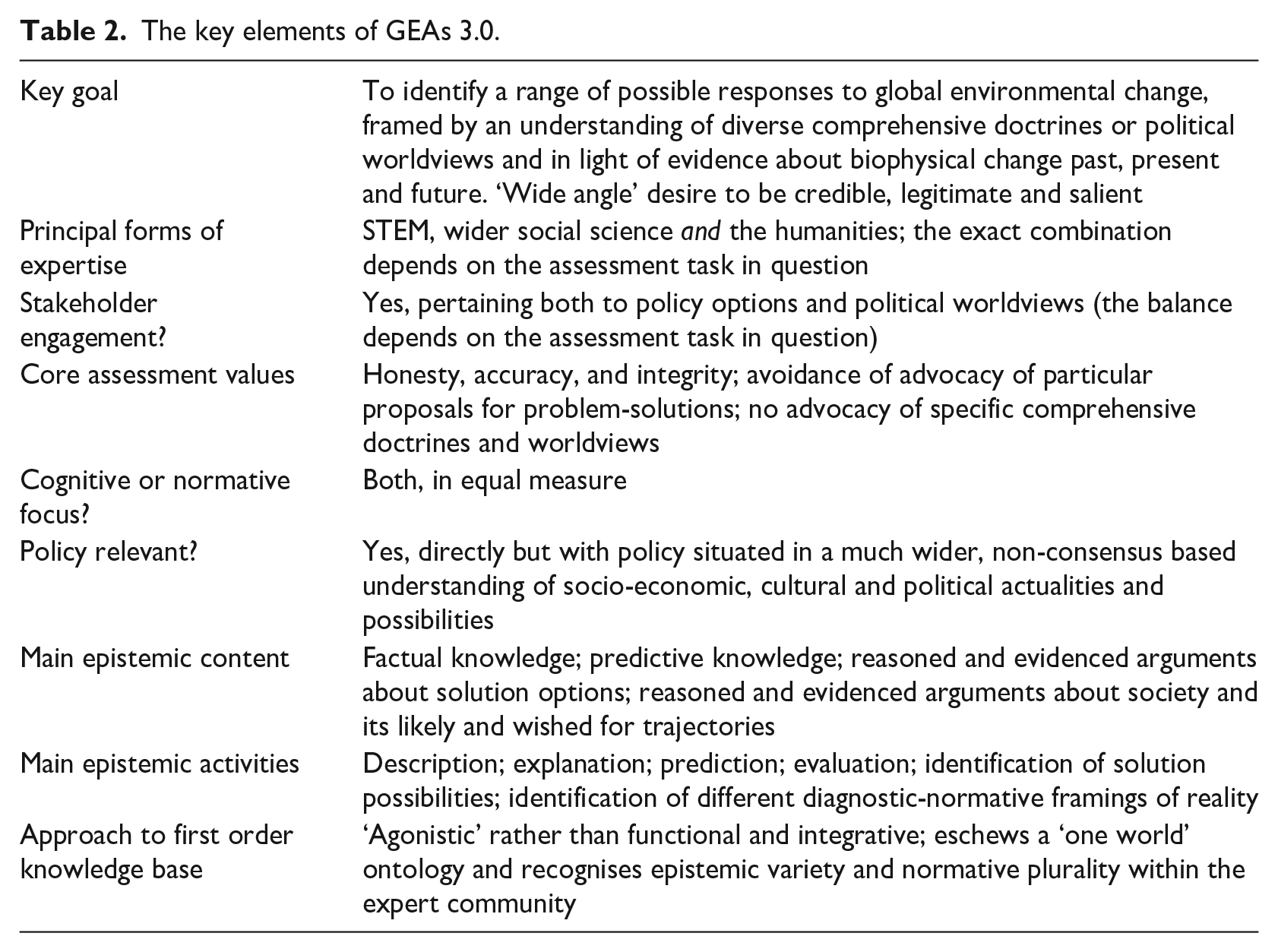
Note that STEM will remain integral to assessments 3.0 (just as with assessments 2.0). Knowledge about biophysical systems (past, present and future; regional and global) and about various technologies, will be indispensable. However, this knowledge will be situated in the context of the plurality of societal perspectives described above. There would be no pretence of asocial science and technology whose character is neutral with respect to various frameworks of sense-making (see Table 2).
The key elements of GEAs 3.0.
Lest the case we have made so far not yet seem sufficiently secure, there are two further reasons why GEAs should enter what to-date has been terra incognita.
The hidden explanations and judgements in existing GEAs
The first is that GEAs 2.0 will enter this new territory anyway, only in a hidden and stealthy manner. The lack of transparency will be problematic. We can already see why in certain IPCC activities. Beck and Mahony (2018) have exposed the ‘anticipatory politics’ hidden in ostensibly ‘policy relevant but policy neutral’ climate change scenarios. They focus on the Representative Concentration Pathways commissioned by the IPCC in 2007 for its fifth assessment report. Unlike previous scenario research, these pathways focussed on what climatic futures might be technically achievable, rather than socially feasible or acceptable. This was an attempt to keep the predictive science free from non-epistemic value judgements. Yet, as Beck and Mahony demonstrate, it introduced such judgements through the back door. They focus on RCP 2.6, a pathway that showed how keeping global atmospheric temperature beneath 2°C of additional warming might be possible. This pathway relied on large scale roll-out of technologies untested at scale – such as bioenergy with carbon capture and storage (BECCS); and it rested on significant assumptions about GHG emissions levels before and after 2050. As Beck and Mahony phrase it, the IPCC’s inclusion of this pathway … performed an important legitimation function for the speculative technology of BECCS, pulling it into the political world, making previously unthinkable notions – such as emissions overshoot and negative emissions – more mainstream and acceptable, as well as perhaps pushing it ahead of policy options (such as radical mitigation) in political calculations [of governments] . . . thus raising new questions about the neutrality of climate science (2018: 4)
Beck and Mahony’s point is two-fold. On the one hand, the pathway was ‘performative’: in the lead up to the Paris Agreement of 2015, brokered by the United Nations, it made certain environmental futures imaginable socially, economically, ethically and politically. But on the other hand, it made essential elements of those futures unavailable for discussion. In terms of Edenhofer and Kowarsch’s ‘pragmatic-enlightened model’, there was no means-ends analysis of things like BECCS rolled-out at scale. In terms of our argument for GEAs 3.0, the pathway left key analytical and evaluative questions about social norms, cosmologies, power relations, injustices, etc., unanswered. What sort of societal arrangements would need to be accepted, tolerated or enforced in a world of large-scale negative emissions technologies post-2050? What alternative worlds are forgone if ‘radical mitigation’ before 2050 is deemed too difficult? Is it right to impose enormous adaptation challenges on our grandchildren, who may experience considerable suffering as a result? These and other big questions were implicit in, yet unanswered by, the science behind RCP 2.6 – so too the other IPCC-commissioned pathways. Without a move towards assessments 3.0 they will continue to be overlooked. Alternatively, they will be dealt with inadequately in other arenas outside the world of social science and the humanities – as we will now explain.
The narrowing and attenuation of political reasoning in government, commerce and civil society
The second additional reason why GEAs 3.0 are necessary returns us to the context in which assessments now operate. We have said much about this context in the previous sections. But one important element has escaped our attention so far: namely, what some regard as the variously ‘post-political’, ‘post-democratic’, ‘anti-political’, partisan and populist character of our seemingly ‘post-truth’ times.
Numerous analysts in universities, the news media and elsewhere have lamented the evacuation of ‘real politics’ worldwide – not only in autocracies (e.g. North Korea), where one expects it, but in erstwhile democracies like the USA, the UK, Italy, Brazil and Australia. For instance, Marxist geographer Erik Swyngedouw (2011) points to how political leaders, special interests and prominent think tanks seek to de-politicise environmental change by presenting it as a ‘management problem’, one that can be tackled without challenging the rules of the capitalist system. The ‘properly political’ has, in his view, been variously vanquished, reduced to slogans (e.g. ‘System change not climate change!’), articulated as inchoate anger (e.g. France’s Yellow Vests) or, at the least, pushed to the margins – as with Extinction Rebellion’s sporadic staged protests in London and elsewhere. Meanwhile, there has been talk of ‘post-democracy’. In Crouch’s (2004) analysis, it involves the hijacking of representative democracies by a set of actors with the power to stymie discussion of alternatives. Oppositional actors seem to lack the resources and infrastructure to sustain protest (e.g. the Spanish Indignados). At the same time, there is considerable evidence that millions of citizens in democracies – even (or especially) established democracies – will not engage with the institutions and processes of government. This is sometimes called ‘anti-politics’ (Flinders et al., 2019). It has various causes – for instance, a perception that politicians are corrupt or that voters’ wishes are rarely satisfied by their elected representatives. It takes the form of a dislike of, cynicism about and disillusionment with politicians, their advisors and their associates.
The flip-side of anti-politics is partisan politics and populism, which are today evident in the USA, the UK, Hungary and several other countries. Partisan politics is oppositional not dialogical and it generates more heat than light: political rivals talk past each other and are apt to misrepresent their opponents. Populism is ‘the idea that the employment of political power ought to be governed directly by the views of . . . the populus, unmediated and unencumbered by social elites . . .’ (Sharon, 2018: 360). Populism is typically ‘anti-establishment’, non-pluralistic (it presumes ‘the people’ share a common interest) and rests on an us-them binary in order to galvanise its followers. Its discourse is big on opinion, emotion, desire and assertion. Populist politicians use rhetoric to simplify political options, and prefer to play to people’s base feelings rather than use credible evidence and robust reasoning. Finally, of late, these various assaults on the institutions and practices of democratic politics have dovetailed with a declining commitment to ‘truth’ in the public sphere. America’s current President Donald Trump (at the time of writing) is emblematic of this. ‘Post-truth’ discourse challenges both the established sources and reliability of ‘truthful statements’ – it offers ‘alternative facts’ and, at the margins, shades into wishful thinking, wilful lies and deception (aka ‘fake news’; see Bufacchi, 2020). It is a non-identical twin to the traditional practices of autocratic governments (e.g. Vladimir Putin’s), who use state media to control the flow of information and ideas within their borders.
Even if some of these claims about the ‘death of politics’ seem exaggerated, they are hardly far-fetched. And there’s no need to pretend there was once a ‘golden age’ of ‘real politics’ that indexes the current malaise. How do these developments relate to GEAs? They suggest a lack of high-quality political debate in the very places – such as the news media and parliaments – where one might reasonably expect to find it. They thereby imply that GEAs 3.0 can play a part in politicising, in a reasoned and sophisticated fashion, the tangle of big issues created by escalating changes to the global environment. These issues, to generalise and over-simplify, are not currently getting the analytical and normative treatment they deserve in the media and government. In universities, by contrast, they are, courtesy of the varied philosophical, theoretical and empirical research conducted in the wider ESSH. GEAs 3.0 can thus help to bridge the gap between this research and a wider world seemingly short of rich discussions about political alternatives and futures.
GEAs 3.0: Communicative reason and the meaning of ‘political assessment’
As should be clear by now, we have made a case for overtly political assessments. We wish to take them beyond the frontiers of GEAs 2.0. But this begs the question of what we mean by ‘politics’. The answer has been left implicit so far. Clearly, we are not referring to the hurly-burly that Lasswell famously described in his 1936 book, Politics: who gets what, when and how? Lasswell was interested in the institutions, arenas and processes that enable bargaining between different groups possessed of rival interests. Politics in this conventional sense is, as the saying goes, a ‘dirty business’. It is thoroughly pragmatic, compromise-laden and contingent. It leads, messily, to ‘the exercise of authority through collectively binding decisions’ (Hope, 2019: 5). By contrast, we are referring to diverse, ordered conceptions of the world that marry diagnosis with critique, analysis with evaluation, evidence with argument. Politics, in Lasswell’s immediate sense, is diminished without a suite of political worldviews to motivate, justify and sometimes challenge it. As Runciman notes, ‘Politics is about the collective choices that bind groups of people to live in a particular way. . . . Without real choice there is no politics’ (2014: 6, emphasis added). ‘Real choice’ involves not only having the mechanisms, skills and resources to effect political change but also a set of alternative frames that define the very parameters of choice, as well as its substantive content. Together, these frames mean that in ‘proper politics’ ‘nothing is fundamental and nothing can be taken off the table’ (Wingenbach, 2011: 21). While GEAs are hardly the only place where political choices can be presented to the world’s 190-plus countries and billions of inhabitants, they could in future be among the most credible places – building on the hard-won authority of GEAs 1.0. 12
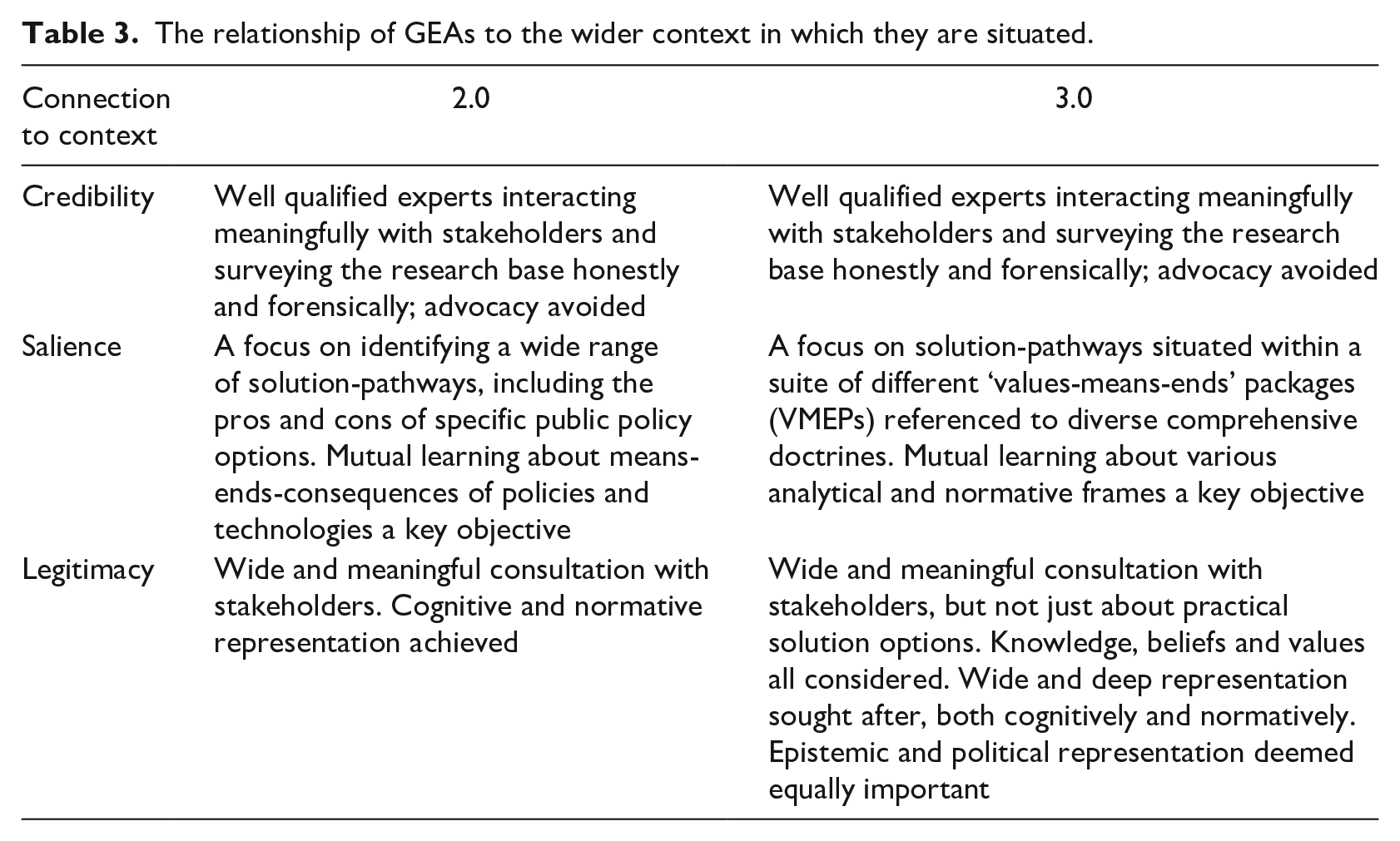
GEAs 3.0 would thus, at base, be about political representation and political reason. They would offer cognitive and normative visibility to a wide range of worldviews or what philosophers sometimes call ‘comprehensive doctrines’ – many of which will be relatively unknown in most countries or have been reduced to stereotypes and soundbites. They would both ‘speak of’ and ‘speak for’, thus using the two recognised pillars of representation. They would marry claims about the biophysical world with claims about the world’s social fabric. This full-spectrum representation would serve not only to reduce ignorance and expand thinking but to correct for the warping effects of social power (which render many worldviews ‘inferior’, invisible or ‘off-limits’ – leading to what Fricker [2007] has termed ‘epistemic injustice’). GEAs 3.0 could also be geared towards dialogue or what Habermas (1981) famously called ‘communicative reason’. Such reason involves interlocutors advancing, defending and iteratively modifying sets of analytical and evaluative claims about the world. In an ‘ideal speech situation’, there would be equality of voice among the interlocutors. Note that communicative reason is not oriented to agreement but, rather, to mutual understanding and shared learning. By treating a variety of political worldviews/comprehensive doctrines with equal seriousness, GEAs could come closer than alternative venues to achieving the Habermasian ideal in reports and other media. 13 They would seek to institutionalise freedom of thought. In sum, by way of their representative and deliberative character GEAs 3.0 would productively ‘speak back’ to the wider context that justifies their creation the first place. 14 They would help to fill a discursive vacuum with well-reasoned and suitably evidenced political content. And they would give a deeper meaning to Kowarsch et al.’s otherwise commendable proposals for assessments 2.0 – see Table 3.
The relationship of GEAs to the wider context in which they are situated.
There are a number of questions that arise about this vision for future assessments. Answering them can help to further clarify, and justify, what’s being proposed here.
First, some might ask: is it possible to ‘assess’ political worldviews (in our expansive definition of ‘politics’)? Is assessment not a purely cognitive, value-free process based on evidence and our best predictions about future risks, opportunities, possibilities and probabilities? The answers are ‘yes’ and ‘no’ respectively. We have a prodigious body of scholarship in disciplines like anthropology, sociology, history and philosophy, the synthesis of which allows us to understand the content of, and areas of contention within and between, political worldviews. Furnishing this understanding does not amount to political advocacy but, instead, to a survey of the ESSH research base akin to the practices of GEAs 1.0. One of the key reasons a careful, non-partisan survey is needed is because it can ‘add value’ to the research base it relies on. For instance, there are overlaps between ecological economics, green political economy, de-growth perspectives, ‘doughnut economics’ and ideas about ‘prosperity without growth’. But without assessment, how far these important bodies of thought can reasonably be parsed would not necessarily be clear outside the academy.
Second, it can also be asked: is it really possible for assessors to claim ‘expertise’ in political matters? Surely, because politics is all about values, preferences, interests and hopes, it falls outside the recognised domains of expertise? Again, the answers are ‘yes’ and ‘no’. As Grundmann reminds us in his paper ‘The rightful place of expertise’, ‘there are different kinds of expertise that deal with different kinds of problems’ (2018: 374). Expertise about political worldviews is special because it aims for a rigorous and in-depth understanding, vouchsafed by academic freedom. In GEAs 3.0, ‘political experts’ working in social science and the humanities would not be expected to make political judgements but, instead, to present the most elaborated versions of various worldviews, while also noting areas of complementarity, ambiguity, contradiction or confusion within them.
Third, some might ask if it’s appropriate for future assessments to purposefully politicise global environmental change. But this question rests on a specific notion of ‘politicisation’, that is, to ‘make political’ something that is somehow before, above or beyond politics. This sort of nefarious politicisation has been very troublesome for many climate scientists and Working Group I of the IPCC. This is because sceptics often hide their value- and interest-based objections to the implications of IPCC assessments by questioning the quality of the science and the motives of some scientists (such as Phil Jones, once head of the Climate Research Unit at the University of East Anglia, England – during the 2009–2010 ‘climategate’ affair, sceptics attempted to discredit him). However, we can also view politicisation more positively. As political theorist Colin Hay notes, ‘ . . .to politicise something – to render it political – is to bring it in to the realm of contingency and to create the possibility of subjecting it to human purpose and intention. Politicisation . . . is about taking responsibility for our collective choices’ (2013: 109). In this light, future GEAs would justifiably seek to make global environmental change political ‘all the way down’. While humans can, of course, never fully subject the Earth System to their ‘purpose and intention’, GEAs could help reveal the real but very different decision-spaces that are defined by competing, though sometimes complimentary, political worldviews. 15
Fourth, those sympathetic to our case might nonetheless wonder about the limits of ‘the political’ in our vision for GEAs 3.0. This vision may seem all too Rawlsian (after the liberal philosopher John Rawls, who maintained that ‘public reason’ was only possible if otherwise opposing political perspectives shared some common evidential and argumentative standards). How, they might ask, do perspectives that challenge the very basis of political discourse get a hearing? Does our vision preclude Chantal Mouffe’s (2005) claim that asking what counts as ‘political’ must be enabled within prevailing political institutions and discussions? Can antagonism and incommensurability somehow be enabled in GEAs 3.0? Though some might not welcome it, our answer is a resounding ‘yes’. Academia in countries like Australia, the UK and the US (where we presently work) remains a largely safe space to air novel thoughts and pose new questions. Universities permit a degree of ‘organised anarchy’ rarely found elsewhere. Experts in social science and the humanities are afforded the time and resources to generate creative and often radical ideas. Consider, for instance, eco- and biocentric worldviews: in the West, their intellectual substance was developed slowly and systematically from the late 1960s by scholars such as Peter Singer. More recently, post-colonial and de-colonial thinking has created serious room for indigenous cosmologies in disciplines like human geography, literary studies and philosophy. In GEAs 3.0, there is no reason to preclude worldviews that seek to politicise what other worldviews simply take for granted politically – such as who legitimate political actors are, where power lies in society, what count as ‘public reasons’, what ‘valid arguments’ sound like, and so on. 16 In an intellectual sense, GEAs 3.0 could represent something of the deep dissensus that Latour’s proposals for a ‘new constitution’ seek to enable in his well-known book Politics of Nature (2004). Dissensus is productive. As philosopher Tan puts it, ‘Contention is . . . superior . . . because of its ability to motivate genuine deliberation (as opposed to self-serving rationalisation)’ (2020: 79).
Finally, some might worry that our case justifies an ‘expertocracy’ – a situation where a cadre of unelected experts (‘philosopher-kings’) do a society’s political thinking for it. Despite Jason Brennan’s (2016) controversial arguments to the contrary, expertocracy can rarely (if ever) be justified. As we hope we have made clear above, GEAs 3.0 would not only include stakeholders’ worldviews (building on the proposals of Kowarsch et al.). The reports would also be designed to foster debate and learning in the wider world, rather than pretend to be the last word on political alternatives and our global environmental future. While Brennan, in his book Against Democracy (2016), may be correct that most citizens are ill-equipped to understand complex political issues, GEAs 3.0 are not intended to replace those citizens’ right and responsibility to try to understand them. Instead, their goal is to empower people with information and ideas, thereby enriching the discursive climate and increasing the chance that political leaders will be held to account. 17 This goal is all the more important in light of the sorry state that public reason often finds itself in today – the UK debates over Brexit since 2016 offer a prime example of this. 18
A paradigm shift too far?
Let us end this very long paper with (i) some brief suggestions about the concrete work GEAs 3.0 could usefully undertake and (ii) some equally brief reflections on whether our vision for assessments is unduly idealistic.
The future work tasks of GEAs 3.0: Some proposals
Though our case for GEAs 3.0 incorporates key elements of assessments 1.0 and 2.0, one can envisage some future assessments focussing largely on political worldviews and being led by a wide spectrum of social scientists and humanists. 19 These assessments would need to identify topics or issues that different worldviews have important things to say about. The topics or issues would need to be of global relevance, and speak across the domains of government, commerce and civil society. Here are some ideas, and none are mutually exclusive:
The assessment of a global sustainability transition: We noted in section five that different definitions, arguments and policy ideas exist for ‘sustainability transitions’. There are profound questions about what is possible and desirable; what is too slow and too ambitious; what ‘sustainability’ means; and so on. An assessment that addressed these questions by way of an exploration of a range of established and newer perspectives could be of considerable value. It would include radical thinking, as much as reformist thinking.
The assessment of the ‘global environmental crisis’: The geoscientific claims about the Anthropocene have been widely interpreted as sounding the global alarm bell. But a ‘crisis’ is not objectively given. There are different definitions of, and reasons given for, a ‘crisis’. Used uncritically, the term crisis can spread a sense of fear or hopelessness, or else give decision makers a justification for taking radical action that is not well justified. Which perspectives perceive a ‘world in crisis’ and why?; what actions do these perspectives argue for and towards what ends?; which perspectives are more sanguine about the future and why?; what are the problems in presuming there is no ‘crisis’?; what are the risks of alarmism and ‘deadline-ism’?
The assessment of the rights and needs of future generations: As geoscientists report, we have already set in train environmental changes that will alter the ‘boundary conditions’ for our children’s children. Present generations are increasingly knowledgeable about the legacy they are bequeathing to those with no choice but to inherit it. The legacy we leave is to some degree in our hands still. An assessment that systematically explores ways of thinking about the needs and rights of the unborn could assist present-day decision making about reducing human impacts on the Earth.
The assessment of global environmental justice: Justice is an elemental motivating concept worldwide, with both ‘environmental’ and ‘ecological justice’ growing concerns since the 1980s, alongside the traditional concern with social justice in areas like education, housing and the workplace. One can envisage an assessment of how addressing the causes and impacts of anthropogenic environmental change will be affected by different notions of just processes and outcomes. Justice for who, for what, and how? A plenary question like this could allow exploration of anthropogenic and ecocentric, as well as secular and theological, notions of a just future.
The assessment of global environmental governance: There is already an effort to coordinate social science and humanities research in this area: namely, the Earth System Governance Project (see Burch et al., 2018). A future GEA on this topic would think expansively about governance possibilities in light of both geoscience (reporting on Earth System changes that may force a coordinated global response) and the range of political worldviews hinted at in this paper.
The assessment of human progress on a fast-changing planet: Like justice, ‘progress’ is a keyword across the globe – many languages have this signifier or something close to it in their vocabulary. But it’s a contested term, and usefully so: there are deep differences of view on what progress looks like, how we measure it, how we achieve it, who (or what) its beneficiaries are, and so on. ‘Whose progress and at what cost?’ is a good question to ask.
A case of fruitless idealism?
Supposing the case we have made for assessments 3.0 is deemed robust intellectually, there are lots of reasons why it seems to fall down practically. We mentioned earlier the formidable difficulties of implementing Kowarsch et al.’s proposals for GEAs 2.0. In this light, our own proposals may seem laughably infeasible. For instance, notwithstanding Grundmann’s corrective, a great many people will simply not find ‘political expertise’ credible. Instead, they will regard it as inappropriate, even illicit. National governments, in particular, will not welcome unelected experts treading on their territory, raising the question of whether intergovernmental (vs wholly independent) GEAs3.0 are even possible. Likewise, the suggestion that GEAs are as much about dissensus as finding common ground will strike some readers as foolhardy. As Hinton notes, ‘Too much disagreement among those who are expected to have the answers may lead to a radical scepticism about the value of expertise’ (2019: 160). There are a myriad of other possible objections to our ideas. Even those who may be sympathetic to them might nonetheless believe that achieving GEAs 2.0 (not 3.0) should be the goal. After all, achieving those goals will be hard enough.
Rather than attempt to counter every possible objection, let us close with a comment about the differences between ideal and practical reasoning. Those who criticise ‘unrealistic’ ideas are inevitably in the grip of status quo bias. History contains countless examples of both long and fast revolutions. Change is often pre-figured by arguments that, in their time, seem out of joint and not credible. As the soixante-huitard slogan goes, ‘be realistic and demand what seems impossible!’. The Marxist literary critic Eagleton (2005: 62) once memorably captured the contingency of the actual and the possible: It is the hard-nosed pragmatists who behave as though the World Bank and caffe latte will be with us for the next two millennia who are the real dreamers, and those who are open to the as yet unfigurable future who are the true realists.
While GEAs are a pretty ‘sober’ mechanism for presenting political alternatives, that may be a key strength in a world where considered action is essential yet political polarisation rife and political literacy often very low.
Conclusion
This paper has made a case for far-reaching change to global environmental assessments. In so doing, it’s engaged constructively with current criticisms of what we have termed GEAs 1.0. While acknowledging the force of these criticisms, we’ve argued that proposals for GEAs 2.0 do not go far enough – this despite those proposals being timely and ambitious, though difficult to implement. Our case for GEAs 3.0 is an attempt to fully foreground the so-called ‘human dimensions’ of global environmental change. It is no longer sufficient for GEAs to speak about the physical environment and its impacts on humans; assessments must also speak about (and for) society at large, in relation to global change. Arguments for assessments 2.0 helpfully highlight important and hitherto underplayed human dimensions. However, there is a wider, deeper, dissonant and more political story to tell. This story involves many metaphorical characters and perspectives but, unlike conventional narratives, it drives towards no tidy conclusion. In this, it is akin to a postmodern novel or a Brechtian play. GEAs 3.0, we have argued, have a distinctive and important role to play in facilitating a meaningful dialogue between the characters in this anti-narrative. The role de-privileges geoscience; it obliges social scientists and humanists to occupy centre stage; it eliminates the is-ought divide; it allows a different sort of boundary work to occur while preserving the autonomy and integrity of assessors; and it makes ‘political expertise’ (in the broad sense) an invaluable rather than inappropriate contribution to what we might today call the ‘conversation of humankind’.
Writing in the 1960s, when the Second World War still cast its very long shadow, English philosopher Michael Oakeshott described the ideal nature of that discussion. ‘True conversation’, he wrote, ‘is not . . . a contest where a winner gets a prize . . . Properly speaking, it’s impossible in the absence of a diversity of voices: in it different universes of discourse meet, acknowledge each other and enjoy a . . . relationship which neither requires nor forecasts their being assimilated to one another’ (Oakeshott, 1962: 66). Human impacts on the Earth require a worldwide conversation of this kind, though no doubt not nearly as polite as Oakeshott implied. GEAs could play their part in facilitating this conversation, however modestly. But first they need themselves to change in significant ways. We hope this paper instigates a discussion about GEAs that, in due time, allows them to engender the sort of dialogue we need about Earth present and future.
Supplemental Material
sj-pdf-1-anr-10.1177_2053019620971664 – Supplemental material for The future of global environmental assessments: Making a case for fundamental change
Supplemental material, sj-pdf-1-anr-10.1177_2053019620971664 for The future of global environmental assessments: Making a case for fundamental change by Noel Castree, Rob Bellamy and Shannon Osaka in The Anthropocene Review
Footnotes
Acknowledgements
Our sincere thanks to Robert Costanza, Ana Lambert and two anonymous reviewers. Their critical comments on an earlier version led to a very substantial rewrite of the paper. We believe the paper is much improved, despite one reviewer still questioning its aims and structure.
Declaration of conflicting interests
The author(s) declared no potential conflicts of interest with respect to the research, authorship, and/or publication of this article.
Funding
The author(s) received no financial support for the research, authorship, and/or publication of this article.

Supplemental material
Supplemental material for this article is available online.
Notes
References
Supplementary Material
Please find the following supplemental material available below.
For Open Access articles published under a Creative Commons License, all supplemental material carries the same license as the article it is associated with.
For non-Open Access articles published, all supplemental material carries a non-exclusive license, and permission requests for re-use of supplemental material or any part of supplemental material shall be sent directly to the copyright owner as specified in the copyright notice associated with the article.
