




Abstract
Despite considerable advancements over the last couple of years, research on the Anthropocene still faces at least two challenges: (1) integrating different approaches from natural, social and cultural sciences, and (2) clarifying the political relevance of this concept. To address these challenges, we propose an interdisciplinary approach from Social Ecology and Political Economy which combines research on social metabolism with a historical approach to capitalist development. We argue that such an interdisciplinary approach can help to better understand the Great Acceleration of production and consumption and the related surge in global resource flows. The observation of such an acceleration in the physical growth of societies, in turn, is perceived as the most convincing argument to explain fundamental shifts in the state and functioning of the Earth system, the Anthropocene. Our approach emphasizes that the Great Acceleration was not homogeneous, neither in space nor in time. Instead, spatial varieties and different historical trajectories must be considered which allow for the differentiation of two phases of accelerated resource use, taking place in different world regions. In this article, we propose an integrated research framework for the study of the Great Acceleration, illustrate the insights to which its application leads and discuss the political relevance of the Anthropocene for further research on social-ecological transformations.
Keywords
Introduction
Recent research, and debate, on the Anthropocene has made significant progress but still faces at least two major challenges: (1) how to better integrate ‘the many Anthropocenes’ (Bai et al., 2016; Brondizio et al., 2016; Toivanen et al., 2017) as analysed by different approaches from natural, social and cultural sciences, and (2) how to clarify and improve the political message of this concept (Dalby, 2016). Both aspects are clearly interlinked as each scientific concept is associated with one or more proposals for the beginning and the societal impact of the Anthropocene, providing according narratives of its societal and political relevance (Bonneuil and Fressoz, 2016; Görg, 2016a; Pichler et al., 2017). Examples for the first challenge are debates on the role of Earth System Sciences (Hamilton, 2016) and the social sciences and humanities, respectively (Lövbrand et al., 2015; Malm and Hornborg, 2014), in conceptualizing the Anthropocene. The second challenge becomes visible in debates on the role of global capitalism (Malm and Hornborg, 2014; Moore, 2016; Soriano, 2018), of technology (Haff, 2014) and on the needs or options for degrowth (Antal, 2018; Reichel and Perey, 2018). Here, the Anthropocene is closely linked to debates on societal transformations, on sustainable and desirable futures and how to achieve them (Bai et al., 2016).
The interdisciplinary perspective of Social Ecology and in particular its research on the social metabolism (Haberl et al., 2016) have offered important insights to the debate on the Anthropocene (Fischer-Kowalski et al., 2014; Pichler et al., 2017). In this article, we build on these contributions by focusing on one important argument for a new Earth era, the observation of the Great Acceleration (Steffen et al., 2011, 2015). 1 We argue that much more can be learned about the Great Acceleration by integrating social metabolism research with Political Economy, in particular the Regulation Theory (RT; Jessop, 2001; Lipietz, 1987). We propose a research framework building on Social Ecology and RT and offer some preliminary insights into the Great Acceleration based on the application of this framework. We thereby wish to engage with the wider debate on the relevance of the Anthropocene as a challenge for social-ecological transformations.
From Social Ecology, we gain a socio-metabolic approach to dynamic society-nature relations (Haberl et al., 2019), as operationalized by the environmental accounting tool of Material and Energy Flow Accounting (MEFA). From RT, we gain insights into different phases and regional expressions of capitalist development, provided by an institutional analysis of interlinked economic, political and cultural dimensions (Brand et al., 2019). This integration allows us to scrutinize the Great Acceleration of resource use as one major explanation for the Anthropocene. The main purpose of this article is to introduce the research framework, offering it up for consideration and opening it to critique. The initial findings on the Great Acceleration are preliminary and serve to demonstrate how we intend to apply the research framework in further research. 2 In this sense, we provide a starting point rather than any final conclusion. As such, we are not offering a classical research paper but we propose conceptual and methodological options for research on the Great Acceleration and social-ecological transformations.
In the ‘Approaches and methods’ section, we elaborate on the approaches and methods involved and explain the structure of the article (and why it differs from a conventional form). In the ‘Analytical challenges of the Great Acceleration’ section, we discuss the challenges of the Great Acceleration in more detail and provide evidence for a historical and spatial differentiation. In the ‘Global resource use dynamics in a historical and societal perspective’ section, we then refer to four dimensions of the research framework, elaborate on their meaning and relevance and why they need further consideration in this regard, before we (see the ‘Conclusion: The Great Acceleration and social-ecological transformations’ section) draw some conclusions for further research on social-ecological transformations and the political relevance of the Great Acceleration and the Anthropocene therein.
Approaches and methods
Social Ecology is premised on an understanding of society as simultaneously biophysical and socio-cultural (Fischer-Kowalski and Weisz, 1999). Accordingly, societies must reproduce themselves not only socially but also biophysically. The material and energy inputs, transformations and outputs that a society requires for its reproduction are conceptualized as social metabolism (Haberl et al., 2019; Pauliuk and Hertwich, 2015). The social metabolism is at once generalizable and highly specific to the society in question. At the national level, industrialized societies, for example, obtain their required material and energy inputs both from domestic agriculture, forestry and mining and from imports; they dedicate a high and increasing share of these inputs to stock-building, 3 produce large amounts of wastes and emissions and export materials and energy to other societies on the output side. They typically process roughly equal amounts of fossil energy carriers, biomass and minerals to meet their material needs, consuming an average of 15–20 tonnes of materials per capita of population and year (Schandl et al., 2017). Within this generalized profile of the industrialized society, however, significant differences exist depending on inter alia, climate and geography, natural resource endowment, population density and settlement patterns, economic and social structure or the role within the global economy (Steinberger et al., 2010). And, of course, the generalized industrial profile is also the product of differences at the subnational level, both vertically and horizontally. One of the tools with which social metabolism can be studied is that of MEFA (Krausmann et al., 2017). This is an environmental accounting approach that provides mass balanced information on all material and energy inputs (extraction, imports) and outputs (discharged wastes and emissions, exports) as well as changes in the materials accumulated in physical structures within society, that is, buildings, infrastructure and ‘fixed capital’. The flows covered by MEFA are defined by the system boundaries between the socioeconomic system and its natural environment (defining extraction and discharge) and between socioeconomic systems (defining imports and exports). Society is conceptualized as biophysically encompassing humans, their livestock, buildings and artefacts. MEFA therefore covers all the flows incurred in building up, maintaining and functioning of these biophysical societal structures (stocks). MEFA is an established tool applied by science and in environmental reporting, for example, by United Nations Environment Programme (UNEP), Eurostat and many countries, and provides detailed data and aggregate indicators related to extraction, trade, consumption of resources and the related wastes and emissions (Fischer-Kowalski et al., 2011). Its key strength is its comprehensive approach to resource use, covering all biomass, ores and metals, fossil energy carriers and non-metallic minerals systematically and historically consistent (Fischer-Kowalski et al., 2011; Krausmann et al., 2017; Schandl et al., 2017).
To better understand the different patterns of resource flows, for example, within the broad variety of industrialized countries and between them and resource exporting countries in the Global South, we need an approach that helps to explain the drivers involved and how patterns of resource use develop over time. Capitalist development over the last 150 years is characterized by very different economic growth models with varying dependencies on certain resources (e.g. from coal to oil and gas, but also regarding new IT technologies), modified by certain political (e.g. the welfare state) and cultural patterns (e.g. the role of certain consumption patterns). To explain these dynamics is one of the big research topics of social sciences (Albritton et al., 2001; Amin, 1994). For our approach, we refer to RT as a theory of non-linear capitalist development, which analyses the history of capitalism not as a linear unfolding of underlying economic drivers but as a sequence of discrete growth models stabilized by political and cultural institutions (Aglietta, 1979; Amin, 1994; Esser et al., 1994; Jessop, 2001; Lipietz, 1987).
In methodological terms, thus, RT refers not only to a quantitative, in particular, monetary perspective and corresponding methods but depends also on qualitative methods like institutional or policy analysis. In the proposed research framework, we start with the analysis of MEFA data and then align them to analyses developed by RT over the last decades, in particular institutional and policy analysis (Becker, 2002; Brand et al., 2008; Jessop, 2001), but also analysis of consumption patterns and lifestyles (Brand and Wissen, 2018; Hirsch and Roth 1986; see the ‘Global resource use dynamics in a historical and societal perspective’ section). We then confront the results with the explanation for the ‘Great Acceleration’ provided by Steffen et al. (2015). The aim is to elaborate on some challenges which are at the centre of this concept: to provide a more detailed picture of global resource use in the 20th century, its different historical phases in different world regions and the role of explicit policies intended to govern resources use and its consequences. To elaborate on these differences is important for stimulating a more profound analysis of the societal causes of accelerated resource use and to identify entry points for a social-ecological transformation.
The overarching aim of the article and the research framework we develop here, thus, is to provide a richer picture of the phenomenon of the Great Acceleration, which is without doubt a major challenge for any sustainability transformation. As mentioned above, the presentation of our research does not follow the conventional structure of an empirical research paper, since this is rather a conceptual paper which refers to empirical work mainly to exemplify the arguments provided. In the ‘Analytical challenges of the Great Acceleration’ section, we discuss the analytical challenges related to the Great Acceleration confronting the conclusions commonly drawn from these diagnosis with some ambiguities of high relevance for a clarification of its scientific results and its political message. In the ‘Global resource use dynamics in a historical and societal perspective’ section, we introduce an (alternative) analytical framework based on MEFA and RT, building on previous research. The analysis we present is by no way comprehensive but rather serves as a starting point for more in-depth research. As basic requirements for a more nuanced picture, we refer to four dimensions that can explain to some degree the major characteristics. Finally, we draw some conclusions from our analysis for the current debate about a social-ecological transformation.
Analytical challenges of the Great Acceleration
The acceleration of global resource use after World War II (WWII), starting in the 1950s, has been proposed as one of the best indications for the beginning of the Anthropocene because it can be related to fundamental shifts in the state and functioning of the Earth system from an Earth System Science perspective (Steffen et al., 2011, 2015). It is also mentioned in the last decision of the Anthropocene Working Group as coinciding with the sharpest and most globally synchronous primary marker, the spread of artificial radionuclides worldwide (21 May 2019, see http://quaternary.stratigraphy.org/working-groups/anthropocene/). However, this diagnosis raises analytical challenges as it focuses on global trends and masks underlying social inequalities and related justice issues as well as different phases in the historical development. In the most recent version of the iconic graphs of the Great Acceleration, 4 Steffen et al. (2015) acknowledge this gap by differentiating selected socioeconomic trends between OECD (Organisation for Economic Co-operation and Development) and BRICS (Brazil, Russia, India, China and South Africa) countries and all other countries. 5 Furthermore, Earth system analysis and major resource use trends, that is, the biophysical dimension of the Great Acceleration are not linked to the analysis of any societal development pattern (Steffen et al., 2015). The Great Acceleration diagnosis addresses the unequal contribution of different regions to the global trend in a rather superficial way and ignores differences between countries within these regions (Mayer et al., 2017) and of different groups of people or social classes within these countries (Lövbrand et al., 2015; Pichler et al., 2017; Wiedenhofer et al., 2016).
Moreover, it also obscures historical details and provides a political message, which is impressive but too simple. Without doubt, the graphs are important concerning the political message they provide: that there is an ever-increasing growth in a variety of biophysical but also socioeconomic parameters. However, these graphs and the prevailing reading of the Great Acceleration do not allow for a more detailed historical analysis of resource use and its consequences and they also do not give any hints for further deeper analysis, in particular concerning political interventions or response strategies. In the graphs of the Great Acceleration, only in a few cases, sweeping historical events or political measures becomes visible, also as a slowdown or stabilization can be found only for a few physical indicators but for different reasons. For example, the great economic and financial crisis in 2008/2009 is discernible but only as a sharp (and brief) disruption in gross domestic product (GDP) without any differentiation of its further development (e.g. regarding different world regions). Steffen et al. (2015) argue that probably only the stabilization of the Antarctic ozone hole is a result of political measures (i.e. the Montreal Protocol), whereas the slowdown of marine fish capture is likely caused by the increasing exhaustion of the world’s marine fish stocks and the slowing of cultivated land by land constraints and an intensification of agriculture. Thus, Steffen et al. (2015) provide a narrative that political responses to global environmental problems have hardly ever been the reason for positive trajectories. Without any doubt, this is an important message for politics. To put it simply, it reveals the fact that over the last seven decades, explicit environmental or resource policies had only very limited impact on the ever-increasing use of material resources and its consequences (e.g. climate warming) at the global scale (Bonneuil and Fressoz, 2016; Görg, 2016a). But is this really the full picture?
Analysing the Great Acceleration from the perspective of Social and Political Ecology, that is, focusing on the resource flows between societies and their natural environment (social metabolism; Pichler et al., 2017), reveals that it was homogeneous neither in space nor in time. Historical phases become easily detectible by a closer look at average global material and energy consumption and the resulting CO2 emissions, building on existing MEFA data. We find evidence for several disruptions of and phases within what has been conceptually homogenized as the Great Acceleration (see Figure 1).
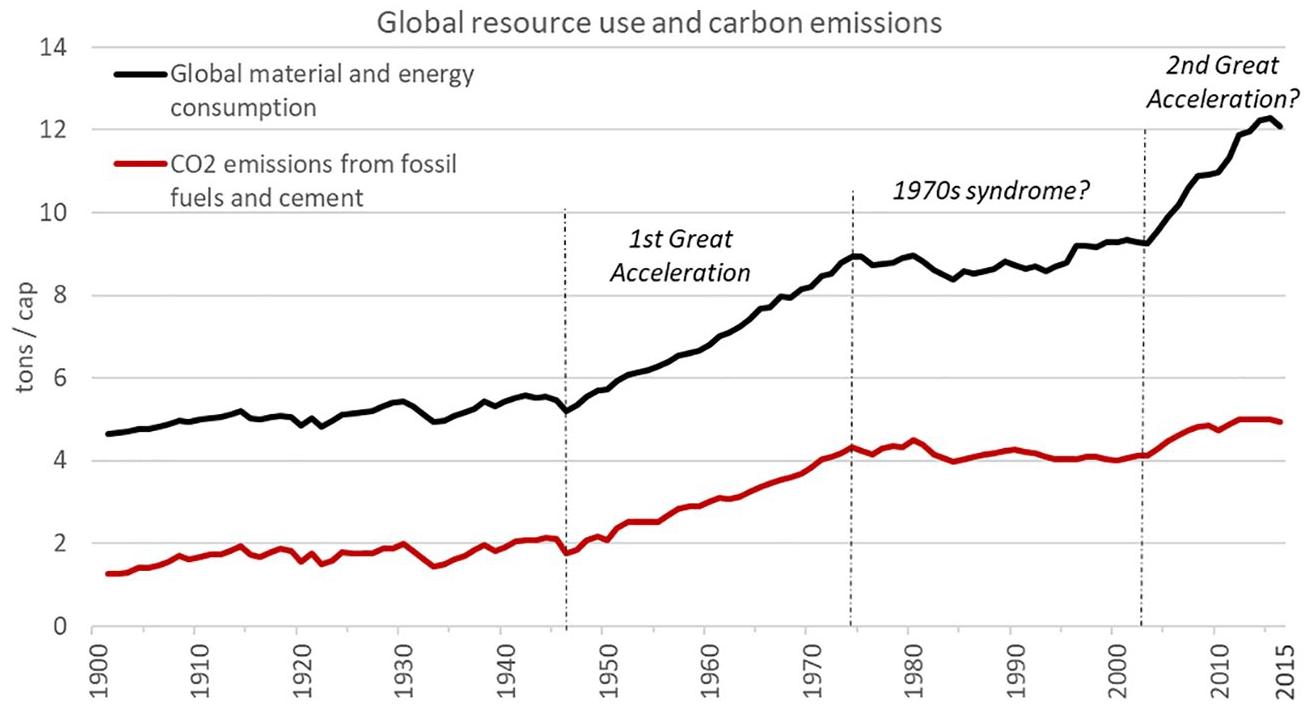
Global use of materials including energy carriers and CO2 emissions from fossil fuel combustion and cement production per capita of global population since 1900, differentiated into three phases.
The development of global per capita trends in resource use and CO2 emissions shown in Figure 1 allow to distinguish between at least three phases of global resource use after WWII: a first phase of accelerated resource use after 1945 was linked to a distinct phase of capitalist development in Western Europe and North America called Fordism (see below). This short period of strong economic growth and rise in prosperity for large parts of Western populations was followed after 1970 by a crisis-driven and contested stabilization of global resource use, where environmental policy may have played a role (Wiedenhofer et al., 2013 and the discussions of a ‘1970s syndrome’, see below). Finally, the turn of the new millennium was marked by an even greater acceleration of global resource use, in which China, India and other emerging economies played a decisive role. We here denote this phase during which global resource use grew at a similar pace as in the post-WWII years as the Second Great Acceleration. 6
However, so far this global picture still obscures regional varieties and different trajectories in different world regions and at national level. Figure 2(a) shows a breakdown of global material use by different country groups, following the country classifications of the United Nations (UN, 2014). It reveals large differences both in the level and the trajectories of resource use across these groups. Also, the relation of resource use trajectories to economic development differs across country groups, as a comparison with income (GDP per capita) trends indicates (Figure 2(b)). The so-called developed economies are characterized by stagnating (after 1973) or even declining (after 2008), but still unsustainably high levels of resource use (Giljum et al., 2014; Schaffartzik et al., 2014; Schandl et al., 2017), especially when the increasing fragmentation of international supply and use chains is taken into account. Socio-metabolic research has shown that developed economies increasingly rely on imports of resource intensive products; this leads to lower direct resource use and an externalization of resource use impacts from industrialized to developing countries, many of them in the Global South (Bringezu, 2015; Srinivasan et al., 2008; Wiedmann et al., 2015). While the group of the so-called least developed countries shows very low and more or less stagnating resource use, China has dramatically increased its resource use and reached a level that even exceeds the average of the developed countries. Resource use in the other developing countries (rest of the world group) is also growing but still lags far behind. To obscure neither regional differences nor the externalization of environmental burdens, a global perspective is required that does not ignore national differences and international interdependencies of national economies (and the international power relations involved, not all national economies are able to influence the global dynamics in the same way).
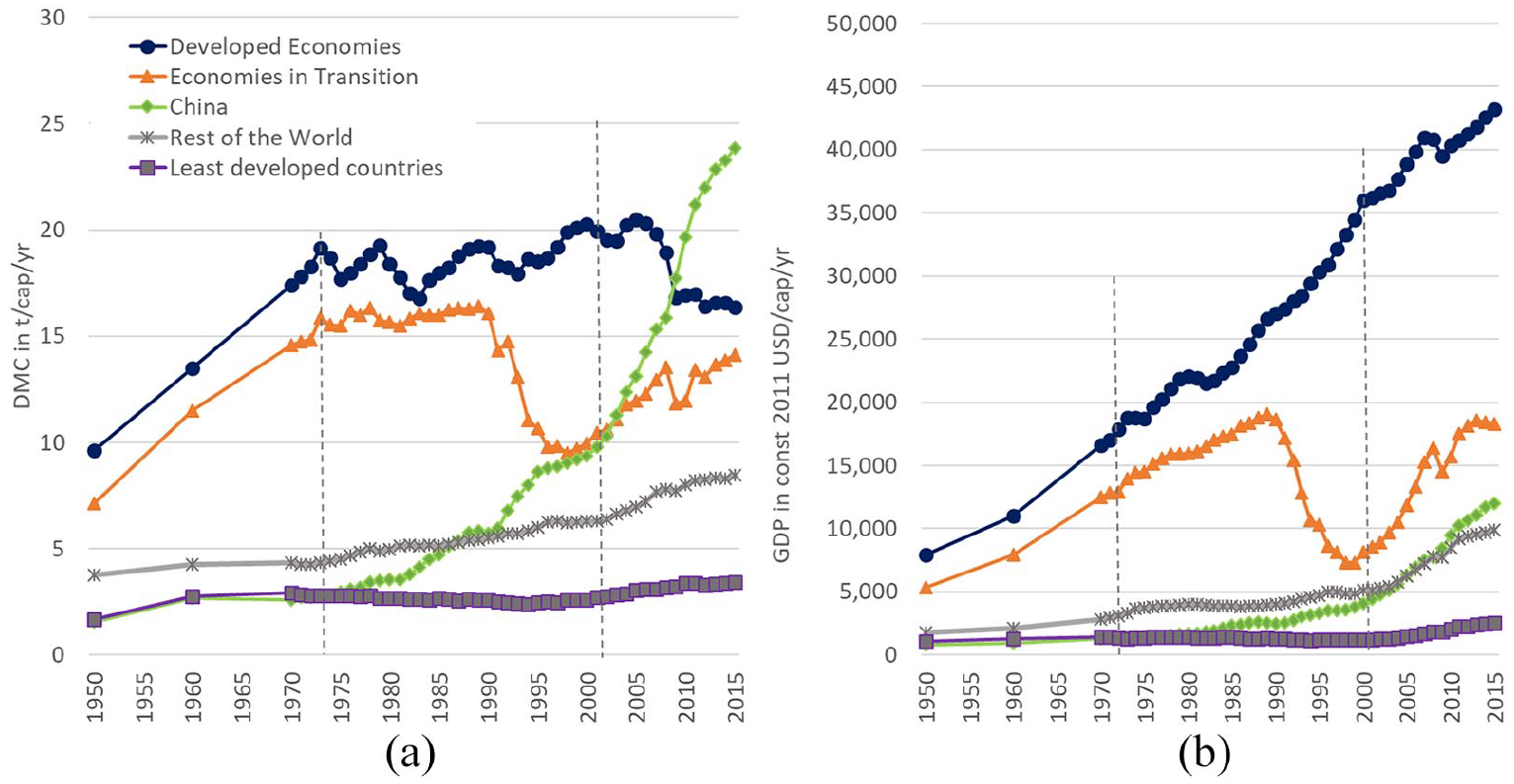
(a) Development of domestic material consumption (DMC) and (b) gross domestic product (GDP) per capita of global population for country groups.
Resource use is a major driver of global environmental change. It directly or indirectly relates to many but not all of the dimensions of the Great Acceleration visualized in the 24 graphs in Steffen et al. (2015). A focus on resource flows could allow for a more nuanced analysis of the societal challenges involved, in particular regarding the interplay of biophysical and socioeconomic processes (Pichler et al., 2017). More specifically, such a focus on socio-metabolic transition processes addresses a major concern regarding the unsustainability of contemporary societies and its development, as unsustainability can be observed in particular concerning global resource use and its consequences (Krausmann et al., 2018; Schandl et al., 2017; UNEP, 2016). In the trajectories shown in Figure 2, the close link between economic performance and resource use becomes visible, for example, regarding the surprisingly similar trajectories of the Developed Economies and the Economies in Transition during Fordism and the low and over long stretches even declining per capita resource use of Least Developed Countries, just like the take-off of China in 1975, but even more after the turn of the new millennium. Socio-metabolic research on global resource use patterns and their relation to socioeconomic development has gained considerable attention in the last years (Haberl et al., 2019) and a number of studies have attempted to explicitly combine social and political science research with the analysis of resource flows. Important issues that have been addressed in this context are, for example, energy use and its transformation (Morris and Jungjohann, 2016; O’Neill, 2018; Roehrkasten et al., 2016), resource extraction and environmental conflicts (Pérez-Rincón et al., 2018; Temper et al., 2015), consumption patterns (Cohen, 2016), ecologically unequal exchange (Hornborg, 1998; Hornborg and Martinez-Alier, 2016; Martinez-Alier, 2002; Mayer and Haas, 2016) or resource use and food regime transitions (Krausmann and Langthaler, 2019). There is, however, still a shocking lack of evidence how global resource dynamics can be addressed in political or institutional terms and how fundamental transformations towards sustainability can be achieved.
Thus, a better understanding is required on how the observed global dynamics are linked to certain societal conditions in different regions of the world, how they are shaped by national development strategies (e.g. specific industrialisation or extraction strategies), and how national development strategies are influenced by the dynamics of the capitalist world system, by global trade patterns and by domestic and global inequalities. We diagnose an analytical gap concerning a systematic understanding of the dynamics of this uneven development in resource use and how it is shaped by socioeconomic crises (i.e. emerging contradictions or tensions within a certain growth model) and/or by societal struggles (i.e. social contestations, emerging from these crises but also expressing political claims, for example, currently for degrowth). What is needed is to distinguish different development paths or growth regimes in a way, where both the dynamics towards unsustainable resource patterns and possible entry points for transformative political interventions can be addressed.
Global resource use dynamics in a historical and societal perspective
In the following, this article addresses these challenges and provides building blocks of an analytical concept of social-ecological transformations. It builds upon a socio-metabolic approach and MEFA research (Haberl et al., 2019; Krausmann et al., 2008) and links this research to a social science approaches on uneven historical and spatial capitalist development, the RT (Aglietta, 1979; Esser et al., 1994; Lipietz, 1987). 7 Whereas MEFA has its strength in revealing resource patterns in a global and long-term perspective, the latter offers analytical tools to understand the conflict and crisis-driven stabilization of distinct phases of capitalist development from a middle-range perspective. In the following, four pivotal topics are presented, which we see as central in guiding further investigation. These topics are distilled from former RT analysis and respond also to some weaknesses of this approach discussed during the last decades (see Atzmüller et al., 2013; Becker, 2002; Esser et al., 1994; Jessop, 2001). The aim is to present entry points for further research. We address (1) the historical and spatial varieties of societal development and its implication for resource use; (2) the interplay of different institutional dimensions including but also beyond economic dimensions, to take political and cultural aspects serious; (3) the role of social inequalities and power relations at domestic and international level; and (4) the interplay of such processes at global, national and local scale to provide an entry point for an empirical analysis of transformation strategies.
The temporally and spatially uneven Great Acceleration
If the Great Acceleration was not homogeneous in space and time, we need an explanation for the distinct historical trajectories of resource use and the national and regional varieties involved. As mentioned above, immediately after WWII, accelerated growth occurred not only in some industrialized countries mainly in North America and Europe but also in the former Soviet bloc (Giljum et al., 2014; Schaffartzik et al., 2014; Schandl et al., 2017). In this phase, economic growth has been driven by the emergence of mass production and consumption, not only the establishment of large infrastructure networks in the industrialized countries of the global North, with oil as the central energy source, but also the establishment of the welfare state and a hegemonic ‘American way of life’, at least in the western industrialized countries. RT was developed since the late 1970s to explain this phase, called Fordism, and the institutional constellation involved, but also the shaping of capitalist development in general (Aglietta, 1979; Esser et al., 1994; Hirsch and Roth, 1986; Jessop, 1990, 2001; Lipietz, 1987). In contrast to other approaches, RT does not restrict its analysis to economic performance as such but refers to enabling conditions of state regulations (e.g. the welfare state for Fordism), the constellations of societal interest (e.g. corporatism), world market integration but also cultural factors and integrates these dimension into an approach of historic-specific institutional constellations (an articulation between a certain accumulation regime and specific mode of regulation) that governs capitalist development (Becker, 2002; Esser et al., 1994).
We argue that integrating MEFA with RT enables us to make sense of these historical and regional varieties in resource use patterns and to explain the relevance of these varieties for social-ecological transformations. From a socio-metabolic perspective, accelerated resource use is intimately linked to a fundamental shift in the energy base of society, that is in a transition from a biomass-based energy system and an agrarian metabolic regime to a fossil fuel–based energy system and the corresponding industrial metabolic regime (Fischer-Kowalski and Rotmans, 2009; Krausmann and Fischer-Kowalski, 2013). Historical and spatial varieties in the resulting resource use patterns (metabolic profiles) are then mainly related to the specific phase of a country in this metabolic transition and the co-existence of countries and segments of population (urban/rural) in different phases of the transition process from the agrarian to the industrial metabolic regime (Krausmann et al., 2008; Krausmann and Fischer-Kowalski, 2013). From this perspective, the Great Acceleration appears as a specific phase within the transition from the biomass-based regime to the fossil fuel–based regime, characterized by a shift from coal to oil and gas, rather than a socio-metabolic transition in its own right (Krausmann and Fischer-Kowalski, 2013).
So far, research on the metabolic transition has mainly focussed on long-term trajectories of societal resource use patterns, using aggregate biophysical indicators such as metabolic rates (material and energy use per capita and year) or the share of biomass in energy provision. This research has impressively shown that on one hand basic characteristics of the metabolic transition appear to be quite similar in many countries (see, for example, Krausmann et al., 2016) and on the other hand that the prevailing industrial metabolic regime cannot become universal (at least not in the form it currently takes in the high-income countries); a sustainability transition would, therefore, require a metabolic transition beyond the fossil fuel–based industrial metabolism (Haberl et al., 2011). From a socio-metabolic perspective, the current metabolic transition in China appears indeed similar to that in the United Kingdom in the 19th century: it is characterized by a high share of coal in energy supply, a fast growth of mineral resources used in heavy industry and to expand infrastructures and the built environment and a rise in per capita energy and material use. A closer analysis, however, reveals differences even in physical terms, especially with regard to the extremely fast pace of growth in material use and the sheer amount of mineral resources consumed, where China alone has used one-third of the total global extraction in the 20th century since 2000 (see Krausmann et al., 2018; Schandl et al., 2017). Moreover, the trends in global resource use are marked by considerable differences in economic and political terms that need to be considered when trying to draw conclusions on future transformations options. In the Chinese case, for example, the high share of coal in primary energy supply is rather an economic disadvantage and the political systems and the technical and cultural aspects are totally different from the 19th century Britain (see below).
During the second half of the 20th century, we observe a relative decoupling of resource use and GDP in many industrialized countries (see also the aggregate trend for developed countries in Figure 2(a) and (b)), meaning that both GDP and resource use grow, but the latter grows at a slower pace than GDP. Absolute decoupling (rising GDP while resource use declines), however, remains an exception and was in the past often related to massive deindustrialisation and rising imports (Krausmann et al., 2018; Schandl et al., 2017). The observed improvements in material productivity (resource use per unit of GDP) stirred hope for a growth in economic wealth with less growth in material resource use. Since 2002, however, improvements in global material productivity stalled and there are signals for a re-coupling of material use and GDP (Krausmann et al., 2018; Schandl et al., 2017, see also Figure 2(a)). Moreover, comparing national economies reveals that specialization in resource extractions and use ‘has increased markedly, especially for fossil fuels and metal ores, but to some extent, also for agricultural products’ (Schandl et al., 2017: 832f). This provides evidence that national economies are increasingly specialized within the global division of labour and, thus, the national peculiarities, but also the interdependencies on the world markets are important to explain such trends.
To address these spatial and temporal peculiarities of national economies, we have to deal not only with their institutional characteristics (in technological, economic, political, and cultural terms and their interplay: see the ‘Institutional constellations as interplay of economic, technical, political, cultural and ecological’ section) but also with the international context of certain national economies, that is, their position in the international division of labour and their role in the capitalist world system. We cannot assume that all countries will follow the same development patterns, due to the positional or power effects inscribed in the capitalist world system (Wallerstein, 1974). Within the global world system, positional effects are unavoidable and powerful countries aim to protect their position by shaping the trade rules accordingly. Thus, the assumption of linear and universal development phases as derived, for example, from economic modernization theory (take-off, maturation and decrease; see Bleischwitz et al., 2018), seems implausible, both from a conceptual and from an empirical perspective. Nevertheless, the notion of global dependencies cannot fully explain why some countries were able to transcend global inequalities and create socioeconomic development paths of their own (often under clear contravention from supposedly universal growth concepts, like the Asian ‘Tigers states’ or emerging economies like China; see Sum, 2013). Here, RT offers an alternative conceptual approach to balance national peculiarities and global interdependencies while explaining patterns and dynamics of socioeconomic growth (see below).
Institutional constellations as interplay of economic, technical, political, cultural and ecological factors
Compared with long-standing discussions on the periodization of post-war capitalism (e.g. Albritton et al., 2001; Amin, 1994; Atzmüller et al., 2013; Becker, 2002), the Great Acceleration lacks a comprehensive understanding of the interplay of several societal dimensions to explain socioeconomic growth. Whereas other approaches focus on single factor explanations, the RT explains certain historical phases as historically specific institutional constellations which are the result of the interplay of different factors. Pfister (2010), for example, identified low energy prices in the face of growing demand after WWII to be responsible for ‘the most unprecedented period of economic growth (as) a unique feature in human history’ (p. 105). Wiedenhofer et al. (2013: 189), however, conclude that it ‘is not very plausible to assume that one single cause – such as the first and/or second oil price shock – has triggered this lasting structural change’. Beside technological, organizational and economic innovations (like Taylorism and mass production), the cultural dimension (the ‘American way of life’; Hirsch and Roth, 1986) and political support (the Marshall-plan for Europe and the Cold War behind; Cronin, 2001) played an important role for the emergence of Fordism too.
The (First) Great Acceleration after WWII (but perhaps also the current Second Great Acceleration) is at the same time historically unique but represents also a distinct phase within capitalism, that is, a phase that has something in common with other phases. For some RT scholars, the history of capitalism represents such an interplay between the continuity of structural conditions of capitalism and the discontinuity of specific institutional constellations that stabilizes certain phases (Aglietta, 1979; Esser et al., 1994; Görg, 2016b; Jessop, 2001; Lipietz, 1987). Structural conditions mean primarily an accumulation imperative shaped by underlying tensions and contradictions that cause periodic crises. The institutional patterns that respond to these crises within a certain mode of regulation are able to stabilize capitalism for a while but without resolving these underlying contradictions (Görg, 2016b; Lipietz, 1987). Thus, RT represents an ambitious approach that analyses economic development as sequence of different accumulation regimes, stabilized by certain mode of regulations. Such a mode of regulation represents not only economic or political institutions but also cultural standards and technical innovations. Examples are the role of consumer goods and mass consumption within Fordism, technical innovations like IT-technologies today (Lüthje, 2013), the international division of labour and the reshaping of global power relations (Jessop and Sum, 2006), but also the changing role of politics and the state within neoliberal globalization (e.g. the internationalization of the state; Brand et al., 2008; Hirsch et al., 2001). However, such an analytical perspective can be improved by more explicitly focusing on the biophysical resources that enhance certain institutional perspectives. As Mitchell (2013) has shown, the material properties of the resource shift from coal to gas in the middle of the 20th century were decisive for a shift in the societal power relations and thus contributed to a transformation of democracy and a weakening of the labour movement. In a similar way, the barriers and potentials for democratic social-ecological transformations must be analysed concerning the shift from fossil fuel–based energies to renewable energies and the current crisis of democracy (Pichler et al., 2018).
We would, however, not go so far as to recommend renaming the Anthropocene after capitalism (the Capitalocene, as suggested, for example, by Moore, 2016) for two reasons. First, the thesis of the Capitalocene neglects the major shifts in the 20th century and the biophysical challenges involved. Second, it ignores the institutional, political and cultural institutions responsible for the First and the Second Great Acceleration and thus conceals the entry point for social-ecological transformations. Seen from an MEFA and RT perspective, the history of capitalism during the last 500 years is marked by several distinct phases of resource use and energy provision, with a dominance of fossil fuels only since the middle of the 19th century. Moreover, the First Great Acceleration was linked to a certain phase of capitalist development established only in certain countries and world regions, and the Second Great Acceleration needs different explanations than the growth phase in the decades following WWII. However, it can be argued that the accumulation imperative of capitalism is the root cause of economic growth and thus for the global increase in resource use in general. The exact economic performance of certain countries, however, is anchored in a certain growth regime, a certain expression between an accumulation regime and its corresponding mode of regulation. The latter is historically specific and closely linked to a shift in the functioning of the state (see, for example, the change from a Fordist welfare state to a neoliberal competition state: Jessop, 2002). This correlation is very important for the current discussion on social-ecological transformations as it enables a distinction between different kinds of transformation, between smaller, larger and a possible Great Transformation (Brand et al., 2019; see below).
Social inequalities and the institutionalization of power relations
It was emphasized several times that the debate on the Anthropocene needs to decompose ‘the Anthropos’ and to emphasize social differences in terms of causation and responsibilities (e.g. Lövbrand et al., 2015). Until now, however, social inequalities at different spatial scales and the power relations involved are only occasionally addressed by research on the Great Acceleration (Bonneuil and Fressoz 2016; Görg, 2016a). As mentioned above, international inequalities have been considered (Steffen et al., 2015), but only at the level of country clusters such as the OECD or the BRICS countries. Different development patterns within these clusters and within single countries have so far, however, been ignored, even if they are crucial to understanding the resource use dynamics and its consequences. Looking more closely at resource use patterns from an MEFA perspective reveals inequalities not only between world regions and countries but also within single countries and social classes. In contrast to Europe, North America and Asia in the First and Second Great Acceleration, the countries from the Global South (i.e. to so-called least developed countries), mainly in Sub-Saharan Africa, exhibit sustained low levels of resource use (Schaffartzik et al., 2014; Schandl et al., 2017; Wiedmann et al., 2015). We can further detect strong inequalities in resource use and its consequences, measured, for example, in terms of carbon footprints, within single countries like China across urban and rural populations and income groups (Wiedenhofer et al., 2016; at the national level: Duro et al., 2018). These intra- and international disparities are important in terms of responsibilities and justice, but they are also important regarding the power relations involved and the options or barriers for a reshaping of resource use patterns, that is, the political dimensions in a comprehensive sense.
Until now, the question whether the Great Acceleration can be addressed by politics or political institutions has been raised only occasionally. As mentioned above, Steffen et al. (2015) argue that at international level only the Montreal Protocol had significant impact on only one dimension of the Great Acceleration, the stabilization of the stratospheric ozone layer (but may also be undermined by an intensively globalized capitalism: Hegglin, 2018). Indeed, there is evidence that multilateral environmental institutions up to now had a limited effect on global resource use and its consequences (like climate warming and biodiversity loss), due to the fact that they were not able to address the power relations involved in neoliberal globalization (Park et al., 2008). But this does not mean that politics is negligible. Many political institutions are clearly dedicated to increase economic growth and a growth paradigm was deliberately inscribed, for example, in economic institutions like the World Trade Organization (WTO) or the OECD (Schmelzer, 2016). Thus, we should avoid to treat political institutions and the state only as instruments for problem solution: they are rather part of the problem that must be reshaped. However, even in this case, the concrete institutional design and its impact depend on the specific interests and values inscribed in certain institutions and thus must be considered empirically.
An important differentiation for empirical research concerns the concept of institution, whether it means agreements or treaties between (collective) actors (like organizations, social movements or even states) or whether structural societal characteristics determine the features of certain institutional settings. RT follows the latter interpretation and argues that in particular the capitalist state is determined by such structural characteristics: his major function is to stabilize a crises and conflict driven societal development through the establishment of a particular kind of social domination (Brand et al., 2008; Esser et al., 1994; Görg, 2018; Hirsch et al., 2001; Jessop, 2002). Yet, this approach does not ignore the role of conflicts in shaping the specific features of certain institutional constellations. For example, Hirsch and Roth (1986) analysed the role of social movements in the emerging post-Fordism and the role of alternative ways of life therein (i.e. the questioning of the prevailing American way of life), but conclude that the overall dynamic was not shaped by these movements (in reverse these movements became instrumental for the establishment of a neoliberal self-management).
What we can learn from these historical experiences and conceptual considerations is that the state and political institutions are neither neutral instruments nor independent actors of problem resolution but social relations in themselves. That means, in practice, they are shaped and can be reshaped by social struggles. Until now, however, the need for economic growth, decisive for societal resource use, in all countries and in the most powerful international institutions was hardly questioned, if at all. Only recently, this orientation towards economic growth was challenged by the degrowth movements, that is, not by those actors dedicated to organize democratic decision making (i.e. the political parties) but from collective actors outside the political system. Thus, it remains an empirical question whether such actors and the conflicts they stimulate (and the power relations involved) can successfully reshape political institutions in terms of reconsidering the need for economic growth. But for larger social-ecological transformations, it may be crucial to open-up the debate on such institutional change (see below).
Cross-scalar linkages in the Great Acceleration
There is clear evidence that institutional constellations at the national level are important for the concrete development paths and its impact on resource extraction and use. At the same time, the position of national economies in the capitalist world system, that is, at global spatial scale, is decisive to understand their room of manoeuvre for alternative development paths. For transformation strategies, in reverse, regional or even local initiatives are perceived as more promising due to need for more participatory processes. Thus, we must address the interplay between processes at global, national and regional (or even local) scale, while analysing the institutional shaping of resource use (Brand et al., 2008; Wissen, 2011). Currently, these scale interactions or cross-scale linkages are not well-represented in research on the Great Acceleration nor in transformation research yet.
A biophysical analysis of resource extraction and trade from MEFA and Political Ecology can inform us about the redistribution of environmental benefits and burdens across countries and thus about the interplay between the global and the national scale (Schaffartzik and Pichler, 2017; Wiedmann et al., 2015). As such, a better understanding of trade relations and their dynamics is paramount to understanding the underlying causes of the Great Acceleration. Trade mediates an increasing spatial disconnect between production and consumption (Erb et al., 2009), which impedes the identification of underlying drivers of growth in resource use. Stagnating or even declining resource use and increasing resource productivity in industrial countries has coincided with continuously growing trade flows and an outsourcing of the environmental and social impacts of this particular development trajectory (Wiedmann et al., 2015). This trade-related disconnect must be considered in biophysical terms but finally it is the result of power relations and has important implications for the transformation of power relations across levels of scale (Brad et al., 2015; Hornborg and Jorgensen, 2010). In fact, resource use in the high-income countries may be sustained (in part) by those countries that have not completely transitioned to fossil energy–based metabolic regimes (Schaffartzik and Fischer-Kowalski, 2018). It has, thus, been argued that the major challenge of the current resource trajectory is an ‘imperial mode of production and living’, deeply anchored not only in the current growth-oriented capitalist mode of production but also in the consumption patterns of a global middle class not only in the industrialized core countries but also in the emerging economies of the Global South (Brand and Wissen, 2018). Following these observations, it is of overarching importance whether regional or local transformation strategies are able to reshape the growth paradigm institutionalized in current international and national institutions and thus to bridge regional, national and global scales.
Conclusion: the Great Acceleration and social-ecological transformations
The diagnosis of a new Earth era has stimulated debate not only within scientific communities but also in cultural institutions and the wider public, due to the ‘shock of the Anthropocene’ (Bonneuil and Fressoz, 2016): the message that the biophysical framework conditions of human life on Earth have changed dramatically and that this change even accelerates and is increasingly perceived as particularly urgent. To respond to this message and to understand the threats in their full scope, and also the options to react appropriately, further investigations from science are needed. From the perspective of Social Ecology and Political Economy, we conclude that such investigations can build upon but should go beyond research in Earth System Sciences, because what is also needed is a better understanding of the socio-ecological dynamics that are causing the crisis of the Earth system. Therefore, a closer assessment of the inequalities within and across societies in time and space that cause these changes is required, especially since the Industrial Revolution and the rise of fossil capitalism (Malm, 2016; Malm and Hornborg, 2014). Presumed that the focus on the mid-20th century as starting point of the Anthropocene is correct, in particular, a better understanding of the profound changes within capitalism after WWII is required: ‘A re-materialized and ecologized history of capitalism appears as the indispensable partner of the Earth system sciences in order to understand our new epoch’ (Bonneuil and Fressoz, 2016: 252). What is missing is an analytical perspective that takes the biophysical changes associated with the crisis of the Earth system seriously while analysing the underlying causes within global societies with special attention towards the question how these causes can potentially be reshaped. To address the economic, technical, political and cultural conditions involved and embodied in interlinked institutions, the quantitative MEFA approach must be better integrated with institutional approaches from social sciences (Cahen-Fourot and Durand, 2016; Gerber and Scheidel, 2018; Kobiela et al., 2018).
Building on an integrated approach of Social Ecology and Political Economy, the multi-scalar interdependencies and dynamic interactions between societies and the natural environment can be analysed in a more comprehensive way (Pichler et al., 2017). This also improves the discussion on the political message of the Anthropocene concept. Whereas until now this message is contested often in a very general way (Dalby, 2016), it may be an advantage to link these debates to research on social-ecological transformations (Görg et al., 2017). In particular, concerning the Great Acceleration, the major argument for determining the beginning of the Anthropocene in the middle of the 20th century, such an approach has some advantages, as discussed above. Social-ecological transformations address not only recent achievements in transformation pathways (like, for example, the German Energiewende (energy transition); Morris and Jungjohann, 2016) but also the challenges involved. This approach aims at a more comprehensive understanding of resource trajectories across global, national and local scales and focuses on the social-ecological conflicts involved (Görg et al., 2017). Thus, it allows for a more realistic understanding of both the options and the challenges for a transformation towards sustainability, which may emerge from the local or regional level but finally have to be examined for its consequences at the global level.
In particular, transformation pathways must be scrutinized concerning their ability to really change unsustainable resource trajectories. As demonstrated above, RT is particularly suitable for a critical analysis of the Great Acceleration in its distinct historical phases and spatial expressions and thus may provide a more appropriate picture for the analysis of contemporary transformation strategies. It conceptualized certain phases of capitalist development as unity of an accumulation regime and a mode of regulation and thus allows for an integrated analysis of economic, technical, political and cultural dimensions. From this approach, a slightly different perspective on how the resource trajectories may be reshaped or transformed can be provided. RT can inform us that such transformations may happen at different scope. It distinguishes between smaller crises, which can be absorbed by the existing mode of regulation, and larger crises which transcend it. As existing institutions, at least in their current shape, are part of a given mode of regulation, deeper transformations cannot be guided by them but must transform them too. Smaller transformations are always possible and are to some degree even necessary to increase the resilience of the current mode of regulation (e.g. technical innovations to improve resource efficiency). But a larger transformation of current growth regimes and the resource base involved must also transform the basic functioning of those institutional constellations that safeguard contemporary growth regimes (e.g. the fossil energy base). It then becomes an empirical question whether transformation strategies discussed under concepts like Green New Deal or Green Growth are able to reshape the resource trajectory discussed as Great Acceleration – or whether more radical transformations like those discussed under the heading of degrowth are required.
If the Anthropocene represents the major challenge for current societies, and if the Great Acceleration is the most convincing argument to explain fundamental shifts in the state and functioning of the Earth system, then it is decisive whether certain transformation strategies are able to address this challenge, that means, to stimulate societal transformations able to end accelerated resource use. Currently, we see no evidence for an absolute decoupling of economic growth and resource use at global scale (and even the phase of relative decoupling is probably over; Krausmann et al., 2018), but we see different trajectories under different institutional conditions in different countries, shaped by various social inequalities and power relations. That means, also alternative strategies must be divers: degrowth is discussed as an alternative but only for most industrialized countries with high share of global resource and energy consumption, whereas post-Extractivism is discussed as an alternative for extractive economies in particular in Latin America (Acosta and Brand, 2018). These varieties and the interdependencies among them (trade, externalities, power relations etc.) must be the subject of further empirical research.
The overarching question therefore is the scope of the transformation required: whether minor transformations (e.g. technical innovations) are able to address the challenges of accelerated resource use, whether we need a larger transformation that establishes a new mode of regulation (new economic, political and cultural institutions), or whether there is evidence that a successful transformation strategy must transform the basic structures of capitalism itself (Brand et al., 2019). Thus, it becomes an empirical question whether decreased resource use is possible within capitalism or not. From a theoretical perspective, there are good arguments whether this question may be denied (Brand and Wissen, 2018). But perhaps reality may surprise us.
Footnotes
Acknowledgements
The article builds on conceptual discussions at the Institute of Social Ecology, which resulted in the research project ‘Challenges for Social-Ecological Transformations’, funded by the Austrian Science Fund (FWF: P32839). The authors would like to thank all colleagues involved in these discussions as much as the anonymus reviers of former drafts of this paper.
Declaration of conflicting interests
The author(s) declared no potential conflicts of interest with respect to the research, authorship, and/or publication of this article.
Funding
The author(s) disclosed receipt of the following financial support for the research, authorship, and/or publication of this article: This research received funding from the Austrian Science Fund (FWF) projects P27590 and P32839. Anke Schaffartzik acknowledges financial support from the Spanish Ministry of Economy and Competitiveness, through the “María de Maeztu” program for Units of Excellence (MDM-2015-0552). No other funding agencies from the public, commercial or not-for-profit sectors were involved.
