



Abstract
The emerging narrative of the Anthropocene has created a new space for changes in global environmental change (GEC) science. On the one hand, there is a mounting call for changing scientific practices towards a solution-oriented transdisciplinary mode that can help achieve global sustainability. On the other hand, the scientists’ desire to avoid exceeding planetary boundaries has broken a taboo on researching solar geoengineering, a dangerous idea of deliberately cooling the Earth’s climate. Whilst to date the two features have been discussed separately, there is a possible confluence in the future. This paper explores this close yet precarious relationship between transdisciplinary GEC science and solar geoengineering in the context of Future Earth, a new international platform of Earth system science. Our aim is to understand how a transdisciplinary mode of science can navigate the contention over solar geoengineering and its course of research without breeding polarization. By seeking the immediacy of ‘problem-solving’, Future Earth is drawn into the solutionist thinking that orders the mode of engagement in pursuing consensus. However, because conflict is inescapable on the solar geoengineering debate, transdisciplinary engagement might as well aim at mapping out plural viewpoints and allowing people to disagree. In transdisciplinary engagement, as co-design signifies the engagement of stakeholders with decision-making in science, a fair and transparent procedure of making decisions is also needed. From our own experience of co-designing research priorities, we suggest that, if carefully designed, voting can be a useful tool to mediate the contentious process of transdisciplinary decision-making with three different benefits for collective decision-making, namely, efficiency, inclusivity and learning. For the future directions of transdisciplinary GEC science, since the Anthropocene challenges are truly uncertain and contentious, it is argued that the science for the Anthropocene should move away from a solutionist paradigm towards an experimentalist turn.
Keywords
Introduction
Climate change is often called one of the greatest challenges in human history. The steadily increasing carbon dioxide (CO2) concentration in the atmosphere is seen as a symbolic figure of human footprints on the Earth, signaling that the Earth has now entered a new geological epoch, the ‘Anthropocene’ (Crutzen, 2002). The narrative of Anthropocene carries the alarming message of exponential and unstoppable growth (the ‘Great Acceleration’) of human activities and their impacts on the natural environment (Steffen et al., 2015a). The concept of ‘planetary boundaries’ (Rockström et al., 2009; Steffen et al., 2015b) was proposed to capture the growing worries about overstepping biophysical thresholds or tipping points of the Earth system, which could cause, if crossed, an irreversible change of the system and disastrous consequences to humanity. The Anthropocene represents ‘a state change in the Earth system’ (Brondizio et al., 2016) – a shift from the stable state of the Holocene to the unstable, uncertain and unpredictable state of the Anthropocene (Steffen et al., 2016, 2018).
The emergence of the Anthropocene narrative has brought two important changes into the field of global environmental change (GEC) research. First, there is a growing recognition that transformation of knowledge systems and intellectual cultures is needed to address the unprecedented Anthropocene challenges (Castree et al., 2014; Cornell et al., 2013). The Anthropocene concept is employed to bring together a wide range of different disciplines and actors, and especially to overcome the schism between natural science and social science (Brondizio et al., 2016; Palsson et al., 2013; Toivanen et al., 2017). In the summer of 2012, Future Earth, a new international research program on Earth system science, was launched by merging the preceding international programs 1 in order to orient GEC science towards more integrated and participatory research that addresses real-world challenges (Leemans, 2016; Rockström, 2016). The purpose of Future Earth was strongly focused upon changing the practice of disciplinary ‘curiosity-driven’ research into that of transdisciplinary ‘solution-oriented’ research to help achieve global sustainability (Future Earth, 2013, 2014). To this end, Future Earth highlights the importance of co-designing research agendas and co-producing knowledge with societal actors (Mauser et al., 2013; van der Hel, 2016). The underlying premise is that transformation of science is a prerequisite for social transformation (Moser, 2016).
Second, the Anthropocene narrative creates a space for ‘speaking the unspeakable’, breaking the silence on radical policy ideas. The scale and urgency of the Anthropocene challenges push some scientists to searching for alternative ‘extreme’ solutions for avoiding a collapse of the stable functioning of the Earth system (Steffen et al., 2011a, 2011b). One example of such extremes is solar geoengineering (also called solar radiation management or SRM), a group of hypothetical technologies to reduce global mean temperature by reflecting sunlight back to space through, for example, releasing aerosols into the stratosphere (NRC, 2015; Royal Society, 2009). Owing to deep uncertainties and serious concerns over social, political and ethical consequences, solar geoengineering had long been considered a taboo. But, a taboo on researching – but not deploying – solar geoengineering seems to be broken, triggered by an essay of a Nobel Laureate chemist, Paul Crutzen (2006), who also coined the term Anthropocene (cf. Lawrence and Crutzen, 2017). Since then, yet still very controversial, scientific publications on the topic have proliferated (Oldham et al., 2014). And now, the serious attempt to conduct in-situ field tests of stratospheric aerosol injection – one of the most discussed solar geoengineering techniques – is underway (Keith, 2017). The support for solar geoengineering research is underpinned largely by the scientists’ anxieties about overstepping climate tipping points and their desires to regulate the stability of the Earth system within planetary boundaries (cf. Steffen et al., 2018). Solar geoengineering appears to be a technoscientific apparatus for the ‘effective planetary stewardship’ (Steffen et al., 2011b).
Yet again, solar geoengineering is still seen as a dangerous idea that can disrupt conventional efforts on climate mitigation, and potentially cause unexpected adverse side-effects (Robock, 2008, 2016). The very idea of intentionally changing climate via technological intervention is accused of being an act of human arrogance (Jamieson, 2013). Solar geoengineering is a hot-button subject among scientists with contending positions, ranging from a bold call for advancing its scientific research (Keith, 2013) to a categorical opposition to the whole concept (Hulme, 2014). The debate around solar geoengineering research – whether and how to research – is determined more by social and political perspectives than scientific and technical ones. Solar geoengineering is often seen as an archetypal case of ‘post-normal science’ (Funtowicz and Ravetz, 1993), requiring early public engagement in a way that helps steer the course of research – including an option of no further research – as socially acceptable and desirable (Stilgoe, 2015).
In this paper, we deal with the two emerging features of GEC research in the era of the Anthropocene: a new mode of solution-focused transdisciplinary science for global sustainability, and a broken-taboo of researching risky, controversial technologies of solar geoengineering. Arising from the same narrative of the Anthropocene, the two features have been rarely discussed together so far. There is, however, a possible confluence of the two streams merged into one. In the wake of the Paris Climate Accord, the goal of limiting global temperature rise to well below 2°C is now seen as a key milestone for rapidly transforming the fossil-fuel-based global economy towards a decarbonized future (Rockström et al., 2017). Future Earth is purporting to help achieve this goal, outlining the roadmap for exponential acceleration of climate mitigation actions in coming decades (Falk et al., 2018). But this is an extraordinarily daunting challenge. If the pace of global CO2 emissions cuts is not accelerated soon, there might be an increasing demand to look into large-scale negative emissions and solar geoengineering as potential ‘extreme solutions’ for keeping the 2°C guardrail (cf. Steffen et al., 2018). In fact, the issue of geoengineering technologies was already – though only briefly – mentioned in some of the founding documents of the Future Earth framework, such as the Grand Challenges report of the International Council for Science (ICSU, 2010; see also Reid et al., 2010) and the Future Earth Initial Design report (Future Earth, 2013).
The aim of this paper is to understand this close yet precarious relationship between transdisciplinary GEC science and solar geoengineering. While Future Earth strongly endorses transdisciplinarity as a new way of producing knowledge conducive to solving the pressing Anthropocene challenges, can solar geoengineering be considered a ‘solution’ for that despite deep controversy over it? Should transdisciplinary engagement aspire to forming a consensual opinion or exhibiting diverse viewpoints regarding solar geoengineering? When conflict is inherent in making decisions about its research direction, how can such conflict be resolved in transdisciplinary engagement without breeding polarization? And, more broadly, with or without solar geoengineering, what might be expected for transdisciplinary science to guide the uncertain futures of the Anthropocene? These are the questions we explore in the paper.
In the next section, we review the birth of Future Earth and its discursive contour of transdisciplinarity, showing that a solutionist thinking has become the dominant feature in Future Earth to order the mode of public engagement in pursuing consensus as a precondition for effective problem-solving. In the following section, we review the different types of participation in decision-making, developed by Renn and Schweizer (2009), as co-design is basically meant to engage social actors with ‘decision-making in science’. We argue that because of the inherent conflict over solar geoengineering, an alternative approach is required beyond consensus-oriented participation. Within the context set out in the previous sections, in the following section we feature our own exercise of co-designing research priorities on solar geoengineering, where voting was employed to facilitate deliberation and decision-making (Sugiyama et al., 2017b). Based on our exercise, we discuss the possibilities of voting in guiding the contested process of transdisciplinary engagement. In conclusion, we suggest future directions of transdisciplinary GEC science for the Anthropocene.
The genesis of Future Earth: From Earth system to global sustainability
The emergence of transdisciplinarity in GEC research, namely, the birth of Future Earth, builds upon a widespread recognition of the Anthropocene and proliferation of ‘sustainability science’ as a new research field (Leemans, 2016). From the early 2000s onward, a call for a closer collaboration across disciplines mounted among GEC researchers; in response, the initiative was taken to start the joint research partnerships between different international programs, 2 which has eventually resulted in the establishment of Future Earth (Ignaciuk et al., 2012). A key issue of this process was convergence – greater integration of knowledge across disciplines was seen essential for addressing the scale and complexity of the Anthropocene challenges (Uhrqvist and Linnér, 2015). The integration of natural science and social science was, in particular, a major challenge, and the desire for bridging this gap mobilized a transition to Future Earth (Lahsen, 2016). However, there are criticisms that Future Earth does not sufficiently engage with critical social science, by prioritizing natural science agendas (Emmenegger et al., 2017; Lövbrand et al., 2015).
In parallel, the field of sustainability science has risen during the same period, which focuses upon understanding the dynamics of coupled human–natural systems and contributing to problem-solving (Clark, 2007; Kates et al., 2001; Miller, 2013). The concept of transdisciplinarity has evolved in sustainability science and been adopted as a new mode of conducting research (Hirsch Hadorn et al., 2006; Lang et al., 2012). While transdisciplinarity is commonly defined as a combination of ‘interdisciplinarity’ and ‘stakeholder participation’ throughout research (Jahn et al., 2012), its conceptual application is driven by the desire for solving societal problems (Gross and Stauffacher, 2014; Polk, 2014). Sustainability science is characterized primarily by its ‘solution-focused’ research agendas (Miller et al., 2014). The notion of transdisciplinarity in sustainability science seeped into GEC science and seeded the launch of Future Earth, which is often labelled by intention as ‘global sustainability science’ rather than ‘Earth system science’ (cf. Lahsen, 2016; Rockström, 2016).
As such, the idea of transdisciplinarity in GEC science, institutionally embodied by Future Earth, was born out of two strands of the intellectual cultures: integrationist (Earth system science) and interventionist (sustainability science). The two standpoints provide an important context on how Future Earth envisions the role of science in society, which in turn determines the mode of engagement with stakeholders in transdisciplinarity (cf. Felt et al., 2016; Mielke et al., 2016).
The solutionist vision in transdisciplinary GEC science
Following the history of Earth system science, the evolution toward Future Earth has been driven by an ever-growing demand for further integration (Uhrqvist and Linnér, 2015). For example, integrative thinking is at the core of computer simulation modeling that enables to describe the Earth system as a single unified, complex system and to recognize that human activities are causing global warming (Schellnhuber, 1999). From this perspective, systems integration between human and environment is an obvious necessity for more holistic understandings of the Earth system (Brondizio et al., 2016; Liu et al., 2015). Knowledge integration is indeed at the heart of transdisciplinarity, considered a ‘major asset’ to be distinguished from conventional interdisciplinarity (Jahn et al., 2012; Scholz and Steiner, 2015). This integrationist view is clearly embedded in Future Earth and necessitates stakeholder engagement as a means to combine scientific knowledge with practical knowledge of non-scientific experts (Klenk et al., 2015; Mauser et al., 2013). Crucially, it is assumed that knowledge integration through engagement establishes a common understanding of the goals and problems to ensure effective decision-making (Klenk and Meehan, 2015).
On the other hand, strongly concerned with problem-solving or solution-finding, sustainability science views its fundamental role in society as mobilizing actions through knowledge production, pointing towards an interventionist view, which says science should engage more actively with actions and decision-making (Irwin et al., 2018; Miller, 2013; van Kerkhoff and Pilbeam, 2017). The aspiration for linking knowledge to action is imbued with Future Earth as overcoming a schism between knowledge and action was a main motive for its own establishment (Lahsen, 2016; van der Hel, 2016). In 2016, Future Earth launched new open platforms to foster transdisciplinary collaboration across disciplines and between researchers and practitioners on key targeted issues (e.g. water–energy–food nexus, urban, health, oceans, etc.) and the platforms were actually named Knowledge-Action Networks. 3 The underlying assumption is that engaging stakeholders (i.e. potential ‘users’ of knowledge) in the research process ensures trust on and legitimacy of science, thereby increasing its problem-solving capacity (cf. Gross and Stauffacher, 2014; Polk, 2014).
As such, the two normative – interventionist and integrationist – views of the role of science in society provide the basic ground for the epistemic goal of transdisciplinary GEC science. From the interventionist perspective, the goal of science is understood as catalyzing social actions and transformations by reducing the gap between knowledge and action (van Kerkhoff and Pilbeam, 2017). The integrationist perspective, on the other hand, seeks to assimilate diverse knowledge into a unified understanding of the problem in order to support evidence-based policy-making (Klenk and Meehan, 2015). A key common interest in both perspectives is that transdisciplinarity is to enhance the utility of scientific knowledge for societal problem-solving (Gross and Stauffacher, 2014; Irwin et al., 2018; Polk, 2014). Notably, public engagement is conceived as a necessary route to achieve this overarching goal of transdisciplinarity. For interventionists, engagement is largely an instrument for creating a usable knowledge to solve real-world challenges; for integrationists, engagement is to create a ‘socially robust’ knowledge (Nowotny, 2003) that can speak for consensus as a prerequisite for effective problem-solving.
We argue that the rise of transdisciplinarity discourse in GEC science is driven by the solutionist thinking that defines the role of science as creating usable and socially-robust knowledge, conducive to promoting ‘evidence-based sustainability solutions’ (Leemans, 2018). Future Earth undoubtedly embraces this solutionist ideology by articulating its own nature as ‘solution-oriented science that enables fundamental societal transitions to global sustainability’ (Future Earth, 2013: 13). As we discuss in the next section, this solutionist vision has considerable implications to the way in which stakeholder engagement is constructed or regulated in transdisciplinary settings.
Co-design as engaging with decision-making in science
It is widely acknowledged that transdisciplinarity denotes a methodological approach to conducting research by combining interdisciplinary research with stakeholder engagement in the research process (Jahn et al., 2012; Lang et al., 2012). In transdisciplinary research, stakeholders (e.g. government officials, civil society groups, the private sector) are typically invited as equal partners to scientists for knowledge production – at least that is what is expected at the theoretical level (Scholz and Steiner, 2015). Recognizing the diverse forms of knowledge and expertise beyond academic disciplines, the role of stakeholders is elevated from passive recipients of using knowledge to active agents of producing knowledge (Klenk et al., 2015). This is why transdisciplinarity is often labeled as ‘new production of knowledge’ rather than ‘democratization of science’ – public engagement with science is advocated primarily because it is expected to provide new opportunities for creating socially-robust and publicly-trusted knowledge (Lidskog, 2008).
In Future Earth the notion of transdisciplinarity is translated into a more concrete concept of ‘co-design’ and ‘co-production’ (Mauser et al., 2013; van der Hel, 2016). While the two concepts are usually applied to the different stages of research (co-design for defining research agenda and co-production for exchanging and integrating knowledge), the both represent the basic idea of ‘upstream engagement’, i.e. public engagement needs to move upstream at an early stage of research to reflect more adequately public concerns (Wilsdon and Willis, 2004). In this sense, the phase of co-design becomes particularly important because it will ultimately determine the overarching direction and goal of a research project by defining the priority of research questions addressed (Moser, 2016). Future Earth defines co-design as the process in which ‘the overarching research questions are articulated through deliberative dialogues among researchers and other stakeholder groups to enhance the utility, transparency, and saliency of the research’ (Future Earth, 2013: 21). The inclusion of stakeholder’s concerns and perspectives into research agendas through co-design is understood to be critical to ensure the legitimacy of research.
Co-design is essentially about engaging stakeholders in ‘decision-making in science’ (i.e. defining research agendas). As pointed out by the seminal work of Arnstein’s ‘ladder of participation’, engagement will be an empty ritual if the power to influence the outcomes of participation is not redistributed to the invited public (Arnstein, 1969). Co-design is aimed at climbing up this ‘ladder of participation’ beyond tokenism or lip service (Klenk et al., 2015) through joint identification of research agendas by scientists and stakeholders. This obviously requires a clear rule of decision-making at stakeholder engagement. However, other than the emphasis on inclusivity and trust-building, there is a lack of discussion about how to design the decision-making process in co-design (cf. Moser, 2016). In the case of solar geoengineering, this point really matters because there is a fundamental disagreement over whether solar geoengineering should be researched or not. Since research is itself a source of disagreement, a simple call for ‘more research’ cannot resolve the controversy around solar geoengineering 4 (Asayama et al., 2017; Rayner, 2015). It is an acute issue for transdisciplinary engagement to find the ways to navigate tensions over and make decisions about the direction of research on solar geoengineering.
Between consensus and conflict: Governing tensions in science
While co-design implicates the engagement of social actors with decision-making in science, there remain many questions about who should be engaged, how decisions should be made and for what goal should be aimed. To reflect on this point, Renn and Schweizer (2009) offer a useful typology of stakeholder engagement, derived from different philosophical viewpoints over participation in collective decision-making (see Table 1). They developed the six ‘ideal types’ of participation, each of which is based on the certain principles of participation, the assumed purpose of participation in decision-making, and the expected outcomes from participation. 5
The six concepts of stakeholder engagement, adapted from Renn and Schweizer (2009).
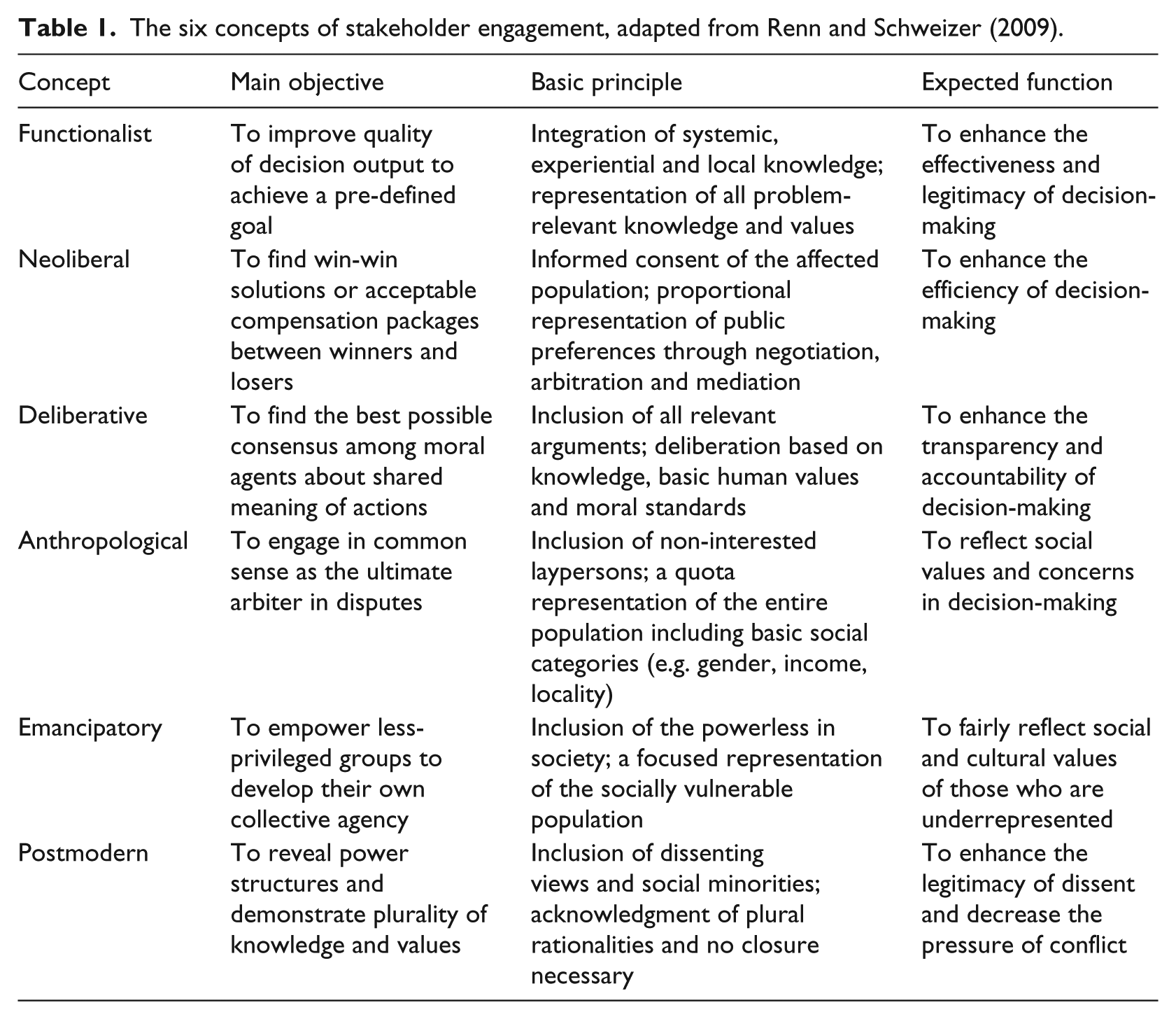
For example, a premise of public perception research on solar geoengineering builds largely on the anthropological concept, as many previous studies focused on exploring the ordinary lay citizen’s understandings of the topic to provide insight for democratic decision-making (e.g. Bellamy et al., 2017; Macnaghten and Szerszynski, 2013; Wibeck et al., 2017). A call for engaging the Global South with the solar geoengineering debate (Rahman et al., 2018; Sugiyama et al., 2017a; Winickoff et al., 2015) is grounded more on the emancipatory concept because such a call is usually motivated by a moral reasoning for giving a voice to the people who are most vulnerable to the impacts of climate change. On the other hand, a primary concern of scholars who proposed the ‘Oxford Principles’ of geoengineering governance slightly overlaps the neoliberal perspective by requiring the informed consent of those affected by the research activities to be obtained (Rayner et al., 2013).
As discussed above, the discourse of transdisciplinarity in Future Earth builds upon the integrationist view on engagement as a means for knowledge integration. This arguably mirrors the functionalist concept of participation to integrate all relevant knowledge and values for effective decision-making. The functionalist concept might well limit participation to some kind of ‘experts’ holding useful – either scientific or practical – knowledge (cf. Lidskog, 2008). Likewise, the Knowledge-Action Networks in Future Earth focus on bringing together ‘the broad range and diversity of specialist expertise represented in the large community of researchers and practitioners’ (Shrivastava et al., 2016). In other words, an interventionist inclination of linking knowledge with action would close a door of participation only for ‘experts’ but not open for everyone. 6 The ‘integration imperative’ (Klenk and Meehan, 2015) also assumes that imposing a consensus through knowledge integration is a precondition for effective decision-making. This partly – if not entirely – resonates with the deliberative concept since its main purpose of participation is to find a consensus among the engaged publics.
Overall, an integrationist impetus of solutionist science in Future Earth would likely order the mode of transdisciplinary engagement through a combination of the functionalist and deliberative concept. Renn and Schweizer (2009) favored this approach, calling it the ‘analytic-deliberative’ decision-making that combines the functionalist’s analytic force with deliberation’s consensus reaching potential. They advocate the analytic-deliberative model because they believe that this approach could produce a ‘tolerated consensus solution’ wherein ‘people who might be worse off than before, but who recognize the moral superiority of the solution, can abstain from using their power of veto without approving the solution’ (Renn and Schweizer, 2009: 182).
There is no doubt that the analytic-deliberative approach has many advantages and sometime offers solutions to a complex problem. However, such an approach can also create a ‘shadow’ by seeking consensus. The commitment to consensus necessarily involves a practice of inclusion and exclusion, which in turn conceals the ontological politics of knowledge (Emmenegger et al., 2017; Klenk and Meehan, 2015). When the debate is characterized more by disagreement than agreement, pursuing consensus is problematic because it will eliminate or oppress the dissenting opinions that might be valuable for addressing complex problems (Sarewitz, 2011). Consensus-seeking may also distract attention away from more urgent issues that require a pragmatic compromise between the disagreed parties, which would paradoxically hinder – rather than help – solving problems (cf. Pearce et al., 2017).
The dispute around solar geoengineering is instructive to capture the intractable nature of consensus-seeking, where experts cannot agree even on using the term ‘geoengineering’ (Sarewitz, 2011). One way to avoid this trap of consensus-seeking is to aim at mapping out the diverse viewpoints of people and revealing the disagreement among them. This approach to engagement is similar to the postmodern concept as its purpose is oriented toward showing the plurality of knowledge. Crucially, from this perspective, no closure on consensus is required – consensus may be reached as a possible outcome of deliberation but is not a mandatory requirement. The focal point of deliberation is placed on showcasing why and about what people disagree. For example, in the participatory exercise of appraising geoengineering proposals, Bellamy et al. (2016) could ‘open up’ the framings of geoengineering rather than ‘close down’ to an aggregated opinion by ensuring the inclusion of diverse perspectives and criteria (cf. Stirling, 2008).
Furthermore, when conflict is inescapable and consensus is far from achievable, as in the case of solar geoengineering, the engagement exercise to some degree comes closer to the neoliberal approach to participation of mediating competing interests. In reality, as van den Hove (2006) argued, stakeholder participation has to be balanced between ‘compromise-oriented negotiation’ and ‘consensus-oriented cooperation’. What is important here is that ignoring the negotiation dimension of participation risks leaving room for the powerful actors to covertly manipulate the participatory process, leading to their preferred outcome as a ‘pseudo consensus’. To avoid such risk of strategic manipulation, a fair and transparent procedure of making decisions is needed. One potential means for a fair arbitration is voting. If properly designed, voting can be useful to reach agreement (but not necessarily consensus) or clarify how agreement is reached (Guston, 2006).
Co-design research priorities through voting
In transdisciplinary research, a task of co-design usually includes defining problem frames and research agendas (Moser, 2016). As co-design might determine the ‘allowable space’ of scientific research by taking into account the interests of stakeholders from outside the science, its decision-making necessarily involves some friction, including a resistance of scientists to intervening in the autonomy of science. Through a negotiation between different societal visions and policy priorities, co-design presumes that scientists and stakeholders come together to identify research agendas, i.e. the goals and activities of a research project. In this process, they normally start from listing a priority of research questions, issues, areas and concerns. For example, Future Earth co-designed a set of research priorities to outline its overall research strategies (Future Earth, 2014). Thus, selecting research priorities can be seen as a crucial first step of co-design.
In this section, we discuss our own experience of co-designing research priorities on solar geoengineering, in which voting was employed in tandem with deliberation to facilitate the decision-making process (Sugiyama et al., 2017b). With a recognition of irreducible disagreement about solar geoengineering, the objective of our exercise was defined to map out the diverse perspectives regarding solar geoengineering. We emphasized to all participants of the exercise that this was not aimed at finding a consensual position, either endorsing or dismissing solar geoengineering as a potential option of climate change responses. The voting method was devised – borrowed from Sutherland et al. (2011) – primarily for practical reasons to winnow the list of research questions at time-constrained settings but was also conceived to mediate the contention between different perspectives. Thus, our exercise of co-design seems to be based partly on the postmodern and neoliberal conceptions of participation (see Table 1). The whole process of the exercise and the result of identified research questions is detailed in Sugiyama et al. (2017b). We focus here on discussing the role of voting as a procedural mechanism of guiding deliberations and making decisions in transdisciplinary engagement.
Situate voting in the deliberative process
Motivated by the desire to support evidence-based policy-making, Sutherland et al. (2011) developed a method for scientists and stakeholders to collaboratively identify research priorities on specific topics. The aim of their method is to incorporate the needs and concerns of policy-makers and other social actors into scientific research questions, thereby bridging the gap between knowledge and decision-making – their motivation therefore resonates with an interventionist impetus. The innovative part of this method is to use voting for identifying research priorities. In their method, the scientists and stakeholders gathered in a workshop setting are assigned to collaborate on selecting high-priority research questions from many ideas proposed by diverse individuals through an iterative process of voting and deliberation. The method has been applied to the various sustainability challenges such as biodiversity (Sutherland et al., 2009), agriculture (Pretty et al., 2010), poverty reduction (Sutherland et al., 2013), sustainable development goals (Oldekop et al., 2016) and water–energy–food nexus (Green et al., 2017). A similar method was also used in Future Earth to define its strategic research agendas (Future Earth, 2014).
Sutherland et al. (2011) suggested two different methods as voting systems: ‘mean-score-ranking’ and ‘remove-or-retain’. The former is to ask each participant to give each question a score (e.g. 1–10 scale) and rank all questions by the mean scores. The latter is to ask each participant to vote whether each question should be removed or retained, then rank all questions by the number of retain votes. In either case, the decision about selecting research priorities rests on the score of votes. These voting systems are efficient and practical when attempting to produce a list of high-priority research issues (somewhat) by consensus. This is why Sutherland et al. (2011) called their method the ‘priority-setting exercise’ – their focus is on clarifying a priority of issues or areas for scientific research to help better policy-making. In our exercise however, we considerably modified the voting rule of Sutherland et al. (2011) to adjust to our purpose of presenting the diverse perspectives on solar geoengineering as a form of research questions.
The basic rule of our voting was as follows: each participant (except workshop conveners) was given an equal, fixed number of votes, and were asked to vote for the questions to be retained; participants could not give each question more than one vote (one vote with one question); and most importantly, all the questions with at least one vote were retained and included in the final list of research priorities (only the questions with no vote were removed). Therefore, we did not assign priority to questions by the number of votes. This modified rule is aimed to ensure viewpoint diversity and policy impartiality. Because people have very different views on what are the highest priorities of issues or areas that research should address, the practice of selecting questions on the basis of the score or number of votes would inevitably marginalize the dissenting or minority views. Furthermore, the practice of defining research priorities by numbers itself can be perceived – even if not intended – as steering the research course toward a particular direction, either for or against solar geoengineering. Thus, while voting is often used to create an aggregated opinion, we instead employed it as a means to explore plural viewpoints regardless of their weight of opinions.
It is worth noting some basic contexts of our exercise. First, all the participants (30 in total) – both scientists (16) and stakeholders (14) – were experts of some kind in the climate policy field and were invited by considering the balance of their expertise, gender, age and political orientation. 7 Their personal views on solar geoengineering ranged roughly from moderate support to strong opposition. Second, the initial list of proposed research questions (before voting) was collected from a number of individuals who were solicited by the conveners and the participants through their social network. The proposed questions covered a wide range of subjects and concerns, from natural sciences to social sciences and humanities perspectives, from supportive to critical views over solar geoengineering. Third, the format of workshop was divided into the three group sessions in chronological order: (1) four parallel small breakout sessions, (2) two parallel mid-size breakout sessions and (3) one final plenary session. The initially proposed questions were allocated more or less equally to each group at the first small breakout sessions. The winnowed list of questions from the first sessions was combined and reallocated to the second mid-size breakout sessions, and the same process continued from the second sessions to the final plenary session. Each session had a pre-defined target number to which the questions were winnowed down. About 350 initially proposed questions before voting were eventually winnowed down to 40 research priorities at the end. Voting was used as part of group deliberations in each session (except the plenary session 8 ). Though the main purpose of voting was to select the questions, it also functioned as a communicative device for participants to exchange their opinions during group sessions.
The benefits and challenges of voting in co-design
What are then the advantages (and difficulties) of using voting as a procedural mechanism of co-design? We argue here that voting has three different benefits. First, voting has a benefit of efficiency for collective decision-making. Co-design is truly a time-consuming process. It requires a strong commitment of stakeholders to active participation – this is one of the most enduring practical challenges for transdisciplinary research (Klenk et al., 2015; Lang et al., 2012; Moser, 2016). Meanwhile, participation does not always lead to making a better decision or producing a substantive outcome, known as the ‘participation fallacy’ (Hirsch Hadorn et al., 2006). Because transdisciplinary research projects often take place in highly temporary settings (Felt et al., 2016), it is not practically sensible to overlook a trade-off between substantive engagement and efficient decision-making. With this regard, voting can be useful to reconcile these two competing demands by enabling collective decision-making under time-pressured situations. In our exercise, voting allowed us to produce a list of research priorities within a very tight schedule of a one-day workshop, otherwise difficult to do.
Yet, some participants in our exercise expressed their frustration with the limited space for deeper deliberation. While voting was embedded in the process of deliberation, the main task assigned to participants was inclined to be a ‘mere’ selection of research questions rather than a deep reflection on them. Owing to intense time pressure, there was little room for reframing pre-determined questions to articulate better their key messages. It is therefore advisable to be careful of finding a sound balance between the two different logics of ‘ordering research’: the logic of efficiency and effectiveness and the logic of openness and reflexivity (Felt et al., 2016; see also van der Hel, 2016).
Second, voting has a benefit of inclusivity by allowing each individual to have a right to make decisions. Moser (2016) notes that one of the most frequent challenges in co-design is related to communication. In fact, group conversations are quite often dominated by a few individuals holding better knowledge or language skills who can clearly articulate their opinions, and hence wield a strong influence on the outcomes. There always exist to some degree ‘unspoken hierarchies’ between those who are knowledgeable or communicative and those who are not (cf. Moser, 2016). From the communication perspective, voting can be seen as an important channel for the quiet, reticent persons to express their opinions and exert their power on decision-making. Also, there remains a deep-seated hierarchy in GEC science, i.e. a dominance of natural science (Lahsen, 2016; Lövbrand et al., 2015). Voting might break – or at least weaken – this hierarchy, for example, by giving more weight to the votes of social science and humanity scholars. In our exercise, no voting right was given to the workshop conveners because they were in a relatively powerful position by taking the role of facilitators for group discussions; meanwhile, an equal number of votes was allocated to scientists and stakeholders alike to treat them as equal partners, which is critical to building a mutual respect for each other (Moser, 2016).
However, there remains the issue of ‘silence’ and ‘non-participation’ in the solar geoengineering debate (Cairns and Stirling, 2014). In our exercise, some stakeholders declined our invitation or were very reluctant to participate because they considered talk of solar geoengineering itself as potential distraction from climate mitigation. There was also a serious concern among some participants that the outcome could be utilized strategically by someone as a pretext for legitimizing the development of solar geoengineering technologies – a danger of ‘co-option’ (Cairns and Stirling, 2014; see also Lang et al., 2012). A clear voting rule can ease such risk of exploitation but is not immune to it. On the one hand, abstention from a vote can be read as a form of ‘implicit endorsement’ (i.e. not necessarily approving but at the same time not explicitly opposing a resolution), while on the other hand it can also mean an objection to making a motion to vote in and of itself. Therefore, in some contexts, it might be advisable to read ‘silence’ or ‘non-participation’ as a form of dissent.
Third, voting has a benefit of learning by offering an opportunity of making choices. Voting is by definition the act of ‘active choosing’ to reflect an individual agency (Sunstein, 2015). According to Sunstein (2015, 2017), active choosing is valuable to promote learning about the underlying issues and develop one’s own preferences, values and tastes because people are pushed into, like it or not, at a state of making decisions. This holds particularly true for solar geoengineering as it is still largely an unfamiliar subject for the public (Burns et al., 2016; Wibeck et al., 2017). In our exercise, many participants did not yet have a personal stake in research on solar geoengineering; when confronted with a state of voting, they became more aware of their preferences related to solar geoengineering and more broadly climate change responses, thereby increased their own agency. Importantly, voting is based on an individual choice but designed for collective decision-making or ‘social choice’ (Guston, 2006). By setting a target number of selecting research questions, our exercise facilitated the negotiations among participants about, for example, whether merging several similar questions into one or keeping them separate independently. In this regard, negotiation should be understood not as a mere bargaining of given preferences (‘pure zero-sum game’) but as ‘a dynamic process in which preferences are endogenously constructed during the process itself, and where power relations are susceptible to change’ (van den Hove, 2006: 14). In other words, voting can foster reflexive learning, i.e. a recursive process of learning about the issue at stake and cognition of ourselves.
Meanwhile, as our attention was focused upon selecting research questions on solar geoengineering, the decision context was confined inevitably within this scope. There was not much space to explore the alternative policy approaches to climate change. Making choices always entails some degree of closure so that it is rather advisable to be aware of unintended ‘discursive lock-ins’ that may implicitly promote learning to normalize the speculative idea of solar geoengineering as a ‘real’ policy option (Bellamy and Lezaun, 2017). To avoid that, it requires a recognition that any decisions are temporary, can be reversed for any reason in the future. It is important to come always back to posing a simple but fundamental question: Can solar geoengineering proposals be considered a legitimate option for governing climate change?
Conclusions and future directions
Guided by the pessimistic narrative of the Anthropocene future where the Earth’s climate will exceed critical planetary thresholds and bring humanity into a dangerously hot planet (Steffen et al., 2018), the dangerous idea of solar geoengineering is coming out from a Pandora’s box. While most techniques are still hypothetical, the increasing trend of solar geoengineering research will probably continue for a while (Boettcher and Schäfer, 2017). For better or worse, it is thus important to consider how to govern solar geoengineering research.
As a new mode of governing science, transdisciplinarity could potentially provide a common ground for collaboration among different academic disciplines and social actors, allowing them to work and speak together on a same platform. Ideally, in the process of co-design where wider social, political and ethical concerns of stakeholders would be translated into scientific research agendas, it is hoped that transdisciplinary research will open the way towards ‘responsible innovation’ of solar geoengineering (Stilgoe, 2015). However, transdisciplinarity might very well also bring into a situation where the debate on solar geoengineering is trapped by entrenched divisions between the pros and cons of further researching, particularly stepping into highly controversial outdoor experiments (cf. Parson and Keith, 2013).
As discussed above, a solutionist belief that is firmly embedded in the Future Earth framework is directing the primary goal of GEC science into finding ‘solutions’ for global sustainability. Insomuch as a solutionist impetus is driving a change from ‘curiosity-driven’ research to ‘mission-driven’ research (cf. MacMartin and Kravitz, 2019), it is not entirely unimaginable that transdisciplinary GEC science within the Future Earth platform would shortly step into the research on solar geoengineering as one potential solution for stabilizing the functioning of the Earth system. The problem, however, lies in the solutionist inclination of using transdisciplinarity (and public engagement) as an instrument for creating consensus around what should be accounted ‘solutions’. While it is unlikely that solar geoengineering is going to be completely pulled off the table as a potential option, it is also impracticable and perhaps premature to reduce plural diverging opinions to one consensual position to accept it as a solution. This is because people embrace radically different political visions over solar geoengineering. Seeking consensus will not only neglect the people’s ambivalence to solar geoengineering (Asayama et al., 2017) but also run a risk of causing ‘politicization of science’ (Sarewitz, 2004), breeding political polarization and paralyzing reasoned debates about the risks and benefits of researching solar geoengineering.
We argue that, for navigating the contentious atmosphere of solar geoengineering research, transdisciplinarity can be conceived not as a solutionist device for making consensus but as an intermediary space where people with contending views are allowed to disagree without being forced to adopt a dominant, consensual view. Starting from a recognition of fundamental disagreement about solar geoengineering, scientists and stakeholders alike must engage more with transdisciplinary politics than transdisciplinary science. In other words, transdisciplinarity is more for governing political negotiation than managing scientific research. If politics is understood as ‘purposeful activities that aim for collectively binding decisions in a context of power and conflict’ (Brown, 2015: 19), the inherent nature of transdisciplinarity is more similar to politics than science because it requires collective decision-making by scientists and stakeholders on research agendas, goals and directions. This does not mean there is no space for science in transdisciplinarity – instead it signifies doing politics in science. And importantly, as politics necessarily involves contestation, ignoring the political dimension of transdisciplinarity (i.e. hiding conflict behind consensus) risks leaving room for strategic manipulation (van den Hove, 2006). This is why a fair and transparent mechanism of decision-making is needed to mediate conflict in transdisciplinary engagement.
We suggest that, if carefully designed, voting can be a useful tool to mediate the contentious process of transdisciplinary decision-making. Also, voting can offer three benefits for collective decision-making: efficiency, inclusivity and learning. While in our exercise we employed voting as a deliberative tool to elicit the diverse perspectives of people, voting is commonly used as ‘a mechanism of social choice’ (Guston, 2006) to aggregate separate individual opinions into a recognizable collective decision. Voting does not necessarily ensure acquiring a consensus but it can identify the level of agreement from ‘unanimity’ to ‘supermajority’ or ‘simple majority’. By carefully arranging the rule conditions (e.g. whom to allocate votes, how to cast votes, how to count votes), voting can settle the explicit procedure of decision-making and hence maximize the utility of decision-making (Guston, 2006).
Of course, voting is not a necessary condition for transdisciplinary decision-making nor is the best way to do so. With insufficient time and space for deliberation, voting can easily turn into a mere machinery of factional numbers game. Greater caution must be given against the expedient use of voting to bypass democratic deliberations. But, if – and only if – rightly placed within the deliberative process, voting can facilitate the democratic politics in science, and thereby may ensure the legitimacy of science for politics.
The experimentalist turn for Anthropocene science
At the end of the paper, we then want to discuss more broadly the future directions in which transdisciplinary GEC science should move forward in the era of the Anthropocene. The Anthropocene concept has drawn a great deal of attention from different disciplines, from natural sciences to social sciences and humanities, and the challenges posed to the humanity are truly transdisciplinary ones, requiring a critical debate across disciplinary and academic boundaries (Oldfield et al., 2014; Toivanen et al., 2017). The global scale of environmental challenges and their complex interconnections with the human system really demand an ever-greater collaboration on global change and sustainability research (Brondizio et al., 2016). Thus, boarding a carrier heading towards the transdisciplinary journey is the right move.
However, the vision of transdisciplinary GEC science, which is distinctly embodied in Future Earth, has been narrowly focused upon the logic of ‘accountability’ (i.e. responding to society’s needs) or ‘impact’ (i.e. producing usable knowledge for society) but has paid little attention to ‘humility’ (i.e. being humble and engaging in reflexive learning) (van der Hel, 2016). What is probably needed for Future Earth is to step back from seeking the immediacy of problem-solving and come to grips with the limit of science. The notion of transdisciplinarity should be divorced from the solutionist thinking which so far monopolizes the discourse of transdisciplinarity in Future Earth. When confronted with the unprecedented scale and complexity of the Anthropocene challenges, seeking an ‘optimal solution’ seems a futile attempt.
Shifting away from the solutionist paradigm, transdisciplinary science could embrace the experimentalist turn, which is more attuned to balanced social learning than expediential societal problem-solving (cf. Huitema et al., 2018). What we mean by ‘experiment’ here is not as a ‘research method’ but as an ‘approach to governing’ (Huitema et al., 2018) – or more likely, a normative standpoint for the way in which science is engaged with politics and society. Owing to the deeply uncertain trajectories of the Anthropocene futures, the science for the Anthropocene should be experimentalist in a sense that could present the multiple opportunities for open-ended learning about society, which stem from both the failures and successes of sociotechnical experimentations. The criteria for ‘usable’ knowledge produced by the Anthropocene science should be then based on flexibility and adaptability – not optimality and controllability – for learning creatively and catalyzing social change (cf. Clark et al., 2016; Moser, 2016).
After all, solar geoengineering can be seen as itself an experimental system (Stilgoe, 2016). Given the deep complexity and uncertainty involved, there will always remain ‘unknown unknowns’ in solar geoengineering – a door is left open to the unexpected and surprises. The research on solar geoengineering therefore has to offer a ‘safe-to-fail’ space for experimental learning instead of striving to make solar geoengineering a ‘fail-safe’ solution to dangerous climate change (cf. Clark et al., 2016). In other words, solar geoengineering must be reimagined not as a promise of technoscientific problem-solving but as ‘collective experimentation’ of the world (Stilgoe, 2016). Because the future is unknown, by allowing to learn about human society from experimenting with solar geoengineering, if ever used or not, humanity may find a way to live through the turbulent time of the Anthropocene.
Footnotes
Acknowledgements
We express our gratitude to all the individuals who spared their time to participate in our workshop and shared their insights for our research. We thank three anonymous reviewers for their comments on the earlier versions of this article.
Funding
The authors disclosed receipt of the following financial support for the research, authorship, and/or publication of this article: This study was supported by the Research Institute of Science and Technology for the Society (RISTEX), Japan Science and Technology Agency (JST) as part of the Future Earth programs. Shinichiro Asayama also acknowledges the receipt of financial support from Grants-in-Aid for JSPS Research Fellow (Grant Number 17J02207) of the Japan Society for the Promotion of Science (JSPS).
