




Abstract
Fire-centred studies have recently been highlighted as powerful avenues for investigation of energy flows and relations between humans, materials, environments and other species. The aim in this paper is to evaluate this potential first by reviewing the diverse theories and methods that can be applied to investigate the ecological and social significance of anthropogenic fire, and second by applying these to new and existing data sets in archaeology. This paper examines how fire-centred approaches can inform on one of the most significant step-changes in human lifeways and inter-relations with environment and other species – the transition from mobile hunting-gathering to more sedentary agriculture in a key heartland of change, the Zagros region of Iraq and Iran, c. 12,000–8,000 BP. In the review and case studies multiple links are investigated between human fire use and environment, ecology, energy use, technology, the built environment, health, social roles and relations, cultural practices and catastrophic events.
Introduction
Some of the greatest impacts of humans on Earth’s ecosystems stem from the use of fire. Fire has transformed landscapes, affected climate and consumed a wide range of resources in human utilisation of it to fuel particular economic, political and cultural strategies and perceived needs. The vital role of fire in human life and social relations is widely recognised from studies of its earliest uses, at least c. 800,000 BP and probably more than 1 million years ago (Dunbar and Gowlett, 2014; Mithen, 1998; Scott and Damblon, 2010; Wrangham and Carmody, 2010). Fire and hearths/ovens have an important role in the life of many societies in creating places of belonging and in transforming landscapes, materials, edible foods and spaces of being, by their energy, heat, smoke and light (Atalay and Hastorf, 2006; Hastorf, 2001; Nelson, 2010).
An investigation of human relations with fire is timely as new interdisciplinary fire-centred theories and analytical techniques enable more contextual and high-resolution analyses of fire use and traces. Clark and Yusoff (2014) highlight the value of fire-centred studies that integrate environmental, social and material approaches as these enable investigation of the dynamic inter-relations between environment and human energy use, ecology and social life, in the past, present and future. In the study of past traces of fire use, previous analyses of the physical traces of fire on archaeological sites, and indeed in landscapes, grapple with problems arising from difficulties in identifying the complex agencies and traces of fire. One of the reasons for this is that routine bulk or spot sampling techniques irreversibly group together diverse materials and micro-lenses, destroy contextual associations, and only selectively recover specific materials that are often then analysed separately (W Matthews et al., 1997; van der Veen, 2007; Wright, 2005). New microanalytical techniques, however, enable simultaneous analysis of diverse organic, inorganic and micro-artefactual materials in situ within their depositional context in resin-impregnated thin-sections and, thereby permit high-resolution analysis of traces of fire and their properties, sequence and associations that are crucial to identifying fire agencies, context and significance (Mallol et al., 2007, 2013; W Matthews, 2010; Schiegl et al., 2003: figures 2-3, 5-7; Weiner, 2010).
There are two principal aims in this paper. The first aim is to appraise ecological and social theories and approaches to the study of fire in order to examine more explicitly ways in which the context and significance of anthropogenic fire use can be analysed to investigate linkages, couplings and interactions between fire, natural systems and human practices at the multiple scales of landscapes, the built environment and individual fire events. The second aim is to apply these theories and approaches to examine archaeological traces of fire and fire use by integration of both new interdisciplinary analytical techniques and more routinely available excavation data. The objective in both the critique and the case studies is to examine the inter-relations between human fire use and environment, ecology, energy usage, technology, the built environment, health, social roles and relations, cultural practices and catastrophic events. The selected case studies examine how fire was used during one of the most significant transformations in human ecology and society – the major change from mobile hunting-gathering to more sedentary agricultural strategies on which modern life is based (Clark and Yusoff, 2014: 216). This paper investigates how fire use was impacted by and impacted on unprecedented changes in ecosystem management, built environments, material technology, social relations and cultural practices. Previous studies of early agricultural fire ecology and use have focused largely on Turkey and the Levant (Asouti and Austin, 2005; Gur-Arieh et al., 2014; Mentzer, 2014; Roberts, 2002). This paper examines new and existing data from the eastern Fertile Crescent to study the impact and use of fire in early agricultural environments and communities in another key heartland of change, as recent studies suggest that there was considerable regional and local variation in environment and ecological strategies and multiple centres of domestication (Riehl et al., 2015; Willcox, 2005; Zeder, 2009). It focuses in particular on the Central Zagros in Iraq and Iran to study highland–lowland variation in human–fire relations, with selective comparison with examples from Anatolia that have been examined in similar ways (Asouti and Austin, 2005; Asouti and Kabukcu, 2014; W Matthews, 2005a, 2005b, 2010; Mentzer, 2014).
The specific research questions examined are: were wildfires of natural or anthropogenic origin and how did they relate to and impact on human, plant and animal species and environment? What were the local vegetation and sources of fuel and how did these change through time in response to changing climate and greater human manipulation and impact on environment in the Early Holocene? What were the cultural uses and significance of fire and how did these change during the transition to more sedentary and agricultural lifeways? What wider implications are there for understanding human–fire relations and sustainable fuel use today?
This paper begins with an introduction to the case study sites and histories of investigation in the Zagros. It critically reviews methodologies in macro- and micro-analyses of palaeoecological and archaeological traces of fire and applications to the Zagros and interdisciplinary theories on fire ecology and use more widely. It then applies these methods and theories to examine changes in the environmental and socio-economic context of fire ecology and resources in the Central Zagros in the Early Holocene, and in specific uses of fire within the built environment. This last section examines changes in use and impact of fire in: food processing and cooking; interior spaces and the built environment; transformation of materials and technology and ritual; and as destructive force. In the concluding section the significance of these new interdisciplinary methods, theories and data are examined in turn with regard to fire use and environment, ecology, energy use, technology, the built environment, health, social roles and relations, cultural practices and catastrophic events.
Zagros case studies: Sites and history of investigation
The Zagros region of Iraq and Iran was one of the key native habitats of wild plants and animals that were domesticated in the Early Holocene, notably barley, goat, sheep and pig (Zeder, 2009). The Zagros mountain chain is up to 4500 m high and more than 1500 km in length. The aim in this paper is to investigate local and regional variation in fire ecology and use by study of sites along a major topographic and ecological highland–lowland transect, c. 250 km west–east in the Central Zagros, from c. 11,800 to 8600 BP (Figure 1). These sites span five topographic and geobotanical zones based on concepts of ‘climax’ vegetation (Zohary, 1973; see Asouti and Kabukcu, 2014). These zones comprise:
Upper/Highland Zagros mountains and intermontane valleys, with site elevations at >1300 m and peaks of >2500–3000 m, classified as upper Kurdo-Zagrosian steppe-forest vegetation
Lower/Piedmont Zagros mountains with valleys and plains, with site elevations of 400–1300 m, with peaks >500–1700 m, classified as lower Kurdo-Zagrosian steppe-forest vegetation
Zagros piedmont-steppe, at the edge of the Mesopotamian steppe and plains, <500 m, below the limit for oak growth (van Zeist 2008: 26), classified as Mesopotamian steppe (Artemisieteae)
Mesopotamian lowland steppe <500 m, classified as Mesopotamian steppe (Artemisieteae)
Khuzestan alluvial plain <500 m, classified as Nubo-Sindian vegetation (Zohary, 1973).
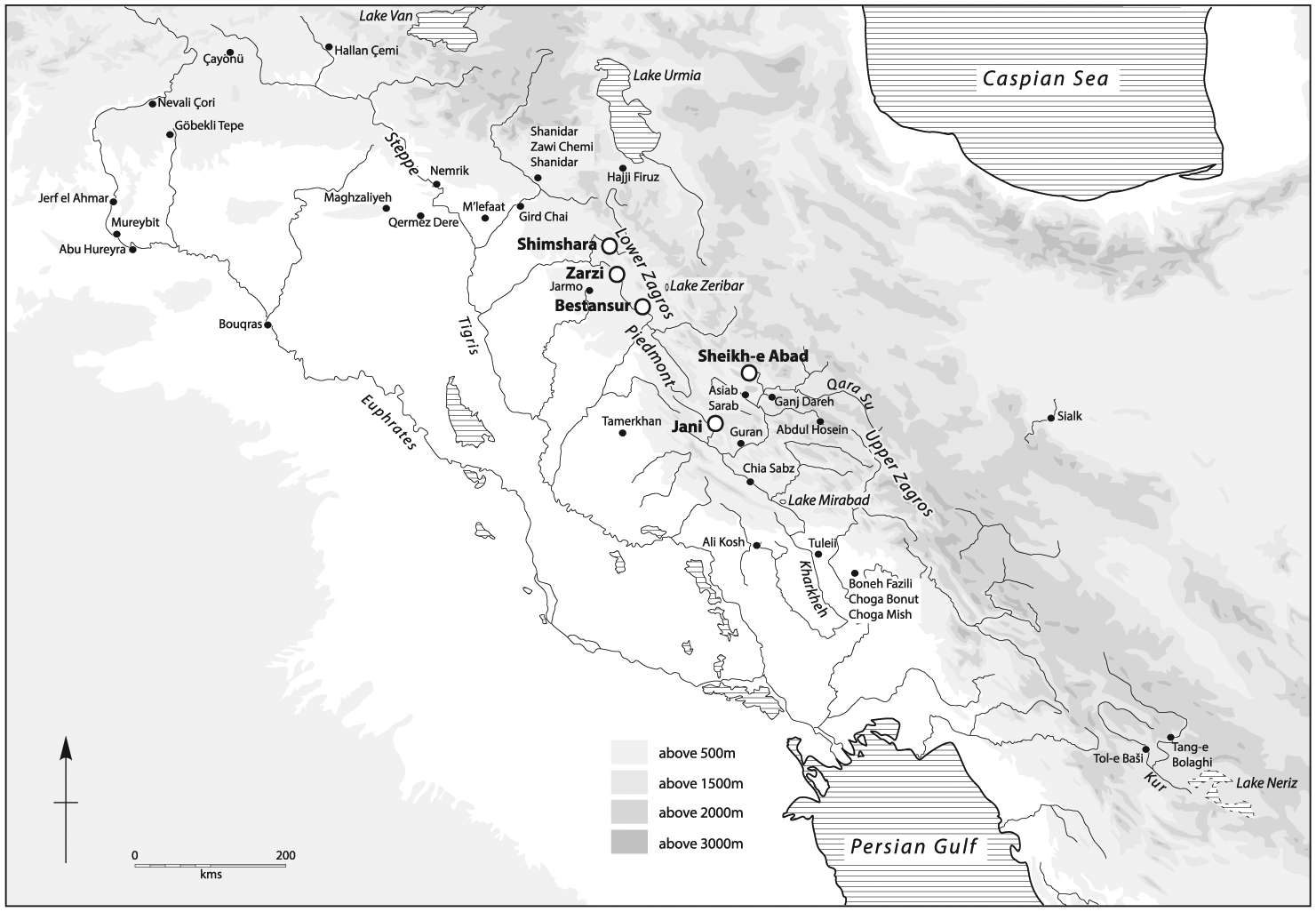
Location of Early Holocene sites in the Zagros.
Pioneering investigations on the origins of agriculture were conducted in this region in the 1940s–1970s at sites such as Asiab, Ganj Dareh, Ali Kosh and Jarmo (Braidwood et al., 1983; Hole et al., 1969; Smith, 1990), recently 14C dated by Zeder (2008: table 3). New excavations at a wide range of Neolithic sites in the Zagros are currently being conducted in both Iran (R Matthews and Fazeli, 2013) and Iraq (W Matthews et al., 2014). The original new research examined in this paper is from the sites of Sheikh-e Abad and Jani in Iran at 1400 and 1200 m a.s.l. c. 11,800–9000 BP (R Matthews et al., 2013) and Bestansur and Shimshara in Iraqi Kurdistan at 553 and 493 m a.s.l. c. 7660–7000 BP (R Matthews et al., in preparation; W Matthews et al., 2014).
Methods: Interdisciplinary analyses of fire on archaeological sites from the Zagros
A wide range of analytical techniques have been applied to archaeological analyses of fire and its diverse organic and inorganic traces from the scale of landscapes to individual burning events within settlements (see Mentzer, 2014: table 1). The Zagros data on anthropogenic fire examined in this paper is drawn from: palaeoecological analyses of lake cores; macroscopic analyses of excavated archaeological features, materials and deposits; bioarchaeological analyses of charred plant remains; and new integrated micromorphological, biomolecular, geochemical and phytolith analyses of traces of fire.
Published multiproxy palaeoecological data on climate, environment, vegetation, fire and potential sources of fuel is examined from lake cores from: Zeribar (basal age c. 40,000 BP; Stevens et al., 2001; Stevens et al., 2008; van Zeist and Bottema, 1977; Wasylikowa and Witkowski, 2008), Lake Urmia (< c. 2000,000 BP; Bottema, 1986, Djamali et al., 2008; Stevens et al., 2012) and Lake Mirabad (< c. 10,300 BP; Griffiths et al., 2001; Stevens et al., 2006; van Zeist and Bottema, 1977); and springs with sedge fen marshes at Lalabad (< c. 40,000 BP) and Nilofar (< c. 28,000 BP; W Matthews, 2013; Wasylikowa and Witkowski, 2008).
Indicators of fire on archaeological sites examined here include: fire installations (hearths and ovens) and fire-spots to study in situ combustion and the socio-economic context and use of fire; fire-rake-out and discard to study the range of discarded burnt materials on sites and their depositional pathways; artefacts and materials such as pottery and fired-lime plasters transformed by fire to study increasing use of pyrotechnology; and buildings/areas destroyed by fire to examine the nature and context of their burning. These characteristics are examined for published excavation data from Zagros sites listed in Figure 1 and new excavation data from Sheikh-e Abad, Jani, Bestansur and Shimshara, cited above.
Most previous reviews of Neolithic ecology and fire focus on charred plant remains recovered by water-flotation and screening (Charles, 2008; Zeder, 2009). Published palaeobotanical data on charred plant remains reviewed here include: in the upper Zagros, Ganj Dareh (van Zeist et al., 1986), Tepe Abdul Hossein (Hubbard, 1990; Willcox, 1990) and Sheikh-e Abad (Whitlam et al., 2013); in the piedmont Ali Kosh (Helbaek, 1969), Jarmo (Helbaek, 1960; Watson, 1983) and Chogha Golan (Riehl et al., 2012, 2013); the north Mesopotamian steppe at Qermez Dere and M’lefaat (Savard et al., 2006); and in the alluvial plains Chogha Bonut (Miller, 2003). Sites with data from analysis of charred seeds and wood are highlighted in italics, other sites represent here data from charred seeds only.
Charred plant remains, however, only represent those plants that were exposed to low temperature burning at <400–500°C, and preservation of plant parts during combustion as well as water-flotation retrieval is highly variable (Boardman and Jones, 1990; Hubbard, 1990; van der Veen, 2007). A wide range of other plants remains are also preserved in geobotanical and archaeological records of fire including phytoliths and calcitic ashes and are detectable by micromorphological and phytolith analyses (W Matthews, 2010; W Matthews et al., 2013; Piperno, 2006; Shillito, 2011, 2013).
This paper explores new micromorphological analyses of intact sequences of deposits to examine the nature and context of diverse organic, inorganic and micro-artefactual indicators of fire in large resin-impregnated thin-sections, 14 cm × 7 cm, 25–30 μm thick, from the upper Zagros at Sheikh-e Abad, lower Zagros Jani (W Matthews et al., 2013, 2014), and the piedmont at Bestansur and Shimshara (R Matthews et al., in preparation). These indicators were analysed in optical polarising and oblique incident light, and incident light fluorescence (Leica Filter system AS, Filter system N2.1S: wavelength excitation 515–560 nm, transmitting >590 nm), following internationally standardised procedures developed by Bullock et al. (1985); Courty et al. (1989) and Stoops (2003). Plant remains were identified by reference to key atlases and reference collections (W Matthews, 2010; Piperno, 2006; Rosen, 1992; Schweingruber, 1990). Dung fuel remains in thin-section were identified by analysis of dung morphology, internal structure and contents, including calcareous spherulites that form in the guts of animals during digestion (Brochier, 1992; Canti, 1999; Courty et al., 1989; Macphail et al., 1997; W Matthews, 2010) and comparison with experimental samples collected in collaboration with Anderson and Ertug-Yaras (1998). Spot samples of deposits were also examined by optical polarising microscopy in the field, mounted in clove oil, to provide immediate feedback during excavation on presence/absence of calcareous dung spherulites and phytoliths.
This paper also draws on published new palaeobotanical data on plant opal silica phytoliths extracted from spot samples from the upper Zagros at Sheikh-e Abad linked to micromorphological thin-sections (Shillito and Elliott, 2013), and from the alluvial plain at Chogha Bonut (Rosen, 2003).
Micro-analyses of materials and pigments in micromorphological thin-sections have been conducted using synchrotron based infrared (IR) microscopy and environmental scanning electron microscopy with energy dispersive x-ray analysis (Anderson et al., 2014). Additional analyses using IR spectroscopy and microscopy to study burning temperatures are currently in progress in collaboration with Professor M Almond, following approaches in microarchaeology established by Weiner (2010).
Portable x-ray fluorescence (pXRF) analyses were applied to detect elevated levels of phosphorus at Bestansur by Elliott (in press; W Matthews et al., 2014) to locate potential dung fuel in areas of burning for verification by spot optical, micromorphological and GC/MS analyses, and for phytolith analyses of dung contents as indicators of animal diet and ecology.
Biomolecular analysis using gas chromatography/mass spectrometry (GC/MS) was conducted to identify traces of coprostanols and bile acids indicative of ruminant and omnivore faeces and sources of dung fuel in spot samples, many of which are linked to micromorphological thin-section samples for comparative micro-contextual analyses (W Matthews et al., 2014; Shillito et al., 2013).
Ethnographic and experimental analyses of fire traces have largely been drawn to date from comparative literature (e.g. Boardman and Jones, 1990; Braadbaart et al., 2012; Mallol et al., 2007, 2013), with some studies at Bestansur (Elliott et al., 2015).
Theories in studies of fire ecology and use
A wide range of disciplines inform our understanding of anthropogenic fire as fire energy, phenomena and materials interact with diverse Earth systems and biota; and human encounters with fire and deployment of it are influenced by a range of ecological, technological, socio-economic, political and cultural considerations. This section critically examines a selection of the theories and approaches that can inform our understanding of past human–fire relations and archaeological indicators of these. It begins with consideration of interdisciplinary approaches to the study of human–fire relations, then examines theories and approaches in investigation of fire ecology and fuel selection, and the socio-economic context and specific uses of fire, which are inter-related and are explored in the following case studies and conclusions. These theories and approaches are drawn from ecology, anthropology, material studies and archaeology, with specific reference to issues investigated in the case studies.
Interdisciplinary theories and approaches in the study of human–fire relations
One of the most recent examinations of theories and approaches in the study of human–fire relations and the social and economic context of these was conducted by Clark and Yusoff (2014), building on earlier research by Pyne (1994, 1997) and Wertime (1973). Clark and Yusoff encourage consideration of energy-centred social theories (Bataille, 1991, 1993) that examine how communities produce and manage fire energy and how, in doing this, social existence is connected to the life of the planet more widely. They also explore Pyne’s (1994, 1997) environmental histories of fire use and management and Wertime’s (1973, 1983) analyses and histories of pyrotechnology to examine fire energy flow and how this is incorporated in social life and economic and political relations. They examine sensual and experimental aspects of human use of fire, drawing in part on Bachelard’s (1994) philosophical psycholanalysis of fire, as well as the transformative properties of fire and the social management and implications of this, drawing on Pyne (1994, 2001) and Wertime (1964). The potential implications of past histories of fire for more sustainable and equitable practices in the present and future are also considered, drawing on current political theories in the study of fuels as socially available energy and fire as an ‘entanglement of social and energetic “powers”’ (Clark and Yusoff, 2014: 211). In their analyses they develop and apply anthropogenic geologic approaches to study and trace the sources, properties, energy and impact of fire materials, properties and energy. A range of these interdisciplinary fire-centred theories and approaches are explored in this paper.
Interdisciplinary theory in fire ecology and fuel selection
Early theories from behavioural and evolutionary ecology of optimal foraging behaviour suggested that landscapes and resources such as fuel will be selected and managed to provide optimal returns in cost-benefit terms, and could thereby be examined by analysis and modelling of net energy expenditure and caloric value (Smith, 1983). However, it has been repeatedly demonstrated that many human foraging strategies are not optimal and involve consideration of a wide range of historically contingent ecological and socio-cultural circumstances and values (Zeder, 2012: 256). Current archaeological theories and approaches, therefore, are more contextual and examine in greater depth the complex co-relations between humans and environment, and the properties and networks of agencies, knowledge, energy and materials. Zeder (2012: 257) in particular, highlights fire as one of the ways in which humans modify the environment to enhance the abundance, accessibility and predictability of plants and animals in particular niches, and thereby create new types of environments and relations with and between species, drawing on niche construction theory (Odling-Smee et al., 2003). In the Zagros case studies below, this paper examines whether landscape fires in the Early Holocene were natural or anthropogenic in origin, and how fire may have impacted on environment and human, plant and animal species and relations and niche construction (section ‘Early Holocene environment and vegetation biomass: Fire incidence and fuel sources’).
The selection of materials for fuel and combustion is rarely directly correlated with environmental abundance or distance from source. Factors influencing the choice of firewood include: the production and abundance of readily collectable drywood which varies according to tree/shrub species, age and structure of stands, seasonality, climate and environment (Asouti and Austin, 2005: 8); microclimates, environments and responses of particular species to natural or anthropogenic disturbance by fire, grazers, browsers, clearance for cultivation, and management by coppicing and cutting (Asouti and Austin, 2005: 8). Other factors influencing fuel selection include: ecological and social strategies, which vary between mobile hunter-gatherers, nomadic pastoralists and settled agriculturalists (see summary in Asouti and Austin, 2005: tables 2–4); associations between particular tasks and goals in which fuel collection may be combined with hunting, gathering or foraging for other resources such as plants for food or crafts (Charles et al., 2014); as well as social and cultural perceptions of particular resources and their performance properties, value, use and materials/residues arising from these. Investigations of these factors can be informed by anthropological and anthropological theories on the inter-relations between environment, dwelling and taskscapes (Ingold, 2000), and the entanglement of flows of energy, matter and information (Hodder, 2012), which are used here to study the relations between fire and particular communities, places and tasks (Hodder, 2011: 157; Marchant and Lane, 2014). There has been some tendency to polarise male and female roles and tasks in the Neolithic, associating hunting and herding with males and the domestic sphere with females (Hodder, 1990). The interdependent roles of men, women and children, however, are more clearly understood if all stages in particular strategies are considered, such as here with regard to fire, fuel collecting, transport, processing and storage, and use of fire in hunting or land clearance and food processing and cooking, drawing on gender and life-cycle studies (see Bolger, 2010: 507). The interconnectedness of people with each other and environment, materials and energy have also recently been explored in studies of their entanglement (Hodder, 2011, 2012).
To examine the environmental, economic and socio-cultural considerations influencing fuel selection and fire use, therefore, the case studies investigate the correlation between local vegetation, fuel sources and ecological and social strategies in the Zagros and how these changed during the transition to increasing sedentism and early agricultural lifeways (section ‘Fuel resources and combustion properties’).
Interdisciplinary theory in the socio-economic context and specific uses of fire
The social and cultural power of fire in drawing people together as well as excluding others have been widely studied, drawing on theories in cognitive evolution (Dunbar and Gowlett, 2014; Mithen, 1998), and is explored below in the case studies on the role of fire in the development of increasing associations with place and early sedentism (section ‘Socio-economic context of fire use: early sedentism and enclosure of fire’). With regard to how fire affects the senses, perception, decision-making and social relations, well-established research in archaeology on phenomenology can be drawn on (Pawłowska, 2014; Sorensen et al., 2014; Tilley, 1994), as here to examine the changing phenomena and management of fire within early sedentary settlements (section ‘Phenomenology of interior fires: the built environment and health’). Bloch (2010), in particular, has examined how constructed settings such as fireplaces may be used to mark continuity in social roles and relations by providing a place that represents these and that can be returned to. In light of this, the construction, placement and use of increasingly enclosed fireplaces in early built environments is critically evaluated to investigate social roles and relations in more sedentary early agricultural communities in the Zagros (section ‘Fire and social roles and relations’).
With regard to the role of fire in the transformation of materials, the significance of fire in enhancing the processing, preservation and nutritional values of newly domesticated foodstuffs in the Zagros is examined (section ‘Food processing and cooking facilities’), drawing on theories and approaches in anthropology, ethnoarchaeology, experimental and food sciences (Atalay and Hastorf, 2006; Hillman, 1984; Wrangham and Carmody, 2010). The use of fire in transformations of materials for construction and artefacts and in technological innovations can be informed by consideration of wider theories and approaches on technological choices and the biographies and life-cycles of materials, which are critically applied here to study innovation in early construction materials and artefacts in early sedentary communities (section ‘Transformation of materials: technology and ritual’). Approaches to technological choices (Dobres, 2000; Schiffer, 2003; Sillar and Tite, 2000; Skibo and Schiffer, 2008) examine how ecological, social, economic, political, cultural, technical and performance considerations are evaluated in the production, transformation, use and discard of materials and explicitly examine fire ecology, pyrotechnology and use (Wertime, 1983). Theories on the biography and life-history materials (Appadurai, 1986) examine the historical agency and significance of specific materials throughout their life cycle and can also inform studies of both the ecological and social context of fire and fuel from source to discard as well as fire as cultural agency. Fire, and the phenomena and materials generated by it, have long been attributed with ritual and symbolic properties and agency (Hastorf, 2001; Hodder, 1987). In particular, smoke has been seen as an intercessionary between beings and worlds as well as having properties of purification or danger. To explore these anthropological aspects of fire, the case studies below, therefore, examine where and how fire was located, managed and used to create and transform relations between people, place and materials in increasingly sedentary and agricultural communities.
Interpretations of destruction of buildings and settlements by fire in the Neolithic of Europe have drawn on theories and approaches in archaeological studies of conflict, warfare, catastrophe and ritual (Stevanovic, 1997). They also benefitted from forensic (Harrison, 2013) and IR investigations (Forget et al., 2015). The environmental and health aspects of fire in archaeology have been investigated by drawing on research in medical and pathological sciences, the built environment and experiment (Christensen and Rhyl-Svensden, 2015). Select examples of how these can be investigated in the Zagros are examined in the final section of the case studies (section ‘Fire as destructive force’).
This fire-centred study, therefore, like that of Clark and Yusoff (2014), aims increasingly to integrate ecological and social theories and approaches in order to examine more fully the interdependent environmental and socio-economic agencies, contexts and considerations influencing energy and carbon flows, and human access to, use and management of these.
Contextual and experimental approaches to fire: Linking theory, method and data
Central to all theories, and the approach developed in this paper here, are contextual approaches that examine the general, particular and specific context of agencies, phenomena and materials and their properties and life-histories, as developed in material culture studies more widely (Robb, 2010). Studies of the post-depositional context, taphonomy and preservation of fire traces and materials are of especial importance to archaeology, as understanding of these is fundamental to all subsequent analyses of the temporal and spatial associations and significance of fire. Major contributions to our understanding of archaeological traces of past fire are currently being made by experimental and ethnographic studies as well as developments in micro-contextual analytical techniques, including micromorphology, which is applied here. Mallol et al. (2007, 2013) in particular, have highlighted ways in which the best preserved traces will often be those that that were rapidly buried as they have often been less subject to post-depositional disturbance and alteration.
Environment and fire ecology and fuel selection in the Central Zagros
How such theories and approaches may be used to inform analyses and interpretations of traces of fire is explored in the following case studies. The first section, here, examines the inter-relations between fire ecology and fuel selection, and environment and socio-economic context in the Early Holocene in the Zagros. The following section examines specific fire uses and impact in early built environments (section ‘Specific uses and phenomenology of fire’).
Early Holocene environment and vegetation biomass: Fire incidence and fuel sources
With regard to the role of natural and anthropogenic fire in landscape modification and niche construction (section ‘Interdisciplinary theory in fire ecology and fuel selection’; Zeder, 2012), climate, environment and vegetation are fundamental parameters in the nature and incidence of wildfires and anthropogenic fire use and fuel availability, and are in turn impacted by fire, as investigated here.
Many Early Holocene sites in the Zagros were situated on ecotone boundaries in environs that provided access to diverse resources and watercourses or springs. Tree pollen, however, only represents <5–15% of taxa from Lake Zeribar cores in the Early Holocene, at 1000 m a.s.l. This was initially interpreted as indicating that the climate was colder and drier in the Zagros, and less hospitable to occupation than other regions (Hole, 1996; Roberts and Wright, 1993; Stevens et al., 2001). However, more recent palaeolimnological and stable isotope evidence from Lake Zeribar and Urmia suggests that the Central Zagros region was wetter than today in the Early Holocene (Stevens et al., 2012; Wasylikowa and Witkowski, 2008). It is likely that tree cover and wood resources were more extensive than these low pollen values imply. Some of the tree genera identified are likely to be under-represented in the pollen sequence, as pistachio is a poor pollen disperser and almond is insect pollinated. Oak pollen is also sparse (<5–10%) in this and the wider Irano-Anatolian phytogeographic region during the Early Holocene. Thus, the scarcity of tree species probably also reflects other factors, including greater distance from Mediterranean refugia of the Younger Dryas, and habitat competition from native browsers and humans as well as grasses (Djamali et al., 2010; Roberts, 2002). Browers such as wild goat were present in the upper Zagros in the Early Holocene and there is increasing evidence of human settlement in the region from at least 11,800 BP (R Matthews and Fazeli, 2013; R Matthews et al., 2013) and of wood-cutting for fuel and timber (W Matthews et al., 2013; Roberts, 2002; Willcox, 1990). Pollen data indicate that there was a rapid increase in grasses from <20% of the assemblage c. 12,000 BP to 50% by c. 10,500 BP, which is significantly higher than values observed today (<20%) and sufficiently abundant to have posed a risk to young oak growth and been less susceptible to seasonal drought (Asouti and Kabukcu, 2014: 168).
Fire is likely to have played a role both in the restriction of trees and in the spread of grasses as fire favours the rapid regeneration of grasses and shrubs over trees (Asouti and Kabukcu, 2014: 169). A rapid increase in landscape fire is attested from 11,800 cal. BP by a spike in microcharcoal from burnt grass awns in Lake Zeribar cores, as in other regions (Turner et al., 2008, 2010; Wasylikowa et al., 2006). This burning may have been due to wildfires from lightning strikes during rapid climate warming in this storm-prone region that is likely to have increased seasonal growth and then drying out of biomass (Lewis, 1972). It may also have been due to human fires, either accidental or deliberate to create open grassland for hunting and early collection and cultivation of large-seeded grasses (Roberts, 2002) in niche construction (Zeder, 2012), as human settlement is also attested from c. 11,800 BP in the region (R Matthews et al., 2013). A decrease in grasses from 10,500 BP is coincident with the appearance of Plantago lanceolata associated with disturbed ground and an increase in human settlement and evidence for goat herd management from at least 10,000 BP (R Matthews and Fazeli, 2013; R Matthews et al., 2013).
It is likely, therefore, that the Early Holocene environment was influenced by a range of climatic, topographic, biogenic and anthropogenic agencies that included anthropogenic fire and early settlement and agricultural and land management practices, as in other regions (Marlon et al., 2013; Roberts, 2002). Lake core data suggest available fuel sources in the lower Zagros mountain region at Zeribar included tree and shrub wood, leaves and nuts, grass, reed and sedge stems, leaves and roots, and other steppe and steppe-forest plants including legumes. Cores from Lakes Urmia, Mirabad, Lalabad and Nilofar suggest the vegetation in these regions was similar, although there were more Chenopodiaceae in lower more southerly regions of the Zagros at Mirabad (van Zeist, 2008).
Fuel resources and combustion properties
Selection and use of fuels, however, are not directly correlated with environmental abundance nor distance from source, and are also influenced by and can inform on ecological and social strategies and practices, as discussed more widely, above (section ‘Interdisciplinary theory in fire ecology and fuel selection’; Asouti and Austin, 2005; Asouti and Kabukcu, 2014; Charles et al., 2014).
Plant remains identified on archaeological sites in the Zagros are attested not only as charred remains but also as pollen (Leroi-Gourhan, 1969); phytoliths (Rosen, 2003), impressions of plants, phytoliths, melted silica and calcitic plant ash (Figure 2; W Matthews, 2010; W Matthews et al., 2013, 2014). From this evidence, a range of fuel types have been identified at Early Holocene occupation sites in the Zagros, including trees, shrubs, reeds, grasses and ruminant and omnivore coprolites.
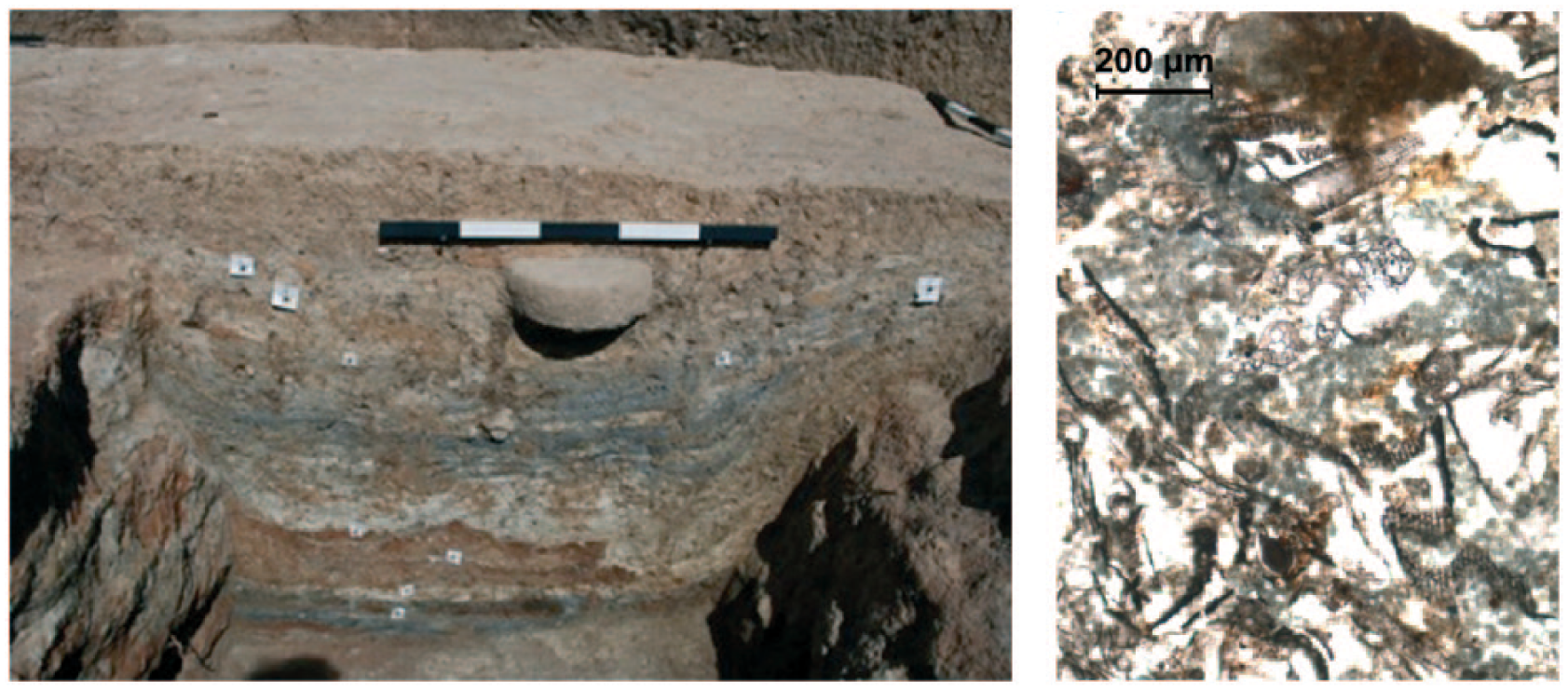
Large interior oven with grass and reed fuel, burnt at temperatures up to >850°C (see Canti, 2003): articulated phytoliths, melted plant opal silica and calcitic plant ashes. (Plane polarised light (PPL)). Building 5, Bestansur, Iraq.
Ecological variation in combusted materials and fuel
There is some evidence that selection of fuels varied according to local environments, precipitation gradients and resource availability. Wood was more commonly burnt on archaeological sites in the highland areas than the piedmont and steppe where charred wood is almost absent and current precipitation is below that capable of sustaining oak, for example (Djamali et al., 2010). In highland sites, charred wood is present at Sheikh-e Abad from 11,800 BP and comprises 85–98% of the charred plant assemblages c. 10,000–9500 BP at Ganj Dareh (Van Zeist et al., 1986) and Abdul Hosein (Willcox, 1990), though trees are poorly represented (<15%) in pollen sequences from Zeribar. In lower piedmont sites charred wood is also present from at least c. 9000 BP at Jarmo (Helbaek, 1960) and Shimshara (see Figure 5). The presence of oak wood in considerable quantities at Jarmo suggests that oak may have recolonised these lower altitudes by this date (Helbaek, 1960; Watson, 1983) and/or was a preferred source of wood. By contrast, charred wood was sparse at sites in the piedmont-steppe region and absent at sites in the lowland piedmont-steppe and plains of Deh Luran and Khuzestan, at Ali Kosh and Chogha Bonut (Helbaek, 1960; Miller, 1996, 2003).
Reeds and grasses were used as fuel across all Zagros ecological zones in the Early Holocene. New phytolith and micromorphological analyses indicated that they were one of the principal sources of fuel in some lower Zagros, piedmont and lowland sites, including Jani (W Matthews et al., 2013; Shillito et al., 2013), Bestansur (Figure 2), and Chogha Bonut (Rosen, 2003). The abundance of reeds at these sites suggests wetlands may have been more extensive in the Early Holocene (Helbaek, 1969; Hubbard, 1990: 218; Rosen, 2003: 131).
Dung has also been identified as a common choice of fuel in all regions from at least: 10,000 BP in the upper and lower Zagros by new integrated micromorphological and GC/MS analyses (Figure 3; Shillito et al., 2013; W Matthews et al., 2013, 2014); 9660 BP in the piedmont zone at Bestansur (Elliott et al., 2015) and 9500 BP in the piedmont-steppe at Ali Kosh (Miller, 1996; Miller and Marston, 2012).
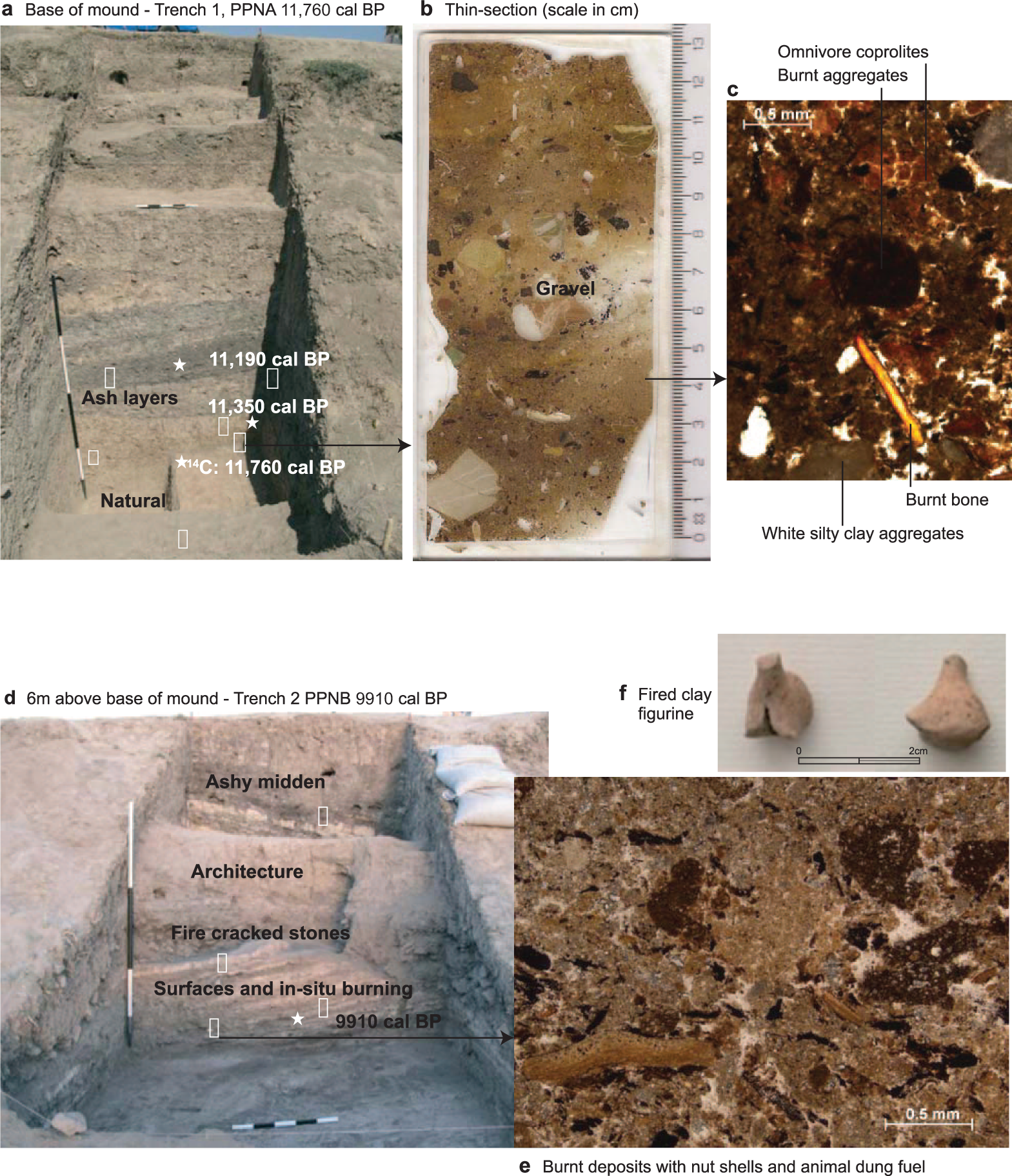
Early ash layers in Trench 1: (a) field section profile (scale = 2 m); (b) resin-impregnated thin-section; (c) burnt aggregates, omnivore coprolites and bone (PPL). In situ burning and ashy deposits in Trench 2: (d) field section profile (vertical scale = 1.5 m, horizontal scale = 50 cm; (e) burnt deposits with nut shells, calcitic plant ash, charred plant remains and animal dung fuel (PPL); (f) fired-clay figurine.
Management, conservation and collection of fuel: Socio-economic strategies
There is increasing evidence that step-changes in woodland management and firewood selection correlate with early stages in the shift in human diet from biodiverse sources to a focus on particular species, during the adoption of agriculture and more sedentary lifeways in the Zagros, and thereby changes in ecological strategies and lifeways more widely (Asouti and Austin, 2005). This shift included a decline in consumption of tree crops such as nuts in favour of cereals. At Ganj Dareh, this shift corresponds with a rapid change from use of Prunus as the principal source of firewood (50%) and conservation of Pistacia trees that supplied abundant nuts – 41% of the charred seed/fruit assemblage in Level E – in 10,000 BP, to use of Celtis/Pistacia as the principle firewood (91%) c. 9950 BP when consumption of nuts declined to only 3.8% and domestic cereals were cultivated in Level D (van Zeist et al., 1984: 222), perhaps also linked to land clearance for early agriculture. This shift corresponds with an expansion in settlement and building construction at Ganj Dareh. By contrast, trees that were highly valued as building timbers were rarely selected for firewood, such as poplar/willow – identified as timbers in burnt destruction debris (Smith, 1990; van Zeist et al., 1984: 221–222). These examples highlight how shifts in fire ecology are closely linked to wider changes in socio-economic strategies and changes in the conception and evaluation of woodlands and land management (Marchant and Lane, 2014).
There are indications that fuel was also collected and selected with a view to other complementary goals, tasks and strategies (section ‘Interdisciplinary theory in fire ecology and fuel selection’; Charles et al., 2014; Ingold, 2000) and was entangled in these (Hodder, 2012). At Ganj Dareh and other Zagros sites, the branches used for fuel may have provided leaf and twig browse fodder for goats (see Halstead and Tierney, 1998), as attested by alternating lenses of non-burnt phytoliths from dicotyledonous woods and grasses, sedges and reeds in an animal at Sheik-e Abad, c. 9600 BP (W Matthews et al., 2013, 2014; Shillito and Elliott, 2013). These branches may also have been collected from coppicing and pollarding to increase tree growth, as outlined by Asouti and Kabukcu (2014) for oak in Anatolia.
Reed, sedge and grass fuel sources may have also been a by-product of other activities including attested uses for roofing, matting, basketry, fodder and edible crops such as large-seeded grasses, cereals and tubers (Figure 2; Braidwood et al., 1983; R Matthews et al., 2013). Harvesting of reeds, sedges, grasses and cereals is attested by the presence of a glossy sheen on chipped stone tools from a range of sites including Ganj Dareh (van Zeist et al., 1984: 201) and Bestansur (R Matthews et al., in prep). Stands of these reeds, sedges and grasses may have been managed and propagated by fire in the Early Holocene, as shown by the abundance of microcharcoal, including awns in Lake Zeribar (Turner et al., 2008, 2010; Wasylikowa et al., 2006).
Selection and use of dung as a fuel source correlates with and is an indicator of the early stages of greater human proximity to and management of animals by at least c. 10,000 BP in the Zagros (W Matthews et al., 2013, 2014; Miller, 1996; Riehl et al., 2012, 2013, in press) and in Southwest Asia more widely (e.g. W Matthews, 2005b; Miller and Marston, 2012; Shahack-Gross, 2011; Shillito et al., 2011, 2013; Stiner et al., 2014). Dung is an excellent source of fuel and is preferred over wood by some potters today as it retains its structure and thereby burns evenly, maintaining oxidised burning conditions (Sillar, 1998). Hesse (1984: 26) argues that dung was such a highly valued source of fuel, especially in regions with few trees, that it was one of the key motivators in the domestication of goat.
Socio-economic context of fire use: Early sedentism and enclosure of fire
Fire-related activities were one of the foci of early visits to many Early Holocene Zagros sites, both before and after the development of agriculture c. 10,200 BP, and were thereby central in developing associations with place at many sites that later became longer-lived settlement mounds, and in creating and representing social relations (section ‘Interdisciplinary theory in the socio-economic context and specific uses of fire’; Bloch, 2010; Clark and Yusoff, 2014). Ethnographic studies by Watson (1979) in the high Zagros highlight how specific stone-constructed hearths are repeatedly returned to each year by individual family groups in mobile pastoralist communities, as the focus of their summer camp for food processing, cooking, light, heat, protection from predators such as wolves and socialising. In another ethnographic example from the Zagros, Arshi and Kasraian (1994/2001), observed that the fundamental household unit, a nuclear or extended family, is called the ojaq, ‘oven’, in semi–nomadic communities that have a village-base. During migration to highland summer pastures, these households coalesce to form larger social groupings, the obah, but when the group returns to their winter houses the larger grouping dissolves and most decisions are made within the household ‘oven/hearth’ group. Whilst these modern examples cannot be directly transferred to Early Holocene societies, they provide some insight into ways in which fire is a key element and phenomenon in social relations (see Atalay and Hastorf, 2006; Clark and Yusoff, 2014; Hastorf, 2001; Nelson, 2010), and how there may have been periodic fission and fusion of social groupings, as suggested for other Upper Palaeolithic/Neolithic communities (Roberts and Rosen, 2009; Wengrow and Graeber, 2015).
The earliest visits to Early Holocene sites in the Zagros left evidence of: digging and occasional lining of pits, for storage and/or fires; accumulations of ash and fire-cracked stones probably used for grilling and roasting food and radiant heat; and debitage and chipped stone tools from a range of activities, including hunting and butchery (Figure 4).
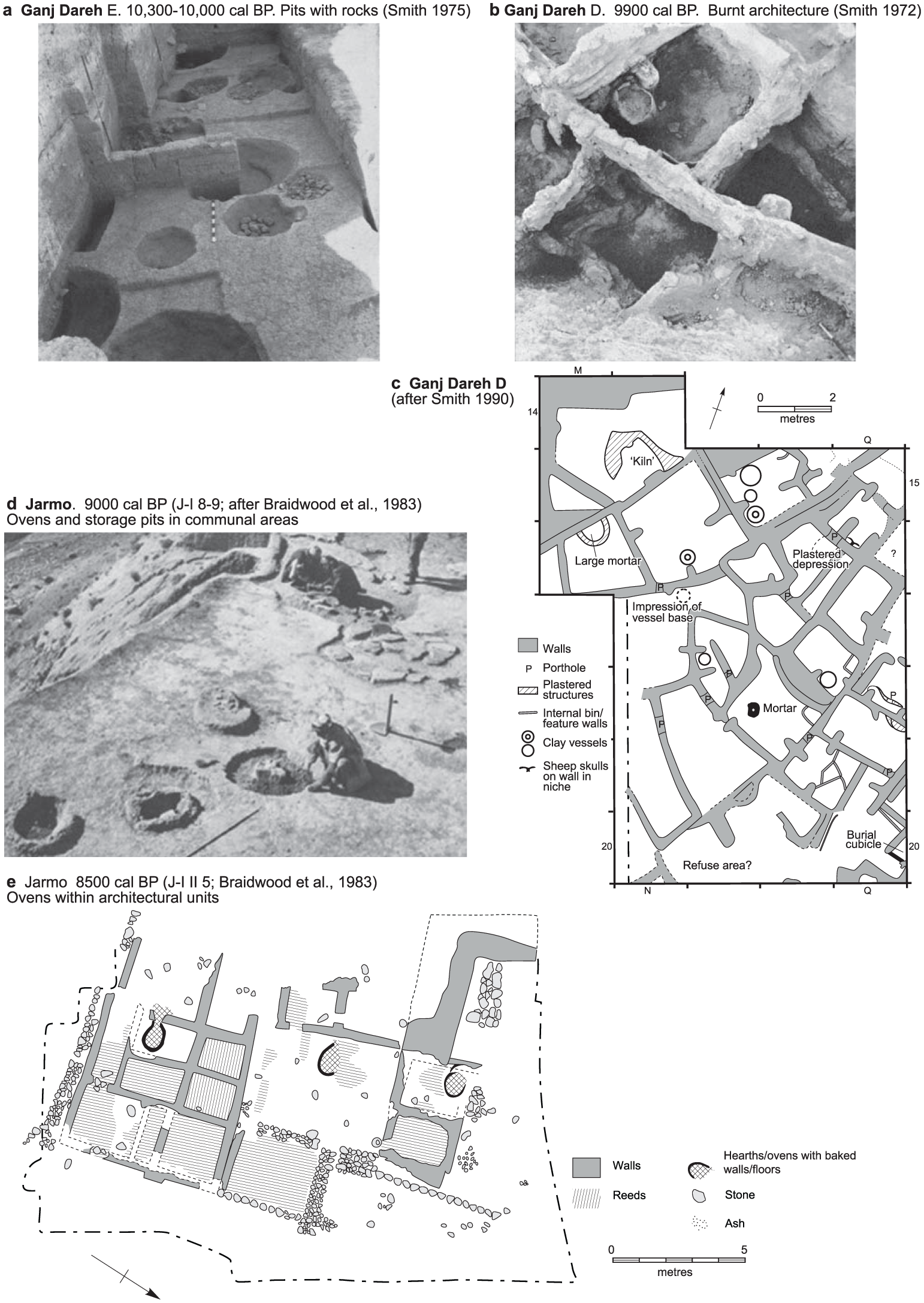
Ganj Dareh, Iran: (a) Neolithic pits with fire-cracked stones Level E (after Smith, 1975: pl. IIIa); (b)–(c) Level D burnt architecture and features (after Smith, 1972: pl Ic, 1990: figure 1). Jarmo, Iraq (d) Ovens and pits in communal areas (J-I 8-9, after Braidwood et al., 1983: figure 74). Courtesy of the Oriental Institute of the University of Chicago; (e) ovens within architectural units (after Braidwood et al., 1983: figure 51).
The scarcity of groundstone tools for food processing in many early levels suggests these sites represent shorter visits for management and collection of resources. Examples of sites with evidence of such periodic activities include in approximate chronological order from 11,800 to 8000 BP: Sheikh-e Abad, East Chia Sabz, Asiab, Jani, Ganj Dareh E, Tepe Abdul Hosein, Tepe Guran, Jarmo, Chogha Bonut and Sarab (SV5). Sites, such as Ganj Dareh Level E and Asiab were clearly used for hunting, collecting and perhaps management of seasonally abundant resources, including wild birds, land snails and clams, and social gathering and perhaps feasting. Ganj Dareh E is likely to have been occupied between the months of May and October, to collect Pistacia nuts and harvest and sow barley. These dry months are also a preferred time for collection of firewood in semi-arid environments as wooded areas are more accessible and drywood is more abundant (Asouti and Kabakcu, 2014: 12). At Jani and Tepe Guran, residues from the earliest fire-related activities are fragmented and mixed with natural sediment, suggesting less frequent deposition and greater exposure to erosion and thereby more intermittent visits rather than permanent occupation, as observed in ethnographic and micromorphological studies of temporary hunter-gatherer hearths (Jani Phase 1, Figure 5; Mallol et al., 2007). Traces of architecture have been identified in early levels of some sites, including burnt aggregates from possible fire installations and isolated fragments of construction materials at Sheikh-e Abad and Chogha Bonut, and short stretches of walls perhaps to provide a wind break for fires at Ganj Dareh E and Jarmo JII9-8.
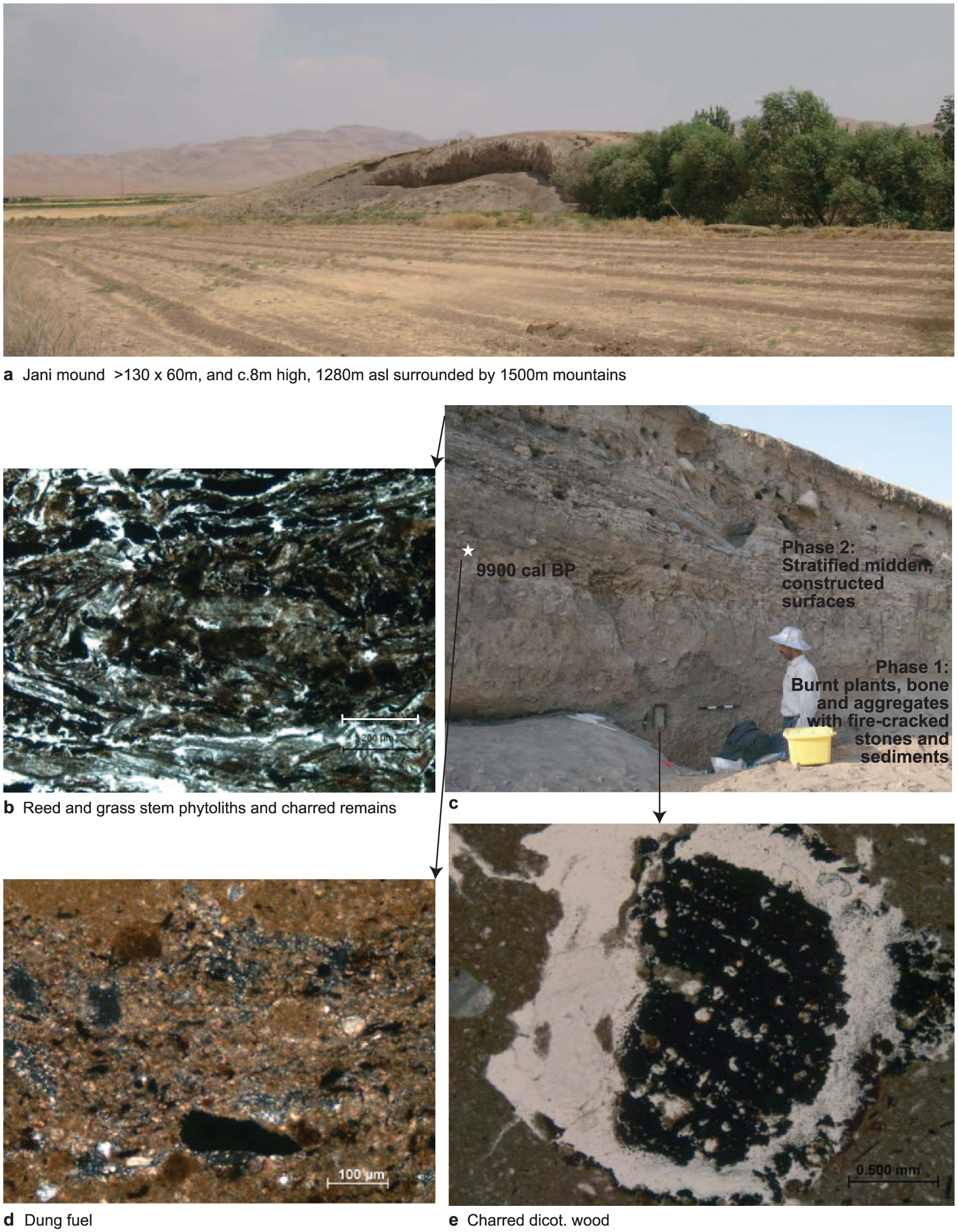
Sequence of traces of fire at Jani, Iraq: (a) Jani mound and environs; (b)–(c) reed and grass stem phytoliths and charred plant remains in stratified midden deposits (Phase 2, scale = 50 cm) and (d) dung fuel (cross-polarised light (XPL)); (e) charred dicotyledonous wood in sediment-rich deposits with fire-cracked stones (Phase 1).
The low mounds of ash from fires in these early sites (Figures 3, 5) may themselves have been viewed as representative of associations with place and of land rights, wealth, roles and status, including access to woodlands and animals for firewood and dung fuel, rivers and marshes for fish, clams, fresh water mussels and reeds, and land for nuts, large-seeded grasses, legumes and land snails, as observed in ethnographic and anthropological studies more widely (Bloch, 2010; Hodder, 1987; Ingold, 2000). Hayden (2009) argues that periodic feasting was one of the ways in which social relations, obligations and any inequalities were created and naturalised in many sites in the Neolithic, as also observed in Central Turkey (Twiss, 2008). Certainly, many of the Zagros sites were visited early in their history for collection and consumption of seasonally abundant resources that could have supported large social groups. In these early levels, fire-related activities were conducted in communal open area contexts, suggesting food processing and cooking facilities and roles may have been shared by several groups (Bernbeck, 2004: 144; Bloch, 2010). The repeated plastering and renewal of many of fireplaces, as at Jarmo JII9-8 and at Jani Phase 3, suggests specific fire installations may have been associated with and maintained by individuals or small groups within these communal areas such as the hearth-groups of seasonally mobile communities observed in ethnographic research in the Zagros that returned to the same fireplaces each year (Arshi and Kasraian, 1994/2001; Watson, 1979). This evidence suggests dual associations to both community and smaller social groups, as explored by Wengrow and Graeber (2015) with regard to Upper Palaeolithic hunter-gatherers.
In the later levels of many Zagros sites, by contrast, hearths and ovens were less frequently placed in communal areas, and were instead incorporated and bounded within architectural units (Figure 4), suggesting food processing and cooking were less communal and more segregated within individual social units. This change corresponded with alterations to the design of buildings from very small-roomed structures to buildings with larger, more rectilinear rooms that could have housed greater numbers of people and a wider range of activities, as at Ganj Dareh, Level B (Smith, 1990), and Jarmo J–I, 6b–d and J–II,5 (Figure 4; Braidwood et al., 1983: figures 41, 51). The increasing segregation and compartmentalisation of fire and other activities has been observed at a wide range of Neolithic sites across the Middle East and is argued to be part of wider socio-economic changes that emphasised the household as a unit of production and consumption (Bogaard et al., 2009; Byrd, 2000; W Matthews, 2012a) and arena for social relations (Baird, 2005). This greater segmentation of social groups and activities around fire installations correlates with increased sedentism and the adoption of agricultural practices in many communities. That many of these discrete architectural units had fireplaces highlights the significance of fire-related activities and the roles associated with them for these social groups, as observed by Bloch (2010) with regard to the continuity of social concepts and roles afforded by more permanent fixtures and fittings within houses at Çatalhöyük (W Matthews, 2005a) and more widely.
Specific uses and phenomenology of fire
What were the specific uses and impacts of fire within these early built environments and communities, discussed above? How were they affected by and influential in changes in increasingly sedentary and agricultural lifeways in the Early Holocene? This section examines archaeological and microanalytical evidence for the type, context and impact of fire use in: food processing and cooking; the phenomenology and health of built environments; transformations of materials in technological and ritual applications; and as destructive force with reference to specific examples from the Zagros and wider theory and approaches (section ‘Interdisciplinary theory in the socio-economic context and specific uses of fire’).
Food processing and cooking facilities
Some of the earliest facilities for fire use at many sites in the Zagros comprise open or pit fires associated with fire-heated rocks, which themselves provided a versatile local or portable source of radiant heat, as at Ganj Dareh E (Smith, 1975, 1990), Sheikh-e Abad Trench 2 (R Matthews et al., 2013) and Bestansur, c. 10,000–9600 cal. BP. Hot rocks could have been used for heating as well as food processing or cooking through: drying/smoking of foodstuffs by suspending these over fireplaces with rocks in situ; parching/toasting/grilling/griddling/baking by placing foodstuffs onto heated rocks either in the fire or onto other surfaces; roasting by placing rocks within pits – often covered; boiling/stewing/grease extraction by placing rocks directly into foodstuffs in containers of skin, wood, basketry or pottery (after c. 10,000 BP) (Atalay and Hastorf, 2006). Within the fire-pits with heated rocks at Ganj Dareh E, the presence of Pistacia nut shells suggests that heat was used to open shells and roast nuts to enhance access, preservation and taste, and/or that shells were used as kindling after consumption as they are highly combustible; and of barley grains suggests that heat may have been used to toast/parch grains to enhance ‘shelf-life’, storage and taste (Hillman, 1984; van Zeist et al., 1984: 219, 221).
Technological innovation in construction of pisé/mudbrick ovens, significantly enhanced management of combustion temperature, oxygen flow, duration and safety by providing a controllable contained environment for fire use, from at least 9750 BP at Ganj Dareh B. The plastered interior and exterior surfaces of these ovens would have generated radiant heat and enabled many of the food processing and cooking stages provided by hot-rock technology, as well as enhanced and added to these. The smooth plastered surfaces of constructed ovens could be more readily used without contaminating foodstuffs and cleaned and renewed over time, concomitant with as well as facilitating more year-round sedentary occupation. The discovery of quantities of charred domesticated and wild barley in a domed oven within a building at Tepe Guran suggests that these structures enabled larger-scale toasting/parching of grain than that permissible using hot-rock technology (Meldgaard et al., 1963; Renfrew, 1969). At Bestansur, a range of fire technologies were used including use of heated rocks and open fires in external areas, as well as large constructed and plastered ovens, within rectilinear multiroomed building complexes (R Matthews et al., in prep).
These fire technologies would have favourably impacted the nutritional value of foods, making them more digestible (Wrangham and Carmody, 2010). They would have increased the range of substances that could be eaten and stored as well as dishes and tastes, particular from newly domesticated and more palatable varieties of plants such as cereals and legumes, and at some point milk products – known in Turkey from c. 7950 BP (Evershed et al., 2008). As food is often central to identity as well as sensual pleasures (Hastorf, 2001) and there is some evidence for local variation in food crops across the Zagros (Charles, 2008), it is likely that sites may have provided different meals with which to nurture and entertain each other and their guests, and that these would have varied seasonally. Suggested Neolithic menus are provided by Atalay and Hastorf (2006).
Phenomenology of interior fires: The built environment and health
With regard to the phenomenology of fire and its impact on experience, decision-making and social relations discussed above (section ‘Interdisciplinary theory in the socio-economic context and specific uses of fire’; Sorensen et al., 2014; Tilley, 1994), the enclosure of fire within constructed buildings created sheltered environments and thereby itself facilitated early sedentism and year-round occupation, particularly during the extremes of cold and wet seasons in the Zagros. Problems of overheating of interiors in the summer would have been mitigated by use of open fires in exterior open areas or placing ovens in small rooms to insulate particular sections of buildings from heat generated, as at Jarmo J-I II 5, c. 8500 BP. Ovens may also have been constructed and used on flat roof tops, as attested by a rare example on a collapsed roof at Neolithic site at Çatalhöyük. These rooftop ovens were probably principally used in warmer months, as oven rake-out is periodically covered by accumulations of rain-wash/snow-melt sediment (W Matthews, 2012b).
Use of fires, hearths and ovens within buildings is also likely to have had an impact on human health as fire heat, smoke and particulates are a health hazard affecting respiratory tract and eyes and tissues (Christensen and Ryhl-Svendsen, 2015; Scott and Damblon, 2010). That smoke did affect interior spaces is attested by the accumulation of soot on multiple layers of whitewash on wall plaster fragments from Shimshara, 9th millennium BP (Figure 6; W Matthews, in prep). These layers of soot and whitewash closely resemble those from the Neolithic site of Çatalhöyük, where seasonal exterior and interior variations in soot accumulations have been identified corresponding with evidence for seasonal oven use (W Matthews, 2005a, 2005b, 2012b).
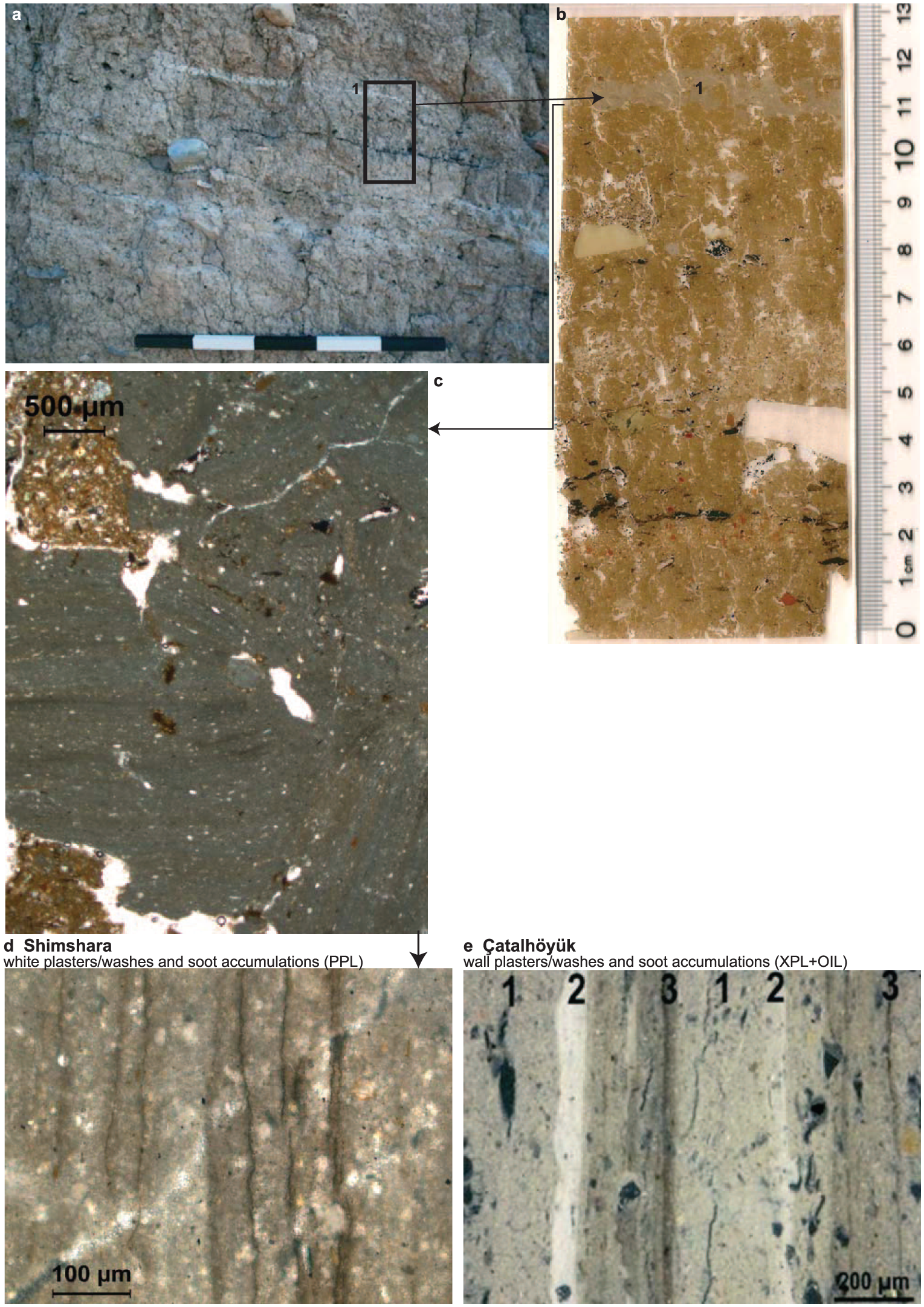
Traces of soot accumulation on Neolithic wall surfaces. Shimshara, Iraq (a) field-section profile (scale = 50 cm; (b) resin-impregnated thin-section; (c) layer comprising aggregates of re-deposited wall plaster (PPL); (d) white wall plasters/washes and soot accumulations (PPL). Çatalhöyük, Turkey, Building 5 (e) white wall plasters/washes and soot accumulations (PPL).
Carbon residue on ribs of some individuals buried below house floors at Çatalhöyük suggest smoke impacted elderly more house-bound individuals (Molleson et al., 2005: figure 12.19). At Tepe Abdul Hossein in the high Zagros Iran, one fireplace had a flue to conduct interior smoke and thereby improve health and comfort for this Neolithic community (Pullar, 1990: plate 8). Air circulation within rooms, prevailing winds and landscape and settlement topography would have had an effect on fire performance and efficiency, including smokiness and draw, and may have influenced the location of fireplaces. The location of fire installations within buildings would also have been influenced by and affected interior illumination as well as articulation of activities and social relations. Fire is also a purifying agent capable of killing microbiological organisms and reducing the toxicity, harm and bulk of noisesome materials such as decaying organic materials and coprolites (Schiffer, 1987). Many components in refuse deposits examined from the Zagros are burnt (Figures 3, 5), highlighting both the value of sources of waste as combustible materials as well as fire in refuse management.
Fire and social roles and relations
The repeated plastering of hearths/ovens in the Zagros, as at Jani (R Matthews et al., 2013) and Jarmo (Braidwood et al., 1983), for example, attests to remarkable continuity in use. This practice supports Bloch’s (2010) suggestion that such fixtures, by their durable nature, provide enduring representations of key social concepts, roles and relations and enable these to be returned to and passed on, affording social stability and continuity (section ‘Interdisciplinary theory in the socio-economic context and specific uses of fire’). In the case of hearths and ovens, these roles are likely to include food processing and preparation, production of craft materials, social and cultural events and gatherings, and the social identities and relations that make these possible, as noted in ethnographic studies for more mobile communities (Watson, 1979). Other aspects of fire that contribute to a sense of belonging and to social memory are the smells and sounds of fire (Pawłowska, 2010; Sorensen et al., 2014), whether evocative of the home, a particular social gathering or catastrophe.
Transformation of materials: Technology and ritual
One of the principal effects of the thermodynamic energy of fire is transformation of material properties. In some societies these transformations may also be considered ‘magical’ and used to mark and enhance particular places or objects (Hastorf, 2001). Fire energy was increasingly harnessed in the creation and elaboration of human material worlds during the Neolithic, as well as in crafting more durable construction materials such as fired-lime, and artefacts such as ceramic vessels and figurines, in its wider potential as a cultural agent (Clark and Yusoff, 2014; Pyne, 1997; Wertime, 1973) and as a source of energy in technological choices (Sillar and Tite, 2000). In Southwest Asia, one of the first materials markedly transformed by fire was fired-lime, c. 12,000 BP, which once rehydrated hardens to provide a rigid waterproof and highly durable material (Goren et al., 2001; Kingery et al., 1988). Production of fired-lime requires large quantities of fuel and sustained temperatures >750–850°C, and thereby represents considerable investments of energy as well as pyrotechnological skill, which was shared across Neolithic communities along exchange networks in Southwest Asia (Özdögan, 2002). In the Zagros, fired-lime or gysum was used for containers at Ganj Dareh A, c. 10,000 BP. It was also used to surface two large elaborate buildings at Tepe Guran (Levels J and E) c. 9000–8600
The production of fired-lime was initially argued to have been one factor in the environmental degradation that lead to the collapse of Neolithic sites in the Levant (Garfinkel, 1987), although climate and social factors are now considered more likely. Meldgaard et al. (1963) suggests that traces of a white powder in a fire-installation from Guran may have been from fired-lime production, but no analyses like those at Çatalhöyük have yet been conducted (see Anderson et al., 2014; W Matthews, 2005b; W Matthews et al., 2013). In the Zagros, fire was also used in modification of bitumen to affix flint in implements such as arrows or sickle blades and cowry shells, probably to skulls as eyes (R Matthews et al., in prep).
Fire was a key element in the innovative production of ceramics across Southwest Asia and the Zagros in the Early Holocene (Boivin, 2008). The lining of ovens was fired during use and manufactured from specially selected alluvial sources with abundant sand size minerals of quartz and feldspar that absorb thermal shock, attesting specific technological choices, as at Çatalhöyük, Turkey (W Matthews, 2005b). Fired and non-fired-clay figurines of human and animals are found at many Epi-Palaeolithic–Early Neolithic sites in the Zagros, including Karim Shahir, Asiab, Ganj Dareh, Ali Kosh, Sarab and Jarmo, where >5500 have been found. The hard-fired ceramic figurines would have facilitated repeated handling either in ritual practices or by children as symbolic objects, ‘toys’ (Figure 3). Some figurines were only fired at low temperatures, are more schematic or remoulded and often occur in secondary discarded contexts (Braidwood et al., 1983), as at Bestansur (R Matthews et al., in prep). In these cases, fire may have been perceived as potent energy and incorporated into acts such as wish magic, supporting suggestions by Morales (1990) and Daems (2008). ‘Clay’ tokens were also variously fired and repeatedly handled and may have been used symbolically and/or as accounting devices or gaming pieces in these communities.
Use of fire as a potent focal point and energy in itself is suggested by micro-contextual analysis of the occasional presence of red pigment in ashes, as at Jani (W Matthews et al., 2013). The colour red is generally considered cross-culturally to be symbolic of life (Tacon, 2004), and was used throughout Southwest Asia in the Neolithic, particularly in burials and wall paintings. At Jarmo red pigment was apparently randomly scattered (Braidwood et al., 1983). At Jani, micromorphological analyses reveal that flecks of red pigments are associated with floor sweepings in layers of charred reeds and grasses. Traces of charred reeds and flecks of red pigment were also identified scattered across a floor with four wild male goat skulls, one smeared in ochre, and a wild male sheep skull in what is probably a ritual building (Building 2) at Sheikh-e Abad c. 7600
Fire as destructive force
There is considerable scope for fire-forensic investigations in the Zagros (section ‘Interdisciplinary theory in the socio-economic context and specific uses of fire’). At Ganj Dareh, Level D, c. 9950 BP, an entire level of buildings was destroyed by fire (Smith, 1990). At Abdul Hosein at least one building in 12-H was catastrophically burnt, trapping a crouching male, female and infant (Pullar, 1990: 61, plate 12). The bodies themselves were not burnt and cranial injuries suggest they may have been crushed by falling debris. The site lies close to one of the major Zagros fault lines so it is possible that the fire occurred after an earthquake, as suggested by Berberian et al. (2012). At Shimshara, at least three building levels (16, 13 and Figure 7) were destroyed by fires with temperatures in some areas high enough exceptionally to partially melt and crack stone artefacts (Mortensen, 1970: figure 44), suggesting attainment of temperatures rarely encountered on other Neolithic sites. The cause of these fires is currently unknown, but they may have been sparked and/or fanned by the high winds that currently periodically funnel through an adjacent gap in the mountains cut by the Lesser Zab river, <4.7 km, distant to the northeast.
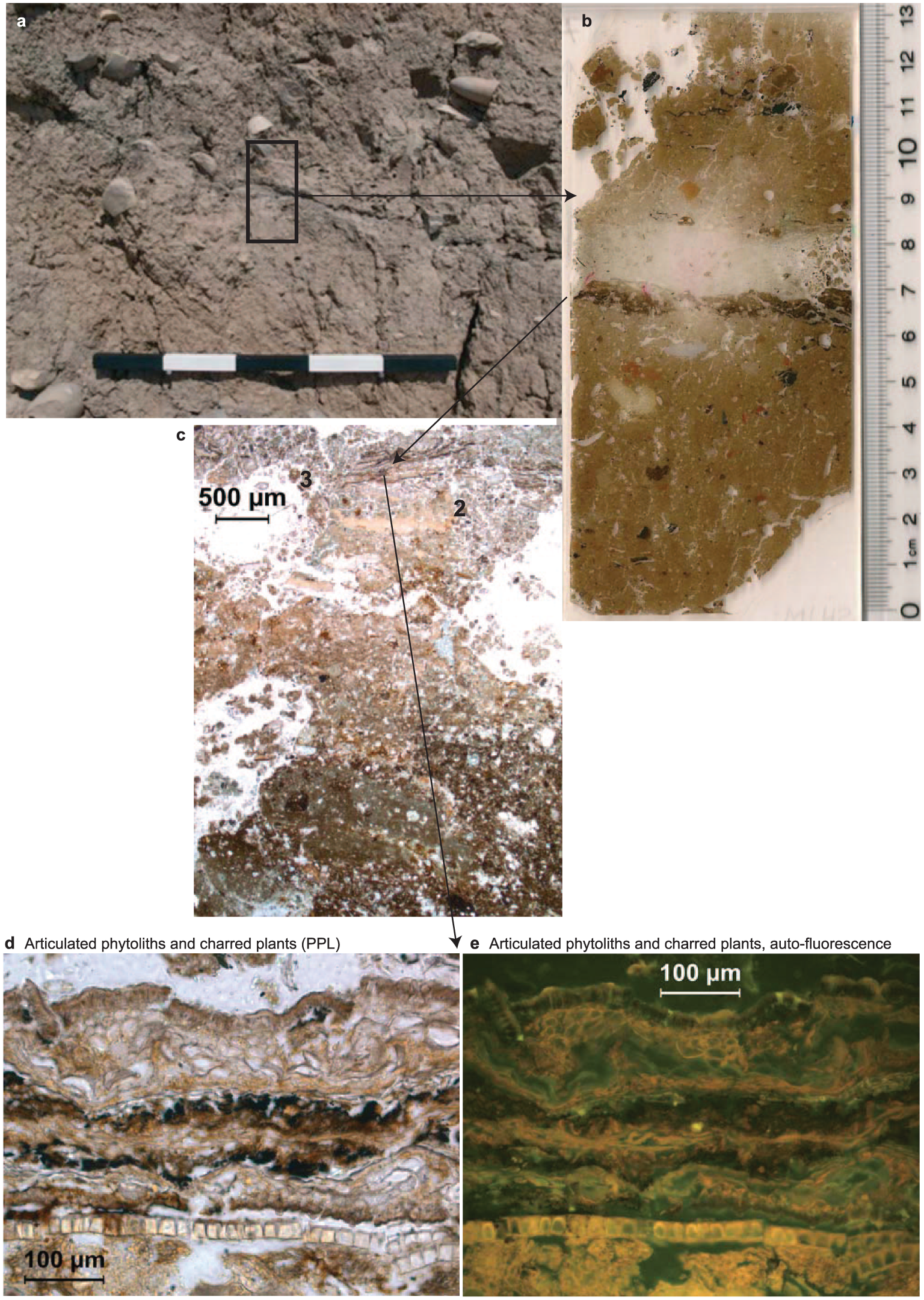
Burnt Neolithic floor surface with overlying phytoliths, Shimshara, Iraq: (a) field section profile (scale = 50 cm); (b) resin-impregnated thin-section; (c) lenses of burnt plant remains on burnt floor surface (PPL); (d) articulated phytoliths and charred plant remains (PPL); (e) articulated phytoliths and charred plant remains autofluorescence (incident light fluorescence (IFL)).
Conclusions
Study of a specific energy such as fire has enabled us to explore and trace the interconnectedness between environment and human ecology, technology and social roles and relations more widely, as suggested by Clark and Yusoff (2014) and sought in ecology (Zeder, 2012), anthropology and archaeology (Hodder, 2011, 2012). From the fire-centred theories, approaches and case studies in this paper, it is evident that a wide range of ecological and social theories and analytical techniques are applicable to the study of fire (Clark and Yusoff, 2014), and that no single theory or approach is necessarily more effective than others. These theories and approaches are not diametrically opposed but can be combined to develop interdisciplinary enquiries that encourage analysis of the multifaceted, multiscalar and inter-related aspects and impacts of fire and thus bring us closer to robust consideration of alternate hypotheses and interpretations. In this review and the case studies, theory, method and data are evaluated and applied from palaeoecological, archaeological, anthropological, bioarchaeological, geoarchaeological and material culture studies. New insights into human–fire relations have been permitted by analysis of diverse traces of fire that are not recoverable by routine excavation, flotation and wet-screening alone, through innovative integration of interdisciplinary micromorphological, biomolecular and plant microfossil analyses (W Matthews, 2010; W Matthews et al., 2013; Mentzer, 2014; Shillito and Elliott, 2013; Shillito et al., 2013). In particular, these techniques have enabled identification of diverse fire-affected plant, dung, micro-artefactual and architectural materials, and high-resolution analysis of their precise associations and taphonomy, crucial to interpretation of the context, history and impact of fire. In this paper, a fire-centred approach has enabled investigation and identification of specific linkages, couplings and inter-relations between humans, environment and other species during the major transformation from mobile hunting-gathering to more sedentary agricultural lifeways on which modern life is based, in a key heartland of these changes, the Zagros of Iraq and Iran, 12,000–8000 BP.
In summary, fire was one of the energies that was increasingly controlled and domesticated in the step-change in human lifeways from mobile hunting-gathering to more sedentary agriculture. With regard to the inter-relations between environment and socio-economic context and fire ecology and fuel selection (Asouti and Austin, 2005; Clark and Yusoff, 2014), palaeoecological data indicate that fire incidence dramatically increased from the outset of the Early Holocene, during rapid global warming (Turner et al., 2010). Fire is likely to have both been encouraged by and to have helped to create the Early Holocene grass parkland and steppe environs across much of Southwest Asia (Asouti and Kabukcu, 2014) and thereby been an agent in niche construction (Zeder, 2012), irrespective of whether these fires were natural or anthropogenic in origin, and accidental or deliberate. There is now new evidence to suggest that humans were present in the Zagros from 11,800 BP onwards and could have been one of the agencies in the spread of fire, as there are abundant residues from fire-related activities from the earliest levels of newly discovered archaeological sites of this early date (R Matthews et al., 2013). These new environs facilitated, and arguably encouraged, human focus on and management and domestication of large-seeded grasses and legumes as well as co-consumers of these, notably goat and sheep, that were more abundant in the Early Holocene in the Zagros, as in many other regions of Southwest Asia (Asouti and Kabukcu, 2014; Roberts, 2002).
From the case studies examined in the section ‘Environment and fire ecology and fuel selection in the Central Zagros’, there is some evidence for local and regional variation in environment and fire resources and fuel selection in the Zagros. This supports wider theories firstly, on the interconnectedness of the environmental, economic, technological and social considerations influencing fuel selection examined in the section ‘Interdisciplinary theory in fire ecology and fuel selection’ (Charles et al., 2014; Marchant and Lane, 2014; Sillar and Tite, 2000), and secondly, on local and regional variation in environment and ecological strategies in pathways to sedentism and early agriculture, and of multiple centres of innovation, within inter-connected networks across Southwest Asia in the Early Holocene (Riehl et al., 2015; Willcox, 2005; Zeder, 2009). In the Zagros case studies, significant linkages have been identified between transitions to early sedentism and plant and animal management and domestication and the availability and choices in selection of fuel. During the early stages of innovation in sedentism and plant management strategies timber-producing trees, such as poplar, and nut food sources, such as pistachio, were not selected for fuel at sites such as Ganj Dareh Level E (van Zeist et al., 1984: 221–222), indicating that fuel consumption strategies were informed by policies of conservation of key construction and food resources in the local environs of places and settlements that were more intensively and repeatedly used for longer periods of time. Fuel selection strategies, however, changed significantly, c. 9900 BP at Ganj Dareh D, to support more year-round larger sedentary communities in substantial built environments, for whom domesticated cereals and goat were selected as the major food sources. Fuel selection strategies changed to include pistachio nut wood, indicating that these trees were no longer conserved, and arguably may have been competing for the same land that was newly being cultivated for cereals, as argued by Roberts (2002) more widely for Southwest Asia. With the development of early animal management and domestication, the dung that they produced was much more readily available from more proximate and penned animals, and was selected as a major fuel source in all of the highland and lowland Zagros regions studied from at least c. 10,000 BP (W Matthews et al., 2013; Miller, 1996); as attested across Southwest Asia from as early as 10,200 BP (W Matthews et al., 1996; Stiner et al., 2014). Hesse (1984) has suggested that obtaining dung to fuel anthropogenic fire use was one of the key motivators in early management and domestication of goat. With regard to the twigs, reeds and grasses identified within animal dung (Shillito and Elliott, 2013) and fuel in hearths and ovens (W Matthews et al., 2013), selection of these fuel sources may have been linked to and by-products from other tasks and activities such as collection of wood and other materials for craft production or construction or food such as nuts and seeds and by-products used as fodder; or alternately may have been consumed by herds accompanying such forays, as considered for these and other materials in new studies of the Neolithic and biographies of materials, energy flows and entanglement more widely (Bolger, 2010; Charles et al., 2014; Hodder, 2012; Ingold, 2000). All of these examples illustrate ways in which fire ecology is closely linked to wider socio-economic strategies and land management and to the conception and evaluation of woodlands (Marchant and Lane, 2014).
With regard to the specific uses and phenomenology of fire examined in sections ‘Interdisciplinary theory in the socio-economic context and specific uses of fire’ and ‘Specific uses and phenomenology of fire’ (Dunbar and Gowlett, 2014; Sorensen et al., 2014; Tilley, 1994), anthropogenic fire use facilitated year-round sedentism by enhancing the warmth and habitability of early built environments, and by aiding the processing, preservation, cooking, digestibility and nutrition of new and existing foods in the Zagros, as in Central Turkey, for example (Atalay and Hastorf, 2006). Fires from early activities at sites, and the residues that accumulated in mounds from these, may themselves have been potent markers of place, status, ownership and access to resources, including the animals that produced the dung used as fuel, as observed ethnographically (Hodder, 1987), highlighting the importance of biographical approaches in which examination of discard is also important (Appadurai, 1986). Fire had a central role in the social roles and relations and ritual life that held these burgeoning communities together in open communal settings, and increasingly within the separate bounded social units of emerging households, across the Zagros and Southwest Asia (Byrd, 2000; W Matthews, 2012a). Fire use was increasingly harnessed and controlled in new constructed and lined hearth and oven installations. The repeated plastering and renewing of these fire installations suggests that they were a focus of key economic and socio-cultural roles and relations. These fire installations, thereby, by their durable nature, provided enduring facilities as well as tangible representations of key social concepts, roles and relations that enabled these to be returned to and passed on, affording social as well as economic stability and continuity (Bloch, 2010) in communal gatherings and within individual households as well as during flexible fission and fusion of social groupings as observed more widely in the Neolithic (Roberts and Rosen, 2009; Wengrow and Graeber, 2015) and ethnographically (Arshi and Kasraian, 1994/2001; Watson, 1979). Fire also impacted on health as attested in a range of built environments (Christensen and Ryhl-Svendsen, 2015; Scott and Damblon, 2010), accumulating on walls as repeated layers of soot at Shimshara in the Zagros, as also observed at Çatalhöyük (Figure 6; W Matthews, 2005a and 2005b).
Fire was used to transform and to create new durable materials including fired-lime, and ceramic vessels, figurines and tokens in these more sedentary communities in the Zagros and across Southwest Asia (Boivin, 2008), with some evidence of local and regional variation in materials, style and technology. Although few fired-lime nor ceramic production areas have yet been analysed scientifically for the Neolithic of the Zagros, comparable analyses in Central Turkey have revealed that the readily available dung from newly managed and domesticated animals was selected as a major source of fuel of choice in these high-energy technologies (W Matthews, 2005b), and is known to have excellent combustion properties (Sillar and Tite, 2000). As discussed above, therefore, fuel selection is likely to have included diverse consideration of environment, access to resources, socio-economic strategies, roles and relations, inter-relationship of tasks and combustion properties and context of use, highlighting the importance of interdisciplinary ecological and socio-cultural theories and approaches (Clark and Yousoff, 2014; Hodder, 2012). Fire may also have been used in rituals (Hastorf, 2001), as red pigments are often associated with burnt materials, and as a destructive force in the face of new inequalities that emerged in communities faced with the increased potential for amassing wealth that sedentary and agricultural lifeways provided. Fire certainly posed an increased risk both as wildfires in these semi-arid environments with abundant grasslands as well as in the newly agglutinating settlements, as several sites in the Zagros were periodically destroyed by fire.
There is considerable future potential for fire-centred approaches. Further insights into fire energies, phenomena and impact on materials could be provided by additional controlled experimental and ethnographic analyses, and by fire-forensic investigations of early built environments, such as those conducted at Çatalhöyük (Harrison, 2013). There is considerable scope for tracing fire use further at the scale of individual communities and inter-site comparisons, to inform on wider debates explored here on the inter-relations, linkages and entanglement between environment, human and other species agency and materials (Hodder, 2012), as additional interdisciplinary data emerge from new excavations across the Zagros. In addition, archaeological studies of past human relationships with fire provide important insights into issues of global concern today and examples of potential future options that require urgent consideration as encouraged by Clark and Yusoff (2014), such as the preservation of biodiversity, fuel availability, insulation, and the sustainability and resilience of social and cultural practices, some examples of which have been considered here. It is hoped this paper has highlighted some of the ways in which fire-centred approaches can contribute to these and wider studies.
Footnotes
Acknowledgements
I am very grateful to Iran’s Culture, Heritage, Handicrafts and Tourism Organisation, the Iranian Centre for Archaeological Research, the State Organisation for Antiquities and Heritage Iraq, the Erbil Directorate of Antiquities and Heritage and its Director, Abubakir O Zainadin, the Sulaimaniyah Directorate of Antiquities and Heritage and its Director Kamal Rasheed Raheem for their kind permission and extremely helpful support in conducting excavations and export of samples for scientific analysis. I would also like to thank the Central Zagros Archaeological Project Co-Directors Professor Roger Matthews, Dr Yaghoub Mohammadifar and Dr Abbass Motarjem and all Team Members for all of their collaboration in fieldwork and research including Dr Ian Bull, NERC LSMSF, as well as the Sulaimaniyah Directorate of Antiquities and Heritage representative, Kamal Rouf Aziz. I wish to thank very much John Jack and Julie Boreham for manufacturing thin-sections, Sarah Lambert-Gates and Margaret Mathews for help with the illustrations, and Professors Sandy Harrison and Roger Matthews for commenting on a draft of this paper. I am also grateful to the British Institute of Persian Studies for permission to adapt the images from the journal Iran in Figure 4. The underlying research data is held by Wendy Matthews at the University of Reading. I am also very grateful to two anonymous reviewers and the Editor for their very helpful comments and suggestions.
Funding
This research was supported by the British Academy (BARDA-48993), Arts and Humanities Research Council (AH/H034315/1), Natural Environment Research Council Life Sciences Mass Spectrometry Facility award (LSMSBRIS038), British Institute of Persian Studies (BIPS) and Department of Archaeology, School of Archaeology, Geography and Environmental Science, University of Reading, to whom I am extremely grateful.