




Abstract
Agriculture has played a pivotal role in shaping landscapes, soils and vegetation. Developing a better understanding of early farming practices can contribute to wider questions regarding the long-term impact of farming and its nature in comparison with present-day traditional agrosystems. In this study we determine stable carbon and nitrogen isotope values of barley grains from a series of present-day traditionally managed farming plots in Morocco, capturing a range of annual rainfall and farming practices. This allows a framework to be developed to refine current isotopic approaches used to infer manuring intensity and crop water status in (semi-)arid regions. This method has been applied to charred crop remains from two early farming sites in the eastern Mediterranean: Abu Hureyra and ‘Ain Ghazal. In this way, our study enhances knowledge of agricultural practice in the past, adding to understanding of how people have shaped and adapted to their environment over thousands of years.
Introduction
Agriculture has had a major role in shaping landscapes, soils and vegetation, and the beginning of agriculture is one of the candidates for the onset of the Anthropocene (Ruddiman, 2003). Developing a better understanding of early farming practices, revealing the various inputs that were required to make agriculture a success under a range of social and ecological conditions, can therefore contribute to wider questions regarding the trajectory of present-day economies and the agricultural basis of today’s subsistence practices.
Although much research has focused on the when and where of early cultivation and crop domestication (e.g. Price and Bar-Yosef, 2011; Willcox, 2013), less is known about the nature of early farming itself, including tillage and weeding, manuring, water management, the longevity of cultivation and the interplay between crop and animal husbandry. Manuring of fields, in particular, implies an investment in the land, since ‘topping up’ of nutrient levels is only required if plots are long-lived; consecutive crop harvests eventually strip the soil of nutrients, which must be replaced if subsequent crop yields are to be maintained (e.g. Rothamsted Research, 2006: 9). Manuring also implies a certain labour input and a close interdependence between crop and animal husbandry, collection and subsequent spreading of manure requires management of domestic animals and is costly in terms of time and labour (Halstead, 2014). Moreover, since manure is a finite resource, strategic decisions about its application were likely to have been necessary in order to maximise crop yields most effectively, and to enable surpluses to buffer against potential future crop failures (Halstead, 1989).
In the so-called Fertile Crescent region of the eastern Mediterranean, where the earliest crop cultivation and domestication are currently documented (Willcox, 2013), rainfed cultivation is possible but water is the major limitation to growth, as in other semi-arid regions (mean annual rainfall 300–600 mm; Food and Agriculture Organization (FAO), 1987; Noy-Meir, 1973; Webb et al., 1978). Water management practices, whether through location of cultivated plots close to natural water sources or on soils with better natural water retention, or through small-scale hand-watering or larger-scale irrigation works, help to ensure favourable and reliable crop yields (Abbo et al., 2010; Halstead and O’Shea, 1989). Manuring has also been found to improve the water use efficiency of some crop species (Hati et al., 2006). As with manuring, water management practices require strategic planning and management of the cultivated environment, since wetter areas in arid regions are likely to be scarce, and high labour inputs may be required for hand-watering and manipulation of water supplies.
By assessing the likelihood of manuring and water management at early farming sites, it is therefore possible to infer the degree to which early farming societies were investing in the long-term productivity of the land and in the day-to-day maintenance of soil quality, and making strategic decisions about the use of valuable resources such as labour, manure and water. A range of models have been proposed for early farming regimes (summarized in Bogaard, 2005), each with varying degrees of labour input and investment in the land: shifting cultivation, extensive ard cultivation, floodplain farming and intensive gardening. Our aim here is not to test these models per se, since this would require incorporation of ecological analysis of arable weed flora alongside stable isotope analysis (cf. Bogaard et al., 2015). Rather, the most relevant contrasts for this discussion of crop isotope chemistry and farming in arid regions are those between relatively low- and high-input forms of cultivation, where management intensity relates to maintenance of crop water and nutrient supply: maintenance of adequate water and soil nutrients would point to relatively intensive management, as in a ‘gardening’ regime. Naturally favourable water supply and soil fertility would arguably be available in floodplains (Sherratt, 1980), but this model for early cultivation was developed without ethnographic support (Isaakidou, 2011) and relies on spring sowing for which there is no archaeobotanical evidence (Hillman, 2000; Jones et al., 2013).
In this paper, stable isotope values were determined for barley grains sampled from a series of modern farming plots in Morocco, one of the few (semi)-arid areas of the Mediterranean where traditional agrosystems offer a range of watering and manuring regimes under different annual rainfall conditions, supplementing stable isotope data from modern bread wheat grains grown under a range of controlled irrigation and manuring regimes at an experimental station near Aleppo, Syria (see Fraser et al., 2011; Wallace et al., 2013). These data allow a framework to be developed that will refine current stable isotopic approaches used to infer manuring intensity and crop water status in (semi)-arid regions. This refined method is then applied to charred (carbonized) crop remains (cereal grains and pulse seeds) from two early farming sites in the eastern Mediterranean: Abu Hureyra in the northern Levant, and ‘Ain Ghazal in the southern Levant (Figure 5). These sites date to the Pre-Pottery Neolithic and beginning of the Pottery Neolithic (PPNB and PN; c.8800-6000 cal. BC), a period during which both cultivation and herding were becoming established and widespread. The intention is to identify crop isotope signatures that deviate from those expected because of environmental factors (for which rainfall is used as an index), and thus to identify, or discount, potential management practices. In this way, our study aims to enhance knowledge of early agricultural practice, informing wider debates regarding societal changes and subsistence strategies at the advent of farming.
Crop nitrogen isotope values
Crop nitrogen isotope (δ15N) values integrate a range of environmental and physiological processes, but largely reflect the δ15N value of the soil in which they are grown (e.g. Evans, 2001; Högberg, 1997). Studies of modern crops have found that manuring can increase the δ15N values of cereals by as much as 10‰, and this increase is related to the intensity – amount and frequency – of manuring (e.g. Bol et al., 2005; Fraser et al., 2011), as well as the type of manure (Szpak, 2014). Based on these modern studies, cereal grain δ15N values for high, medium and low/no manuring levels have been estimated (see Figure 3; cf. Bogaard et al., 2013: figure 1). Since changes in manuring level take a number of years to register in crop δ15N values (Fraser et al., 2011), contrasts in crop δ15N values reflect sustained differences in cultivation, indicating variable investment in the land over many years.
The potential of δ15N values of carbonized crop remains from archaeological sites as a means of assessing manuring intensity has been demonstrated in a number of recent studies within temperate Europe (Bogaard et al., 2013; Fraser et al., 2013; Kanstrup et al., 2014; Styring et al., in press; Vaiglova et al., 2014), revealing that farmers in Europe and the Mediterranean practised varying levels of manuring on sites from as early as 5900 cal.
To distinguish the contribution of manure from environmental factors (such as aridity), the approach of recent studies has been to estimate the δ15N values of plants consumed by herbivores found at the same archaeological site/phase, by subtracting the offset (c. 4‰; Steele and Daniel, 1978) between consumer and diet from the δ15N values of preserved herbivore bone collagen, and to use this as a proxy for an unmanured crop δ15N value (Bogaard et al., 2013; Fraser et al., 2013; Styring et al., in press; Vaiglova et al., 2014). This estimated δ15N value could differ from the true δ15N value of unmanured cereal grains because herbivores consume a range of plant parts, making it difficult to apply a consistent δ15N offset (Fraser et al., 2011; Rothamsted Research, unpublished data, 1991). There is also a possibility that domestic herbivores may have received supplementary fodder in the form of crop residues, which may have been manured. Notwithstanding these limitations, the estimated herbivore diet gives an approximate indication of the δ15N values to expect for unmanured crops, allowing some assessment of whether any environment-related enrichment of crop 15N is likely, independent of that resulting from agricultural management. In cases where faunal bones are not found or bone collagen is not well-preserved, or the range in herbivore δ15N values is so large that an unmanaged plant δ15N baseline is not meaningful (e.g. Pearson, 2013), an independent means of inferring a plant isotopic baseline for a particular environment is necessary.
Aridity and nitrogen isotope values
Various studies of soils and vegetation have found a positive correlation between aridity (low rainfall and high evapotranspiration) and δ15N values (e.g. Aranibar et al., 2004; Austin and Vitousek, 1998; Craine et al., 2009; Handley et al., 1999; Hartman and Danin, 2010; Heaton, 1987; Swap et al., 2004). The mechanisms of this enrichment remain speculative, but current hypotheses suggest that δ15N values relate to the ‘openness’ of the nitrogen (N) cycle: the extent to which N is in excess to plant demand and can therefore be lost through volatilization (c.f. Austin and Vitousek, 1998). Any process that decreases the flux of N into organic matter or increases the flux of N from organic matter to mineral pools favours this volatilization and therefore N loss (Handley et al., 1999). Both plant growth and microbial activity decrease with decreasing soil moisture, producing an excess of readily volatilized mineral-N (Barber, 1995; Stark and Firestone, 1995) whose loss increases the δ15N value of the remaining soil-N. This enrichment in soil 15N can be enhanced by progressive cycles of wetting and drying, which also stimulate loss of N in the form of N2O and NO (Austin et al., 2004). Rainfall thus tends to account for the majority of the variation in δ15N values of unmanaged plants (e.g. Craine et al., 2009; Handley et al., 1999; Hartman and Danin, 2010; Swap et al., 2004), but the trend is complicated by differences in mychorrhizal interactions (Craine et al., 2009), soil texture (Aranibar et al., 2004) and plant type (Gebauer and Ehleringer, 2000; Hartman and Danin, 2010).
Crop carbon isotope values
Crop carbon isotope (δ13C) values reflect the water status of the crop during its growth period (e.g. Araus et al., 1997; Farquhar and Richards, 1984). In C3 plants, differences in plant δ13C values relate to the degree of stomatal conductance, i.e. the rate of passage of CO2 through stomata, which is regulated according to water availability (Ehleringer et al., 1993; Farquhar et al., 1989). In well-watered conditions, open stomata freely permit the assimilation of CO2, allowing discrimination against the heavier 13C isotope and resulting in more negative plant δ13C values. In drier/poorly watered conditions, closed stomata restrict the assimilation of CO2, reducing discrimination against 13C and resulting in less negative plant δ13C values.
The degree of discrimination against 13C varies between species (e.g. Ferrio et al., 2005; Flohr et al., 2011; Wallace et al., 2013), so that e.g. barley and wheat grown in the same watering conditions will have different δ13C values. Water status itself can be influenced by many factors, including water inputs (i.e. rainfall, anthropogenic watering) and water losses (i.e. evapotranspiration), as well as by the water-holding capacity of the soil. For this reason, Wallace et al. (2013) proposed three broad levels of water status based on crop δ13C values: poorly watered crops for which water availability imposes major limitations on growth; well-watered crops for which water is not a major limitation on growth; and moderately watered crops which fall between the two.
When using crop δ13C values to infer water status of archaeological crop remains, it is also necessary to account for the change in the δ13C value of atmospheric carbon dioxide (δ13Cair) over time. Today, the δ13Cair value is c. −8‰ (White and Vaughn, 2011) but it was higher in the past. The δ13Cair values for the time periods covered by the archaeobotanical samples were therefore approximated by the AIRCO2_LOESS system (Ferrio et al., 2005) and these are given in Wallace et al. (2015). This allows the watering bands established from modern crop watering experiments to be applied to crop remains from different time periods. Crop δ13C values are converted to ∆13C values by the following equation (Farquhar et al., 1989)

Crop isotope values in semi-arid regions: A pilot study in Morocco
This study determines the δ15N and δ13C values of hulled six-row barley grains (Hordeum vulgare subsp. vulgare) growing in traditionally managed manured and unmanured fields (n = 34) receiving different quantities of annual rainfall (190 to 700 mm/yr) and supplementary water from irrigation in Morocco from October, 2013 to March/May, 2014 (Figure 1 and Supplementary Table 1, available online). This isotope study was carried out alongside a weed survey of the same fields. Table 1 gives details of the climate, manuring and irrigation regimes, summarized by farm. Since these are not experimental plots, better control over manure and water inputs was not possible, but these agricultural conditions represent real-life situations, providing an insight into the constraints imposed on agricultural decision making by the environment. No commercial N-containing fertilizers were used on any of the plots included in this study and had not been used for at least three years prior to crop sampling. For the most part, interviews were conducted with farmers who tended the fields. The mean annual rainfall quoted is from the Aquastat climate information tool (http://www.fao.org/nr/water/aquastat/climateinfotool/index.stm) from the Food and Agriculture Organization of the United Nations. The data for the Aquastat climate information tool originated from the CRU CL 2.0 data set (New et al., 2002) and use the means of observations made from 1961 to 1990. The aridity index (a numerical indicator of the degree of dryness) for each location was calculated by dividing mean annual precipitation by reference evapotranspiration (Middleton and Thomas, 1997), as quoted by the Aquastat climate information tool. Ten ears were randomly selected from each field, or were selected from five locations along a transect through each field. Half of the collected ears were then threshed, and a random selection of 50 grains was homogenized in a freezer mill to give an average isotope value for the growing condition. More details of the analytical methods are given in Supplementary Information, available online.
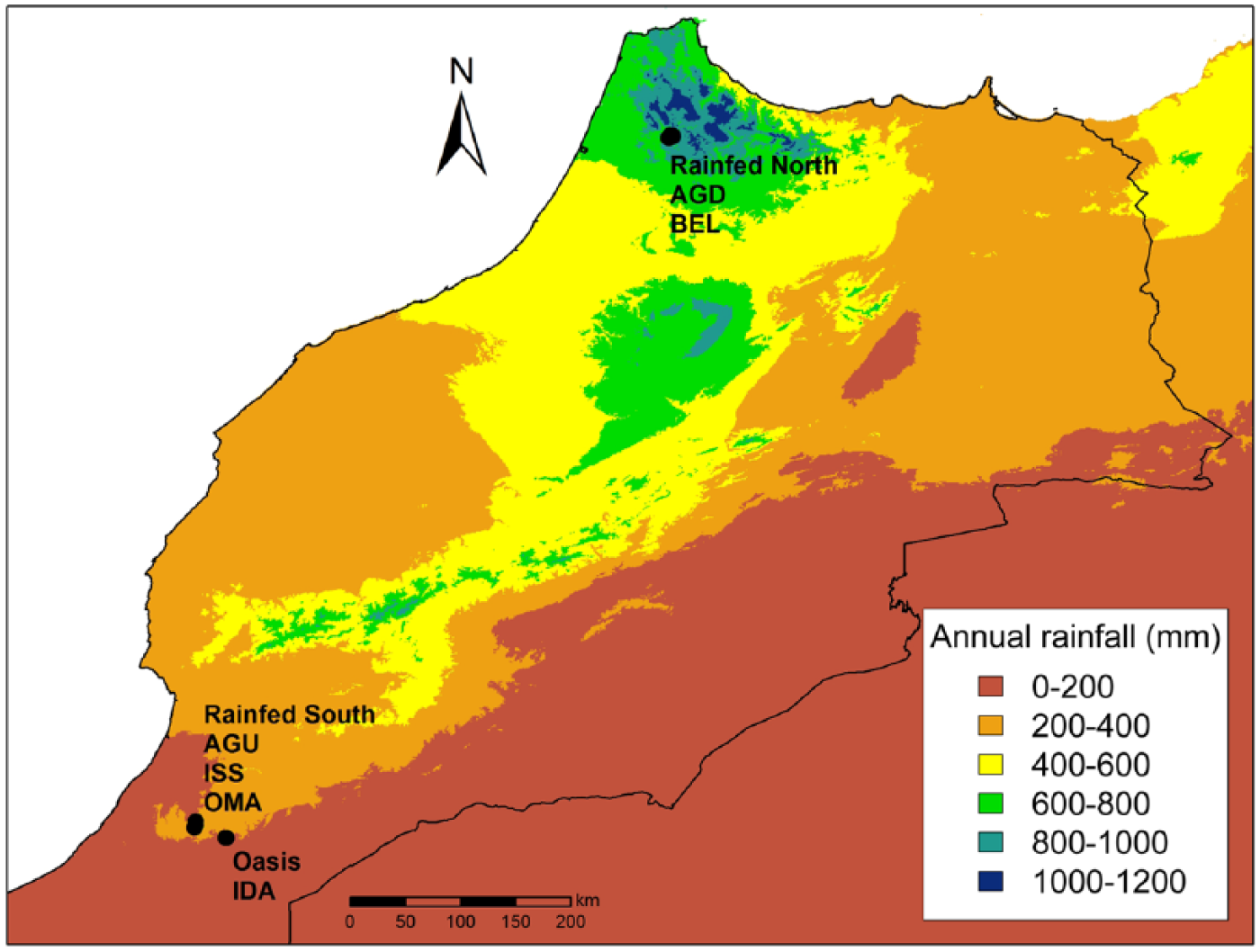
Rainfall map of Morocco with sampling locations marked. See Table 1 for explanation of site abbreviations.
Details of climate and manuring regimes at modern farming plots in Morocco, summarized by farm.
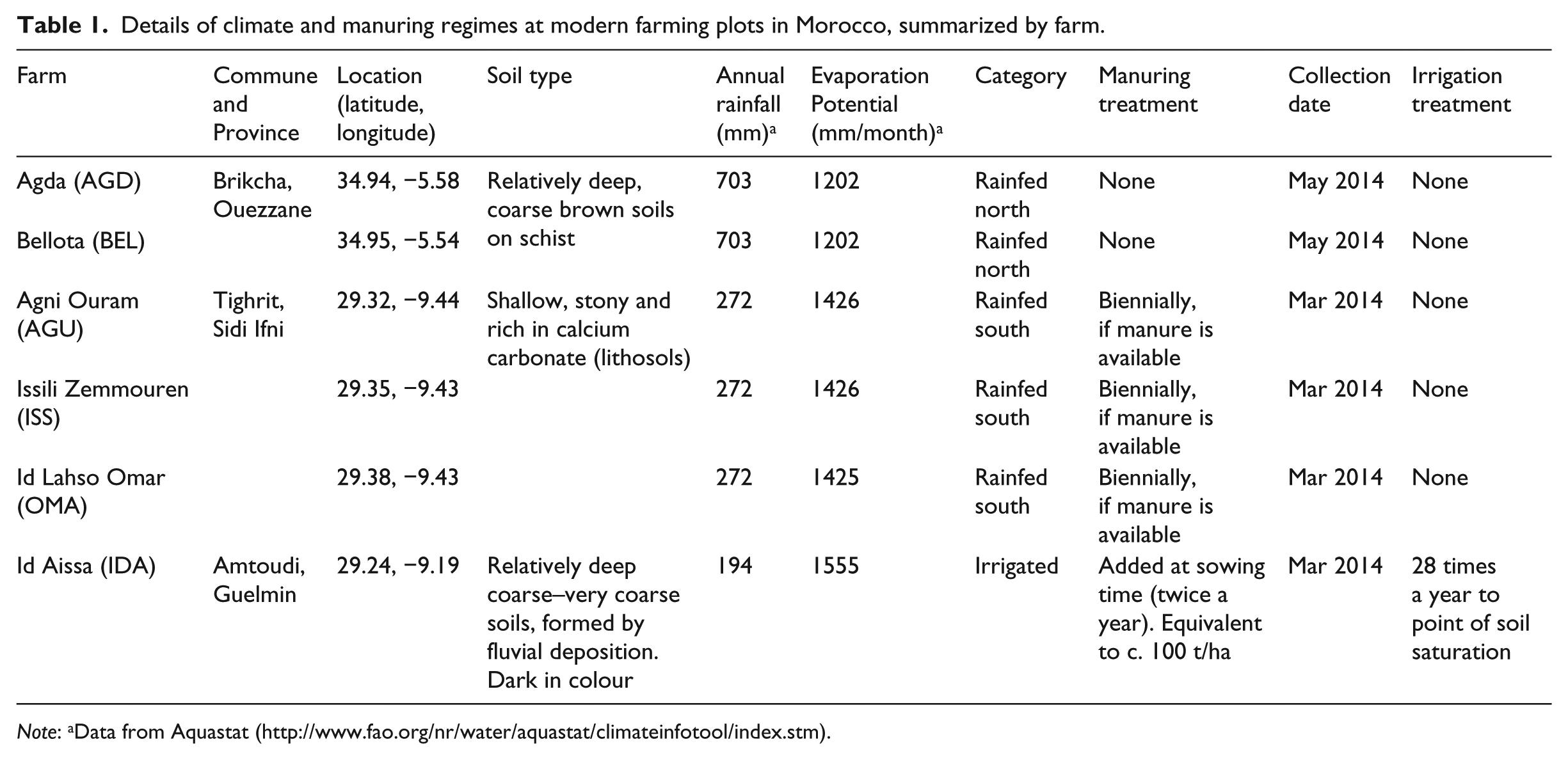
Note: aData from Aquastat (http://www.fao.org/nr/water/aquastat/climateinfotool/index.stm).
Figure 2 plots barley grain δ15N values against ∆13C values. Watering bands are defined from those determined for modern two-row hulled barley grains grown under different irrigation regimes in Borja, Spain (Wallace et al., 2013), and adjusted for the difference in ∆13C values of two-row and six-row barley growing in the same watering conditions (c. 1‰; Voltas et al., 1998, 1999). The barley sampled in the Rif region of northern Morocco (Figure 1; AGD and BEL) received no manure and relatively high annual rainfall (703 mm/yr) and growing conditions are classified as dry-subhumid from the calculated aridity index (0.58; UNESCO, 1979). Its ∆13C values fall into the well-watered band (Figure 2) and its relatively low δ15N values, ranging from −0.3 to 1.4‰, plot within the no/low manuring band established from modern experimental farms in temperate Europe (Figure 3; Bogaard et al., 2013; Fraser et al., 2011).
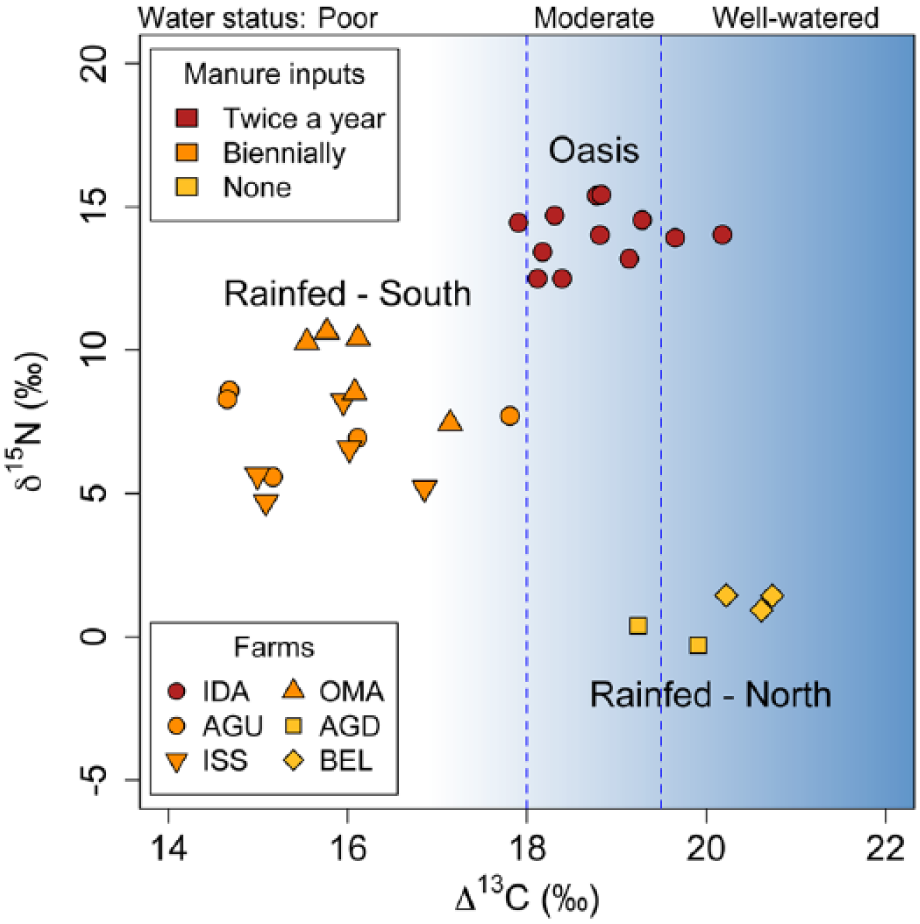
Plot of modern barley grain δ15N against ∆13C values, with watering bands for six-row barley marked.
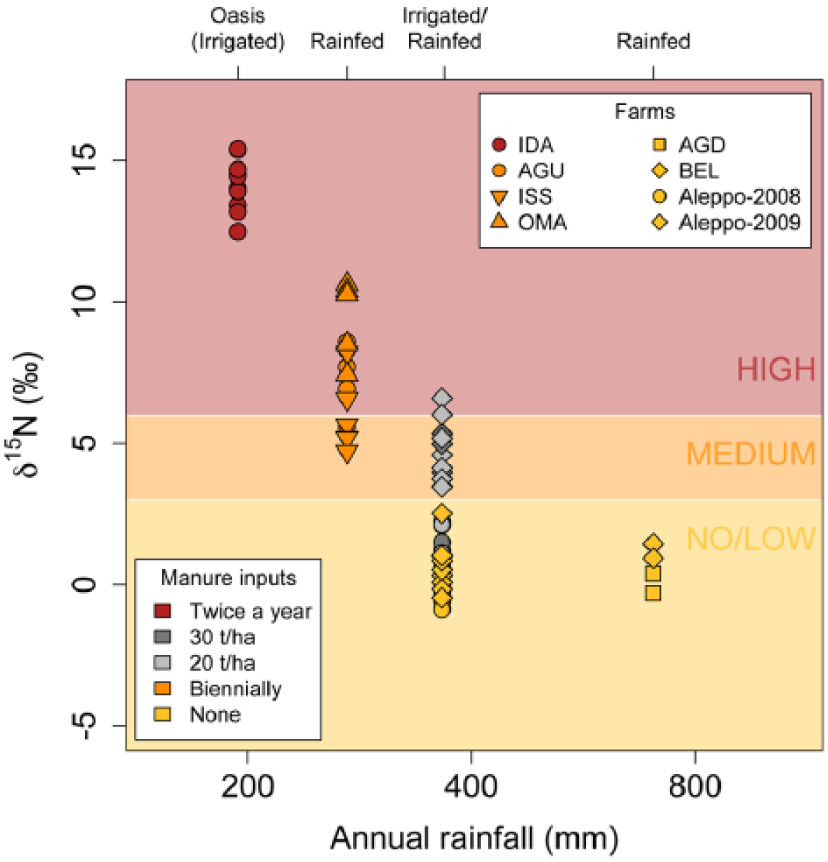
Plot of barley and bread wheat δ15N values against a natural log scale of mean annual rainfall for their location. Manuring bands established from δ15N values of cereals grown in experimental and traditional farming plots in temperate Europe are shown. NB. Aleppo plots were newly established in both years and therefore the effect of manuring on bread wheat δ15N values was variable (grey symbols).
Also plotted in Figure 3 are the δ15N values of bread wheat grains grown in controlled conditions on newly established plots at an experimental station near Aleppo, Syria (Figure 5 and Supplementary Table 1, available online). These bread wheat plots received differing quantities of manure and irrigation water in two separate years of cultivation (see Fraser et al., 2011). There is no difference in the δ15N values of bread wheat and barley grown under the same manuring conditions (Fraser et al., 2011), so barley and bread wheat δ15N values can be used interchangeably here. As Fraser et al. (2011) note, the effect of manuring on cereal grain δ15N values is variable on these newly established plots, with grain δ15N values increasing significantly with manuring in the year when rainfall was higher (2009) but to a much lesser extent when rainfall was low. The level of irrigation had no clear effect on bread wheat δ15N values (Fraser et al., 2011). These results demonstrate that the effect of manure on crop δ15N values can be detected after the first year of manure application, but the extent to which δ15N values increase is variable, likely influenced by changes in annual rainfall and past land use.
The barley sampled in and around the Amtoudi oasis in southern Morocco (Figure 1) came from both rainfed and irrigated oasis fields. The rainfed fields are associated with three different farms (AGU, ISS, OMA) situated within 30 km of the oasis, but located at a higher elevation (up to c. 1110 m a.s.l. compared with c. 780 m a.s.l.), which means that they receive more rainfall (272 mm/yr compared with 194 mm/yr) and can support rainfed crops. Nevertheless, the growing conditions are classified as arid by the calculated aridity index (0.19; UNESCO, 1979). The rainfed fields received low quantities of sheep manure every two to three years. The barley δ15N values range from 4.7 to 10.6‰ (Figure 2), the large variability likely reflecting a wide geographical region and therefore more varied environmental conditions, and considerable variation in manuring practice between fields. The barley ∆13C values (Figure 2) indicate that they were relatively poorly watered, and thus that water was a limitation to growth. Figure 3 shows that the determined grain δ15N values overestimate the level of manuring based on bands established in temperate Europe, since the majority fall within the high manuring band.
The fields in the oasis receive lower annual rainfall than the rainfed fields nearby, but they are irrigated every 15 days in autumn and every 7 days in summer (a total of 28 times over the growing season), by flooding to the point of saturation with water from an underground aquifer. It has been calculated that irrigation water input equates to c. 70 mm per irrigation cycle and c. 2000 mm/yr (see Supplementary Information for calculations, available online). The environmental conditions are classified as arid from the calculated aridity index (0.12; UNESCO, 1979), but if irrigation water input is also considered, the calculated aridity index is 1.42. The oasis fields receive sheep manure twice a year, with each autumn- and summer-sown crop, equating to c. 100 t/ha – an extremely high level of manuring that is readily observable in the dark colour and texture of the resulting artificial ‘dung-soil’ (see Table 1). The barley δ15N values range from 12.5 to 15.4‰ (Figure 2; IDA), the smaller variation in δ15N values compared with the rainfed fields reflecting a much more uniform method of manuring. The barley ∆13C values (Figure 2) indicate that they were moderately to well-watered, demonstrating that irrigation inputs were sufficient to prevent water being a limitation to growth. In Figures 3 and 4, the δ15N values of the barley from the oasis fields have been plotted against a natural log scale of mean annual rainfall for their location. We use mean annual rainfall rather than water input (i.e. rainfall + irrigation water) because it acts as an index of wider environmental conditions (e.g. temperature, evaporation potential), which all affect the ‘openness’ of the N cycle and thus the volatilization of 15N-depleted N, resulting in higher plant δ15N values. Moreover, the level of irrigation (water input ranging from c. 250 mm/yr to c. 1200 mm/yr on experimental plots near Aleppo) has not been found to affect cereal grain δ15N values in previous studies (Fraser et al., 2011). The δ15N values of the barley growing in the oasis fields plot correctly within the high manuring level band in Figure 3, but are much higher than the δ15N values of any other cereal grains determined in temperate Europe (Fraser et al., 2011; Kanstrup et al., 2011).
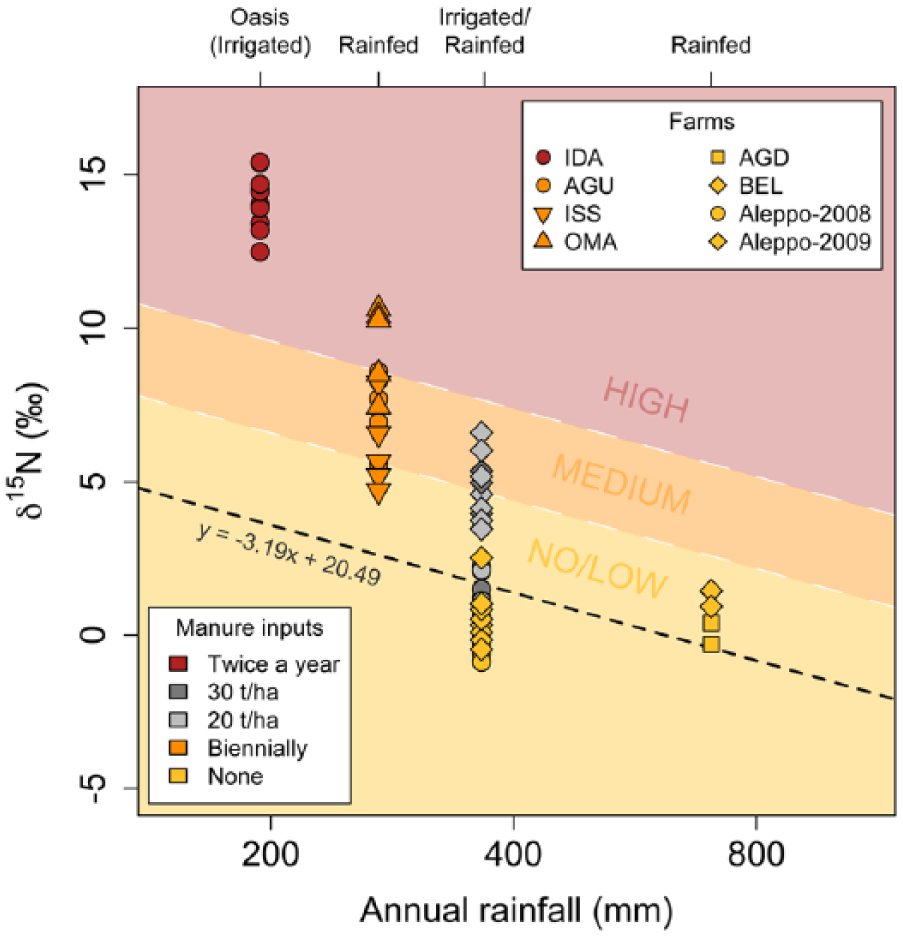
Plot of barley and bread wheat δ15N values against a natural log scale of rainfall, with manuring bands adjusted for the regression between unmanaged plant δ15N values and rainfall.
Disentangling the effect of manuring from aridity on cropδ15N values
Ideally, we would have sampled both manured and unmanured crops from all regions in Morocco in order to fully assess the difference in δ15N values caused by manuring. However, no fields in the Rif region studied were manured because of a lack of available manure, and all fields in and around the Amtoudi oasis received some manure input. We have therefore made use of the trend determined by Hartman and Danin (2010) between δ15N values of unmanaged (unmanured) annual plants and the natural log scale of mean annual rainfall in order to estimate the expected δ15N values of unmanured cereals at different rainfall levels.
In the Hartman and Danin study, unmanaged plants were sampled along a rainfall transect in Israel, from 1000 mm to less than 50 mm mean annual rainfall. The regression for annual plants (δ15N = −3.19[log(mean annual rainfall)] + 19.09) from this study was chosen as the closest comparison to cereals. Furthermore, it ignores the δ15N values of plants growing on exposed ridges, where very low N availability and reliance on atmospheric N-fixation by cyanobacteria leads to very low δ15N values in areas of low rainfall (Evans and Ehleringer, 1993; West, 1990). Such conditions are unlikely to be relevant to arable land. More δ15N data from unmanaged cereal grains growing in different rainfall regimes is needed to refine this relationship further, but this is difficult to attain since agriculture in many (semi-)arid regions now involves irrigation and/or artificial fertilizers and many of the soils have become too degraded for viable crop yields. In order to relate the δ15N values of annual plant leaves determined in the Hartman and Danin study to the δ15N values of cereal grains, the mean offset in δ15N between bread wheat grains and leaves from a range of inorganic-N and manure fertilized plots throughout a growing season (1.4 ± 0.9‰; Rothamsted Research, unpublished data, 1991) was used to adjust the regression line.
In Figure 4, we again plot the barley δ15N values against the natural log scale of mean annual rainfall. We have used the regression between unmanaged plant δ15N values, adjusted for grain-leaf offset (δ15N = −3.19[log(mean annual rainfall)] + 20.49), and the natural log scale of mean annual rainfall to adjust the manuring level bands established in temperate Europe. With these adjusted manuring bands, the δ15N values of the sampled barley grains more accurately reflect the true manuring levels. The δ15N values of barley grains from northern Morocco plot on the regression line for no manure, the δ15N values of barley from the rainfed fields in southern Morocco plot around the medium level of manure, and the δ15N values of barley from the oasis fields plot in the high manuring level band. The bread wheat grains from Aleppo also plot within the no/low and medium manuring level bands, which broadly corresponds to the rates of manure applied on these newly established plots. As noted above, manuring of plots in the drier year (2008) at Aleppo did not result in a clear increase in crop δ15N values.
The adjusted manuring bands more accurately reflect known manuring practices in Morocco and Syria and can therefore tentatively be used to assess past manuring practice from crop δ15N values at sites situated in areas with low rainfall. Herbivore bone collagen δ15N values can also be used to estimate unmanured plant δ15N values and therefore further ground truth this model on a range of archaeological sites.
The early farming sites of Abu Hureyra and ‘Ain Ghazal
To date, the earliest evidence for crop cultivation has been found in southwest Asia, dating to the 10th millennium
Abu Hureyra, on the southern bank of the Euphrates river (Figure 5), is a significant site as its occupation spanned the transition from a hunter-forager to farming economy. The site is located at the boundary of two contrasting environmental zones: drier steppe to the south and moist, often waterlogged, floodplain to the north (Moore et al., 2000: 3). Today the site receives c. 230 mm of annual rainfall but it has been estimated from δ18O values of speleothems in the Soreq Cave that annual rainfall was c. 175–450 mm higher between 10,000 and 7000 BP (c. 8000–5000 cal.
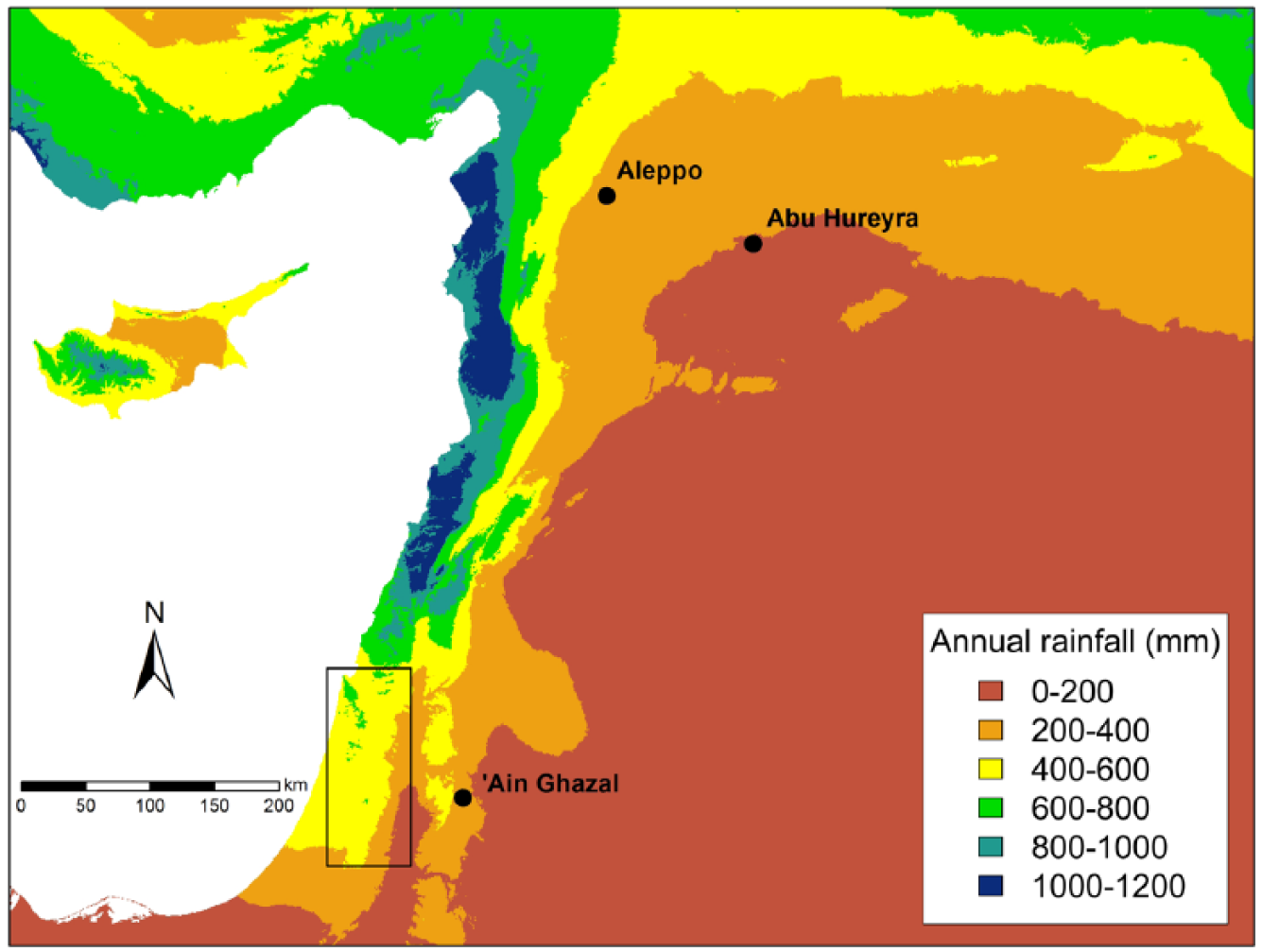
Map showing location of the archaeological sites Abu Hureyra and ‘Ain Ghazal and the modern experimental station near Aleppo. Present-day annual rainfall is represented by shading. The area of the Hartman and Danin (2010) study is indicated by the box.
Period 2A dates from c. 8800 to 7400 cal.
In period 2B (c. 7400 to 6200 cal.
‘Ain Ghazal is located in modern Jordan (Figure 5). It is situated immediately adjacent to the Wadi Zarqa, which would have been a permanent stream during the site’s occupation, in a transition zone between oak woodland and open steppe desert (Simmons et al., 1988). Today the site receives c. 250 mm of annual rainfall, placing it in an area vulnerable to fluctuations in rainfall. Analysis of wood charcoal found at the site has indicated the presence of deciduous oak woodland in the surroundings, which requires >300 mm rainfall per year and this has been used to infer that rainfall must have been at least 100 mm higher during the PPN (Neef, 2004). Again, the barley δ15N values are plotted against a range of rainfall values between 175 and 450 mm higher than today’s rainfall (cf. Bar-Matthews et al., 1997).
‘Ain Ghazal was occupied for over 2000 years, from c. 8500 to 5500 cal.
‘Ain Ghazal, unlike many sites in the Levant that were abandoned at the end of the PPNB, was occupied into the Yarmoukian phase of the Pottery Neolithic. Nevertheless, from the beginning of the PPNC, the variety of faunal species exploited by the inhabitants of ‘Ain Ghazal decreased significantly and it has been proposed that this was related to degradation of the surrounding landscape by removal of the natural vegetation through cultivation, grazing and deforestation (Köhler-Rollefson, 1988), exacerbated by climatic deterioration in c. 6200-6000 cal. BC (Bar-Matthews et al., 1999). Although the archaeobotanical samples in this study date to the Middle and Late PPNB, when evidence for landscape degradation is not as advanced as that in the later PPNC, there is the possibility that vegetation and accompanying soil degradation would have impacted the methods of cultivation, or indeed led to adaptations in order to redress the negative impacts of soil erosion on productivity.
To summarize, δ15N values of hulled barley grain and pulse seed samples from the Early Neolithic sites of Abu Hureyra and ‘Ain Ghazal in the eastern Mediterranean were determined. These derive from both storage and refuse contexts spanning the Middle to Late PPNB and into the early PN, when crop cultivation was likely a mainstay of subsistence but reliance on hunting changed through time. Situated in areas where fluctuations in rainfall could have presented a risk to the success of crop cultivation, these sites are a good representation of cultivation in a relatively dry region. By placing the crop isotope determinations of barley from these archaeological sites in the framework of our modern study, we hope to constrain interpretation of cultivation practices, in particular water management (considered in Wallace et al., 2015) and manuring, and thus reveal more about the nature and intensity of early agriculture.
Isotopic composition of fauna and crops from Abu Hureyra and ‘Ain Ghazal
The δ15N values of archaeological barley grain and pulse seed samples are given in Supplementary Table 2, available online, and their corresponding δ13C and ∆13C values, as well as the δ13Cair values used to calculate the ∆13C values, can be found in Wallace et al. (2015). As explained in the section ‘Crop carbon isotope values’, it is common practice to convert plant δ13C values to ∆13C values, to allow comparison between time periods when atmospheric CO2 differed in its isotopic composition.
The determined barley grain ∆13C values from Abu Hureyra are relatively varied (15.3–18.7‰; Figure 6), with samples falling predominantly in the moderate- to poorly watered band, with the exception of a well-watered outlier with ∆13C = 18.7‰ (Wallace et al., 2015). The large variation suggests that barley was cultivated on soils receiving variable water inputs and/or with varying water retention capacity. Although the crop isotope results cannot preclude floodplain cultivation (the relatively high δ15N values could result from loss of 15N-depleted nitrogen via denitrification as a result of seasonal flooding), given the risk posed to crops by spring floods, this variation in water status is more likely to be due to variation in the water retention of soils on the steppe or wadi sides. However, since the samples span the site’s occupation, this variation could also be due to differences in annual rainfall over time (Wallace et al., 2015). The range in barley ∆13C values at Abu Hureyra (3.5‰) is similar to that of the barley grown in rainfed fields in south Morocco (3.2‰; Figure 6), suggesting that variation could indeed have been due to such natural differences in the water retention of soils in the vicinity of the site.
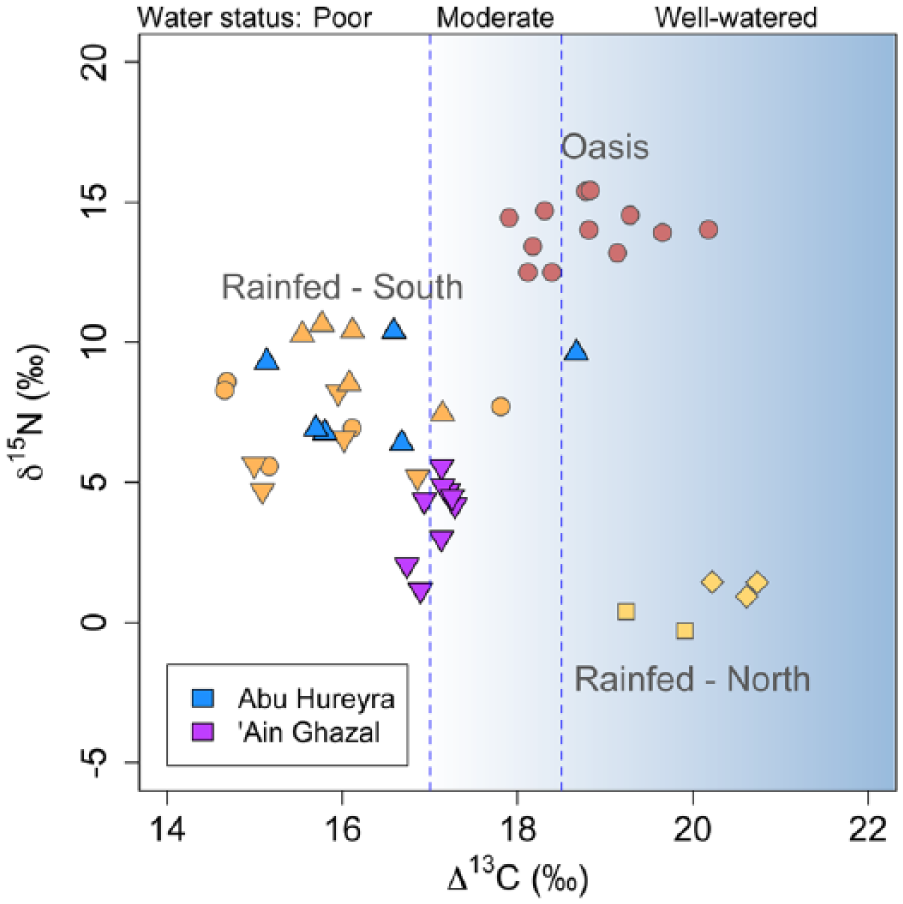
Plot of δ15N against ∆13C values of barley grain from Abu Hureyra and ‘Ain Ghazal, with modern barley grain isotope values plotted for reference. The watering bands for 2-row rather than 6-row barley are marked, to allow for comparison with archaeological 2-row barley ∆13C values.
The δ15N values of barley grains from Abu Hureyra are relatively high, ranging from 6.4‰ to 10.4‰ (Figure 6). Without faunal δ15N data it is not possible to estimate the δ15N values of unmanaged plants in this region, but by plotting the Abu Hureyra barley δ15N values against the natural log scale of the range of estimated past annual rainfall, it is possible to estimate the effect of aridity to some extent (Figure 7). The values plot within the high band of manuring at all annual rainfall values. There is no clear chronological difference in the δ15N values and the low sample number precludes any statistical analysis. Some degree of manure application therefore cannot be excluded at Abu Hureyra during the PPNB and PN. However, it is possible that the relatively high crop δ15N values were due to cultivation in soils that experienced temporary waterlogging and thus denitrification, such as on floodplains and wadi slopes (cf. Hartman and Danin, 2010). More work is needed to characterize crop growing conditions in such temporarily waterlogged soils and this should incorporate a multi-isotope approach, alongside weed ecological data, in order to distinguish different potential contributions to elevated crop δ15N values (e.g. manuring and/or seasonal waterlogging).
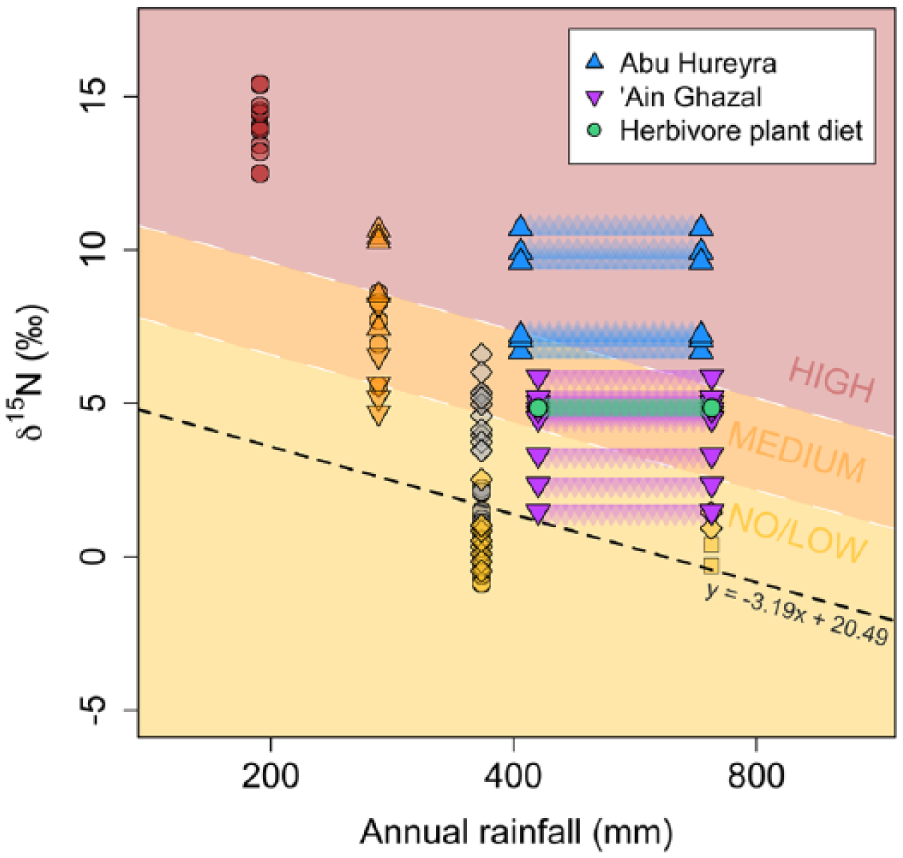
Plot of archaeological barley δ15N values against a natural log scale of rainfall, with manuring bands adjusted for the regression between unmanaged plant δ15N values and rainfall. The δ15N values of modern barley and bread wheat grains from Morocco and Syria are plotted for reference.
The δ15N values of these barley grains dating to the PPNB and PN are not significantly lower than those of individual rye grains (8.7–11.1‰; p = 0.113) dating to the Epipalaeolithic (determined by Araus et al., 2014), despite the >1500 year gap between their deposition. The authors have suggested that the high δ15N values of these rye grains are due to them growing on ‘dump-heaps’, which likely had higher δ15N values than the surrounding soils. The climate is also believed to have been drier than the succeeding PPN (Bar-Matthews et al., 1997). This demonstrates that if decreasing fertility of soils in the wider region was leading to decreasing crop δ15N over time (cf. Araus et al., 2014), soil conditions were being managed in some way at Abu Hureyra in the PPNB, maintaining higher crop δ15N values than those expected for unmanaged plants.
The δ13C and δ15N values of bone collagen from 36 goats, 4 sheep and 10 caprines from ‘Ain Ghazal (MPPNB to PPNC) have been determined by Miller (2012) and Makarewicz (2007). The δ13C values range from −20.7‰ to −16.2‰ and the δ15N values range from 6.8‰ to 10.8‰, with a mean of 8.9‰. There was no statistical difference in δ15N values between the chronological phases of the PPNB, but Miller observed that both the δ13C and δ15N values of caprines from the PPNC (n = 9) were higher than the PPNB. She interprets this as evidence for greater consumption of C4 plants growing in more arid environments (Miller, 2012). The inferred mean unmanaged plant δ15N value estimated from the faunal bone collagen is 4.9‰. This can be compared with the δ15N values of the barley grains in this study and also to the regression line of δ15N against natural log transformed rainfall determined from the Hartman and Danin (2010) study (Figure 7). The fact that the estimated faunal plant diet δ15N value plots in the medium band of manuring suggests that the herbivores were consuming plants growing in areas of the landscape where loss of N was enhanced, perhaps in seasonally wet stream beds where moisture levels and therefore plants remain into the summer months (Hartman and Danin, 2010). This highlights the benefit of considering herbivore bone collagen δ15N values in relation to the regression of plant δ15N values and rainfall in order to identify potential feeding strategies that could bias the unmanaged plant δ15N baseline value.
There is very little variation in the ∆13C values of barley grain samples from ‘Ain Ghazal (16.7–17.3‰; Figure 6; Wallace et al., 2015). This range is as tight as that determined in modern barley grown under the same water conditions (Wallace et al., 2013), suggesting that farmers at ‘Ain Ghazal had strict control over water availability, possibly through the use of the spring and floodplains close to the site. Their ∆13C values fall into the moderately watered band, again consistent with a degree of intentional watering to improve their water status. The floodplain at ‘Ain Ghazal is very limited in extent and thus unlikely to have supported enough crop cultivation to provide the population of the 5–10 ha settlement. It seems therefore that well-watered conditions were maintained elsewhere, possibly on terraced fields close to the spring. The δ15N values of barley grains from ‘Ain Ghazal are relatively low, ranging from 1.2‰ to 5.6‰ (Figure 6). The barley δ15N values are similar to or lower than the unmanaged plant δ15N baseline estimated from the faunal δ15N data (4.9‰), suggesting that the barley was growing in soil with a lower δ15N value than plants consumed by herbivores. When the ‘Ain Ghazal barley samples are plotted against the natural log scale of the range of estimated past annual rainfall, they plot within the low-medium bands of manuring (Figure 7), implying that any manuring input was minimal.
The ∆13C and δ15N values of pulses from ‘Ain Ghazal (n = 7) have also been determined (Supplementary Table 2, available online). The ∆13C values are relatively varied and fall within the moderate- to poorly watered band (Wallace et al., 2015). The greater variation in pulse ∆13C values compared with barley could be because pulses tend to be more sensitive than cereals to water shortages during seed filling (Brouwer et al., 1989), so variation in water availability during this growth period would result in greater variation in pulse compared with barley ∆13C values. The pulse δ15N values range from 0.9‰ to 2.3‰, which is close to but slightly higher than the δ15N value of atmospheric-N (Yoneyama et al., 1986), and this indicates that they indeed received the majority of their N from N-fixation. The slight elevation of pulse seed δ15N values over that of atmospheric-N could indicate some uptake of soil-N, which is more favourable when the concentration of soil inorganic-N is high (e.g. in manured soils; Streeter and Wong, 1988; Waterer and Vessey, 1993).
Thus we see evidence for two different strategies of crop cultivation in the PPNB and early PN, although greater numbers of crop samples for isotope analysis would be needed to characterize these more fully. At Abu Hureyra, barley was grown in rainfed fields whose soils varied in their water-holding capacity, with organic matter levels equivalent to high manuring rates, potentially relating to dung from the domestic sheep and goats herded in the vicinity of the site. At ‘Ain Ghazal, farmers seemed to have had strict control over the water status of their barley, possibly through watering their crops from the spring. There is no evidence for intensive manuring at the site, possibly because sheep and goats were herded away from the settlement (cf. Köhler-Rollefson and Rollefson, 1990), or periodic grazing of sheep and goats on arable fields did not result in high levels of manuring (cf. Bogaard and Isaakidou, 2010). The relatively high frequency of pulses recovered from the site could also reflect the practice of cereal–pulse rotation, which would have helped to replenish soil nutrients.
Conclusions
Although a relatively small modern pilot study, the δ15N values of barley grains growing in fields in present-day Morocco have provided a framework for reconstructing past farming practices, in areas where a (semi-)arid environment complicates the manuring δ15N signal. We use the regression line established by Hartman and Danin (2010) between unmanaged annual plant δ15N values and the natural log of annual rainfall to assess the relative importance of manuring at two early farming sites. Taken together, the material evidence from archaeological sites and crop isotope values can constrain scenarios of early farming practice. For example, low crop δ15N values preclude intensive manuring at ‘Ain Ghazal, which is consistent with the theory that the high frequency of pulses at the site is linked to maintenance of soil fertility. By contrast, the relatively high δ15N values of barley from Abu Hureyra cannot exclude the possibility of manuring as a means of maintaining soil fertility, although it is possible that cultivation of temporarily waterlogged soils (wadi bottoms and slopes) contributed to these high δ15N values. In both situations, however, the importance of manuring inferred from crop δ15N values would have been overestimated using the manuring level bands established for temperate Europe, rather than the framework developed here. This study provides the basis upon which to carry out further δ15N value determinations of modern cereal grains at other locations – and particularly on floodplains – to refine this framework, further constraining interpretations of possible farming regimes. The emerging evidence for crop growing conditions and early farming practices in western Asia presented here, as in Neolithic regimes in Europe (e.g. Bogaard et al., 2013), suggests that the flexibility of the early farming ‘package’ of cereals, pulses and livestock enabled communities to develop contrasting strategies to adapt to different ecological and social settings.
Footnotes
Acknowledgements
We would like to thank Andrew Moore and Gary Rollefson for granting access to the crop remains from Abu Hureyra and ‘Ain Ghazal, respectively. We are extremely grateful to Hamish Ferguson, Laura Green, John Hodgson, Erika Nitsch and Elizabeth Stroud for their help with crop sampling in Morocco and to Abed Aderdour for his generous help with crop sampling and translation in southern Morocco. We would also like to thank Paul Poulton for access to the unpublished data from Rothamsted Research. We are grateful to three anonymous reviewers for their helpful comments that have greatly improved this manuscript.
Funding
This work was supported by the Natural Environment Research Council (NE/E003761/1, PI Bogaard) and the European Research Council (AGRICURB project, grant number 312785, PI Bogaard).
References
Supplementary Material
Please find the following supplemental material available below.
For Open Access articles published under a Creative Commons License, all supplemental material carries the same license as the article it is associated with.
For non-Open Access articles published, all supplemental material carries a non-exclusive license, and permission requests for re-use of supplemental material or any part of supplemental material shall be sent directly to the copyright owner as specified in the copyright notice associated with the article.
