




Abstract
There are cases in which Bible translation has involved the demonization of local terminology. This is the case with the translation of the Bible into the Kachin language of Myanmar (Burma). The pre-Christian religion of Kachins was Nat worship, which provided religious vocabulary items for the Kachin Bible translation. The local term Nat (meaning “spirit”) was used for several demonological terms in the Kachin Bible. This study argues that the local term Nat was demonized in the process of Bible translation, resulting in a lasting and damaging impact on the biblical and theological understanding of Kachin Christians.
The demonization of local terminology in Bible translation has been the topic of previous research (e.g., Dube 2017, 3–25). In this paper, I will address the demonization of local terminology in the translation of the Bible into the Kachin language of Myanmar (Burma) by examining the use of a local term, Nat (meaning “spirit”). This study argues that the local term Nat, which carried a neutral meaning, was demonized in the process of Bible translation, resulting in a lasting and damaging impact on the biblical and theological understanding of Kachin Christians. First, I will briefly discuss the history of Kachin Bible translation. Second, I will discuss the use of Nat in the Kachin Bible. Third, I will demonstrate how the term was demonized. Fourth, I will discuss the impact of this translation decision. Finally, I will suggest an alternative translation of the demonical terms in the Kachin Bible.
The history of Bible translation in the Kachin language
Kachin peoples (also known as Jinghpaw, Singpho, or Jingpo) are a confederation of ethnic groups who inhabit the Kachin State in Myanmar (Burma) and neighboring Yunnan Province in China, as well as Arunachal Pradesh in Assam, Northeastern India. The majority of Kachins live in Myanmar, and they are one of the eight major ethnic groups of Myanmar. The Kachin people includes six ethnolinguistic groups: Rawang, Lisu, Jinghpaw, Zaiwa, Lacid, and Lhaovo (Tegenfeldt 1974, 11–24). Despite the various spoken dialects among Kachins, the Jinghpaw dialect, also known as the Kachin language, which American missionaries used as the medium for the first Kachin Bible translation, has gradually become the common language of the Kachin people over the past century.
Before Christianity was brought to the Kachins by American missionaries, the religion of the Kachins was Nat worship, a type of animistic or folk religion. In the Kachin language, it is called Nat Jaw. According to Ola Hanson (1913, 149), “It can be understood as Shamanism or animism in a form peculiarly adapted to the habits and intellectual development of a semi-savage mountain people.” 1 This pre-Christian religion of the Kachins provided local vocabulary items for the Bible translation.
The Kachin Bible was translated by a Swedish-American missionary, Ola Hanson. Since the Kachins did not possess a script, Hanson formulated an orthography for the Kachin language using the Latin alphabet and compiled a grammar and a Kachin–English dictionary before he began translating the Bible into Kachin (Hanson 1896, 1906). The Kachin Bible translation took more than thirty years. The work began in 1892 and the entire Kachin Bible was completed on August 11, 1926 (Tegenfeldt 1974, 170–71). The Kachin Bible, also known as the Jinghpaw Hanson Version Bible (Chyoi Pra Ai Chyum Laika: The Holy Bible in Kachin/Jinghpaw 1951), was first published in 1927 and is still the Bible for Kachin Christians today. Currently, there are more than 600,000 Kachin Baptists, and Ola Hanson is even today strongly revered as the father of the Kachins. A new version of the Kachin Bible, known as the Jinghpaw Common Language Bible (2009), 2 was published fifteen years ago, but it has not supplanted the Hanson version. Most Kachin Christians prefer the Hanson version over the Common Language version.
The use of Nat in the Kachin Bible
In the Kachin Bible, the word Nat is used only for the demonic, although the original meaning of the word Nat was neutral. In the Kachin Old Testament, the word Nat is used for the translation of Hebrew term שֵׁד šēd “demon,” which occurs only twice (Deut 32.17; Ps 106.37). In the Kachin New Testament, the word Nat is used primarily for the translation of three Greek terms, διάβολος diabolos “devil,” δαιμόνιον daimonion “demon,” and πνεῦμα pneuma “spirit” (πονηρόν ponēron “evil” or ἀκάθαρτον akatharton “unclean”). These different words are rendered with different words in English Bible translations. For the translation of διάβολος diabolos, English Bibles tend to use “the devil”; 3 for the translation of δαιμόνιον daimonion, “demon”; and for the translation of πνεῦμα πονηρόν pneuma ponēron or πνεῦμα ἀκάθαρτον pneuma akatharton, “evil/unclean spirit” (see e.g., KJV, ASV, NIV, CSB). Ola Hanson, however, translated all three terms with the same word, Nat. The neutral meaning of Nat is completely absent from the Kachin Bible and Nat is solely reserved for the demonic meaning. Although the original meaning of Nat is neutral and it can be used for both good or bad spirits, Nat is used for πνεῦμα pneuma only when it is modified by the adjectives πονηρόν ponēron, ἀκάθαρτον akatharton, or by the noun δαιμόνιον daimonion. That is, Nat is used for “spirit” only when it refers to evil or unclean spirits or to the devil, never for the human spirit or the Holy Spirit.
I also have made several observations of the use of Nat in the Kachin New Testament. First, the word Nat is mostly capitalized (although this is not very consistent) when it is used for διάβολος diabolos “devil,” but not capitalized when it is used for δαιμόνιον daimonion “demon” or πνεῦμα pneuma “spirit.” In fact, to Kachin readers, the meaning of Nat does not change whether it is capitalized or not. Second, an alternative term, Ji Nat “ancestral spirit,” appears for δαιμόνιον daimonion “demon.” The word Ji Nat, however, does not add any meaning because Nat or Ji Nat are merely interchangeable terms.
The original meaning of Nat in the Kachin cultural context
The word Nat (Nats in plural form) 4 in the Kachin language is usually translated into English as “spirit” or “demon” (Hanson 1906, 465). The proper meaning of Nat, however, needs to be understood in terms of the Kachin religious and cultural context, namely Nat worship. The word Nat has several connotations. First, Nat refers to angelic beings, rather than spirits. They are believed to have bodies like humans, and eat, drink, work, and go hunting. Some Nats are believed to have attractive faces and golden raiment, whereas others are believed to have a hideous appearance (Gilhodes 1922, 83).
Second, the word Nat carries a neutral sense and does not convey a negative connotation. To the Kachin mind, Nats are divided into two groups: the good Nats and the bad Nats. The good Nats are the inhabitants of heaven and called Ningtsa Nat ni “the sky Nats.” The bad Nats dwell on earth and are called Ga Nat ni “the earth Nats.” The good Nats are good because they can render good services to humans; the bad Nats are bad because they cause harm to humans. All Nats, either good or bad, have their own names. For instance, the names of the good Nats are Sinlap Nat, Mu Nat, Ningshe Mu Nat, Lamu Madai Nat, Ga Madai Nat, Nbung Nat, Jan Nat, Shata Nat, and Bungga Nat.5 The bad Nats are Jahtung Nat, Lep Sinnam Nat, Sawn Nat, Hpyi Lamum Nat, Sing-yaw Nat, Ndang Nat, Sawa Nat, Gunjang Nat, Shinglam (Shing-ram) Nat, Nat Gun, and Ba Lam Nat (Brang Shawng 2015, 37–38; Gilhodes 1922, 37–51; Hanson 1913, 109–29). 6
Third, the word Nat refers to a household deity. Kachin people have a particular devotion to some Nats. Every family has its household deity or domestic Nat. Each family chooses their own Nats depending on the status of the family. For instance, du magam “the lords” worship Madai, Sinlap, Jan Wa, Jan Nat, or Shata Nat, whereas the darat daroi “commoners” worship the souls of their ancestors or Hkring Wang or Jan Wa (Gilhodes 1922, 84).
Fourth, the word Nat can also refer to the spirit of a dead person. According to Nat worship, each person has at least two minlas “souls”; one is perfect or pure and the other imperfect. At death, the imperfect soul is sent to the country of the ancestors or elsewhere according to the kind of death, whereas the pure soul becomes a Nat and continues to stay at home and live on alms from the family members. Some believe it can also take flesh again in the body of a small child or of a domestic animal (Gilhodes 1922, 81). The kind of death of a person determines the kind of Nat one will become. For instance, the soul of a person who died by some kind of accident will become Sawa Nat or Sawn Nat. Such Nats are called wa hkrang e byin wa ai Nat ni “spirits who came into being by means of accident” (Brang Shawng 2015, 22–23).
The demonization of Nat in the process of Bible translation into Kachin
As discussed above, originally, the word Nat alone never carried a demonic connotation. But the word Nat was demonized in the Kachin Bible when it was used exclusively as a translation for the term “demon.” This was emphasized by the fact that a foreign word, Wenyi (from the Burmese word for “soul/spirit”), was adopted to translate “human/Holy spirit.” The word Wenyi is a Burmese word for spirit or soul, and it is consistently used for the Holy Spirit or a human’s spirit in the Kachin Bible. In other words, the positive or neutral meaning of Nat was either completely ignored or purposely dismissed by the Kachin Bible translator.
Although we cannot be certain of the reasons behind the choice of Nat for rendering a demonic sense in the Kachin Bible, there are two plausible causes of the demonization of Nat. First, it might have been caused by the Bible translator’s negative attitudes towards the existing religion and culture of the Kachin people, especially Nat worship. Simon Pau Khan En (2012, 159) remarks that the Western missionaries who came to Myanmar were not ready to discern the inseparable fusion of religion and culture among the people whom they loved and served. According to him, the missionaries understood their mission to be the abolishing of the existing religion and culture of the people and the replacing of it with Christianity and the culture of the missionaries. Nat worship was conceived of as negative and corrupted, and therefore eradication of Nat worship was regarded as the sine qua non of preaching the gospel (En 2012, 159). Being the product of his own time, Hanson very likely adopted such an attitude toward Nat worship, which in turn contributed to the demonization of the word Nat. Hanson’s negative attitude toward the word Nat becomes even more significant if we compare him with other authors of his time. For instance, H. F. Hertz (1902, 113) defines Nat as “spirit” in a neutral sense. Gilhodes, an early Catholic missionary among the Kachins, also recognizes the neutral meaning of Nat (Gilhodes 1922, 83). It should be noted here that Gilhodes’s understanding is more in tune with the local understanding. This attitude toward Nat is also described by Tegenfeldt, who states, “Probably it is more meaningful from a Kachin point of view to classify the Nats as those who are at least potentially benevolent and those who do nothing but work evil against man” (1974, 47). But Tegenfeldt himself, unfortunately, adopts Hanson’s understanding of Nat. He states that “even the benevolent spirits are not concerned to do good, rather they are less likely to cause trouble than the others, unless of course they are neglected or in some way offended” (Tegenfeldt 1974, 47).
Second, the demonizing of the word might also have been caused by the misunderstanding of Nat by Ola Hanson. Although Hanson recognized that Nat means “supernatural being” (Hanson 1913, 131), Hanson defines Nat entirely by its negative connotation. For example, while acknowledging that Nat can refer to either a good spirit or bad spirit, in the Kachin dictionary he defines Nat as “spirit or demon” and lists the names of Nats without indicating that some are good and some are bad (Hanson 1913, 465). Thus, his dictionary entry was already biased. And this negative definition of Nat seems to be consistent with his book on Kachin culture and traditions (Hanson 1913, 149–69). Thus, Hanson’s understanding of Nat was too narrow since it was valid for only one of the several connotations the term carries. This allowed him to use it only for various demonological terms in the New Testament.
The impact of the demonization of Nat for Kachin Christians
The demonization of Nat has had several impacts upon the Kachin community as a whole, both in the past and in the present. First, the demonization of Nat created a social conflict between Kachin Christians and Kachin non-Christians. Kachin converts began to perceive their fellow Kachins who were still worshipping Nats as demonic and they wanted to distance themselves from them. Likewise, the Nat-worshipping Kachin community perceived the Kachin converts as betrayers and enemies of their own cultural heritage (Tegenfeldt 1974, 317). Tegenfeldt observed that this conflict was one of the major obstacles to church growth among the Kachins (Tegenfeldt 1974, 314–18). 7 Such conflict still occurs between Kachin Christians and Kachin non-Christians, although it is not as intense as in the past.
Second, the demonization of Nat has created an existential dilemma for Kachin Christians. Kachin Christians do not easily abandon the beliefs and practices of Nat worship after they accept Christianity, as is true with others who practice animism, as Vowels (2016, 228–29) has observed. To use Hiebert’s (1993, 257) words, “They simply went underground.” The Kachin Christians, although they can easily abandon their devotion to Nat worship, have ways of life that are greatly immersed in pre-Christian cultural practices. For instance, they still practice the naming pattern derived from the names of Nats. 8 In other words, the demonization of the word Nat was not only the demonization of the pre-Christian religion but also the demonization of the cultural heritage of the Kachin people. When the word Nat is perceived as demonic, it creates an existential dilemma for Kachin Christians. It distances them from their cultural traditions.
Third, the use of Nat creates a confusion over biblical demonological terms by using the same word Nat for different terms. 9 The Greek words διάβολος diabolos “devil” and δαιμόνιον daimonion “demon” are quite different in their meaning. Throughout the New Testament, the word διάβολος diabolos “devil” refers to the devil or Satan, the adversary of God and the leader of all forces of evil, while a δαιμόνιον daimonion “demon” is thought of a servant of Satan who takes control of people and causes all kinds of physical and emotional disorders (Bratcher 1981, 27, 35). Although the New Testament writers use several different Greek terms, Ola Hanson uses Nat for all these different Greek terms. Such usage fails to make an important distinction between the different terms. Edward Langton once complained about the translators of the English Revised Version for their failure to make an important distinction between the “devil” and “demons.” He pointed out that the revisers translated the Greek word δαιμόνιον daimonion “demon” everywhere by “devil” while knowing that the Greek words for the devil and demons are quite different. He argued that using the same word to translate different terms has contributed to much confusion of thought. For instance, a possessed person is supposed to be possessed by evil spirits or demons, not by the devil (Langton 1970, 26). According to the Revised Version, however, people were possessed by devils (Mat 8.28-33; 9.33-34). 10 Langton’s complaint can similarly apply to the Kachin Bible. Due to the use of the same word Nat for different terms, the readers lose biblical nuances regarding the terms.
Conclusion
Thus far, I have argued that the originally neutral term Nat has been demonized by the way it was used in the Kachin Bible translation and that this has left a lasting impact on Kachin Christians. My intention here is not to diminish the accomplishment of the Kachin Bible translator, Ola Hanson, who worked so hard his entire life for the Kachin people, but to recommend improving his work in this particular area.
To improve the Kachin translation of terms such as “devil” and “demon,” the problem should be approached conceptually as well as practically. At a conceptual level, we have to deal with our own ideologies and attitudes toward Nat worship, while at a practical level, we have to come up with alternative translations for these terms.
First, a positive or at least neutral attitude toward Nat worship should be adopted. Condemning it from the outset will not help. In the case of Kachin, I agree with En (2012, 75) when he states that to condemn Nat worship as an absurdity and as superstition is to overlook the profound religiosity and the cultural realities of the Kachin people. A neutral or positive attitude toward Nat worship will help us to see the value of it for the Kachin people. En’s theological reflection on Nat worship in Myanmar is very helpful in this regard. He suggests four principles for a more positive attitude toward Nat worship: (1) to regard Nat worship as a preparation for the gospel, (2) to see Christianity as the fulfillment of Nat worship, (3) to judge Nat worship in light of the gospel and redeem it from rottenness, and (4) to regard Nat worship as a way to enrich the gospel message in this particular context (En 2012, 74–77). Therefore, a proper study of Nat worship is needed, and this, no doubt, will lead to more understanding; this is more a fruitful attitude than either ignoring or demonizing Nat from the outset.
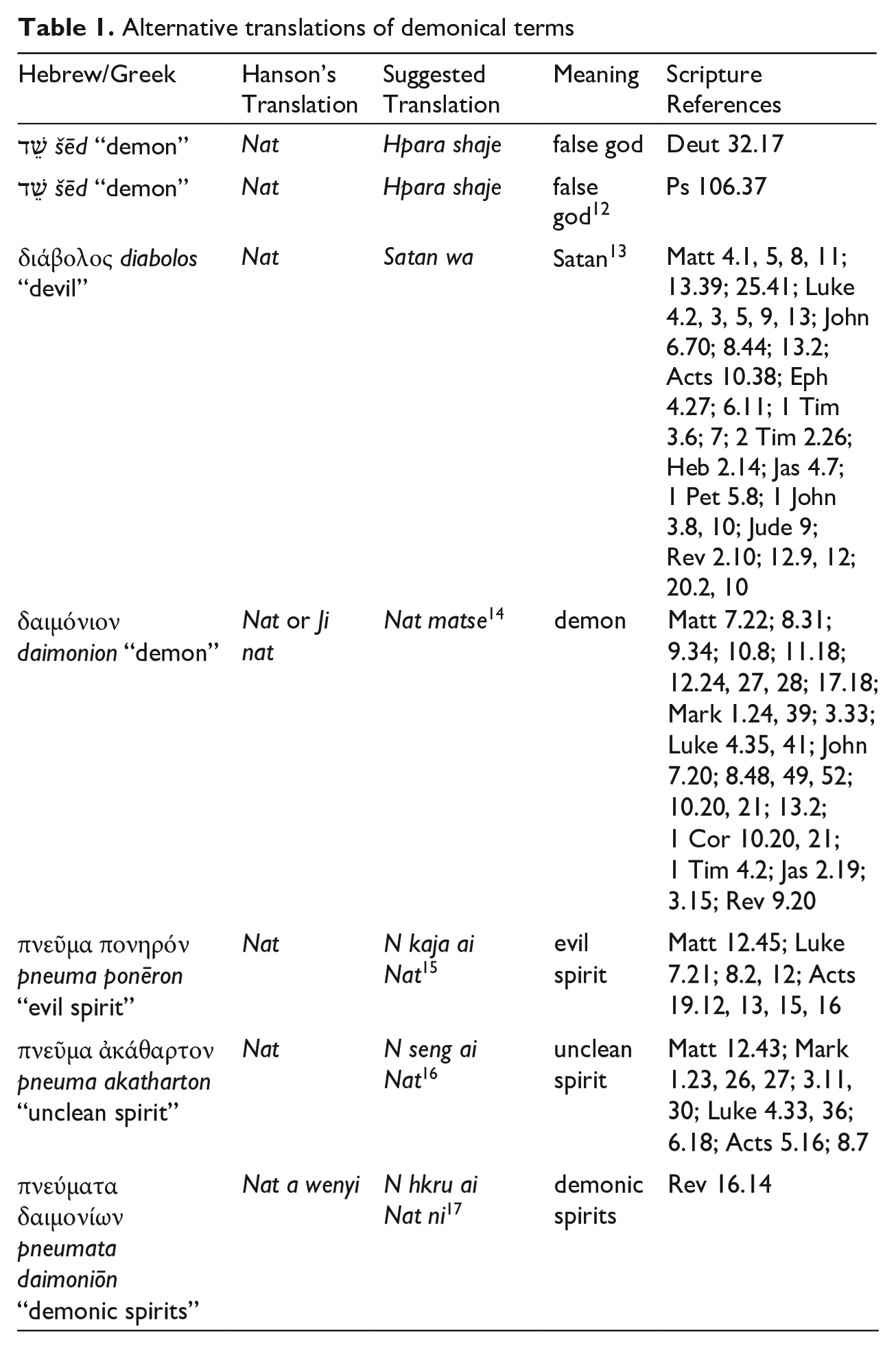
Second, at a practical level, instead of using the single word Nat for the various Hebrew and Greek terms for “devil” or “demon,” one should consider more seriously the viability of the different terms for evil spirits in the Kachin language. One way to do this is to look at the names of Nats which carry fully demonic connotations, such as Jahtung, Matsa, Ndang, Sawn, Lasa, Sawa, and Hpyi Lamun. 11 Another option, which I prefer, is to render them with a modification of existing local words. I conclude by suggesting how the various Hebrew and Greek terms can be rendered differently. Instead of using only Nat for all expressions, different demonical terms can be rendered as laid out in Table 1.
Alternative translations of demonical terms
Footnotes
1.
Nat worship is also found among other ethnic groups in Myanmar, such as Bahmas, Shans, Chins, and Kayins, and the forms of worship may vary in their minute details. This study focuses only on Nat worship among Kachins.
2.
Jinghpaw Common Language Bible is a Kachin Bible translated by two local translators, Rev. La Ja Maji and Sara Jawng Li Lama; they worked from the English Good News Bible (GNB).
3.
The exceptions are for the three occurrences in 1 Tim 3.11; 2 Tim 3.3; and Titus 2.3, which refer to a characteristic of a person (“slanderer”). The Kachin New Testament does not use Nat for these three occurrences either.
4.
Though the exact plural form of Nat in the Kachin language is Nat ni, for the sake of English readers, I am using Nats as its plural form. In doing so, I am following the practice of authors such as Simon Pau Khan En (2012) and  .
.
5.
Sinlap Nat, Mu Nat, and Ningshe Mu Nat refer to the “thunder Nats”; Lamu Madai Nat refers to the “sky Nat”; Ga Madai Nat refers to the “earth Nat”; Nbung Nat refers to the “wind Nat”; Jan Nat refers to the “sun Nat”; Shata Nat refers to the “moon Nat”; and Bungga Nat refers to the “breeze Nat.”
6.
Jahtung Nat, Lep Sinnam Nat, and Sawn Nat refer to evil Nats that dwell in caves, waterfalls, and dense forest. Hpyi Lamum Nat and Sing-yaw Nat refer to the evil Nats possessed by certain humans. Ndang Nat and Sawa Nat refer to evil Nats that cause violent death, and Gunjang Nat, Shinglam (Shing-ram) Nat, Nat Gun, and Ba Lam Nat refer to the Nats that cause troubles and sickness for people.
7.
En notes that such a chasm between local culture and imported Christianity exists among other ethnic Christians in Myanmar too (2012, 159).
8.
Kachin Christians today still follow the traditional naming pattern. The Kachin cultural pattern of naming children is as follows: for the boys, Gam for the first, Naw for the second, La for the third, Tu for the fourth, Tang for the fifth, Yaw for the sixth, Hka for the seventh, Roi for the eighth, and Kying for the ninth; for the girls, Kaw for the first, Lu for the second, Roi for the third, Htu for the fourth, Kai for the fifth, Hka for the sixth, Pri for the seventh, Yun for the eighth, and Kying for the ninth (Hanson 1913, 156; , 8, 149).
9.
10.
This rendering was corrected by later revisers who used the term “demon.”
11.
All these terms refer to the evil spirits who are the most mischievous. These Nats make people sick or die. Jahtung refers to a cruel monster inhabiting caves, waterfalls, and dense forest which makes people mad or sick or die; Matsa refers to a demon of curses and maledictions; Ndang refers to an evil spirit which causes trouble and death for women at the time of childbirth; Sawn refers to a malignant female spirit which causes death to a woman in childbirth; Lasa and Sawa refers to the evil spirit which cause people death by violence or accidents; and Hpyi Lamun refers to a spirit with the power to bewitch human beings (Tegenfeldt 1974, 47–48; Gilhodes 1922, 46–48; , 379, 559, 605).
12.
NIV translates שֵׁד šēd as “false god.” Such a translation fits well in the Kachin cultural context.
13.
14.
15.
N kaja ai “evil” qualifies the word Nat, so the neutral meaning of Nat is preserved.
16.
N seng ai “unclean” qualifies the word Nat, so the neutral meaning of Nat is preserved.
17.
N hkru ai “demonic” qualifies the word Nat ni “Nats,” so the neutral meaning of Nat ni is preserved.