




Abstract
The New Testament contains over 3,000 non-Greek words. Many of these are simply cases of loanwords, seen especially in the case of proper nouns and toponyms. However, others retain their foreign value in the text, illustrated especially by the addition of an in-text translation or explanation. These examples of flagged code switching point to further examples of unflagged code switching. After dealing with the function of code switching in the New Testament, this article analyzes the treatment of nine examples of unflagged code switching in forty-four passages. The results point to a clear distinction in the translational practice between traditional and modern Bible versions.
In linguistics, one of the important recent areas of investigation involves the study of how contact between and among languages shapes communication. Studies in multilingualism have highlighted numerous ways in which bilingual speakers borrow and mix linguistic elements, ranging from lexical borrowings 1 to semantic loans and loan translations, to code switching and mixing. Many researchers have focused their attention on spoken dialogue, giving the mistaken impression that these linguistic influences are limited to oral language. Language contact, however, shapes all levels of communication, including written communication. 2 What is more, these aspects of language contact present a rather unique problem to the translator, for they open up several mutually exclusive possibilities in translation.
For many students of the New Testament, the idea of foreign words inserted into the biblical text may seem almost impossible to imagine. In fact, it is often the case that the non-Greek vocabulary of the New Testament seems to fly under the radar. Upon reflection some may call to mind certain Aramaic phrases mentioned in the Gospels and assume that language contact is limited to this very reduced set of examples. And yet the statistics seem overwhelming. Out of the 7,936 verses in the New Testament, 2,207 of them contain one or more of 3,129 foreign words. That means that roughly one in every three verses contains at least one non-Greek word. Most of these words (2,463 or 78.7%) appear in the narrative sections of the Gospels and Acts. 3
The 3,129 non-Greek words in the New Testament come from a variety of different languages. This corpus is made up of 381 unique words, 274 (71.5%) of which come from the Semitic languages Hebrew, Aramaic, or Syriac (see Figure 1). 4 An additional 68 foreign words (17.75%) in the New Testament come from Latin, and the remaining 41 foreign words (10.7%) come from a variety of other languages, especially those of Asia Minor.
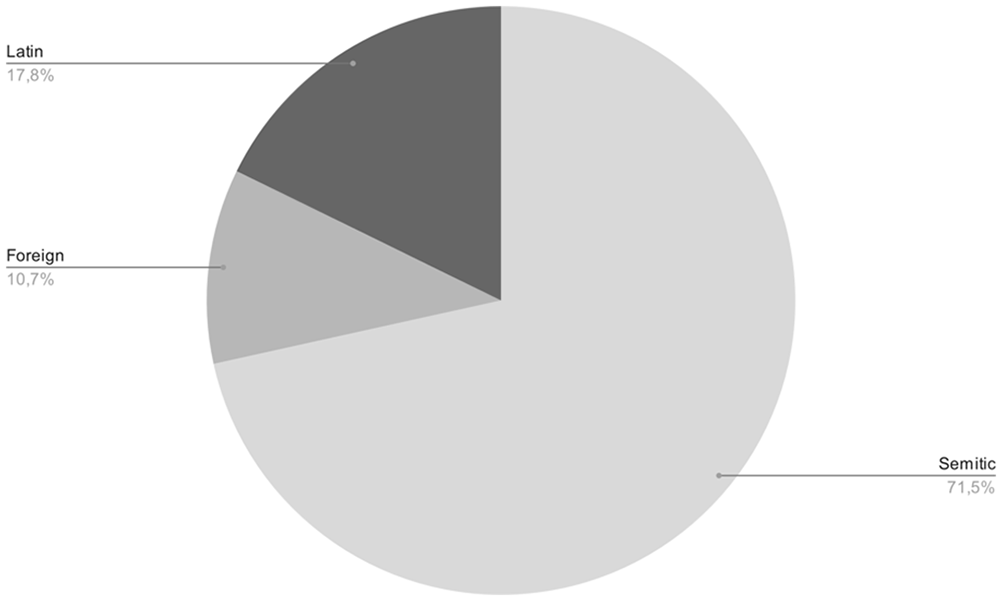
Origin of foreign words in the New Testament
The focus of this paper will be limited to the examples of Semitic words, the largest family of foreign words found in the New Testament. Of course, the other types of foreign words could also be studied with profit, but there is not enough space to do so in this article.
Even for those with an extensive knowledge of the New Testament, the data presented so far may seem exaggerated, almost beyond belief, but a closer survey of the data will quickly dispel unbelief. Most (86%) of the Semitic foreign words which appear in the New Testament are either proper names from the Old Testament (e.g., Ἀβραάμ “Abraham”; 63%), 5 gentilics (e.g., Χαναναῖος “Canaanite”; 1.5%), or toponyms (e.g., Γαλιλαία “Galilee”; 22%) (see Figure 2). 6 Of course, any time the New Testament mentions a character from the Old Testament or a location in or around Israel, it is technically inserting a non-Greek term into a Greek text. For most readers, however, a foreign name hardly seems worthy of being included in a tabulation of foreign words, and especially with regards to translation, since names tend to experience minimal adaptation when expressed in a new language. Yet, even if all of the names of people and places are excluded from the list, there still remains a rather surprising number of Semitic words sprinkled throughout the New Testament (38 words appearing in 444 verses). It is from these remaining foreign words that the corpus for this study is taken. But first it is important to distinguish the different types of language contact displayed throughout these examples.
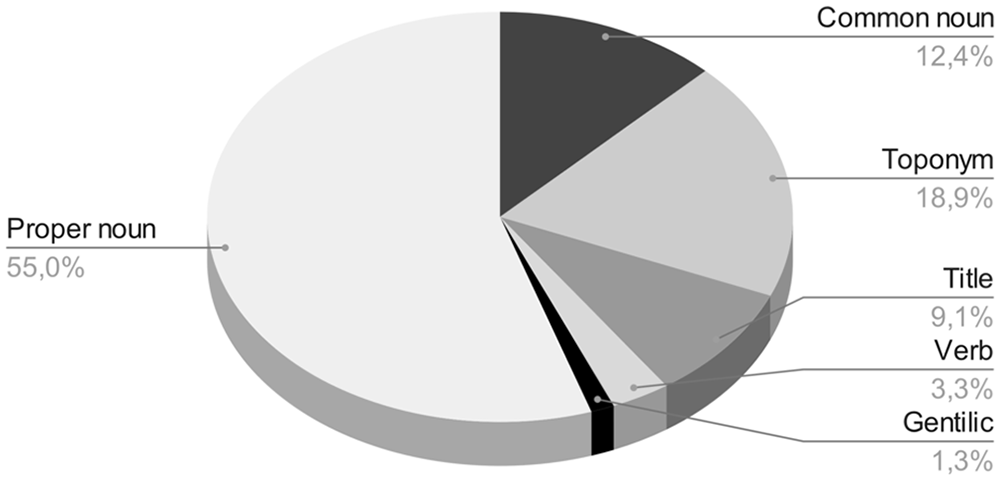
Categories of Semitic foreign words in the New Testament
Linguistic background
Any language which is in contact with other languages will be influenced by those languages. Given the cultural and linguistic context of the New Testament, the presence of foreign words in the text is precisely what one would expect (Silva 1980, 214). 7 It is, however, important to establish some different categories of foreign influence, for not all foreign words are equally foreign. The first category is that of lexical borrowing or loanwords. A loanword is “the direct transfer of an element from one language to another, where the original phonetic form adapts to the phonology of the receiving language without interpretation or translation” (Gómez 2020, 391). 8 Poplack and Sankoff suggest characteristics that loanwords share: “frequency of use, native-language synonym displacement, morphophonemic and/or syntactic integration [and] acceptability” (Poplack and Sankoff 1984, 103). 9 One can assume that the presence of foreign words in a text like the LXX or the New Testament suggests that these terms enjoyed a broad level of acceptability.
The LXX has multiple examples of non-Greek words, thus establishing the historical presence of these loanwords in Koine Greek. It is likely that many of these words would have felt no more foreign to the original recipients of the New Testament than the term restaurant does to modern English speakers. 10 For example, the Hebrew word גָּמָל “camel” was borrowed into Greek as κάμηλος and later into English as camel. The noun is fully adapted into the morphological and phonetic system of Greek and well established by over fifty uses throughout the LXX as well as examples from Philo and Josephus (Bauer et al. 1999). This kind of loanword is often called an established borrowing because it has become fully integrated into the receptor language, thus displacing any other term which might have been employed for the same referent in previous dialects of the language.
However, not all loanwords are equally well established in the language. 11 For example, in Gen 29.27, the LXX uses the term ἕβδομος “seventh” to translate שְׁבֻעַ “week.” 12 This sense of the word, however, never appears in the New Testament, which instead employs the Semitic borrowing σάββατον for “week” based on the Hebrew term mentioned above. 13 This lexical borrowing has clearly displaced the previous term ἕβδομος, since the latter never appears in the New Testament. Other examples of an established Semitic loanword in the New Testament include words like satan or Passover (Gómez 2020, 405–6).
It is clear that foreign words may be borrowed and assimilated into a language with no need for translation or explanation. It seems equally clear that these borrowings undergo a process of assimilation which is not instantaneous (Poplack and Sankoff 1984, 100). 14 In other words, bilinguals insert a word 15 or words from language B into language A; over time these words are gradually integrated and become common enough in language A that eventually monolinguals begin to use them as if they had historically always been a part of language A (Myers-Scotton, quoted in Hadei 2016, 14). The most appropriate term for the initial contact which may eventually lead to established borrowings is code switching, “when linguistic elements from two or more languages [are] combined in one clause or sentence” (Myers-Scotton 2006, 203). “A change of code in the same statement is called code-switching, whereby expressions from one language are introduced into another. It includes the insertion of isolated words, but also the inclusion of longer discourses” (Gómez 2020, 392). 16 While there is some debate among linguists about an exact distinction between code switching and borrowing (Poplack and Sankoff 1984, 99), 17 at least one situation is clearly distinguishable from lexical borrowing: flagged code switching. “Flagged switching draws attention to itself, marked by repetitions, hesitations, metalinguistic comments, and the like” (Treffers-Daller 2009, 60). Since in borrowing, the foreign word has become integrated at least semantically into the receiving or matrix language, there is no need for a metalinguistic comment such as an explanation or a translation. However, when the author feels the need to explain a foreign term or phrase, it is a textual clue that the author deems the word or phrase sufficiently foreign to the audience and it should therefore not be treated as an established lexical borrowing. 18 In the New Testament, flagged Semitic code switching appears in the following passages:
Ἐμμανουήλ, ὅ ἐστιν μεθερμηνευόμενον Μεθ᾽ ἡμῶν ὁ θεός “Emmanuel, which is interpreted ‘With us God’” (Matt 1.23)
ἐν τῷ Βεελζεβοὺλ ἄρχοντι τῶν δαιμονίων “by Beelzeboul, the prince of the demons” (Matt 12.24)
Γολγοθᾶ, ὅ ἐστιν Κρανίου Τόπος λεγόμενος “Golgotha, which is called ‘Place of the Skull’” 19 (Matt 27.33; cf. Mark 15.22; John 19.17)
Βοανηργές, ὅ ἐστιν Υἱοὶ Βροντῆς “Boanerges, which is ‘the Sons of Thunder’” (Mark 3.17)
Ταλιθα κουμ, ὅ ἐστιν μεθερμηνευόμενον Τὸ κοράσιον, σοὶ λέγω, ἔγειρε “Talitha koum, which being interpreted is ‘Little girl, I say to you, arise’” (Mark 5.41)
Κορβᾶν, ὅ ἐστιν, Δῶρον “Korban, which is, ‘Gift’” (Mark 7.11)
Εφφαθα, ὅ ἐστιν, Διανοίχθητι “Effatha, which is, ‘Be opened’” (Mark 7.34)
Αββα ὁ πατήρ “Abba, Father” (Mark 14.36; Rom 8.15; Gal 4.6)
Ῥαββί, ὃ λέγεται μεθερμηνευόμενον Διδάσκαλε “Rabbi, which being interpreted means ‘Teacher’” (John 1.38)
τὸν Μεσσίαν, ὅ ἐστιν μεθερμηνευόμενον χριστός “the Messiah, which being interpreted means ‘Christ/Anointed One’” (John 1.41; 4.25)
Λιθόστρωτον, Ἑβραϊστὶ δὲ Γαββαθα “Lithostroton, and in Hebrew Gabbatha” (John 19.13) 20
Ραββουνι, ὃ λέγεται Διδάσκαλε “Rabbouni, which means ‘Teacher’” (John 20.16)
Ἁκελδαμάχ, τοῦτ᾽ ἔστιν Χωρίον Αἵματος “Akeldama, this is ‘Field of Blood’” (Acts 1.19)
As far as translation is concerned, the examples of flagged code switching listed above are of little interest. Since the foreign word is identified as such, virtually every major English Bible translation handles each passage in the same manner: the foreign term is transliterated and then followed by an interpretation in the target language parallel to the source language.
Established lexical borrowings, particularly those loanwords established either in the LXX, in other Koine literature prior to the New Testament, and/or through a high degree of frequency in the New Testament writings, and flagged code switching are two clearly distinguished categories of foreign words in the New Testament. There is, however, one last necessary category on the spectrum of the incorporation of Semitic words into the Greek of the New Testament: unflagged codeswitching. 21 This study labels these words as code switching since the foreign words are never or very infrequently found in previous Koine literature or because they are explained in at least one other passage. For example, the term κορβᾶν appears only twice in the New Testament. Mark flags it in his Gospel with the translation “gift” (Mark 7.11), while Matthew uses it to refer to the temple treasury with no explanation whatsoever outside of the context (Matt 27.6). The same term appears in three separate passages in Josephus (Ant. 4.73; B.J. 2.175; and C. Ap. 1.167; Bauer et al. 1999); however, in each case, Josephus flags the term with a translation or an explanation. As Mussies notes, “The absence of translation is striking only in those cases where we do not have current loan words like σάββατον [week] or familiar names like Ἰωσήφ [Joseph], but rather rare or even unique words and phrases. … It is also unclear why μαμωνᾶς [mammon] is not translated by Matthew and especially why not by Luke, while both of them added to such a character as Βεελζεβούλ [Beelzeboul] the elucidating apposition ‘the prince of demons’ (Matt 12.24; Luke 11.15)” (Mussies 1984, 429). The term μαμωνᾶς does appear in several passages of the pseudepigraphal book of 1 Enoch. Given, however, the fact that the book was originally written in Aramaic and later translated into Greek, it is hard to conclusively argue that the uses of the foreign word mammon are necessarily previous to the New Testament. The same is true of the term γέεννα. Besides its use in 1 Enoch, it also appears in the Sibylline Oracles, a work which is known only through a sixth-century edition and is suspected to have been influenced by Christianity. All of the other foreign words listed below are not referenced in Koine literature outside of the New Testament. It is to this category of Semitic words in the New Testament that the rest of this study will be dedicated.
κορβᾶν (Matt 27.6; cf. Mark 7.11 where the code switching is flagged)
μαμωνᾶς (Matt 6.24; Luke 16.9, 11, 13)
Βεελζεβούλ (Matt 10.25; 12.27; Luke 11.18-19; cf. Matt 12.24; Mark 3.22; Luke 11.15 where the code switching is flagged)
ῥαββί (Matt 23.7; 26.25, 49; Mark 9.5; 11.21; 14.45; John 1.49; 3.2, 26; 4.31; 6.25; 9.2; 11.8; cf. John 1.38 where the code switching is flagged)
ῥαββουνί (Mark 10.51; cf. John 20.16 where the code switching is flagged)
ῥακά (Matt 5.22)
γέεννα (Matt 5.22, 29, 30; 10.28; 18.9; 23.15, 33; Mark 9.43, 45, 47; Luke 12.5; James 3.6)
μαράνα θᾶ (1 Cor 16.22)
ὡσαννά (Matt 21.9, 15; Mark 11.9-10; John 12.13)
Textual background
The New Testament has a number of clear examples of foreign words which do not fit into the pattern of established loanwords. In the cases of flagged code switching, nearly all English Bible versions transliterate the foreign words, thus signaling to the reader that the author for some reason has chosen to insert information into the text from another language. The explanation or translation which follows the foreign word further highlights the code switching. In the case of unflagged code switching, however, the decision of how the translator should handle the text depends on whether or not the translator deems it important for the reader to be cued about the presence of a foreign word in the text. A translator must therefore first of all analyze whether the foreign words in the text fulfill a textual function or if they are simply unremarkable aspects of Koine style which do not develop the meaning of the text.
It is no surprise that some translators will look past the presence of an unflagged foreign word and clearly render the meaning of the text. Since the translation includes all of the explicit semantic elements of the source text, it can hardly be considered a mistranslation. But it is important to note that there is no shortage of interpreters who point to the presence of foreign words in the text as an important interpretive clue which should be maintained in translation (Gómez 2020, 400). “Lexical borrowing and code-switching are two deliberate strategies used by Mark through which he fulfills certain social and literary functions, which reinforce his leadership as interpreter of the Jesus tradition” (Gómez 2020, 414). 22 Given the focus on translation practice, this article cannot explore the interpretative arguments for judging the importance of the presence of unflagged code switching in the above mentioned passages. 23 The following, however, is a summary of several suggested functions that code switching may play in the semantics of the NT text.
Code switching helps to highlight the historicity of the text. The detail of the actual words spoken in specific contexts heightens the realism of the narrative. 24
Code switching strengthens the cultural aspect of the text. Although the narrative develops in Greek, the presence of foreign words reminds the reader of the original context of the story. This happens both through direct quotations in narratives as well as borrowed toponyms and proper names which surround the events of the story. 25
The use of code switching helps build bridges with the original audience. Especially in the case of unflagged code switching in which the author assumes that the readers have enough cultural knowledge to fill in the blanks and comprehend the message, there is a sense of connection and community with shared linguistic concepts. “Some of these Aramaic words were undoubtedly known and used by the community since words such as hosanna, rabbi, amen, and abba appear in other texts (John 1.51; Gal 4.6; Rom 8.15)” (Gómez 2020, 404). 26
The insertion of Semitic terms within the text probably also had the effect of distancing the text from the upper-class elite literature of the Greco-Roman world (Gómez 2020, 406).
Translators who choose not to retain some aspect of the foreign word in their translation seem to suggest that they do not view the presence of the foreign word as primary, while those who transliterate the foreign word seem to suggest that the code switching in the source-language text of the New Testament carries out a specific function and must therefore be reflected in some way in the target-language text.
Methodology
As stated above, the New Testament has at least nine different Semitic words which appear without being flagged or identified by the author. None of these words is attested by the LXX, which means that they had not been in use in the community for a long period of time, and none of them has an elevated frequency in the New Testament so as to be considered an established loanword. Also, several of these appear with metalingistic explanations in other passages, backing up the claim that they cannot be considered established lexical borrowings. These nine Semitic words appear in forty-two verses. Two are simply common nouns. When Mark reports Jesus’ use of the word κορβᾶν in his teaching against the practice of the Pharisees (7.11), he flags the term with the parenthetical interpretation ὅ ἐστιν Δῶρον “which is/means a gift.” Matthew, however, uses the same term to describe the temple treasury in the dispute over what to do with the money that Judas had returned before hanging himself (27.6). Here Matthew’s use of the foreign term is unflagged code switching. Matthew and Luke also record Jesus’ use of the noun μαμωνᾶς in reference to money. In both Matt 6.24 and Luke 16.9, 11, 13, this Semitic code switching is unflagged (see Table 1).
Unflagged code switching in the New Testament
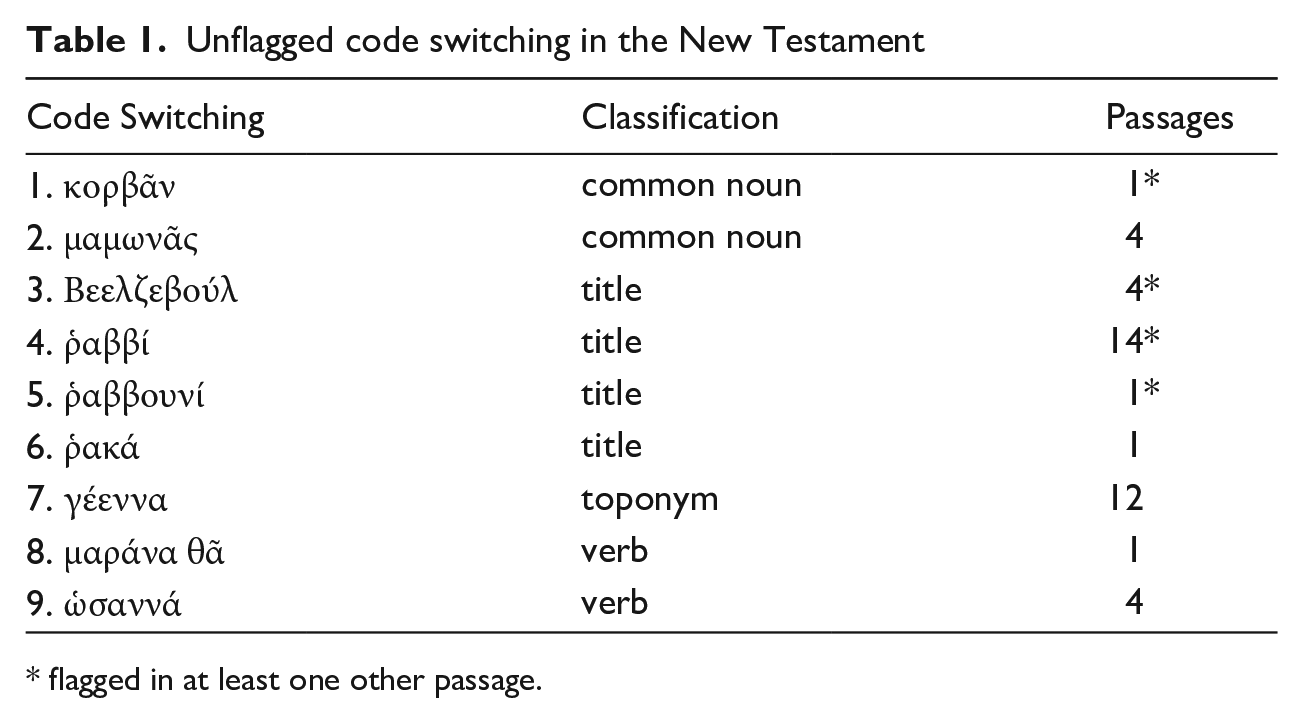
flagged in at least one other passage.
Next there are four different Semitic words used as titles: Satan is called Βεελζεβούλ (literally “lord of flies”), Jesus is called ῥαββί “my teacher” and ῥαββουνί “my great teacher,” and a brother is called ῥακά “an empty one, a fool.” The first time Matthew records the term Βεελζεβούλ, the word is unflagged (10.25). Two chapters later, however, the Pharisees use the term, and this time it appears with an explanatory phrase (ἄρχοντι τῶν δαιμονίων “the prince/ruler of demons”). In parallel passages, both Mark (3.22) and Luke (11.15) record the same interpretation. Following this flagged use, both Matthew (12.27) and Luke (11.18-19) repeat the title without a linguistic flag. The term ῥαββί appears fifteen times throughout the Gospels. It is interesting to note that the first time the term appears in John’s Gospel, it is flagged with a translation (ὃ λέγεται μεθερμηνευόμενον Διδάσκαλε “which being translated means Teacher”). The same word, however, is unflagged in Matthew (23.7-8; 26.25, 49), Mark (9.5; 11.21; 14.45), and other passages in John (1.49; 3.2, 26; 4.31; 6.25; 9.2; 11.8). 27 Both Mark (10.51) and John (20.16) also use ῥαββουνί, a slight alteration of the same title. In this case, John once again flags the term with the same translation used in 1.38, ὃ λέγεται Διδάσκαλε “which is/means Teacher.” Mark, however, uses the Semitic term with no flag (10.51). Finally, Matthew presents Christ’s warning about insulting a brother (5.22). After stating the general prohibition against anger, he goes on to give two specific terms in which this anger may be expressed. The first is a Semitic word (ῥακά, apparently from רֵיק “empty”; cf. Gen 37.24) and the second, a parallel Greek word, Μωρέ “fool.”
The word γέεννα (Gehenna, literally “valley of Hinnom”; cf. Neh 11.30 גֵּיא־הִנֹּם) is the only example of a toponym in this list. 28 Yet it is different from all of the other toponyms in the New Testament, because the context indicates that Jesus is using the term as a reference to a spiritual place of eternal retribution. The synoptic Gospels all record Jesus’ use of this term. It is often modified with the genitive modifier τοῦ πυρός “of fire.” James also uses this Semitic word in his epistle (3.6).
The final two examples are distinct from all of the previously mentioned words because they are both verbs. The apostle Paul closes out the final chapter of his first letter to the Corinthian believers with the phrase μαράνα θᾶ. The phrase is built on a Syriac phrase meaning “The Lord come.” Here it has been code switched into the Greek with no explanation or translation. Evidently the Corinthian believers had been exposed to this phrase and the apostle assumes that they would understand it without any direct interpretation on his part. 29 The final example comes once again from the Gospels. In their account of Jesus’ triumphal entry into Jerusalem, Matthew (21.9, 15), Mark (11.9-10), and John (12.13) all record the cry of the crowd: ὡσαννά, based on the Hebrew from Ps 118.25, הוֹשִׁיעָה נָּא “save” (with a particle of entreaty). The LXX translates this phrase as σῶσον δή “save” (with a particle of intensification), but all of the Gospel writers who include this detail choose to give the Hebrew word directly through unflagged code switching rather than to quote the LXX.
All treatments of foreign words in a translation fall into two basic tendencies. The first is simply to translate the foreign word with a target-language equivalent. In this case, the presence of the foreign word is not registered in the translation. This practice is common in clear cases of established loanwords. For example, in 2 Cor 1.22, 5.5, and Eph 1.14, Paul uses the Semitic loanword ἀρραβών from עֵרָבוֹן (see Gen 38.17) to mean a “pledge” or “guarantee.” Every major English Bible translates this term with an English equivalent such as “earnest” or “seal.”
The other tendency is to transliterate the foreign word from the source language (which is itself a transliteration of the original foreign word), thus leaving the foreign origin of the term evident in the translation. This is clearly seen in the treatment of proper names as well as all of the examples of flagged code switching listed above. As soon as the source text translates or explains the foreign word, the translator is forced to transliterate or else the translation would have an unexplained repetition. Thus, for example, when John relates the conversation that the Samaritan woman had with Jesus, he records that she was awaiting the coming of Μεσσίας “Messiah” (from מָשִׁיחַ; see Dan 9.26). John follows this code switching with the translation ὁ λεγόμενος χριστός “which is/means Christ.” 30 The only other option would be to conflate the foreign word and its translation into one single translation, thus skipping material in the source text, but generally most Bible translations do not handle the text in this way.
In the case of foreign loanwords, it is normal for a translation to give a target-language equivalent, but in the case of code switching, many translations will highlight the presence of the foreign word in the source text by transliterating. In some cases, especially unflagged code switching, a translation may add a note in the text to further explain the foreign word. This is the case in Rev 9.11, although the added note belongs not to the Hebrew name but the Greek name, which the original audience would have understood directly. Here NIV states, “They had as king over them the angel of the Abyss, whose name in Hebrew is Abaddon and in Greek is Apollyon (that is, Destroyer).” Other translations follow this practice as well, although most relegate the explanatory phrase or translation to translational notes.
The research question behind this article asks how the major English Bible translations handle unflagged code switching. Do they treat it more like established borrowings to be translated or do they retain the foreign character of the source text and transliterate?
The final methodological step is to establish a list of English Bible translations to study. It is important to include a broad selection of translations covering different periods of time and different theoretical and theological perspectives. The list includes translations which follow the traditional style of Bible translation solidified by the King James Version (1611; standard text from 1769). Bibles in this family include those versions which used KJV as a base: ASV (1901), NASB (1960–1995), NKJV (1982), NRSV (1989, 1993), 31 ISV (1996–2012), and ESV (2001). The study also includes modern translations which often break from the style and wording in the traditional family of translations. These modern versions include NIV (1973–2011), NET (1996–2006), CSB (2017), GW (1995), NLT (1996, 2004, 2015), CEV (1995, 2006), and GNB (1992). The Vulgate (382) and two Catholic translations have also been included. The Vulgate itself gives an interesting comparison with English Bible translations in its treatment of unflagged code switching. Both Douay-Rheims (1582) and NAB (1970, 1986, 1991, 2010) follow the Vulgate closely in the passages in question.
Analysis
A comparison of the treatment of all forty-four verses in which an example of unflagged code switching appears reveals the following. The only translation which handled all of the examples of unflagged code switching in exactly the same way is the Vulgate. It consistently transliterates every example: Corban, Beelzebub, mammona, Rabbi, Rabboni, raca, gehenna, Maran Atha, Hosanna. NAB also transliterates in 77.4% of the passages, but translates κορβᾶν in Matt 27.6 as “the temple treasury” and μαμωνᾶς in Luke 16.9 and 11 as “wealth.” 32 NAB also translates the word ῥαββουνί as “Master” in Mark 10.51. Douay-Rheims transliterates all of the foreign words in this study with the exception of γέεννα, which appears as “hell” in all twelve verses. At the other end of the spectrum, the translation which is the most unpredictable is GNB. It translates in 37 (84%) of the passages. Five are transliterated without a note, one is transliterated with a note, and one is left untranslated.
The traditional English Bible translations have a marked tendency towards transliterating unflagged code switching. Within the traditional family of KJV, ASV, NASB, NKJV, NRSV, ISV, and ESV, 60% of the verses with unflagged code switching are transliterated; the rest are translated. All of the traditional versions transliterate Βεελζεβούλ and ὡσαννά. On the other hand, they all translate κορβᾶν as “the temple treasury” or simply “the treasury” and γέεννα as “hell” or “hell fire.” With the rest, the traditional translations are somewhat divided. In the case of μαμωνᾶς, KJV, NKJV, ASV, and NASB 33 transliterate, while NRSV (“wealth”), ISV (“riches/wealth”), and ESV (“money/wealth”) translate.
In the treatment of ῥαββί, all of the traditional English translations transliterate the word except for KJV, which transliterates it (“Rabbi”) in Matt 23.7-8; John 1.49; 3.2, 26; 4.31; 6.25, but translates it as “Master/master” in Matt 26.25, 49; Mark 9.5; 11.21; 14.45; John 9.2; 11.8. 34 As for ῥαββουνί, NKJV, ASV, NASB, ISV, and ESV 35 transliterate. KJV translates it as “Lord” and NRSV as “My teacher.” The treatment of ῥακά in Matt 5.22 is interesting because it is the only passage in which the traditional translations are equally split between translation and transliteration: ASV, NKJV, NRSV, and ESV transliterate while the rest translate: KJV (“Thou fool”), NASB (“You fool”), and ISV (“You fool!”). A similar situation happens with μαράνα θᾶ in 1 Cor 16.22: KJV, ASV, NASB, 36 and ESV all transliterate, while NKJV (“O Lord, come!”), NRSV (“May our Lord come!”), and ISV (“Our Lord, come!”) translate.
As might be expected, 37 the modern translations (NIV, NET, CSB, GW, NLT, CEV, and GNB) are much less unified in their approach. And yet there is a strong tendency towards translation (55%) rather than transliteration (38%). Among these translations there are also examples of explanatory translations (5%) such as “Satan” instead of “Beelzabub” (NLT and CEV in Matt 10.25; NLT in Matt 12.7 and Luke 11.18; and NLT and CEV in Luke 11.19). 38 In Matt 5.22, GW translates ῥακά simply as “an insulting name.” Finally, CEV in Matt 21.15 breaks from its normal translation for ὡσαννά and simply explains it as “shouting praises.” In the case of Βεελζεβούλ, the modern translations generally transliterate with the exception of NLT (see above) which translates as “prince of demons” in Matt 10.25. The same is generally true for ῥαββί as well, with the exception of GNB and CEV which both go back and forth between “Teacher” and “Rabbi.”
All of the modern versions translate κορβᾶν (“the treasury/the Temple treasury”), μαμωνᾶς (“wealth/riches/money”), and γέεννα (“hell/hellfire”). In the case of ῥαββουνί, NLT (“My Rabbi”), NET (“Rabbi”), and CSB (“Rabbouni”) all have some form of transliteration. The rest translate: GNB and GW have “Teacher” and CEV has “Master.” NIV is the only modern version to transliterate ῥακά. The rest translate as “idiot” (NLT), “You good-for-nothing!” (GNB), and “fool” (CEV, NET, CSB). In the case of μαράνα θᾶ, almost all translate (58.8%) as “Come, Lord!” (NIV), “Our Lord, come!” (NLT, GNB, NET, GW, CSB), 39 and “And may the Lord come soon” (CEV). Finally, with ὡσαννά, NIV, NET, GW, and CSB all transliterate (“Hosanna”). The rest translate: “Praise God” (NLT), “praise/praise God/praise be to God!” (GNB), and “Hooray!/Hooray for God!” (CEV).
Conclusion
One interesting observation based on the examples analyzed above is that the treatment of unflagged code switching in English Bible translations seems to be roughly indicative of the overall style of the translation. Bibles which place greater importance on formal equivalence (Nida 1964) are generally more likely to transliterate most examples of unflagged code switching (see Figure 3). In contrast, Bibles which move more towards a functional or dynamic equivalence (Nida 1964) have a marked tendency to translate the examples of unflagged code switching. 40 The data from the traditional English Bibles display a clear preference for transliteration on one end moving towards an almost even hybrid translation/transliteration approach: ASV (70.5%), NASB (68.2%), NKJV (65.9%), ISV (59.1%), ESV (56.8%), NRSV (54.6%), and KJV (52.3%). 41 The data from the modern translations also correspond generally to the overall style of the translation. The modern versions can easily be grouped into two categories. Some have a mixture of formal/functional equivalence not wholly unlike some of the traditional Bibles: NIV (59.1%), NET (54.6%), CSB (56.8%), and GW (54.6%). Others are more clearly geared to functional equivalence as seen in their preference for translation over transliteration: NLT (31.8%), CEV (13.6%), and GNB (11.4%).
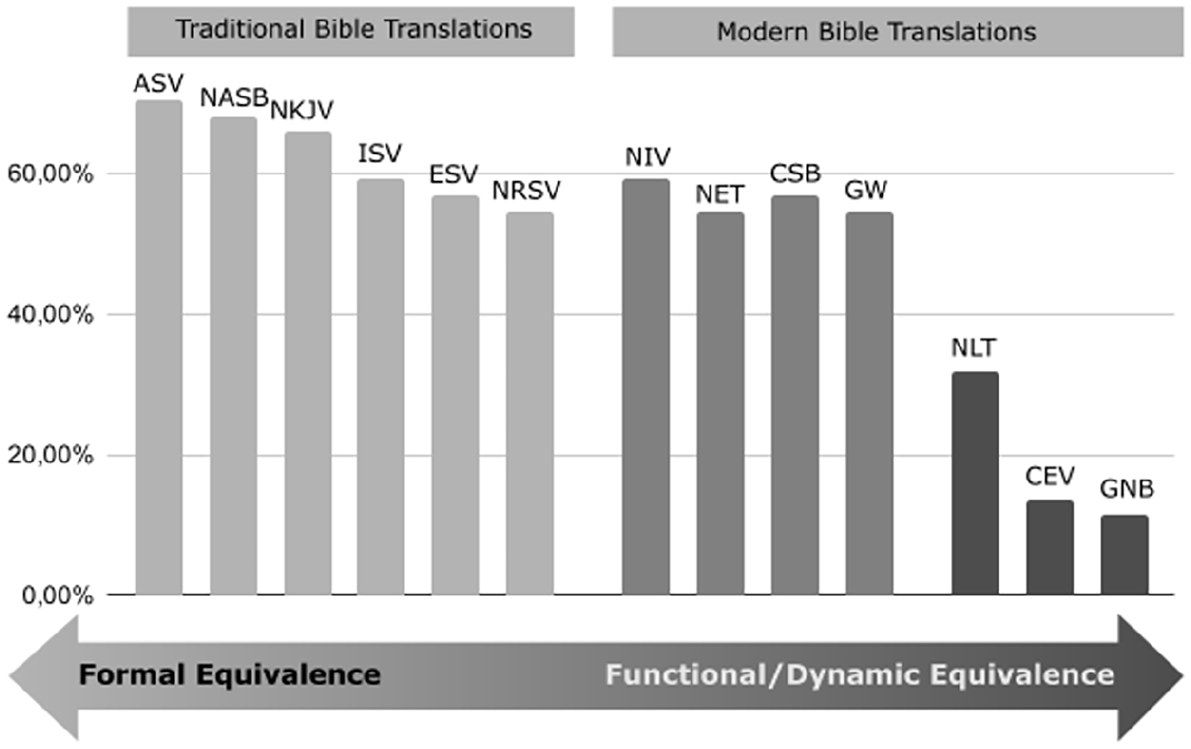
Treatment of unflagged code switching in translations
If these examples of unflagged code switching play some role in the overall textual scheme of the New Testament beyond the simple semantic content implicit in the word, as suggested above (under “Textual background”), then it is logical to expect translations to maintain some element of the foreignness in the target language text. While no modern English translation maintains the complete foreignness of all of the words included in this study, most of the traditional English Bible versions transliterate a high percentage of these Semitic foreign words. While these translations may be harder to read for those who do not have as much background knowledge of the Scriptures, they are probably better for study since they give modern readers communicative clues that can help inform their study. The Bible versions that are more likely to translate foreign words will definitely be more communicative, although they may not allow readers to contemplate certain aspects of the original text of the New Testament.
Footnotes
1.
Lexical borrowing has traditionally been the principal focus of studies of language contact.
2.
This paper will demonstrate the extent of language contact which influenced the written text of the Greek New Testament.
3.
4.
Distinguishing between Hebrew and Aramaic can often be problematic. “It has become traditional, since the work of G. Dalman, to reserve the term ‘Hebraism’ for Semitisms which are attested in the LXX and, on the assumption that Aramaic was the native tongue of Jesus and His disciples, to use the term ‘Aramaisms’ for all other examples” ( , 105). Given the translational focus of this paper, the precise identification of the embedded language is unimportant. Instead these words will simply be referred to as foreign words of Semitic origin.
5.
At times the foreign nature of these names is readily apparent and a translation of the name is given. One case in point is the treatment of the name Melchizedek in Heb 5.
6.
Toponyms include names of places or geographic features, such as Jericho, the Jordan, as well as the names of other places such as Γαββαθά “Gabbatha” in John 19.13.
7.
According to Black, “The most obvious influence of the Semitic languages on the New Testament [involves] Hebrew and Aramaic words which are simply transliterated into Greek. From Hebrew we have allelouia, amen, geenna, korban, manna, pascha, sabaoth, sabbaton, and Satanas. From Aramaic we find abba, ephphatha, korbanas, mammonas, maranatha, rabbi, raka, talitha koumi, and eloi, eloi, lama sabachthani” (, 221).
8.
An important part of this definition is the final phrase, “without interpretation or translation.” Many definitions of lexical borrowing do not explicitly state this clarification, e.g., “A linguistic unit (usually a lexical item) which has come to be used in a language or dialect other than the one where it originated” (, 286).
9.
See also Dickey (2012, 60) and , 392).
10.
The term restaurant was borrowed into English during the nineteenth century from the French verb restaurer, meaning “to restore or refresh.” It was allegedly connected to an eating establishment through a window advertisement employing the text of Matt 11.28: “Come unto me … and I will give you rest.” Through metonymy, the term began to be used as a common noun to refer to any eating establishment ().
11.
12.
See also LXX text of Dan 9.27.
13.
The NT word σάββατον refers not only to the first day of the week (שַׁבָּת; see Exod 16.23 in LXX) but also to the entire week (שְׁבֻעַ). This is clearly illustrated in Matt 28.1: “Now after the Sabbath (σαββάτων), toward the dawn of the first day of the week (σαββάτων)” (ESV).
14.
15.
16.
On code switching, see also Myers-Scotton (2006, 203) as well as Poplack and Sankoff (1984) and .
17.
“There is no unequivocal way of deciding when a lexical item from one language, used during discourse in another language, whether by a single speaker, or repeatedly in a community, should be considered a loanword. It may constitute all or part of a code-switch, which is a phenomenon quite distinct from borrowing” (, 99).
18.
19.
This passage is interesting because the Semitic borrowing is explained through a Latin borrowing.
20.
Similar to Matt 27.33 above, the Hebrew toponym is explained with a Latin loanword.
21.
22.
23.
For further argumentation on the interpretative value of foreign words, see Black 1988, Gómez 2020, and .
24.
25.
26.
27.
28.
The Hebrew phrase normally appears as גֵּיא בֶן־הִנֹּם “the valley of the son of Hinnom.” The LXX, however, translates this phrase as φάραγγι υἱοῦ Εννομ “ravine of the son of Onom.”
29.
30.
Some translations have used the Hebrew loanword Messiah to translate Χριστός “Christ.” This brings out the meaning of many NT passages nicely, but in this passage as well as John 1.42 it causes a problem, since these are the only two passages in the NT which actually use the Hebrew term Messiah directly.
31.
RSV is not included because it matches up closely with ESV (which was derived from it).
32.
It is interesting to note that in Matt 6.24 and Luke 16.13, NAB transliterates “mammon.” This is especially surprising in Luke because in the same context the Greek word is translated in verses 9 and 11 and then transliterated in verse 13.
33.
The 1995 revision of NASB changed its approach and translated μαμωνᾶς as “wealth.”
34.
35.
ESV in Mark 10.51 is surprising, since it transliterates the word as “Rabbi” instead of “Rabboni” or “Rabbouni.”
36.
Here the 1995 NASB changes its treatment and translates “Our Lord come!” where the 1977 NASB had transliterated.
37.
The fact that these modern translations are generally unrelated, unlike the traditional translations which all attempt to retain some identity with the general style of KJV, suggests that there is no unified pattern among them. Yet it is interesting to see that there is a general tendency towards translation rather than transliteration.
38.
In Luke 11.19, it is interesting to note that GNB leaves the word untranslated. Since Beelzebul was mentioned in the previous verse, GNB avoids the repetition, presumably for stylistic reasons.
39.
The original HCSB from 1999 transliterated with an added translation “Marana tha that is, Lord, come!” This was changed to a simple translation in the 2017 CSB version.
40.
Simply taking into account the number of times that a version transliterates one of the above-mentioned examples of unflagged code switching generates a rough order of translations which matches fairly closely with the findings in measuring the amount of formal shifts in English Bible translations. The amount of formal shift measured in Bell 2009 produced the following spectrum of translations (measured from fewer formal shifts, i.e., more formal equivalence, to more formal shifts): ASV, NASB, KJV, RSV, HCSB, NIV, NJB, NEB, TEV, MSG.
41.
Here KJV scores quite low in the list especially because of the mixed treatment of ῥαββί. If one ignores the KJV treatment of ῥαββί, the percentage would be 60%, placing KJV much closer to NKJV.