




Abstract
The editors of Proverbs structured the book to counter traditional negative sentiments about women. Proverbs such as 19.13, “a stupid child is a ruin to a father, and a wife’s quarreling is a continual dripping of rain” (NRSVue), are misogynistic, presenting problems for the contemporary reader and arguably for the ancient editor as well. Their strategy to combat these old sayings included beginning and ending the book with positive feminine figures, Wisdom in the prologue (Prov 1–9) and the Strong Woman in Prov 31.10-31, and using negative masculine stereotypes as a foil for the negative feminine ones. Recent translations that use gender-neutral language mask these tropes about men’s behavior.
Critics sensitive to gender roles have mixed reactions to the book of Proverbs. The feminine figure of Wisdom (חָכְמָה ḥokmâ) in 8.1–9.6 provides a positive image, while the famous poem about the Strong Woman (אֵשֶׁת־חַיִל ʾēšet-ḥayil, literally “Woman of Strength”) that closes the book in 31.10-31, has admirers and detractors (Yoder 2012, 241). Juliana Claassens notes the mixed reviews feminist biblical scholars have given to her (2016, 16). Few would disagree that proverbs such as 19.13, “a stupid child is a ruin to a father, and a wife’s quarreling is a continual dripping of rain” (NRSVue), are misogynistic, presenting problems for the contemporary reader. This article argues that the editors of Proverbs structured the book to counter these traditional negative sentiments, including using negative masculine stereotypes. Recent translations that use gender-neutral language mask these tropes about men’s behavior.
The sages significantly shaped the book of Proverbs, providing new lenses for readers to view its traditional sayings. Christl Maier writes that the editors did not erase the old traditions but passed them on in creative new ways (2017, 269). The key argument here is that the editors of Proverbs included negative sentiments about women, perhaps because they were so much a part of the tradition that they could hardly exclude them, but countered them in several ways. First, they created the twin feminine figures of Wisdom in the prologue (chapters 1–9) and the Strong Woman in the final poem (Prov 31.10-31). Second, to offset the negative stereotypes of women, such as the quarrelsome woman in 19.13, they included proverbs about similarly stereotyped difficult people explicitly identified as male.
The most obvious way the sages shaped the book of Proverbs was by adding the feminine figure of Wisdom in the prologue, capitalized here because she is a figure, not just a concept. Her negative metaphorical foil, Folly, literally the Woman of Foolishness, or Foolish Woman (אֵשֶׁת כְּסִילוּת ʾēšet kəsîlût), 1 balances her portrait. At the end of the book, the human Strong Woman (31.10-31), whose antithesis is the Strange/foreign woman (זָרָה zārâ, נָכְרִיָּה nokriyyâ), provides another counterweight. Commentators generally conclude that the first nine chapters and the last chapter of Proverbs are the newest parts of the book, added by editors at a late stage of its development (Schipper 2019, 44–60; Fox 2008, 48–49; 2009, 899–900). They form a woman-dominated frame. The first nine chapters introduce the theme of wisdom. Near the end of this prologue is Wisdom’s long speech in 8.22-31. She is a personification rather than a hypostasis or embodiment of the divine (Bellis 2018, 84–88). She is not God. The dramatic depiction of Wisdom’s banquet in 9.1-6 follows. The prologue concludes with a short section of wisdom teaching (9.7-12) and Folly’s sparse banquet (9.13-18). It cannot compare to Wisdom’s grand party.
Just as Wisdom’s foil on an abstract level is Folly, the writers introduce another set of contrasts on a human level. They describe the Strange/foreign Woman (נָכְרִיָּה, zārâ זָרָה nokriyyâ; 2.16; 5.3, 20; 6.24; 7.5), 2 also known as the evil woman (רָע rāʿ, 6.24), 3 as sexually alluring. 4 She is the focus of the father’s advice to his son in 2.16-19, 5.1-21, 6.24-35, 5 and in an evocative story in 7.6-23 about a youth seduced into a disastrous adulterous relationship. The material in these four chapters and the other references to the Strange/foreign Woman comprise the negative core of the first nine chapters. Strong wisdom/Wisdom 6 material surrounds it (1.1–4.27) except for 2.16-19, which introduces the Strange Woman, and 8.1-12.
The counterpart of the Strange/foreign Woman is the Strong Woman. Although human, her abilities are so many and great that many perceive her as an impossible Superwoman (Yoder 2012, 241–2). She is a tireless household manager and takes care of the poor. Honored by her children and husband, she surpasses all. A more positive image of women is hard to imagine, except that she does not seem to take care of herself. She neither rests nor enjoys life with friends. These failures are the problem that keeps many contemporary readers from embracing her. From an ancient (male) perspective, she is the perfect woman. Thus, she contrasts both with Folly on an abstract level and the Strange/foreign Woman on the human plane. So, a nine-chapter section dominated by the figure of Wisdom at the beginning and a final poem lauding the Strong Woman bookend the book of Proverbs. In this structural way, the ancient sages communicated their positive evaluation of women, overshadowing negative stereotypes.
The advice in the prologue of Proverbs (chs. 1–9) is an introduction to the rest of the book, a primer on how to live a successful life in the phrase’s broadest sense. Such a life included an excellent mate and a wholesome character enabling one to live fully (Brown 2021; Vayntrub 2021). A father and sometimes a mother present the material to a son or sons (“my son,” Prov 2.1; 3.1, 21; 4.10, 20; 5.1, 20; 6.1, 3, 20; 7.1, and “sons,” 4.1; 5.7; 7.24; 8.32).
The feminine figure Wisdom is central to this guide for young men. She is the personification of wisdom, whom they were to seek diligently. She receives tribute in 3.13-20. The wisdom writers portray her antithesis, Folly, in a surprisingly comparable way: they both walk the streets luring young men. In 1.20-21, Wisdom is in the streets and squares, calling young men to come to her. In 8.1-4, she is on the heights, doing much the same. Discerning the difference between W/wisdom and F/folly requires judgment. The subtle disparity between the two characters is the key. Wisdom directs them to success and happiness (e.g., 3.5-10; 8.11, 20-21, 32-35); Folly sends them to their doom (e.g., 7.22-23; 9.18).
Beyond the frame around the book, the sages may have added antidotes to the five negative female stereotypes in Proverbs, 19.13, 21.9, 21.19, 25.24, and 27.15, of which two pairs are either remarkably similar or identical except for one variant Hebrew form. They all share a version of the term אֵשֶׁת מִדְיָנִים ʾēšet midyānîm “quarrelsome woman” (literally “woman of quarrels”). Prov 21.9 reads:
It is better to live in a corner of a rooftop Than in a full house shared with a quarrelsome woman.
Prov 21.19 is similar:
It is better to live in a wilderness Than with a quarrelsome woman and vexation.
Prov 25.24 is identical to 21.9 except for a variant form of one word (מִדְיָנִים midyānîm, 21.9).
It is better to live in a corner of the rooftop Than in a full house shared with a quarrelsome woman (מִדְוָנִים midwānîm).
Prov 27.15 is like 19.13, quoted in the introduction to this paper:
A continual dripping on a rainy day And a quarrelsome woman are alike.
Although these proverbs are disagreeable to many contemporary sensibilities, not just to women, it is helpful to notice that six to eight other proverbs on quarreling (depending on how one counts) focus explicitly on male stereotypical behavior: 15.18, 16.28, 18.19, 20.3, 26.(20), 21, (22), and 29.22. 7 These proverbs use either the word אִישׁ ʾîš “man” or another equivalent masculine term to establish that these are male stereotypes, not generic ones that applied to anyone.
Before looking at these in detail, a comparison of 21.9, one of the negative feminine stereotypes, and 26.21, its masculine complement, is revealing. Prov 21.9 reads:
It is better to live in a corner of a rooftop Than in a full house shared with a quarrelsome woman (מֵאֵשֶׁת מִדְיָנִים mēʾēšet midyānîm).
Prov 26.21 reads:
Charcoal for embers and wood for a fire And a quarrelsome man (וְאִישׁ מִדְוָנִים wəʾîš midwānîm) for kindling discord.
Both proverbs come from domestic life. Prov 21.9 uses domestic architectural imagery (roof and house).
Prov 26.21 focuses on the hearth at the center of the home. The terms used of the man and woman are identical, except that they use slightly variant forms of the word for quarrelsome, one with a vav and the other with a yod. So, 21.9 and 26.21 are twin proverbs.
One masculine stereotype (18.19) uses kinship and military architectural imagery to describe negative male behavior:
An offended brother is stronger than a walled city; Such discord is like a barred fortress.
The offender is a brother rather than a woman or wife, and the building has changed from a house to a walled city/fortress, reflecting the different social roles of men and women. Men, the presumed writers of most proverbs, were unlikely to complain about husbands’ behavior. Nevertheless, the parallel between 21.9 and 18.19 is clear. These two proverbs are not perfectly symmetrical because women’s and men’s roles were not identical (Meyers 2009, 19–41). Despite these differences, the sages called out both men and women as ill-tempered.
The female stereotypes all focus on domestic relationships, while the masculine ones with negative stereotypes are broader, reflecting the gender roles men played in ancient society.
In 16.28, the focus is on how contentious behavior negatively impacts male friendships, an example from private rather than public life:
A deceitful man (אִישׁ ʾîš) stirs up discord, And a backbiter (נִרְגָּן nirgān) alienates his friend.
This is a particularly interesting proverb, at least from a contemporary perspective, as it is the sort of complaint we expect to be lodged against a woman, not a man.
The remaining masculine stereotypes are more general and could come from either domestic or public life. Prov 15.18 reads:
A hot-tempered man (אִישׁ ʾîš) provokes discord. A patient one calms strife.
Prov 20.3 reads:
It is honorable for a man (אִיש ʾîš) to desist from contention, But every jerk
8
becomes entangled.
Prov 29.22 reads:
An angry man (אִישׁ־אַף ʾîš-ʾap) provokes discord. A hot-tempered man
9
(וּבַעַל חֵמָה ûbaʿal ḥēmâ) commits many offenses.
The preceding verses provide six cases in which proverbs present stereotypically querulous, explicitly masculine behavior. Three more verses may belong on the list. Two similar verses (Prov 26.20 and 26.22) surround Prov 26.21, one of the established cases of masculine stereotypes, here printed in italics:
20For lack of wood a fire goes out, And without a backbiter (נִרְגָּן nirgān) contention is stilled.
21
Charcoal for embers and wood for a fire
And a contentious man (אִישׁ ʾîš) for kindling strife. 22The words of a backbiter (נִרְגָּן nirgān) are bruising. They penetrate one’s inner parts.
The word נִרְגָּן nirgān occurs only four times in the Hebrew Bible, in these two verses (Prov 26.20, 22) and Prov 16.28 and 18.8 = 26.22. Brown, Driver, and Briggs (1907, 920) translates נִרְגָּן nirgān as “backbiter”; Clines (1993–2011, 416) as “whisperer, backbiter, gossip”; and Köhler, Baumgartner, and Stamm (2004, 873) as “slanderer.” Since 26.20-22 seems to be a cluster of verses describing a similar behavior, they likely all depict a single masculine stereotype. נִרְגָּן nirgān also occurs in 16.28, another proverb describing stereotypically negative male behavior, as seen above.
Adding up totals, two of the troublesome women’s proverbs are identical (21.9 = 25.24), and 19.13 and 27.15 are similar, for a total of three to five problematic women’s proverbs at most. Six of the proverbs dealing with contentious men explicitly speak of male figures (אִישׁ ʾîš “man”), and two more are associated with male stereotypes, for a total of six to eight male stereotypical proverbs.
It is impossible to know how these proverbs describing contentious behavior might have struck ancient Hebrew ears. Undoubtedly, they would have heard them differently than we do, especially since we access them primarily in translation. It seems likely that they would have noticed the proverbs pointing out the problems with contentious masculine behavior more than contemporary readers since popular current translations mask the explicitly masculine nature of these sayings. Even though we are often deaf to them ourselves, they were likely an intended foil to the negative stereotypical proverbs about women in Proverbs since women generally had a lower status than men in ancient Israel. In other words, the negative feminine stereotypes likely came first, followed by the masculine ones written in a more progressive era to blunt the force of the negative feminine tropes.
Table 1 presents the translations of the key terms in the masculine and feminine proverbial stereotypes in one typical contemporary Protestant, one Catholic, and one Jewish translation. NRSVue, a National Council of Churches project in collaboration with the Society of Biblical Literature, was completed in 2021. NABRE dates to 2010. Both are gender-neutral translations concerning human beings. This approach serves some purposes, but it presents a problem in Proverbs. It masks the masculine stereotypical sayings that balance the feminine ones. In 21.9 and 26.21, for the matching phrases, woman/wife of contention/quarreling/strife//man of contention/quarreling/strife, NRSVue and NABRE translate the feminine terms as “contentious wife” and “quarrelsome woman” respectively, but the matching masculine terms as “quarrelsome person” and “quarrelsome,” in both cases hiding the specifically masculine nature of these proverbs intended to show male behavior in a negative light.
Translation of six phrases in four modern English translations
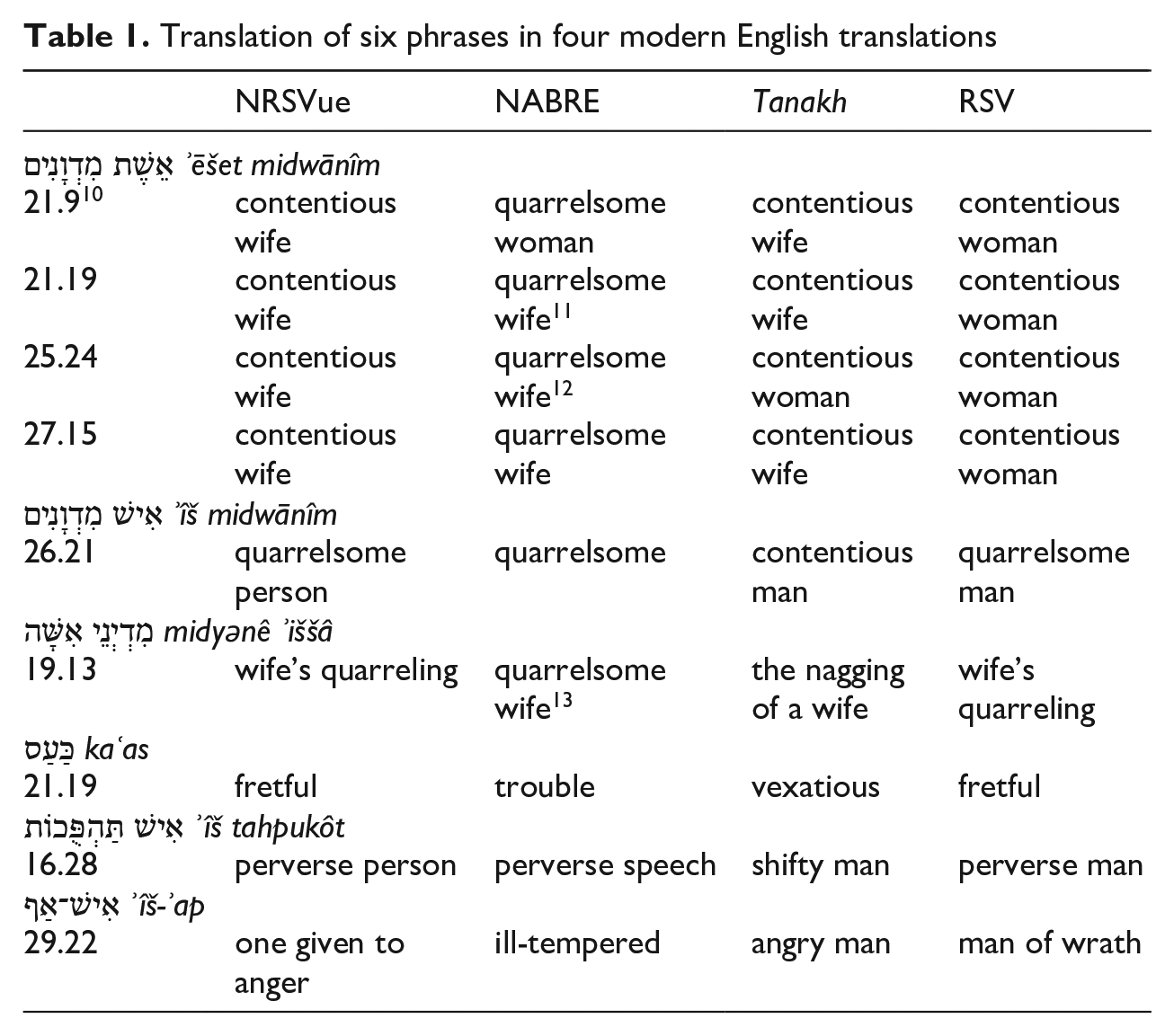
The older RSV, published in 1952 by the Division of Christian Education of the National Council of Churches, translates these phrases in Prov 21.9 and 26.21 as “contentious woman” and “quarrelsome man,” parallel phrases. The Hebrew אִשָּׁה ʾiššâ means both “woman” and “wife,” so this translation is accurate. In the context, the woman that the author of the proverb may have had in mind might have been a wife, but a female resident could also be a mother-in-law, a sister, an aunt, or a grown daughter in an extended family, so it is not a certainty that the woman in question would always have been a wife. Thus, RSV’s translation, “woman,” is preferable to “wife.” NABRE also translates this phrase in 21.9 as “quarrelsome woman,” though in other similar texts, its translations render אִשָּׁה ʾîššâ as “wife.”
Tanakh, published by the Jewish Publication Society in 1985, stands midway between RSV and the more recent translations. Its rendering of “contentious wife” and “contentious man” is perfectly parallel.
In the other male stereotypes with the word “man,” Prov 16.28 and 29.22, NRSVue and NABRE mask these sayings’ explicitly masculine negative nature. In the case of NRSVue, the translators call the man “perverse person” (16.28) and “one given to anger” (29.22). NABRE depersonalizes it to “perverse speech” (16.22) and again generalizes it to “the ill-tempered” (29.22). RSV translates the phrase in 16.22 as “perverse man” and the one in 29.22 as “man of wrath,” so that it is evident the referents are male. Similarly, Tanakh renders the phrase in 16.28 as “shifty man” and the one in 29.22 as “angry man,” again allowing the reader to see the writer’s intention.
As laudable as it is to update the biblical text for contemporary readers, unintended consequences sometimes result, such as in the cases of stereotypical masculine proverbs intended to balance the feminine ones. If translators make the male language disappear from the text, we also should rewrite the feminine stereotypes. We could translate Prov 21.9 as:
It is better to dwell in a corner of the rooftop than with an argumentative person in a spacious house.
Similarly, we could render Prov 19.13:
Foolish children are the calamity of their parents: and the contentiousness of a spouse (relative?) is a continual dripping.
Here the rewriting includes changing “son” in the first line to “child” to follow the general principle of gender-neutral translation. Similarly, “father” should become “parent(s)” since children’s and spouse’s (relatives’) behavior equally affects both parents. Translators should be consistent and explain translation principles in the introduction if they wish to make such changes. Changing some gendered words without clearly indicating the basis of the choices and being inconsistent can confuse readers.
In conclusion, the ancient editors provided at least two ways to offset the negative stereotypes of women in Proverbs. They created a female-dominated envelope with a prologue in which the feminine figure of Wisdom predominates and a final paean to the Strong Woman. In addition, they included six to eight proverbs dealing with stereotypically male quarrelsome and similar behavior to counterbalance the three to five negative female stereotypes dealing with quarrelsome women. Unfortunately, gender-neutral translations such as NRSVue and NABRE mask this second strategy. In these translations, the male stereotypes become bland tropes that could be applied to anyone, regardless of gender, rather than hitting their intended target of querulous males. The contemporary reader or hearer completely misses the counterweight that they provide to the well-known misogynistic sayings. This problem is sufficiently serious that it should cause translators to reconsider gender-neutral translation principles. Other unfortunate consequences may lurk beneath the surface of good intentions.
Footnotes
1.
Two primary kinds of fools appear in Proverbs. The כְּסִיל kəsîl is inept. He is not so much malicious and morally corrupt as he is simply socially unaware. Nevertheless, Proverbs does not look kindly on this kind of fool. The כְּסִיל kəsîl takes no pleasure in understanding (Prov 18.2) and has no interest in learning (Prov 17.16). This type of fool called Folly is the kind of person some varieties of English might call a jerk or a schmuck. The אֱוִיל ʾĕwîl, by contrast, is morally corrupt, despises wisdom and instruction (see 17.28), and is arrogant (12.15) and contentious (12.16; 20.3; 28.3). A third type of fool appears less frequently: a נָבָל nābāl is a senseless, even ignoble man like Abigail’s husband in 1 Sam 25. See Prov 17.21 where this type of fool is associated with the כְּסִיל kəsîl. See also Prov 17.7 and 30.22.
2.
The figure of the Strange Woman occurs outside of the first nine chapters in 22.14 and 23.27. These verses could have been the source of the figure in the first nine chapters. Prov 22.14 reads:
The mouth of a strange woman is a deep pit.
He who is doomed by YHWH falls into it.
(This and all translations, unless otherwise noted, are mine.) Similarly, 23.27 says:
A prostitute is a deep pit.
A strange foreign woman is a narrow well.
In these two verses, the Strange/foreign Woman is depicted sexually: the mouth in 23.27 is a sexual allusion. Combined with the reference to a deep pit and narrow well in 23.27, the term may suggest more than kissing; the word prostitute in 23.27 is a clear reference to sexual activity. These verses may refer to the vagina. Interestingly, neither of these verses focuses on adultery the way the Strange/foreign/evil woman verses do in the first nine chapters. The concern in 22.14 and 23.27 is on fornication rather than adultery. The author has apparently adapted those verses for a different use in the prologue. For further reading on the Strange Woman, see Tan 2008; Camp 1991; and  .
.
3.
The Hebrew רָע rāʿ in Prov 6.24 does not mean “another” as NRSVue and NABRE translate, but “bad, unethical.” That translation comes from a revocalization to רֵעַ rēaʿ “friend or companion,” based on the LXX ὑπάνδρου hypandrou “(wife) of a man.” In this context, “unethical” and “wife of a(nother) man” have similar meanings.
4.
Prov 5.3 focuses on the lips:
For the lips of a strange woman drip honey.
Her mouth is smoother than oil.
Two other proverbs describe slippery/deceitful words (אֲמָרֶיהָ הֶחֱלִיקָה ʾămārêhā heḥĕlîqâ;) and a slippery/deceitful tongue (מֵחֶלְקַת לָשׁוֹן mēḥelqat lāšôn;).
5.
In this passage she is not called the Strange Woman; rather, in 6.24 she is described as evil (רָע rāʿ) and foreign (נָכְרִיָּה nokriyyâ). In 6.26 married women (אֵשֶׁת אִישׁ ʾēšet ʾîš “a woman/wife of a man”) are the real concern. In 6.29, the woman is called the wife of a neighbor (רֵעַ rēaʿ). In 6.32, adultery (נֹאֵף noʾēp) is the focus. Interestingly, if Prov 22.14 and 23.27 are the origin of the Strange/foreign/evil Woman trope in the prologue (in 2.16; 5.3, 20; 6.24; 7.5), then the author of this newer material has changed the woman’s nature from a prostitute (22.14; 23.27) to a married woman in search of illicit sex. It is not clear whether she is called strange/foreign because of the illicit nature of the sex or that she is literally a foreigner. The fact that the possibly originating verses of the Strange Woman trope are about prostitution and the new ones are about adultery suggests that the strangeness has more to do with sex than ethnicity in their context in Prov 9.
6.
Wisdom is capitalized when it refers to the personified figure Wisdom (e.g., 8.1–9.6) but is written in lowercase when it refers to the abstract concept of wisdom.
7.
Yoder complains that the sages included no proverbs urging women to avoid abusive men (2012, 238). She is correct, but given that the audience was young men, this is not surprising.
8.
Three kinds of fools appear in Hebrew, but the אֱוִיל ʾĕwîl, translated here as “jerk,” is the worst. This kind of fool is not just ignorant but actively despises wisdom and instruction (see Prov 1.7 and 17.28). See note 1.
9.
The Hebrew phrase “owner/lord/husband of wrath” only occurs here and in Nah 1.2 where it refers to YHWH.
10.
Prov 21.9 uses the alternate form מִדְיָנִים midyānîm. The only difference is in the yod being substituted for the vav.
11.
NABRE adds this misogynistic note to its unobjectionable translation: “In Proverbs, two great obstacles to a happy household are foolish children and quarrelsome spouses. The nagging wife is also mentioned in Prov 19.13 and Prov 27.15; Prov 25.24 is a duplicate.” Note that in Prov 19.13, 25.24, and 27.15, the translation is “quarrelsome woman,” not “nagging wife”! NABRE does not use this misogynistic term in its translations but is more tone-deaf about what it says in the notes. See note 12. The only translation of the four in this table that uses the word “nagging” is Tanakh in Prov 19.13.
12.
NABRE adds this note: “A humorous saying about domestic unhappiness: better to live alone outdoors than indoors with an angry spouse. Prov 21.9 is identical and Prov 21.19 is similar in thought.” This saying may seem humorous to the male translators/editors, and may have originally been intended humorously, but many contemporary readers do not think it is funny.
13.
NABRE notes, “One of many sayings about domestic happiness. The perspective is male; the two greatest pains to a father is [sic] a malicious son and an unsuitable wife. The immediately following saying is on the noble wife, perhaps to make a positive statement about women.”