




Abstract
Understanding ζηλοῦτε in the indicative mood, this paper proposes the following translation of 1 Cor 12.31a: “Yet, are you continuously striving for the ‘greater’ spiritual gifts?” Considering the flow of Paul’s arguments, the indicative reading of ζηλοῦτε should be preferred to the imperative reading that is predominantly found in Bible translations and scholarly discussions. Furthermore, translating this indicative ζηλοῦτε interrogatively (i.e., as Paul asking a rhetorical question)—rather than as a simple statement—can help Bible readers better recognize the rhetorical force of the passage. This paper defends this indicative-interrogative translation by challenging four common objections to the indicative reading of 1 Cor 12.31a.
Keywords
Most Bible translations presuppose that ζηλοῦτε (a conjugated form of ζηλοῦν “to strive for”) in 1 Cor 12.31a is used in the imperative mood, implying that Paul exhorts the Corinthian audience to “strive for the greater spiritual gifts.” Grammatically, however, the verb can also be understood as indicative, in either a statement or a question. The indicative reading of ζηλοῦτε, a possibility mentioned by the UBS Handbook on 1 Corinthians (Ellingworth and Hatton 1994, 289), has been supported by a small number of scholars, but largely ignored in Bible translations and facilely dismissed in scholarly discussions. Aligned with the minority position, I suggest that the indicative reading of ζηλοῦτε is preferable. Furthermore, I argue the whole sentence in 1 Cor 12.31a is best understood interrogatively (i.e., as Paul posing a rhetorical question),
1
considering the flow of the surrounding verses and Paul’s arguments in 1 Cor 12–14. The text and proposed translation of 1 Cor 12.31a are as follows:
ζηλοῦτε δὲ τὰ χαρίσµατα τὰ µείζονα.
2
(NA28/UBS5) Yet, are you continuously striving for the “greater” spiritual gifts? (Proposed translation)
I will substantiate my claim by challenging four common objections that scholars raise against the indicative reading of 12.31a.
Survey and assessment
I present a survey and assessment of Bible translations and scholarly literature (mostly commentaries, but not limited to them) to demonstrate that (1) the imperative reading of 1 Cor 12.31a is predominant, and yet (2) a small number of interpreters are open to the possibility of the indicative reading.
Examples of English translations are given below.
Use your ambition to try to get the greater gifts. (CEB) But earnestly desire the higher gifts. (ESV) Set your hearts, then, on the more important gifts. (GNB) But earnestly desire the greater gifts. (NASB) Now eagerly desire the greater gifts. (NIV) But earnestly desire the best gifts. (NKJV) But strive for the greater gifts. (NRSVue)
Four observations can be made. For the purpose of this paper, the first one is important. First, all six English translations use the imperative translation of ζηλοῦτε in 12.31a. The sentence is understood as Paul’s command or exhortation to the Corinthians. Second, four of them (ESV, NASB, NKJV, NRSVue) translate δέ adversatively (“but”), while NIV renders it “now” and GNB “then.” CEB disregards this particle in translation. These differences likely reflect the interpretative decisions of the translators, 3 but of course, Bible translations do not provide detailed information about why a word is translated this or that way. Third, apart from the question of the verbal mood, there is a virtual agreement on the choice of a translation equivalent for the verb ζηλοῦν: “to strive for” (NRSVue) or “to earnestly/eagerly desire” (ESV, NASB, NIV, NKJV). 4 Fourth, all the translations more or less agree on the meaning of τὰ χαρίσµατα τὰ µείζονα: “the greater gifts” (CEB, NASB, NIV, NRSVue), “the higher gifts” (ESV), or “the more important gifts” (GNB). Only NKJV (“the best gifts”) differs substantially, which is probably because it uses a different Vorlage (i.e., the Textus Receptus).
Four select translations in other languages (two European languages and two East Asian languages) show that the imperative translation of 12.31a is not limited to the Anglophone context.
Ainsi, désirez les dons les plus importants. “Thus, desire the most important gifts.” (Nouvelle Français courant) Strebt aber nach den größeren Gaben! “But, strive for the greater gifts!” (Lutherbibel 2017) あなたがたは、もっと大きな賜物を熱心に求めなさい。 “All, earnestly seek for the greater gifts.” (Japan Bible Society Interconfessional Version)
5
여러분은 더 큰 은혜의 선물들을 간절히 바라십시오! “All, eagerly desire the greater gifts of grace!” (New Korean Translation)
The issue of translating δέ in diverse ways appears here, too. The German Lutherbibel translates δέ contrastively, while in French (NFC), it is understood illatively or cumulatively. This Greek particle is reflected neither in the Japanese nor the Korean version. 6 Yet, all four concur in taking ζηλοῦτε as an imperative, as the aforementioned English translations do. All these examples of translations in other languages present the sentence in 1 Cor 12.31a as a command/exhortation.
Translations of this verse appearing in scholarly works follow a similar pattern of preference. This first list shows scholars who support the imperative reading of 12.31a:
What you ought to do is persistently to long for yet greater gifts. (Robertson and Plummer 1914, 271) Strive for the greater gifts. (Barrett 1971, 296) But you be zealous for the more important divine gifts! (Orr and Walther 1976, 287) But earnestly desire the higher gifts. (Holladay 1979, 167) But eagerly desire the greater gifts. (Kistemaker 1993, 411) Zealously strive for the greatest gifts. (Smit 1993, 248) But eagerly desire the greater gifts. (Hays 1997, 217) Strive/be zealous for the greater gifts. (Horsley 1998, 175) Avidly desire the greater gifts. (Collins 1999, 466) But eagerly desire the greater gifts. (Soards 1999, 267) Continue to be zealously concerned about the “greatest” gifts. (Thiselton 2000, 1024) But eagerly desire the greater grace-gifts. (Garland 2003, 590) But strive for the greater gifts. (Keener 2005, 106) Now eagerly desire the greater gifts. (Ciampa and Rosner 2010, 609) Seek the greater spiritual gifts. (Perkins 2012, 150) Now eagerly desire the greater gifts. (Fee 2014, 682) Eagerly desire the greater gifts. (Schreiner 2018, 270) Ambitionnez du moins les dons de grâce les plus grands. “At least aspire to the greatest gifts of grace.” (Allo 1934, 335)
7
Aspirez aux dons les plus importants. “Aspire to the most important gifts.” (Senft 1990, 163) Aber strebet nach den höheren Gnadengaben! “But strive for the higher gifts of grace!” (Lietzmann 1969, 64) But strive for the higher gifts! (Conzelmann 1975, 211) Strebet aber nach den höheren Charismen. “But strive for the higher charismata.” (Schrage 1991, 206)
This list shows scholars who support the indicative reading:
You strive for the best gifts. (Louw 1988, 334) But are you striving for the greater gifts? (Fitzmyer 2008, 484) Mais vous avez le désir des charismata les plus grands. “But you have the desire for the greatest charismata.” (Chevallier 1966, 158)
Iber (1962, 49) does not give a translation but argues that the verse should be translated in the indicative mood, that is, as a plain statement. 8
Two things are agreed upon by virtually all these interpreters (regardless of imperative or indicative translation): Paul believes that all the gifts should be (1) measured by love and (2) used in order to build up the community. Different views do emerge around exegetical issues, such as whether to view love as one of the spiritual gifts, or how to understand the connections between 12.31a and 12.31b. Yet, more importantly, my survey shows that the imperative reading of ζηλοῦτε in 1 Cor 12.31a, which understands the verse as a command or exhortation, is predominant in the modern history of scholarly interpretation, as in Bible translations. Only a few scholars support the indicative option, and the interrogative reading of ζηλοῦτε is even more rare (only Fitzmyer). 9
Those advocating for an imperative reading can be further divided into four subgroups. While Group A and Group B hold contrasting positions, Groups C and D intersect with Groups A and B in more complex ways (e.g., some belong to both Groups A and D). Thus, these four categories are not mutually exclusive.
Group A: Lietzmann (1969, 64); Barrett (1971, 296); Hays (1997, 217); Collins (1999, 471); Garland (2003, 602–3); Keener (2005, 107); Schreiner (2018, 271). They consider 12.31a Paul’s genuine exhortation. There is no irony or sarcasm in this exhortation.
Group B: Smit (1993, 253); Horsley (1998, 175); Perkins (2012, 150); see also Bauer et al. (1999, 427, s.v. “ζηλόω” 1a, which follows Smit’s proposal). They believe that this verse is an ironic or sarcastic exhortation. While Paul apparently exhorts them to strive for the greater gifts, what Paul really means is the opposite. This position could be partly compatible with an indicative reading, such as Iber’s and Louw’s.
Group C: Thiselton (2000, 1024); Garland (2003, 602); Ciampa and Rosner (2010, 616). According to scholars in this group, Paul is primarily redefining what are greater spiritual gifts. This view can fit in Group A (i.e., there is no irony/sarcasm in this exhortation) or Group B (i.e., Paul makes an ironic/sarcastic exhortation before he goes on to redefine the gifts).
Group D: Hays (1997, 218); Collins (1999, 471); Schreiner (2018, 271). They regard this exhortation, taken together with other verses such as 14.1 and 14.5, as evidence that Paul actually ranks spiritual gifts—particularly assigning prophecy a higher place, while giving glossolalia a lower place. Proponents of this view usually overlap with Group A, but not all in Group A explicitly argue this position.
Groups A and B are clearly distinct views within the imperative camp. Group C is also a nuanced interpretation of the imperative in 12.31a. However, these different options are not possible if the verse is translated as imperative without further comments (as in the lists of major-language versions, above).
I believe the indicative-interrogative reading of 12.31a (i.e., grammatically indicative, functionally interrogative), partly overlapping with the irony theory above, should be preferred. In the immediate context, several rhetorical questions in vv. 29-30, using the negator µή to elicit negative answers, reveal Paul’s conviction that not all are apostles or prophets, and so on, and not all have gifts of healing or speaking in tongues, and so on. If one understands 12.31a as Paul’s genuine exhortation for all to strive for greater gifts, then it contradicts Paul’s point in the preceding verses (contra Collins [1999, 471], who believes the flow of Paul’s argument requires the imperative reading). It is true that Paul wants to impose certain order (e.g., 14.26-33a), but it should be noted that Paul does not seek to achieve this goal through hierarchizing the spiritual gifts. In chapter 12 as a whole, Paul avers that there is no hierarchy among the gifts (Louw 1988, 334) nor among members in the community (Zimmermann 2021, 1–7). For the whole community, different gifts are allotted to each individual member, according to the will and activity of one God-Lord-Spirit (12.4-11). I contend that 12.31a is best seen as a culmination of the series of Paul’s questions (vv. 29-30), conveying his critical tone. My translation of vv. 29-31 is:
Are all apostles? (An implicit answer to the question: No, they are not.) Are all prophets? (No, they are not.) Are all teachers? (No, they are not.) Do all perform powerful deeds?
10
(No, they do not.) Do all have spiritual gifts [χαρίσµατα] of healings? (No, they do not.) Do all speak in tongues? (No, they do not.) Do all interpret? (No, they do not.) (12.31a) Yet, are you continuously striving for the “greater” spiritual gifts? (Yes, we are …) (12.31b) Then, I am still showing you the most excellent way.
Strictly speaking, I seek to refute those particular strands of imperative reading which take 12.31a as Paul’s genuine exhortation (Group A) and understand prophecy as a greater (or the greatest) gift over against glossolalia (Group D). This means that my understanding of the meaning/function of this verse partially aligns with the non-interrogative, indicative reading (i.e., a plain sentence), which suggests that Paul critically describes the Corinthian situation. The indicative-interrogative could even be partly compatible with another strand of imperative reading that views this exhortation as irony/sarcasm (Group B). Yet, as mentioned before, this critical tone (in the plain statement) or ironic nuance (in the imperative), when printed in Bible translations without further comments, may not be easily noticed, regardless of a translator’s intent. Therefore, I believe the translation of v. 31a as a rhetorical question, proposed by this paper, can effectively help biblical readers to recognize the rhetorical force of the passage. Building upon the preceding questions in vv. 29-30 that imply negative answers (“No, they are not,” etc.), Paul’s culminating rhetorical question in v. 31a aims to elicit a positive answer from the audience (albeit reluctantly: i.e., “Yes, we are …”).
Still, the imperative reading of 12.31a remains prevalent in both Bible translations and scholarly interpretations. This is probably because interpreters assume that there are solid reasons to object to the indicative reading. 11 What are these objections to the indicative reading? Are they indeed persuasive? The next section examines four common objections and convincingly demonstrates that they do not form a definitive basis for the imperative reading (especially regarding Groups A and D).
Challenging four common objections
Four arguments that support the imperative reading against the indicative reading of 12.31a are presented below. I arrange them in the order of proximity to 12.31a (from closest verses to distant ones) and question the validity of each objection. Cumulatively, my discussion in this section defends the indicative reading of ζηλοῦτε in 12.31a.
Objection 1: In 1 Cor 12.31b, Paul says that he is going to show the Corinthians “the more/most excellent way” (καθ’ ὑπερβολὴν ὁδόν), that is, love (ch. 13). If love can be understood as a spiritual gift, this suggests that Paul hierarchizes spiritual gifts and demands his audience desire the greater gifts.
To this objection, first of all, it should be noted that 12.31a and 12.31b use different words: τὰ χαρίσµατα τὰ µείζονα (“the greater gifts”) appears in 12.31a, whereas καθ’ ὑπερβολὴν ὁδόν is used in 12.31b. However one interprets καθ’ ὑπερβολήν (either adjectivally or adverbially), 12 the two expressions are not identical in meaning. Perhaps the flow from 12.31a to 12.31b shows a gradual intensification (from what’s greater to what’s excellent). Even so, in the following discourse (ch. 13), Paul does not provide a list of “greater gifts” (plural). Rather, all gifts are relativized from an eschatological perspective (13.8-10).
Second, although some interpreters consider love to be the greater spiritual gift (e.g., Lietzmann 1969, 64; Collins 1999, 472; interestingly, Chevallier also thinks so [1966, 159], though he is more nuanced), love is counted nowhere in Paul’s letters as one of the χαρίσµατα “gifts.” In Gal 5, for example, love is listed as a fruit (καρπός) of the spirit, not a gift (Louw 1988, 331). The language of fruit and gifts are metaphorical understandings of the benefits granted those in Christ, but they display an important conceptual difference. In Paul’s discourse in Gal 5, love, joy, patience, and so on are not individually distributed, as if some have love and do not have joy, while others have joy but not patience. Love, joy, patience, and so on can be seen as characteristics commonly shared by all Christ-believers. Furthermore, all these characteristics (they are not “virtues in the Greek sense of the term” [Betz 1979, 286]) are collectively the fruit (singular) of the Spirit. This differs from Paul’s description of χαρίσµατα “gifts”: each gift is individually assigned for the sake of the community, and not all members receive the same gifts (esp. 1 Cor 12.29-30). In short, Paul’s discourse in 1 Cor 12–13 does not regard love as a spiritual gift (Garland 2003, 602–3; Fee 2014, 692; also, Conzelmann 1975, 216). Consequently, 12.31b, which introduces the “excellent way,” cannot be definitive evidence to support the imperative reading of 12.31a.
Objection 2: Paul’s list of gifts/offices in 12.28 uses the ordinal expressions (“first,” “second,” and “third”). This suggests Paul ranked spiritual gifts according to their importance and value. Therefore, Paul’s exhortation to desire the greater gifts makes sense in this context.
At first glance, 12.28 seems to indicate that there are higher and lower gifts, but a close look at the verse reveals that this conclusion is far from obvious (Witherington 1995, 261). The verse cannot be neatly understood as a ranking of gifts. The gifts/offices in 12.28 (note that the two categories are not clearly distinguished for Paul), which “God appointed in the church” (ἔθετο ὁ θεὸς ἐν τῇ ἐκκλησίᾳ), can be divided into three groups (Table 1).
Gifts/offices in 1 Cor 12.28
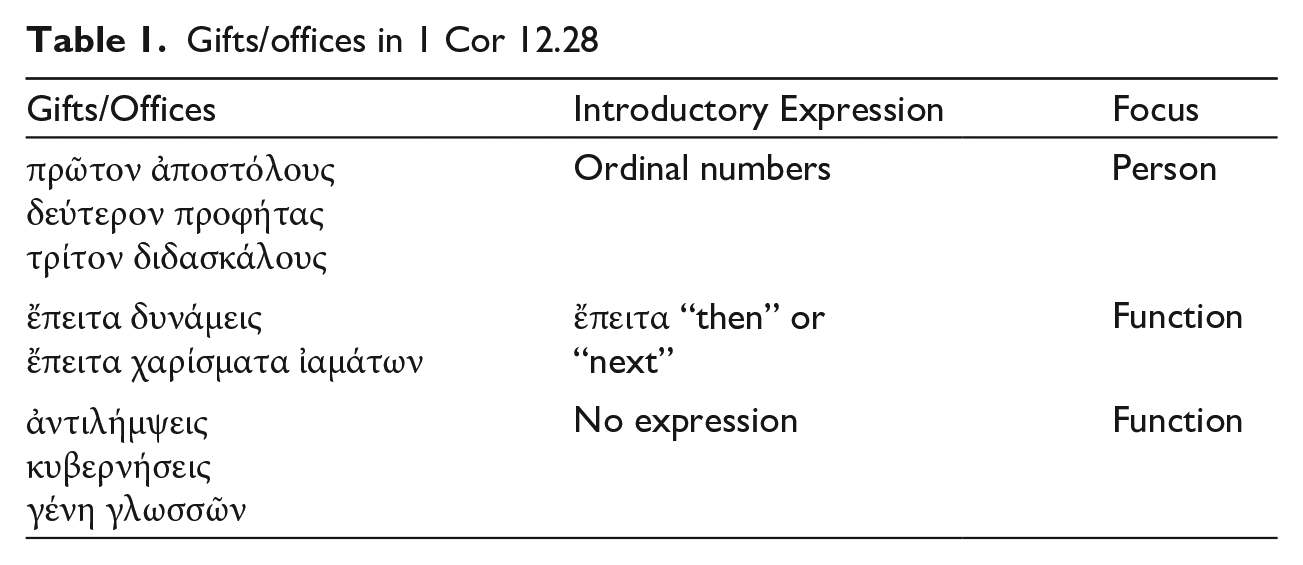
The first three gifts/offices are described in terms of person (masculine plural), while the rest are mentioned in terms of function (Witherington 1995, 261). The numbered expressions only appear for the first three: apostles, prophets, and teachers. These ordinals are usually understood to signify order of importance (Schrage 1991, 231–35), but it is also possible that they merely indicate the chronological order, that is, “an indication of historical time when such functions emerged in the church” (Fitzmyer 2008, 482). The two gifts that follow (powers and charismata of healing) are introduced with ἔπειτα, 13 and three more (helping, administration, and tongues) appear without any introductory expressions.
Tongues appear at the end of the list, and from that, some scholars infer that Paul views it as the lowest gift (e.g., Kistemaker 1993, 446). Yet, the order of appearance of items in such a list tells nothing about their relative value; for example, ἀγάπη “love” is mentioned at the end of the triad of Christian characteristics, but it is µείζων τούτων (“greater than these” or “the greatest of these,” 13.13). The general fluidity of the gift lists here and elsewhere in Paul (e.g., 1 Cor 12.8-10; Rom 12.6-8; cf. Eph 4.11-12), regarding what gifts are included and in what order they are arranged, is noticeable. As Orr and Walther note, “[T]hese gifts were widespread and recognized but not precisely locked in a pecking order” (1976, 288). Simply speaking, 1 Cor 12.28 does not provide a full list or ranking of gifts.
Objection 3: With the same verb (ζηλοῦτε) as 12.31a, Paul makes a similar exhortation in 14.1 to strive for πνευµατικά “spiritual things.” Furthermore, the use of µᾶλλον “more/rather” indicates that prophecy is a greater gift that the audience should strive for.
Contrary to this objection, two arguments can be made. First, semantically, πνευµατικά “spiritual things” are not the same as χαρίσµατα “gifts” (Hays 1997, 208). 14 As seen at the beginning of ch. 12, Paul’s use of πνευµατικά is comprehensive: as 12.4-6 shows, the term can cover χαρίσµατα “spiritual gifts,” διακονίαι “services,” and ἐνεργήµατα “activities,” not just χαρίσµατα alone. 15 Back in ch. 2, Paul’s discourse of πνευµατικά/πνευµατικοί is more general and even ambiguous; 16 he does not specifically talk about spiritual gifts. It is possible that certain Corinthians used the term πνευµατικά in a limited and competitive way (which cannot be definitively confirmed; see footnote 15). Then Paul’s response is to redefine it and make corrections (Hays 1997, 207). It is interesting that Fitzmyer claims that πνευµατικά can be translated “spiritual gifts” (Fitzmyer 2008, 456–57, 507–9); a distinction between πνευµατικά and χαρίσµατα could further strengthen his translation of 12.31a using the indicative mood.
Second, even if one wants to strongly argue that these two (πνευµατικά and χαρίσµατα) are the same, one has to admit 14.1 does not explicitly say what Paul counts as “greater” gifts. Above all, the expression “greater” is lacking in 14.1. One might also claim that µᾶλλον δέ (literally “but rather”) functions comparatively, but that is not the case. In light of Paul’s phraseology in his undisputed letters, µᾶλλον δέ in 14.1 does not convey the idea of preference over against other competing options. Consider the following two examples and my proposed translations:
Χριστὸς [Ἰησοῦς] ὁ ἀποθανών, µᾶλλον δὲ ἐγερθείς (Rom 8.34) Christ is one who has not merely died, but has also been raised νῦν δὲ γνόντες θεόν, µᾶλλον δὲ γνωσθέντες ὑπὸ θεοῦ (Gal 4.9) But now, having known God, or to put it better, having been known by God
The function of this phrase is not to make comparisons, but to clarify or to specify what has been said immediately before. Clarification is the main function. With these two examples, 1 Cor 14.1 (Διώκετε τὴν ἀγάπην, ζηλοῦτε δὲ τὰ πνευµατικά, µᾶλλον δὲ ἵνα προφητεύητε) can be translated and arranged (Figure 1):
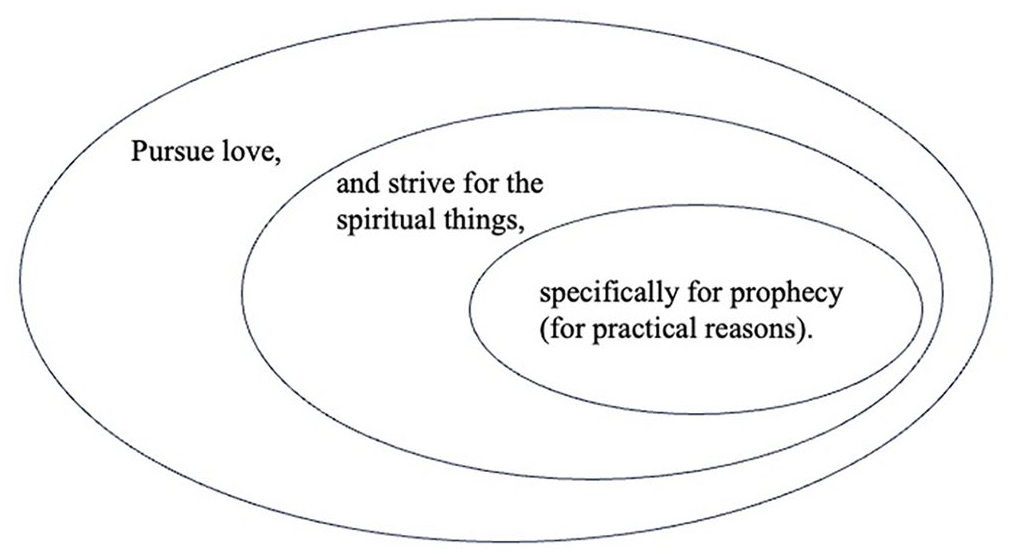
1 Cor 14.1
One could envision 14.1 as concentric circles/ellipses or layered ground. The pursuit of love provides the foundation on which one strives for spiritual things in the comprehensive sense (πνευµατικά), not restricted to a few competitive χαρίσµατα. Then, the spiritual gift of prophecy is mentioned as an example of ones recommended for this community in a practical sense. Furthermore, the difference between 12.31a and 14.1 can also be found in number. As Iber correctly points out (1962, 44–45), Paul’s general remark about “greater gifts” (plural) in 12.31a and a specific recommendation for a particular gift (singular)—that is, prophecy—are not easily reconciled. In short, the use of µᾶλλον δέ in 14.1 does not claim that prophecy is the greater (or even greatest) gift, but it is merely an example of a practical gift for this community.
That Paul does not call prophecy the greater/greatest gift (singular) is significant, given that Paul just talked about love as the greater/greatest of the three enduring Christian characteristics (13.13). Paul could have also used the same sentence in 14.1 if he really intended this comparative sense. By “the most excellent way” (12.31b), what Paul means is that a real hierarchy is established between commonly held Christian characters (especially love) and individually distributed spiritual gifts; the former is excellent, while the Corinthians strive for the latter. Even if all the gifts become ineffective at the eschaton (13.8-10), faith, hope, and love abide forever (13.13). Thus, 12.31a and 14.1, while using the same verb (ζηλοῦτε), are not just a repetition of the same idea but a fundamental development. Paul attempts to transform the perspective of his audience so that they can approach this whole issue anew (Iber 1962, 51). In short, explaining what he means by the “greater gifts” (12.31a) is not Paul’s priority in 14.1.
Objection 4: 14.1 might not convey the idea of relative greatness of certain gifts (especially prophecy), but 14.5 is even clearer. The verse makes a contrast between speaking in tongues and prophecy, with a preference for the latter (using µᾶλλον “more/rather”). Furthermore, Paul states that one who prophesies is better/greater (µείζων) than one who speaks in tongues.
This final objection is stronger than the previous three, but it can also be questioned. First, regarding µᾶλλον δέ in 14.5a, I maintain that the phrase’s function is still clarification, especially considering the force of ἵνα “in order to.” I would translate 14.5a as follows: “I want you all not merely to speak in tongues, but also to do so to prophesy.” Second, regarding Paul’s use of µείζων “better/greater” in 14.5b, which may be an even stronger reason for the imperative reading of 12.31a, I would say that Paul focuses on people who use the gifts, not the gifts themselves (Conzelmann 1975, 215). Paul does not devalue tongues-speaking per se (Turner 1996, 224), and tongues are not prohibited in a wholesale way (see 1 Cor 14.39; Louw 1988, 335; Ahn 2013, 168). In a sense, Paul’s discourse in chs. 12–14 amounts to Paul’s rehabilitation of tongues in the community for its proper use. As Witherington rightly notes, “prophecy is not inherently a greater gift than tongues” (Witherington 1995, 282). This is similar to Paul’s discursive strategy elsewhere. For example, in 1 Cor 1, Paul does not value gospel proclamation over baptism itself, but rather problematizes a particular use of baptism in the community (Jeong 2023, 159–67).
Third, Paul’s assessment of prophets and tongues-speakers is contingent on one caveat—one who prophesies is greater than one who speaks in tongues, if interpretation of the tongues is not provided. If interpretation is provided (so that everyone can plainly understand the content of the tongues), then the difference in value between prophecy-speakers and tongues-speakers disappears. Paul indeed exhorts his audience to pray for interpretation (14.13). Fee (1980, 14) notes, “With interpretation even tongues becomes intelligible and is therefore one of the ‘greater gifts’ in church.” While I do not think that Paul endorses the concepts of greater and inferior gifts, Fee is correct that the absence of interpretation is the only circumstance where one who prophesies is greater (µείζων) than one who speaks in tongues.
Concluding remarks
I have demonstrated the advantages of the indicative reading of 1 Cor 12.31a and how the four most common objections to the indicative reading can be challenged. The result of this study indicates that the imperative reading (especially as understood by Groups A and D) should no longer be assumed. Bible translators can also be reminded that the indicative reading of 12.31a is already suggested in Ellingworth and Hatton’s UBS Handbook (1994, 289) as a possibility that creates a close connection between 12.31a and 12.31b. To better communicate the rhetorical force of the indicative reading for Bible readers, I have further argued that the verse is best translated as a question. My proposed translation of 1 Cor 12.31a is: “Yet, are you continuously striving for the ‘greater’ spiritual gifts?” With the question in 12.31a, which is a culmination of Paul’s rhetorical questions (vv. 29-30), Paul criticizes certain Corinthians who may have competed for greater χαρίσµατα “gifts.” 17
My reading of 12.31a has further benefits. First, it helps readers notice a relatively ignored aspect of Paul’s hierarchy-making discourse. After confirming the equal importance of members of the body (12.12-26), affirming the uniqueness of each one’s gift (vv. 27-30), and criticizing those Corinthians who were striving for the “greater” gifts (v. 31a), Paul offers a much bolder statement that trumps the Corinthians in a wholesale way (v. 31b). He is going to demonstrate what the more/most excellent way is: love. In other words, Paul draws his audience’s attention to the difference between love (quintessential for church unity) and all the gifts (that may be causing competition in the Corinthian community). 18 Moreover, this passage reveals that the real hierarchy exists between Paul (the founding apostle and authoritative teacher) and his Corinthian audience (“infants in Christ” [3.1], only capable of eating liquid food and in need of the apostle’s discipline/corrections)—in short, the transition from 12.31a to 12.31b exemplifies Paul’s discourse of power.
Second, Pauline interpreters who want to identify a hierarchy among gifts (mainly, between prophecy and tongues; Group D) tend to amplify Paul’s own, though more subtle, anxiety about glossolalia, including both ecstatic nonhuman utterances and speaking in foreign languages (i.e., heteroglossia). 19 The imperative reading in the sense supported by Group D may be appealing to those who avoid tongues-speaking for theological reasons, as Louw points out (1988, 331). For Paul, his Corinthian congregation, and subsequent interpreters, language is a locus of political contestation (Tupamahu 2023), and Paul’s discourse of imposing “order” (14.40) embodies this contestation. Paul discourages unintelligible linguistic phenomena (14.7-11), but Paul’s basic principle about the divine origin of all gifts and their equal values in the body of Christ (throughout ch. 12), along with his statement that he speaks in tongues more than all else (14.18), challenges his own (and Pauline interpreters’) uneasiness about glossolalia/heteroglossia. This gestures toward new possibilities emerging from the multiplicity of languages. The author of Acts, one of the early Pauline interpreters who understood glossolalia as heteroglossia (Acts 2), captures this latent point in the Pauline legacy (Acts 10.45-46a and 11.17). Speaking in tongues, a gift of God that is not inferior to other gifts (indeed, there is no inferior gift), is an index of a new social reality in Christ.
Footnotes
1.
There is no difference in form between indicative and interrogative in this verse. Usually, commentators do not mention the interrogative possibility at all (there are some exceptions, e.g., Schrage 1991, 240, who explicitly opposes both indicative and interrogative readings). In my literature review, only one scholar ( , 484) argues for the interrogative reading of ζηλοῦτε, but he does not provide detailed justification. My paper substantiates Fitzmyer’s suggestion.
2.
In some manuscript traditions, including the Majority Text (ℳ), κρειττονα (or κρεισσονα) “better” appears in place of µειζονα “greater.” While I prefer µειζονα text-critically, I acknowledge that the alternative reading (i.e., κρειττονα/κρεισσονα) could weaken the connection between 1 Cor 12.31a and 14.5 even further. The verbal connection between 12.31a (µείζονα) and 14.5 (µείζων) has been one of the reasons why many scholars understand 12.31a as Paul’s genuine exhortation.
3.
Fee points out that it is difficult to translate δέ (2014, 689n265), and he translates the particle as “now.” Harrisville explicitly objects to reading of δέ in 12.31a in a contrastive sense (, 214). Yet, the contrastive sense of δέ is important to one’s understanding of the flow of Paul’s rhetorical questions (vv. 29-31a).
4.
There is no substantial difference between these two translations (“strive for” vs. “earnestly desire”) (Ciampa and Rosner 2010, 617). See also , 427, s.v. “ζηλόω”), where these two translations appear in the same category.
5.
The verb ending なさい indicates a polite command, as if teachers/parents advise or order their students/children. I am thankful to my friend, Uijin Jung, for letting me know this subtle meaning in the Japanese sentence.
6.
This could be because of each target language’s syntactic and pragmatic particularities, or alternatively, because of particular interpretative decisions.
7.
Allo’s use of du moins “at least” is an interesting way of communicating Paul’s concessive tone (if not ironic).
8.
Criticisms of the imperative reading are usually credited to article, but exegetical problems with the imperative reading were already pointed out by Johannes Weiss in his 1910 commentary, as Iber himself notes (1962, 43). Yet, Weiss’s solution (i.e., viewing 12.31 as written by a redactor) was based on his unwarranted hypothesis that chapter 13 as a whole was also this redactor’s work. Weiss is correct in pointing out that Paul does not view love as a charism.
9.
As Louw notes (1988, 330–31), some early interpreters in church history understood 1 Cor 12.31a as indicative (e.g., Theodoret of Cyrus; probably John Damascenus). See also Schrage 1991, 240n761 (Theodoret and Photius are mentioned there). Theodoret probably provides the clearest evidence that the indicative (and interrogative) reading of 12.31a existed among ancient Christians, although it was never predominant. According to , 330), Theodoret of Cyrus “takes zēloute in his commentary in 1 Cor to be indicative while reading the sentence as a question: ‘Some have read this statement as a question, namely, Do you indeed strive for better gifts?’”
10.
This sentence (µὴ πάντες δυνάµεις) is hard to translate because Paul’s expression is elliptical, and the subject (πάντες “all people [masc.]”) and the predicate nominative (δυνάµεις “powers”) do not seem to correspond.
11.
Or, it may be that interpreters/translators usually avoid deviating from standard translations and interpretative traditions. I am thankful to an anonymous reviewer for drawing my attention to this possibility.
12.
More scholars understand it adjectivally. For adverbial options, see Horsley 1998, 175. Either way, the grammatical difficulty of this phrase is not satisfactorily resolved. Some early manuscripts (e.g., P46 Dp*) read εἴ τι “if anything” instead of ἔτι “yet/still,” which precedes the phrase καθ’ ὑπερβολὴν ὁδόν. This reading may reflect the struggle with the difficulty in the adjectival understanding of καθ’ ὑπερβολήν. If one chooses εἴ τι, then καθ’ ὑπερβολήν is separated from ὁδόν and does not modify it (see , §272). Text-critically, I follow ἔτι, which is adopted in NA28/USB5.
13.
Cf. 1 Cor 15.23-26 and 15.5-8 for Paul’s use of ἔπειτα. Paul does not usually use the word to indicate the order of importance or value.
14.
For the opposite view (i.e., the two terms are interchangeable), see Conzelmann 1975, 204; , 255.
15.
My distinction between πνευµατικά and χαρίσµατα is based on my exegesis of 1 Cor 12.4-6, rather than a particular reconstruction of what the Corinthians would say (e.g., Chevallier’s discussion of the distinction between χαρίσµατα and πνευµατικά [1966, 161–63]). According to Fee, Chevallier’s view is unconvincing because Chevallier regards χαρίσµατα as the word used by the Corinthians (, 691n273). However, it should be noted that Fee’s description of Chevallier’s position is misleading. Chevallier argues that ζηλοῦτε τὰ πνευµατικά (14.1) is the Corinthians’ expression (1966, 162) and suggests that Paul strategically uses the term χαρίσµατα to redefine how the Corinthians thought about πνευµατικά. It is hard to verify this reconstruction. At least, it is possible to say that Paul would have resisted a restricted use of the term πνευµατικά.
16.
For example, Paul’s enigmatic phrase πνευµατικοῖς πνευµατικὰ συγκρίνοντες in 2.13 seems to have an intentional ambiguity (regarding whether πνευµατικοῖς is masculine plural or neuter plural). The issue (spiritual people or spiritual things) also arises in 12.1, but not in 14.1. The term in 14.1 clearly refers to things, not people.
17.
However, I do not claim this corresponds precisely to the actual situation in the Corinthian community. Only the passage constructed by Paul remains, and the voice of the Corinthians is absent. It is possible that the question in 12.31a only reflects Paul’s perception of the problem.
18.
Thus, although I do not agree with Smit’s translation, his view of 1 Cor 12.31–13.13 as a “depreciatory speech” within the genus demonstrativum is helpful (1993, 246, 251, 260).
19.
Due to the scope of this paper, whether Paul talks about heteroglossia in particular or glossolalia in general cannot be discussed adequately here.