




Abstract
This article first evaluates the social structure of Turkish-speaking communities, the traumatic experiences they have faced, and the latest trends as of 2023. Societal changes in Turkey and their effects on vocabulary are outlined. The reactions of people to these changes are evaluated in light of the historical background in Turkey. The article goes on to give a brief summary of Bible translations into Turkish from 1665 to 2023. After that, the opinions of Muslim scholars about current Bible translations are evaluated. In addition, fifteen Turkish-speaking Muslims were surveyed to understand their preferences and criticisms about current translations. Based on input from emerging groups of Muslims who accept the Bible as a sacred text in addition to the Qur’ān, the article presents a series of suggestions about how to improve Bible translations for Turkish-speaking Muslim readers.
Keywords
Like all other societies, Turkish-speaking communities change over time. Consequently, the types of translations they need in order to understand and evaluate religious texts also change accordingly. The goal of this article is to discuss the criteria that should be taken into consideration in Bible translations for Turkish-speaking Muslims. This will be done by evaluating the impact of societal changes on the vocabulary of Turkish speakers today, the traumatic events people have experienced, and current trends that are influencing people today. The article goes on to summarize the changes in Turkish Bible translations throughout history and describe criticisms obtained from the Internet and suggestions based on field research among Turkish Muslims who accept the authority of the Bible in addition to the Qur’ān.
The impact of societal changes on vocabulary
There are more than one hundred million Turkish speakers in Turkey and scattered throughout the rest of the world. In the past hundred years of the Turkish Republic, Turkish society has developed certain negative attitudes due to the traumatic events it has experienced. It has been influenced by global trends, and the interests and skills of people have changed. In order to convey the revelation of the Bible in a more intelligent way, it is necessary to be aware of the changes in Turkish-speaking communities. The first issue is the change in social structure.
Due to increasing urbanization and individualization in the twenty-first century, the number of people per household has dropped to 3.17, its lowest value in history (TÜİK 2022). Family relationship terms have become simplified. Terms like dayıoğlu “maternal uncle’s son,” halakızı “paternal aunt’s daughter,” and the like are being simplified and replaced by the loanword kuzen “cousin” (Taşbaş 2020, 13). Young people who live in the city are increasingly unable to distinguish between words that include the age and gender of farm animals, such as “sheep,” “lamb,” and “ram.”
Furthermore, views about religion have changed, and this has been significantly influenced by migration to and from Turkey. Large numbers of people have migrated from countries such as Syria and Afghanistan where people tend to have a much stronger Muslim identity than the average Turkish citizen. This has given rise to increased xenophobia and even new insults toward foreigners among Turkish people, who are otherwise known to be very hospitable (Kurt 2019).
On the other hand, there is a significant amount of migration from Turkey to Western countries, which are known for their Christian and atheist identities. When diaspora Turks meet new ethnicities and religions, the meanings that they attach to words and concepts change in their new contexts. Some diaspora Turks do not mind using the Turkish word Tanrı “God” to refer to the Creator, whom they would normally call Allah. Others, however, use the word Allah even when speaking foreign languages. These and other examples should be evaluated in light of changes in perception about religious terms, and this research should be used to translate the message of the Bible according to the current needs of the people.
Traumatic experiences
People living in Turkey are facing a new set of traumatic experiences as they come to the end of the first century of the Republic of Turkey. Current problems include economic stress, lack of freedom of expression, corruption, polarization, violence, and the use of religion to influence politics, society, and public opinion. These are in addition to the threat of war and pressure that limits religious practice (Düzel 2012). Compounded by deep-rooted fears from the past, all of these factors have imposed a range of traumatic influences on Turkish society. People who are experiencing economic difficulties may be susceptible to “prosperity gospel” movements that emphasize the wealth promised to Abraham and his descendants. Those who have suffered from corruption, violence, polarization, and religious abuse may be more attracted to Jesus’ sermon on the mount and the moral laws in the Torah than they are to other parts of the Bible. Careful translation and explanation of interesting sections like these will help to guide people who are opening a Bible for the first time. When traumatized people read the Bible, it is possible for them to find conflicting messages that could lead them to become legalistic, violent, or even incapable of standing up for their rights.
On the other hand, the fears that people have accumulated from the past may cause them to stay away from the text. Many Turks have been brought up in an environment full of hostile attitudes towards Greece due to the history of war between the two nations, so they may stop reading the Bible as soon as they hear the sound of Greek names. Alternatively, a Muslim fed with anti-Semitic rhetoric may overreact when reading the name “Israel.” To overcome that prejudice, it may be helpful to explain that the prophet named Jacob is the same person as the prophet named Israel, especially when supported by verses from the Bible and the Qur’ān, which he is obliged to believe (Gen 35.10 refers to this event and Q Āli ʿImrān 3.93 seems to refer to Jacob using the name Israel). Although globalization has made nations more reliant on each other and has helped to overcome the hostile attitudes caused by World Wars I and II, recent developments remind us that a broader conflict could occur at any time. In such an environment, we should be aware that the Bible is not the sole property of people in nations that are traditionally Christian, but it is valuable for Muslims too.
Another fear that creates trauma in society is the fear of an attempt to destroy religious values. This fear became discernable during the efforts to secularize Turkey, which lasted throughout the twentieth century. This has led to strong anti-secular rhetoric coming from a large part of society, especially in the past twenty years. This is evident in a harsh reaction against the use of secular words in the Bible, such as Tanrı “God” and tapınma “worship.” These were implemented in an attempt to replace words that come from Arabic, the primary language of Islam. For example, Muslim Turks usually refer to Allah “God” and ibadet “worship.” In contrast, some secular people react negatively to words with Arabic and Persian roots, which are associated with Islam. Since it is not possible to produce a translation that appeals to both of these groups at the same time, that means it is necessary to produce different translations in order to deliver the message of the Bible to both halves of society. This issue will be discussed in more detail in the section “Turkish Bible translations,” below.
The last traumatic influence we must consider is the way that authority figures have used religion for their own benefit, which has caused many people to distrust religious leaders. On the one hand, the lack of trust has fueled certain groups that promote the fundamentalist idea of “Qur’ān alone,” which bears some similarities to the Christian Reform movement of the sixteenth century. Increasing criticism of the interpretations of conservative Islamic scholars and teachers has pushed some devout Muslims to reject such rhetoric in favor of reading the Qur’ān directly and practicing religion based on Islam’s primary text. On the other hand, abuse of religion has also fanned the spread of deism and atheism in some segments of society, especially in the younger generation. Tensions between young people and the older generations who describe themselves as religious have been compounded by distrust of religious leaders, resulting in significant impact on the value judgments of society.
Current trends
A rapid series of changes have occurred in the twenty-first century, which is another issue that must be understood in order to convey the message of the Bible correctly. The way technology is used and new methods of communication have created Gen Z. This generation’s perspective on religious issues, including the revelation of God, is more liberal than previous generations (Gökçe and Tekin 2021, 202; Demir 2022). Gen Z and the subsequent generation have the advantage of being able to quickly access any religious source they want, including the revelation of the Bible. However, it is difficult for them to evaluate religious sources because of their short attention span and their lack of desire to devote themselves to a cause. This is a global change and should be taken into consideration for Bible translation.
Another concept that has gained importance in recent years is diversity. In this day and age, people do not necessarily make a simple choice between distinct religions and sects but are able to express their individual opinions. In the past, the Bible was considered to contain texts that belong only to Jews and Christians, but now it has begun to be read by those of other faiths. For example, various groups of Muslims have emerged who accept the authority of the Bible in addition to the authority of the Qur’ān. Turkish translations of the Bible should take into consideration the needs of these groups who put both the Qur’ān and the Bible at the center of their beliefs but do not consider themselves to be Christians or Jews. As will be discussed in the following sections, these Muslims face certain difficulties when trying to read existing Turkish Bible translations. However, before describing the problems faced by Turkish people today and how to solve them, it will be useful to review the history of Turkish Bible translations.
Turkish Bible translations
The history of Bible translation in Turkish goes back to the seventeenth century. Yahya bin İshak produced a draft in Ottoman Turkish around 1661 and Wojciech Bobowski (known as Ali Bey) completed a manuscript in 1665. In his very thorough history of Bible translation in Turkish, Privratsky (2014) notes that both of these translations are remarkable because they were intended for a Muslim audience. As noted by Woodard (2016), the 1665 translation freely rendered the names for God. It included honorifics where the translator deemed it suitable and rendered the same Hebrew or Greek theonym with different words in Turkish. However, these translations were never published and therefore were not readily accessible to Muslims.
At the beginning of the nineteenth century, J. D. Kieffer edited Ali Bey’s translation, and the first full Bible was published in 1827 using the Ottoman script (Perso-Arabic). Kieffer’s editing eliminated some of the Islamic phrasings used in the 1665 translation, such as the use of honorifics (Privratsky 2014, 39–40). However, the pre-Islamic name for the pagan sky-god, Tanrı, was eschewed in place of Allah to translate Hebrew אֱלֹהִים ʾĕlōhîm and Greek θεός theos. Other examples of continuing Islamic/Arabic influence include the words used for “law,” “righteousness,” “worship,” “disciple,” and “high priest,” as listed in Table 1 (below). After a number of revisions, this translation was published in the Latin-based modern Turkish alphabet in 1941. These translations were primarily used by the Orthodox community, many of whom still prefer to use the 1941 translation. The primary indicator of this is that the Turkish Bible Society is currently working with leaders from Orthodox backgrounds to produce an updated version that retains its overall word choice and style.
A selection of renderings in various Turkish Bible translations
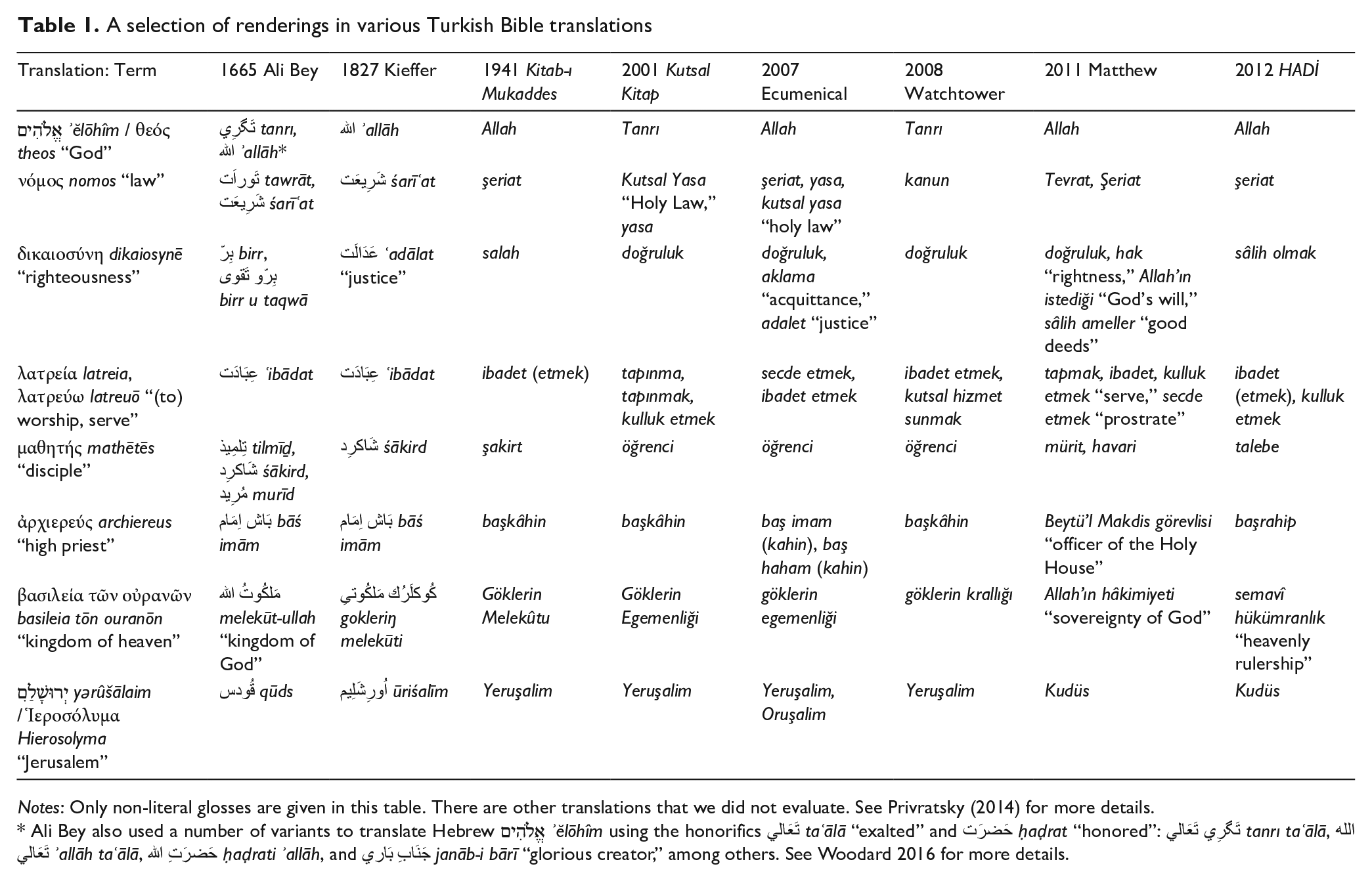
Notes: Only non-literal glosses are given in this table. There are other translations that we did not evaluate. See Privratsky (2014) for more details.
Ali Bey also used a number of variants to translate Hebrew àÁìÉäÄéí ʾĕlōhîm using the honorifics تَعَالي taʿālā “exalted” and حَضرَت ḥaḍrat “honored”: تَگرِي تَعَالي tanrı taʿālā, الله تَعَالي ʾallāh taʿālā, حَضرَتِ ﷲ ḥaḍrati ʾallāh, and جَنَابِ بَاري janāb-i bārī “glorious creator,” among others. See Woodard 2016 for more details.
A completely new translation of the New Testament was published in 1987, which was revised and published with the Old Testament in 2001 (Bible Society in Turkey and Translation Trust 2001). An edition which includes the Deuterocanonical Books was published by the Bible Society in Turkey in 2003 (Bible Society in Turkey and Translation Trust 2003). This translation used a “pure Turkish” approach, using plain Turkish words instead of terms based on Arabic cognates (Privratsky 2014, 89). This was in keeping with the Turkish Language Institute (Türk Dil Kurumu), which promotes language reforms introduced by Kemal Atatürk to restore pre-Islamic “pure Turkish” words. Sometimes this required infusing theological meaning into a nonreligious word. One example would be translating “righteousness” as dōruluk, which in a secular context means “correctness” or “honesty.” Another option was to use words with pagan connotations such as kahin for “priest,” even though it means “soothsayer” in a non-Christian context. The work on this translation was done in the 1990s during a time when secular Kemalist governments were in power and Atatürk’s secular language reforms dominated public speech and the educational systems. This version quickly gained popularity, especially among Protestant churchgoers, and has had a strong influence on the way Christians speak (Richardson 2019). As a result, there is a significant gap between most Christians and Muslims today when it comes to discussing spiritual topics. However, this translation still has appeal for the segment of the populace in Turkey for whom Islamic terminology is distasteful.
A group of Muslims produced a translation of the Bible based on the Ali Bey 1665 translation which they call the “Ecumenical Bible” (Bayraktar 2007). The translation does not normally take into account existing manuscript evidence, so it includes the long version of Matt 6.13 without any footnote. On the other hand, it includes the long version of 1 John 5.7-8 in the text with a footnote pointing out the insertion of trinitarian theology, albeit with incorrect manuscript dating. According to the introduction, one reason for this publication was to provide translations of the deuterocanonical/apocryphal books. Islamic influence is arguably visible where the verb προσκυνέω proskyneō “do obeisance/prostrate/worship” is translated as secde etmek “prostrate” when the object is God or Satan (Matt 4.9-10), but eğilmek “bow” when the object is Jesus (Matt 14.33). The widespread Muslim idea that Christians have corrupted their scriptures shows up in this translation in 2 Cor 2.17, which is translated “we do not falsify/distort (tahrif) the word of God like many others.” The cover of the book prominently features a star of David and a cross, perhaps as a warning to readers that the content of the book is not Islamic. It is our understanding that very few people know about this translation or use it.
Jehovah’s Witnesses published a version of the Bible in 2008 (Watch Tower 2008). It appears to closely reflect their New World Translation in English, so naturally it reflects that sect’s theology. It uses fairly modern Turkish, similar in many ways to the 2001 Turkish Bible.
In 2011, a small group of foreigners worked with Turkish Muslims to produce a translation of the book of Matthew that would be more easily understood by traditional Sunni Muslim readers (Yule 2011). This translation caused significant controversy among Christian Turkish speakers as well as the foreign Christian community. The primary reasons were the choice of Mevla “Lord/Protector” for πατήρ patēr “father” and Allah’ın Vekili “representative of God” for υἱὸς τοῦ θεοῦ huios tou theou “son of God.” All of these renderings were footnoted and the translation was accompanied by a transliterated Greek text and a literal translation on the facing page. The word mürit was also rejected by Christians as a rendering of “disciple” since this has connotations of being devoted to a Muslim sheikh. Many Christian Turkish speakers find the use of Islamic and Arabic-related words to be offensive, viewing it as a compromise or concession to Islamic theology. Since traditional Islam rejects the death and resurrection of Jesus, they associate Islamic terminology with the spirit of the Antichrist. Based on the personal experience of the authors, the opinions of a small number of Turkish speakers about this text range from “useful” to “ambivalent.” Some of them appreciate the interlinear feature and see the terminology as helpful in communicating biblical principles to Muslims. Others have become used to reading the whole Bible in the 2001 version and so the style of language does not necessarily appeal to them.
Ali Şimşek, who played a significant role in the 2001 translation, realized that the government’s secularization program in the 1990s had had very little effect on speech patterns of the Muslim community. Muslims were still using Arabic-based words to discuss matters of faith. Consequently, he spearheaded an effort to produce a new translation that uses more Muslim idioms. The New Testament was published in 2012 as Halk Dilinde İncil (HADİ, “Injil in the Language of the People”; World Bible Translation Center 2012) and the full Bible is currently undergoing final revision. The intended audience of this translation is the “average person” (World Bible Translation Center 2012, xii) in a country that is predominantly Muslim. Çinpolat (2022) confirms that one of the main reasons that HADİ was produced is because over the years, notable differences in language use developed between Christian and secular people on the one hand and Muslim people on the other. Therefore, the goal of HADİ is not to replace the 1941 and 2001 translations, which serve Christian and secular audiences, but to communicate to the remainder of the populace. This is a result of the fact that there are multiple subgroups in society who, even though they speak the same national language, use that language differently when it comes to spiritual topics.
Criticism collected from the Internet
Since Muslim readers are concerned about theology, this leads them to be more critical of translations done by Christian publishers such as Kitab-ı Mukaddes Şirketi (The Bible Society in Turkey) and Yeni Yaşam Yayınları. This section will present criticisms that various Muslims in Turkey have leveled against these Bible translations, based on written publications and video presentations.
Influence of the translator’s theology
There are a small number of Turkish Muslims who do consider the Bible to be a reliable source in addition to the Qur’ān, but since they have not yet published any academic work, we are dependent on statements made by them on social media and in personal interactions. The most well-known person to hold this position is Cumhur Erentürk, who publishes videos on the Internet. In his video titled “Which Torah and Injil Translation Should I Read?” (Erentürk 2019b), he states that he does not particularly like Bible translations done by Protestants. He warns his audience to pay attention to the theological positions held by the translators when they are choosing a translation. He says that the 2001 translation of the Bible was based on Ali Bey’s 1665 Ottoman translation but claims that it was distorted to serve the purposes of Protestant beliefs. Consequently, Erentürk does not recommend this translation to his audience due to the influence from trinitarian theology. Instead, he recommends the Ottoman translation or the 1941 translation. In addition, he recommends current translations produced by Jehovah’s Witnesses and Jewish publishers.
Phrases used to address Jesus and God
The primary criterion used by contemporary Bible-reading Muslims to evaluate a translation is consistency in the translation of various concepts. In a video discussing translation problems, Erentürk (2021, 28:00) points out that when the word κύριος kyrios “master” is used in Matt 27.63 to address Pontius Pilate, it is translated with the word Efendi “sir/master,” which is a respectful way to address a person. However, when the same word is used to address Jesus, it is translated with the word Rab “Lord,” which in today’s Turkish is used only for God. He goes on to point out that in Ps 110.1, there are two different words used: יהוה yhwh “LORD” and אָדוֹן ʾādôn “master.” The 2001 Turkish Bible translated this as RAB Efendime … diyor “The LORD says to my Master.” The Greek text of Mark 12.36 quotes this Psalm as Εἶπεν κύριος τῷ κυρίῳ μου Eipen kyrios tō kyriō mou, using the word κύριος kyrios in both cases. This was translated in the 2001 Turkish Bible as Rab Rabbim’e dedi ki “The Lord said to my Lord.” He admits that the Greek text has been literally translated into Turkish, and that God and Jesus are referred to with the same word. However, the capitalization of Rab here in Turkish indicates that deity is clearly being ascribed in both cases. This is in clear contrast to the word used for Pilate in Matt 27.63. Cumhur Erentürk (2021, 32:00) and Buket Sayıner (pers. comm., October 13, 2023) argue that although these two different concepts are expressed with the same word in the New Testament, the original meaning is clearly distinguished in the Psalms. Therefore, they say, these concepts should be translated into Turkish consistently. By not doing that, they believe that trinitarian theology is intentionally inserted into the Bible text by the translators. Erentürk says that people are confused by the fact that the same concept is translated with two different words for Pilate and Jesus, while no distinction is made between God and Jesus. A number of Bible scholars point out that the second occurrence of κύριος kyrios refers to the Messiah (Bratcher and Nida 1993, 388; France 2002, 487), and Lane (1974, 437) says that the scribes in Jesus’ time would have recognized the messianic reference. If the original audience could perceive the difference between the two occurrences of “lord” (when read aloud, יהוה yhwh was read as אֲדֹנָי ʾădōnāy, a suffixed form of אָדוֹן ʾādôn), that would be the basis for reflecting this in a translation. Consequently, a number of translations reflect this distinction in various ways: Rab Efendime dedi “The Lord said to my Master” (HADİ); “The LORD said to my Lord” (New Living Translation); قَالَ اللهُ لِسَيِّدِي qāla llāhu lisayyidī “Allah said to my master” (Arabic Sharif); قالَ ُ تَعالى لمَولايَ qāla llāhu taʿālā limawlāya “Allah said to my lord” (Arabic True Meaning).
As for other prominent Muslim scholars who discuss the Bible, Zafer Duygu (2019, 190–91) and Kenan Has (2014, 1087) also argue that the concept of “lord” used for Jesus in Bible translations should not be translated with the word Rab “Lord,” which is used to refer to God in Turkish. They object to using the same word to address God and Jesus and they demand consistency according to their point of view. Since the word κύριος kyrios “lord” ranges from a respectful way of addressing a human to referring to the Creator God, it is clear that literal consistency and concordance is impossible in this case. A good translation should not be manipulated by the audience but is the result of dialogue and mediation between the ancient text and its context on the one hand and modern sensitivities and understandings on the other. By listening to Muslim readers, translators can give them a voice as a stakeholder in this dialogue. Based on this interaction, methods can often be found to address the concerns of the audience while being faithful to the original text, as with the examples given above.
Human characteristics attributed to God
Another issue that Turkish Muslim readers criticize in Bible translations is the attribution of certain human characteristics to God. For example, Erentürk (2017a, 2021) criticizes the translation of Gen 3.8 for this issue. Although the word מִתְהַלֵּךְ mithallēk can mean “to go to and fro, to go about,” it is translated as yürüyen “walking” in the 2001 Turkish Bible. Erentürk sees this to be a reflection of Christian theology that envisions God walking on two legs. Instead of the image of “God walking around,” he prefers the idea of “the sound of the LORD God moving about,” as rendered in the New Jewish Publication Society version. We note here that the hithpael of the verb הלך hlk can refer to non-bipedal motion for nonhuman objects (Ezek 1.13; Ps 58.8) and even for God (2 Sam 7.6).
Similarly, the concept of “rest” in the translation of Gen 2.2 was criticized by Erentürk (2017b), where he questions the idea of God becoming tired. He notes that the word שַׁבָּת šabbāt “Sabbath” has the same root as modern Hebrew שְׁבִיתָה šǝbîtâ “strike, cessation of work.” He states that the focus should be on finishing the work, not on the concept of rest. He points out that many translations, including the Jewish and Jehovah’s Witnesses versions, use the same word in the sense of finishing some work in verses such as Gen 8.22, Josh 5.12, Neh 6.3, and Isa 14.4 and 17.3. From a theological perspective, he also points out that God does not get tired (Isa 40.28). Erentürk’s criticisms should remind us of Q Al-Aʿrāf 7.54 and Q Qaf 50.38, which state that God sits on the throne after his act of creation and does not get tired. Because this is actually a valid point, a number of translations in other languages use phrasing that prevents the wrong implication that God rested because he was tired: “he ceased on the seventh day all the work” (New English Translation; New Jewish Publication Society version); لَمْ يَعْمَلْ فِي الْيَوْمِ السَّابِعِ lam yaʿmal fī l-yawmi l-sābiʿlamīaʿmal fī al-īaūmi al-swābiʿi “he did not work on the seventh day” (Sharif Arabic);خدا كار آفرينش را تمام كرده، دست از كار كشيد khudā kār afarīnesh rā tamām kardah, dast az kār kashīd “God finished his work of creation and stopped working” (Persian Contemporary Bible).
Erentürk’s objection to anthropomorphism comes from his Islamic understanding that God cannot be compared with anything in his creation. This raises the issue of intertextuality between the Bible and the Qur’ān: whether Christians like it or not, Muslims will inevitably bring along their Islamic and qur’ānic background knowledge when they read the Bible. This intertextual interaction indicates the importance of knowing about the Qur’ān when translating the Bible. If the translators take this into account, then it is often possible to find ways to translate the Bible that are faithful to the text and also avoid causing misunderstandings for Muslims. Since any text has an assumed audience, this makes it likely that separate translations would be necessary to communicate effectively to both Christian and Muslim communities.
Falling prostrate as a form of worship
One of the pillars of Islam is ritual prayer, where people kneel on the ground, touching their hands, knees, feet, and foreheads to the ground. Islam teaches that prostration in this manner should be done only for the purpose of worshiping God (Certel 1997, 344). However, this action is not necessarily done with the intention of worship, because it can be performed in the presence of a king in some cultures as a sign of respect. This is one of the criticisms of the 2001 translation mentioned by Buket Sayıner (pers. comm., October 13, 2023), who objected to the word tapınsın “let them worship” in Heb 1.6, referring to the action of angels toward Jesus. Instead, she proposed the expressions boyun eğmek “to bow” or secde etmek “to prostrate,” which describe an action that indicates acceptance of a superior authority. She immediately added that she did not know Greek, but the Turkish verb tapınmak “worship” is used only for a deity. For a Muslim, the word tapınmak “worship” refers to the entire act of ritual prayer (namaz or salat in Turkish), while secde etmek “to prostrate” describes a physical action that is only a part of the prayers. It is well known that the verb προσκυνέω proskyneō refers to the custom of prostrating oneself (Bauer et al. 2000, 882), which is the case in Acts 10.25. The question of whether the act is intended as worship or to acknowledge authority is a matter of interpretation. For this reason, a number of translations use phrasing in Heb 1.6 that means “to prostrate,” including the 1941 Turkish translation and HADİ (secde etmek), German Common Language (sich vor ihm niederwerfen “bow down before him”), and Lighthouse Arabic (أن يَنحَنُوا أَمامَهُ ساجِدينَ an yanḥanū āmāmahu sājidīna “that they bow down before him, prostrating”).
Creation of Eve from Adam’s rib
Turkish Muslims who read the Bible often find parallels when they compare certain passages with the Qur’ān. The creation of Eve from Adam’s rib in Gen 2.21 is one of these stories. Erentürk (2017b) criticizes the translation of this verse, stating that צֵלָע ṣēlāʿ “side” should not be translated with the word “rib.” He points out that the Jewish scholar Rashi says that this word is also used for the front side of the tabernacle mentioned in Exod 26.20. He quotes Ibn Ezra and Rashi on Gen 2.21. Erentürk continues by referring to Q An-Nisāʾ 4.1, stating that no detail about a bone is given there. Some Christian commentaries also concur with the point that “A better translation of ṣēlāʿ is ‘side’” (Hamilton 1990, 178). Here is a case where a Muslim reader who is limited to Turkish language resources is making a point that Jews and Christians are already aware of.
Essence and image of God
Erentürk (2019a) also strongly objects to the translation of the word μορφή morphē “form” in Philippians 2.6, where it is translated into Turkish as öz “essence” to describe the relationship between Jesus and God. This word is translated as biçim “shape,” suret “exemplar,” or benzerlik “likeness” elsewhere in the Bible, such as in Mark 16.12. Erentürk states that this word should be treated similarly to Hebrew צֶלֶם ṣelem “image” (Gen 1.26; 5.1; 9.6). After giving a number of arguments and translations, he concludes that since this word has only been translated as “essence” in this verse, this shows that the translators have let their trinitarian viewpoint influence the translation. In fact, Ralph Martin states that “‘Being in the form of God’ looks back to our Lord’s pre-temporal existence as the Second Person of the Trinity” (Burtch 1971; Phil 2.6). This is an admittedly difficult phrase to translate, so it not inconceivable that translators might apply a trinitarian perspective to translation. That said, the 1941 Turkish Bible uses the word suret “form, appearance” here, the same word it uses to translate צֶלֶם ṣelem “image” in Gen 1.26. Furthermore, there are a number of English translations that choose to translate this phrase literally as “form of God,” including the New English Translation, New Revised Standard Version, and New American Standard Bible.
Making Moses like God
Muslim Turkish readers can also be suspicious of phrases that seem to attribute divine characteristics to people in the Bible. The most striking example of this is found in Exod 7.1, where Moses assumes the role of God with respect to Aaron and Pharaoh. The 1941 and 2001 Bible translations use the phrase Allah/Tanrı gibi “like God,” which contradicts the Islamic idea that nothing can be compared to God. The translation done by Jehovah’s Witnesses (Watch Tower 2008) does the same. Many Turkish readers like Buket Sayıner (pers. comm., October 13, 2023) note that the word “like” does not exist in the Hebrew text of this verse. Sayıner stated that she understands that God made Moses “like” himself in a functional way in this verse, but that this verse should still be translated without adding the word gibi “like.” She pointed out that God calls his chosen representatives “gods” (John 10.34; Ps 82.6) and said that she wanted the text to be faithful to this language. In support of this point, Ali Bey’s 1665 translation uses the phrase سَنِي فِرعَونَه تَگرِي يَرِنَه قُودُم seni firʿavna taŋrı yerine kodum “I put you in the place of God to Pharaoh” (Privratsky 2023), while a Jewish translation done in 2004 says Seni Paro’nun efendisi yapıyorum “I am making you Pharaoh’s master” (Farsi 2004, 55).
Suggestions gathered from a survey
Fifteen Turks residing inside and outside of Turkey were interviewed for this article, many of whom respect Erentürk’s teaching. Each of them reads the scriptures each week individually and in a group environment. The research was conducted as one-on-one interviews via video connection or in writing where the participants were presented with a series of questions. The survey participants came from various ethnic, political, and religious affiliations, but all of them consider themselves to be Muslim and respect the Bible in addition to the Qur’ān. More than half of them said they preferred to use the Turkish version of the Jehovah’s Witnesses’ New World translation, while the rest use the 2001 contemporary translation. Approximately half of the survey participants said that the translation they prefer today was not the same translation they used when they first started reading the Bible. An equal number of people had switched from the New World to the 2001 translation and vice versa. One participant preferred the German Elberfelder translation for its literal renderings, one person compared Ali Bey’s 1665 translation with the New Testament translations done by Cosmades (2010) and Candemir (2003), one person sometimes reads the HADİ translation because it uses words that are not offensive, and one person was aware of the 2011 translation of Matthew with interlinear rendering. More than half of the participants specifically stated that they compared different translations. Those who preferred the New World translation said that was because it reads fluently and because they believed it contains less corruption due to trinitarian theology. Those who prefer the 2001 translation either read it because it contains less interpretation, out of habit, or because its mobile phone applications are better.
One of the participants stated that he began reading the 2001 translation as a result of the Qur’ān’s command to believe in other books. However, he switched to other translations because Gen 2.2 contained phrasing that was completely contrary to his concept of God (as discussed in the section “Human characteristics attributed to God,” above). Another participant stated that she became used to secular terms such as kilise “church,” kutsal olmak “be holy,” and Tanrı oğlu “son of God,” so she likes the 2001 translation. She also said that she approved of words such as cemaat “congregation,” salih olmak “be righteous,” and semavi oğul “heavenly son” in the 2012 HADİ translation, which imply Arabic-influenced Islamic concepts. She finds the language of both translations to be pleasing. A number of the participants emphasized that they were disturbed by the influence of trinitarian theology that they found in the translations. This confirms that when Muslim readers choose a Bible translation, the theology that influences the translation is just as important to them as accessibility and their familiarity with the translation.
References to other verses
Participants in this study stated that they care about and support the addition of footnotes with cross-references to other verses in the Bible. The majority of participants said that such references would be helpful for understanding the text. However, a few of them said that people can easily understand it even if there are no references. They said that since God acts as a teacher in the Qur’ān and the Old and New Testaments, there are already a sufficient number of references in the text. In this regard, we should note here that most of the participants in this study started reading the Bible because it is mentioned in the Qur’ān. Note that the Bayraktar 2007 Bible translation and the study Bible published by Yeni Yaşam Yayınları (2010) include extensive cross references.
Explanations about words and verses
It was observed that Turkish Muslims who believe in the Bible are usually very wary when it comes to footnotes that explain certain words and verses. They stated that the various explanations they have read often made the situation worse, and they expressed fears that such explanations might distort the true meaning of the text. Their concerns were that it is often unclear which word needs explanation and why, but that long explanations tend to turn into a commentary. Participants were asked to give an approval rating from 0 to 5 regarding a series of statements about how explanatory notes should be implemented. They gave an average approval rating of 3.7 for providing explanations about words, an average rating of 3.3 for short explanations about verses, and a rating of 2.0 for longer explanations about verses. These ratings were subject to the condition that such explanatory notes do not impose ideas upon the reader. In addition, they gave an average approval rating of 3.8 to the statement that noting variations in the original manuscripts is necessary and a rating of 4.9 to the statement that notes about manuscript variants would be helpful.
Use of secular versus Islamic terminology
The majority of participants were not very concerned about whether secular or Islamic terminology is used in Bible translations as long as the proper meaning is provided. However, the participants expressed a variety of opinions on this matter, including:
Qur’ānic phrasing should be used so that it is possible to make connections with concepts in the Qur’ān.
Even if the translation is done by a Muslim, the word in the translation should reflect the original form and the Islamic equivalent should be given in a footnote.
Footnotes should not drift into interpretation.
The choice to use either secular or Islamic terminology will alienate readers from the other segment of society.
Contemporary Turkish style should be used so young people can understand it better.
Even Islamic words should be translated into Turkish.
Turkish renderings of Hebrew words that have cognates in Arabic
Since Hebrew and Arabic are related languages, translators should consider using words in the Bible that are based on the Arabic terms in the Qur’ān instead of searching for Turkish equivalents. An example of this is the Arabic نفس nafs “soul.” According to Q An-Nisāʾ 4.1, Allah created humans from a single نفس nafs, and from that نفس nafs he created spouses. Like Hebrew נֶפֶשׁ nepeš, the Arabic نفس nafs is very difficult to translate into Turkish. None of the Turkish words ruh “spirit,” can “soul,” kendi/benlik “self,” or arzu “desire” can fully represent the concept of the Arabic word نفس nafs as it is used in Islam. For this reason, many translators of the Qur’ān prefer to leave this word in Arabic without translating it into Turkish. It would be possible to use the word nefs in Turkish to translate a number of passages in the Bible that contain the Hebrew word נֶפֶשׁ nepeš, such as Gen 9.4, which is translated into Turkish as kan canı içerir “the blood contains the soul” by the 2001 Turkish Bible.
When the participants in the study were asked about their preference based on this example, 64% preferred nefs, since it is an Arabic word that has become Turkish. On the other hand, 36% were hesitant or stated that this should only be used in footnotes as an explanation. Those who liked the word nefs gave the following reasons:
People need to learn about important terms and concepts in the Torah and the Qur’ān.
These words have more or less become Turkish words.
Providing the original word is helpful for those who are doing research.
Conversely, those who preferred that such words should be put in the footnotes stated that:
Selecting one option may be helpful for some people, but it also makes it harder for other people to understand.
The meaning should be given in plain Turkish words instead of Arabic words which can often be interpreted in different ways.
It should be kept in mind that the group that prefers footnotes tend to be those who study Greek, Hebrew, and Arabic words, and therefore spend more time on textual analyses. In conclusion, most of the participants support the use of Arabic words that have become Turkish when they have a similar root in Hebrew, although some of them had reservations about this.
Allah or Tanrı?
Of the Bible-believing Muslims who participated in this study, 75% said that there is no difference as to whether the word Allah or Tanrı is used for God. While 17% preferred the word Tanrı because it is Turkish, only 8% clearly preferred the word Allah to refer to the “one true God,” unless polytheistic deities are in view. It should be kept in mind that these results reflect the views of Muslims who believe in the Bible and have been reading it for at least a year, not Muslims who have never read the Bible.
Influence of trinitarian theology
Almost all of the participants in the research stated that it is very important to them that belief in the Trinity should not influence the translation. We described this issue in the sections “Influence of the translator’s theology” and “Essence and image of God,” above.
Religious identity of the translator
Participants in the research gave a variety of answers about how important it was to them whether a translation was made by Christians, Muslims, or another group. Some thought that Muslims should be involved in the translation process because the Bible is not just a book for Christians, but also for Muslims. However, they all agreed that there are not yet enough Muslim Turks who have the competency required to translate the Bible into Turkish.
Congruence of Bible translations with the Qur’ān
Some of the participants in the study feel a need for a translation of the Bible that is congruent with the Qur’ān. Those who support this idea said that this would make it easier to understand all of the Holy Books together and provide a broader perspective. Some said that a team of Muslims who believe in all the Holy Books should be formed to accomplish this task, and the comment was made that the academic community should also assist in such an endeavor. Christians may object that using qur’ānic terminology will cause the reader to misunderstand the Bible because of what they believe to be incorrect Islamic theology. However, we must also understand that terminology is determined by how it is used in the text. We have noted above that the 2001 Turkish Bible used secular words like dōruluk “correctness” and pagan words like kahin “soothsayer,” yet these words have taken on the correct biblical meanings of “righteousness” and “priest” because of how they are used in the text. Similarly, when words with Arabic roots and Islamic connotations are employed in Bible translations, they become defined within the overall biblical context.
References to qur’ānic verses
Although there were various opinions on this point, more than half of the respondents supported the idea of referencing qur’ānic verses in Bible translations. This would be similar to the approach used in translations of the Qur’ān done by Suat Yıldırım (2004) and Süleymaniye Vakfı (2023), which refer to Bible verses in appropriate locations. The comment was made that such an approach would also enable “the People of the Book” to understand a given subject correctly. However, more than one person said that it should be made clear to the reader that such footnotes were being made by Muslims who believe in the Qur’ān as well as the Bible, not by people from other religions who do not believe in the Qur’ān. This is a further indication that a Bible translation such as this would require a combined effort between Bible scholars and Muslims who believe in the Qur’an.
Interlinear translations and the translation of specific words
All of the participants in the study stated that they wished they had an interlinear Bible translation in Turkish. Some said that they consult websites such as biblehub.com to look up the meaning of a word in controversial verses or to find other verses where the same Hebrew or Greek word occurs. Unfortunately, that website is very difficult for Turkish Muslims to use due to its complexity and the language barrier. Furthermore, most Muslims do not know about the interlinear Turkish translation of Matthew, which is not sufficient anyway since it does not cover the whole Bible. Thus, our research shows that an interlinear translation is needed by Turkish Muslims who read the Bible.
Comparing Bible translations
Due to the abundance of Qur’ān translations in Turkey and prominent debates about certain Islamic teachings, a number of websites have emerged since about 2010 that enable the reader to display a list of various Turkish translations of a given verse of the Qur’ān. Most of the Muslim Turks who participated in this study wished that this was possible for Turkish Bible translations as well. They said that they were tired of switching between different websites to make such comparisons.
Conclusion
No matter how carefully the Bible is translated into a local language, it is not possible for a translation to meet everyone’s needs or to fully reflect the nuances of the original. Turkish-speaking Muslims have had various reactions to different Turkish Bible translations throughout history. These are partly due to the linguistic and societal factors we have discussed here. Turkish-speaking Muslim leaders have various criticisms about Bible translations and they list several points that lead to misunderstanding. A significant reason for this is intertextuality: Muslim readers inevitably bring qur’ānic and Islamic assumptions along when they read the Bible text. A translation that does not take this into account will inevitably be confusing for Muslim readers.
Ali Şimşek, who played a major role in the 2012 Halk Dilinde İncil translation, admitted that previous translations were not accepted by most people, which indicates the need for a translation that uses the language of common people (Çinpolat 2022, 723). However, since previous translations appeal to Christians and secular-minded people, Muslims view them as tools for promoting Christianity in general and the doctrine of the Trinity in particular. For that reason, it is doubtful that they will embrace the HADİ 2012 translation with open arms. In fact, they may perceive it as dubious missionary activity that uses Islamic terminology (Çinpolat 2022, 721–23). This shows that using the appropriate style of language for the audience is not enough. It is important that stakeholders from the intended audience be included in the translation process. It is possible that collaboration between Bible scholars and Qur’ān scholars could not only lead to a translation that is more understandable and acceptable to Muslims, it could also help Christians understand Islam more accurately. If done well, such an effort could contribute to a spirit of goodwill and mutual respect between two communities that desperately need it today.
