



Abstract
The Gospel of Luke (7.1-10; par. Matt 8.5-13) relates a tale wherein Jesus heals a military officer’s slave at a distance. The slave remains in the background throughout the pericope, never speaking, much less appearing at all. Luke offers little information about this slave aside from his illness and the fact that he was ἔντιμος to the centurion (7.2). This word ἔντιμος has generally been construed as denoting the slave’s emotional or personal value to the centurion, most commonly as “dear.” This article argues that there is little lexical support for such a rendering. I will attempt to address the lacuna around the word ἔντιμος and its rendering in English translations, attending especially to epigraphic evidence for the term’s use. In short, I will argue that rather than denoting emotional importance, the term ἔντιμος designates the respect for the slave within the centurion’s household.
The Gospel of Luke (7.1-10; par. Matt 8.5-13) relates a tale wherein Jesus heals a military officer’s slave at a distance. The slave remains in the background of the pericope, never speaking, much less appearing at all. He is healed without ever even meeting Jesus. It would be fair to characterize this individual as a minor character within the Gospel of Luke and indeed this slave has been treated as such in the history of scholarship.
Luke offers little information about this slave aside from his illness and the fact that he was ἔντιμος to the centurion (7.2). This word ἔντιμος has generally been construed as denoting the slave’s emotional importance to the centurion. A variety of recent English translations render the phrase δοῦλος . . . ὃς ἦν αὐτῷ ἔντιμος in similar ways:
“a slave whom he valued highly” (NRSV) “servant, who was dear unto him” (ASV) “servant who was very dear to him” (BBE) “servant who was very important to him” (CEB) “servant who was highly valued by him” (ESV) “servant who was very dear to him” (GNB) “slave, who was highly regarded by him” (NASB) “servant, whom his master valued highly” (NIV) “slave who was dear to him” (RSV) “servant . . ., who was much valued by him” (YLT)
These recent translations do not differ greatly from how early Modern English translations rendered the phrase.
“servant, who was dear unto him” (KJV) “seruaunte . . . whom he made moche of” (Tyndale) “seruaunt . . . that was precious to hym” (Wycliffe) “seruaunt which was deare vnto hym” (Great Bible) “seruant . . ., which was deare vnto him” (Geneva)
Two interpretations of the term prevail. Most translations depict the slave as bearing emotional importance for the centurion (e.g., “dear”), though a minority depict him as holding utilitarian significance for his master (e.g., “valued”). Biblical scholars usually agree: Darrell Bock (1996, 1:636), for instance, prefers “dear” to translations emphasizing the slave’s utility, and John Nolland (1989, 316–18) observes that there is “a quite unusual degree of concern shown by this centurion for his slave.” Numerous other examples could be cited. 1
Despite the frequency with which commentators assert that ἔντιμος bears an emotional connotation, no comparative evidence has been marshalled to support this understanding of the word. This is not an overstatement. Aside from invocations of dissimilar uses of the term in the Septuagint (LXX), there has been effectively no serious analysis of the term ἔντιμος, whether in the Gospel of Luke or elsewhere in antiquity. Rather, there is a pervasive tendency to rely upon one’s own intuitions about what the word must mean or to extrapolate its significance from its literary context (i.e., Luke’s more robust characterization of the centurion). In either case, the use of the word, especially as applied to slaves, is an entirely untouched topic.
This silence is striking, since Luke’s application of the term to a slave is extremely odd. The term ἔντιμος (spelled ἔντειμος in some dialects) means “honored” or “valuable” in Greek, consistent with its etymology deriving from ἐν and τιμή—“in” and “honor,” respectively. Slaves, as is well known, were devoid of honor in Greco-Roman contexts. 2 Indeed, the term is used for a slave in only a single known pre-Lukan instance, an early Roman inscription from Thermus in the Roman province of Achaea (IG 9.1.2.82c).
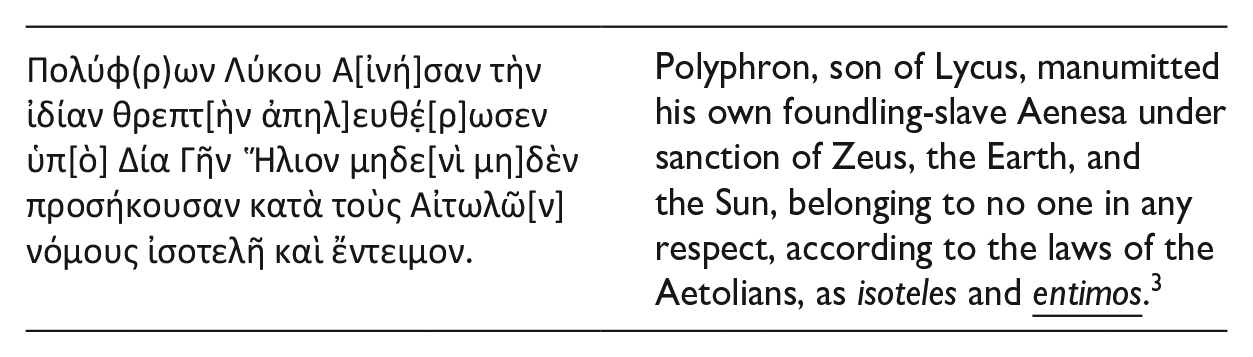
Rachel Zelnick-Abramovitz argues that in this instance ἔντιμος is probably a legal term referring to civic rights held with the taxation status of isoteles—it is a highly technical legal term, to say the least. As evidence, Zelnick-Abramovitz (2005, 81; cf. Rocca 2012, 257) points to several other Aegean inscriptions where ἔντιμος specifies the rights conferred upon an individual (e.g., IG 9.1.2.728; Ephesos 135; IKyme 4, 5, 7, 8). Aenesa’s situation differs greatly from that of Luke’s slave, as she is a freedperson and the word designates the specific privileges granted to her in a legal regime considerably different from that of Herodian Galilee. 4 Luke’s deployment of the term for a slave is without a known precedent.
In what follows, I will attempt to address the lacuna around the word ἔντιμος and its rendering in English translations, attending especially to epigraphic evidence. In short, I will argue that rather than connoting an emotional importance, the term ἔντιμος designates the respect (i.e., honor) for the slave within the centurion’s household. To make this argument, the article proceeds in three further sections. The first section will examine usage of the term in a variety of Greek texts of antiquity. This will help provide a sense of how the term functioned in literary and epigraphic contexts. Once its range of use has been established, the second section will briefly examine the historical appeal of the prevailing rendering “dear” in English translations. What are the exegetical and political conditions that render this a plausible (or desirable) reading, despite a general absence of evidence? The matter is hard to extricate from the phenomenon of chattel slavery and its defense in antebellum America. The article concludes with a tentative account of the scenario that Luke imagines for the slave, as well as how this depiction fits into the broader themes of the pericope in Luke’s narrative, with an eye toward how translators might consider these issues in English renderings of the pericope.
1. Usage in antiquity
Although ἔντιμος derives from ἐν and τιμή, etymological origins do not necessarily correspond to a word’s lexical domain at a later time. To get a better sense of the word’s usage in the Hellenistic and Roman periods, one might productively turn to the epigraphic and literary record. Though far from complete, this selection is representative of the broader textual traditions of antiquity.
JIWE 1:39, no. 22 (Brusciano; 4th century C.E. or earlier)
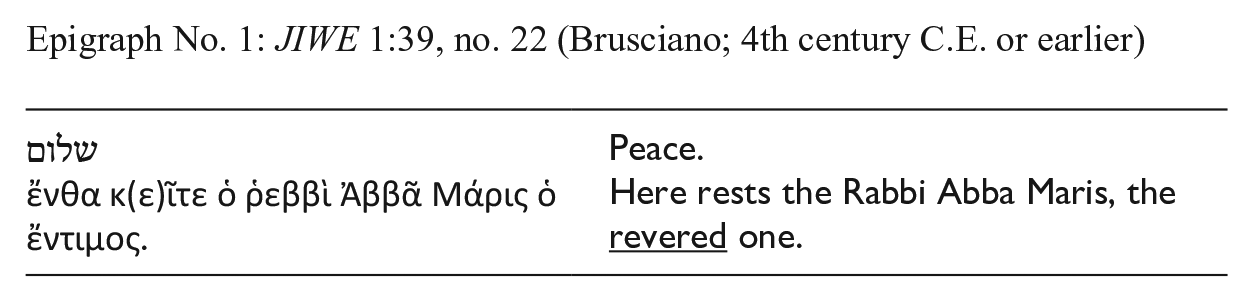
What does one make of the designation ἔντιμος for Rabbi Abba Maris, where the word is a key term on his epitaph? Giancarlo Lacerenza suggests that
the expression ὁ ἔντιμος . . . seems to indicate public rather than private recognition, but we do not know the precise meaning the writers of the epigraph, relatives or disciples of Abba Maris, intended. Should they have had the liturgical (biblical) vocabulary in mind, ἔντιμος in the Septuagint usually indicates a person held in special consideration, esteemed by his people. (Lacerenza 2021, 299)
Andrew Chester (2013, 114) likewise suggests that in this case the term evokes an “overlap between personal and public virtue.”
KILyk 1, no. 388 (Lystra; 3rd century C.E.)
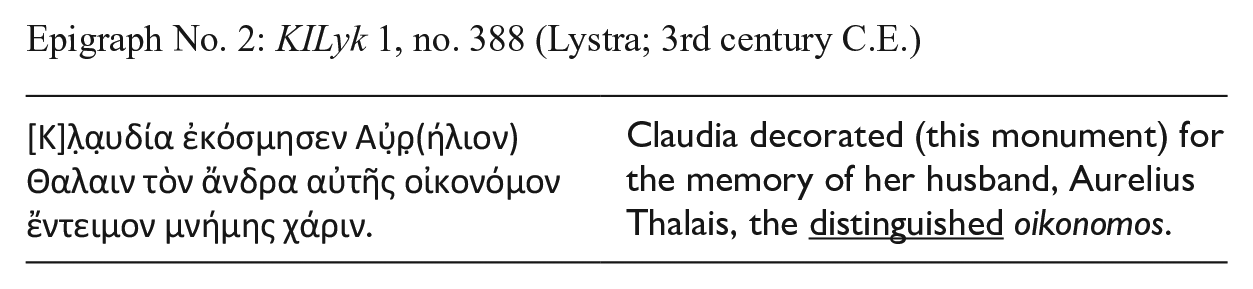
Like the previous epitaph, ἔντιμος refers to the honor of the deceased, specifically in his capacity as oikonomos—an administrator of some sort. It is likely that Aurelius Thalais worked as a private estate manager, rather than at the civic level, as one would expect his widow Claudia to have mentioned it if he served as oikonomos of a city like Lystra. Against this reasoning, one might note that most private oikonomoi were either slaves or freedpersons and Aurelius’s name suggests that he was a freeborn Roman citizen, likely after the Edict of Caracalla that granted citizenship to all free peregrines. But in the absence of anything to firmly establish him as the Lystran oikonomos, it is preferable to assume he acted in a private capacity. Though Claudia imagines her husband as being respected by society at large, the stature of the private oikonomos was by definition connected with the individual household.
TAM 4.1.288 (Sucaklar, uncertain date)
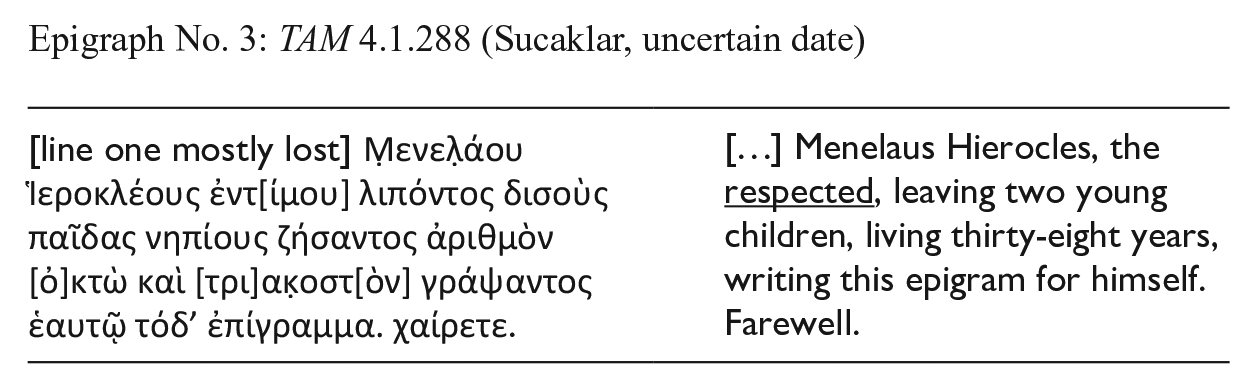
The term is again used in an absolute sense, in a clearly public capacity: Menelaus Hierocles was respected by society at large. The reasons are entirely unclear, as is the issue of whether this is a patronymic or the name of the deceased himself.
SEG 43.945 (Yapildak, Byzantine)
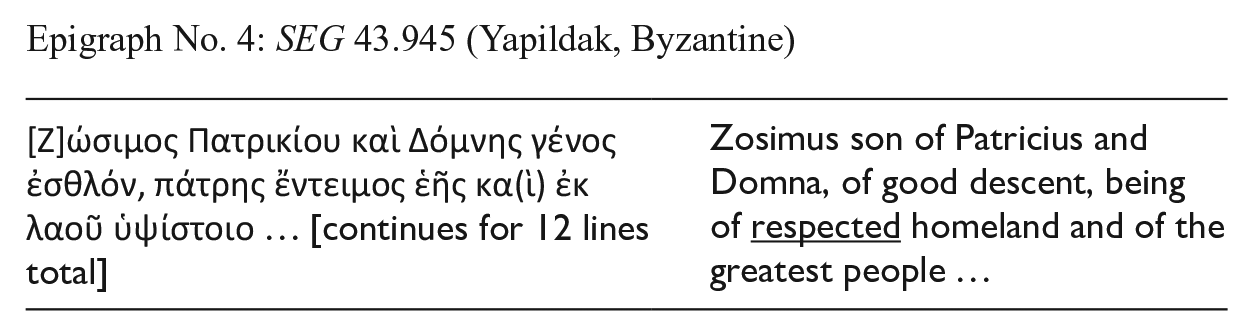
Zosimus presents a rather unusual case. The term is not used in an absolute sense, but to more specifically characterize his descent—a clear preoccupation in the almost comically repetitive introduction to this inscription. But more interesting is that, whereas the family of Rabbi Abba Maris and Claudia, wife of Aurelius, were non-Christian and clearly unfamiliar with the text of the New Testament, this is not so obviously the case with Zosimus. Zosimus seems to have been an oracle who practiced divination by invoking both Homeric poetry and “the inspired scriptures”—possibly referring to the texts of the Christian Bible (Fox 1987, 404). The inscription is incredibly fascinating and warrants more study than it has received, raising many questions. Among the inscriptions discussed so far, this one bears the most sophisticated vocabulary and uses far more complex sentence structures than the commonplace formulas found in others. Unlike the previous examples, it is not clear whether this inscription was written independently of Luke, given his use of the “inspired scriptures.”
IGBulg 1.2.390 (Sozopol, 2nd–1st century B.C.E.)
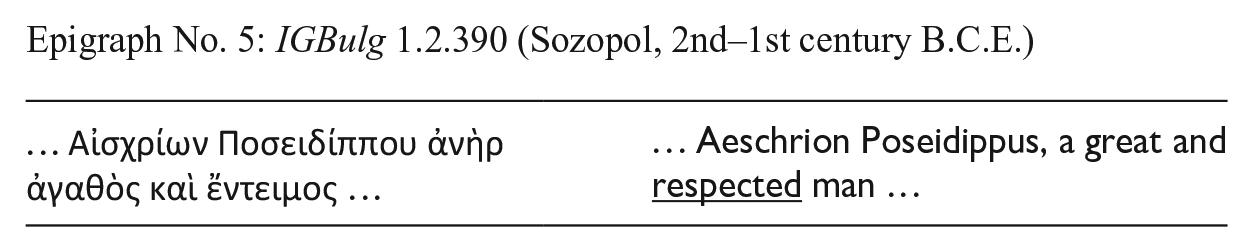
The inscription in this case and the following is long—at least twenty lines—and most of it irrelevant. Here, though, Aeschrion is characterized by a pair of words that give a better sense to the public recognition of his virtue, being paired with ἀγαθός.
SEG 26.1214 (Lyon, late 2nd–3rd century C.E.)

An inscription at least twenty-six lines long, here line 5 is extracted for its relevance. It honors a certain Eutecnius, praising his parents (appropriately, his name means “good child”). Again, the public recognition of their honor is the main purpose of the inscription, announcing to the reader the virtuous line from which its honoree descends.
Literary texts: Septuagint
Perhaps even more important is how ἔντιμος was used in the LXX, since Luke made extensive use of that corpus in composing his Gospel. I refer here to some texts that apply the term to human beings.
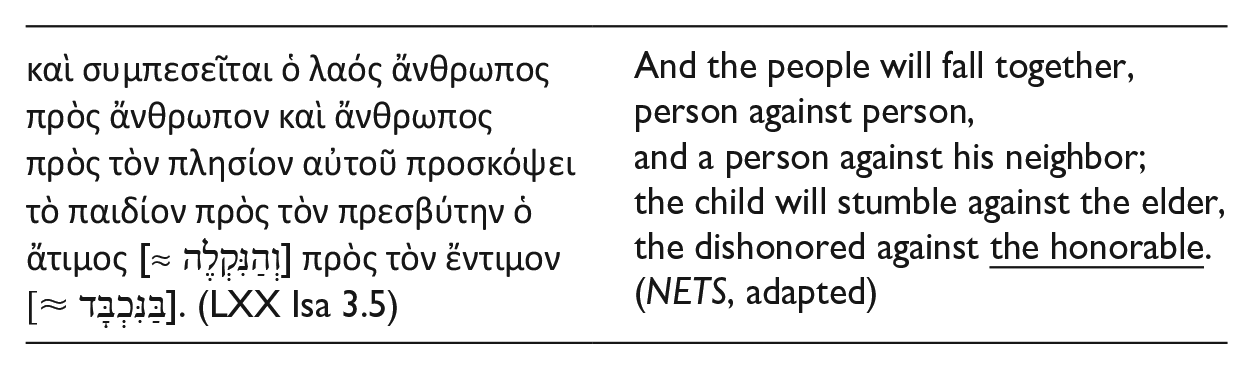
Here, Isa 3.5 distinguishes the honorable from the dishonored as a self-evident class of people. LXX Isaiah uses it in contradistinction with ἄτιμος, clearly retaining its etymological link to τίμος; an emotional link here is precluded—it must refer to social classes.
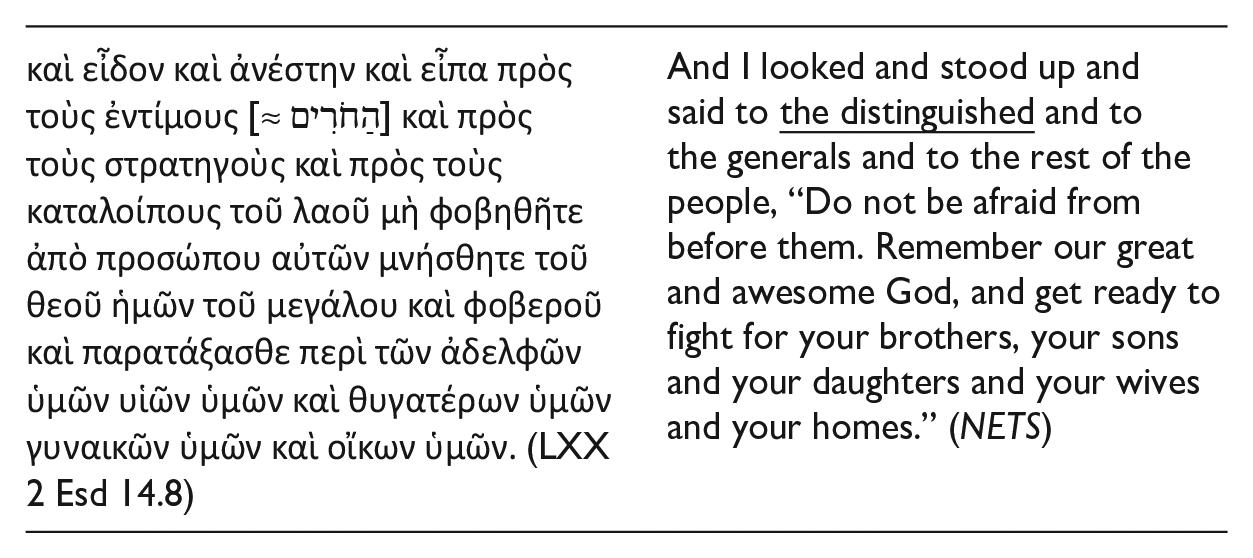
In 2 Esd 14.8 (= Neh 4.14), the term characterizes the social elite of Judah, with whom Nehemiah angrily contends. Second Esdras uses it several more times, all referring to the elites as a social class (14.13; 15.7; 16.17; 17.5).
Literary texts: Gospel of Luke
The Gospel of Luke uses the word only one other time in Luke–Acts. I quote here Luke 14.7-11 to give a sense of its use in context.
8 When he noticed how the guests chose the places of honor, he told them a parable. 9 “When you are invited by someone to a wedding banquet, do not sit down at the place of honor, in case someone
In Luke 14.8, the more important (ἐντιμότερος) guests at a wedding feast are given prioritized seating. Used in the comparative degree, the word describes one’s relative position within the social hierarchy of a hypothetical wedding. Jesus, naturally, turns this conventional wisdom on its head, but nevertheless deploys the term in a manner consistent with its meaning in the texts we have seen so far.
Summary of findings
The term denotes a person’s admirable performance in an occupation or office in the epigraphic record, such as acclaiming a rabbi, veteran, oikonomos, and so on. This association affirms the recognition of their virtue, usually in a public capacity. The LXX’s usage, especially in the substantive function, affirms this: τοὺς ἐντίμους refers to social elites—those recognized by the people of Jerusalem as important and honorable. Also noteworthy is Luke’s use of the term in this capacity in 14.8. When applied to people, the term has nothing to do with emotional intimacy, but concerns prestige, esteem, and virtue: that is to say, one’s successful acquisition of honor in the eyes of one’s contemporaries.
2. Ἔντιμος as emotional intimacy in recent interpretation
Why, if the term seems to be clearly in the lexical domain of “distinguished,” “respected,” and “important,” is the term consistently rendered something closer to “dear” in English translation? I would suggest that two primary factors can account for the popularity of this rendering. First is anglophone discomfort with chattel slavery: This rendering serves to soften the passage by attributing benevolence to the centurion as a slave-owner. Second is the interpretive inertia of Jerome’s rendering of the passage in the Vulgate. We will take these in turn.
It would be uncontroversial to say that although slavery has no serious defenders today, the matter was a point of contention among Christians in the not-too-distant past. There is much to be said about how the pericope under consideration figured into intra-Christian debates about the legitimacy of slavery, 5 but there were common trends in how this particular word was rendered. On the one hand, this rendering of emotional intimacy fits with a trend going back to the early modern English translations of minimizing the presence of slavery within the New Testament. Note also, for instance, how many of the translations quoted at the beginning of this article render the word δοῦλος as “servant.” Commensurate with the preoccupations of those translating the New Testament in early modern England, slavery as an institution was irrelevant; instead, these translations emphasized obedience within broader social systems of labor relations (e.g., apprenticeships, servant–master relationships). 6 Thus, early modern English translations commonly present servants as faithful and implicitly marked by the “dignity of free labor,” which Naomi Tadmor has detailed extensively. One’s labor (as a servant) should be enacted with joy and would be returned with favor. Though this was a sort of crypto-abolitionist rendering, it nevertheless encouraged complacency within exploitative hierarchies.
On the other hand, many interpreters in the American South before the Civil War were also eager to translate the term ἔντιμος as “dear” precisely to support slavery. The pericope provides the longest interaction Jesus has with anyone regarding slavery in the Gospels—that Jesus praised the centurion in no uncertain terms suggested to many that the institution of slavery was venerable in its own right. For instance, South Carolina congressman Laurence Keitt commented before the US House of Representatives (1858, 406),
He heals the slave of the centurion, and has no rebuke for slavery, but praises for the officer’s faith. No, sir, nothing of condemnation, nothing of even reproof from the Savior’s lips, for the “vile wretch,”—the “man stealer,” who, according to the approved Yankee formula “held his brother man in bondage.”
That the centurion regarded the slave as “dear” established that slavery was not built upon cruelty, but upon a humane hierarchy—at least according to slavery apologists. William Gannaway Brownlow (Brownlow and Pryne 1858, 83), for instance, asserted that even though Roman slavery was far less humane than American slavery, Jesus nevertheless “established the fact that a man could be Christian and yet hold slaves,” pointing to the centurion’s treatment of the slave as his evidence. Numerous others regarded the centurion’s treatment of the slave as an alibi for slavery as a moral institution, as even Jesus regarded a slave-owner as an exemplar of the Christian faith (Luke 7.9: “Not even in Israel have I found such faith!”; par. Matt 8.10). Rendering the term “dear” proved useful to both defenders of slavery and those hoping to bring about its end—it is neither inherently abolitionist nor pro-slavery as a translation.
The other major factor explaining the popularity of this interpretation is the influence of Jerome’s Vulgate, which seems to have begun the tradition of rendering ἔντιμος as an index of emotional intimacy. Compare the Greek of Luke 7.2 with Jerome’s Latin:

Jerome’s rendering of ἔντιμος as pretiosus is significant: Rather than referring to the Greco-Roman economy of honor found in the term ἔντιμος, pretiosus instead operates in the semantic domain of value (usually meaning “precious”), whether emotional or financial. This was naturally read as the former, given the centurion’s philanthropy, his regard for the slave’s health, and the praise he receives from Jesus. This reading has proven influential, and even in the period of ad fontes, it continues to propel interpretation of the passage, even among interpreters otherwise well attuned to Greek lexicography. 7
Also important is the use of the term elsewhere in the LXX, especially as applied to nonhumans. To provide two examples:
And the king proceeded still to send a third leader, an officer of fifty, and his fifty. And the third officer of fifty went to him and knelt on his knees before Eliou and entreated him and spoke to him and said, “O man of God, do let my life and the life of these fifty slaves of yours be precious [ἐντιμωθήτω δὴ ἡ ψυχή μου καὶ ἡ ψυχὴ τῶν δούλων σου] in your sight. Look, fire came down from heaven and consumed the two former officers of fifties and their fifties, but now do let the life of your slaves be precious [ἐντιμωθήτω δὴ ἡ ψυχὴ τῶν δούλων σου] in your sight.” (LXX 4 Reg 1.13-14 = 2 Kgs 1.13-14 NETS) And those that are left will be more valuable than unsmelted gold, and man will be more valuable [ἔντιμος] than the stone from Souphir.
In both cases, ἔντιμος designates value—emotional in the former and financial in the latter. However, neither instance refers to a human being, and examination of the corpus of the LXX indicates that the term is never used in such a capacity when referring to humans. If one extends the search to other Greek texts of antiquity, one would be similarly hard-pressed to find an example of such. Nevertheless, commentators occasionally cite these passages as evidence that Luke designates the slave’s emotional importance to the centurion by using the term (e.g., Mader 1992, 227). There is, however, a clearly distinct meaning when applied to humans as opposed to nonhumans.
3. The Lukan scenario
If the term does not mean “dear” when applied to people and if the term is counterintuitive when applied to slaves more specifically, what is the situation Luke is attempting to communicate? Comparison with one other instance of a slave being designated as ἔντιμος in ancient literature and Luke’s presentation of slaves elsewhere in the Gospel may elucidate the matter.
There are rare instances of post-Lukan texts applying the term to slaves. Although the Acts of Xanthippe, likely composed in the third or fourth century C.E., depicts a nameless but honored male slave (ὁ δοῦλος ἦν ἔντιμος) becoming enamored with Paul’s teaching before falling sick, the text offers little by way of detail about the reasons for the slave’s designation. More productive, though, is the term’s use in a textual variant of the Shepherd of Hermas (Sim. 5.2.2). 8 When introducing the Hermas’s Parable of the Vineyard, a slave is introduced thus:
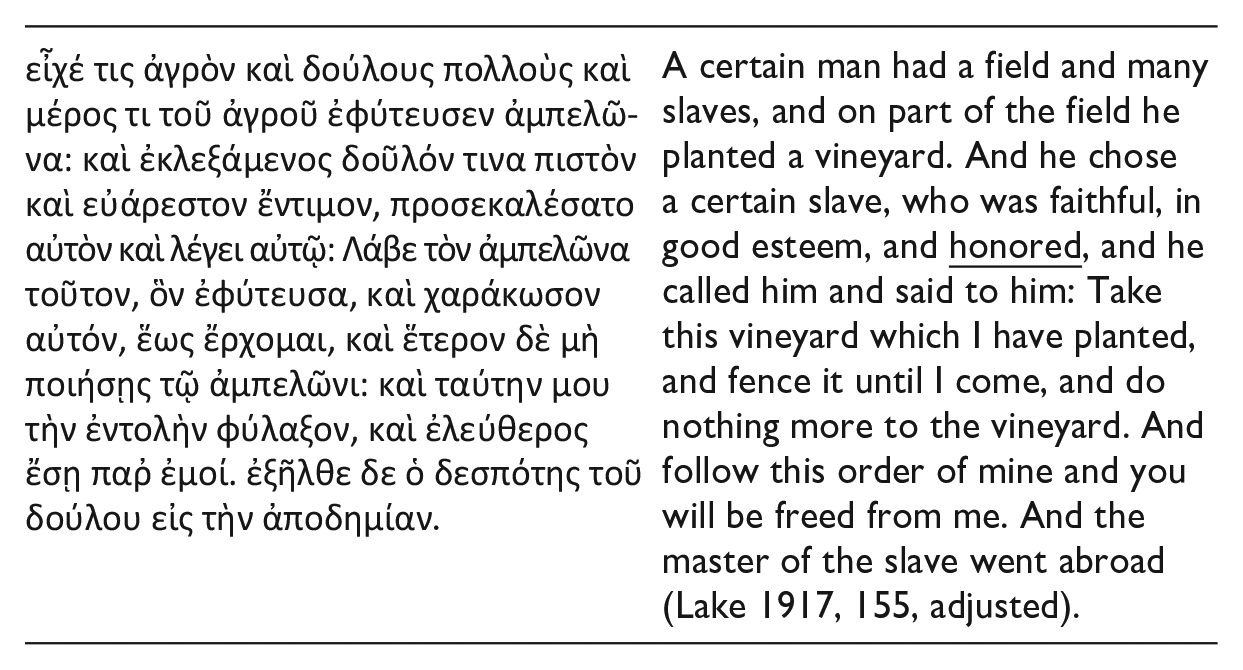
This slave is afforded a number of important responsibilities, acting as the oikonomos of the man’s estate. It is not entirely clear when this textual variant was introduced to the manuscript tradition, but this usage is entirely consistent with what one finds about slaves in managerial positions in other Greek and Latin texts.
Slaves are common in Luke, often being morally neutral figures who simply carry out orders without any valuation (e.g., parable of the dinner or Prodigal Son—the slave simply does as ordered, but this is not commended in any way). Particularly to this point is Luke 17.9: “He does not thank the slave because he did the things which were commanded, did he?” Following orders seems to be a level of minimal expectation in Luke and is not worthy of the designation ἔντιμος in its own right. Rather, failure to do as told is tantamount to insubordination. The use of the slave metaphor throughout Luke–Acts should be read in this light: it is precisely the humble obedience of Christians that makes them slaves of their Lord (cf. Acts 2.18; 4.29; 16.17).
Elsewhere in Luke, “good” slaves are marked by several features: They exhibit preparedness (12.37), those in managerial positions show philanthropia (12.42-46), and they are productive and resourceful (19.11-27). 9 These seem largely to be slaves who act as oikonomos or at least have some sort of managerial role for the estate. This role within the household seems to be a reward in 12.44 (“Truly, I say to you, he will set him over all his possessions”), but I would note that the following passage, where the slave beats other slaves, seems to presume that the slave is in some position of authority and that this punishment is unwarranted—this would have been standard in Roman society and is also the outlook in the parable of the vine-growers: The slave the master sends is unjustly beaten. Recall also that being a good manager is cause for reward in Luke 19.11-27. That is, the slave who invests wisely is rewarded.
As noted in the discussion of Epigraph No. 2 above, the oikonomos of a given household was usually enslaved and often simply referred to as δοῦλος in Greek literature. 10 It is significant that when other ancient writers describe honored slaves, they tend to discuss oikonomoi. Thus, for instance, Xenophon (Oeconomicus 12.16) quotes Isomachus on his treatment of estate managers, writing in the fourth century B.C.E.: “Whenever I notice that they are careful [ἐπιμελομένους], I commend them and try to show them honor [ἐπαινῶ καὶ τιμᾶν πειρῶμαι αὐτούς]; but when they appear careless, I try to say and do the sort of things that will sting them [δήξεται αὐτούς].” Like the owner in the Parable of the Minas, Isomachus rewards good managers with honors, but punishes those who fail to be productive.
Perhaps more telling is a quotation from the church father Lactantius (De Ira Dei 5.12), who designates charge over the domus and familia as a reward for slaves, one that not only affirms their relative honor, but grants additional prestige within the household as well:
The master calls the good slave a friend and decorates him and puts him in charge of the domus and the familia and all the master’s affairs, but the bad slave he punishes with cursing, lashes, nudity, hunger, thirst, chains. The one is an example to the others not to sin, and the other is an example to good behavior, so that some are coerced by fear, others driven by
This is not to mention the other forms of honor that oikonomoi and other enslaved estate managers claimed for themselves in honorific statues, or even honors granted by others (e.g., the gerousia of a given town dedicating a statue to a freedman named Publius Anteros; INik 1203).
That the slave may be an oikonomos also makes sense of Luke’s phrasing, namely the dative αὐτῷ—that the slave was ἔντιμος for him, the centurion. This can be read either as the centurion personally holding the slave in esteem or perhaps as a synecdoche for the centurion’s household, a household that has multiple slaves and has amassed enough wealth that he can act as donor to the local synagogue. That is, rather than the slave’s importance to the centurion for emotional reasons, the term likely designates the importance and respect the slave was afforded within the centurion’s household, probably in regard to his duties. The centurion may well have cared for this slave at an emotional level, but ἔντιμος seems to have little to do with the emotional aspect of their relationship—the word pertains mostly to his importance to the household.
Conclusion
Ἔντιμος, I would suggest, operates in the semantic domain of “esteem,” situating the slave within the Roman economy of honor. This makes sense of the Lukan pericope more broadly, which shows a preoccupation with these matters. Both Matthew and Luke show the centurion as deferential on the matter of his worthiness (ἱκανός; Luke 7.6; Matt 8.8), but Luke alone depicts the Jewish elders as asserting the merit of the centurion (ἄξιός; 7.4), offering an explanation as to why. That the slave is introduced through a similar lens not only varies the vocabulary, but subtly introduces this theme within the pericope: it is not one’s social importance that determines one’s value to the Lukan Jesus, rather, it is their πίστις. Biblical translators would do well to render these terms (i.e., ἔντιμος [esteemed], ἄξιός [worthy], and ἱκανός [worthy]) as mutually evocative in their versions. 11 My own suggestion for a rendering of Luke 7.2 would be something like, “But a certain centurion’s slave, whom he held in esteem, was sick and nearing death.” 12
Footnotes
1
A few commentators go even further, suggesting that Luke’s characterization implies a homoerotic relationship between the centurion and the slave. Donald Mader (1992, 229) contends that “Luke, in introducing [the term ἔντιμος], was recognizing that the centurion’s actions displayed a depth of feeling which was over and above that of an ordinary master–slave relationship.” For more on this interpretation, see  .
.
3
All translations are mine unless otherwise indicated.
4
One might also note that Ἔντιμος/ Ἐντειμος served as a name from the Archaic Greek period well into the Roman era. Entimos of Crete, for instance, was regarded as the founder of the city of Gela (circa 688 B.C.E.: Thucydides 6.4.3; Diodorus 8.23); various inscriptions also attest the name (IG 12.1.44, 12.1.55, 12.1.107, 12.8.220; SEG 52.1418; CIL 19.470; I.Lind. 51, 88). However, I am aware of no slaves or freedpeople bearing the name, as it instead seems to be found among the upper classes—itself evidence that the term was not associated with slaves.
6
7
I am grateful for a peer reviewer’s observation that Erasmus pushed this even farther in his 1519 Latin version, rendering ἔντιμος as charus.
9
Note that the last of these, the Parable of the Minas, depends on an unironic reading of the pericope (i.e., that the owner is a stand-in for God). Some interpreters have recently argued for an economic-realist reading of the parable that implicitly criticizes the owner’s exploitation. See, most famously, , 150–68.
12
My thanks to the participants at the Society of Biblical Literature annual meeting (Ideological Criticism section) as well as participants at the Toronto Oriental Club for their extremely helpful feedback on an earlier version of the paper. Thanks also to the two peer reviewers who brought further insights that have helped tighten up this paper.
Abbreviations
ASV American Standard Version (1901)
BBE Bible in Basic English (1950)
CEB Common English Bible (2011)
CIL Corpus inscriptionum latinarum
Ephesos Ephesos Inscriptions (Börker and Merkelbach 1979, in References)
ESV English Standard Version (2001, 2016)
Geneva Geneva Bible (1599)
GNB Good News Bible (1976, 1994)
Great Bible Great Bible (1539)
IG Inscriptiones graecae
IGBulg Inscriptiones graecae in Bulgaria repertae (Mihailov 1970, in References)
IKyme Die Inschriften von Kyme (Engelmann 1976, in References)
I.Lind. Lindos inscriptions (Blinkenberg, Kinch, and Dyggve 1941, in References)
INik Inschriften des Museums von İznik (Nikaia) (Şahin 1979, in References)
JIWE Jewish Inscriptions of Western Europe (Noy 1993, in References)
KILyk Die kaiserzeitlichen Inschriften Lykaoniens (Laminger-Pascher 1992, in References)
KJV King James Version (1611)
NASB New American Standard Bible (1971, 1995)
NETS New English Translation of the Septuagint (Pietersma and Wright 2007, in References)
NIV New International Version (1978, 2011)
NRSV New Revised Standard Version (1989)
RSV Revised Standard Version (1952)
SEG Supplementum epigraphicum graecum
TAM Tituli Asiae Minoris (Dörner 1978, in References)
Tyndale Tyndale Bible (1526 and revisions)
Wycliffe Wycliffe Bible (1395)
YLT Young’s Literal Translation, by Robert Young (1862/1898)