




Abstract
This essay argues that Martin Luther’s choice of asabthani in Matt 27.46 instead of sabachthani in his source text, Erasmus’s 1519 edition of the New Testament, was based on the reading azabt(h)ani occurring in many editions of the Latin Vulgate printed in the late fifteenth and early sixteenth centuries. Although Luther based his translation primarily on the Greek and Latin texts included in Erasmus’s Novum Testamentum of 1519, he repeatedly preferred readings of the Vulgate to those of Erasmus. This also applies to this reading asabthani in Matt 27.46.
A great deal has been written about the question of the sources on which Martin Luther and his collaborators drew for their translation of the New Testament, published in September 1522. 1 But several recent studies of this subject are limited in scope. They often seek to identify the source of a particular book of the New Testament in Luther’s translation of 1522 or examine the influence of one or more specific sources. 2 But since the pioneering research of Albrecht (1929) and Freitag (1931) 3 of about a century ago, there has not been a large-scale thorough and detailed investigation. This is a desideratum that urgently needs to be met.
The primary sources of Luther’s September Testament
Nevertheless, the generally accepted view is correct: The primary and chief basis of Luther’s translation was Erasmus’s second edition of the New Testament, printed and published in 1519 by Johann Froben at Basel. 4 In this edition the Greek text and Erasmus’s revision of the Latin Vulgate were printed in parallel columns, allowing the reader easily to compare the Greek text with Erasmus’s version of the Latin and vice versa.
Martin Karrer has recently argued that Luther began to translate the New Testament in the Wartburg from Nikolaus Gerbel’s edition, printed at Hagenau in 1521 (Karrer 2017, esp. 303–10). 5 This was a reprint of Erasmus’s 1519 edition of the Greek text only, without the Latin version. Indeed, Luther appears to have received a copy of this edition in the Wartburg in the same year, 1521. 6 But the definitive version of the September Testament of 1522 no longer allows one to determine that Luther ever made use of Gerbel’s edition. In the first place, we can only work from the final text printed in 1522, in which it is impossible to distinguish between what Luther translated in the Wartburg in 1521 and the translation he made later in Wittenberg. Second, it is doubtful that Luther’s knowledge of Greek was adequate for a translation from a Greek-only edition. Dibbelt may have exaggerated the deficiency of Luther’s Greek in 1521, 7 but Luther was certainly not well-versed in reading Greek at the time (Volz 1972, 44*–45*). As late as June 1521, he declared in a letter to George Spalatin, “I am learning Hebrew and Greek,” 8 and we know that, as far as his Hebrew was concerned, he then felt incapable of translating the Old Testament without the help of his learned friends in Wittenberg (Volz 1972, 51*n58). Was his Greek much better?
But above all, in the rare cases in which Gerbel’s text differs from Erasmus’s Greek text of 1519, Luther follows Erasmus 1519 and not Gerbel. This is the case, for example, in Matt 15.19, where Erasmus 1519 reads φόνοι (murder) but Gerbel has φθόνοι (envy); Luther has “Mord” (murder). The same applies to Acts 21.3, where Erasmus 1519 reads ἀναφάναντες δὲ τὴν Κύπρον (when we had caught sight of Cyprus), Gerbel has ἀναφανέντος δὲ τῆς Κύπρου (a conjecture, “when Cyprus had come into sight”), and Luther has “Als wyr aber Cypern yns gesicht kamen” (when we had caught sight of Cyprus). Karrer argues that Luther and his helpers may only have chosen these translations in Wittenberg (Karrer 2017, 304–5). But what is the evidence for such an assumption? How can we know whether Luther originally followed Gerbel in these cases and only later chose another reading? In the September Testament it is absolutely impossible to distinguish the earlier and later stages of the translation process. It therefore appears to be impossible to prove that Luther made use of Gerbel.
On the other hand, there are good grounds for the view that Luther used Erasmus 1519. It is in any case clear that he used the Erasmian text either in the original edition of 1519 or in Gerbel’s reprint of 1521. This is evident, for example, from his translation of Acts 10.21. Here Erasmus 1519, compared with his text of 1516, inserted after πρὸς τοὺς ἄνδρας (to the men) the words τοὺς ἀπεσταλµένους ἀπὸ τοῦ Κορνηλίου πρὸς αὐτόν (who had been sent to him from Cornelius). This longer text also occurs in Gerbel’s reprint of 1521, undoubtedly reproduced from Erasmus 1519. Luther included the longer text in his translation: “die von Cornelio zu yhm gesand waren” (who had been sent to him from Cornelius). Luther thus followed the text of Erasmus’s second edition, which was also included in Gerbel. But as shown above, he did not follow the readings in which Gerbel’s edition deviated from Erasmus 1519. The conclusion must be that Luther’s translation was made directly from Erasmus 1519.
At the same time, however, Luther could repeatedly deviate from this source text under the influence of the text of the Vulgate. 9 In Acts 2.30, for example, Erasmus 1519 inserted before καθίσαι a few additional words not found in his 1516 text: τὸ κατὰ σάρκα ἀναστῆσαι τὸν Χριστόν (that Christ would rise according to the flesh). Gerbel too has this longer text. Erasmus included the passage in his translation of 1519: “quantum ad carnem, Christus exoriretur ac …” (that according to the flesh, Christ would rise and …). But Luther’s translation of 1522 omits these words, clearly because they do not occur in the Vulgate, and Luther did not want to deviate from the Vulgate at this point. Another case in point is Luther’s translation of Acts 7.59. Here several Vulgate editions, for example, the Biblia cum Glossa Ordinaria printed at Basel by Froben and Petri in 1498–1502, and the Biblia cum pleno apparatu summariorum produced by the same printers in 1509, have the addition “qui nesciunt quod faciunt” (who do not know what they do). Luther adopts the longer text and translates, “denn sie wissen nicht was sie thun” (because they do not know what they do). Since the longer text does not occur in the Greek or Latin text in any of Erasmus’s editions, Luther must be dependent here on a Vulgate edition (Albrecht 1929, 581). 10
It is probable that other sources also influenced the text of Luther’s translation of 1522, in particular such medieval exegetical corpora as Nicholas of Lyra’s Postilla litteralis and the Glossa Ordinaria. But at any rate it can be taken as established that the chief bases on which the September Testament rests were (1) Erasmus’s Novum Testamentum of 1519 in both its Greek and Latin texts, 11 and (2) the Vulgate in its late form, as often printed around 1500 and in the first quarter of the sixteenth century. 12
Luther’s asabthani in Matt 27.46
With the above general information in mind, we can now examine a specific passage in Luther’s translation, namely, Matt 27.46, the last words that Jesus speaks in this Gospel. In Luther’s translation of 1522 these words read, “Eli Eli, lamma asabthani?” Luther always maintained these words right up to his definitive translation of the complete Bible, printed at Wittenberg in 1545. 13 The striking feature of this choice is that the last word differs greatly from both the Greek text and the Latin version in Erasmus 1519. There, the Greek text has Ηλεὶ ἠλεὶ, λαµᾶ σαβαχθανί, and the Latin version has “Eli eli lama sabachthani.” What can have led Luther to change Erasmus’s σαβαχθανί / sabachthani into asabthani?
The difference between the two words is clear: σαβαχθανί and sabachthani in Erasmus are transliterations of the Aramaic verb שְׁבַקְתַּנִי (šəbaqtani) “you have forsaken me.” The word asabthani in Luther is the transliteration of the Hebrew verb עֲזַבְתָּנִי (‘ăzabtānî), which has the same meaning, “you have forsaken me.” Luther thus changed Jesus’s last word from Aramaic to Hebrew. A good reason for this may have been that the three preceding words, Ηλεὶ ηλεὶ, λαµᾶ / Eli eli, lama, are Hebrew (אֵלִי אֵלִי לָמָה) and not Aramaic. Since these words are a citation from Ps 22.2, it was easy to find the Hebrew verb in any edition of the Hebrew Bible. Moreover, Erasmus had written a long note on Matt 27.46, further expanded in 1519, in which he not only cited and explained the Hebrew of Ps 22.2 at length, but also remarked that “it is probable that Christ pronounced the words of the Psalm the way they were written by the Psalmist himself” 14 —that is, in Hebrew.
Yet it is unlikely that Luther would have deviated so radically from his primary source, the biblical text of Matt 27.46 in Erasmus 1519, merely on the grounds of his knowledge of the Hebrew text of the psalm or a note in Erasmus’s Annotationes. He must have had a more important reason for such a drastic intervention in the biblical text of Matthew and such a deviation from Erasmus’s Greek and Latin. In fact, there was such a reason: In many Latin Bibles printed in Luther’s time, the text of Matt 27.46 had azabthani or a variant spelling of the word, not sabachthani or a variant spelling. 15 This is the case in the following editions:
Biblia with glosses and Nicholas of Lyra’s Postilla. Basel: Froben and Petri, 1498, folio: lamma azabtani.
Biblia with glosses and Nicholas of Lyra’s Postilla. Basel: Froben, Petri, and Amerbach, 1502, folio: lamma azabtani.
Biblia with glosses and Nicholas of Lyra’s Postilla. Basel: Froben and Petri, 1506–1508, folio: lamma azabtani.
Biblia with Hugh of St. Cher’s Postilla. Basel: Amerbach, Petri, Froben, and Koberger, 1498–1502, folio: lamma azabtani.
Biblia with Hugh of St. Cher’s Postilla. Basel: Amerbach, Petri, and Froben, 1504, folio: lamma azabtani.
From then on until 1522, azabt(h)ani occurs in Matt 27.46 in quite a few printed Vulgates. This is the case in the following editions:
Biblia cum pleno apparatu summariorum. Basel: Froben and Petri, 1509, folio: 16 lamma azabthani.
Biblia cum pleno apparatu summariorum. Lyon: Mareschal, 1510, 8o: lamma azabthani.
Biblia cum pleno apparatu summariorum. Lyon: Sacon, 1511, 8o: lamma azabthani.
Biblia cum concordantiis … per … Albertum Castellanum. Lyon: Sacon, 1513, folio: lama azabthani.
Biblia cum pleno apparatu summariorum. Basel: Froben, 1514, folio: lamma azabthani.
Biblia cum summariorum apparatu pleno. Lyon: Sacon, 1515, 8o: lamma azabthani.
Biblia cum concordantiis, ed. de Gradibus. Lyon: Sacon, 1516, folio: lama azabthani.
Biblia cum concordantiis, ed. de Gradibus. Lyon: Sacon, 1518, folio: lamma azabthani.
Biblia cum concordantiis, ed. de Gradibus. Lyon: Sacon, 1519, folio: lamma azabthani.
Biblia cum concordantiis, ed. de Gradibus. Lyon: Sacon, 1521, folio: lamma- |azabthani.
Biblia cum summariorum apparatu pleno. Lyon: Sacon, 1522, 8o: lamma azabthani.
Biblia cum concordantiis, ed. de Gradibus. Lyon: Sacon, 1522, folio: lammaazabthani.
This list, which does not claim to be exhaustive, shows that many Vulgates of Luther’s day—about half of those printed up to 1522—did not read Matt 27.46 as sabachthani but as azabthani or a variant spelling. The other Vulgates read sabachthani or a variant spelling. It is easy to understand that Luther and his colleagues were not inclined to give up the widespread reading azabthani, to which they apparently were attached, in favor of Erasmus’s edition of the Greek text, with σαβαχθανί. Luther’s choice of asabthani (in which the “z” of the printed editions was replaced by “s”) derived from his familiarity with and respect for the text of the Vulgate to which he was accustomed, and from which he was unwilling to deviate without good reason.
A further reason that Luther chose to stick to the Vulgate reading in Matt 27.46 may have been that many early sixteenth-century Vulgate editions also read azabthani or azabtani in the parallel passage Mark 15.34. This is true, for example, of the following editions:
Biblia cum pleno apparatu summariorum. Basel: Froben and Petri, 1509, folio: azabthani.
Biblia cum concordantiis … per … Albertum Castellanum. Lyon: Sacon, 1512, folio: azabtani.
Biblia cum pleno apparatu summariorum. Basel: Froben, 1514, folio: azabthani.
Biblia cum summariorum apparatu pleno. Lyon: Mareschal, 1514, 8°: azabthani.
Biblia cum concordantiis … per … Albertum Castellanum. Lyon: Sacon, 1515, folio: azabtani.
The agreement between Matt 27.46 and Mark 15.34 in reading azab-t(h)ani in many Vulgate editions may have tempted Luther and his collaborators to assume that, considered historically, Jesus’s last word was azabthani or asabthani in Hebrew, not σαβαχθανί / sabachthani in Aramaic, in spite of the readings σαβαχθανί and sabachthani that Erasmus 1519 offered in both Matt 27.46 and Mark 15.34.
It should also be noted here that azabthani is the reading of Matt 27.46 in Erasmus’s Latin translation included in his first edition of the New Testament (1516), in spite of the reading σαβαχθανί in the parallel Greek column there. The reading azabthani in the Latin column is due to the fact that Erasmus’s translation was just a revision of the Vulgate. Obviously, the revision was done on the basis of a Vulgate edition that had azabthani in Matt 27.46, and Erasmus failed to adapt this to the reading σαβαχθανί, which he had found in the Greek manuscripts he used in Basel. It was not until the second edition of his New Testament (1519) that he changed azabthani in his Latin version of Matt 27.46 to sabachthani. Yet there is no reason to suppose that Luther’s asabthani in Matt 27.46 goes back to azabthani in Erasmus 1516. The influence of the Vulgate on Luther’s September Testament is so pervasive that it is sufficient to explain his choice of asabthani in Matt 27.46. Another explanation is unnecessary.
Luther’s choice of asabthani in Matt 27.46 had far-reaching consequences. In 1726, Johann Sebastian Bach composed his St. Matthew Passion (BWV 244). The recitatives in the text of this composition were taken from Matt 26–27 and, as a matter of course, from the then-standard German translation of the Gospel, that of Luther. As a result, Luther’s asabthani became part of Bach’s Matthew Passion and is sung in practically all performances of this oratorio, although countless other translations of Matthew into contemporary languages read sabachthani in accordance with the Greek text underlying the passage. Both Bach’s autograph for the work (ca. 1736) and a copy made by Johann Christoph Farlau (ca. 1756) clearly read asabthani (see Figure 1; Ochs 2008, 61).
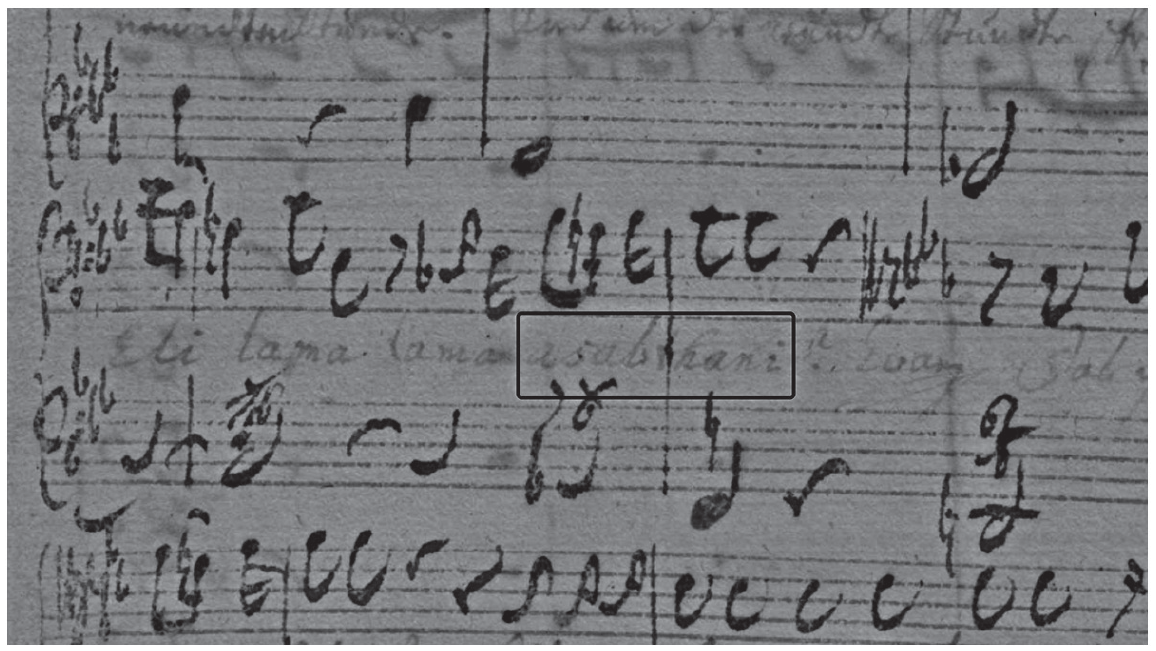
Bach’s St. Matthew Passion, Vox Christi recitative. The word asabthani can be seen in the outlined rectangle. Used with permission from the Staatsbibliothek zu Berlin–PK (shelfmark: Mus.ms. Bach P 25). Source: http://resolver.staatsbibliothek-berlin.de/SBB0001C20900000142.
Conclusion
The assumption that the primary source of Luther’s translation was Erasmus’s 1519 second edition of the New Testament, in both its Greek and Latin texts, can be regarded as solidly based. But Luther also repeatedly followed readings of the Vulgate, with which he was thoroughly familiar. The influence of the Vulgate is the best explanation of Luther’s reading asabthani in Matt 27.46, in which he deviated from Erasmus’s σαβαχθανί and sabachthani. In fact, many Vulgate editions of the late fifteenth and early sixteenth centuries read azabthani. Luther could also have found support and confirmation for the reading asabthani in the Hebrew text of Ps 22 in the Old Testament, עֲזַבְתָּנִי (‘ăzabtānî ), which is also cited in Erasmus’s Annotationes on Matt 27.46. But his choice of asabthani must have been inspired above all by his familiarity with, and respect for, the Vulgate.