




Abstract
This article investigates an often-neglected element in Bible translations, namely footnotes and interlinear notes. The notes in Mark from five contemporary Chinese versions are examined through an analytical framework based on Skopostheorie. These notes serve as test cases to illustrate how different versions deal with difficult translational and text-critical issues. In particular the example of the shorter and longer endings of Mark shows the tension between present-day New Testament textual criticism and the conservative mentality of Chinese churches. On the basis of six selected examples, this article concludes that notes should not merely be seen as trivial information but, on the contrary, they can offer a fresh look at the contexts of Bible versions, their skopoi, and their translation decisions. Therefore, in order to gain a more comprehensive understanding of Bible versions, investigation of paratextual elements should receive more attention than it presently does.
Keywords
1. Introduction
As it is said in the book written by the prophet Isaiah [some ancient scrolls do not have the word “Isaiah”] saying . . . .
1
This is what Chinese readers see when they open the first page of the Gospel of Mark in the Chinese Union Version (CUV), the most influential Bible version among Chinese Protestants. The note is inserted in the middle of Mark 1.2 and introduces a textual variant to readers. According to Metzger (1994, 62), the quotation of Mark 1.2-3 is composed of Mal 3.1 and Isa 40.3, so arguably some scribes altered the words to a less precise formula. The presence of this note illustrates the main concern of the present article, namely, footnotes and interlinear notes in Chinese Bibles. To put it more concretely, five contemporary Protestant Chinese versions—CUV89, TCV95, RCU10, NCV05, and CCV10 2 —will be examined with respect to their use of notes.
Due to space limitation, the corpus that this article focuses on is the Gospel of Mark. The main reason for such a selection is the “longer ending” (i.e., Mark 16.9-20) which has held canonical status in the tradition of Chinese churches. It is thus intriguing to see how different Chinese versions tackle this well-known text-critical issue with the help of their textual notes. In addition, five other passages containing different kinds of notes will be examined, which can offer a more diverse picture of the use of notes. However, before moving to the practical side to analyse these notes, a theoretical framework is called for. The following section will first sketch paratextual studies and their application to Bible translation and Chinese Bibles. Then a working framework will be provided on the basis of Skopostheorie.
2. Paratextual studies and paratext in Chinese Bibles
2.1 A brief sketch of paratextual studies
Since French literature critic Gérard Genette’s seminal monograph Paratexts (1997; French in 1987) appeared, many scholars have directed their attention to “paratextual elements” in printed books, such as titles, dedications, prefaces, and footnotes. According to Genette, it is these accompanying materials that make present main texts. In his words, “the paratext is what enables a text to become a book and to be offered as such to its readers and, more generally, to the public.” Paratext, he continues, “is at the service of a better reception for the text and a more pertinent reading of it” (1997, 1–2). In short, paratext offers a way to interpret the main text, or to use Genette’s phrase, it offers a “threshold of interpretation.”
Genette’s work proposes a fresh perspective to look into materials that have been neglected for a long time. In line with this new approach, many recent studies concentrate on paratextual elements not only in printed books (e.g., Smith and Wilson 2011) but in manuscripts as well (e.g., Ciotti and Lin 2016). Other studies expand this approach to investigate translational works, making it more relevant to the present article. For instance, Christiane Nord, one of the advocates of Skopostheorie, focuses on titles and headings in some translated texts (Nord 1995). 3 From the perspective of the notion of “function plus loyalty,” Nord indicates several functions of those titles (see also Nord 1997, esp. 123–36).
Turning now to the field of Bible translation, there are quite a number of studies focusing on one specific paratextual element, namely section headings. David Clark and Christer Åsberg summarize discussions on the section headings of Bible versions in the last four decades up to their time (Clark and Åsberg 2006). They concentrate on the articles in The Bible Translator (UBS) and Notes on Translation (SIL). Liesbeth van Klinken-Rijneveld picks up the same topic in the light of Skopostheorie (2007). From a functional approach, van Klinken-Rijneveld’s article attempts to solve the problem of conflicting purposes in the preparation of section headings, and a few schemes are provided to help Bible translators clarify their purposes and make decisions (195–98). More recently, Nord (2012) also applies the functional approach to analyse pericope titles in the corpus of several German and English versions of the New Testament. After examining different functions of those pericope titles, Nord concludes that, ideally and theoretically, their main function “is to make the reception of texts produced in a rather distant culture easier by structuring them” (74).
Apart from the studies on section headings, other paratextual elements of Bible versions are discussed less frequently. Nonetheless, two exceptional works deserve to be mentioned. First, Jacobus A. Naudé examines paratextual elements (he uses the term “metatexts”) in KJV (Naudé 2013). By carefully analysing two prefaces and several marginal notes, Naudé argues cogently that “these metatexts served as a subtle but powerful tool for mediating conflicting theological views” (158). Naudé’s study shows that paratextual elements of Bible versions are not “neutral” at all but, on the contrary, reflect the cultural and theological contexts of those versions to a certain extent. 4
A decade earlier, Lourens de Vries discussed the paratext and the skopos of the Dutch Statenvertaling of 1637 and of the Indonesian Bahasa Indonesia Sehari-hari of 1985 (de Vries 2003). According to de Vries, the skopos of these two versions can be elucidated through investigating their paratextual elements. The former version uses marginal notes to emphasize particular doctrines, such as perspicuitas and inspiration. Similarly, the latter version, though based on a different skopos, attempts to make the message as clear as possible by using glossary, notes, and pericope headings. In sum, both Naudé’s and de Vries’s works illustrate that in Bible versions paratext can be taken as unique “channels” through which we are able to glimpse the world of editors, translators, and target readers.
2.2 Previous studies on paratext in Chinese Bibles
With regard to Chinese Bibles, very few attempts have been made to examine the issue of paratext, to the best of my knowledge. On the one hand, studies concerning Chinese versions mainly take a historical approach, in which the issue of paratextual elements seldom occurs. For instance, Jost Oliver Zetzsche’s master monograph, The Bible in China: The History of the Union Version or The Culmination of Protestant Missionary Bible Translation in China, contains both an overview and consideration of numerous aspects related to the preparation of this version (Zetzsche 1999). Yet the discussion about its paratext is almost absent. By the same token, Thor Strandenaes does not take the usage of paratextual notes into account in his examination of the translational principles of five Chinese versions (Strandenaes 1987).
On the other hand, three studies do mention the usage of notes and headings in Chinese Bibles. First of all, George Kam Wah Mak investigates the attitude of the British and Foreign Bible Society (BFBS) toward the principle of “without note or comment” in late nineteenth-century China (Mak 2015). At that period of time, according to Mak, the practice of notes was limited and marginalized. One of the selected versions in the present article, CUV89, follows in this tradition, because it was first published in 1919.
5
Second, in her monograph on the life and work of S. I. J. Schereschewsky (1831–1906), Irene Eber analyses some marginal notes in his Bible translation (Eber 1999, 189–99). Following the same line, Cao Jian contributes an article on Schereschewsky’s 1874 version of the Old Testament (Cao 2006). To illustrate Schereschewsky’s exegetical principles, Cao analyses the text of Gen 1–4 as well as its section headings (133–36). Like Naudé’s observation above, Cao’s conclusion also shows that paratextual elements in Schereschewsky’s version do reflect the translator’s concerns and interests: Rather than using headings to summarize, Schereschewsky used them to add Christian interpretations onto the OT text. The headings also demonstrate the dependence on Chinese religious and philosophical terms in expressing Christian concepts. (2006, 136)
2.3 Working framework of the present study
As the above survey shows, interest in paratext has been growing over the last two decades. However, a framework to analyse different types of paratextual elements, in particular in matters of Bible versions, is still lacking. In order to analyse and compare the notes of contemporary Chinese Bibles, a working framework is hereby proposed.
According to de Vries, there are two types of paratextual elements in Bible translations: First, elements that are seen as part of the translation and that vary from one translation to another, for example divisions of the text into pericopes. Second, elements that do not normally vary from one translation to another and that are not seen as part of the translation like chapter and verse divisions. (2003, 177)
The present study will focus on de Vries’s first type. 6 In line with Skopostheorie, two classes can be further developed on the basis of this classification 7 : (A) notes pertaining to the text as a translation, and (B) notes pertaining to the text as an ancient document. The former class relates more to the world of the target audience and can be divided into three subclasses: (A1) translational notes on Greek wording, (A2) notes of alternative translations, and (A3) intertextual notes. The latter class concerns the source text, and can also be divided into three subclasses: (B1) explanatory notes on source words, (B2) interpretational notes in matters historical or cultural, and (B3) text-critical notes. Within this framework, not only will every note be recorded properly but its function can also be analysed carefully.
3. Footnotes and interlinear notes in five selected Chinese versions: The Gospel of Mark as a case study
I will now turn to the data of the present article, namely footnotes and interlinear notes added by translators in CUV89, TCV95, RCU10, NCV05, and CCV10. By applying the framework proposed above, an overview of the notes in the Gospel of Mark can be seen in Table 1.
An overview of the use of notes in Mark
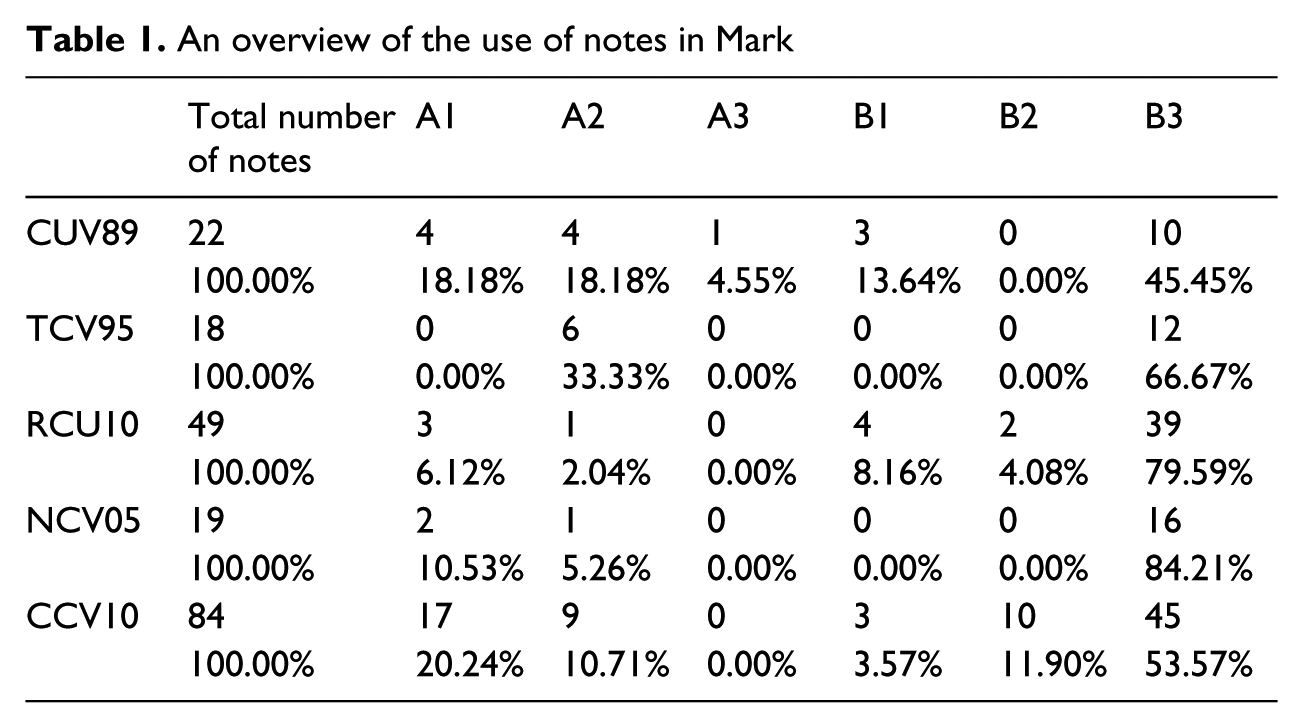
Several initial observations may be mentioned. First, statistically speaking, notes on text-critical issues are the most frequent type of note in all of these Chinese versions. Next in frequency, except in RCU10, is the type of note concerning translational issues, either notes on Greek wording or notes offering alternative translations. Second, notes on historical and cultural information seldom occur. RCU10 has two notes (both at Mark 12.42) to explain the currency system of the first century. CCV10 uses this type of note more frequently to explain the ancient measurement system. 8 Last, intertextual notes are extremely rare; actually only one note belongs to this type. 9 This infrequent use may be caused by the presence of parallel texts below pericope titles (all versions) and an appendix of Old Testament quotations (CUV89 and TCV95). With the above overview in mind, let us examine six examples in more detail.
3.1 The text-critical issue at Mark 1.1 (B3)
Despite its sequence in the framework, the text-critical issue at Mark 1.1 (Table 2) needs to be discussed first, for it will provide sufficient context to CUV. UBS4/5 reads this verse as Ἀρχὴ τοῦ εὐαγγελίου Ἰησοῦ Χριστοῦ [υἱοῦ θεοῦ], and gives the reading within the brackets a C-rating (see Metzger 1994, 62). Among the five selected Chinese versions, four (TCV95, RCU10, NCV05, and CCV10) are aware of this issue and use a note to explain such a textual variant, as many contemporary English versions do.
10
This particular note corresponds to the skopos of following the UBS GNT as base text.
11
However, CUV89 does not have any note at 1.1. The reason is the Greek base text it follows. Here the reading of the Textus Receptus may have been translated, because this Greek text and KJV were still influential at the end of the nineteenth century when CUV was prepared. Moreover, many members of its translation committee were British and American missionaries who regarded KJV as the version.
12
Consequently, a tension arose: in theory CUV claimed to follow the Greek text behind RV consistently, but in practice the Textus Receptus may have been followed frequently.
13
At Mark 1.1, RV reads, The beginning of the gospel of Jesus Christ,
1
the Son of God . . . Marginal note: 1 Some ancient authorities omit the Son of God.
Notes at Mark 1.1
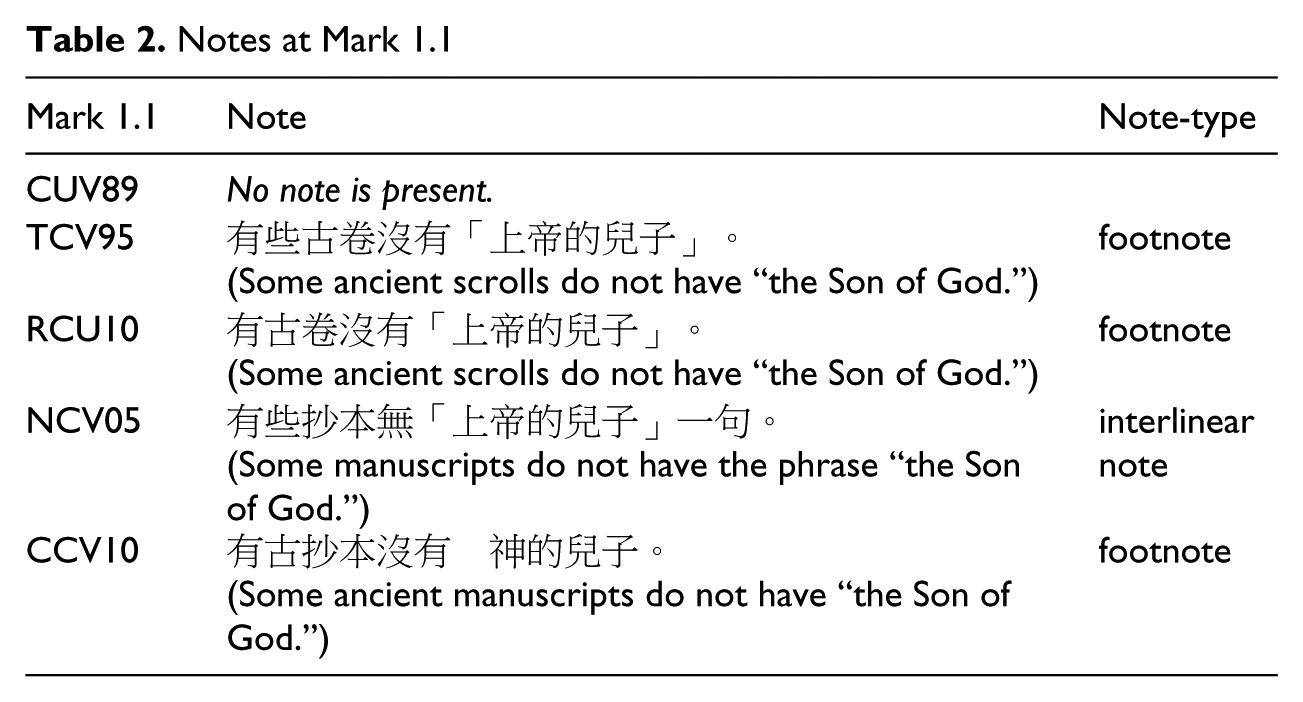
Viewed in this light, it is understandable why the CUV translators may not have taken the marginal note of RV into consideration. They may have decided to follow the reading of KJV, which puts “the Son of God” in the main text without any note.
3.2 The translational note at Mark 13.8 (A1)
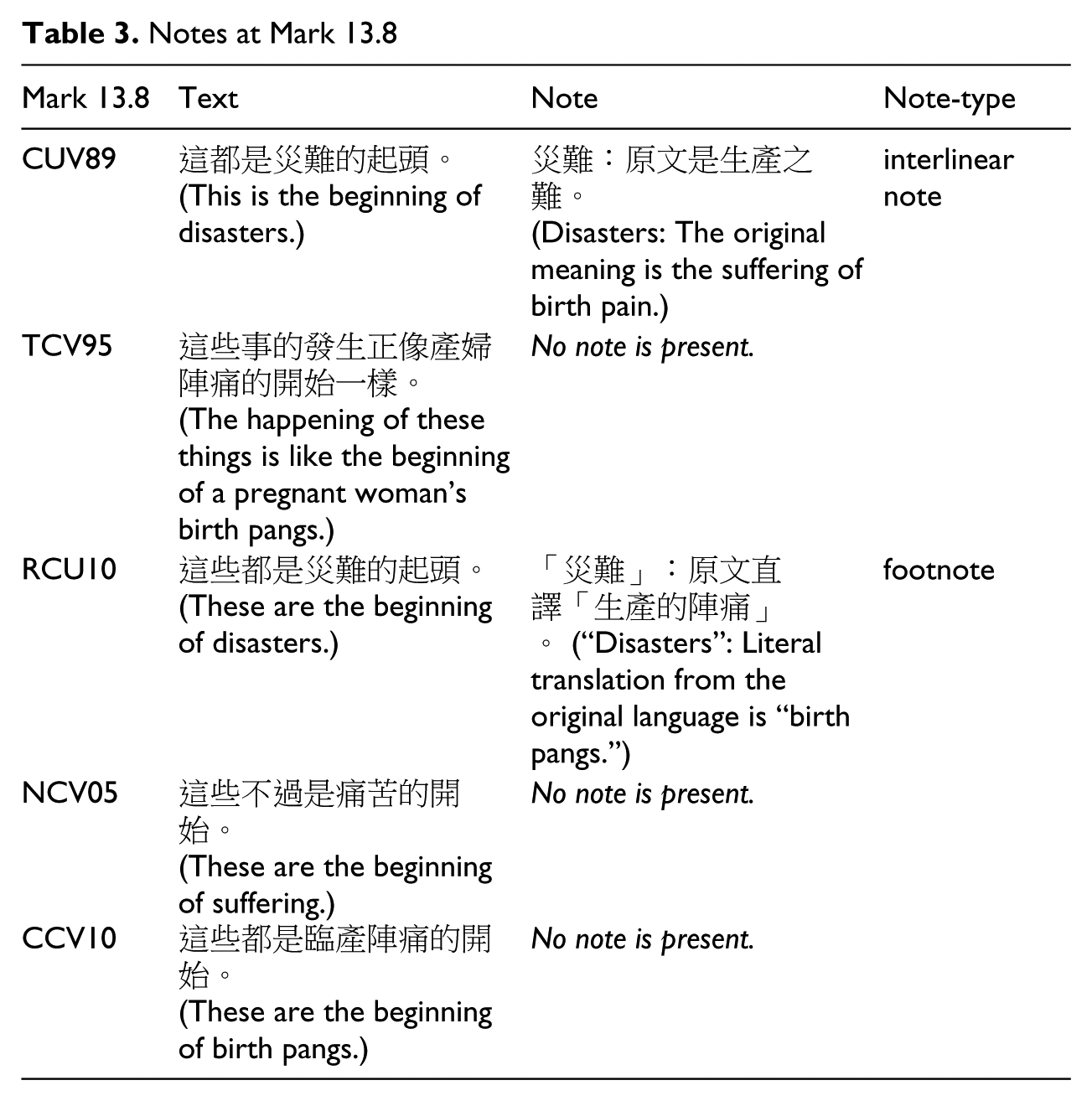
In these Chinese versions, a common reason for using notes is to explain Greek wording. This type of note is often present when the meaning of the Greek is difficult to grasp. Take Mark 13.8 for example (Table 3). To tackle the unique expression of ἀρχὴ ὠδίνων, CUV89 offers the generic term 災難的起頭 (the beginning of disasters) in the main text and puts its specific meaning in an interlinear note. 14 Among the other four versions, only RCU10 also gives a translational note here, which explains the exact meaning of the Greek word ὠδίν. It shows that this revision of CUV89 makes limited modifications, as promised in its preface. 15 However, TCV95 and CCV10 translate this Greek word as 陣痛 (birth pangs) without any notes. Interestingly, NCV05 follows CUV89 in using a generic expression, yet it leaves out the corresponding note. 16 In short, this example shows that RCU10 and NCV05 are close to the translation of CUV89. Both follow the generic approach of CUV89, but NCV05 does not provide the additional description given in the note.
Notes at Mark 13.8
3.3 要愛人如己 (Love people as yourself) in Mark 12.31 (A2)
Sometimes the influence of CUV was hard to ignore, even if the translators of later Chinese versions noticed its translation was somehow problematic. For instance, CUV89 translates Jesus’ “second commandment” as 要愛人如己 (Love people as yourself). This is obviously an inappropriate translation of the Greek phrase Ἀγαπήσεις τὸν πλησίον σου ὡς σεαυτόν, for πλησίον is taken too generically. 17
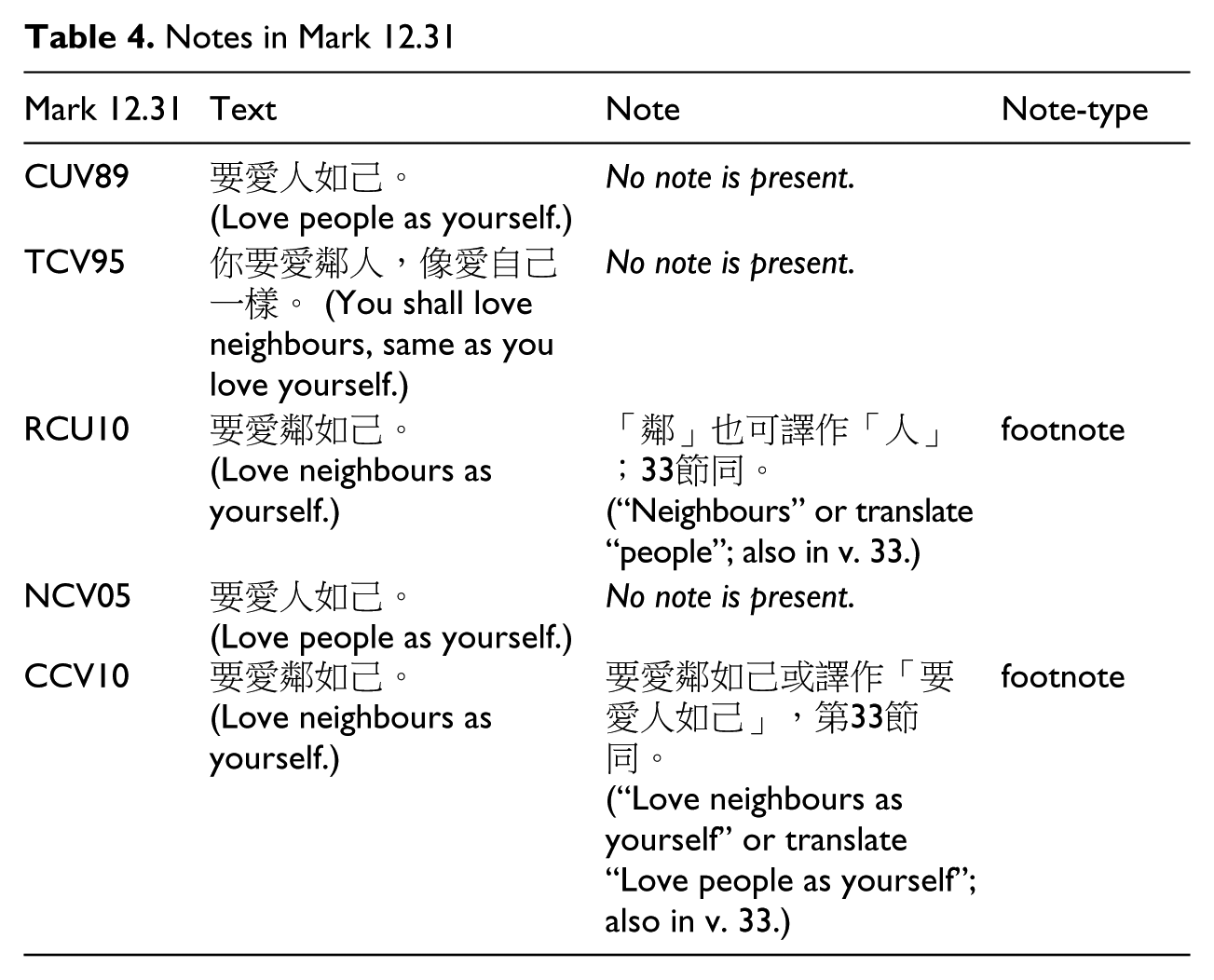
Concerning the four post-CUV versions (Table 4), NCV05 follows CUV89 word for word as it typically does and without any note. 18 On the other hand, TCV95 offers a more colloquial translation: 你要愛鄰人,像愛自己一樣 (You shall love neighbours, same as you love yourself). The notes offered by RCU10 and CCV10, however, are intriguing. Both versions notice the meaning of the Greek and render 鄰 (neighbours) in the main text. Nevertheless, they have kept the translation of CUV89 in their footnotes. As a consequence, the term τὸν πλησίον can still be taken as 人 (people) (see Figure 1).
Notes in Mark 12.31
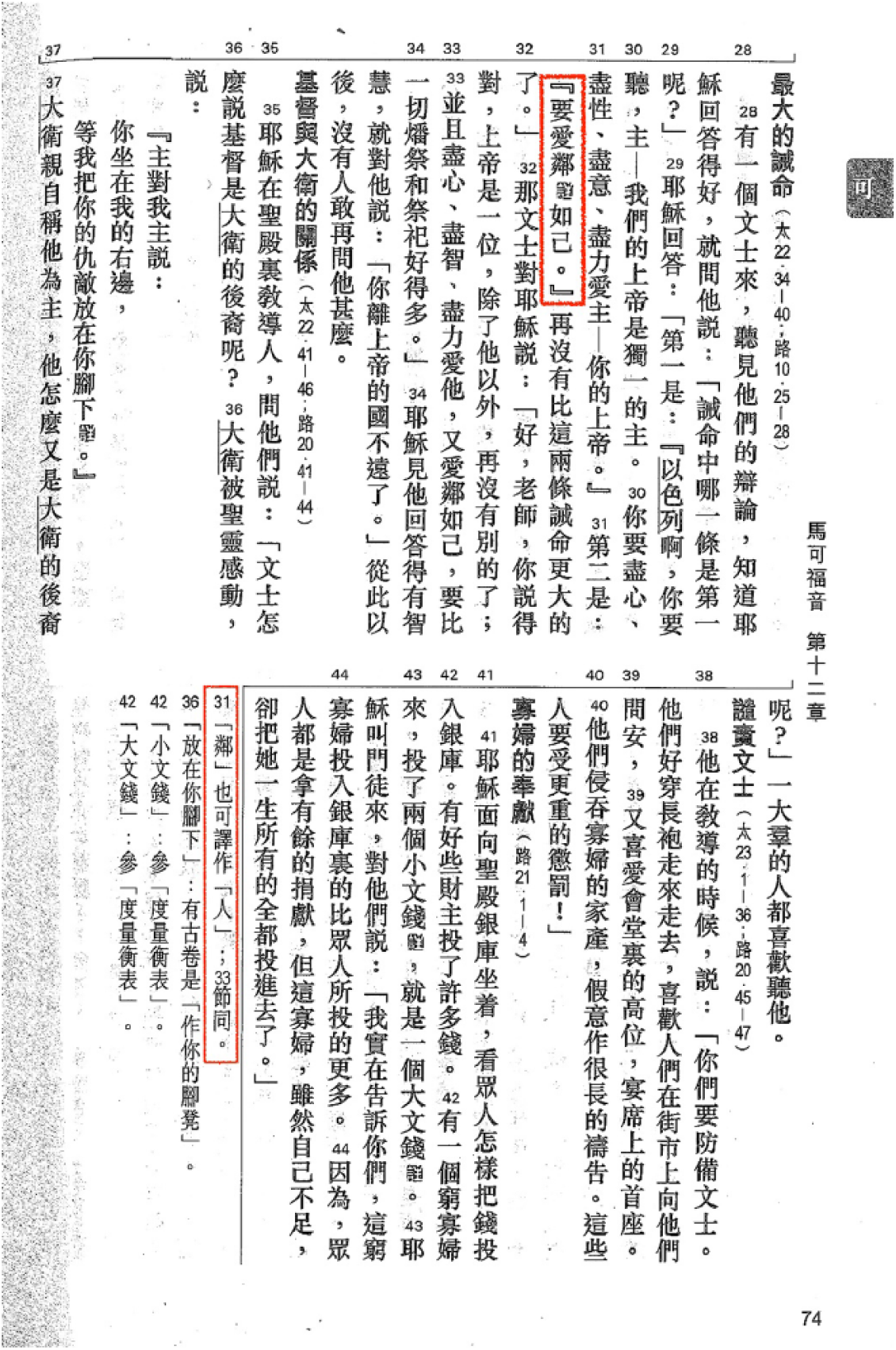
RCU10 text and note at Mark 12.31
From the perspective of Greek semantics, such a note makes little sense. It seems most likely that the addition of the note takes the dominance of CUV into account. Many conservative Chinese readers would be unhappy with the rendering of Jesus’ commandment being modified, even by a single word. To put it another way, the function of the footnotes in RCU10 and CCV10 is to create a safe ground for translations which differ from CUV but are in fact a better translation of the Greek.
3.4 拉比 (Rabi) versus 拉波尼 (Raboni) in Mark 9.5 and 10.51 (B1)
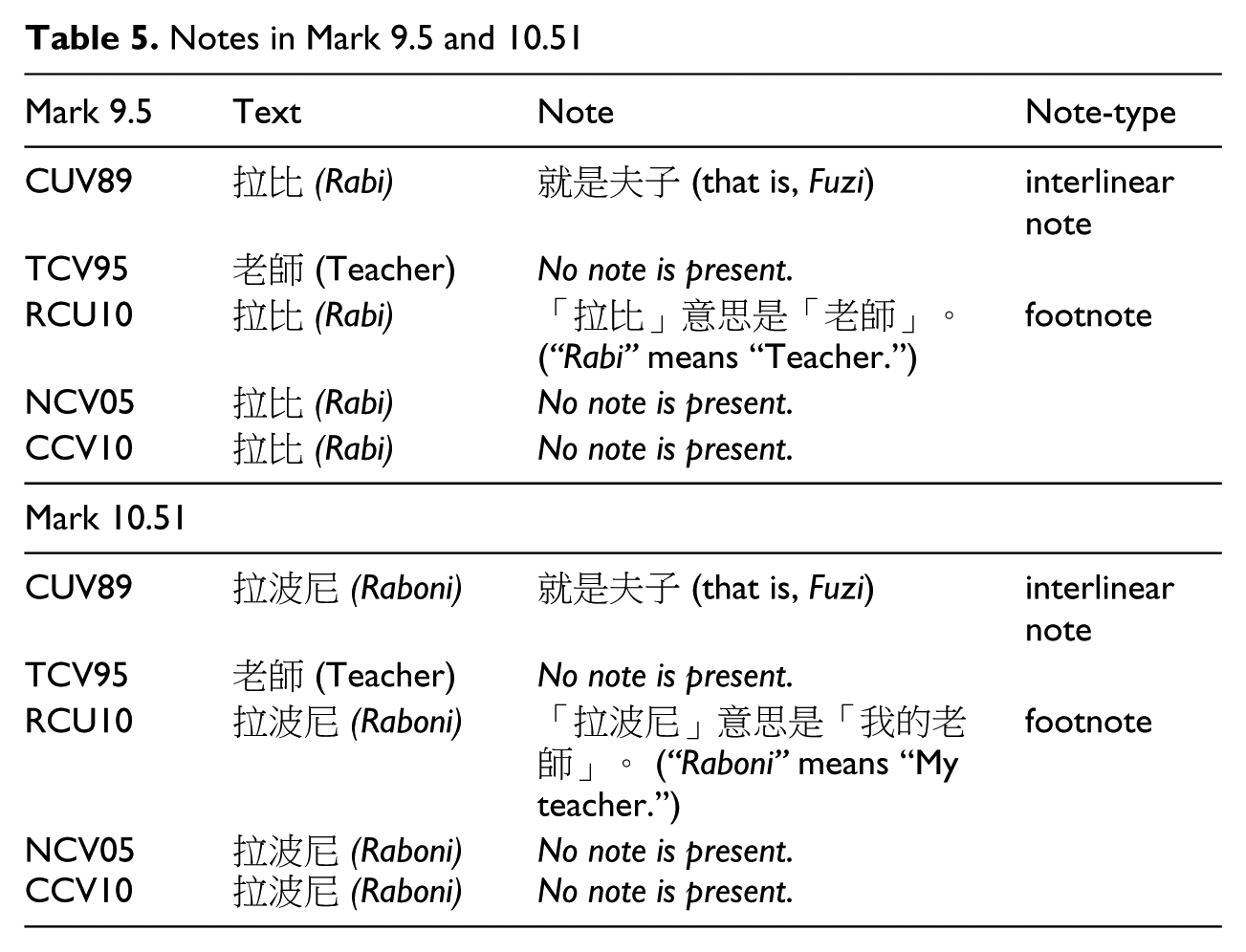
The text of the New Testament contains plenty of terms which indicate the cultural background of the first-century Greco-Roman world. The Jewish notion of “rabbi” is a good example (Table 5). At Mark 9.5, CUV89 transliterates the Greek word Ῥαββί into 拉比 (Rabi), just like “Rabbi” in English. Similarly, at 10.51 the Chinese transliteration of Ραββουνι is given—拉波尼 (Raboni). 19 In order to explain these unfamiliar terms to Chinese readers, the same note 就是夫子 (that is, Fuzi) 20 is applied on both occasions, although the Greek words have slightly different meanings. The transliteration implies that the text is an ancient document from another culture, but the note provides a corresponding reference for its readers. These notes are followed by RCU10, which also corrects the latter one. By way of contrast, in keeping with its functional equivalence translation technique, TCV95 puts 老師 (Teacher) in the text without any notes. Interestingly, both NCV05 and CCV10 use the same terms as CUV89 without any notes. 21 It is perhaps because they consider 拉比 (Rabi) to be easily understood after such long use of CUV, and take 拉波尼 (Raboni) as a similar term. This phenomenon also illustrates the prominent role CUV has played in Chinese Bible translations.
Notes in Mark 9.5 and 10.51
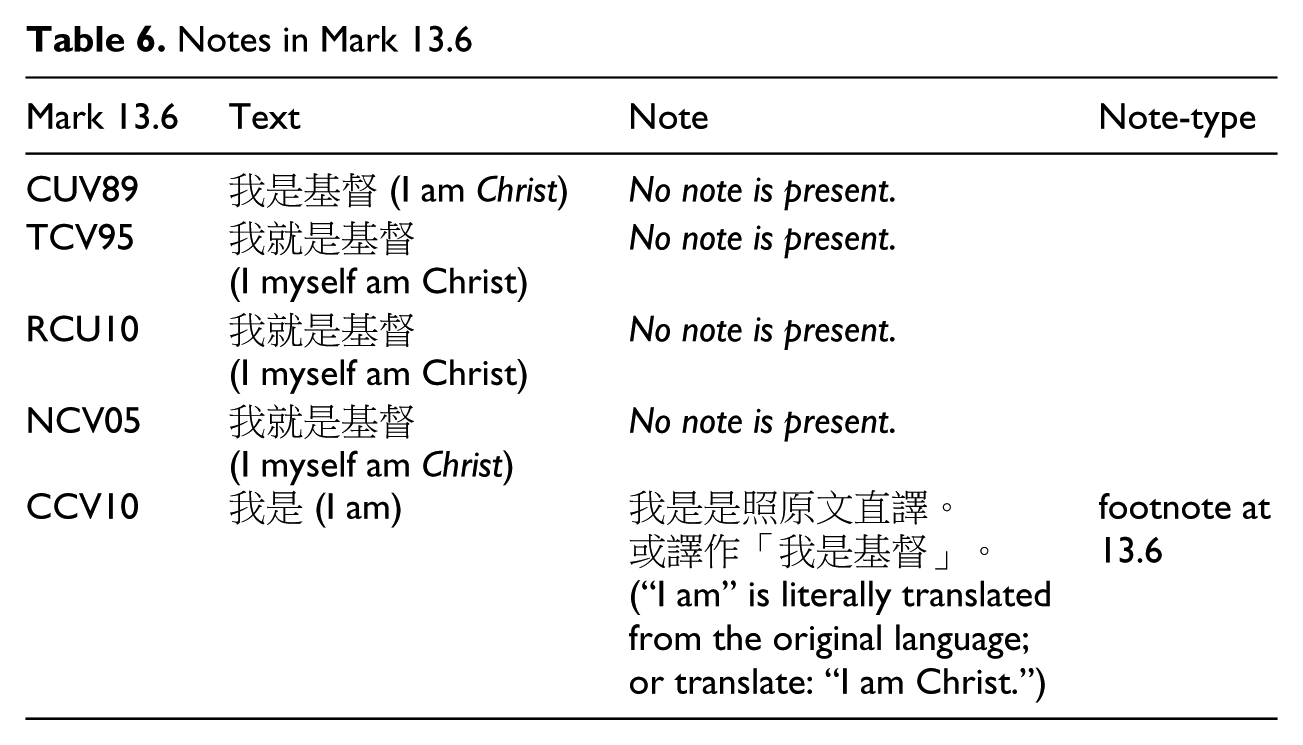
3.5 我是 (I Am) in Mark 13.6 (B1)
In the apocalyptic saying in Mark 13, Jesus announces that many will come in his name and lead astray the believers. More specifically, they will pretend to be him and say, Ἐγώ εἰµι (13.6). In most languages, it is difficult to translate this phrase literally. Many versions thus add a direct object. CUV89 reads 我是基督 (I am Christ) by adding dots alongside “Christ” (see Figure 2).
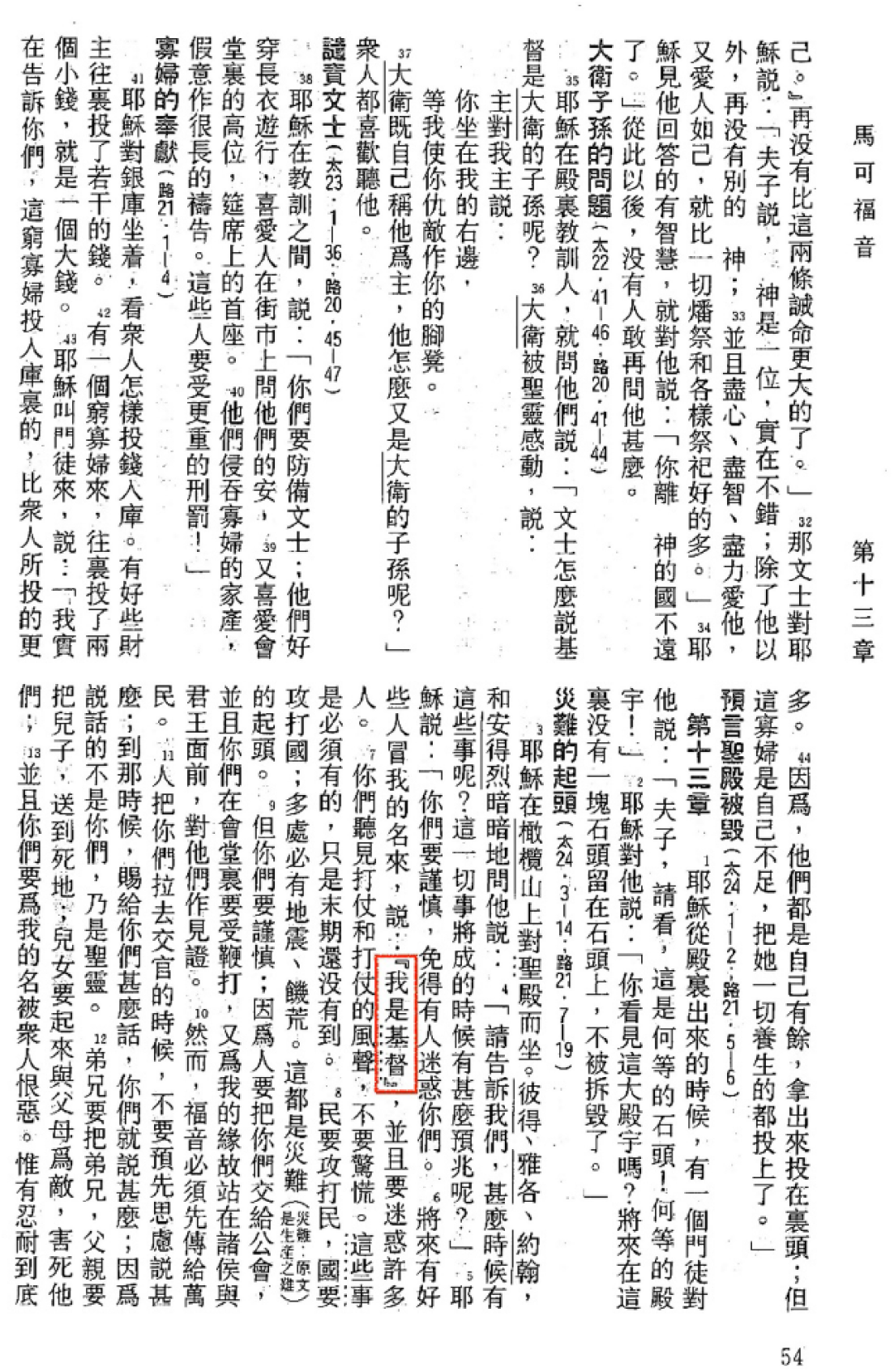
Dots alongside “Christ” (in outlined rectangle)
This practice in Chinese versions means that the word does not belong to the Greek text but is added by translators for clarification, just as KJV puts such words in italics. 22 In more recent Chinese versions, only NCV05 uses the same device. TCV95 and RCU10 add the word “Christ” in the main text instead. The most remarkable reading is given by CCV10, which offers a unique translation at 13.6 with a footnote (Figure 3). In the text CCV10 reads 我是 (I am) only, which reflects the Greek syntax directly, but it also creates an obscure Chinese expression. To explain such a strange translation a footnote is added: “‘I am’ is literally translated from the original language; or translate: ‘I am Christ.’” The unfamiliarity to Chinese readers created by its translation has been solved by providing an explanatory note (Table 6). 23
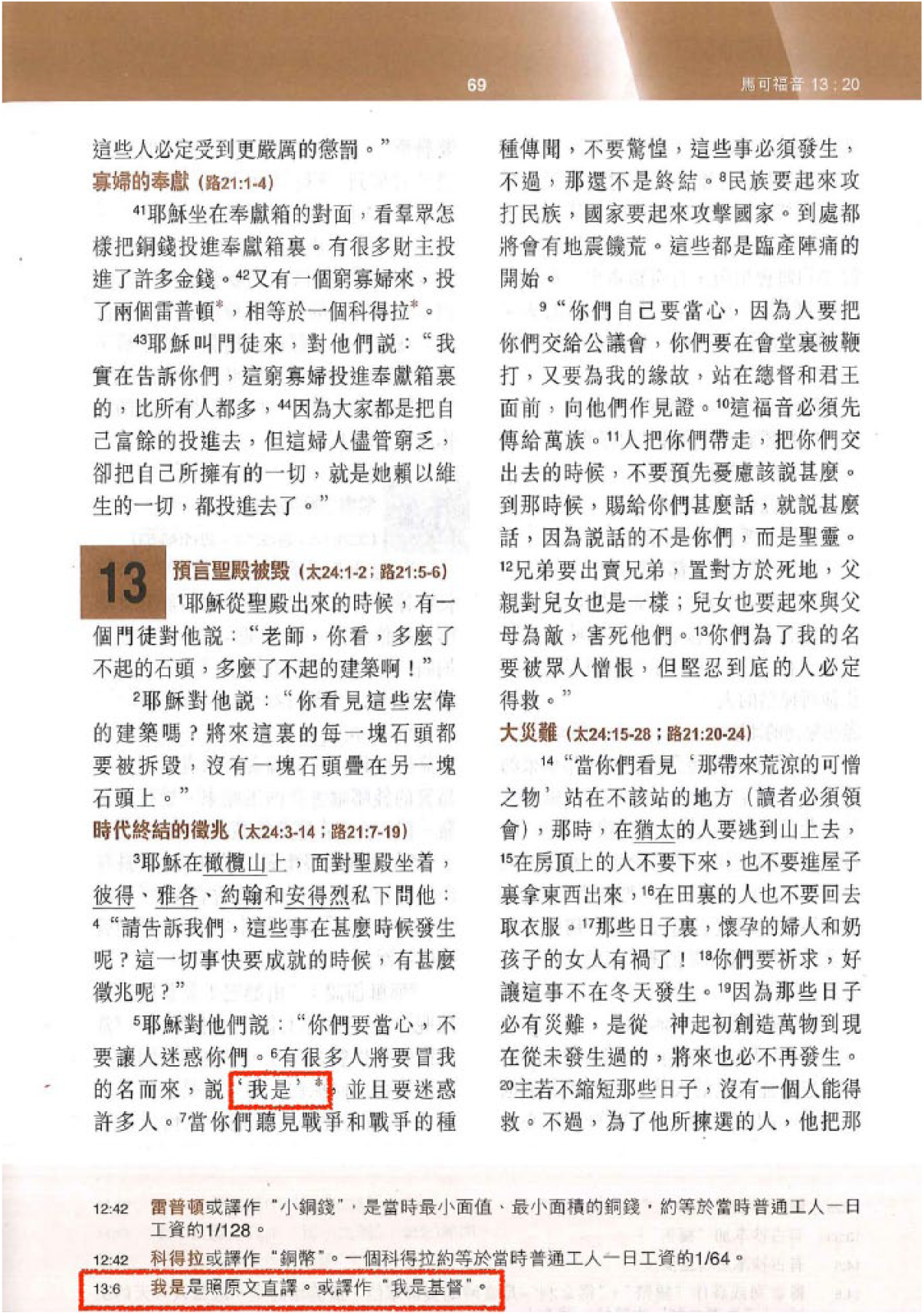
CCV10 text and footnote (in outlined rectangles)
Notes in Mark 13.6
3.6 Text-critical issues concerning Mark 16.9-20 (B3)
As mentioned above, CUV89 corresponds to the Textus Receptus in many places, in particular where the critical text is different from the traditional readings such as in KJV. The ending of Mark certainly belongs to this category. Without any notes or brackets, CUV89 regards the longer ending as part of its main text. This is not a surprise, because these twelve verses have been taken as canonical not only by printed editions of the Greek New Testament but also by a vast number of manuscripts. 24 Even RV does not add brackets around the pericope, although there is a two-line space between v. 8 and v. 9 as well as a corresponding note. 25 Viewed in this light, the translators of CUV had many reasons to keep this pericope in the text without mentioning its textual uncertainty. 26
The four other Chinese versions offer three different kinds of solution to this text-critical problem. First, NCV05 is the closest version to the tradition of CUV. It presents Mark 16.9-20 without brackets and adds a brief note after v. 8: “Some manuscripts do not have vv. 9-20.” Then at the end of the Gospel an extensive note on the shorter ending occurs (see Table 7). By underrating the textual witnesses against the longer ending, NCV05 gives the impression that the pericope of vv. 9-20 is still the ending of Mark. 27
Notes in Mark 16 (SH = Section Heading; IN = Interlinear Note; FN = Footnote)
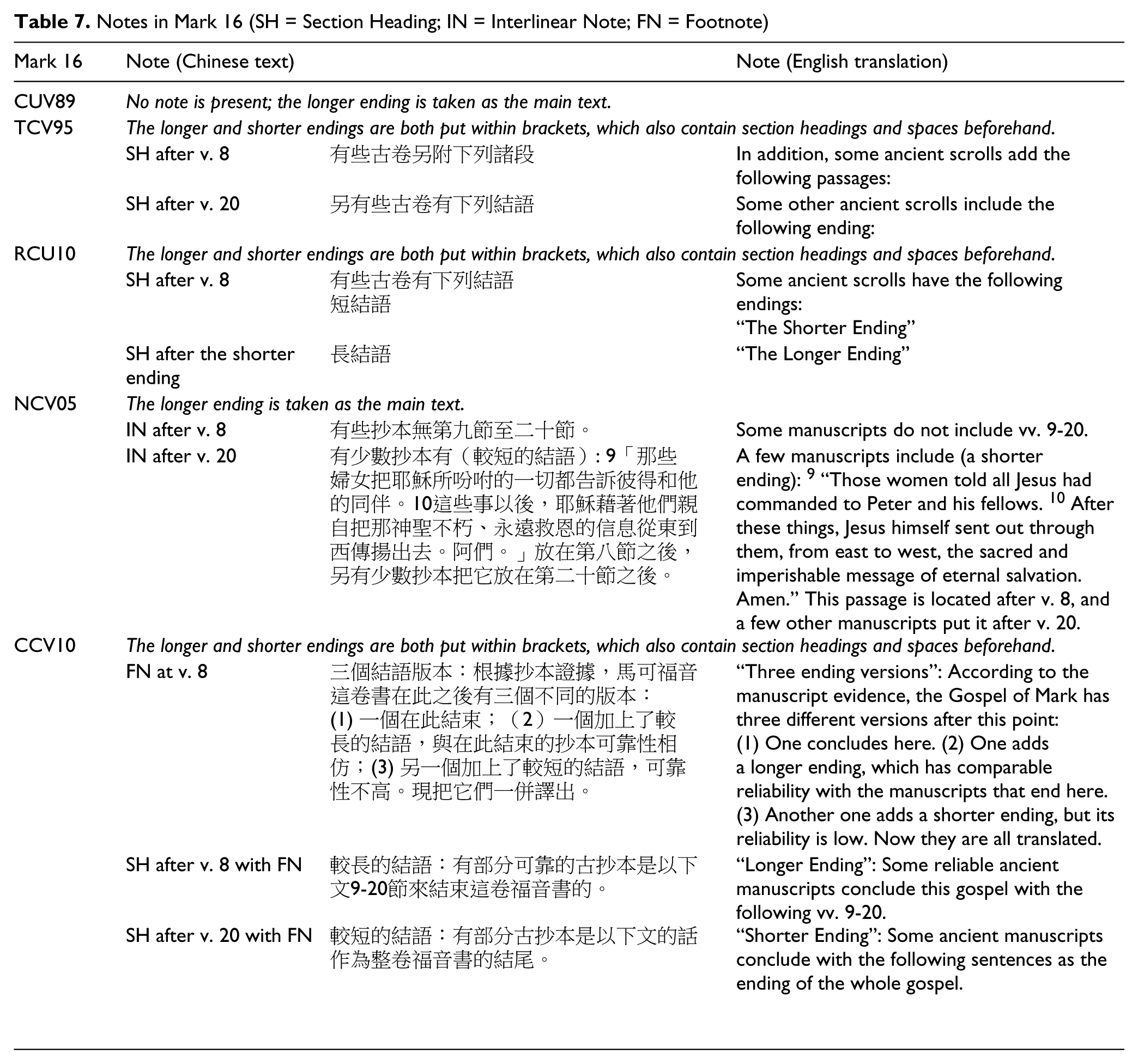
Second, the solutions presented in TCV95 and RCU10 are quite similar. Both versions put the longer and the shorter endings in brackets to indicate their textual uncertainty. And, instead of adding footnotes, they use additional section headings to explain such phenomena. Yet it should be noted that these section headings merely mention that endings have been attested in some manuscripts without any evaluation. Probably this is left out intentionally.
Third, CCV10 offers some more information about this issue. It has three footnotes and two section headings (see Figure 4 and Table 7). At the end of v. 8, a detailed footnote is given to explain the three different endings of Mark. Intriguingly, the longer ending is said to have “comparable reliability with the manuscripts that end here [v. 8]” (emphasis added). 28 This would not pass unnoticed by the eyes of most New Testament textual critics, for present-day scholarly consensus is quite the opposite. It is surprising to come across such a statement in a version that claims to incorporate the new results of biblical studies. On the other hand, this again might be the consequence of taking the traditional reading of the influential CUV into account. By emphasizing the reliability of the longer ending, a larger portion of Chinese Christians would accept CCV10 more easily.
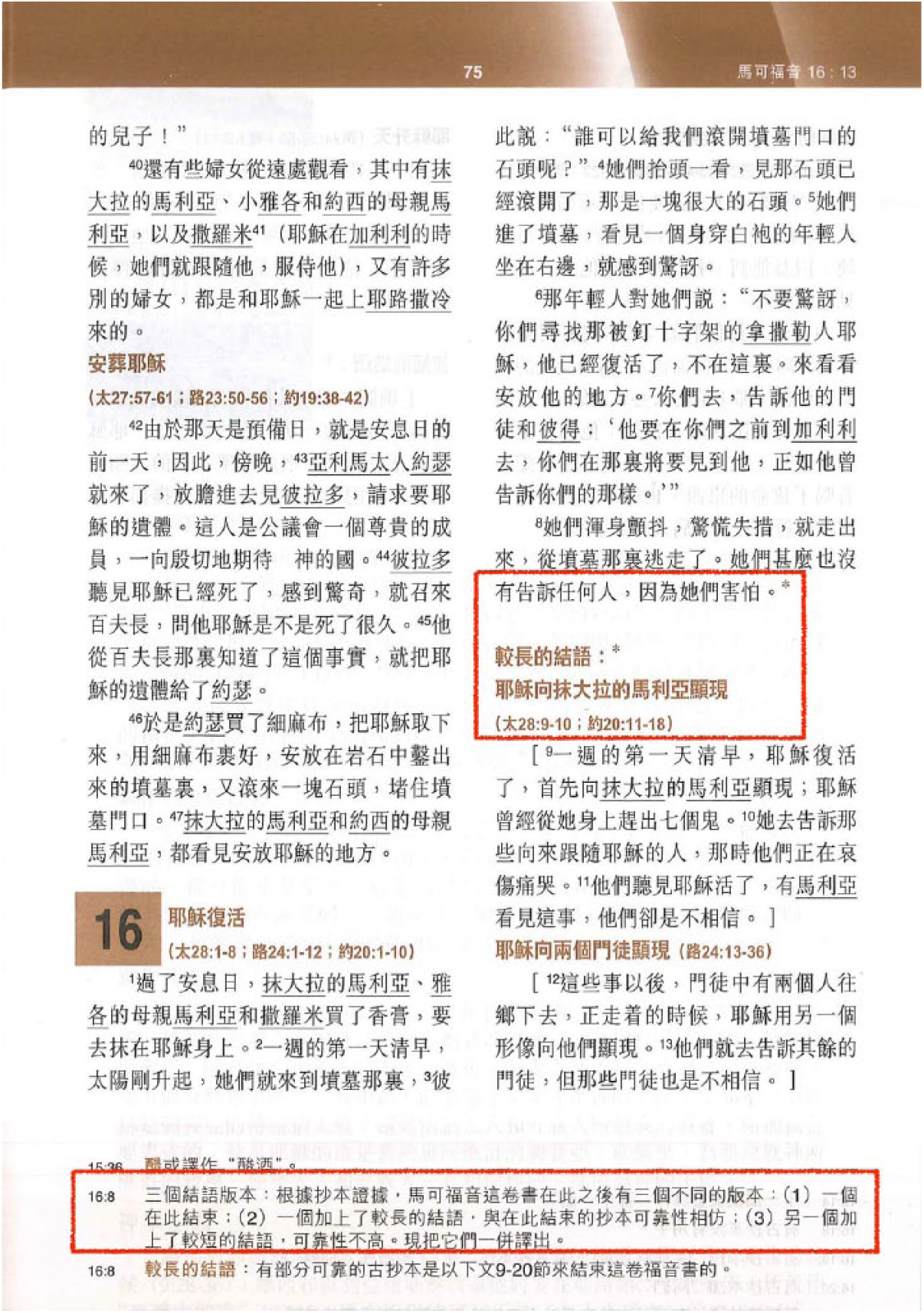
CCV10 text and footnotes, Mark 16.8
To sum up, the four later Chinese versions must face the canonical status of the longer ending established by CUV. All of them respond to it by using notes and other paratextual elements. NCV05 has followed in the footsteps of its ancestor closely and, although it does offer text-critical notes, it presents the longer ending as its main text. The other versions attempt to find a balance between contemporary New Testament textual scholarship and the conservative mentality of Chinese churches. TCV95 and RCU10 put the longer ending in brackets but remain silent as to its textual uncertainty. In its footnote CCV10 even expresses confidence in the longer ending’s textual reliability. Viewed in this light, it is clear that the legacy of CUV remains even today.
4. Concluding Remarks
The above investigation leads us to the following conclusions. First of all, footnotes and interlinear notes in Bible versions are not trivial features as many have long perceived. Instead, they can offer a fresh look at those versions as well as their contexts, skopoi, and translation decisions. The examined examples of CUV89 illustrate this point clearly. As a product of the early twentieth century, this version contains a limited number of notes. Most of them belong to the category of translational notes (A1 and A2) or text-critical notes (B3). Furthermore, two examples of text-critical issues (3.1 and 3.6) indicate that the translators sometimes followed the traditional readings as their base text, although a better Greek text had already been made available from the late nineteenth century onwards. At any rate, it is this version that became the version among Chinese-speaking communities. For this reason, later Chinese versions have to dialogue with the translation offered by CUV, as the six selected examples have shown.
Second, on the basis of their usage of notes, some skopoi of the four post-CUV versions can be uncovered. Both NCV05 and RCU10 build their works upon CUV89, yet with different uses of notes. On the one hand, as shown in sections 3.2–5, NCV05 adheres closely to the readings offered by CUV89, but it frequently withdraws the corresponding notes. Yet the number of text-critical notes increase (16 in total; cf. 3.1 and 3.6), which may reflect the change of the base text. The notes on Mark 16.9-20, however, indicate that this version retains the longer ending as its main text. On the other hand, as the official revision of CUV89, RCU10 follows its predecessor closely, including many textual notes (3.2 and 3.4). In particular, section 3.3 indicates how this revision incorporated the influential translation of CUV through a specific note. Concerning text-critical notes, RCU10 quadruples the number in CUV89 (39 in total), which is based on the skopos to mention important text-critical issues according to UBS4.
Third, TCV95 and CCV10 offer translation approaches different from that of CUV89, although its legacy is still observable. The former version has limited the number of its notes and offers only two types of note, namely notes of alternative translations (A2) and text-critical notes (B3). As sections 3.2–4 show, colloquial renderings without any notes are the typical translation approach of this version, which is in line with the theory of functional equivalence. At the same time, the occurrence of text-critical notes reflects one of its skopoi, namely using UBS4 as its base text. The latter version, CCV10, offers the greatest number of notes (84 in total). Many notes concern historical and cultural matters or Greek wording, as shown clearly in section 3.5. Among the five versions under examination, CCV10 uses notes to explain its translation decisions most frequently. Since one of its skopoi is to provide resources for further translation projects (Preface, iii–iv), an abundantly annotated version can easily be expected. 29 Nevertheless, its confidence in the longer ending indicates that the influence of the CUV tradition is still strong.
I hope the present article has made a small contribution to this often-neglected element in Bible versions. In the future, I hope to build on this study and investigate both synchronic and diachronic perspectives more deeply. First, on the basis of the framework and results of this article, a more comprehensive examination of paratextual elements in contemporary Chinese Bibles can be initiated. Such study will be able to clarify or pinpoint the skopos and translation decisions of the versions under examination. A comparison between Protestant and Catholic Chinese versions can be made as well. Second, from a historical perspective, a similar survey of paratext in Bible versions from nineteenth-century China would be of great value. 30 It would not only provide an opportunity to get acquainted with the translators and editors of those versions; it could also uncover valuable resources in the development of paratextual features in that specific period. 31
Footnotes
1.
正如先知以賽亞(有古卷沒有以賽亞三個字)書上記着說 . . .; in this article all English translations are mine.
2.
CUV89, TCV95, and RCU10 are products of the United Bible Societies. NCV05 and CCV10 were prepared by independent associations. Full bibliographical information can be seen in Abbreviations below. A revision of NCV05 (“Worldwide Chinese Bible”) is in progress, its New Testament having been published in 2015. Nevertheless, because it is much more influential in global Chinese-speaking communities, this article will focus on NCV05 and its notes. The modifications of the new revision will be given in footnotes if necessary.
3.
Note that Nord quotes Genette’s earlier work (Palimpsestes: La littérature au second degré [Paris: Editions du Seuil, 1982]) in 1995, 283 n. 3.
4.
5.
CUV89 is a slight revision of the 1919 version. Major changes are the use of a modern punctuation system and modification of some archaic words as well as geographical terms (see  , 354–55 for the revision principles). Nevertheless, CUV89 also modifies the wording of interlinear notes without changing their meaning. E.g., the note at Mark 1.2 in the 1919 version reads 有古卷無以賽亞三字, an archaic way of saying the same thing; cf. n. 1 above.
6.
Yet, infrequently notes do indicate adjustment of verse divisions: at Mark 7.21 and 12.14, CCV10 states explicitly that the division of UBS4 is being followed.
7.
A handy introduction to Skopostheorie can be found in Nord 1997. Nord distinguishes two basic types of translation processes, namely “documentary” (source-culture oriented) and “instrumental” (target-culture oriented) translations (47–52). Moreover, proposes to consider further Chinese Bible translation projects from a functionalist approach.
8.
Among ten occurrences in CCV10, five notes explain the currency system (Mark 6.37; 12.15; 12.42 [2x]; 14.5), four refer to time terminology (6.48; 15.25; 15.33 [2x]), and one gives an explanation of liquid measurement (4.21).
9.
At Mark 13.26, CUV89 offers an intertextual reference to Matt 24.30.
10.
E.g., NRSV: “Other ancient authorities lack the Son of God”; NIV: “Some manuscripts do not have the Son of God.”
11.
13.
RV was published in 1885. Its NT text was based on a fresh reconstruction using current text-critical methods. Mak 2010 provides an excellent analysis of the tension between the BFBS and missionaries in China at the end of the nineteenth century. The former preferred the Textus Receptus but the latter, who were directly involved in translating the New Testament into Chinese, preferred the critical text of the day. Cf. Mak 2010, 179–85; , 276–78.
14.
At this point CUV89 has an approach similar to KJV, which reads “the beginnings of sorrows” in the main text and “The word in the original importeth the pains of a woman in travail” in the footnote.
15.
See also Mark 16.15 for another example.
16.
Note that its revision modifies this verse and offers a text just like CCV10.
17.
Neither KJV nor RV has any similar reading here. This translation might be influenced by Chinese ethical idioms, where the generic term 人 (people) is often used to designate other people as a whole.
18.
Its revision correctly translates this term as 鄰人 (neighbours).
19.
Interestingly, NRSV reads “Rabbi” in 9.5 but “My teacher” (with a footnote “Aramaic Rabbouni”) in 10.51. NIV gives “Rabbi” in both cases.
20.
In Mandarin, 夫子 (Fuzi) is an archaic and respectful term used by pupils in addressing their teacher, or more generally, a respected person. It originates from the name of Confucius (551–479 B.C.E.), the famous Chinese sage.
21.
At Mark 9.5, the revision of NCV05 adds a note referring to Matt 23.7-8 to explain this term. At 10.51, it gives 我的老師 (My teacher) in the main text and explains the Greek word in the footnote.
22.
In this verse it is clear that CUV89 follows KJV (“I am Christ”). RV reads “I am he” here.
23.
Another example in Mark is the translational note on οἱ δώδεκα (4.10; 6.7; etc.). A footnote at 6.7 states that its literal translation is 那十二個 (the Twelve), though the text still reads “the twelve apostles.”
25.
The note reads, “The two oldest Greek manuscripts [i.e., Codex Sinaiticus and Codex Vaticanus] and some other authorities omit from ver. 9 to the end. Some other authorities have a different ending to the Gospel.” Viewed in this light, RV signifies the secondary quality of the traditional reading, albeit only in an implicit way.
27.
Yet the revision does put this pericope in brackets and its notes are similar to CCV10.
28.
See also the footnote on the longer ending: “Some reliable ancient manuscripts conclude this gospel with the following vv. 9-20” (emphasis added).
29.
Yet, there is a “footnote version” of CCV10, which contains more notes and can almost be seen as a study Bible.
30.
Recently digital images of many rare Chinese Bibles were made available online via the Faith–Hope–Love Centre (http://bible.fhl.net/ob/). Moreover, mentions an ongoing project of digitisation of old Chinese Bibles under the auspices of the Digital Bible Library. These two projects make such historical research much more accessible.
31.
I thank Prof. Dr. Lourens de Vries for his guidance of this study, and I thank Lung-Kuang Huang and Rev. Dr. Paul McLean for their feedback on earlier drafts of this article. I also thank the anonymous reviewers for their comments. All errors are of course mine.
Abbreviations
CCV10 Holy Bible—New Testament, Contemporary Chinese Version (Standard Edition)《聖經.新約全書—新漢語譯本(普及版)》. 2010. Hong Kong: Chinese Bible International.
CUV89 The Holy Bible—Chinese Union Version, with New Punctuations《新標點和合本》. 1989. Hong Kong: Hong Kong Bible Society.
KJV King James Version
NCV05 The Holy Bible—New Chinese Version《聖經新譯本》. 2005. 2nd edition. Hong Kong: The Worldwide Bible Society.
NIV New International Version
NRSV New Revised Standard Version
RCU10 The Holy Bible—Revised Chinese Union Version《和合本修訂版》. 2010. Hong Kong: Hong Kong Bible Society.
RV Revised Version
TCV95 The Holy Bible—Today’s Chinese Version《現代中文譯本修訂版》. 1995. Revised edition. Taipei: Bible Society in the ROC.
UBS GNT UBS Greek New Testament. Specific editions are indicated by number: UBS1 (1966), UBS4 (1993), UBS5 (2014)