




Abstract
An increase in the number of individuals trying to lose weight has enabled the development of online weight-loss support communities (Weight Watchers, Dukan, etc.). This research aims to study whether and how social support in these communities affects dietary self-efficacy to improve individuals’ food well-being. After an initial qualitative study with 25 community users, we formulated hypotheses and tested them in a quantitative study involving 335 users. The results show that social support contributes to dietary self-efficacy through two sequential mediators: identification with community members and motivation to comply with group norms. Our analyses also show that nutritional knowledge moderates the relationship between motivation to comply and dietary self-efficacy. The results of these two studies enrich the literature on online communities and allow us to suggest managerial recommendations for administrators of these communities and health professionals.
Keywords
Despite having a dietician and the support of my husband, I felt the need to connect with individuals who were in a similar situation as mine and were also motivated by their own weight loss journey.
According to a French survey (ObÉpi-Ligue contre l’Obésité) 1 published on 30 June 2021, 47.3% of French adults (i.e. one in two) were overweight or obese. Obesity is a global public health issue that can lead to various complications, including high blood pressure (Kotsis et al., 2010; Wolk et al., 2003), type II diabetes (Verma and Hussain, 2017), certain cancers (Almendros et al., 2020), and sleep apnea (Almendros et al., 2020; Wolk et al., 2003). In addition to physical health consequences, being overweight or obese can significantly impact the psychological well-being of individuals, leading to conditions such as depression (Luppino et al., 2010; Markowitz et al., 2008), lower self-esteem (French et al., 1995; Johnson, 2002), social isolation (Hajek et al., 2021), and even eating disorders (Tanofsky-Kraff and Yanovski, 2012).
Thus, some individuals seek solutions to their weight problems online and join virtual spaces to exchange information with their peers with similar concerns. 2 Thus, they turn to online communities in a broad sense (Bagozzi and Dholakia, 2002) or online support communities that focus on physical and/or moral health concerns (Pechmann et al., 2021; Song et al., 2020). While online support communities focused on weight loss have proliferated in recent years (Weight Watchers, Dukan, 3 etc.), research on this subject continues to flourish. Examples include the work of Hwang et al. (2007) that aimed at quantifying the proportion of “bad” advice circulating in the weight-loss community; the work of Hwang et al. (2010) and Wang and Willis (2016) seeking to highlight the nature of the content of exchanges; and, more recently, Gallin et al. (2019) analyzing the social comparison and social influence exerted in these virtual spaces. To the best of our knowledge, no study to date has determined “whether” and “how” participation in these online support communities enables members to feel more capable of engaging in balanced eating, that is, whether their participation affects their level of dietary self-efficacy.
We investigated whether social support, including advice, guidance, or encouragement received through participation in these communities, contributes to increased dietary self-efficacy. We studied this relationship from the perspective of regular fruit and vegetable consumption (in line with the recommendations of the French National Nutrition and Health Program). Indeed, while self-efficacy is not strictly a behavioral measure, it represents an individual’s belief in one’s ability to perform a new task or meet a challenge (Bandura, 1997). Studies have shown that self-efficacy is a crucial factor in weight loss, particularly when adopting and maintaining a balanced diet (Linde et al., 2006; Mai and Hoffmann, 2012; Parkinson et al., 2017; Schwarzer and Renner, 2000; Wang and Chen, 2022). To address this question, we conducted two complementary studies using a sequential exploratory design (Creswell and Plano Clark, 2018). An initial qualitative study involving 25 online weight-loss support community users helped refine the conceptual framework and formulate research hypotheses. The hypotheses were tested in a second quantitative study involving 335 online weight-loss support communities.
Thus, by seeking to understand how social support contributes to dietary self-efficacy, this study aligns with the Transformative Consumer Research Movement (Mick, 2006; Mick et al., 2012) and specifically falls within the field of food well-being (Block et al., 2011; Bublitz et al., 2013, 2019). In addition to its theoretical contributions, the findings of this research are relevant to various stakeholders: (1) marketing practitioners operating in various online support communities (Doctissimo, Dukan, etc.), (2) public health actors involved in the fight against overweight and obesity, and (3) health professionals supporting individuals suffering from such issues to optimize their care.
The following sections describe the conceptual framework of this study. Subsequently, a qualitative study and its associated results are presented, followed by a quantitative study. Finally, we discuss the theoretical and managerial contributions of our findings and suggest avenues for future research.
Theoretical background
Dietary self-efficacy, a driver for healthier eating habits
During the Transformative Consumer Research (TCR) conference in 2009, a movement that focused on analyzing individual and collective consumer well-being (Gorge et al., 2015; Mick, 2005; Mick et al., 2012; Nabec, 2017), researchers called for more marketing research on food well-being (Bublitz et al., 2013). Block et al. (2011: 6) defined food well-being as “a positive psychological, physical, emotional, and social relationship with food, both at individual and societal levels.” Block et al. (2011) identified five key factors influencing individuals’ relationships with food: socialization, literacy, marketing, availability, and policy. In our research, we focused on the first two factors proposed by Block et al. (2011) by studying social and motivational phenomena (such as social support, identification with members, and motivation to adopt community norms) within online weight-loss support communities (food socialization) and by seeking to understand their effects on dietary self-efficacy (food literacy).
In 1977, Bandura published his seminal work on self-efficacy, also known as personal effectiveness, defined as an individual’s belief in their ability to perform the behaviors necessary to achieve the desired outcomes. Self-efficacy represents the subjective belief in one’s potential for success in achieving a goal (Warner and Schwarzer, 2020). It is context-specific, linked to particular domains such as weight loss, physical activity, or a balanced diet (Nezami et al., 2016), and can evolve based on experience (Bandura, 1977; Muretta, 2005; Wang and Willis, 2016, 2018; Warner and Schwarzer, 2020). Moreover, higher self-efficacy is associated with a greater sense of well-being. Individuals with high self-efficacy are more likely to feel healthy, experience lower levels of depression or illness, and recover faster from illnesses or injuries than those with low self-efficacy (Bandura, 1992). Bandura (2004) also emphasized the importance of goal setting (and related action plans) in mediating the relationship between self-efficacy and behavior.
Over the years, particularly since Bandura’s publications, the definitions and understanding of self-efficacy have expanded, and a significant set of works have highlighted the sources of self-efficacy. This can be determined by four antecedents (Bandura, 1986, 1997; Gallopel-Morvan, 2006; Muretta, 2005):
Past experience of behavior that provides a sense of mastery and success (mastery experience);
Vicarious experience, based on comparing one’s abilities with those of others;
Verbal reinforcement (verbal persuasion) that involves receiving encouragement leading to increased effort and a greater likelihood of success in a given task;
Physiological arousal or emotional stimulation resulting from stress, fear, or anxiety.
Regarding research on self-efficacy in relation to being overweight and obese (Chambliss and Murray, 1979; Linde et al., 2006; Weinberg et al., 1984), Weinberg et al. (1984) highlighted the importance of a pre-existing high level of self-efficacy in the weight loss process of obese individuals. This variable has been identified as a facilitator of weight loss (Bas and Donmez, 2009; Edell et al., 1987; Glynn and Ruderman, 1986; Kim et al., 2017; Roach et al., 2003; Wang and Willis, 2016) and the maintenance of weight loss in the long run (Glynn and Ruderman, 1986). However, as Linde et al. (2006) pointed out, weight loss cannot be considered as a behavior. Weight loss results from several behaviors, such as physical activity and diet control.
In the context of food, self-efficacy can be defined as an individual’s belief in their ability to adopt balanced eating behaviors (Wilson-Barlow et al., 2014). The literature on dietary self-efficacy shows that it predicts balanced eating behaviors, including lower salt intake, consumption of fiber-rich food, and avoidance of fatty and sugary foods (Roach et al., 2003; Schwarzer and Renner, 2000; Shannon et al., 1990; Slater, 1989). Specifically, it is associated with increased fruit and vegetable consumption (Anderson et al., 2007; Brug et al., 1995; Van Duyn et al., 2001; Zhou et al., 2017), which is a strategy recognized as effective for weight loss 4 (Champagne et al., 2011; Sartorelli et al., 2008). Shannon et al. (1990) also demonstrated the mediating role of dietary self-efficacy in the relationship between exposure to social factors (support from family and friends) and weight-loss dietary behaviors. Furthermore, as highlighted by Nabec (2017), the socialization of individuals to nutrition involves an ecosystem of actors assuming different roles in society, such as family or school, and “it may also be based on online groups, for example, in the case of people on slimming diets” (Nabec, 2017: 86). This study examines this ecosystem from the perspective of online weight-loss support communities.
Online weight-loss support communities
Definition and conditions of existence
Weight-loss support communities are a subcategory of online communities (also known as virtual communities) and are defined as “social spaces in the digital environment that allow groups to form and be sustained primarily through ongoing communication processes” (Bagozzi and Dholakia, 2002: 3). They can be created through brand initiatives (called brand communities, such as Weight Watchers, Dukan, or Cohen communities). Thus, an interest in a specific brand is a prerequisite for involvement in the community (Johnson and Lowe, 2015; Mathwick et al., 2008; Muniz and O’Guinn, 2001; Raïes and Gavard-Perret, 2011). Other communities are created by the users themselves for other users (unrelated brand communities) and are free of charge. This is the case with discussion groups on Facebook, doctissimo.fr, and aufeminin.com, which may be organized around a specific type of diet (such as Weight Watchers, Dukan, Cohen, etc.) or broadly related to weight loss. These environments allow sharing goals and challenges without feeling judged (de la Pena and Quintanilla, 2015).
Participation, that is, the generation of content – is at the origin of any community; it is the sine qua non condition for the existence of these gatherings (Bagozzi and Dholakia, 2002; Ind et al., 2013; Pechmann et al., 2021). It plays an active role in building relationships (Ind et al., 2013). Participating is an intentional social action (group intentions, “we intentions”) motivated by individual factors (e.g. other members’ approval regarding one’s choices) and social factors (such as the need to belong to the community) (Bagozzi and Dholakia, 2002; Dholakia et al., 2004; Porter et al., 2011). This participation develops and enriches the community’s social capital (Mathwick et al., 2008), that is, the intangible resource from which instrumental and expressive benefits will flow, benefits that are available at the individual or communal level, embedded in accumulated through a specific social structure and governed by relational norms of voluntarism, reciprocity and social trust. (p. 834)
The antecedents of participation in a virtual community (in a broad approach) have been extensively studied: attachment, which represents member’s affective relationship with the online community (Ren et al., 2012), trust in community members (Casalo et al., 2008; Ridings et al., 2002), identification with community members (Chang et al., 2013; Dholakia et al., 2004; Lee et al., 2011; Pechmann et al., 2021; Zhou, 2011), commitment to the community (Wiertz and de Ruyter, 2007), that is, the willingness to maintain one’s relationship with the community (Gupta and Kim, 2007), the need for information, or the relationship building and enjoyment derived from browsing the community (Ren et al., 2012). Another explanatory variable often highlighted in the literature is social support (Dholakia et al., 2004; Ridings and Gefen, 2004): individuals participate in online communities to exchange social support (Chiu et al., 2015; Pechmann et al., 2021). Social support is facilitated by interactive discussions on successful weight loss experiences and these discussions are sources of active participation in community exchanges (Wang and Willis, 2018).
Focus on social support: Effects and different derived user profiles
Social support in online health support communities refers to the material and psychological resources available to help individuals cope with stressful events (Cohen, 2004). It positively impacts subjective well-being, that is, the satisfaction with online social life nurtured in these communities (Chiu et al., 2015). Support can be informational (members exchange opinions, advice, and tips) and/or emotional (members encourage or comfort each other and show empathy) (Babic et al., 2022; Cohen, 2004; Houston et al., 2002; Nambisan, 2011; Phoenix and Coulson, 2008). Emotional support is one of the main motivations for participating in a virtual community (Johnson and Lowe, 2015).
Phoenix and Coulson (2008) also distinguished between esteem support (messages containing compliments) and network support (messages that aim to expand an individual’s social network by recommending it to other members). Based on an observation of Weight Watchers support group members who attend weekly meetings, Ballantine and Stephenson (2011) distinguished three groups focused on social support: (1) passive recipients who benefit from informational (advice) and emotional (empathy, encouragement) support but mainly play an observer role; (2) active participants who benefit from informational and emotional support and communicate more with other members; and (3) mere visitors who receive little informational and emotional support but communicate little with other participants.
de la Pena and Quintanilla (2015) conducted netnography on four Facebook pages (related to physical activity and healthy eating). This revealed that these groups provide individuals with a virtual place to find encouragement, obtain answers to health-related questions, and share successes, all motivating others. Online groups help individuals achieve their personal goals more easily (Johnson and Lowe, 2015). Active members can have a significant influence on behaviors (Esmaeeli et al., 2022) and specifically on individuals’ health (Cohen, 2004; Umberson and Karas Montez, 2010) and weight control (Hwang et al., 2010; Marcoux et al., 1990), through the exchange of opinions (Marcoux et al., 1990). These exchanges can lead individuals to feel a sense of belonging to a group and identify with some of its members (Bhattacharya et al., 1995).
The role of social identity and norms in these communities
Adopting community norms
According to social identity theory (Tajfel and Turner, 1986), part of the self-concept is linked to membership in a social group. There is a connection, a close relationship between members who claim to know each other even if they have never met (Muniz and O’Guinn, 2001). Social identity revolves around three components:
Cognitive social identity, which can be reflected in categorization: individuals feel a sense of belonging through the process of categorization (Dholakia et al., 2004; Zhou, 2011) and are aware of belonging to the group (Ellemers et al., 1999).
Evaluative social identity, which reflects the importance attributed by the user to being a member of the community (Zhou, 2011) and refers to self-esteem based on belonging to the group (Dholakia et al., 2004; Ellemers et al., 1999).
Affective social identity, which corresponds to emotional involvement in the community (attachment and belonging: Algesheimer et al., 2005; Bagozzi and Dholakia, 2002; Dholakia et al., 2004; Ellemers et al., 1999; Zhou, 2011). It is also called “affective commitment” (Tsai and Bagozzi, 2014).
Identification occurs when individuals define themselves as group members (Dholakia et al., 2004; Shen et al., 2010). In line with Kelman (1958), identification is one of the reasons why individuals adopt group norms, that is, show conformity. Conformity, in Kelman’s (1958, 1961) sense implies that an individual accepts influence to obtain a favorable reaction from others without necessarily considering personal beliefs and to obtain rewards or avoid punishment (Bearden et al., 1989; Shen et al., 2010). For example, Berger and Rand (2008) showed that when the consumption of alcohol or fatty foods is associated with undesirable groups, individuals are less likely to consider or consume these products. Some groups serve as models and strongly influence individuals’ behaviors and choices (Bearden and Etzel, 1982: 184). These so-called “reference groups” can be comparative or normative (Kelley, 1952). Comparative referents represent standards of achievement or models but are not directly related to the person being influenced. According to Childers and Rao (1992), these may be stars or heroes. Normative referents, on the contrary, transmit norms, attitudes, and values; they may be parents or peers (Childers and Rao, 1992). Venkatesan (1966) highlighted that individuals tend to comply with the group norm in the context of decision-making and in the absence of objective standards (e.g. a specific rule). Motivation to comply refers to this conformity process.
In the context of online communities, Leal et al. (2014) revealed that a community can act as a normative reference group because participants are susceptible to strong identification with others. They are highly inclined to imitate or adopt the attitudes and behaviors of others if they consider them important and as a foundation of the social group (Carmen, 2008).
Influence of community norms on eating behaviors
Social norms were defined as “implicit codes of conduct that provide a guide to appropriate action” (Higgs, 2015: 38) but also as rules and standards that group members understand and that guide and/or constrain social behavior without the force of laws. These norms arise from interactions with others (Cialdini and Trost, 1998) and may affect different types of behaviors harmful to oneself or others, particularly tobacco (Aloise-Young et al., 1994; Ennett and Bauman, 1994; Kinard and Webster, 2010; Simons-Morton et al., 2001), as well as the use of illicit substances (Allen et al., 2006; Simons-Morton and Farhat, 2010), alcohol (Kinard and Webster, 2010; Simons-Morton et al., 2001), and dropping out of school (Berten and Van Rossem, 2011).
More specifically, with regard to eating behaviors, the influence of norms on eating originates from social behavior and commensality (Sobal and Nelson, 2003): human beings tend to eat in groups (Fischler, 2011). Thus, they can influence each other, particularly when eating meals (De Castro and De Castro, 1989; McFerran et al., 2010). For McFerran et al. (2010), the presence of other people acts as an influence that inhibits and restricts food consumption because of the norms that govern it. Norms strongly affect food choices (Povey et al., 2000). Louis et al. (2007) showed that the more individuals identify with a group, the more they perceive eating in a balanced way as the norm and the more they intend to adopt a balanced diet. Mollen et al. (2013) studied the impact of social norms on healthy versus unhealthy food choices by conducting a campus experiment to test the effects of these three messages. Their results revealed that students made healthier choices when exposed to the message containing a healthy descriptive norm (“Every day, more than 150 students at (Name of University)”). Leahey et al. (2011) highlighted that the more an individual has a network of friends trying to lose weight, the more they intend to lose weight because of shared social norms regarding weight control. These normative processes interest us in online weight-loss support communities. The main goal is to achieve weight loss, reinforcing the acceptance of shared norms within a group. Social cognitive theory assumes a collective perspective: individuals act together to improve their lives by sharing their beliefs (Bandura, 2004).
Thus, our research proposes to complement this body of work to determine whether social support in an online weight-loss support community can positively impact users’ dietary self-efficacy, thus moving beyond the often overly individualized approach to health given by the existing work on TCR (Gorge et al., 2015). More specifically, we focused on the sources of self-efficacy in line with Bandura (1986, 1997), Gallopel-Morvan (2006), and Muretta (2005), thus constituting the theoretical background of our research. A mixed-methods approach was used to achieve this objective (Creswell et al., 2011; Creswell and Plano Clark, 2018; Onwuegbuzie and Combs, 2010; Teddlie and Tashakkori, 2008). The following section provides details of the qualitative study and its contributions to the hypothesis formulation.
The qualitative study
Methodology
A qualitative study was conducted through individual semi-directive interviews with online community users. 5 The interviews aimed to extend the literature review and formulate hypotheses to be tested in a quantitative study.
Data collection
Twenty-five individual semi-structured interviews were conducted with users (WeightWatchers Community, Doctissimo, Aufeminin, Carenity, Entrepatients, Linecoaching, Aujourdhui, and Le Diet message boards). 6 Each interview lasted between 1 and 2 hours. The interview guide included questions about the diets the person was following or had followed, their use of the community, and the exchanges they had with other members.
Sample characteristics
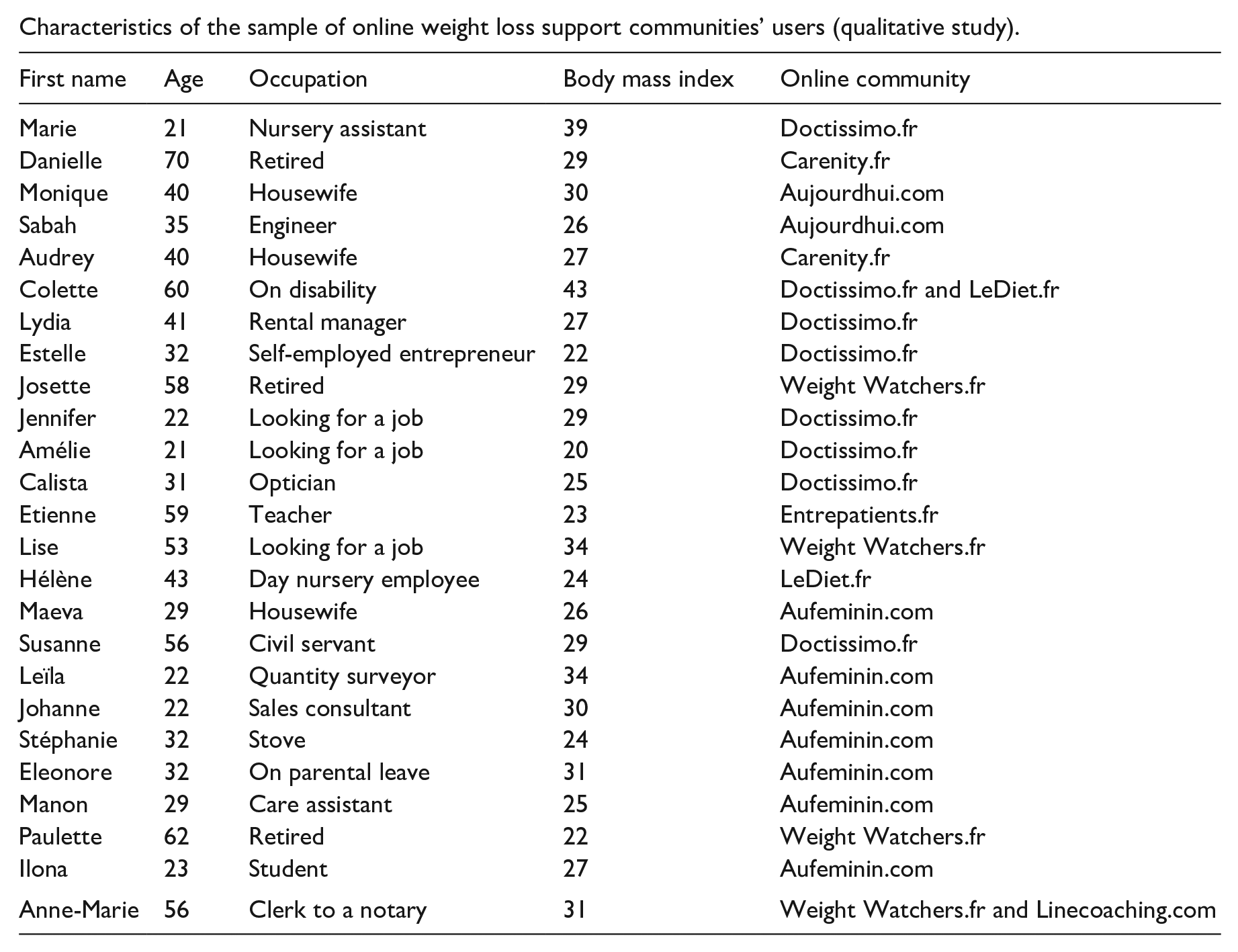
Twenty-four of the respondents were female. This overrepresentation of women in online weight-loss communities is not surprising as it was also salient in other studies (Ballantine and Stephenson, 2011; Bradford et al., 2017; Hwang et al., 2010). The age of the respondents ranged from 21 to 70 (M = 39.5) years, and the body mass index (BMI) ranged from 20 (normal) to 43 (class III obesity). They belonged to different socio-professional categories and were mostly employees (10 users; see Appendix 1). They wanted to lose weight for aesthetic and health reasons, and none had any disorders or illnesses that required dieting. Therefore, the results and recommendations must be interpreted in light of this important finding.
Data analysis
The collected, recorded, and transcribed content was analyzed using NVivo. We proceeded according to Schilling’s (2006) five-level qualitative content analysis spiral to detail the coding procedure (no latent content analysis; identification of interviewees’ reactions; definition of units of analysis; preliminary category system; coded protocol; and analysis/interpretation). Thematic analysis was used to interpret the content and compare opinions.
Results
The respondents’ discourse highlights the importance of social support in online weight-loss support communities. An articulation of the three main topics that emerged from the interviews is as follows:
Social support appears to be an antecedent to identifying with community members.
Identification with community members positively impacts the motivation to comply with the norms that govern the community.
Motivation to comply with community norms strengthens dietary self-efficacy.
Social support and identification with community’s members
Support is particularly important in these communities, so much represented that one of the users spontaneously mentioned a “support community” (Johanne, 22), the academic term used to describe these communities (Ballantine and Stephenson, 2011; Huang et al., 2019; Moisio and Beruchashvili, 2010). Users typically exchange information and provide emotional support. Audrey (40) stated that she wanted to feel less alone and perceived the community as a way of getting “advice and support.” Elodie (40) pointed out that this advice helped her “to find a solution, to be able to stay at a stable weight, to be able to eat normally.” However, emotional and social support appears to be the most sought-after type in online weight-loss communities. It was particularly prominent in respondents’ discourse (23 sources, 65 occurrences) compared with informational support (8 sources, 10 occurrences). The following discussion illustrates the need for emotional support: It also helps to put things into perspective, to realize that we’re all in the same boat and that we all have our slumps. We’re here to give ourselves a boost. I think that’s what it’s all about. I think that when we go to the discussion forum, we’re looking to share and support each other. (Estelle, 32) When you say that you’ve lost weight or that you overate, it’s nice to read on the message boards “keep going, you can do it.” You feel motivated and supported. (Jennifer 22) Just sharing our difficulties, I think it makes sense. It can lift up our spirits. We can get motivated again. (Sabah, 35)
Phoenix and Coulson (2008) referred to esteem and network support. The verbatim reveals that emotional support and esteem support are intertwined. Indeed, users find comfort in receiving compliments or encouragement, a source of well-being for supportive individuals (Cutrona and Russell, 1990; Loane et al., 2015). Congratulating others, whether they have gained or lost weight, is so ingrained in these communities that it becomes an automatism, as Céline (29) said, “Whether someone has gained or lost [weight], we still say ‘congratulations,’ it becomes mechanical.” However, these interviews did not address the issue of network support.
The respondents’ discourse also shows that support and identification with community members are closely linked. For example, Jennifer (22) indicated that she had been looking for exchanges with similar-profiled people: These are profiles that resemble us, so we feel more involved. It’s not that I’m against it, but I’m not going to go to the post of someone who’s had a bypass. It’s not that I’m not concerned, but it won’t be the same profile as mine at all, so we won’t be able to talk much about our journey.
Identification appears to be a central aspect in online weight-loss support communities, as illustrated by the verbatim of Lise (53): You know, there’s one thing I’ve always found rather difficult: being advised when trying to lose weight by skinny people. Somehow, do they really know what a diet is and what it’s like to go through a diet? I’m not sure. We’re talking here between buddies who have their moments of weakness, the blues that could lead us to eat a whole chocolate bar. That doesn’t explain our behavior, that’s not what I mean, but there’s an understanding that you don’t necessarily get with a health professional.
This is in line with the research of Johnson and Lowe (2015), who showed that, in virtual health communities, emotional support exchanged in a community in which the identification process is strong can lead to skepticism toward people outside the group.
A total of 14 users (28 occurrences) mentioned the need to identify with other community members: “Despite having a dietician and the support of my husband, I felt the need to connect with individuals who were in a similar situation as mine and were also motivated by their own weight loss journey” (Eléonore 32). According to participants in these communities, having the same goals is very important to be able to exchange with other members: “Someone who is telling me ‘I have 70 kilos to lose,’ I’ll help him/her, that’s not the point, but I’ll identify a little less with his/her situation.” (Jennifer, 22) or There’s one member, and I’m just thinking about it now, she’s only got 5 kg to lose. For me, 5 kg would almost make me laugh, you see, because it’s easy to lose 5 kg. When you go over 20 kg, it starts to get worrying. That’s why I’m doing it [the diet]. But I don’t really care about 5 kg. (Claude, 70)
Sharing a common goal thus seems to be an antecedent of the support that may be exchanged between members: People who come to discuss on the message boards are looking for support. I have been looking for the same thing, to find other people with the same problem and support each other all the way, right up to weight loss. (Estelle, 32)
Support is a dynamic process built up over time, which seems to impact the perceived identification between members, as emphasized by Aurélie (22): We’re all here for the same thing, the diet, so we all want to lose more or less weight depending on our objectives. Trying to lose weight brings us closer together. While talking with each other, we can see that we have things in common in life.
In the literature, sharing commonalities is an important factor in predicting community participation (Bagozzi and Dholakia, 2002; Dholakia et al., 2004; Huang et al., 2019; Lowe and Johnson, 2017; Nambisan and Baron, 2007; Pechmann et al., 2021; Tsai and Pai, 2014; Woisetschläger et al., 2008; Zhou, 2011) and, in particular, the susceptibility to help in-group members rather than people belonging to other groups (Thompson et al., 2016).
Thus, the aforementioned academic research tested the effect of variables related to community identification, sometimes named “identification” (Woisetschläger et al., 2008), sometimes “social identity” (Bagozzi and Dholakia, 2002; Lowe and Johnson, 2017; Tsai and Pai, 2014; Zhou, 2011) on variables such as “participation” (Tsai and Pai, 2014; Woisetschläger et al., 2008; Zhou, 2011), “group intentions” (“we intentions” Bagozzi and Dholakia, 2002) or “social support” (Lowe and Johnson, 2017). This suggests that identification is an antecedent to social support. However, not all these studies operationalized the independent and dependent variables in the same way. Community identification is not the same as social identity, and participation, measured in terms of the frequency of interaction or willingness to interact, is not the same concept as the exchange of social support. On the contrary, it is through the receipt and/or sharing of information (i.e. social support) that community members become acquainted with each other and thus develop (or not) a sense of identification with community members (Pechmann et al., 2021). Indeed, it seems logical that participants should take part in the community’s discussions and exchange support to discover the commonalities (beyond a common goal) they share with other members and thus be able to identify with them: “Through virtual community participation, consumers realize their common identity or kinship with others facing similar challenges” (Johnson and Lowe, 2015: 3).
To the best of our knowledge, the social support exchanged in these communities (Dholakia et al., 2004; Ridings and Gefen, 2004) has never been studied as an antecedent of community identification. Based on the results of this qualitative study, we propose a better understanding of the link between social support and identification by examining the impact of social support on identification:
H1. The more the users receive social support, the more they identify with community members.
Identification with community members and motivation to comply
Norms are a genuine part of groups and gatherings of individuals (Porter, 2004). Indeed, a group is defined as two or more individuals who share a set of norms, values, and beliefs and interact to achieve individual and mutual goals (Carmen, 2008). Their actions are often consistent with the social groups they identify with (Childers and Rao, 1992). Does feeling like a “member” of a support community (definition of identification from Dholakia et al., 2004) lead individuals to comply with the norms promoted in these communities? The results from the qualitative study reveal that participants in a community choose the one whose norms are congruent with their own (43 occurrences): don’t judge other members (10 occurrences), post your weight loss every week (7 occurrences), be honest (8 occurrences), post your menus (6 occurrences), don’t stick to restrictive diets (6 occurrences), contribute every day to the community (5 occurrences), set a specific goal (3 occurrences), lose weight (1 occurrence), and enjoy a cheat meal 7 per week (1 occurrence). For example, Ilona (23) stated: “We do a recap every Wednesday, i.e., every Wednesday, we commit to posting our weight.” Eléonore (32) pointed out: “The person who created this group encourages us to come and talk on the discussion forum every day.”
Some respondents, however, mentioned the possibility of lying when discussing with other community members, even if most users said they didn’t: I’m honest, but I could say anything. I could say, well, I didn’t have gastroplasty, I lost 67 kilos all by myself. But I didn’t. I lost 60 kilos with gastric banding. If I had preferred, I could have lied. I hope other people don’t lie, either. (Sylvie, 56)
“It would be really unhealthy to say things that aren’t true” (Marina, 32), “I say to myself ‘they have been lecturing me, but they’re doing the same thing anyway, they just don’t say it’” (Sandrine, 29). Sandrine (29) went so far as to say that she had already lied: It could happen to break one’s diet. [. . .] as I usually see that everyone else is strictly sticking to a diet, I feel like an odd man. So I try not to show it too much. Sometimes I don’t indicate what I really ate.
Therefore, we can deduce that the pressure of the group is strong: showing off one’s performance in terms of weight loss is important to the point of lying to avoid losing face and being admonished by the other group’s members, or to the point of thinking that the other members are lying because their weight loss is too significant to be true.
These results converge with those of Babic et al. (2022): social dynamics can have beneficial effects but also give rise to anxiety and worry. Competition seems to be implicitly established, but without the respondents reporting any negative impact, as Emilie (23) explained: “We don’t have a competition, but a kind of ranking, from the one who achieves the most important weight loss to the one who achieves the less important weight loss.” In line with Kelman’s (1958) work on conformism, identification with members of the community (“we’re in the same boat” Sylvie, 56) can therefore leads to greater motivation to comply to achieve weight loss goals and show off a certain level of performance. These considerations lead us to propose the following hypothesis:
H2. The more the users identify with the community members, the more motivated they are to comply with the community norms.
Motivation to comply and eating behaviors
The respondents’ verbatim highlights the norms that exist in weight-loss communities. Ajzen’s (1991) motivation to comply is used in this article to examine norms. Indeed, conformity refers to the normative influence of other members, regardless of their personal beliefs (Kelman, 1961; O’Reilly and Chatman, 1986). This corresponds to subjective norms, meaning that an individual considers what others think they should do (Fishbein and Ajzen, 1975). For example, Eléonore (32) said: “You have to come and talk a bit about what you’ve eaten during the day, what you’re doing, and she [the community leader] has implemented specific rules, e.g., coming at least once a day.” Users mentioned the need to share their food choices on the community, as Pascale (60) indicated: “We post every day what we’ve eaten” or Marina (32) who added that community users had “implemented rules,” including “explaining what we eat.”
For 8 users, the communities enable to share recipes: “We talk about recipes a lot” (Josette, 58), “I have been looking for recipes because trying to vary my diet and eat healthy is not always easy, as well as getting ideas to cook” (Jennifer, 22). Sharing can be seen as a positive effect of participating in these communities on food choices, as individuals discover new foods and recipes to help them achieve their weight loss goals (Haws et al., 2017). Claude (70), when talking about sharing recipes in the community, said: “It was a salmon pasta gratin. With fish. It gave me an idea because I’m not used to cooking that.” Myriam (32) added, I’ve incorporated chocolate, for example, into my diet, even though I did not eat chocolate at all. I prefer salty food. I usually prefer salty snack food. Incorporating chocolate into my diet helps me to get through the day. This is a little moment of pleasure that has been recommended in the message boards.
Weight management results in a complex behavior for many consumers (Parkinson et al., 2017). Therefore, this qualitative study led us to question the perceived ability to accomplish a difficult behavior (Bandura, 1997). When considering discussions around food, do users of this type of communities feel more confident in their ability to maintain balanced eating behaviors even if they encounter difficulties? Self-efficacy includes difficulties encountered and the belief in one’s ability to overcome them (Muretta, 2005; Schwarzer and Renner, 2000). Difficulties are represented in the discourse of the users interviewed: “I need to be boosted too, I’m having slumps. This weekend, I broke my diet. I didn’t weigh myself, but I’m sure I’ve put on 2 kilos” (Sylvie, 56): I like good food, but I’m getting back on track. I think I’ll be sticking to this diet for the rest of my life. This diet has helped me realize that being overweight can be managed, but it’s something you must watch out for every day. (Annie, 43)
Thus, self-efficacy includes effort and perseverance (Bandura, 1986, 1997; Bui et al., 2011; Luszczynska et al., 2007; Warner and Schwarzer, 2020).
While Bandura (2004) highlighted the role of self-efficacy in social outcomes (materialized by the motivation to comply with norms), Kim et al. (2017) examined the effect of social support and self-efficacy on weight loss. Other research investigated interpersonal dynamics on dietary self-efficacy. For example, Fitzgerald et al. (2013) showed that individuals encouraged by their peers to adopt unhealthy diets had lower dietary self-efficacy. Chiu et al. (2015) found that social support exchanged in a support community positively affected self-efficacy, supporting the work of Luszczynska et al. (2007), who also established this link but considered social support as encouragement.
Slater (1989) also highlighted the link between motivation to comply with the expectations of one’s entourage and dietary self-efficacy without, however, examining social support exchange and the identification process. The entourage is studied here from the perspective of family and friends. Shannon et al. (1990) showed that social support (friends and family) influenced eating behavior through self-efficacy (before, during, and 2 months after a weight-loss program). However, they did not consider social identification and motivation to comply. In the context of online weight-loss support communities, among the sources of self-efficacy discussed in the literature review, Wang and Willis (2016) shed light on past behavioral experiences (mastery experience), the most important source of self-efficacy. According to Muretta (2005), strong experiences (success in a given task) consolidate self-efficacy, whereas negative experiences (failure in a given task) weaken it. However, verbal persuasion (which can take the form of social support) and vicarious experiences (which can take the form of identification with community members, followed by the motivation to comply with community norms) seem important in online communities. Indeed, Wang and Willis (2016) did not focus on social support, identification, and motivation to comply. Investigating potential mediators between social support and dietary self-efficacy is necessary to explain the resulting eating behaviors. Thus, we propose that the motivation to comply has a positive effect on dietary self-efficacy and formulate the following hypothesis:
H3. The more motivated the users are to comply with the expectations of other community members, the greater the perceived dietary self-efficacy is.
The ability to maintain a healthy eating pattern and the numerous discussions around food led us to question the members’ level of dietary knowledge. Consuming fruits and vegetables is part of consumers’ vision of a balanced diet (Paquette, 2005). De Vriendt et al. (2009) revealed that a high level of dietary knowledge was associated with higher fruit and vegetable consumption. What occurs when individuals are exposed to group norms? Is still the effect of motivation to comply strongly associated with dietary self-efficacy when the level of dietary knowledge is high? We find this variable interesting, as some respondents addressed a higher level of dietary knowledge, like Chantal (62): A few years ago, there were things I didn’t eat that I eat now. For example, in the morning, I used to eat a piece of fruit and a dairy product, and it was easy to eat bread and butter. Now I vary my diet, it can be oatmeal, cornflakes, or a slice of ham. Before, I didn’t vary at all, and maybe it was too fatty.”
For Sandrine (29), sharing menus in the community, which is one of the community’s possible norms, is a source of new ideas for preparing her meals: “As we post our menus, it gives us ideas.” Aurélie (22) also pointed out that the exchange of recipes had encouraged her to modify her meals: While exchanging recipes, we compare, well we don’t compare our menus, but we expose them to each other so we say, ‘oh yes that would be nice’. So, inevitably, we pick up recipes from right and left. We try to balance as much as possible.
We then wonder what would happen when individuals gain dietary knowledge. Drawing on the work of De Vriendt et al. (2009) and the verbatim outlined above, we hypothesized that the level of dietary knowledge could be a negative moderator of the effect of motivation to comply with dietary self-efficacy:
H4. The effect of motivation to comply with dietary self-efficacy is even stronger when dietary knowledge is low.
The results of this qualitative study enabled us to formulate the aforementioned hypotheses. The sequential mediation of the effect of social support on dietary self-efficacy through community identification (M1) and motivation to comply (M2) with dietary knowledge moderating the effect of motivation to comply with dietary self-efficacy should be tested. The following section describes the quantitative study conducted to test the model.
Quantitative study
Methodology, participants, and measurements
Participants in the second study were recruited through an online panel (Toluna) that administered a Qualtrics questionnaire. The sample comprised 335 respondents, all users of online weight-loss support communities (selection criterion). The questionnaire was divided into four parts: (1) usage of online weight-loss support communities; (2) habits; (3) personal data related to weight loss experiences; and (4) sociodemographic questions.
Once again, the sample was characterized by an overrepresentation of women (79% among participants), consistent with the findings of the qualitative study mentioned earlier. The participants’ ages ranged from 18 to 66 years (M = 37, SD = 11.89). The average BMI, calculated based on the participants’ responses to weight and height questions, was 26, indicating an “almost normal” BMI. However, it is worth noting that some participants exhibited extreme BMI (BMI min = 13 and BMI max = 55). The sample includes various types of online communities (e.g. Doctissimo and Weights Watchers, etc.).
Social support was assessed using Nambisan’s (2011) scale, whereas identification with community members was measured using a 5-item scale developed by Algesheimer et al. (2005). The 4-item motivation to comply scale was based on Ajzen’s (1991) work and insights from the qualitative study. This scale evaluates individuals’ sensitivity to subjective norms, capturing their inclination to comply with the expectations of others (e.g. “The approval of other community members regarding my food choices is important to me”). Dietary self-efficacy was measured using the 3-item scale proposed by Lhakhang et al. (2014). Dietary knowledge was assessed using a 20-item scale developed by Dickson-Spillmann et al. (2011). Participants obtained a mean score of 12.82/20, indicating a relatively good understanding of the fundamentals of a healthy diet (minimum score = 3/20 and maximum score = 20/20; SD = 3.26; α = 0.67). To minimize order effects, the items within each construct were presented randomly using the randomization function in Qualtrics. Appendix 2 provides a comprehensive overview of all the items and response modes.
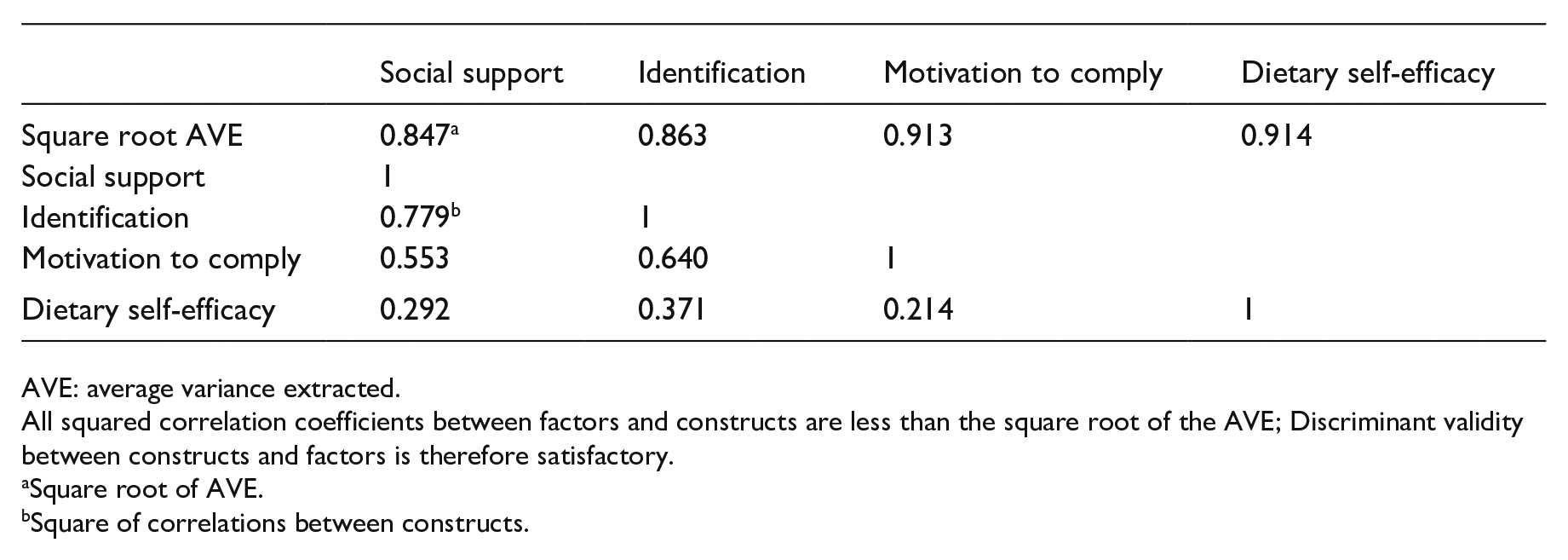
Before conducting the hypotheses testing, the reliability and validity of the multi-item measures were analyzed using principal component analysis in SPSS. The Kaiser–Meyer–Olkin (KMO) indices were above 0.5, as recommended by Hutcheson and Sofroniou (1999), and Bartlett’s test of sphericity was significant, indicating the suitability of the data for factor analysis. Convergent validity was assessed following Fornell and Larcker’s (1981) procedure. All multi-item scales demonstrated satisfactory convergent validity, with Cronbach’s alphas exceeding 0.8 and extracted variances surpassing 0.7, as Hair et al. (2010) recommended. Discriminant validity was also established as all squared correlation coefficients between the constructs were lower than the square root of the mean extracted variance (see Appendix 3 for details). The Harman test was also conducted to examine the potential bias of common method variance (CMV). The results indicated that when all items were loaded onto a single factor, they accounted for 23.76% of the variance, suggesting that CMV bias was not a significant concern in the data analysis.
Results
The hypotheses were tested using the PROCESS V3 macro developed by Preacher and Hayes (2008) with 5000 bootstraps and Model 87, which simultaneously included two sequential mediators and a moderator.
The results demonstrated an indirect effect of social support on dietary self-efficacy mediated sequentially through two proposed mechanisms: community identification (M1) and motivation to comply (M2). Moreover, the findings indicate the presence of a moderated mediation in which dietary knowledge moderates the relationship between motivation to comply (M2) and dietary self-efficacy (Figure 1).
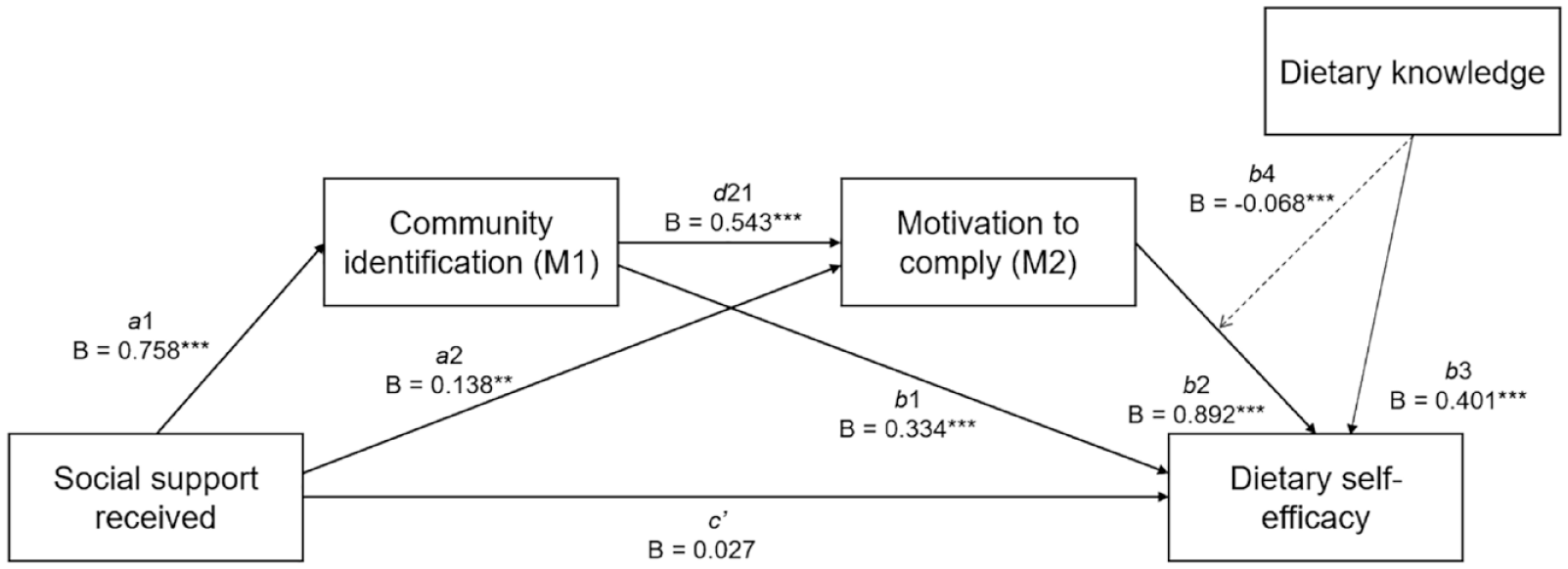
Results overview for the quantitative study.
More specifically, the more social support individuals receive, the more they identify with the community (b = 0.76; t = 22.69; p < 0.001; 95% CI = [0.691–0.823]), thus supporting H1. Identification with the community strengthens motivation to comply (b = 0.54; t = 7.96; p < 0.001; 95% CI = [0.409, 0.677]), supporting H2. Moreover, the positive effect of social support on the motivation to comply remained significant when the effect of community identification was controlled for (b = 0.137; t = 2.076; p = 0.039; 95% CI = [0.007; 0.268]). In line with H3, the stronger the motivation to comply, the higher the level of dietary self-efficacy (b = 0.89; t = 4.300; p < 0.001; 95% CI = [0.484; 1.300]). When controlling for the effects of community identification and motivation to comply, the results indicated that social support did not have a statistically significant direct effect on dietary self-efficacy. (b = 0.03; t = 0.380; NS; 95% CI = [−0.113; 0.167]). In contrast, the effect of community identification on dietary self-efficacy remained significant when the effect of motivation to comply was controlled (b = 0.338, t = 4.300, p < 0.001; 95% CI = [0.179; 0.492]). Furthermore, while dietary knowledge has a positive effect on dietary self-efficacy (b = 0.401; t = 5.724; p < 0.001; 95% CI = [0.263; 0.539]), the results revealed a significant and negative interaction effect between motivation to comply and dietary knowledge on dietary self-efficacy (b = −0.068; t = −4.512; p < 0.001; 95% CI = [−0.098; −0.038]). To examine the conditional effect of motivation to comply on dietary self-efficacy, we explored the effect at the mean value and −1 and +1 standard deviations of the dietary knowledge variable. The results showed that at −1 standard deviation (i.e. a dietary knowledge score of 9), motivation to comply has a significant and positive effect on dietary self-efficacy (b = 0.280; t = 3.241; p < 0.001; 95% CI = [0.110; 0.450]). At the mean value of dietary knowledge (a score of 13), motivation to comply no longer has a significant effect on dietary self-efficacy (b = 0.008; t = 0.132; p = 0.895; 95% CI = [−0.108; 0.124]). Finally, at +1 standard deviation (a score of 16 for dietary knowledge), motivation to comply has a significant and negative effect on dietary self-efficacy (b = −0.196; t = −2.714; p = 0.007; 95% CI = [−0.339; −0.054]). In addition, the index of moderate sequential mediation was statistically significant (Index = −0.028; 95% CI = [−0.045; −0.134]). These results are presented in Appendix 4. 8
General conclusion
By combining qualitative and quantitative studies, our research revealed that social support affects dietary self-efficacy through two sequential variables: (1) identification with community members and (2) motivation to comply. Furthermore, the results shed light on the moderating effect of dietary knowledge on the relationship between motivation to comply and dietary self-efficacy and the direct effect of dietary knowledge on dietary self-efficacy.
Theoretical contributions
Three main theoretical contributions were identified. First, regarding online weight-loss support communities, while Wang and Willis (2016) emphasized the influence of past experience on self-efficacy, our two studies revealed the importance of two other factors mentioned in the literature (Bandura, 1986, 1997; Gallopel-Morvan, 2006; Muretta, 2005) that have been identified as having less impact on self-efficacy (Wang and Willis, 2016): verbal persuasion (through social support) and vicarious experience (through identification with community members and motivation to comply).
This research also provides additional insights into two key components of food well-being, defined by Block et al. (2011): socialization and dietary skills. Our findings contribute to a deeper understanding of the first component of food socialization, as our results showed that eating behaviors can be influenced by others within a specific social context – in this case, within weight-loss communities. Our findings also revealed that dietary knowledge moderates the relationship between motivation to comply with community norms and dietary self-efficacy, thus contributing to a deeper understanding of dietary skills or “food literacy” (Cullen et al., 2015; Truman et al., 2017). These results provide different insights from the findings of Slater (1989), who suggested that knowledge related to health and nutrition does not impact self-efficacy, and the work of Shannon et al. (1990), which highlighted the lack of influence of knowledge regarding low-calorie and low-fat foods on self-efficacy and eating behaviors.
Second, this work sheds new light on the relationship between social support and identification with community members. Our findings revealed that social support serves as an antecedent to the identification process of community members. This hypothesis has not been previously tested in existing research, although it was suggested by Pechmann et al. (2021). Lowe and Johnson (2017) emphasized that users of virtual communities, especially those related to health, experience greater emotional support as they identify more strongly with community members. Based on the interactions with the participants in the qualitative study, pursuing a common goal seems to be the main driver of the support process, subsequently influencing identification with community members. However, considering the nature of this quantitative study (a cross-sectional survey), we cannot rule out the possibility of a recursive effect between social support and identification with community members.
Third, the results complement the existing literature on interactions within support groups. This aligns with the findings of Scott and Vallen (2019), who emphasized the significance of studying reciprocal behaviors in food-related exchanges, particularly within group dynamics. In this regard, both studies showed the existence and spread of norms within online weight-loss support communities. Considering the members’ focus on weight loss, these norms primarily revolve around dietary guidelines. However, contrary to the findings of Babic et al. (2022), no adverse effects of the group were identified, except for one: some members mentioned feeling tempted to lie about their weight loss progress.
Finally, this research contributes to the existing body of knowledge on dietary self-efficacy, as pointed out by Povey et al. (2000). We proposed, tested, and validated a distinct relationship between social support and dietary self-efficacy compared with the framework proposed by Povey et al. (2000). According to their perspective, social support moderates the link between self-efficacy and intention to adopt healthy eating habits. Our qualitative and quantitative studies show that social support influences dietary self-efficacy through community identification and motivation to comply.
Managerial and societal contributions
Weight-loss support communities could be used as a tool by healthcare professionals, as the qualitative study revealed that social support exchange benefits individuals. This would depend on the patient’s willingness to participate in a support community during the weight loss process (the professional should question the patient when starting follow-up). If the patient agrees, the professional can recommend a patient community that is halfway between a brand community and a consumer-initiated community, such as Carenity. Exchanges in these communities are moderated, and members are invited to discuss chronic diseases (not just overweight or obesity). In this community, which is developed in close collaboration with doctors, members can express their opinions on their treatment, thus contributing to medical research. Members also receive relevant information (medical innovations, interviews with doctors, and patient testimonials). Therefore, this type of community is a useful and relevant tool in the multidimensional management of overweight and obesity (treating the cause or causes, not just the consequences) and could be a source of psychological well-being through the exchange of support.
Health professionals might build their community by gathering their patients exclusively to enable more “supervised and monitored” exchanges with people sharing similar issues. We addressed the importance of finding people in the same situation, through the phenomenon of identification. The community would then be framed by the professional, who could improve the follow-up of their patients by getting to know them better and better characterizing their eating behavior. Patients could also benefit from interactions that help them with the long and tedious weight loss process. It would also be an alternative to the well-known Weight Watchers, Dukan, and other communities whose programs are particularly criticized for their low-calorie content or overemphasis on certain foods. For example, the first phase of the Dukan program only involves consuming proteins, which can lead to kidney disease. 9
In addition, people who have reached their goals but wish to maintain their weight loss can continue participating in these communities and exchanging information with others, with social support being a lever to reach personal goals more easily (Johnson and Lowe, 2015). Indeed, periodically visiting the community could be a lever for stabilizing one’s weight in a context where 95% of diets fail (the yo-yo effect). 10 In addition, social support strengthens one’s dietary self-efficacy in terms of regular fruit and vegetable consumption, in line with the National Nutrition Health Plan that promotes “eat & move” and “eat 5 fruits and vegetable pieces a day.” According to the PNNS4 2019–2023, “it is essential to support French people in facilitating their food choices,” 11 especially as self-efficacy, in general, has been identified as a lever for maintaining or losing weight (Bas and Donmez, 2009; Edell et al., 1987; Glynn and Ruderman, 1986; Kim et al., 2017; Roach et al., 2003; Wang and Willis, 2016).
From a marketing perspective, and in line with the findings of Mathwick et al. (2008) on social capital in peer-to-peer communities, this would also address the issue of community survival, which is one of the concerns of community members. Socialization contributes to community survival. Social support can thus be seen as the most important lever for keeping community members active and, thus, for community survival. Community managers (whether brands offering slimming programs or healthcare professionals) must focus on encouraging community members to exchange social, informational, and emotional support. This could take the form of messages like, “Ask the community for advice today,” “Feeling down? Talk to community members,” or “Congratulate other members who have lost weight today.” Weekly rankings could also be designed to encourage the exchange of support: members who gave the most advice during the week, members who provided the most encouragement during the week, and members who posted the highest number of messages in the community. Therefore, social support is the keystone that enables community managers to guarantee the survival of their community and enables members to increase their food well-being through dietary self-efficacy.
We cannot ignore that 82.4% of our sample participated in this type of communities without the assistance of one or more healthcare professionals. Although the results presented in this article did not highlight any adverse effects, the high representation in our sample of people who were not monitored invites us to question the role of legislators. For example, Gallin et al. (2019) reported that some healthcare professionals are against unmoderated communities due to potential misinformation and incentives to undertake overly restrictive and, therefore, unhealthy diets. A banner and/or pop-ups should appear systematically in any food-related community that is not moderated; for example, “Please check the information on this community with your doctor. Changing your diet without medical advice can have serious health consequences.” Stricter moderation of the content of these communities is necessary to remove comments that advocate extreme methods. Newsletters should be designed to raise awareness among members of online food communities about certain methods to avoid because they are harmful to health.
Finally, in relation to Transformative Consumer Research, to establish partnerships between TCR-oriented academic research and healthcare professionals caring for overweight and obese people, we recommend that the TCR Executive Leadership and Social Impact Council within the Association for Consumer Research integrate webinars for healthcare professionals on the following topics: 12 “Optimizing the support and well-being of overweight and obese people: social support in online weight-loss support communities as a lever for action” or “Online weight-loss support communities: better understanding them for multidimensional weight loss management.” Within the TCR movement, Ozanne et al. (2011) emphasized the importance of the link between researchers and consumers, which can be established through online communities. Patient communities can be ideal places to transform ordinary users into user-actors. Healthcare professionals and researchers can call upon them to collect or provide information to help scientific research, in line with the project mentioned by Ozanne et al. (2011) on entomology.
Limitations and avenues for future research
This research has some limitations that may be further explored in future studies. Causality inferences can only be achieved through experimental research. Therefore, the hypotheses that were tested and supported (or not) should be considered in light of the limitations above, particularly regarding the direction of the relationship between social support and identification (i.e. which variable acts as the antecedent and whether there is a recursive effect). Another limitation was the motivation to comply with the measure used in the quantitative study. While we built our measure on Ajzen’s (1991) work and adapted it based on qualitative study results, the scale creation process did not follow established procedures such as those proposed by Churchill (1979) or Rossiter (2002).
Furthermore, we used Harman’s test to check for CMV bias, a method criticized by Podsakoff et al. (2003). In line with the recommendations of Richardson et al. (2009), we did not perform further post hoc analyses to detect this bias because, as Fuller et al. (2016) pointed out, CMV does not represent a significant threat in correlational studies in which multi-item measures with satisfactory reliability are used. However, employing the marker variable technique within confirmatory factor analysis would have been relevant to detect this potential CMV bias (Williams et al., 2010).
Our quantitative study used self-reported measures with a cross-sectional design instead of the observational measures used in a longitudinal study. The phenomena examined in this study, which occur within online weight-loss support communities, are complex and evolve over time through community members’ active or passive involvement. Inagaki and Orehek (2017) proposed that social support contributes to personal satisfaction and alleviates stress. However, the authors raised that they questioned the threshold at which the provision of social support ceases to positively impact health. Therefore, it would be valuable to investigate through a longitudinal study the point at which the exchange of social support within online weight-loss support communities no longer positively influences dietary self-efficacy. A longitudinal study specifically carried out by researchers would also enable the integration of all participants at the same time, thus controlling for the duration and type of participation (in line with the typology proposed by Ballantine and Stephenson, 2011), as well as weight before and after dieting, to test the link between dietary self-efficacy and the number of kilos lost. A limitation of the methodology used in this study is that the dependent variable was dietary self-efficacy rather than a behavioral variable related to diet. However, with all the precautions that need to be taken in interpreting this result and in view of the limitations outlined above, we carried out an additional analysis showing that dietary self-efficacy predicts food variety 13 (β = 0.428; t = 8.635 and p < 0.001). Therefore, further research on the links between social support, self-efficacy (general or dietary), and weight loss is required.
As indicated in the sample descriptions, the respondents in the studies were members of different types of communities (brand communities linked to a specific program, such as Weight Watchers; brand-unrelated communities, such as Doctissimo discussion forums; or patient communities that are partially moderated, such as Carenity). Johnson and Lowe (2015) showed that members of virtual health communities react differently to out-group people depending on whether the community is branded (vs unbranded). Indeed, the participants’ skepticism toward healthcare professionals (out-group) was lower when the community was related to a brand. Future research should, therefore, focus more on this community characteristic (brand-related vs brand-unrelated communities).
By addressing the level of dietary knowledge, we slightly addressed food literacy (Block et al., 2011). Future research should examine this level of food competence (the skills needed to access, select, prepare, and consume meals: Velardo, 2015). Other variables would also be worth examining, such as the perceived ability to control one’s weight (weight locus of control), defined as “the beliefs women have about the controllability of their weight” (Martin et al., 2007: 197). This could moderate the relationship between motivation to comply and dietary self-efficacy. This definition by Martin et al. (2007), which specifically addresses women, raises a key question for future research: Why are there so many women in these weight-loss support groups? Both studies in this research predominantly included women. Interviewing more men would be interesting, even though there are fewer of them in weight loss support communities. More specifically, this limitation invites us to ask why there are more women or fewer men in these communities? Indeed, French statistics published by ObEpi in 2021 showed that more men than women were overweight or obese (53.5% men vs 41.3% women). 14 Thus, men should not be overlooked in marketing studies on overweight and obesity.
Footnotes
Appendix 1
Characteristics of the sample of online weight loss support communities’ users (qualitative study).
| First name | Age | Occupation | Body mass index | Online community |
|---|---|---|---|---|
| Marie | 21 | Nursery assistant | 39 | Doctissimo.fr |
| Danielle | 70 | Retired | 29 | Carenity.fr |
| Monique | 40 | Housewife | 30 | Aujourdhui.com |
| Sabah | 35 | Engineer | 26 | Aujourdhui.com |
| Audrey | 40 | Housewife | 27 | Carenity.fr |
| Colette | 60 | On disability | 43 | Doctissimo.fr and LeDiet.fr |
| Lydia | 41 | Rental manager | 27 | Doctissimo.fr |
| Estelle | 32 | Self-employed entrepreneur | 22 | Doctissimo.fr |
| Josette | 58 | Retired | 29 | Weight Watchers.fr |
| Jennifer | 22 | Looking for a job | 29 | Doctissimo.fr |
| Amélie | 21 | Looking for a job | 20 | Doctissimo.fr |
| Calista | 31 | Optician | 25 | Doctissimo.fr |
| Etienne | 59 | Teacher | 23 | Entrepatients.fr |
| Lise | 53 | Looking for a job | 34 | Weight Watchers.fr |
| Hélène | 43 | Day nursery employee | 24 | LeDiet.fr |
| Maeva | 29 | Housewife | 26 | Aufeminin.com |
| Susanne | 56 | Civil servant | 29 | Doctissimo.fr |
| Leïla | 22 | Quantity surveyor | 34 | Aufeminin.com |
| Johanne | 22 | Sales consultant | 30 | Aufeminin.com |
| Stéphanie | 32 | Stove | 24 | Aufeminin.com |
| Eleonore | 32 | On parental leave | 31 | Aufeminin.com |
| Manon | 29 | Care assistant | 25 | Aufeminin.com |
| Paulette | 62 | Retired | 22 | Weight Watchers.fr |
| Ilona | 23 | Student | 27 | Aufeminin.com |
| Anne-Marie | 56 | Clerk to a notary | 31 | Weight Watchers.fr and Linecoaching.com |
Appendix 2
Appendix 3
| Social support | Identification | Motivation to comply | Dietary self-efficacy | |
|---|---|---|---|---|
| Square root AVE | 0.847 a | 0.863 | 0.913 | 0.914 |
| Social support | 1 | |||
| Identification | 0.779 b | 1 | ||
| Motivation to comply | 0.553 | 0.640 | 1 | |
| Dietary self-efficacy | 0.292 | 0.371 | 0.214 | 1 |
AVE: average variance extracted.
All squared correlation coefficients between factors and constructs are less than the square root of the AVE; Discriminant validity between constructs and factors is therefore satisfactory.
Square root of AVE.
Square of correlations between constructs.