




Abstract
To improve consumers’ online shopping experiences, companies invest in the visual design of their websites. Although some studies show that visual design positively influences consumer reactions, other studies do not confirm that influence. This research is aimed at exploring those contrasting findings by investigating two boundary variables (website use and user expertise) that delimit the scope of the positive influence of visual design on consumer intentions towards using and recommending e-commerce websites. Two preliminary studies (Study A and Study B) investigate the level at which visual design is mentally construed. The two main studies (Study 1 and Study 2) test our research hypotheses. Study 1 results reveal that visual design exerts different effects on individuals’ intentions depending on when the site is evaluated (before vs after use). Study 2 provides greater insight into the role of visual design after the actual use of the website by considering the moderating role of user expertise. Those findings lead to concrete recommendations about how e-retailers can create more engaging experiences.
Introduction
The visual design of an e-commerce website is a vector of differentiation for companies seeking to gain a competitive advantage in increasingly competitive markets (Bleier et al., 2019). A GfK Survey (2015) of 26,000 consumers across 22 countries indicates that one in three consumers agree that a technology product’s look and style play a significant role in purchasing decisions. A visually attractive website is a valuable asset for a company. It contributes to the unique shaping of the corporate image (Jiang et al., 2016) and improves consumers’ online shopping experiences (Xu and Schrier, 2019). Yet, a study by Cognizant (Pring, 2014) reports that fewer than 30% of the 300 American and European executives interviewed believe that their company offers customers ‘high quality’ digital experiences (p. 4). Our research analyses the extent to which the visual design of a web interface can contribute to creating more engaging consumer online shopping experiences.
Research in marketing, information systems and human–computer interaction has long focussed on interfaces’ so-called functional features, such as usability, that help consumers perform tasks or achieve goals (Ziamou et al., 2012). Although some researchers also stress the importance of considering non-functional features, especially interface visual design, for improving consumers’ online experiences (Coursaris and Van Osch, 2016), their studies have yielded contradictory results. Some studies confirm that visual design positively influences consumers’ judgements (e.g. Cai and Xu, 2011; Coursaris and Van Osch, 2016; Jiang et al., 2016; Lee and Koubek, 2010; Van Schaik and Ling, 2008, 2009), but others find it has no influence (e.g. Ben-Bassat et al., 2006; Cyr et al., 2006; Hassenzahl, 2004; Kim and Lennon, 2008; Sheng and Teo, 2012), or even a negative influence (Wu et al., 2017), on the product or system evaluation. Visual design’s impact on consumers’ online shopping experiences is thus more complex than it initially appears, thereby stressing the need to examine the boundary variables 1 that might explain such seemingly contradictory results.
The time frame within which a consumer evaluates an interface – before versus after use – is a factor identified both in the marketing (e.g. Thompson et al., 2005; Wood and Moreau, 2006) and the human–computer interaction literature (e.g. Hassenzahl, 2004; Lee and Koubek, 2010; Tuch et al., 2012; Van Schaik and Ling, 2009) as modifying consumer attitudes towards an interface. Although the human–computer interaction literature reveals that visual design’s effects depend on whether the systems are evaluated in pre- or post-use contexts, it fails to provide a rationale to explain those results. Conversely, the marketing literature does offer solid arguments based on construal-level theory (CLT) to explain why that occurs. Still, it does not examine visual design and its effects before versus after use (see Thompson et al., 2005).
Based on CLT, our research aims to extend our understanding of visual design’s effects on consumer intentions (to use/reuse and recommend) towards e-commerce sites. Specifically, we propose that such effects depend on the point at which consumers mentally construe visual design (before vs after website use). We also suggest that the expertise gained by consumers while initially navigating a website may modulate the effects of visual design. That focus on the early stages of interface use is consistent with the lack of research conducted in post-use contexts (Lakshmanan and Krishnan, 2011; Monnot, 2020; Retana et al., 2018).
This study is part of a research stream challenging the common assumption that enhancing the attractiveness of visual design automatically leads to positive outcomes. It contributes to enriching prior research on visual design effects in three ways, by: (1) providing for the first time, to the best of our knowledge, empirical evidence, using both an implicit association test (IAT) and the behavioural identification form (BIF), that visual design activates high-level (abstract) construals. That association is important because it clarifies why, in certain circumstances, the visual design does not have the expected beneficial effects on consumer behaviour and, consequently, why it is appropriate for companies to address that issue. (2) Confirming that visual design has a positive influence before use, but its main originality is to provide evidence that visual design continues to play an important role during the post-use phase only if consumers have gained expertise in navigating the web interface. (3) Confirming that visual design positively affects consumer intentions to use an e-commerce site and their intentions to recommend it to others. The latter is significant as it contributes to triggering positive word of mouth, which is essential to the success of online retailers (Berger, 2014).
Theoretical framework
To better understand the influence of visual design on online shopping experiences, our research mobilises CLT as the theoretical foundation. We first define the concept of visual design and provide an overview of the studies that examine its effects on consumer judgements and reactions to systems. We then refer to CLT in stating the conceptual assertion from which our research hypotheses are derived.
Visual design definition and characteristics
Visual design field developed from both user interface design and graphic design. Visual design plays a predominant role in influencing consumer attitudes and behaviours (Bloch, 1995), and it is an important aspect of the product or system design (Mishra et al., 2015). The term ‘visual design’ is widely used by practitioners and researchers. For example, the Norman Nielsen Group lists ‘visual design’ as an article-search keyword for its database. 2 Academic studies (e.g. Coursaris and Van Osch, 2016; Cuddihy and Spyridakis, 2012; Deng and Poole, 2010; Tuch et al., 2009) also use it to refer to the sensory and structural features, as designed by engineers or web designers, from which consumers form their first impression (King et al., 2020) of a product or interface and a global attitude towards its appearance (Mishra et al., 2015). Specifically, Cyr et al. (2006) define visual design as ‘the balance, emotional appeal or aesthetic of a website and it may be expressed through colours, shapes, font type, music or animation’ (p. 951). That definition stresses the distinction between the global evaluation, referring to its appeal (or attractiveness), and the specific features on which the evaluation is based. Several studies investigate the design features that determine the attractiveness of digital interface visual designs, such as on websites (for a summary, see Post et al., 2017). Colour combinations, symmetry and framework shapes are widely recognised as being capable of improving product or system beauty appreciation (e.g. Coursaris and Van Osch, 2016; Schloss and Palmer, 2011; Tuch et al., 2010; Westerman et al., 2012), especially when it is being used (Minge, 2008).
Visual design effects
Despite its centrality and importance in consumer attitudes and behaviours, there is a lack of research into visual design’s effects. As various researchers (see, for instance, Cai and Xu, 2011; Van Schaik and Ling, 2008) note, there are fewer empirical studies on the effects of interface visual design than on their functional features, such as their usability. Some studies show more positive user judgements when digital systems are perceived to be highly visually attractive rather than lowly visually attractive (Cai and Xu, 2011; Coursaris and Van Osch, 2016; Ha et al., 2007; Hall and Hanna, 2004; Jiang et al., 2016), (Lee and Koubek, 2010; Mishra et al., 2015; Robins and Holmes, 2008; Schenkman and Jönsson, 2000; van der Heijden, 2003; Van Schaik and Ling, 2008, 2009). But others do not support such findings. For example, Kim and Lennon (2008) show that website visual design positively influences consumer attitudes when they navigate a website, but it does not significantly affect their purchase intentions. Hassenzahl (2004) also shows that, during the early stages of interface use, consumer satisfaction relates more strongly to pragmatic than hedonic attributes (including visual design). Ben-Bassat et al. (2006) find that visual design has no significant effect on the perceived value of computer-based phone book systems. Other studies show that visual design has no direct impact on consumer evaluations of mobile phone interfaces (Chopdar and Balakrishnan, 2020; Cyr et al., 2006; Sheng and Teo, 2012) and websites (Van der Heijden, 2003; Xu and Schrier, 2019). Finally, Wu et al. (2017) emphasise a potentially negative effect on the consumption of highly visually attractive products, as people appreciate the extra creative effort invested. Still, it makes people less prone to consume them to avoid destroying the results of that effort.
Tuch et al. (2012) note that the different methods used to investigate visual design’s effects may explain such contrasting results. 3 They also stress the correlational nature of such studies and the need for more experimental studies to enhance internal validity. Other researchers indicate that the effects of product or system visual design depend on individual (Bloch et al., 2003) and contextual variables (Cai and Xu, 2011; Hoegg et al., 2010; Van Schaik and Ling, 2008, 2009). We propose that visual design’s effects depend on the level at which visual design is mentally construed, and we provide arguments for that conceptual assertion below.
Construal level of an interface’s visual design
According to CLT, psychological entities (actions or objects) can be interpreted in accordance with various levels of representation. Liberman and Trope (1998) specify that high-level construals – compared to low-level construals – are characterised by two criteria: (1) their high level of abstraction (vs low-level) and (2) their focus on desirability (vs feasibility). Regarding the level of abstraction, Liberman and Trope (1998) specify that high-level construals are general and abstract, while low-level construals are specific and concrete. Liberman et al. (2007) give the example of the entity ‘tiger’, which can be construed, at a higher level, in terms of a global animal family (‘feline’) and, at a lower level, in terms of concrete morphological characteristics (‘large quadruped’). Regarding the focus on desirability, Liberman and Trope (1998) posit that high-level construals focus on an object’s desirability, that is the benefits a consumer can derive from object purchase or use.
Conversely, low-level construals focus on the object’s ‘feasibility’ aspect, which refers to the means that a consumer should implement for purchasing or using it. For example, in a gambling context, the value of winning refers to the desirability of the object ‘game’, that is the benefits, whereas the probability of winning refers to its feasibility, that is the means (Sagristano et al., 2002). Another example is that of the object ‘kitchen’ being represented in high-level construal as ‘a room where a good meal can be prepared’. In contrast, the low-level representations relate to specific elements, such as the size of the sink, the number of chairs or the type of kitchen hood.
Based on the literature review, we propose that visual design owns the two characteristics of a high-level construal mentioned above, that is a high level of abstraction and a focus on desirability. First, a digital system’s visual design is based on the specific features defined by engineers or designers, but consumers perceive them in a general and abstract way. Mishra et al. (2015) discuss television screen resolution and pixel density as examples. The specifications provide consumers with an overall subjective perception of visual clarity, which is more abstract (or global) than the technical components. Similar reasoning can be applied to interface visual design. For example, hue, saturation and brightness rely on specific technical characteristics, but users get a global perception of those characteristics that influence their visual interface appearance judgements (Seckler et al., 2015). Second, by providing pleasure and sensory stimulation, a product’s visual design is a source of ‘value or benefit’ for consumers (Bloch, 1995: 378). That concurs with how Liberman and Trope (1998) define desirability. For that reason, Hassenzahl (2004) considers digital interface attractiveness (or beauty) to be a ‘high-level construct’ (p. 323) compared to usability features. Fiedler (2007) also argues, but offers no empirical evidence, that an object’s visual appearance (or beauty) corresponds to a high-level construal. Elder et al. (2017) also show that visual images trigger higher construal levels. By analogy, we propose – as our conceptual assertion – that visual design activates high-level construals, that is a high level of abstraction and a focus on desirability.
Development of the hypotheses
Combined effects of visual design and website use
The CLT founding principle is that psychological distance changes the level at which an individual mentally construes an action (or object). Liberman and Trope (1998) define psychological distance as the degree to which an individual perceives an entity (an object or action). Individuals primarily form high-level representations of temporally distant actions, with low-level construals formed as the temporal distance decreases. Such temporal distance influences on construal levels have given rise to several marketing studies (see Maglio, 2020 for a synthesis). Taking temporal distance to be when technology product (digital audio player) use is considered (before vs after use), Thompson et al. (2005) analyse its impact on consumer perceptions of added features. Those authors indicate that, before product use, consumers perceive additional features as increasing desirability, which results in a positive evaluation. Conversely, after using the product, the addition of new features is interpreted as decreasing the ease of use, thereby resulting in a negative evaluation. Thompson et al. (2005) explain that in the ‘before-use condition’ (p. 437) when product usage is considered psychologically ‘distant’ (p. 433), consumers tend towards high-level construals and focus on desirability aspects. In contrast, in the ‘after-use condition’ (p. 437), where temporal distance is psychologically ‘near’ (p. 433), product use leads consumers to prioritise low-level construals and be more focussed on feasibility features.
We propose to adapt that well-established temporal distance operationalisation to website use (before use = distant vs after use = near). We expect it to moderate the influence of visual design on consumer intentions (i.e. intention to use/reuse and intention to recommend).
Intention to use is an established system acceptance indicator (Venkatesh et al., 2012), also used in e-retailing contexts (Belanche et al., 2012), reflected the anticipated degree of system use and recognised as a strong predictor of actual system use (Morris and Dillon, 1996). It is part of user experience under the International Organisation for Standardisation (IOS) definition: ‘a person’s perceptions and responses that result from the use and/or anticipated use of a product, system or service’. 4 Intention to use is largely utilised in pre-use contexts (i.e. when consumers have not used a system), especially by researchers applying technology acceptance models (e.g. Davis, 1989). In post-use contexts (i.e. when consumers have navigated the system at least once), researchers refer to the intention to continue using a system (Jasperson et al., 2005). That is similar to the intention to revisit (Cuny et al., 2015) or reuse a system (Hung et al., 2016).
Intention to recommend is recognised as a strong predictor of customer loyalty (Moldovan et al., 2011). Finn et al. (2009) note studies revealing that it predicts firm performance better than customer satisfaction. Recommendations indicate positive word of mouth (Berger, 2014) and explicit endorsement instead of implicit endorsement, where people only say they like a product or system without recommending it (Packard and Berger, 2017). To the best of our knowledge, visual design’s influence on the intention to recommend a system has not been empirically tested. Our research addresses that gap by suggesting that the effect of visual design on intention to recommend a system depends on website use (before vs after use). Relying on those founding principles of CLT, we might expect visual design to exert a greater influence on intentions to use and recommend systems before use than after, as it refers to system desirability and is perceived in the abstract. To that end, we propose:
The moderating role of user expertise in post-use situations
When navigating a new website for the first time, users learn where to find the information and how it is structured. That helps them to develop procedural skills and gain an understanding of how the website works for them. Accordingly, we expect that users might activate high-level construals through which they enjoy the beauty of the website. Thus, we define the concept of user expertise and justify its moderating impact.
Definition of user expertise
Alba and Hutchinson (1987) define consumer expertise as ‘the ability to perform product-related tasks successfully’ (p. 411). It is well-recognised that consumers gain knowledge after an initial experience with a product or system (Billeter et al., 2011; Wood and Moreau, 2006). Gaining knowledge while interacting with a system increases consumers’ familiarity with the system (or similar ones) without necessarily increasing their expertise (Alba and Hutchinson, 1987). To become an expert in a specific domain, consumers must be able to use the available information to develop new or restructure defined knowledge (Alba and Hutchinson, 1987). Expertise in digital products is more difficult to acquire when it involves high learning costs (Lakshmanan and Krishnan, 2011; Monnot, 2020). Human–computer interaction (e.g. Grossman and Fitzmaurice, 2015; Lawson et al., 2009) and information system (e.g. Aljukhadar and Senecal, 2016; Sedera and Dey, 2013) literature widely discusses the user expertise concept, with such expertise defined as ‘a user’s ability to complete tasks with the system’ (Grossman and Fitzmaurice, 2015: 472).
Expert users, high-level construals and visual design
Prior studies show that people with extensive knowledge tend to develop more abstract mental representations of information (i.e. using high-level construals) than those with limited knowledge (Vaubel and Getty, 1990). Researchers also suggest that experts might be more receptive to stimuli congruent with their tendency to favour abstract mindsets. For example, Hong and Sternthal (2010) argue that experts (vs novices) react more positively to stimuli that are congruent with their tendencies to process information in an abstract (vs concrete) way. They show that experts evaluate an MP3 player more favourably when an advertisement focuses on product desirability (a high-level construal) rather than device usability (a low-level construal). The opposite is observed for novices. Hong and Sternthal (2010) argue that the fit between the experts’ abstract processing of environmental stimuli and the high-level construals they emphasise triggers positive feelings, which, in turn, positively influence experts’ evaluations. Other studies (e.g. Kelting et al., 2017; Nam et al., 2012) show the positive effects of that fit, but our research extends the scope to consumer evaluations of e-commerce sites.
Given all those findings, particularly by Hong and Sternthal (2010), we suggest that user expertise moderates the influence of visual design on website user intentions to use and recommend. When consumers gain expertise in navigating systems – that is, according to Alba and Hutchinson (1987), when consumers have acquired the knowledge, skills, or ability to perform specific tasks effectively with systems – they will be favourably influenced by the system features that fit with expert users’ abstract (or high-level) processing, as is the case with visual design. In a post-use situation, we propose that visual design’s positive influence, such that highly (vs lowly) attractive visual design triggers higher (vs lower) intentions, would depend on users’ interface navigation expertise.
Overview of the studies
We conducted four studies with two main objectives. First, to confirm our conceptual assertion, positing the association between visual design and high-level construals, two preliminary studies (Study A and Study B) were developed. Study A tests the abstraction at which visual design is represented using an implicit association test (IAT). Study B explores the degree to which visual design activates a high-level (or desirability-focussed) mind-set using a Behavioural Identification Form (BIF). Second, we conducted two main studies to test our research hypotheses (Study 1 and Study 2). Study 1 tests H1 and H2 through manipulation of a fictitious website’s visual design (lowly vs highly attractive) and website use (before vs after use), and studies their interaction impact on intentions (to use/reuse and recommend a website). Study 2, focusing on the after-use stage, tests H3 and H4 by considering the moderating role of user expertise in the relationship between visual design and consumer intentions. Figure 1 shows the proposed research model and summarises the hypotheses. Figure 2 summarises the study objectives and details the research design.
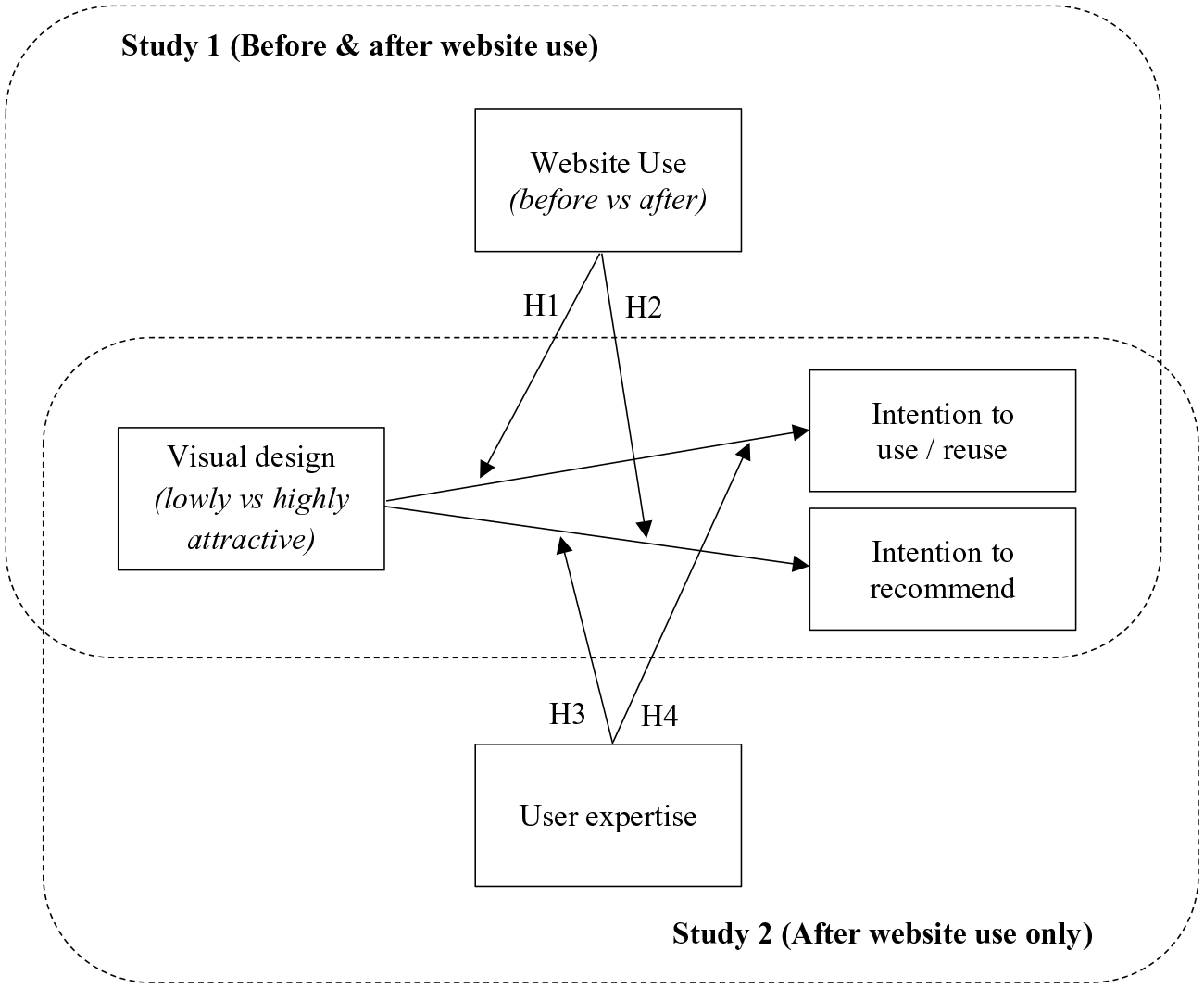
Research model and hypotheses.
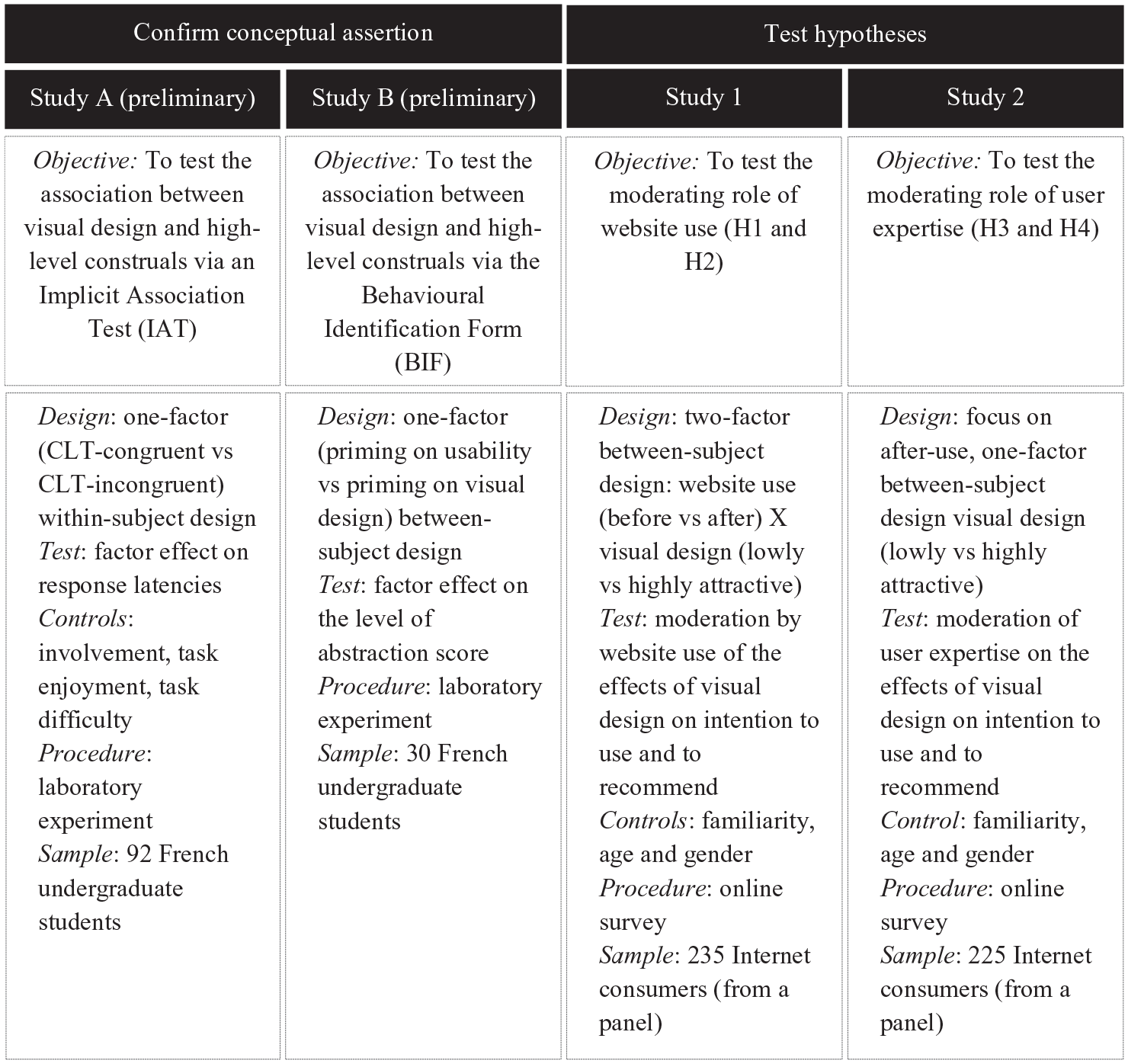
Summary of the study’s aims and research design.
Preliminary Study A: Implicit association test
To confirm the association between visual design and high-level (or abstract) constructs, we conducted an IAT in a computer laboratory. IAT is especially useful for exploring concept abstraction levels (Bar-Anan et al., 2006). IAT performance results, calculated from participants’ speed in categorising words, are a robust measure of people’s automatic associations (Greenwald et al., 2003; Rozin et al., 2012) and are particularly useful in our context. On entering the laboratory, participants were randomly assigned to computers, told that the purpose of the study was to test word associations, and asked to read the on-screen instructions, which stated that the study would consist of several blocks.
Participants and procedure
Study A involved 92 French undergraduate students tasked with categorising stimuli into four categories (design, usability, abstract and concrete). We used usability to compare our results, as that concept is associated with concrete features (Ho et al., 2015). The words appeared in the middle of the screen, with the category labels at the top. IAT stimuli were drawn from four categories of words associated with: (1) design (stylish, attractive, colourful, beautiful, decorative, harmonious, illustrated and aesthetics), (2) usability (simple, easy, useful, convenient, operational, guided, usable and functional), (3) abstract ideas (arts, sciences, models, dietetics, love, time, mind and movement) and (4) concrete things (train, bicycle, chair, perfume, chocolate, watch, brain and book). Two human–computer interactions and two CLT-expert researchers discussed and chose all the words. Synonyms were used for the words related to design and usability. A pre-test with 48 participants confirmed that the participants perceived the selected concrete and abstract words according to different levels of abstraction Mconcrete = 2.02 (SD = 0.91); Mabstract = 4.54 (SD = 0.79); Mdiff_abst-conc = 2.52 (SD = 1.22); t(47) = 14.33; p < 0.001. We used a bipolar scale ranging from 1, for concrete, to 7, for abstract.
During the IAT, when each word appeared on-screen, the participants pressed a key on the right or left side of the keyboard to associate it with the right or left category shown. Only one answer was correct, with a red cross appearing to indicate participants answered incorrectly. Instructions were given before each block. Participants were asked to minimise their incorrect answers and complete the task as quickly as possible. In line with the established protocol, each participant completed seven trial blocks, including two critical blocks. Stimuli from all four categories were presented in blocks 3, 4, 6 and 7, for a total of 128 trials per participant across four blocks (see Table 1 for details). The two critical blocks were block 4 (CLT-incongruent), with category labels concrete or design (vs abstract or usability), and block 7 (CLT-congruent), with category labels abstract or design (vs concrete or usability). An implicit association between abstract and design was reflected in faster response latencies than for the responses between concrete and design.
Sequence of the trial blocks in IAT (Study A).
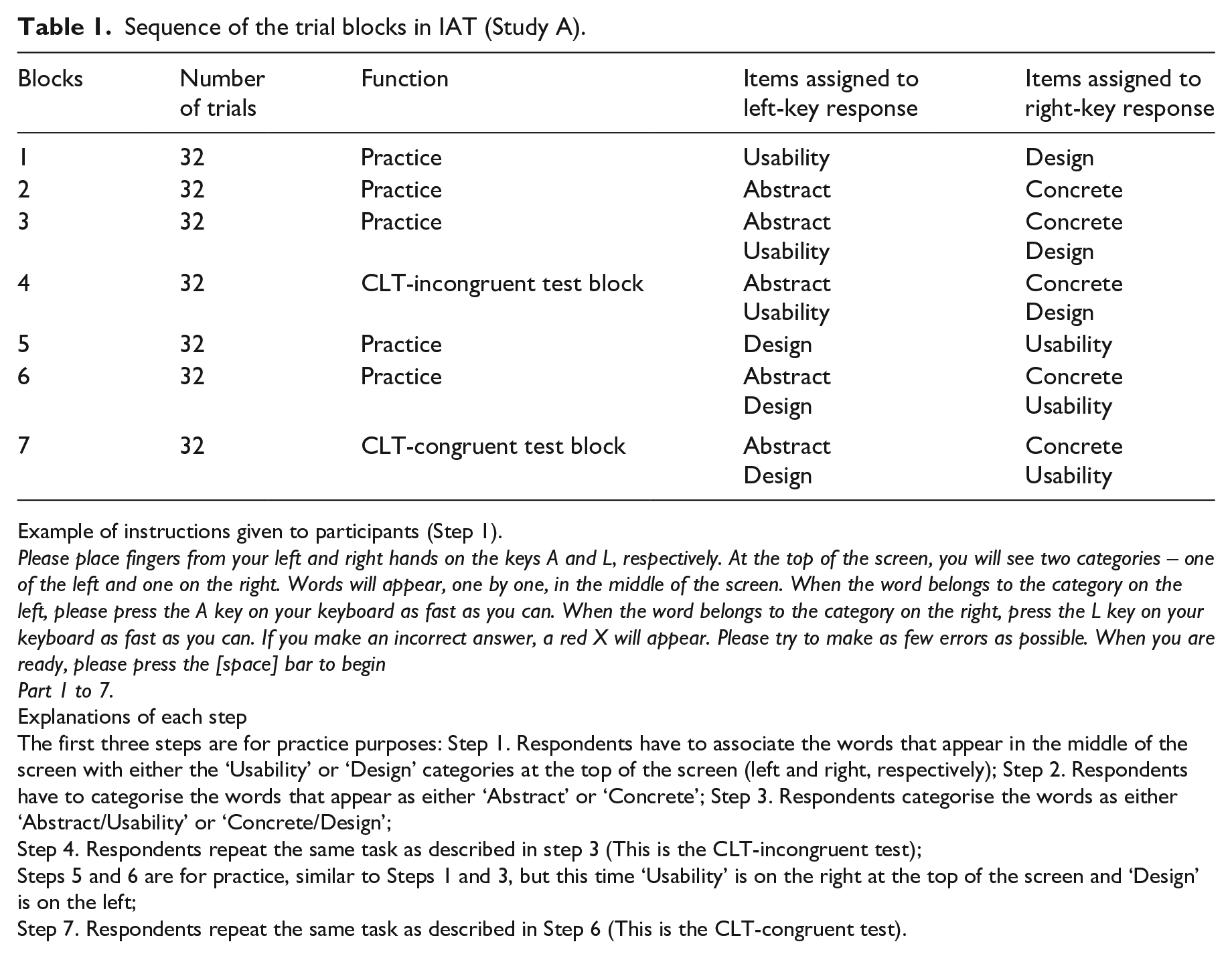
Example of instructions given to participants (Step 1).
Please place fingers from your left and right hands on the keys
Part 1 to 7.
Explanations of each step
The first three steps are for practice purposes: Step 1. Respondents have to associate the words that appear in the middle of the screen with either the ‘Usability’ or ‘Design’ categories at the top of the screen (left and right, respectively); Step 2. Respondents have to categorise the words that appear as either ‘Abstract’ or ‘Concrete’; Step 3. Respondents categorise the words as either ‘Abstract/Usability’ or ‘Concrete/Design’;
Step 4. Respondents repeat the same task as described in step 3 (This is the CLT-incongruent test);
Steps 5 and 6 are for practice, similar to Steps 1 and 3, but this time ‘Usability’ is on the right at the top of the screen and ‘Design’ is on the left;
Step 7. Respondents repeat the same task as described in Step 6 (This is the CLT-congruent test).
Measurements
The revised IAT scoring algorithm (Greenwald et al., 2003) used resulted in a final sample of 90 respondents (Mage = 19.20, SD = 0.67; 95.6% male). The data were scaled down due to: (1) eliminating nine trial response latencies over 10,000 ms, (2) excluding two participants with response times under 300 ms on more than 10% of the critical trials, (3) including all response latencies (wrong responses were transformed using the block mean and adding 600 ms), and (4) calculating two difference scores reflecting the response latency differences between the CLT-congruent and CLT-incongruent blocks. The first difference score used critical test blocks 4 and 7; the second used practice blocks 3 and 6. Each difference score was divided by the pooled SD of the associated blocks’ response latencies, and we averaged the quotients. The resulting measure is the IAT D effect (Greenwald et al., 2003). Mean response times were calculated in milliseconds for each critical block.
We used three control variables to rule out alternative explanations for the findings. Involvement during IAT task completion was measured using three seven-point items (very involved/very uninvolved, concentrating very hard / concentrating very little, paying a lot of attention/paying very little attention, α = 0.873) (Martin et al., 2009). Task enjoyment was measured with an item we created (To what extent did you like doing this association test? I did not like it at all = 1 to I liked it a lot = 7) and subjective task difficulty (What degree of effort did you use when doing the association test? Not a lot of effort = 1 to a lot of effort = 7).
Results
The response times are significantly faster in the CLT-congruent blocks than in the CLT-incongruent blocks (t(89) = 5.39; p < 0.0001; D = 0.18; SD = 0.32). The mean response time when participants classified stimuli into the CLT-congruent categories was 1,242.55 ms in the CLT-incongruent block 4 (SD = 295.03), compared with 1,166.01 ms (SD = 260.15) in the critical CLT-congruent block 7 (see Figure 3). In line with our predictions, Study A results show the participant responses to be faster in CLT-congruent conditions (abstract and design) than in CLT-incongruent conditions (concrete and design).
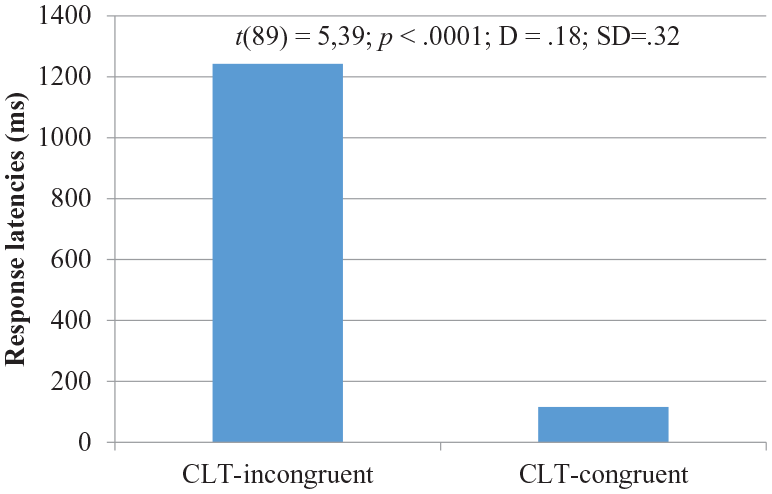
CLT-incongruent (concrete/visual design) versus CLT-congruent (abstract/visual design) associations according to IAT results (preliminary study A).
The results also indicate that none of the three control variables influenced the IAT D effect (involvement: t(88) = −0.14, p = 0.890; task enjoyment: t(88) = 0.80, p = 0.424; and task difficulty: t(88) = 0.84, p = 0.403), so those variables do not explain the implicit association.
In agreement with our conceptual assertion, the participants implicitly associate visual design with high-level (or abstract) features, which correspond to the first characteristic of a high-level construal. Building on that result, we further tested our assertion to show an association between the second characteristic of a high-level construal (i.e. desirability-focussed) and visual design in a new preliminary study using an explicit measure and real-life stimuli.
Preliminary Study B: Behaviour identification form
The purpose of preliminary Study B was to replicate the findings of the association between high-level construals and visual design shown in Study A. In Study B, we use the second characteristic of high-level construals and another measurement tool, the BIF (Vallacher and Wegner, 1989). The BIF allows exploring the association between a website’s visual design and its high-level (or desirability-focussed) construal. The BIF is a 25-item dichotomous response questionnaire in which respondents are asked to describe 25 actions. Previous studies have used this test to evaluate the construal level induced by psychological distance.
Participants and procedure
Study B examined whether priming individuals on visual design would lead them to adopt a high-level mind-set focusing on entity desirability instead of usability. Thirty French business school undergraduates completed a written questionnaire (age = 19.96, SD = 1.20; 78.6% males). The between-subjects factorial design included two different priming conditions by adapting the Lee et al. (2010) protocol to our context. The participants were exposed to a printed screenshot of a fictitious travel agency’s web interface. We primed either visual design or usability by asking the participants to think about the website’s visual design (visual design, n = 15) or how they would navigate it (usability, n = 15). They then completed the BIF, as developed by Vallacher and Wegner (1989). This test which requires to describe 25 actions (e.g. making a list) identified either as low-level construals, focusing on how the action is performed and on the feasibility of the action (e.g. writing things down), or as high-level construals, focusing on why or with what effect the action is performed, and on the desirability of the action (e.g. getting organised). They had to choose between those two descriptions for each action. Each high-level-oriented choice was coded as 1, with each low-level-oriented choice coded as 0. Scores were totalled for each participant, resulting in a high-level identification score (or a BIF score) ranging between 0 and 25 (MBIF = 16.07, SD = 4.03).
Results
We analysed BIF score variance (ANOVA) with the type of priming (visual design vs usability) as the independent variable. In line with our predictions, participants in the visual design condition achieved a higher BIF score than those under the usability condition (MVisual_Design = 17.67, SD = 3.83 vs MUsability = 14.47, SD = 3.68; F(1, 28) = 5.44, p = 0.027) (see Figure 4). That indicates that individuals under the visual design condition identify the actions using higher-level construals than those under the usability condition.
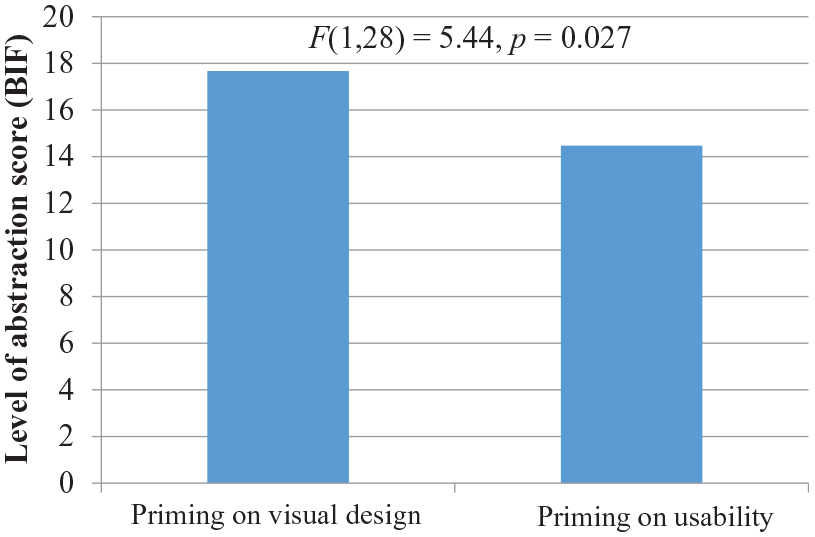
BIF scores across visual design versus usability priming conditions (preliminary study B).
Having validated our conceptual assertion regarding the relationship between visual design and high-level construals, we further tested our research hypotheses through two main studies. Study 1 tested H1 and H2. Study 2 tested H3 and H4.
Study 1: The influence of website use on consumer intentions
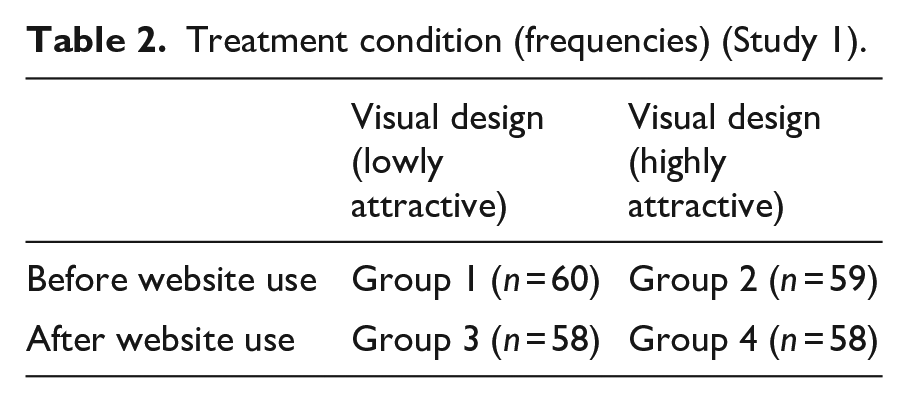
Study 1 tests H1 and H2, with two types of website use (before vs after use) combined with two levels of visual design (lowly vs highly attractive) to produce four treatment conditions. Table 2 shows the design details.
Treatment condition (frequencies) (Study 1).
Subjects
Using a French Qualtrics panel of Internet users over the age of 18, we collected 235 online responses, which were randomly assigned to one of the four conditions (58–60 participants in each of the four experimental cells) (Table 2). Males comprised 49.8% of the sample (Mage = 41.09, SD = 12.80). In terms of familiarity with websites, there is no difference between the two design conditions (Mfam_lowly_attractive = 4.45, SD = 1.34; Mfam_highly_attractive = 4.62, SD = 1.60; t(233) = 0.91, p = 0.366) or between the two website use conditions (Mfam_before = 4.66, SD = 1.51; Mfam_after = 4.41, SD = 1.44; t(233) = 1.35, p = 0.180; I am familiar with browsing websites from 1 = I do not agree at all to 7 = I totally agree).
Experimental procedure
The participants were exposed to a travel agency’s web interface for a visit to Morocco. The stimulus was identical to an actual web interface, with the participants offered various options, such as type of stay, hotel category, city, hotel comparison, and activities. A web developer created two versions of the web interface to operationalise the independent variables. The participants were first exposed to the site, then had to provide information about it and answer questions about their experience, which was measured in terms of intention to use (under the before-use condition) or intention to reuse (under the after-use condition) the system and intention to recommend it to others. Additional questions checked the manipulation of the visual design and profile (e.g. age, gender and familiarity with travel websites). Intention to use and intention to reuse the system refer to potential subsequent use of the travel system in question, with the reference point as the stage when consumers express their intentions: after merely being exposed to a system (before-use condition) or after system navigation (after-use condition).
Measurement
Independent variable
Similar to Minge (2008), we simultaneously manipulated three noticeable design characteristics which, at first sight, create lowly attractive versus highly attractive visual design conditions: colour combinations, symmetry and framework shapes.
Colour: Individuals holistically process colour pairs (Schloss and Palmer, 2011). Low contrasts between colours lead to greater feelings of harmony that increase individual preferences (Ou and Luo, 2006) and are preferred over combinations of high-contrast colours (Minge, 2008). As colours with long wavelengths (e.g. red) are less appealing than colours with short wavelengths (e.g. green) (Jacobs and Hustmyer, 1974), we assume that combinations of contrasting background colours (e.g. red and green) would be less attractive than backgrounds with more balanced colour combinations (e.g. orange and blue pastel colours).
Symmetry: Symmetry has a positive effect on consumer website perceptions (Tuch et al., 2010) and Gestalt psychology laws of perceptual organisation recognise its role in visual design. Symmetry guides perceptions of website beauty by establishing a regular structure and meaningful form on interfaces (Bauerly and Liu, 2006). We use block alignment as a specific component of vertical symmetry that increases interface attractiveness (Tuch et al., 2010) and assume that aligned blocks would be more attractive than non-aligned blocks.
Framework shape: Consumers tend to prefer round objects to angular ones (Westerman et al., 2012). Round objects appeal more than sharply contoured ones due to the common knowledge that sharp objects can cause physical harm (Bar and Neta, 2007). We assumed that round framework shapes would be more attractive than square framework shapes.
A web designer combined those three characteristics to create two versions of the travel system. The highly attractive condition included a low background colour difference (pastel orange and blue, and white), aligned blocks and round framework shapes. The lowly attractive condition included a high background colour difference (green and red), non-aligned blocks, and square framework shapes (see Figure 5). Two design developers also assessed the interfaces. Participants either viewed a site screenshot (before actual use) or were asked to navigate the interface (after actual use) and evaluate their experiences, with consistency ensured by all undertaking the same number of tasks. The before-use scenario involved three tasks with two printed screenshots showing a lowly or highly attractive visual design (e.g. ‘What is the activity offered by the online travel agency?’). The after-use scenario had three tasks involving navigating one of the two web interfaces (e.g. ‘How many five-star hotels offer a desert visit?’).
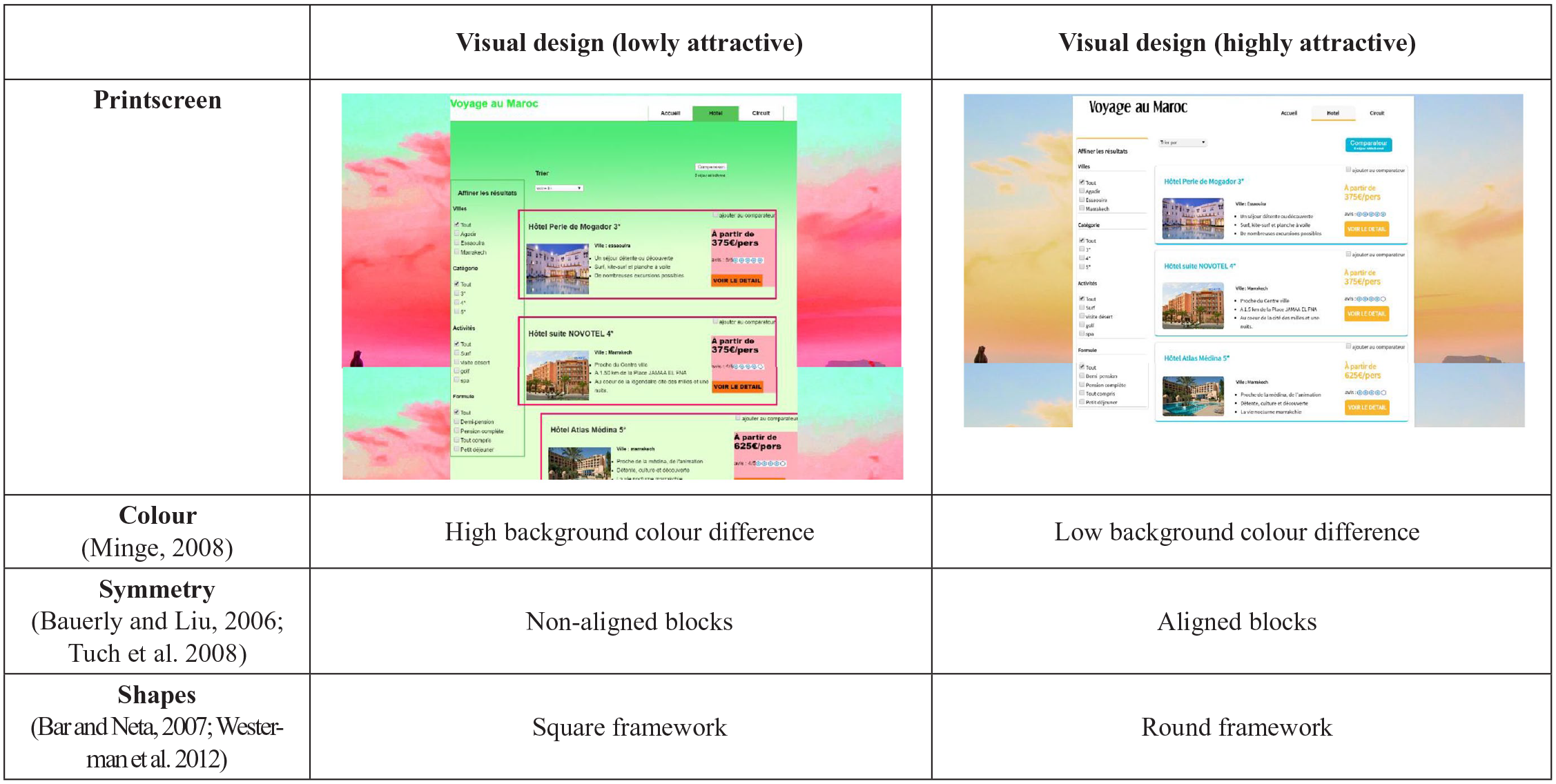
Website stimuli used in Study 1 and Study 2 (created and implemented by a web developer).
Dependent variables
We measured intention to use (before-use condition) or to reuse (after-use condition) the system with a two-item scale adapted from Venkatesh et al. (2003): ‘I intend to add this website to my bookmarks’; ‘I intend to use this website to book my trip’ (from 1 = strongly disagree to 7 = strongly agree) (Pearson correlation coefficient = 0.886, p < 0.0001). We used one item adapted from Finn et al. (2009) to measure intention to recommend, ‘I would recommend this website’ (from 1 = strongly disagree to 7 = strongly agree).
Manipulation checks
To check the manipulation of the visual design, we used a three-item scale of perceived design adapted from Ben-Bassat et al. (2006): ‘This website seems visually attractive’; ‘This website seems beautiful’; ‘This website seems to have an attractive design’ (from 1 = strongly disagree to 7 = strongly agree) (Cronbach’s alpha = 0.963). The perceived visual design result is higher in the highly attractive condition than in the lowly attractive condition (Mlowly = 4.27, SD = 1.58; Mhighly = 5.07, SD = 1.31; t(233) = 4.228; p < 0.0001).
Control variables
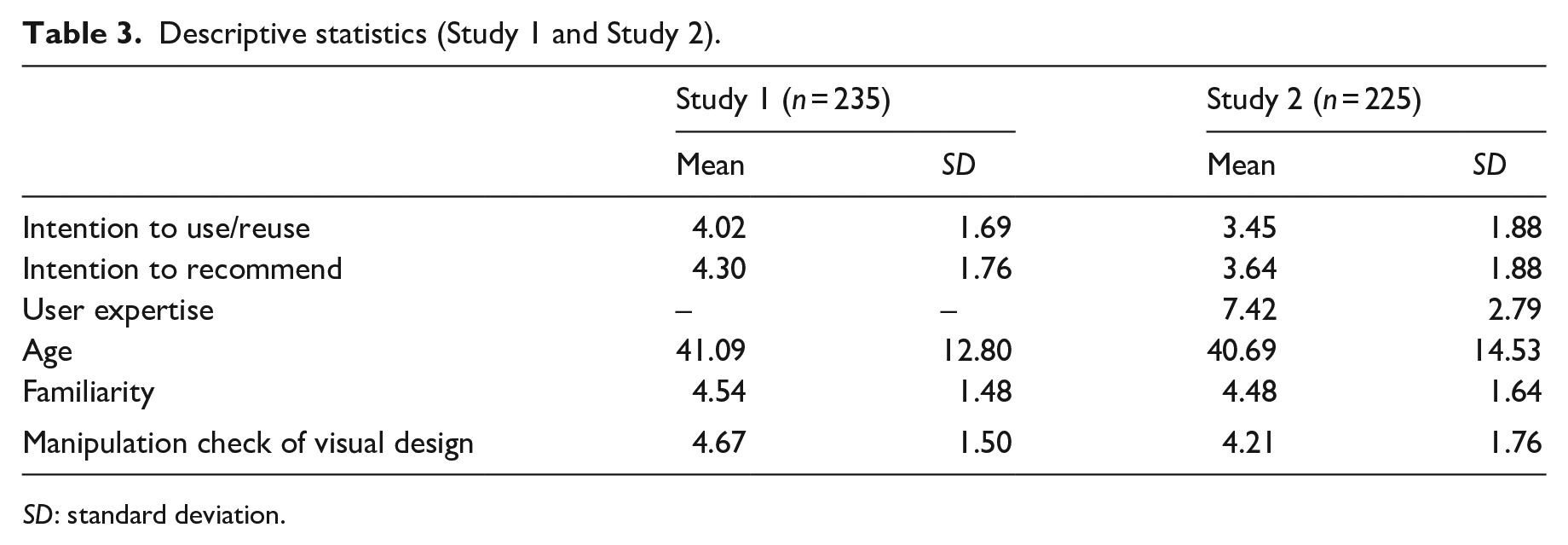
There was no difference between the visual design conditions in terms of gender (χ2 = 1.54, p = 0.215), familiarity (t(233) = 0.91, p = 0.366) or age (t(233) = 0.65, p = 0.516). A statistically significant difference between the website use conditions was noted in terms of gender (χ2 = 4.09, p = 0.043) and age (Mbefore: 42.71 years old (SD = 12.77) > Mafter: 39.41 years old (SD = 12.67)); t(233) = 1.99, p = 0.048), but not in terms of familiarity (t(233) = 1.35, p = 0.180). As such, we added gender and age variables as covariates to the model for testing our hypotheses. Table 3 presents the sample’s descriptive statistics.
Descriptive statistics (Study 1 and Study 2).
SD: standard deviation.
Data analysis
Two regression models using the Preacher and Hayes (2004) macro for SPSS tested the effects of visual design and website use, and their interaction time frames, on intention to use/reuse and intention to recommend (see Table 4). The results show that interface visual design had a statistically significant positive main effect on intention to use/reuse (Mlow: 3.78 (SD = 1.74) < Mhigh: 4.26 (SD = 1.61); t(233) = 2.12, p = 0.036, b = 0.230) and on intention to recommend (Mlow: 4.03 (SD = 1.72) < Mhigh: 4.57 (SD = 1.76); t(233) = 2.36, p = 0.019, b = 0.270), but website use had no statistically significant main effect on the two dependent variables. More importantly, a statistically significant interaction effect was recorded on intention to use/reuse (t(233) = −1.96, p = 0.052, b = −0.213) and on intention to recommend (t(233) = −2.21, p = 0.028, b = −0.249). The spotlight analysis showed, for both intentions, a statistically significant difference between the lowly and highly attractive design conditions before use (intention to use: t(233) = 2.90, p = 0.004; intention to recommend: t(233) = 3.26, p = 0.001), but no statistically significant difference between the lowly and highly attractive design conditions after use (see Figure 6, Graphs (a) and (b)). In line with H1 and H2, those results indicate that the visual design of an e-commerce site has a stronger impact before actual use than after actual use. Age and gender were used for control purposes, and added as covariates (Model 1.2 and Model 2.2, Table 4). Age appears to have a positive direct effect on consumer intentions.
Results of regression analysis (Study 1, n = 235).
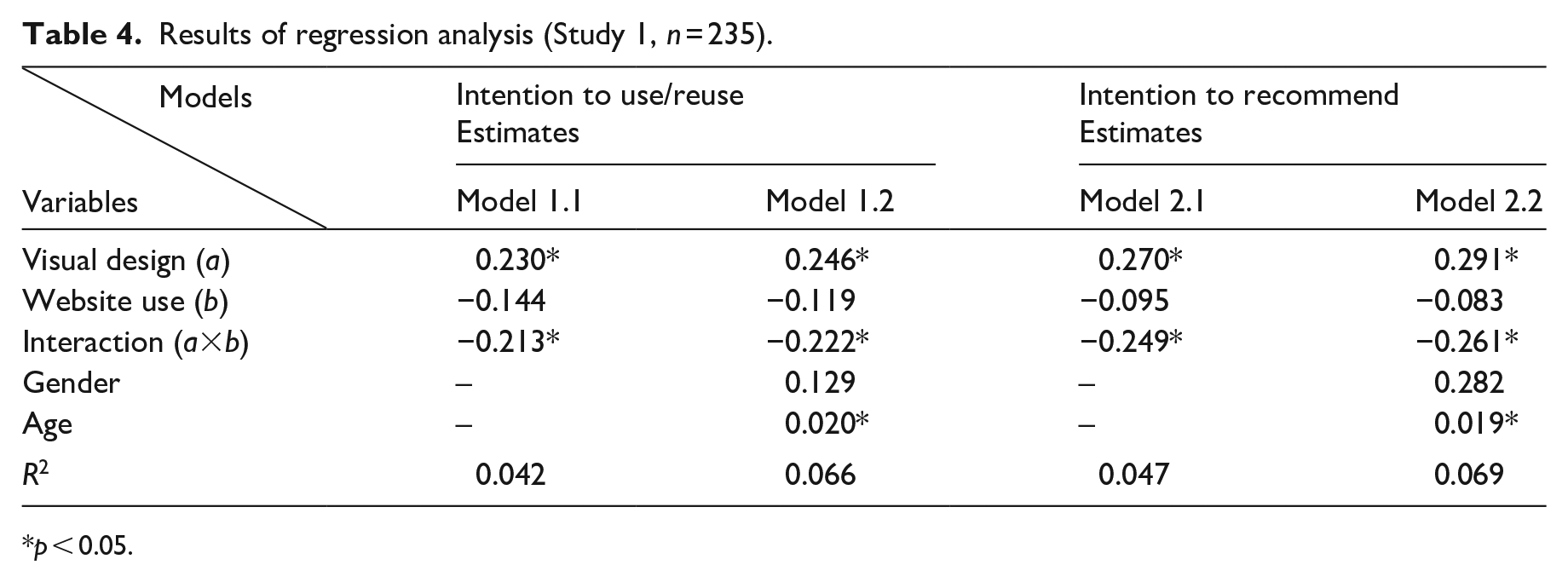
p < 0.05.
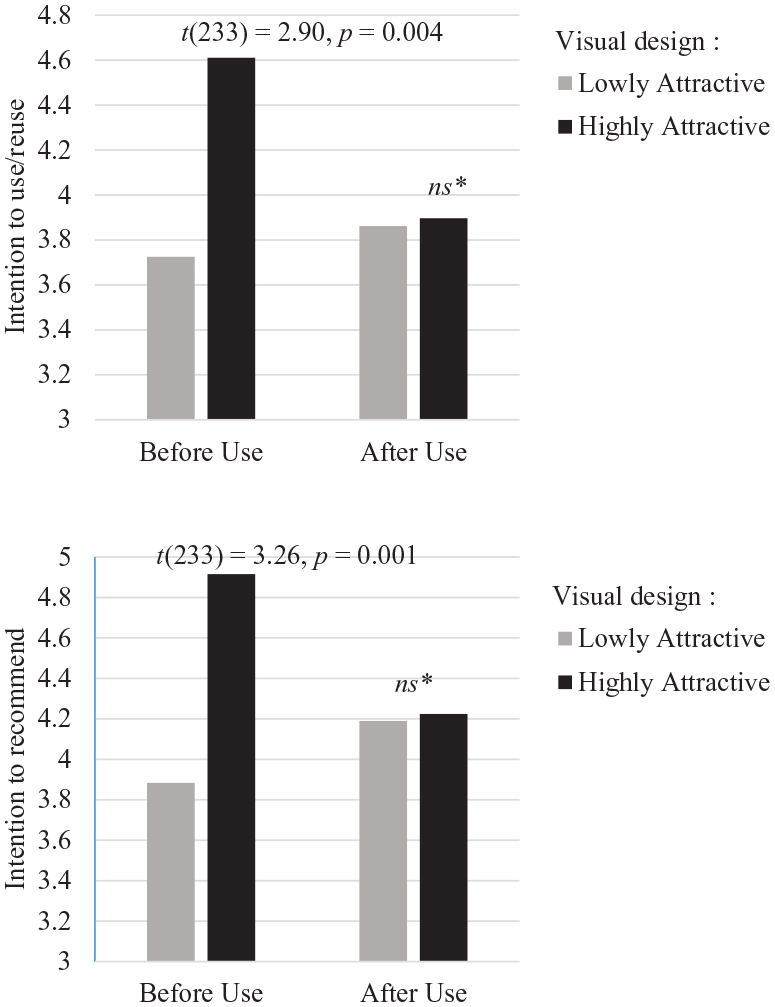
Interaction effect between visual design (lowly vs highly attractive) and website use (before vs after) on (a) intention to use/reuse and (b) intention to recommend.
In line with previous studies, the results show that consumer intention is higher when the visual design is highly attractive. More importantly, our results suggest that the effect depends on website use, as it only appears to be significant before use. Building on that finding, we aimed to gain a deeper understanding of the effects of visual design by introducing a boundary condition to their occurrence during the after-use condition.
Study 2: The moderating role of user expertise after use
Subjects, procedure and measurements
Using a similar panel and procedure to Study 1, we collected 225 responses from participants randomly assigned to one of the two visual design conditions (109 in the lowly attractive condition and 116 in the highly attractive condition). The participants (49% male, Mage = 40.69, SD = 14.53) were fairly familiar with travel websites (M = 4.48, SD = 1.64; responding to the statement, ‘I am familiar with travel websites’ from 1 = strongly disagree to 7 = strongly agree). The main difference between the Study 1 and Study 2 procedures was that a user expertise measure was calculated for Study 2.
As with Study 1, Study 2 involved questions about browsing one of two web interfaces depending on the experimental condition. Our measure of user expertise reflects the definitions provided by Alba and Hutchinson (1987) and Grossman and Fitzmaurice (2015) and is consistent with prior studies (e.g. Demangeot and Broderick, 2010; Roehm and Sternthal, 2001; Sujan, 1985). A user expertise score was constructed by totalling each participant’s score on each of the 12 questions asked (four questions for each of the three different navigation tasks), with a correct response valued as 1 and an incorrect response as 0. For example, one task asked participants to look for a five-star hotel offering a desert trip. They had to answer four questions related to (1) how many hotels they found, (2) the hotel name(s), (3) the city/cities where the hotels were located and (4) the price(s) to book a room in the hotel(s). There was only one correct answer for each question, so each participant could get a user expertise score ranging from 0 to 12 (Mexpertise = 7.42, SD = 2.79, Min = 2, Max = 12) (see Table 3). Study 2 used the same scales as described for Study 1 to measure intention to reuse (r = 0.944, p < 0.0001) and intention to recommend. Table 3 shows the sample’s descriptive statistics.
Manipulation check and control variables
The Study 2 manipulation check is the same three-item scale as described in Study 1 (Cronbach’s alpha = 0.99). That indicates that the perceived design is more attractive under the highly attractive condition than under the lowly attractive condition (Mlowly = 3.74 (SD = 1.80) < Mhighly = 4.65 (SD = 1.61); t(223) = 3.98, p < 0.0001). No statistically significant difference was recorded between the two conditions in terms of age or familiarity (age: t(197) = 0.905, p = 0.366; familiarity: t(223) = 0.718, p = 0.473), or in terms of gender (χ2 = 1.64, p = 0.200). Likewise, no statistically significant difference was found in the expertise scores across the visual design conditions (F(1, 223) = 0.585 p = 0.445; Mexp_lowly_attractive = 7.28 (SD = 2.70) vs Mexp_highly_attractive = 7.56 (SD = 2.88)).
Data analysis
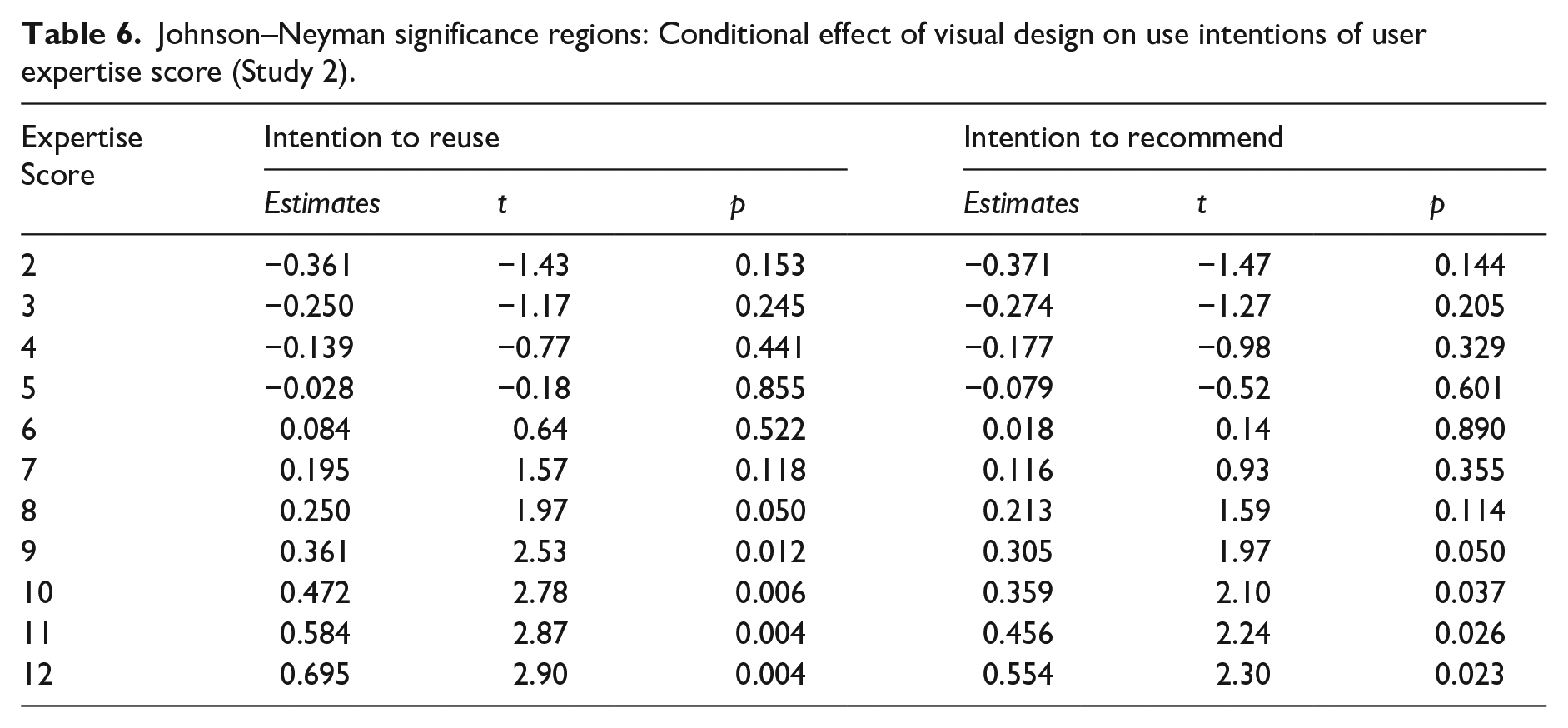
We applied two regression models using the Preacher and Hayes (2004) macro for SPSS to test the effects of visual design, user expertise, and interaction stage on intention to reuse and intention to recommend (see Table 5). The results show that neither visual design nor user expertise has a statistically significant main effect on user intentions. A statistically significant interaction effect was, however, observed on intention to reuse (t(223) = 2.49; p = 0.014, b = 0.111) and on intention to recommend (t(223) = 2.17; p = 0.031, b = 0.097). Using the Johnson–Neyman test, the floodlight analysis identified regions along the user expertise continuum where the simple effect of visual design was and was not significant. For both intentions, when the user expertise level increases, the visual design effect on consumer intentions becomes statistically significant (intention to reuse: ranging from 8 to 12; intention to recommend: ranging from 9 to 12) (see Table 6 and Figure 7). In line with H3 and H4, those results indicate that the visual design impact depends on how a consumer performs when using the e-commerce site. Age and gender were used for control purposes and added as covariates. Still, the results show no simple effect on the two dependent variables, with the interaction result unchanged by their addition (Model 1.2 and Model 2.2, Table 5).
Results of regression analysis (Study 2, n = 225).
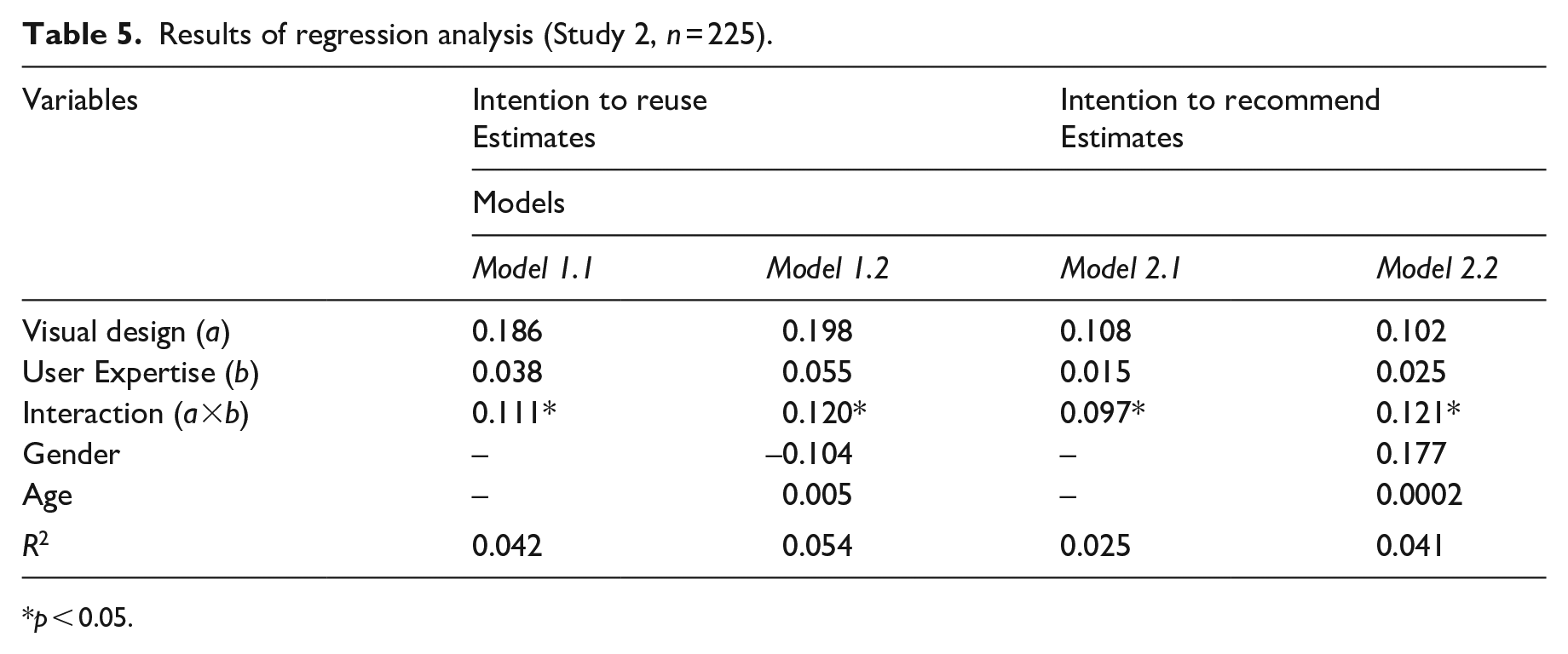
p < 0.05.
Johnson–Neyman significance regions: Conditional effect of visual design on use intentions of user expertise score (Study 2).
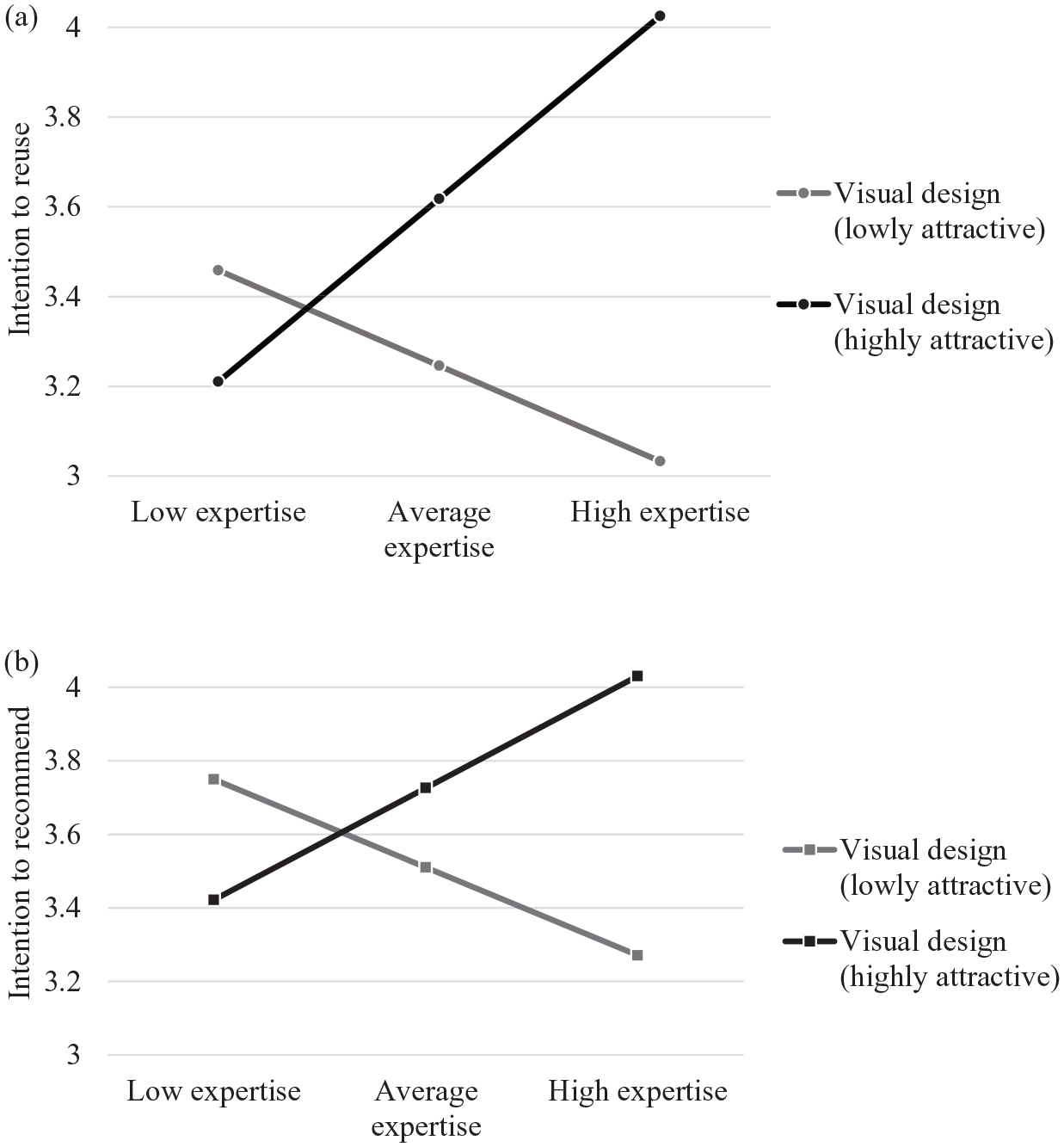
Moderating effect of user expertise on the impact of visual design on (a) intention to reuse and (b) intention to recommend in post-use situation.
The aim of Study 2 was to improve our understanding of an e-commerce site’s visual design impact on intentions to reuse and recommend it after actual use. The results show that visual design has no direct effect on such intentions, but those effects depend on the consumers’ ability to perform product-related tasks successfully. The visual design positively influenced the adoption process only when consumers performed well during site navigation.
Discussion
Theoretical contributions
This research makes several contributions to the literature. It uses the CLT framework to offer a new perspective for understanding visual design’s complex effects. Indeed, to the best of our knowledge, our research is the first to provide empirical evidence that visual design triggers high-level (or abstract) construals. We use renowned tools to show the implicit associations between visual design and abstract concepts (IAT) and evaluate the construal levels induced by an e-commerce site (BIF). This work also contributes to the temporal distance literature. Such psychological distance is studied in various contexts, such as communication (Kim et al., 2009) and pricing (Bornemann and Homburg, 2011). Similar to Ho et al. (2015), our research applies the temporal distance concept to understand how consumers interact with e-commerce websites. In particular, it extends the work of Thompson et al. (2005) by focusing on how the time frame in which a system is used influences consumer responses to visual design.
Our findings are unique within visual design research, where most digital system studies examine the effects after a single exposure or after use. In line with Thompson et al. (2005), our research focuses on those two stages simultaneously and shows that the time of judgement modifies the effects of visual design on consumer intentions. The positive effects of visual design after merely being exposed to a product or system are well-recognised in the literature and confirmed by our research. A more important result is that visual design still positively influences consumer intentions in a post-use situation, but only when users have gained a high level of expertise in using the website. That finding concurs with research highlighting experts’ superior perceptual skills to those of novices in various domains. For example, experts are more able than novices to process visual information holistically (Sheridan and Reingold, 2017), rapidly distinguish between visual areas relevant for making judgements on environmental stimuli (Sheridan and Reingold, 2014), and solve complex tasks after glancing very briefly at a picture (Kundel et al., 2007). Our study shows that experienced users are more able to take account of website design elements in an evaluation than less experienced users.
Our research also adds to the literature on the early stages of consumer interaction with technological innovations (Lakshmanan and Krishnan, 2011). Understanding how people use interactive devices is critical because under-usage (or non-usage) can negatively affect consumer satisfaction (Shih and Venkatesh, 2004). Our findings clarify how an e-commerce site’s visual design contributes to user retention, as the recommendation intention is a strong predictor of user loyalty and positive word of mouth (Moldovan et al., 2011).
Managerial implications
This research identifies an important condition in the emergence of the beneficial effects of websites’ visual design during the use phase: acquiring the skills needed to browse an interface smoothly. In other words, our results show that consumers only appreciate visual design if they can find products or information easily. That result is consistent with the Nielsen Norman Group’s recommendations to companies in a report about interface design: A pretty design can make consumers more forgiving of minor usability problems, but not of larger ones. (As the first law of e-commerce states, if the consumer can’t find the product, the consumer can’t buy the product). Even great-looking sites will have no revenue if they suffer from poor findability).
5
Our results provide empirical evidence of the conditioned role of visual design discussed by the Nielsen Norman Group. Thus, our research validates the observation that skills-acquisition enabling consumers to achieve their goals successfully is necessary for visual design to be beneficial in terms of consumer intentions. We believe that companies should implement tools to facilitate interface browsing and ensure that consumers can easily access the information they want. Although companies currently invite consumers’ purchasing experience feedback, we suggest that practice be extended to cover information-search activities. If such feedback suggests that consumers are not navigating the system effectively (e.g. failing to find the information they require), companies can help to improve that aspect and, as indicated by our results, give consumers the opportunity to derive benefits from the visual design of the e-commerce site.
Some companies have been investing in design, especially in intensely competitive industries (Luchs et al., 2015), as a point of differentiation and a potential source of value (Luchs and Swan, 2011). Nevertheless, significant spending to create appealing systems cannot lead to success if consumers do not value those systems. We also recommend that companies consider the positive effects of visual design on intention to recommend a system, as recommendation intent is considered a positive word-of-mouth indicator. A Word-of-Mouth Marketing Association report (Fay, 2014) stresses the significant value of word of mouth for marketers: ‘Nothing persuades brand trial, adoption and loyalty better than a recommendation from another consumer, particularly a trusted friend or family member’ (p. 3). As our research provides evidence of visual design’s positive influence on the intention to recommend a system, companies should consider that visual design investments could potentially generate long-term benefits for customer acquisition and retention strategies.
Limitations and avenues for future research
This research has several limitations, which serve as avenues for future research. First, it focuses on the day-to-day, utilitarian activity of searching for information. It would be interesting to examine whether our findings apply to hedonic tasks when navigating systems, especially as the Internet is becoming an entertainment source to fulfil consumers’ hedonic needs (Novak et al., 2000). This study could also integrate the hedonic aspect of the experience. In trying to understand how visual design affects online customer experience, the role of hedonic variables can be studied, such as pleasure, which is the intensity with which an individual feels joy and contentment with their environment (Broach et al., 1995). That variable seems especially interesting as a strong correlation appears between the appeal of a website and the amount of pleasure experienced by users during their interactions (Lavie and Tractinsky, 2004).
Second, this research uses a categorical variable to study the moderating role of website use since the aim is to explore the effect of visual design both before and after use. Future studies should study more diverse times of judgement. Indeed, we concentrate on initial interactions with a single interface to understand the consumer experience as it unfolds. As such, the results only indicate visual design’s short-term effects. After a few days, participants could have been asked to revaluate their experience to assess whether the visual design impact remains the same. More research is needed to assess visual design’s long-term influence and external validity. Using a continuous variable would allow more precise identification of the point at which visual design impact decreases. Future research should seek to replicate our findings in prolonged use and real market conditions, but focusing on the early use experience stage is critical, as learning costs are especially high for technological innovations at that stage (Ziamou et al., 2012).
Finally, another interesting avenue for research would be to include in our experimental design some individual variables likely to moderate the effects observed in our study. Adding other variables could also help increase the model’s determination coefficient. Particularly valuable variables to consider would be the centrality of visual product aesthetics or the level of importance that visual design holds for consumers in their relationships with products. It may affect the visual design impact (Bloch et al., 2003).
Footnotes
Acknowledgements
We thank Sophie Dupuy-Chessa and Eric Céret from Laboratoire Informatique de Grenoble for their collaboration on this project and Darren Dahl for feedback on earlier versions.
Funding
The author disclosed receipt of the following financial support for the research, authorship and/or publication of this article: This work was supported by the French National Research Agency in the framework of the Investissements d’Avenir programme (ANR-15-IDEX-02).