




Abstract
The British Urology Researchers in Surgical Training (BURST) is a UK-based, trainee-led urology research collaborative. Since inception in 2014, BURST has led projects in several urological subspecialties with the aim of improving urological practice for patient benefit. Key innovations we have used include an emphasis on social media communications and developing innovative technology solutions to improve collaboration. In this review article, we summarise our recent studies and highlight important strategies for performing collaborative research.
Introduction
The British Urology Researchers in Surgical Training (BURST) is a UK-based, trainee-led urology research collaborative. We aim to produce high-impact multicentre research that improves patient care. Collaborative research has emerged as an efficient method for investigating clinical questions. This approach can deliver large, prospective global data sets which would otherwise be challenging to produce through conventional, single-centre studies.
Research collaboratives can produce large data sets from a range of international sites. A key starting point for all BURST studies is the establishment of a subcommittee group and external steering committee to aid study design. 1 Following study launch, a large network of international collaborators from hospital sites provides data from their local institution. Large numbers of centres can participate, culminating in data sets which are representative of global populations. Adequate powering of studies is a key advantage of collaborative studies and can help answer several research questions in a single study. The RESECT, IDENTIFY and MIMIC studies conducted by BURST have sample sizes of 19,505, 11,059 and 2518 patients, respectively, improving the ability of analyses to answer multiple research questions2–4 within a single data set. The traditional method of running clinical studies is still appropriate to answer some research questions or to help generate pilot data and hypotheses, but small single-centre studies may still be limited in generalisability and applicability. In contrast, conventional single-centre studies may be better suited to complex study designs or long follow-up periods.
BURST is a non-profit organisation led by urology surgeons in training, doctors and medical students, with input from consultant urologists, statisticians, health economists, patients and members of the public. Since its inception in 2014, BURST has published several papers exploring diverse topics in urology. In this review article, we outline some of our recent work, from the establishment of the collaborative in 2014 to ongoing studies and highlight some important learning points from our collaborative.
Brief history
The concept and subsequent formation of BURST was inspired by a presentation of the ROSSINI study by the West Midlands General Surgery Collaborative at the British Association of Urological Surgeons (BAUS) annual conference in 2014.5,6 The ROSSINI study was one of the earliest examples of a trainee-led collaborative project in the UK and was the first multicentre observer-blinded randomised controlled trial (RCT) of sufficient size and quality to establish whether the use of a wound-edge protection device in adult patients undergoing abdominal surgery leads to a lower rate of surgical site infection. Over the last 10 years, BURST has led a similar collaborative approach within the UK urology community, continuing the strong involvement in academic urology by British trainees. The committee of BURST has grown from a small team to an organisation comprising 30 core members and an additional panel of international representatives. In keeping with its expansion, BURST has delivered projects in most urological subspecialities, focussing on studies that may have direct implications for clinical practice (Figure 1).
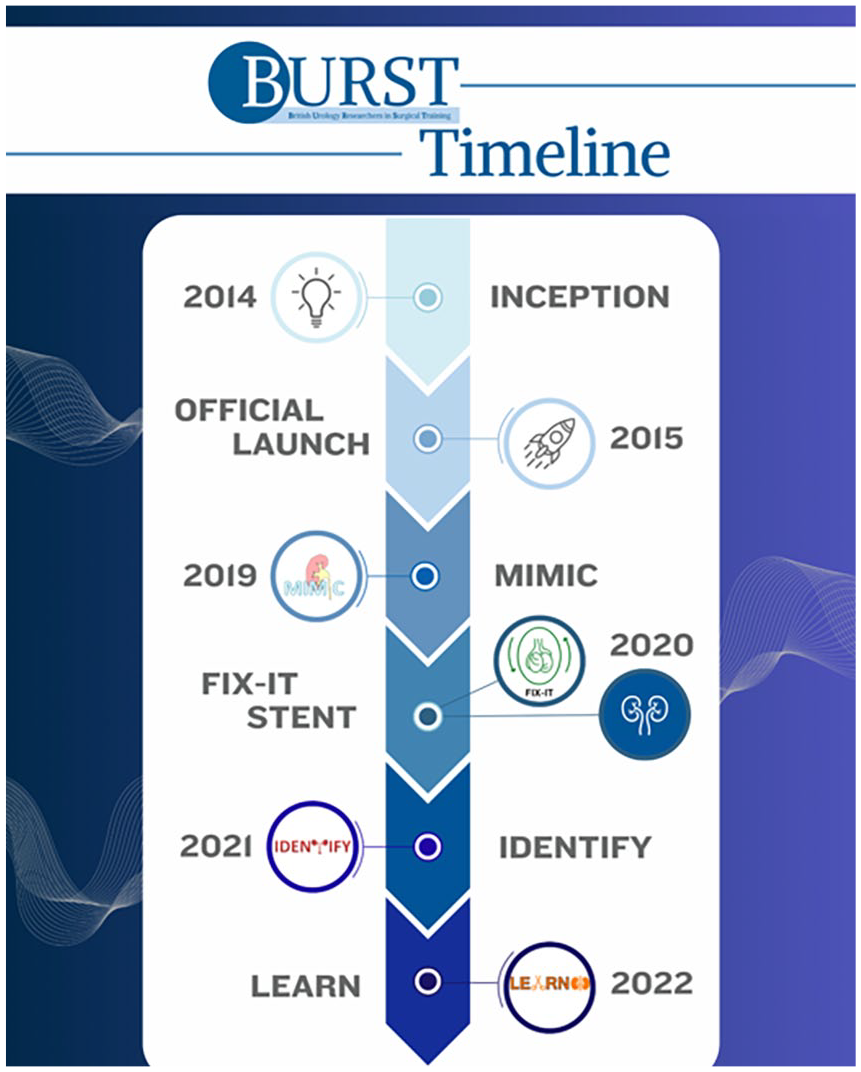
A timeline of completed BURST projects.
The first project by BURST was an international cohort study (Multi-centre cohort study evaluating the role of Inflammatory Markers In patients presenting with acute ureteric Colic, or MIMIC), designed to identify the factors associated with spontaneous stone passage (SSP) in acute ureteric colic patients, with a particular focus on inflammatory markers. Overall, 4170 patients were recruited from over 71 sites and 4 countries. 4 The findings demonstrated no association between inflammatory markers (including white cell count, C-reactive protein) with SSP and confirmed stone size and position as one of the most important prognostic factors. MIMIC is a comprehensive prospective data set evaluating the potential contributors to SSP. Since publication, BURST has developed a calculator to aid clinicians with decision-making for patients with acute ureteric colic by predicting the chance of SSP.
Following on from MIMIC, BURST produced another large international prospective observational study in the form of IDENTIFY (the investigation and detection of urological neoplasia in patients referred with suspected urinary tract cancer: a multicentre observational study). 3 IDENTIFY investigated the prevalence of urinary tract cancers in patients referred to secondary care due to haematuria. IDENTIFY accrued a greater sample size than all previous studies, enabling adjustment for risk factors and geographical variation. The results were developed into a risk calculator to determine the chance of malignancy in patients with haematuria, which may aid clinicians in their decisions regarding management. 7 We anticipate the findings may aid development of a risk-stratified approach to haematuria investigation pathways.
Aside from large observational studies, BURST has also conducted other types of research to improve best practice in common urological operations. An example is FIX-IT, a project which addresses the lack of guidelines on the technical conduct of scrotal exploration. A consensus document has been created based on input from numerous specialists and trainees from the UK, which is endorsed by BAUS. 8 In addition, BURST produced the Survey on ureTEric draiNage post uncomplicaTed ureteroscopy (STENT). Findings from STENT support the feasibility of using an RCT to investigate if no ureteric drainage is superior to ureteric drainage. It also identified self-reported reasons for stent placement by surgeons following ureteroscopy. 9
In addition to research output, education is also a primary objective considering the trainee-led nature of BURST. LEARN (standing for uroLogical tEAching in bRitish medical schools), is a comprehensive audit of undergraduate urological education in the United Kingdom.10,11 The results show urological teaching is satisfactory when benchmark-ed against the British Association of Urological Surgeons (BAUS) undergraduate syllabus. However, findings from LEARN also emphasise the lack of placement opportunities and experience in catheterisation procedures. BURST has also developed educational modules for British Journal of Urology International (BJUI) knowledge platform, most recently a point-of-care ultrasound course for testicular torsion derived from our RESCUE project. 12 This has been delivered as an in-person course as well.
Recent and future studies
BURST has multiple projects in development (Figure 2). Several projects are closed to recruitment and are now in the process of data analysis and dissemination. A key study BURST awaiting publication is RESECT. RESECT is our largest project to date. 2 It is an international observational study with an embedded cluster RCT evaluating the use of audit and feedback to improve the quality of TURBT and answer whether this is associated with a reduction in early recurrence rates of non-muscle invasive bladder cancer. RESECT evaluates institution-targeted performance feedback and educational instrument versus standard of care (i.e. no performance feedback in the control arm).
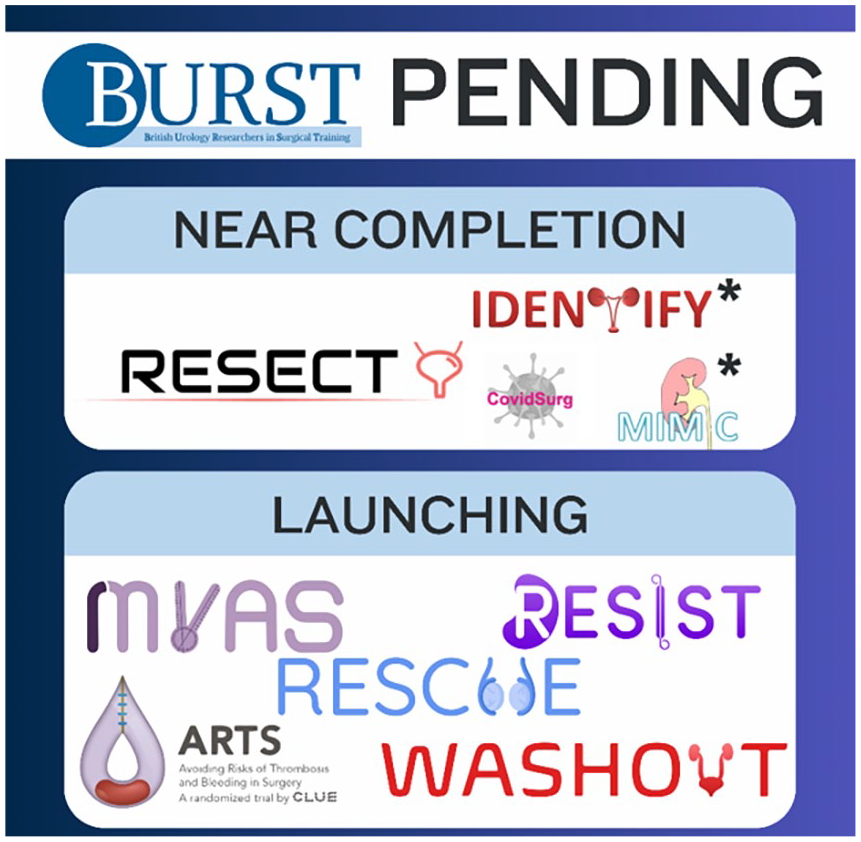
An overview of upcoming BURST research projects.
WASHOUT (Ward AdmiSsion of Haematuria: an Ob-servational mUlticentre sTudy) is our next large-scale project, 13 for which site registration and data entry has op-ened (Figure 3). As seen in IDENTIFY, 32% of patients admitted with unscheduled haematuria have a urological malignancy, with a 30-day mortality of 5% and 1-year mortality of 23%. 3 In England alone, 25,000 patients are admitted annually with unscheduled haematuria, comprising 15% of all urological emergency admissions. 14 There are no guidelines as there is a lack of evidence underpinning best practice, and there is likely wide variation in management across studies. 15 WASHOUT aims to address this gap in the literature by analysing current management practices and subsequent patient outcomes in institutions internationally. The primary outcome is length of stay. Using the findings, BURST hopes to contribute to the development of a consensus guideline and an implementation study in future. Currently, pre-registration statistics have surpassed initial targets. Over 400 sites have expressed interest, the largest number for any BURST project so far. WASHOUT has now opened for formal registration (https://redcap.link/washoutregistration).
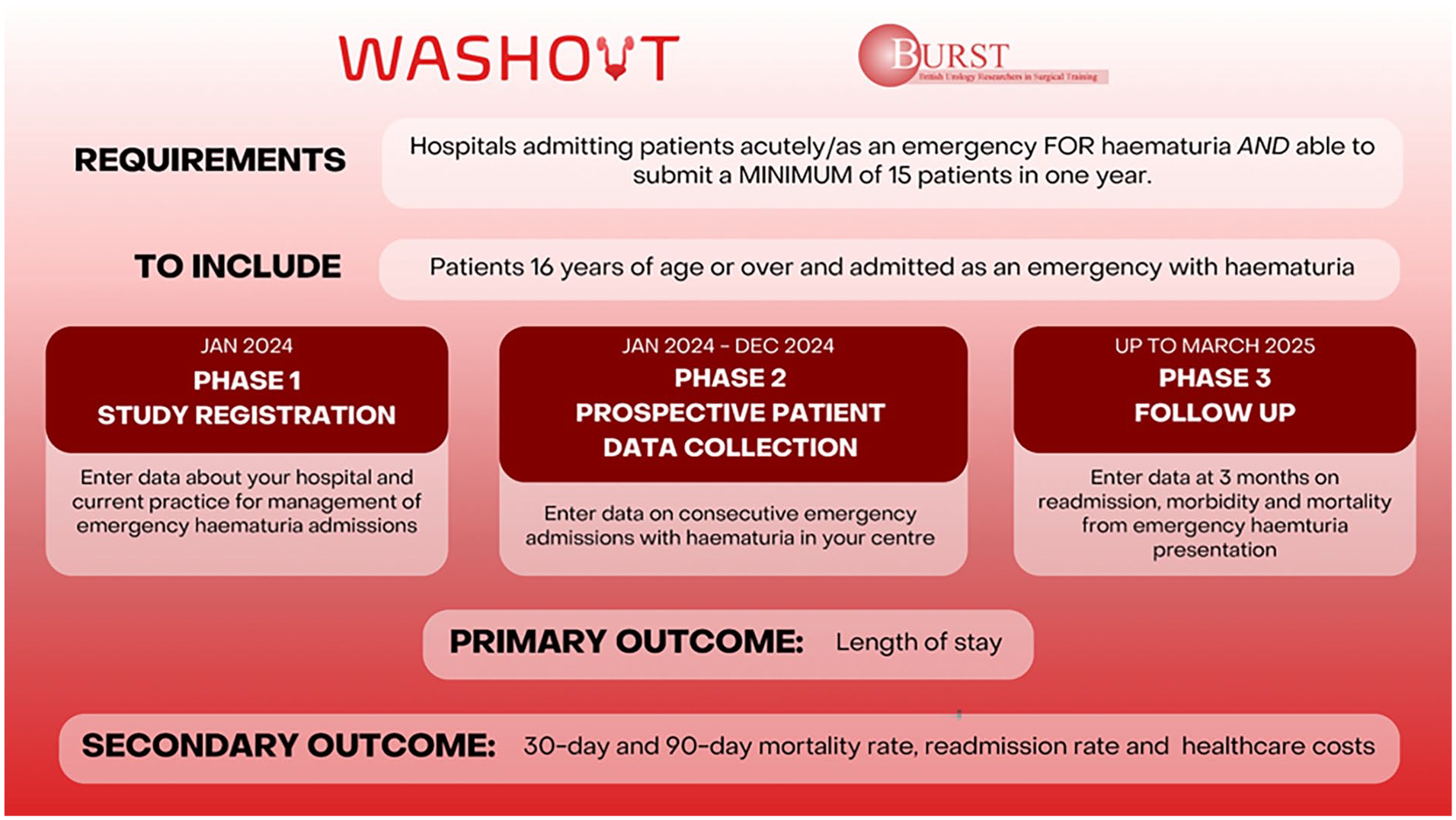
Infographic on WASHOUT.
BURST is also seeking to expand our educational content with the launch of the LANDMARK platform. LANDMARK is a free wiki-style online resource of peer-reviewed summaries of seminal papers in urology which form the basis of modern clinical practice. The purpose of the website is to act as a revision resource for trainees undergoing specialist exams such as the FRCS, and for clinicians to refresh their knowledge on the key evidence underpinning modern urology. The LANDMARK website will be launching mid-2024.
Learning points
Research collaboratives require effective communication, long-term strategy and innovation to adapt to setbacks to continue delivering on large-scale projects. Over the past decade, BURST has built upon mistakes and accomplishments of successive projects. BURST’s profile and output have led to the acceptance of collaborative research for trainee requirements for certificate of completion of training (CCT) in urology. Getting involved in collaborative research is now an effective way for trainees to get involved in research and contribute to larger studies.
Several factors have contributed to the successful delivery of BURST studies. First, BURST has put a strong emphasis on social media presence. The organisation has a communications team dedicated to creating graphics and advertising our activities. Among peer organisations, BURST has had the highest growth on X (previously Twitter) consistently in the past 2 years with over 7020 followers currently. Key factors include scheduled posting, in addition to social media engagement with partner sites and institutions. By focussing on social media expansion, we have been able to better recruit sites and disseminate our successes while building our trusted reputation.
The recruitment of international representatives who help organise and coordinate BURST projects in their respective countries is another contributing factor to the successful delivery of international projects. International representatives have had a significant impact in establishing BURST’s wider reputation and recruitment network across the world. BURST’s international representatives also have the opportunity to present and publish their subset of national data, which aids further dissemination of work.
BURST’s adoption of new technology has helped facilitate projects and made it easy for collaborators to contribute high-quality data. A major challenge posed by collaborative research is the time taken to review data quality due to the large volume of data points involved. For example, we developed the RESECT online data quality application. This online application automatically allows collaborators to identify errors and address them easily, without the need for manual data checking. Another example of process automation is the launch of our automatic certificate software. Collaborators can print their own certificates to demonstrate their contribution without lead time. Finally, our funding sources, including charitable and industry-based organisations, allow us to appropriately fund our work to the highest quality.
Conclusion
BURST has proven the feasibility of trainee-led collaborative research in urology within the United Kingdom and internationally. Our collaborative approach has helped answer clinically relevant questions with the aim of implementing changes in day-to-day practice for patient benefit. Our work involves large global observational studies, but we have begun to branch out to interventional trials and educational projects in urology.
Innovation has played an important role in maintaining our profile and increasing the appeal of collaboration with us. The lessons we have learnt over the past 10 years apply to any aspiring research collaborative. Our most important innovations include emphasis on social media communication, dissemination of research, and the establishment of international representatives to increase our global reach.
Finally, aside from the main advantage of large sample sizes collected within short timeframes, collaborative research also provides an avenue for trainees who are not academia-oriented to contribute to research and redefine clinical practice. BURST remains open to new research ideas, partnerships with other organisations, or any individual wishing to collaborate or contribute. Further information can be obtained at https://www.bursturology.com/.
Footnotes
Acknowledgements
BURST would like to acknowledge The Urology Foundation (TUF), Rosetrees Trust, British Journal of Urology International, Action Bladder Cancer UK, Karl Storz, Photocure and Medac Pharma for their support of the BURST organisation.
Conflicting interests
The author(s) declared no potential conflicts of interest with respect to the research, authorship, and/or publication of this article.
Funding
The author(s) received no financial support for the research, authorship, and/or publication of this article.
Ethical approval
Not applicable.
Informed consent
Not applicable.
Guarantor
V.K.
Contributorship
Q.M. wrote the first draft of the manuscript and designed the figures. N.K. was involved in editing the figures. All authors reviewed and edited the manuscript and approved the final version of the manuscript.
