



Abstract
Background
The National Endoscopy Database (NED) project commenced in 2013 under the auspices of the Joint Advisory Group. The aim is to upload endoscopy procedure data from all units across the United Kingdom to a centralised database. The database can be used to facilitate quality assurance, research and training in endoscopy.
Objective
This article describes the development and implementation process of NED from its inception to date.
Methods
NED utilises automated data uploading of a minimum dataset from local endoscopy reporting systems to a central national database via the internet. Currently all data are anonymised. Key performance indicators are presented to endoscopists and organisations on a web-based platform for quality assurance purposes.
Results
As of October 2018, 295 endoscopy services out of a total of 529 known services in the UK (56%) are actively uploading to NED. Data from more than 400,000 endoscopic procedures have been uploaded.
Conclusion
UK-wide data collection from endoscopy units to a central database is feasible using an automated upload system. This has the potential to facilitate endoscopy quality assurance and research.
Key summary
Summarise the established knowledge on this subject.
Endoscopy is a commonly performed investigation, and quality of endoscopy is known to vary widely. Initiatives to improve endoscopy quality are based on data from local or national audits. These audits can be time consuming and prone to bias. The technology exists to automatically gather endoscopy data on a national scale from local units. What are the significant and/or new findings of this study?
The National Endoscopy Database facilitates automated endoscopy data uploading from units across the United Kingdom to a centralised database. These data can be used for quality assurance, service intelligence and research purposes.
Introduction
Endoscopy is the most commonly performed gastrointestinal procedure. In the United Kingdom (UK), around 2 million procedures are performed each year. Around 500 endoscopy units are registered with the Joint Advisory Group on GI Endoscopy (JAG), the organisation which oversees endoscopy quality in the UK. These units are mainly in the state National Health Service (NHS) but also in the independent and private sectors. Around 4100 endoscopists practise in England alone. 1
Endoscopy quality is known to vary widely among individual endoscopists and among units.2–8 A fourfold variation in post-colonoscopy colorectal cancer (PCCRC) incidence has been demonstrated among hospitals in the UK. 9 Likewise, key performance indicators (KPIs) of endoscopy have been shown to vary in the UK. 7 Auditing KPIs against nationally set standards and feedback to endoscopists has the potential to improve individual performance, 10 an approach that has been championed by JAG and other endoscopy organisations, including the European Society of Gastrointestinal Endoscopy. 11
Measurement of endoscopy quality by audit can be time consuming, limited to constrained time frames, resource intensive and prone to error and bias. The need for a robust, standardised electronic system to allow comprehensive and reliable national collection and calculation of endoscopy performance metrics was previously identified. 12 Whilst similar projects pooling endoscopy data exist internationally, none captures data automatically from source on a national scale. Feedback of such data has been shown to be effective in improving endoscopy quality though not on the scale that the National Endoscopy Database (NED) could facilitate.13–16
What is NED?
The NED project commenced in 2013 under the oversight of the JAG with representation from national societies including the British Society of Gastroenterology (BSG), Association of Upper GI Surgeons, and the Association of Coloproctology of Great Britain and Ireland.
The NED project aims to automate the upload of data from every gastrointestinal endoscopy procedure in the UK to a centralised database (NED) in real time. The rationale for this is fourfold:
Quality assurance – NED will permit the automated calculation of standardised KPIs that can be used by individual endoscopists and their organisations to monitor and improve endoscopy quality. This will reduce the burden on each endoscopy unit having to perform its own performance audits, whilst increasing the objectivity of such reports. Endoscopy training – The UK already has a national database of endoscopy procedures performed by trainees: the JAG Endoscopy Training System (JETS).
17
However, this requires trainees to manually enter every endoscopy procedure data into their online e-portfolio. The final version of NED will remove the need for trainees to double-enter these data. Endoscopy service intelligence – An accurate overview of endoscopy workload and workforce will facilitate capacity and demand management and contribute to longer-term planning for endoscopy delivery both locally and nationally. Endoscopy research – A comprehensive database of all endoscopy procedures performed in the UK will be a unique and invaluable research platform.
Materials and methods
NED database and linkage
All the major manufacturers of endoscopy reporting systems (ERS) in the UK, as well as a number of smaller bespoke systems, were engaged in the development of NED from the beginning of the project. The intention of NED from the outset was to develop a minimum dataset rather than attempting to develop a single national ERS, thus allowing ERS companies to continue to innovate and improve their systems. The minimum dataset was defined by consensus from the NED steering committee and aligned with established KPI data defined by JAG for purposes of quality assurance.
ERS companies have modified their software to produce a minimum dataset that can be automatically exported using an.xml schema via the internet to the NED database. The intention is for the user experience of the reporting system (clinical report-writing) to be disrupted as little as possible, with NED data capture and upload taking place automatically.
Areas of standardisation required for implementation of NED.
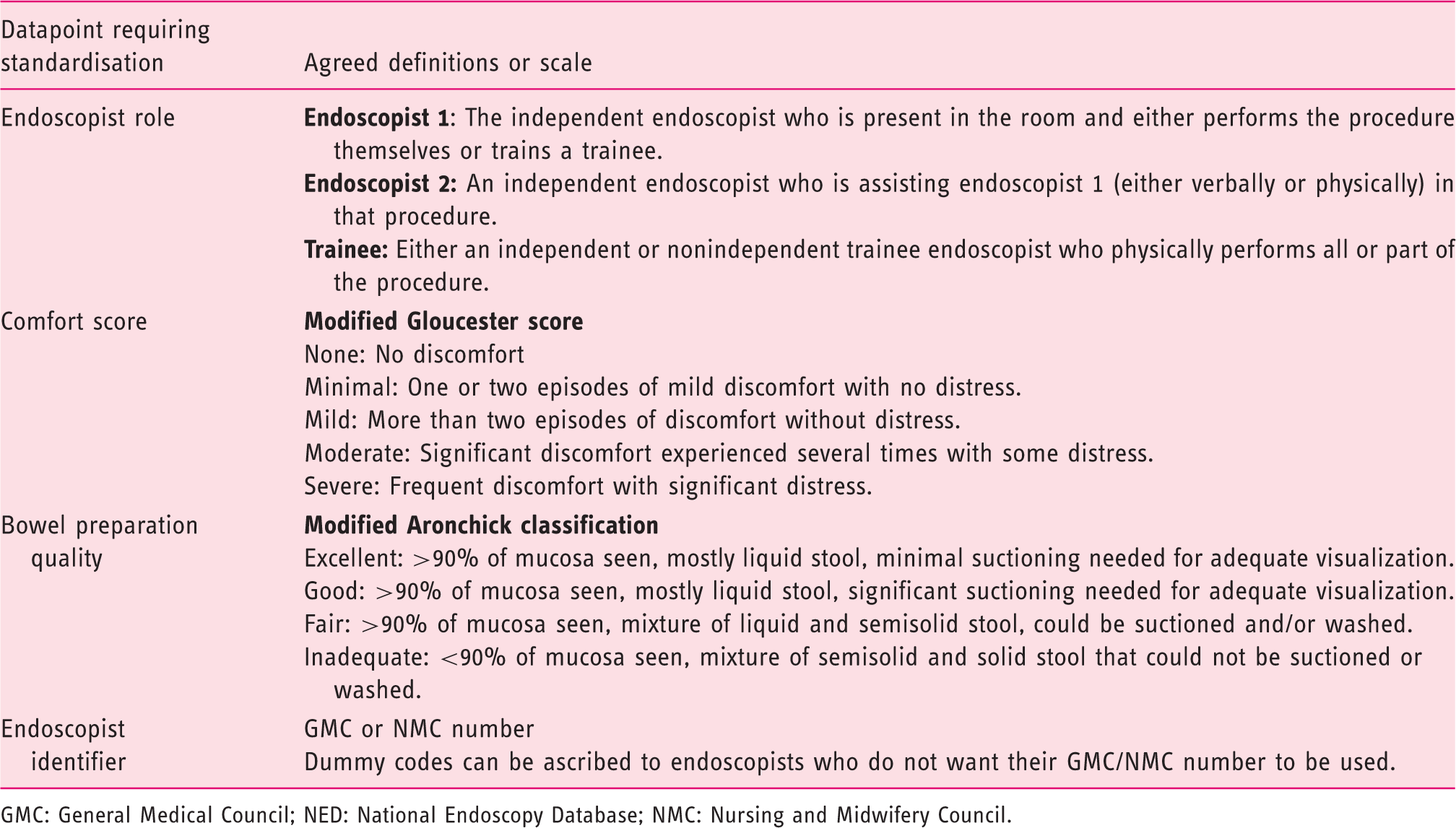
GMC: General Medical Council; NED: National Endoscopy Database; NMC: Nursing and Midwifery Council.
To minimise the possibility of data entry error and variation in accuracy of reporting by endoscopists, NED recommends data fields in reporting systems are automatically populated and free text entries are restricted. For instance, withdrawal time can be manually recorded but this is prone to data entry error. This can be minimised by automatically recording the time between capture of images in the caecum and rectum.
NED uses the same software and data schema as the JETS database. NED uses Extensible Markup Language (XML) to define the data collection items, this allows for complex data structures to be created and efficient validation of the data being uploaded from the ERS. The NED upload mechanism utilises a secure Simple Object Access Protocol web service which suppliers call to pass the procedure data to as XML messages. A multithreaded message queue is used to control the performance of the NED upload service, allowing many thousands of procedures to be received and processed in a controlled manner.
The NED import service uses XML Schema Definition to validate the XML data as well as carrying out additional business validation checks. The import service notifies suppliers and service contacts of errors found via email (in real time and as daily digest).
The NED KPI system uses Microsoft Analysis Services and Online Analytic Processing cubes to provide fast, secure access to information in the form of benchmarked reports and funnel plots at national, organisation, site and individual endoscopist levels. KPIs are calculated internally based on methodology derived from published standards. 5
NED quality assurance
Key performance indicators produced by NEDi1.
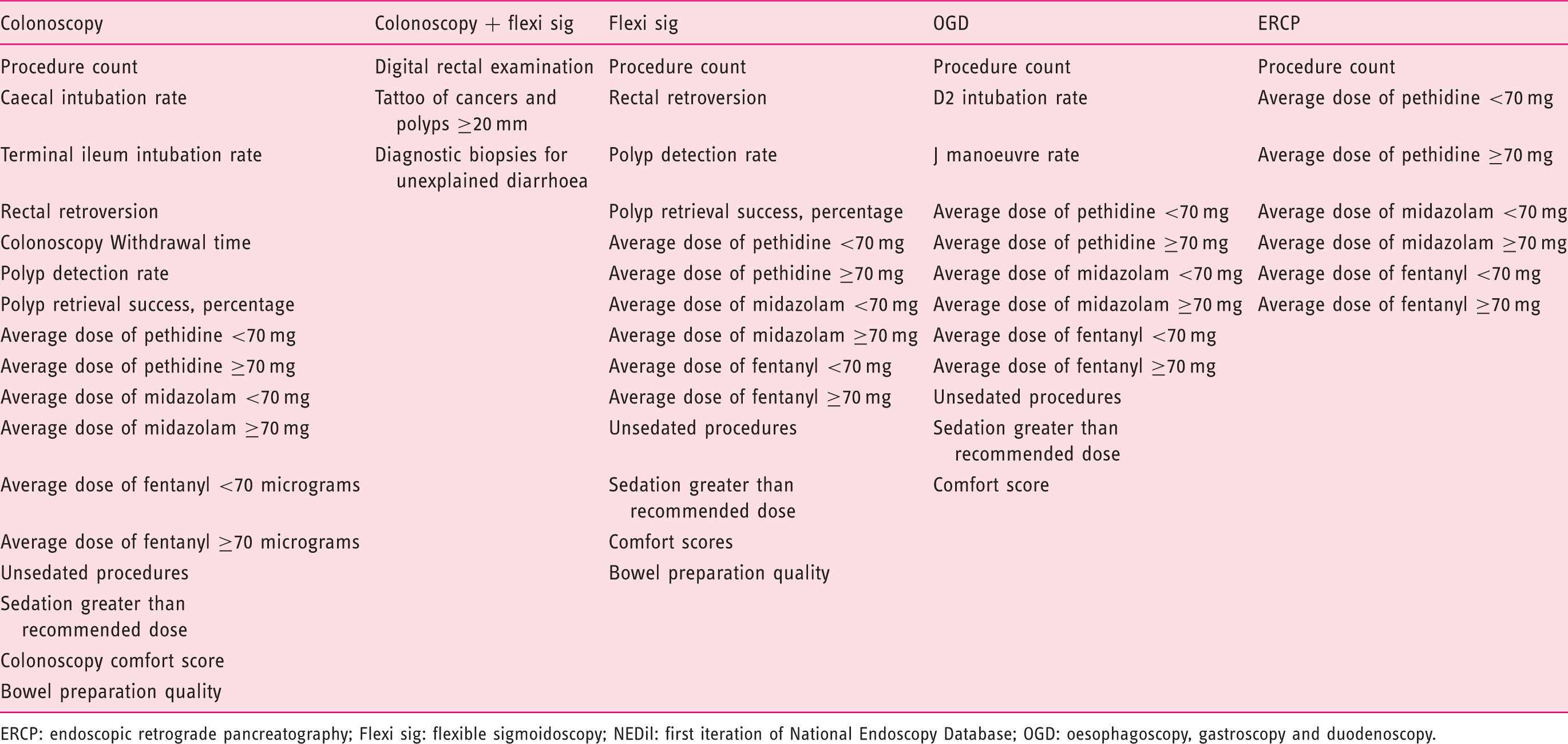
ERCP: endoscopic retrograde pancreatography; Flexi sig: flexible sigmoidoscopy; NEDil: first iteration of National Endoscopy Database; OGD: oesophagoscopy, gastroscopy and duodenoscopy.
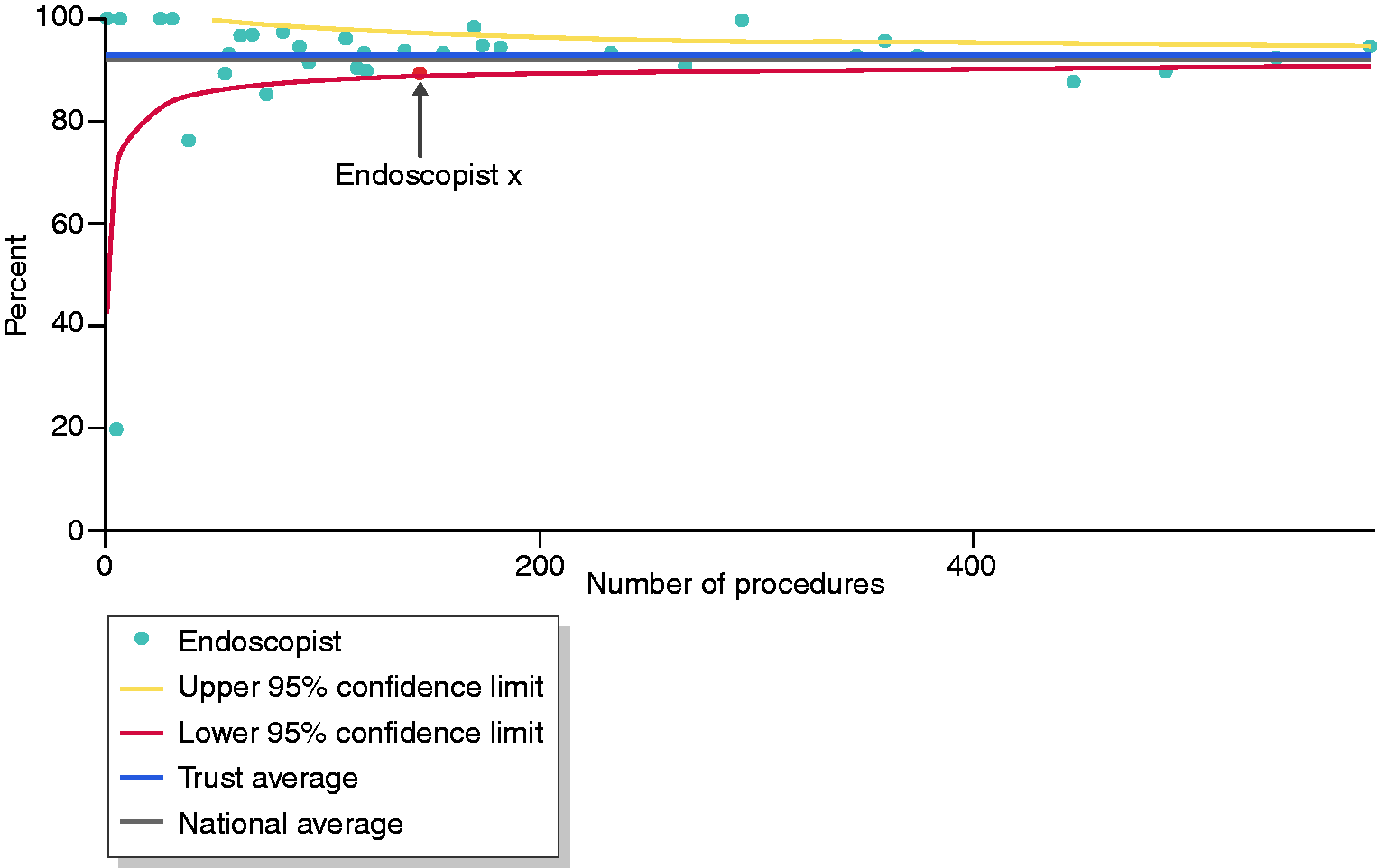
The KPIs generated by NED are presented to users on a website at www.ned.jets.nhs.uk. A valid JETS/NED registration and password are required for an endoscopist, based at a site that is uploading to NED, to enable them to log on and see their performance data (Figure 1). The website presents KPIs using a traffic light system referencing national standards. KPIs are also presented on funnel plots allowing users to compare their data to national standards (Figure 2).
18
Screenshot of the National Endoscopy Database website which displays endoscopist-specific key performance indicators (KPI) in colonoscopy for an anonymised endoscopist. Screenshot of the National Endoscopy Database website funnel plot function, which displays the caecal intubation rate for Endoscopist X (red dot), in relation to the performance of individual endoscopists within the organisation (blue dots), the organisation average (blue line) and the national average (grey line).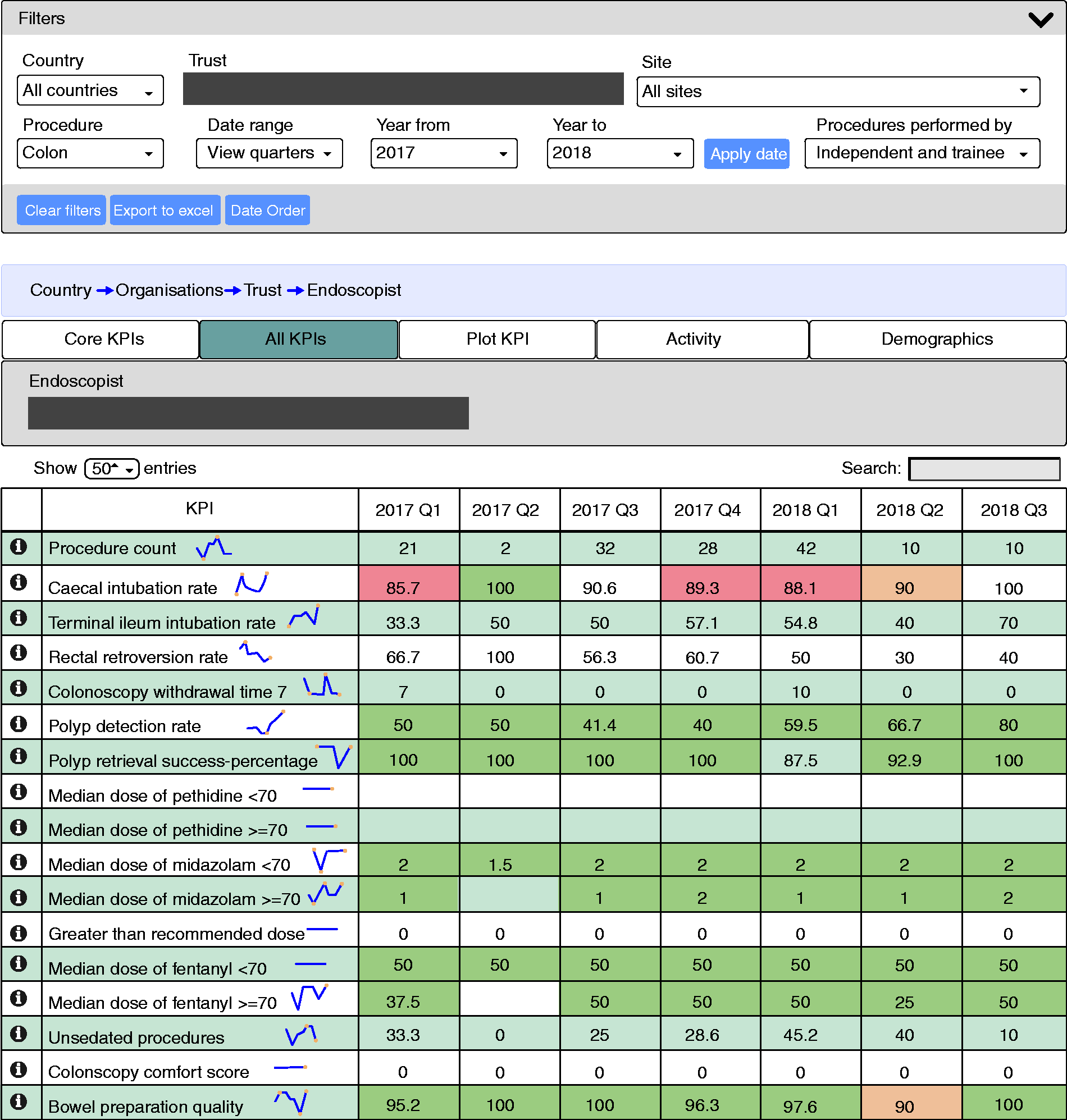
Endoscopists may also download a spreadsheet of their performance for appraisal and revalidation purposes. NED uses the General Medical Council (GMC) or Nursing and Midwifery Council (NMC) number to identify endoscopists: This enables data for endoscopists who scope at multiple sites to be collated. For example, an endoscopist who practises at an NHS trust and a private provider will be able to view their KPIs either separately or combined, providing both organisations are uploading to NED.
There is a hierarchy of access for NED data: Individual endoscopists are able to view only their own data in detail. Other endoscopists’ data appear as anonymised data points. Endoscopists can view their own data compared with organisation and national benchmarks. Named endoscopist-level data cannot be viewed outside the organisation. Organisation endoscopy leads have additional access to view named data for endoscopists in their organisation. National-level access can be granted with appropriate permissions, for example, for the purposes of JAG inspection, providing data at named organisations but anonymised by endoscopist.
It is hoped that the ability for endoscopists to access their performance data quickly, viewed against national benchmarks, will facilitate quality improvement. Services using NED will be able to monitor endoscopy performance within their organisation, aiding quality assurance and facilitating quality improvement. Around three-quarters of the JAG-mandated audits can be automatically generated by NEDi1, potentially making the JAG accreditation process more efficient and accurate. Audits that require data that are not obtained at the time of the procedure, such as adenoma detection rate, post-endoscopy complication rates and PCCRC rates, cannot currently be performed by NED, although work is under way to allow future database linkage.
NED was initially implemented at a small number of pilot sites. These were selected by each ERS manufacturer to test and validate the upload process. Once a pilot had been successfully completed, compliance with the NED system was attributed to the ERS. Roll out to further sites could then commence.
Successful implementation at a site relies on cooperation among the local endoscopy management team, IT services and the ERS manufacturer. Supporting materials and documentation are available on the NED website. 19
JAG has incorporated a mandatory NED compliance measure into the UK GRS audit for endoscopy units. As of October 2018, more than 400,000 procedures had been uploaded to NED. Roll-out is progressing well: Currently, 295 endoscopy services out of a total of 529 known services in the UK (56%) are actively uploading to NED.
Information governance
NED does not upload patient-identifiable data. For this reason individual patient consent is not required nor was an application for support under the Health Service (Control of Patient Information) Regulations 2002. The Information Commissioner’s Office, the Confidentiality Advisory Group and the National Research Ethics Service were consulted and supported this approach.
To ensure individual hospital trusts and organisations approve NED prior to implementation, the NED project has mandated that local Caldicott approval be obtained. Each organisation has its own Caldicott approval process. NED provides background information for Caldicott guardians and specimen forms for applicants. These are available as part of a ‘starter pack’ on the NED website.
NED and JETS also process endoscopist data. Personal details including GMC or NMC number are held to enable linkage with the JETS database and generation of key performance indicators for endoscopists who work across multiple sites.
Endoscopist permission is obtained when a JETS username and password is applied for. Endoscopists are informed of data governance issues during the local implementation phase and given the opportunity to decline the use of their GMC or NMC number as an identifier. In these cases a dummy code can be issued. Endoscopy data associated with a dissenting endoscopist are still uploaded to NED for quality assurance purposes.
Individual patients can also dissent from their data being used for audit purposes. It is recommended that patients who request that data from an endoscopy procedure are not uploaded to NED are directed to the local information governance department.
The General Data Protection Regulation (GDPR) became enforceable in May 2018 and covers the processing of personal identifiable information of data participants. NED is compliant with GDPR requirements.
NED and endoscopy training
Since its roll-out in 2008, the JETS e-portfolio has relied on trainees manually entering their training data. 17 This enables the generation of personalised trainee metrics and learning curves which can be used to evaluate competency progression.20,21 For oesophagoscopy, gastroscopy and duodenoscopy, flexible sigmoidoscopy and colonoscopy, trainee metrics are also applied to support JAG certification, which is necessary for independent practice. As such, accurate and unbiased recording of training data is necessary to measure trainee experience and competence.
The automated population of training data from the ERS into the JETS e-portfolio is a key aim of the NED project, and was born partially in response to trainee feedback on JETS functionality. Ultimately, trainee procedures will be identified via their unique identifier (GMC/NMC) and uploaded to NED. Data will be visible in the trainees’ normal JETS accounts. All NED-compatible ERS are required to support the allocation of trainee and trainer roles for diagnostic and therapeutic procedural components. The allocated roles of unsupervised, observed or physically assisted by the trainer allow the accurate mapping of data into the JETS e-portfolio. Depending on each endoscopist’s role, each training procedure will be uploaded separately into the trainee and trainer’s NED accounts.
Accuracy of the upload data is paramount; inaccurate data uploads could disadvantage trainees undergoing the JAG certification process. The accuracy of uploaded training data remains vulnerable to human error, with trainee omissions and incorrect role allocation being the commonest issues. Trainees and trainers are therefore encouraged to agree on the contents of each endoscopy report prior to submission. The data uploaded into the JETS e-portfolios will remain modifiable to allow the correction of such errors; such changes made within JETS will be audited to improve the accuracy of future uploads.
NED and research
NED data will provide a resource for service evaluation and research. Approval for data use will be overseen by the JAG research committee.
An example of a research project using NED data is the NED-APRIQOT (Automated Performance Reports to Improve Quality Outcomes Trial) study, which is a three-year project that started in March 2018 funded by Health Foundation and conducted by Newcastle University and the JAG. It studies the use of automated performance reports to improve quality outcomes in colonoscopy.
Other potential research opportunities created by NED include:
opportunities to inform study design based on intelligence around endoscopy case load volume, enabling closer working with industrial partners to deliver efficient commercial research, informing the design of investigator-led projects by providing data on case mix, and analysis of factors which contribute to performance and efficiency.
The future of NED
As the coverage and depth of NED data increase, NED will be used to facilitate JAG visits, reducing the burden on endoscopy units. Integration with JETS will progress, reducing the need for manual data entry by trainees.
As with all nationally collected datasets, the NED schema is under constant review. A consultation exercise with key stakeholders will generate specifications for the next iteration of the NED schema (NEDi2). This schema will then be shared with ERS manufacturers. It is envisaged that the next iteration of NED could enable production of:
endoscopic retrograde pancreatography performance indicators, endoscopic ultrasound performance indicators, enteroscopy performance indicators, and integration with MST 4.0 and SNOMED terminology
Future iterations of NED may include a unique patient identifier (such as the NHS number), which would facilitate linkage with other national databases such as UK Hospital Episode Statistics data or the UK Inflammatory Bowel Disease registry.22,23
Currently, NED cannot perform audits that require data not obtained at the time of the procedure, such as adenoma detection rate and post-endoscopy complication rates. Linkage with other data sets may allow such audits to be completed automatically. Appropriate governance and potentially individual patient consent would be necessary.
Conclusion
Centralised national collection of endoscopy data can be performed using an automated upload process. NED can provide endoscopy key performance indicators to endoscopists and organisations for quality assurance and audit purposes. NED may also facilitate research and service development.
The UK implementation of NED will facilitate a paradigm shift in quality assurance in endoscopy. This concept may be adopted by healthcare economies internationally to improve transparency of performance, and ultimately drive improvements in endoscopy-related patient outcomes.
Footnotes
Acknowledgements
The authors acknowledge the following for their assistance with this study: Hester Christmas, the Royal College of Physicians Accreditation Unit, Mark Feeney, Roland Valori and Andrew Wyman.
Author contributions
Made a substantial contribution to the concept or design of the work; or acquisition, analysis or interpretation of data- TL, KS, SE, JD, JS, MB, RB, PR, PD, MR
Drafted the article or revised it critically for important intellectual content- TL, KS, SE, JD, JS, MB, RB, PR, PD, MRApproved the version to be published- TL, KS, SE, JD, JS, MB, RB, PR, PD, MR.
Declaration of conflicting interests
None declared.
Ethics approval
The Information Commissioner’s Office, the Confidentiality Advisory Group and the National Research Ethics Service were consulted and supported the approach to not require an application for support under the Health Service (Control of Patient Information) Regulations 2002.
Funding
This research received no specific grant from any funding agency in the public, commercial, or not-for-profit sectors.
Informed consent
Because NED does not upload patient-identifiable data, individual patient consent is not required.