




Abstract
In 1996, Purdue Pharmaceutical's (Purdue) launched OxyContin, an opioid painkiller, with the largest marketing strategy in pharmaceutical history. Literature has now established that Purdue's marketing of OxyContin was a root cause of the current opioid crisis, responsible for over 600,000 deaths in and beyond North America. Guided by actor-network theory, this study conducted a document analysis and key informant interviews (n = 18) to examine the processes through which Purdue constructed, mobilized, and embedded their marketing narratives in global health practice and policy environments. The data generated reveals Purdue's narrative, conveying that opioids are both safe and necessary for the treatment of pain, was constructed as a means of increasing the prescription of OxyContin, and therefore, shareholder profits. As reports of opioid dependence and overdose deaths began to rise in the early 2000s, Purdue added a second component to their narrative: that any misuse of prescription opioids was due to the personal failings of “drug addicts” rather than the company's product or actions. This narrative was then mobilized through recruiting key actors, including public relation firms and medical professionals, to reach physicians, policymakers, and the public. Through disseminating their narrative and embedding it in news articles, academic scholarship, and educational resources, Purdue successfully increased opioid acceptability and delayed policy responses to the opioid crisis. By embedding their narrative in public health fora, Purdue continues to have significant implications for global health policies and medical practices. By better understanding how Purdue mobilized and enrolled actors to deflect accountability from their corporate malfeasance, this study provides insight into how certain actors can exert disproportionate influence over regulatory, medical, and public domains.
Introduction
The opioid crisis, that is, the harms associated with both prescription and illicit opioid use, is one of the most pressing public health issues in North America. Though this crisis, now responsible for more than 600,000 deaths in and beyond Canada and the United States (Centre for Disease Control and Prevention, 2021; Government of Canada, 2021), has been exacerbated by social and structural forces, its roots lie in the pharmaceutical industry, with a company called Purdue Pharmaceuticals (Purdue). In 1996, Purdue launched OxyContin, a prescription opioid, marketed to treat the generic condition of pain. Prior to this launch, opioids were mainly prescribed to palliative and cancer patients due to their efficacy in short-term pain relief but high risks of dependence (Keefe, 2021). However, looking to expand its market, Purdue aggressively marketed OxyContin as the first-ever non-addictive, long-lasting painkiller that would “revolutionize” the treatment of chronic pain (Ryan et al., 2016b; Van Zee, 2009).
Purdue's marketing strategy was multifaceted and well-resourced, including an extensive team of sales representatives who marketed the product directly to physicians (Van Zee, 2009). Other strategies employed to promote OxyContin included funding studies to minimize the drug's risks (Van Zee, 2009), providing financial incentives to physicians for prescribing and promoting the drug to their patients (Van Zee, 2009), lobbying regulators to support broader use of the product (Posner, 2021), and sponsoring “pain management” initiatives that advocated for the more frequent prescription of opioids (Posner, 2021). As a result of these strategies and tactics, prescription rates surged in the early 2000s, alongside rates of dependence and overdose deaths (Alam and Juurlink, 2016; Manchikanti et al., 2012). In 2007, as it came to light that Purdue's marketing claims about the safety of OxyContin were known by the company to be false, three Purdue executives were fined over US$600,000 for misbranding the drug (Brownlee and Coy, 2007). Though this fine is seemingly significant, it was small compared to the more than US$30 billion Purdue has profited from the sale of OxyContin in the US (Ryan et al., 2016b). Moreover, despite the fine, Purdue continued to market OxyContin, and other opioid products not only in the US, but globally, in countries such as Peru, Brazil, China, and Australia through the international arm of the company, Mundipharma (Ryan et al., 2016a).
Even with this fine, Purdue continued to push for increased sales while the opioid crisis deepened in North America, and reports of increased rates of dependence and overdose deaths continued to emerge (Keefe, 2021). An essential component of Purdue's push was a strategically crafted narrative around opioid dependence that shifted responsibility from the company and their product to the individual drug user and their predispositions to substance use (Armstrong, 2019; Fitzgerald and Fitzgerald, 2020). This narrative re-positioned opioid dependence as a personal failure to obscure Purdue's role in creating the crisis and ensure that prescribing OxyContin remained best practice in the treatment of chronic pain (Fitzgerald and Fitzgerald, 2020).
Through this strategic dispersion of their marketing narrative, Purdue fostered an environment, that not only facilitated, but also encouraged frequent and insistent opioid prescribing by physicians. In engaging academics, physicians, and advocacy groups in their narrative, Purdue created a vast and interconnected global network that resisted attempts to illuminate opioid-related risks and harms, including rising dependence and overdose rates (Clark and Rogers, 2019; Lurie, 2021; McGreal, 2019). This network was also effective in impeding any policy responses to the crisis, claiming that any such actions would obstruct critical access to opioids for those with legitimate pain (Humphreys et al., 2022b; Noah, 2019). As a result, policy responses to the opioid crisis were tragically delayed, allowing the crisis to grow unchecked for years.
Due to the devastating breadth of the opioid crisis, scholarship has examined multiple facets of its social, corporate, and structural contributors (Dasgupta et al., 2018). Though the crisis was exacerbated by such external factors, including punitive drug policies and a lack of accessible and affordable housing (Dasgupta et al., 2018), scholarship has well-established Purdue as the core instigator of both the initial prescription-focused phase of the opioid crisis (Cutler and Glaeser, 2021; Maclean et al., 2020; Van Zee, 2009) and the ongoing illicit opioid issues in Canada and the US (Alpert et al., 2022; Arteaga and Barone, 2022; Dennett and Gonsalves, 2023).
Public health and policy research has also examined the multiple regulatory failures that contributed to and worsened the crisis, including the close ties between opioid manufacturers and regulatory bodies (Lurie, 2021; Perrone et al., 2016), the pattern of prioritizing profit over public wellbeing that plagues the pharmaceutical industry (Braithwaite, 2013; Gagnon, 2013), and the lack of global monitoring, transparency, and accountability mechanisms in place to govern transnational pharmaceutical companies (Wilks, 2020). This substantial body of literature examining Purdue, OxyContin, and the opioid crisis strongly centers a North American perspective, specifically the US and Canada, largely due to the origins of Purdue's operations within the US and the concentration of opioid overprescription and opioid-related harms within these countries. However, to date, little attention has been paid to how Purdue's marketing narrative became embedded in global healthcare practices and policy environments, hindering a rapid response to crisis.
Narratives can be seen as crucial actors within networks. They help to stabilize and justify the connections between different actors by providing a shared understanding, rationale, or goal. This understanding of narratives as actors has been employed to examine how industries, such as the tobacco and food industries, have mobilized marketing narratives to influence not only global perceptions but global health policy as well (Nicolosi and Korthals, 2008; Young et al., 2012). Such research demonstrates how corporations create shared understandings and agendas to participate in shared agenda settings and policymaking discussions, including those related to public health and industry regulation (Fitzpatrick et al., 2022; Freudenberg and Galea, 2008; Hastings and Liberman, 2009). This research builds on these analyses of corporate influence on global health policy by examining how Purdue mobilized actors and material resources to create and embed this narrative in global health networks. It is essential for examining how corporate actors, specifically the transnational pharmaceutical industry, influence public health discourses and practices.
Aim
Addressing this gap in the literature, this study employs key ideas of actor-network theory (ANT) to examine the processes through which Purdue's marketing narratives were constructed, mobilized, and embedded in global health practices and policy environments. A keen interest is paid to how Purdue pursued these objectives through two interrelated strategies:
The mobilization/enrollment of allies (e.g. scholars, physicians, lobbyists, and media); and, The use of inscription devices (e.g. peer peer-reviewed literature, regulatory reports, and international guidelines) to stabilize their narrative.
Methods
ANT
This qualitative case study employed ANT to guide data collection and analysis. ANT is an approach to research that can be summarized as “a disparate family of material semiotic tools, sensibilities and methods of analysis that treats everything in the social and natural worlds as a continuously generated effect of the webs of relations within which they are located” (Law, 2009). ANT prioritizes methodology through providing an infralanguage, meaning a specialized set of terms, aimed at explaining, amplifying, linking, and incorporating nonhumans into social scientific accounts (Sayes, 2014). Such infralanguage consists of a repertoire of terms and guiding principles to better understand the workings of complex networks (Latour, 2005), such as global health systems. ANT helps show how stories and accounts influence the formation and stabilization of networks, providing insights into the construction of social realities and power dynamics within networks.
Aligning with ANT, actors are defined as any entity, human or nonhuman, that exerts some form of agency or effect upon other entities (Latour, 2005). Enrollment refers to the processes through which actors are recruited or aligned to participate in and support a network's specific program (Callon, 1986). This process is essential to the stabilization of networks through ensuring the cooperation of more and diverse actors. Inscription devices, within the frame of ANT, refer to the tools, instruments, or mechanisms that translate actions or events into a material form (Latour and Woolgar, 2013). In the context of health and pharmaceutical systems, inscription devices may take many forms, such as peer-reviewed literature, news articles, organizational reports, or policy documents. Such devices are crucial to the stabilization of networks and the production of knowledge since they facilitate a complex phenomenon being transformed into concrete records that can be circulated among networks.
Furthermore, this paper draws on ANT's ideas of program/anti-program. “Program,” here, refers to the actions, strategies, and goals Purdue implemented within health networks to achieve their specific objective of increasing shareholder profits (Akrich and Latour, 1992). In contrast, the “anti-program,” refers to the efforts of actors and/or actor-networks that oppose or resist the program, meaning actions to curb the overprescription of opioids or hold implicated actors to account for their actions. Applying this infralanguage of actors, relationships, enrollment, and program/anti-program throughout this analysis aids in examining the complex interplay of actors, strategies, and power dynamics that shape and inhibit dominant narratives.
Data collection
Data was collected via two sources: a document analysis and key informant interviews. For the document analysis, documents were sourced from databases, organizational websites, and by recommendation from relevant knowledge experts between August and September 2022. Search strategies were created in consultation with a health science librarian at the University of Toronto. See Appendices A and B for full search strategies. Documents were collated and uploaded to Covidence review software, where duplicates were removed. Both peer-reviewed and grey literature were screened against the following inclusion criteria: (1) the document refers to global health systems and/or transnational actors as defined by Hoffman and Cole (2018); (2) the document refers to Purdue's misrepresentation and mass-marketing of OxyContin (this criteria was taken up broadly, meaning the document referred to Purdue, the Sackler family, Mundipharma, or OxyContin); (3) the document was published between 2007-present; and (4) the document was published in or translated into English. See Figure 1 for the full PRISMA diagram. Searches identified 36 total documents, including 10 peer-reviewed articles (five commentaries and five primary research) and 26 grey documents (14 news articles, five press releases, four organizational reports, and three miscellaneous).
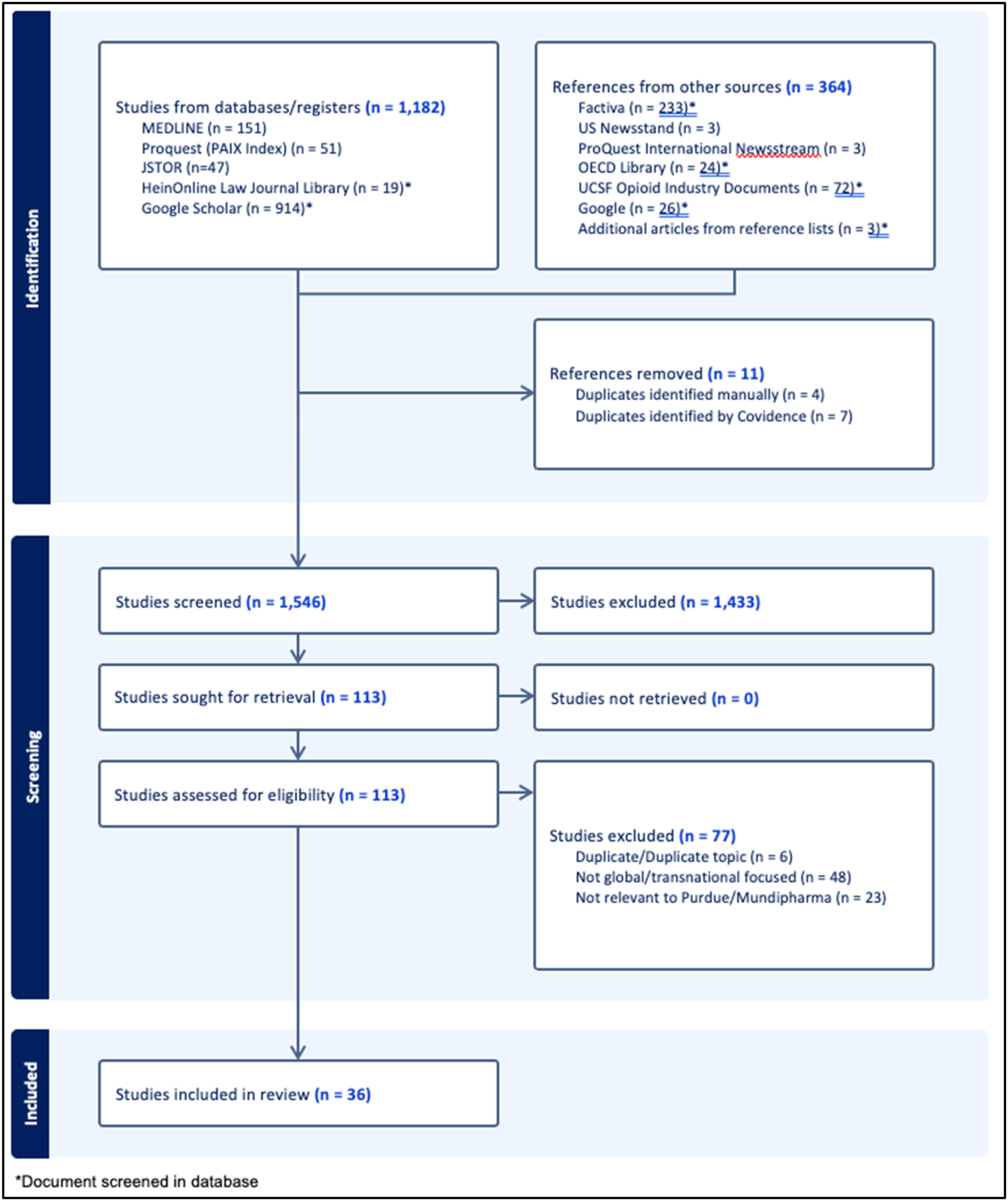
PRISMA diagram.
For the key informant interviews, a purposive sample (n = 18) was recruited guided by the following criteria: (1) transnational actor (as defined by Hoffman and Cole (Hoffman and Cole, 2018)) with exposure to the topic of Purdue and OxyContin AND content expertise in global health; (2) Over the age of 18; and (3) able to communicate in English. Informant characteristics are included in Table 1. Many key informants held multiple roles, most with academic appointments at an educational institution. Many key informants were located within the US (n = 8) and Canada (n = 5) due to the concentration of the opioid crisis within these countries. All interviews were conducted virtually by author AB using Zoom meeting software, were audio and visual recorded, and transcribed verbatim. Informants provided written consent to participate in this study, and monetary compensation was not provided. Ethics approval for this study was received from the University of Toronto Research and Ethics Board on 13 July 2022 (protocol no. 43067).
Key informant characteristics.

Data analysis
Data analysis for the document analysis and interview data was guided by ANT, including the focus on narrative description and the need to remain as close to the data as possible (Latour, 2005). Actors, networks, and relationships were centered throughout the data analysis process through an explicit focus on how they were created, deconstructed, and/or maintained to form, strengthen, and stabilize networks (Callon, 1986). Excel was used to inductively code both the transcripts and the included documents (Thomas, 2003). After initial passes were taken through all data, the data was coded based on the following domains: (1) narrative purpose; (2) narrative development, including human and nonhuman actors, key relationships, and inscriptions devices; and (3) narrative impacts and implications. Themes across domains were identified and compared across data from both interviews and documents. Demonstrative excerpts were extracted from both documents and transcripts to support the identified themes and deepen the interpretation of identified networks.
Results
Data from document analysis and key informant interviews illustrate the complex processes through which Purdue constructed, mobilized, and stabilized a marketing narrative promoting the mass prescription of OxyContin. It is important to note that a large portion of the documents and key informant-perspectives center Canadian and US perspectives due to Purdue's extensive marketing of OxyContin in these countries, as well as the concentration of the harms resulting from the company's actions (i.e. the opioid crisis). However, as demonstrated by the results below, the company's actions and influence extended beyond these national borders to international organizations, prescribers, and the general public globally. The results are organized following the three key elements of Purdue's narrative identified in this analysis: (1) the purpose, or intent; (2) the actors and inscriptions devices enrolled; and (3) the processes through which it was stabilized and rendered durable in local and international fora. In examining the construction and impacts of Purdue's narrative, particularly the role it played in shaping perceptions of opioid acceptability and delaying regulatory action, findings reveal the strategic coordination of actors, networks, and inscription devices that facilitated the reinforcement of Purdue's program while simultaneously deflecting accountability for opioid-related harms.
Constructing Purdue's profit-driven narrative
The starting point for understanding how Purdue constructed and mobilized their narrative to advance their program, is understanding the purpose or intent behind the narrative. As Purdue's program aimed to increase company and shareholder profits, its narrative was constructed to advance this interest from the initial launch of OxyContin in 1996. Informants and documents identified that the narrative contained key components that Purdue pursued to promote the prescription of OxyContin.
As described by informants, a prominent component of Purdue's narrative promoted opioid prescriptions by establishing that opioids are not only safe, but also essential to the treatment of pain patients. Purdue relied on short-term studies focused on patients with acute injuries to support their claims that minimized the risk of addiction (Van Zee, 2009). This message was launched in Purdue's initial press release for OxyContin in 1996, which stated that, “…the fear of addiction is exaggerated” and that there is “little risk of addiction from the proper uses of these drugs for pain.” (Purdue Pharma L.P., 1996)
The press release continues to state, …the underreporting and undertreatment of pain remains one of the most pressing issues affecting the quality of patient care today. (p. 3)
Amidst the rising addiction rates in and beyond the US, Purdue maintained these claims about the safety of opioids and reaffirmed the necessity of prescription opioids in treating the widespread “endemic” of chronic pain. This construction of pain as an urgent crisis that physicians were failing to address was central to Purdue's narrative, as it provided the problem to which their product, OxyContin, was the solution. A key informant described Purdue's stance on the increased reports of overdose and dependence, And so, their message was that the rise in the prescribing was a good thing. Millions of patients with chronic pain were now benefiting from increased use of opioids. (US; Activist and academic)
These claims founded the basis for Purdue's narrative that they would mobilize in their marketing strategy to convince physicians, policymakers, and patients that their product was both beneficial and essential in the treatment of pain.
However, as reports of opioid misuse and overdose rose alongside the increased prescription of OxyContin, Purdue's narrative that opioids are both safe and essential was challenged. To maintain their claims, Purdue set out to shift responsibility for the steep increases in addiction and overdose deaths to individual drug users, and away from the company and their product. One key informant described this strategy, So, what they did, was they characterized the problem as if all of the harms that were being reported on were limited to so-called drug abusers. In fact, there is an e-mail that's become public from Sackler and he's, you know, writing this e-mail in response to press reports about problems with OxyContin, where he's really describing their PR strategy, which is to put the blame on the abusers, the junkies. (US; Academic)
The email described by this key informant was made public in a complaint by the state of Massachusetts against Purdue, and quotes Richard Sackler's stating, …we have to hammer the abusers in every way possible. They are the culprits and the problem. They are reckless criminals. (Commonwealth of Massachusetts, 2019)
The Massachusetts proceedings also detail a 2000 board meeting where the Sackler family planned their response to the rising rates of OxyContin-related harms to, deflect attention away from the company owners. (Commonwealth of Massachusetts, 2019)
This narrative supported Purdue's program in reaffirming that OxyContin is both safe and necessary, and diverted policy attention away from their marketing and onto drug users. One informant explained Purdue's line of thinking, In your effort to address this problem [of addiction and overdose deaths] don't punish the pain patients because of the bad behavior of the drug abusers. Again, framing this as if we have these two distinct populations, a population of pain patients who were helped by opioids, and a population of drug abusers. (US; Academic, healthcare provider, and international organization representative)
Here, we see the initiation of what Purdue and their networks described as the need for “balance” in opioid prescribing and access. This need, also described as the “principle of balance,” suggests that policies are needed to address two distinct, yet simultaneous problems: first, the problem of untreated pain, and second, the misuse of prescription opioids by drug abusers. This narrative became the common understanding that Purdue aimed to disperse among its networks, to prevent policy action aimed at reducing the prescription of OxyContin.
Through this carefully crafted narrative, Purdue aims to prevent, hinder, and impede policy action that may limit the prescription of opioids. One informant described this effort, Going back to the late 90s, early 2000s, what you had was a very effective effort to miss frame the problem [of addiction and overdose deaths] so that policymakers would not take steps that might have reduced prescribing of opioids. (US; Academic)
As these rates of addiction and overdose deaths related to OxyContin were increasing in Canada, the US, Australia, and other parts of the world, a key informant noted, And what Purdue did not want to happen, was interventions that would reduce its profits. They wanted to protect or to preserve that status quo or even see that sales would continue to increase. (Canada; Academic and healthcare provider)
These quotes reflect Purdue's deliberate misframing of the issue of addiction and overdose deaths to divert attention away from the role of overprescription and ensure that policymakers would not enact measures to limit opioid prescribing. This strategic narrative allowed Purdue to maintain and even expand opioid sales globally, despite rising rates of opioid-related harms in countries such as Canada, the US, and Australia. Below, we examine the key avenues, actors, and inscription devices through which Purdue disseminated this narrative to better understand how and why there was a substantial delay in the policy response to the over-prescription of opioids.
Enrolling allies and inscription devices: Strengthening Purdue's network
In this section, we discuss how Purdue recruited actors and inscription devices to their program to expand the reach, influence, and impact of their narrative. Through their extensive marketing plans, Purdue employed numerous strategies to disseminate their narrative to physicians, policymakers, and the public. Though there were countless strategies employed by Purdue, three avenues were described in detail by key informants and in identified documents: (1) media; (2) peer-reviewed publications; and (3) continuing medical education.
Purdue targeted both the public and prescribers through publishing in news outlets as well as academic journals. One informant described how Purdue enrolled public relations (PR) firms in their network to support the publication of their narrative in diverse news outlets, Purdue worked with public relations firms to get stories placed in media outlets that would misframe the problem, one of the PR firms that they work with was called Dezenhall who helped place articles in both liberal and conservative media. (US; Academic and activist)
The informant continued to describe two examples of this work, Slate Magazine had an article in 2004 written by Maia Szalavitz, which at the time that she wrote that article, she was working for an organization that had an undisclosed relationship with Purdue. I think the title of the article was the Myth of the OxyContin Addict. Something like that, which suggested that people having problems with OxyContin were already addicts and they were just individuals getting their hands on the drug. A more conservative media outlet ran an article written by Sally Satel, who also worked with PR firms for Purdue Pharma, and at the time that she wrote the article, was an American Enterprise Institute [AEI] Fellow with AEI also receiving money from Purdue. The title of her article was something along the lines of OxyContin Doesn't Cause Addiction, its Abusers Were Already Addicts. (US; Academic and activist)
Both articles mentioned by this informant remain publicly available (Satel, 2004; Szalavitz, 2004). In this quote, the informant identifies several actors that Purdue enrolled to disseminate their narrative, including a prominent PR firm and journalists in both conservative and liberal media sources. Documents and key informants illustrate how Purdue provided direct and indirect funding to influence journalists, leading to articles that echoed the company's narrative by shifting blame for OxyContin-related harms onto individual drug users. The articles included lines such as, When you scratch the surface of someone who is addicted to painkillers, you usually find a seasoned drug abuser with a previous habit involving pills, alcohol, heroin or cocaine, (Satel, 2004) The fact is, if the media and the government were to acknowledge the truth—that OxyContin addiction occurs primarily among previous addicts—they would have to admit that easy solutions like prescription-drug registries and more physician prosecutions won’t work. (Szalavitz, 2004)
In enrolling journalists in their program, meaning their objective to promote the safety and thereby the sale of OxyContin, Purdue was able to communicate its narrative broadly to the public. Further, these news articles, inscribed with their favored narrative, then became inscription devices that were able to be shared and referenced among networks.
Seeking to further influence public opinion and scientific knowledge production, Purdue extended the reach of its narrative via publications in academic journals. One informant described this strategy, I mean, you could also look at, you know, medical journals which have published ghostwritten articles … Where the articles are written by the drug company or by a company the drug company hires and get published with the names of key opinion leaders. (US; Academic and regulator)
This informant describes how Purdue employed similar strategies to enroll researchers in their program as they did with journalists, through direct or indirect payments to “key opinion leaders” who would then write authored or ghost-written articles aligning with Purdue's interests (Alonso, 2021). The peer-reviewed studies produced from these relationships served as further inscription devices that were frequently referenced in Purdue's promotional material as means of supporting the increased prescription of OxyContin.
A third avenue Purdue utilized to disseminate their narrative about OxyContin was by using medical education. When referring to marketing messages created by Purdue, specifically that opioids were not addictive and that there is an untreated epidemic of pain, one informant stated, Those are all messages that were created by industry but were then disseminated not only by industry and its vendors, but also by people with no connections to industry [physicians], because that's what they were being taught in their medical school. Healthcare providers were being taught in their residency programs these ridiculous concepts like oh, patients in pain can't get addicted. I was taught that in residency, like how ridiculous of a statement is that. (US; Academic and activist)
Here, an informant describes how Purdue's narrative was extended beyond its direct communications and marketing materials by embedding its messages in medical education (Glauser, 2013; Persaud, 2014). This strategy ensured that medical students were taught, by educational materials and lecturers, the messages Purdue created to increase opioid prescribing. After graduation, these physicians carried these messages into their medical practices and other policymaking and teaching endeavors. Documents echoed informants’ descriptions of Purdue's influence on medical education. For example, in the Lancet Commission on the Opioid Crisis in and Beyond North America, authors describe Purdue's influence on medical education, providing the example of Tufts University's, Tufts University acknowledged how educational decisions at the institution were inappropriately shaped to serve Purdue Pharma's interests (e.g. using corporate materials in teaching, blocking a book documenting the opioid crisis from being chosen as the common book that all incoming MD and MPH students would read and discuss). (Humphreys et al., 2022a: 567)
Documents identified that Purdue's influence extended to many universities and medical institutions, including those outside the US (Larkin et al., 2017; Persaud, 2014). This data demonstrates how Purdue's global strategy enrolled physicians in their program, targeting them as medical students through sponsoring curriculum materials and lecturers. In this strategy, like the one above, Purdue-influenced peer-reviewed literature were key inscription devices referenced in course content. Additional course materials, including textbooks sponsored by Purdue and their funded pain advocacy groups (Persaud, 2014), were further inscription devices translating and stabilizing their messages in materials that were shared, kept, and referenced as seemingly credible sources of information.
Stabilizing the narrative: Lasting impacts and global implications
This final section of results examines how Purdue's stabilized narratives influenced action. Narratives often play a key role in legitimizing power structures, and by analyzing the creation and maintenance of Purdue's narratives, we can interrogate the mechanisms through which their influence was maintained. Though the implications of Purdue's stabilized narrative are numerous, interconnected, overlapping, and wide-reaching, results emphasized two interrelated outcomes: (1) increased opioid acceptability; and (2) delayed policy response to the increased rates of opioid-related dependence and overdose deaths.
Through disseminating their narrative that prescriptions opioids are non-addictive and essential to treat the existing epidemic of pain, Purdue was able to sway the public, physicians, and policymakers in favor of the increased prescribing of opioids. The enrolment of these actors in Purdue's program, in combination with their strategic use of inscription devices, created an environment where opioids were widely accepted. An informant described the success of this strategy, The public perception and the medical perception were that pain was under-treated and that we had been unjustified in withholding opioids for the treatment of chronic pain. Because, as the teaching was and everybody believed it, they were effective, and they didn't harm. (UK; Pain advocacy group, academic, and healthcare provider)
Purdue maintained this narrative even as rates of dependence and overdose deaths began to increase alongside the increased prescription of OxyContin. For example, on Purdue's Partners Against Pain website, which was created as a resource for both physicians and patients, Purdue cites opioid-related addiction studies in acute pain patients to misrepresent the risk of taking OxyContin for chronic pain stating, The medical purpose [of opioids] is clear and the effects are beneficial, not harmful. True addiction very rarely occurs when opioids are being used properly under medical supervision to relieve pain. (Partners Against Pain, 1998)
The company countered any doubts about OxyContin's safety by framing drug abusers as the issue, rather than their product. Through stabilizing this narrative in a diverse range of publications, and successfully disseminating these devices throughout their networks, Purdue was able to influence not only perceptions of prescription opioids, but also policymaking at national and international levels. One informant discussed the impacts of this narrative on Federal Agencies in the US, If you look, for example, at some of the key federal agencies in the United States, that would have been charged with tackling this problem. Like agencies within the Department of Health and Human Services, SAMSA, which is the Substance Abuse, Mental Health Services Administration, or NIDA, National Institutes of Drug Abuse, the reports that they would put out about the problem of prescription opioids would, you know, frame the problem just as Purdue had intended to have it framed and so you could see reports that were published that suggested that, you know, the rise in the prescribing was helping pain patients. (Canada; Attorney)
The informant continued to remark how the influence of this narrative extended beyond North America to international health organizations and governing bodies, It was a framework that the World Health Organization accepted; it was a framework that the United Nations bodies that would have a say were accepting, for example, the International Narcotics Control Board, the C&D Commission on Narcotic Drugs, the Office of Drugs and Crime within the United Nations all seemed to really be accepting this framework. (Canada; Attorney)
Through their networks, including pain advocacy groups and pain experts, Purdue promoted their narrative, including the principle of balance, internationally to the point where it was, and continues to be, the basis for opioid related reports and guidelines internationally (Dowell, 2022; Organization, 2000).
Purdue's enrolment of key actors, such as physicians, pain management organizations, and public health officials, and the strategic use of inscription devices, including scientific literature and guidelines, stabilized a network where opioids were widely accepted. This network positioned opioids as the standard and ethical treatment for pain, which went largely unquestioned due to widespread support and alignment. As a result, policies limiting opioid prescriptions were delayed, with regulatory bodies facing resistance from an entrenched narrative supported by research and expert testimonies.
Discussion
This study demonstrates how Purdue mobilized a narrative and recruited a network to increase the prescription of their product, OxyContin. By applying key concepts of ANT, including enrollment and inscription devices, the lens of ANT helped elucidate how actors were recruited to Purdue's program to align with their goals and promote their narrative. In examining these enrolment processes and the use of inscription devices, we can better understand how Purdue's narrative became entrenched in the public, medical community, and regulatory structures at national and international levels.
Results from the documents analysis and key informant interviews show that Purdue's narrative aligned with their program of increasing the prescription of OxyContin—and ultimately increasing shareholder profits. The components of this narrative included emphasizing that OxyContin is non-addictive when prescribed by a physician and that there is an “epidemic” of pain in the general population that is currently undertreated. These objectives were pursued through Purdue's narrative that shifted responsibility for the increased rates of overdose and dependence away from their marketing practices by asserting that OxyContin is not “addictive,” but rather, people with preexisting substance use issues are misusing the drug. Purdue's prioritization of profits over the wellbeing of the patients taking their product aligns with existing literature detailing the disconnect between the business objectives of pharmaceutical companies and the needs and wellbeing of the public (Gagnon, 2013). This disconnect, though a result of several contributing forces, can largely be attributed to the significant financial return companies see as a result of increased promotional practices (Baker, 2019; Gagnon, 2013; Lexchin, 2016; Montalban and SakinÇ, 2011). Therefore, we argue that Purdue's profit-driven narrative exemplifies a broader systemic issue in the global pharmaceutical industry—the disconnect between pharmaceutical business models and public health needs.
Further, this study identifies how Purdue effectively stabilized their profit-driven narrative through its strategic enrolment of actors (physicians, researchers, and policymakers), and the deployment of inscriptions devices (news articles, peer-reviewed studies, and guidelines). In doing so, Purdue extended the reach and influence of its narrative beyond its direct in-the-moment marketing interactions, demonstrating ANT's idea of material durability that posits when relationships are performed and embodied in inanimate materials, they tend to last longer and be more stable than those that depend on face-to-face interactions (Law, 1992, 2009). By embedding and dispersing its curated narrative in news, academic, and educational materials, Purdue established a network that supported its program, thereby creating an environment that encouraged opioid prescription and delayed efforts to limit prescription.
Though action has now been taken to decrease opioid prescribing and facilitate the more cautious prescription of opioids (Hodge Jr et al., 2018; Noah, 2019; Olsen, 2016), Purdue's narrative remains pervasive in parts of our health systems globally. For example, the Purdue-created “principle of balance” which refers to the need to balance the prescribing strong opioids (e.g. OxyContin) for pain patients and the risks of opioid misuse, continues to be a key argument in policy discussions around access to opioids in international fora (The Lancet Global, 2024; United Nations Office on Drugs and Crime, 2022; World Health Organization, 2000). Though it is beyond the scope of this paper to evaluate the merit of this principle in international policy-making, this Purdue-constructed concept has been stabilized in multiple international health documents, such as the World Health Organization's Achieving Balance in National Opioid Control Policy, a guideline whose purpose is to “encourage governments to achieve better pain management by identifying and overcoming regulatory barriers to opioid availability” (World Health Organization, 2000: 2); the United Nations Office of Drugs and Crime's discussion paper Ensuring Availability of Controlled Medications for the Relief of Pain and Preventing Diversion and Abuse: Striking the Right Balance to Achieve the Optimal Public Health Outcome, that aims to “Assist member states in moving forward with practical action in this area” (UNODC, 2011: 1); and recently, a UNODC webinar Putting people first at the forefront of balanced opioid governance (United Nations Office on Drugs and Crime, 2022). The stabilization of Purdue's narratives within such mediums is significant as it demonstrates the reach of Purdue's marketing strategies. Specifically, Purdue's ability to reach international health organizations who are central actors in setting policy agendas and providing guidance to policymakers at local and national levels on best practices.
These findings underscore the importance of critically assessing how corporate narratives can become embedded in global health systems. Since Purdue and OxyContin is only one example of many of the mass harms that can be caused by pharmaceutical marketing practices, the relationships between corporate interests, scientific communities, and regulatory bodies require greater scrutiny. Further, this analysis emphasizes the risks of pharmaceutical influence over prescribing practices, policy development, and medical education. The extensive and misleading promotion of OxyContin created a landscape where public health was secondary to corporate profits. As such, this study echoes existing calls for stricter regulation of pharmaceutical marketing, transparency in relationships, accountability mechanisms, and unbiased medical education (Furlan et al., 2020; Gac et al., 2023; Goodwin et al., 2021; Humphreys, 2017; Humphreys et al., 2018; White, 2022).
Limitations
Study results were generated from documents and key informant interviews with a diverse range of experts on global health and pharmaceutical systems. However, results are limited to the documents that were publicly available at the time searches were conducted. This is noteworthy since legal cases against Purdue and the Sackler family are ongoing, and Mundipharma continues to promote its products in international markets, meaning more recent data and perspectives are not represented in this analysis. Further, interview data was generated from a small but targeted sample of key informants, meaning that though a range of relevant experiences was captured, findings may not be representative of all possible perspectives. Finally, though this study takes a global lens on the case of Purdue and OxyContin, a significant number of documents and key informants centered on a North American perspective due to the heightened concentration of the opioid crisis and Purdue's operations in Canada and the US. That being said, US pharmaceutical companies exert significant influence on global health and pharmaceutical systems, and therefore, the systems governing such companies have global implications.
Conclusion
The entrenchment of Purdue's narrative in public health fora continues to have significant implications for public health policies and medical practices. By directing the responsibility of the harms caused by the misleading mass-promotion of OxyContin to individual drug users, corporate practices were overlooked, leading to inadequate responses and ineffective policy measures. By better understanding how Purdue mobilized and enrolled allies to deflect accountability from their corporate malfeasance, this study provides insight into how influence was exerted within these networks. In doing so, we reveal how certain actors, such as pharmaceutical companies, can exert disproportionate influence over regulatory, medical, and public domains.
In investigating the use of inscription devices such as academic scholarship and regulatory reports, we uncover how knowledge is constructed, legitimized, and disseminated within health and pharmaceutical networks. This aids in better understanding the role of such devices in shaping not only public perception but national and international policy. Learning from one of the most devastating cases of pharmaceutical harms to date, this research can inform the development of more robust accountability and regulatory mechanisms that prevent transnational pharmaceutical companies from directing public health narratives and shirking responsibility for the harms they cause. This includes strengthening regulatory frameworks and improving transparency in scientific research and communication.
Footnotes

Ethical considerations
Ethics approval for this study was received from the University of Toronto Research and Ethics Board on 13 July 2022 (protocol no. 43067).
Consent to participate
Informants provided written consent to participate in this study.
Funding
The author(s) disclosed receipt of the following financial support for the research, authorship, and/or publication of this article: Author AB received funding to support their doctoral studies from the Government of Canada's Social Science and Humanities Research Council.
Declaration of conflicting interest
The author(s) declared no potential conflicts of interest with respect to the research, authorship, and/or publication of this article.
Data availability statement
All data included in this analysis from documents can be found in the article's reference list. Interview data is not publicly available to protect the confidentiality of key informants.