




Abstract
Lifetime psychedelic substance use has previously been linked to nature relatedness and pro-environmental behaviour. Yet, participants’ responses to the self-report measures in these studies may have been affected by stereotypical associations or confirmation bias. We therefore re-examined this link by measuring three pro-environmental dependent variables: nature relatedness, concerns about climate change, and objective knowledge about climate change. Additionally assessing lifetime experience with 30 psychoactive substances, we collected an international convenience sample for an online survey (n = 641), Controlling for age, educational attainment, and covariation in substance use indicators, psychedelic use (primarily the use of psilocybin) predicted objective knowledge about climate change directly, and indirectly via nature relatedness. Further, it predicted concern about climate change indirectly via nature relatedness. The results suggest that the relationship of psychedelics with pro-environmental variables is not due to psychological biases, but manifests in variables as diverse as emotional affinity towards nature as well as knowledge about climate change.
Introduction
Recent research provided correlational and tentative causal evidence that psychedelic substance use leads to increases in a number of pro-environmental variables (Argento et al., 2019; Forstmann and Sagioglou, 2017; Kettner et al., 2019; Lyons and Carhart-Harris, 2018; Nour et al., 2017). Yet, this research assessed subjective, self-reported outcomes and could thus be biased by stereotypical associations of psychedelics with a certain set of personality traits, values, and behaviours that correspond to the cliché of a nature-loving member of the hippie culture (Forstmann and Sagioglou, 2021). In the present research, we thus re-examined the association of lifetime psychedelic use with psychological determinants of pro-environmental behaviour by measuring not only nature relatedness, but also objective knowledge and affective concern about climate change.
Psychedelics and nature
Studying administration effects of psychedelics demands extensive resources and strict permission procedures. Accordingly, data on causal effects is scarce and much of it reports on clinically-relevant variables (for recent reviews, see e.g., Aday et al., 2020; Forstmann and Sagioglou, in press). Yet, although few, survey and administration studies reliably suggest that psychedelic substance use is positively linked to environmental measures such as nature relatedness (Nisbet et al., 2009), which can broadly be described as feeling close and kindly towards nature. The results from a large-scale online survey showed that nature relatedness mediated the relationship between psychedelics and pro-environmental behaviour, also when covarying personality traits, political views, and use of other substances were controlled for (Forstmann and Sagioglou, 2017). Pre-post surveying of individuals self-administering psychedelics similarly showed lasting increases in nature relatedness (Kettner et al., 2019), while Canadian indigenous community members self-reported intensified appreciation of and connection to the natural world after participating in a retreat involving the use of the psychedelic plan brew Ayahuasca (Argento et al., 2019). Lastly, clinically depressed patients receiving two doses of psilocybin reported significant increases in nature relatedness one week and 7–12 months after the treatment, while healthy controls who did not take psilocybin did not show an increase over time (Lyons and Carhart-Harris, 2018).
These effects could be due to the mystical-type experiences (Kangaslampi et al., 2020) and feelings of ego dissolution (Kettner et al., 2019; Nour et al., 2017; Pöllänen et al., 2022; Uthaug et al., 2018) that psychedelics induce, as they were strong correlates of the increase in the individual's relationship to nature following a psychedelic experience. In line with these findings, psilocybin administration studies found dose-dependent increases on self-reported external unity, that is, feelings of interconnectedness with objects from the external world (Griffiths et al., 2008). Furthermore, individuals reported enhanced connectedness and empathy towards other humans (e.g., Forstmann et al., 2020; Griffiths et al., 2018), and increases in mindfulness (e.g., Soler et al., 2018; Uthaug et al., 2018) after psychedelic use. Although, at this point, the precise psychopharmacological effects of psychedelics are not fully understood, there is a reliable association between psychedelic use and enhanced relatedness and empathy towards one's environment, including both nature and fellow humans.
The present research
A limitation of these studies is that they only assessed self-reported pro-environmental variables. The association of psychedelics with, for example, nature relatedness, may therefore be enhanced by cognitive biases such as social desirability (Lange and Dewitte, 2019) or specific stereotypical knowledge. In fact, even prominent scientific conferences on psychedelic research are often accompanied by stereotypical visualizations and leisure activities (Forstmann and Sagioglou, 2020), which may reflect and perpetuate cognitive representation of psychedelic users as nature-affine individuals. In addition, knowledge about research linking psychedelics to nature-relatedness may cause expectancy-consistent responses of users. The objective of this research was therefore to complement the study of psychedelic use and nature relatedness with an objective measure of pro-environmental concern, namely objective knowledge about climate change.
To this end, we designed a survey measuring the lifetime experience with psychedelics as well as various potentially confounding psychoactive substances such as cannabis and MDMA, some of which have previously been linked to pro-environmental measures. Furthermore, we assessed nature relatedness as a psychological facet of pro-environmental concern as well as two measures related specifically to climate change. We decided to focus on climate change because it is regarded as the most pressing threat to planetary life (UNEP, 2021), while it is also a more confined topic than pro-environmental behaviour in general. We developed a measure of affective concern about the consequences of climate change and used performance on a quiz on climate change as an indicator of objective knowledge.
Firstly, we expected to replicate the previously established link between lifetime psychedelic use and nature relatedness. Furthermore, as prior research reported associations of nature relatedness with objective knowledge in children as well as with various measures of environmental concern, we expected nature relatedness to be positively correlated with both concern and knowledge about climate change. Finally, due to the expected link between psychedelic use and nature relatedness, we expected psychedelic use to have indirect effects on objective knowledge and worry about climate change, mediated by nature relatedness. We expected these effects to hold when controlling for educational attainment and age as covariates. We decided to control for these two variables, as both are potentially related to climate change knowledge (given that life experience and education allow for the acquisition of more objective knowledge about these issues) and psychedelic use (given that different socioeconomic backgrounds, as assessed through education, may correspond to different access to and preference for psychoactive substances).
Method
In the country in which this research was conducted, it is not necessary to get explicit ethical approval if the study conforms to the guidelines of the local psychological society, which was the case for the present study.
Participants
In order to obtain a sample with varying lifetime drug use experience, we recruited a convenience sample via the university mailing list, local student Facebook groups, and drug-related forums on social media platforms. Six-hundred-and-forty-one participants completed the online questionnaire (342 male, 296 female, 3 non-binary/other/none; MAge 24.54, SD = 7.01). Participants were of various nationalities including 259 Germans, 156 Austrians, 96 US Americans, and 55 Italians. The sample had rather high educational attainment (349 high school graduates and 251 university graduates).
Materials and procedure
We designed a cross-sectional survey study, in which participants reported demographic data, prior experience with psychoactive substances, nature relatedness, knowledge about climate change, and worry about climate change (in this order) 1 . The survey was available in English (n = 183) and German (n = 458).
Psychoactive substance use
Lifetime experience with drug use was assessed with the recreational drug experience questionnaire (Forstmann and Sagioglou, 2017). It measures people's lifetime experience with 30 psychoactive substances. On a scale from 1—never to 5—more than five times, individuals indicated how often they had taken a substance for “recreational purposes—that is, when not taken for treatment of a medical condition”. Items included, for example, psychedelic substances (e.g., LSD, psilocybin, mescaline, DMT), dissociative anaesthetics (e.g., ketamine), opiates (e.g., heroin, codeine), empathogens (e.g., MDMA), amphetamine, methamphetamine, Cannabis, and popular legal drugs (alcohol, tobacco, caffeine).
Nature relatedness
Nature relatedness (NR) was assessed with the scale by Nisbet et al. (2009). It comprises three subscales: NR-self, NR-perspective, and NR-experience, answered on 5-point scales ranging from 1—disagree strongly to 5—agree strongly. We included the complete NR-self subscale (α = .85; e.g., “ My connection to nature and the environment is part of my spirituality.”), and three items each for NR-perspective (α = .70; e.g., “Humans have the right to use natural resources any way we want.”), and NR-experience (α = .48; e.g., “My ideal vacation spot would be a remote, wilderness area.”). We calculated mean scores for overall NR as well as each subscale, so that higher values would indicate higher levels of NR.
Climate change knowledge
Knowledge about climate change was measured with 10 single choice questions taken from a test developed by Bodzin and Fu (2014). Sample question (correct answer in italics): “During the last 50–60 years, average annual temperatures in most places have risen by approximately…a) 0.1–2.0 degrees Celsius, b) 3.0–5.0 degrees Celsius, c) 7.0–9.0 degrees Celsius, or d) 10.0–12.0 degrees Celsius.” For each participant, we computed a sum score of correctly answered questions (M = 5.46, SD = 2.15, Median = 5, skew = 0.03), with scores ranging from 0 to 10. Overall, the distribution of correct responses suggests that individuals did not notably use external sources to enhance quiz performance (see Figures 1 and 2).

Percentage of correct answers to the 10 questions of the objective climate change knowledge quiz.

Distribution of the number of correct responses to the objective climate change knowledge quiz.
Climate change concern
We designed six items to assess negative affective attitudes about the consequences of climate change (α = .81; 5-point Likert scale ranging from 1—strongly disagree to 5—strongly agree). Sample items were: “Climate change is a major threat to nature, humans and earth.”; “Thinking about climate change triggers anxiety and fear.” Higher values indicate higher levels of concern about climate change.
Results
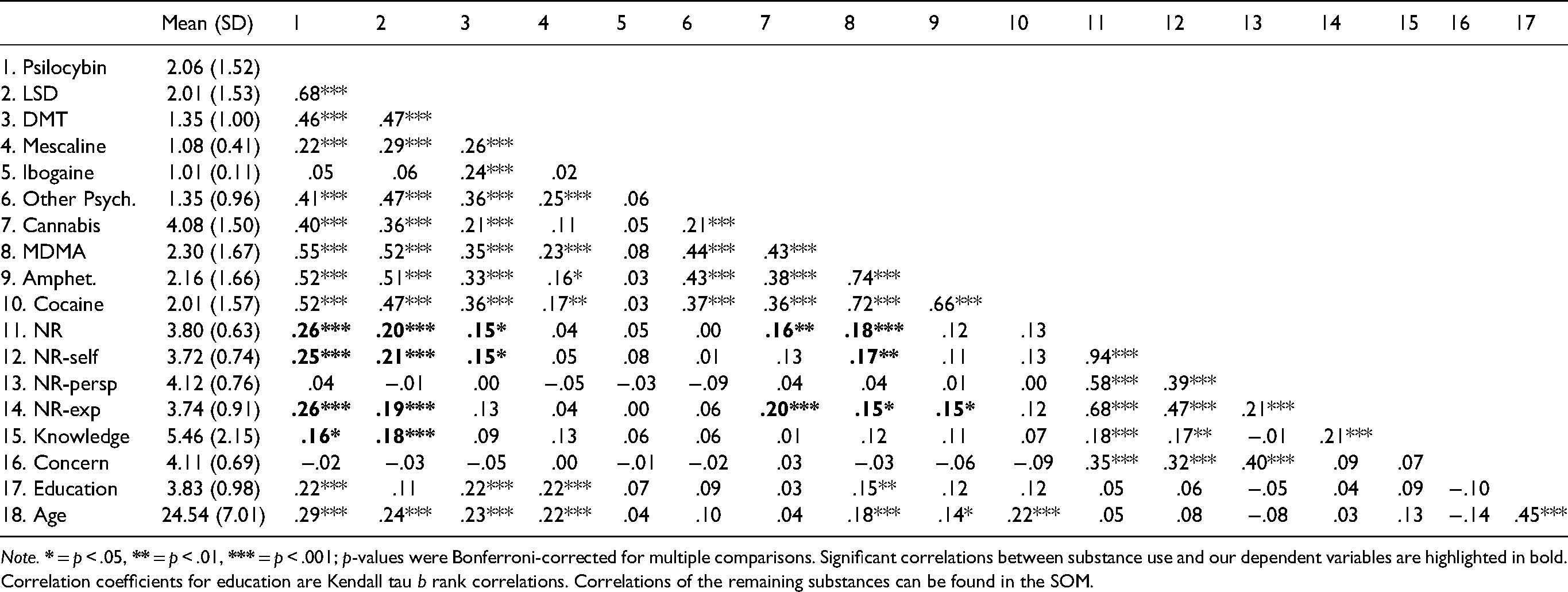
Expectedly, participants indicated greatest familiarity with the legal substances caffeine (M = 4.92, SD = 0.48), alcohol (M = 4.84, SD = 0.69), and tobacco (M = 4.15, SD = 1.46). This was followed by cannabis and illicit substances MDMA, amphetamines, psilocybin, LSD, and cocaine (see Table 1). More than 35% of our participants had experience with LSD and 40% with psilocybin, while 16%, respectively, reported to have taken both substances more than five times. We thus successfully recruited a diverse sample with regard to lifetime experience with psychedelic drugs.
Correlations, means, and standard deviations for experience with psychedelic substances, experience with most commonly used illicit substances, nature relatedness, climate change knowledge and concern, education, and age
Note.
Raw correlations
Bonferroni-corrected raw correlations (Table 1) reveal that use of some psychedelics—mostly psilocybin, LSD, and DMT—was positively associated with overall nature relatedness and its subdimensions NR-self and NR-experience, as were use of MDMA and cannabis. Climate change knowledge was indeed exclusively correlated with use of the psychedelic substances psilocybin and LSD, whereas concern about climate change was not significantly correlated with any of the substances.
As expected, nature relatedness and its three subdimensions were meaningfully correlated with both knowledge about climate change and concern about climate change, with the exception that knowledge was uncorrelated to NR-perspective and concern was uncorrelated to NR-experience.
Substance use and nature relatedness
To account for covariance between substance use variables, we used linear regression to predict nature relatedness and its subdimensions from our substance use indicators. Of all substances, only psilocybin use significantly predicted the overall nature relatedness score, β = 0.228, SE = 0.058, z = 3.91, p < .001, 95% CI = [0.113; 0.342], as well as all three subdimensions, NR-self, β = 0.180, SE = 0.059, z = 3.06, p = .002, 95% CI = [0.065; 0.295], NR-experience, β = 0.229, SE = 0.059, z = 3.86, p < .001, 95% CI = [0.113; 0.345], and NR-perspective, β = 0.140, SE = 0.061, z = 2.31, p = .021, 95% CI = [0.021; 0.259].
When replacing the six psychedelic substances with a mean score of overall psychedelic substance use, this mean score significantly predicted the overall nature relatedness score, β = 0.222, SE = 0.065, z = 3.41, p = .001, 95% CI = [0.094; 0.350], as well as the NR-self, β = 0.206, SE = 0.065, z = 3.15, p = .002, 95% CI = [0.078; 0.333], and NR-experience subdimensions, β = 0.202, SE = 0.066, z = 3.07, p = .002, 95% CI = [0.073; 0.331], replicating the pattern previously reported in the literature (Forstmann and Sagioglou, 2017).
Mediation analysis
To investigate whether it is indeed the case that higher levels of nature relatedness are not merely due to response tendencies in psychedelics users, but are truly reflective of a different mindset with regard to nature, we tested in a next step whether higher levels of nature relatedness as a result of psychedelic use are predictive of greater objective knowledge and greater concern about climate change. To that end, we specified a structural equation mediation model, in which we regressed overall nature relatedness onto all 30 substance use variables, as well as onto age and education. Further, we regressed our two dependent variables, climate change knowledge and concern, onto nature relatedness, age, and education. Lastly, to allow for a test for mediation, we added direct paths between psilocybin use (the most likely candidate based on the prior analyses) and our two dependent variables to the model. Both dependent variables were further covaried to account for shared variance.
To test for mediation, we specified two indirect effects: 1. Psilocybin use → nature relatedness → climate change knowledge, and 2. Psilocybin use → nature relatedness → climate change concern, and their respective direct and total effects (Figure 3). The model fit turned out to be good, indicated by comparative fit index (CFI) = .821, and root mean square error of approximation (RMSEA) = .035, 90% CI = [.023;.045].

Mediation analysis. Note. Coefficients represent standardized regression coefficients. Other variables in the structural equation model are not displayed, but statistically accounted for.
Similar to the results of the simple regression analyses, past use of psilocybin emerged as a significant predictor of nature relatedness, β = .228, SE = 0.058, z = 3.91, p < .001, 95% CI = [0.113; 0.342]. Other positive, yet weaker, effects were found for cannabis use, β = .114, SE = 0.050, z = 2.26, p = .024, 95% CI = [0.015; 0.213] and N2O use, β = .092, SE = 0.044, z = 2.10, p = .036, 95% CI = [0.006; 0.177]. Significantly negative associations with nature relatedness were found for experience with “other psychedelics”, β = −.158, SE = 0.050, z = −3.17, p = .002, 95% CI = [−0.256; −0.060], and tobacco, β = −.123, SE = 0.047, z = −2.62, p = .009, 95% CI = [−0.215; −0.031].
Nature relatedness, in turn, was a significant positive predictor of scores on our climate change knowledge quiz, β = .150, SE = 0.039, z = 3.81, p < .001, 95% CI = [0.073; 0.227], as well as of concern about climate change, β = .379, SE = 0.035, z = 10.82, p < .001, 95% CI = [0.310; 0.447]. In this model, the dependent variables did not significantly covary, p > .37.
Testing the two indirect effects, we found that psilocybin use had a positive indirect effect on climate change knowledge via nature relatedness, β = .034, SE = 0.013, z = 2.72, p = .007, 95% CI = [0.010; 0.059]. Controlling for this indirect effect reduced the total effect of psilocybin on climate change knowledge (β = .117, SE = 0.041, z = 2.84, p = .004, 95% CI = [0.036; 0.198]) by 29%, yet still leaving a significant direct effect, β = .083, SE = 0.042, z = 1.99, p = .047, 95% CI = [0.001; 0.165].
Likewise, we found a significantly positive indirect effect of psilocybin use on concern about climate change via nature relatedness, β = .086, SE = 0.024, z = 3.64, p < .001, 95% CI = [0.040; 0.133]. However, controlling for this indirect effect produced a negative direct effect of psilocybin use on climate change concern (β = −.066, SE = 0.039 z = −1.68, p = .093, 95% CI = [−0.144; 0.011]), which add up to a nonsignificant total effect, p > .65. When replacing the separate psychedelic substances with the mean overall psychedelic use score, a highly similar pattern of results emerges.
Discussion
Confirming prior findings, we replicated the association of lifetime psychedelic use with nature relatedness in an international sample. Additionally, both the zero-order correlations and the structural equation model suggest that psilocybin is most strongly related to our pro-environmental outcome measures, followed by LSD. This is in line with findings reported by Luke (2017: 131) that psilocybin is most commonly associated with reported increases in connection to nature. Future research could follow up on this tentative finding by investigating whether this is due to, yet to be identified, unique psychopharmacological mechanisms of psilocybin, to phenomenological differences in the effects of the substances, or due to unknown confounds in the individuals who take psilocybin versus other psychedelics. Nevertheless, all psychedelic substances show a similar pattern of association with our outcome variables, suggesting that differences in the relationship of psychedelics with pro-environmental variables may be of quantitative rather than qualitative nature.
Notably, we extended prior research by showing that psychedelic use and nature relatedness positively predict objective knowledge about climate change. Moreover, nature relatedness mediated the link between psychedelics and objective knowledge. We can thereby rule out that the association of psychedelic use and pro-environmental variables is due to response biases. Possibly, effective protection of the environment seems to become increasingly important the more connected people feel to nature, and they therefore inform themselves more extensively about climate-related matters (Kals et al., 1999). Although the influence may be mutually reinforcing, nature relatedness is more plausibly the cause than the consequence of objective knowledge. In fact, increasing knowledge about nature did not predict increased connectedness (Lumber et al., 2017).
Nature relatedness, as conceptualized here, reflects a deep personal connection to nature, experiencing comfort in natural environments, and seeing nature as an essential part of the self. It is associated with positive mental and physical health outcomes (e.g., Martyn and Brymer, 2016; Nisbet et al., 2011). Yet, recent research suggests that it may also be related to mental health issues such as stress and depression, possibly due to a heightened awareness of the noticeable ecological destruction in people's immediate environment (Dean et al., 2018). In line with this reasoning, we found nature relatedness to predict concern about climate change. With the increasingly visible negative consequences of climate change—Europe's 2022 summer was the hottest, driest and involving the largest wildfires in recorded history, causing tens of thousands of people to be evacuated (Copernicus, 2022)—feeling connected to nature may thus cause despair and distress, gradually curbing its positive mental health effects. Future research could follow up on this complex relationship.
Relatedly, the effects of psychedelics seem ambivalent with regard to concern about climate change. Our results suggest that psilocybin use increases worry about climate change via an increase in nature relatedness, but that psilocybin use has an additional effect on users, independent of nature relatedness, that decreases concern about climate change. Such an additional process may be a generally lower tendency to worry, as indicated by psychedelic users’ scoring higher than the norm on emotional stability and a positive correlation between psychedelic use frequency and emotional stability (Johnstad, 2021). The interplay of these reversed effects with personality could be a worthwhile subject for future research. Speculating, for people with high trait emotional stability, psychedelics may relieve climate change anxiety, while for people low in emotional stability, psychedelics may increase such anxiety due to its increases in nature relatedness. While these effects of psychedelics on climate concern should not change their influence on pro-environmental behaviour—as both nature relatedness and concern about climate change have a positive (yet multiply determined, complex) impact on pro-environmental behaviour (Gifford and Nilsson, 2014)—they could help understand the exact mental health outcomes of psychedelic use.
Due to its cross-sectional design, the causal effects theoretically proposed remain empirically untested. Possibly, one or multiple unknown third variables account for individuals taking psychedelics, feeling connected to nature, and informing themselves about climate change. Although prior research has tested a number of potential confounds, such as general personality and political orientation (e.g., Forstmann and Sagioglou, 2017), we cannot rule out the existence of further variables. Although difficult, future research involving administration of psychedelics is urgent to support many of the still tentative conclusions about the causal effects of psychedelic substances. For example, the general personality trait openness to experience was increased by a single psilocybin dose taken 1–3 months prior (MacLean et al., 2011; Madsen et al. 2020), and is linked to lifetime experience with psychedelic substances (Forstmann and Sagioglou, 2017; Nour et al., 2017). At the same time, openness to experience is the most critical personality predictor of pro-environmental variables (Gibbon and Douglas, 2021). Future administration studies could thus test a potential pathway from psychedelic-induced increases in openness to experience to pro-environmental attitudes and behaviour. Likewise, it may be worthwhile to investigate how different personality profiles (assessed at baseline) interact with psychedelic substance use to either promote or attenuate climate change concern, either by affecting certain personality traits or by influencing other cognitive processes related to the formation of these concerns.
Finally, this study assessed attitudes and knowledge about climate change, but did not include a measure of actual behaviour. Although difficult to study due to its complex determinants (Gifford and Nilsson, 2014), combining administration studies with an experience sampling method may dramatically increase both internal and external validity of psychedelic-pro-environmental research. While actual use will allow for causal conclusions, experience sampling is a critical method for assessing actual, as opposed to self-reported (often misreported), pro-environmental behaviour (e.g., Kesenheimer and Greitemeyer, 2022). Furthermore, the investigation of additional variables related to pro-environmental concern such as awareness of the sixth mass extinction (Ceballos et al., 2015) or human-animal relations (Caviola et al., 2019) may be worthwhile. For example, a recent study on a large representative US sample found that lifetime psychedelic use predicts positive human-animal relations, most likely via psychedelic induced ego dissolution (Pöllänen et al., 2022). That said, administration studies should increasingly focus on understanding psychedelics’ mechanism of action in order to understand what causes the connectedness. Currently, use of psychedelics is criminalized in most countries, and so understanding their mechanism could potentially enable the development of alternatives.
Conclusion
Psychedelics are associated with increases in nature relatedness and objective knowledge about climate change—both of which prior research identified as strong predictors of pro-environmental behaviour. Further investigation into psychedelics is currently drastically limited by regulatory policies, although evidence-based calls for urgent reduction of these barriers may eventually lead to a facilitation of psychedelic research. Until then, educational policy makers should capitalize on the fact that nature relatedness is positively linked to objective knowledge about climate change by enabling regular sessions promoting positive affective attitudes towards nature. Such an affinity may promote interest and knowledge, and, ultimately, all of these variables can interactively promote effective pro-environmental efforts at the individual level.
Footnotes
Acknowledgements
We thank Anna K. Müller and Marie Michels for collecting the data, and Anna K. Müller for her help in developing the measures related to climate change.
Declaration of conflicting interests
The author(s) declared no potential conflicts of interest with respect to the research, authorship, and/or publication of this article.
Funding
The author(s) received no financial support for the research, authorship, and/or publication of this article