




Abstract
The recent surge in recreational (non-medical) use of nitrous oxide (N2O, also known as ‘laughing gas’) often by inhaling it from balloons, has attracted the attention of some politicians with calls to control its possession under the United Kingdom (UK) Misuse of Drugs Act 1971 (currently selling, but not possession, for recreational use is controlled under the Psychoactive Substances Act 2016). Meanwhile, the recreational use of nitric monoxide (NO) as delivered by alkyl nitrites, also known as ‘poppers’ has also raised concerns, but unlike N2O, its use was not controlled under the 2016 Act.
To inform future-decision making processes and ensure that any such decisions are based on the best evidence, Drug Science conducted a Multi-Criteria Decision Analysis (MCDA) about N2O and poppers to compare the overall harms of these two drugs to the harms of 20 drugs previously evaluated and published by Nutt et al.
The group assessed harm scores for N2O and poppers on the original 16 harm criteria using the associated 0 to 100 scales, on each of which 100 had been assigned to the most harmful drug and zero to the least harmful, though that often meant no harm.
On the overall harm scale, N2O scored 6, just above magic mushrooms (psilocybin) while ‘poppers’ scored 5. Together these are the three lowest drugs on the overall harm scale. Although their overall scores are similar, the reasons behind the ratings differ. Nitrous oxide was considered more harmful than poppers for Dependence, Environmental Damage, Drug Related Relative Impairment of Mental Functioning, and Family Adversities, while poppers are more harmful than N2O for Injury, Drug Related Damage, Economic Cost, and Drug Related Mortality.
When assessing the risk different substances may hold when making policy decisions, it is important to acknowledge the relative contribution of these diverse harms within different domains.
Introduction
The recent surge in the recreational use of nitrous oxide (N2O, ‘laughing gas’) (Kaar et al., 2016), often by inhaling it from balloons, has attracted the attention of some policy makers and public health professionals especially in the United Kingdom (UK). Nitrous oxide is a colourless gas that is commonly used as an anaesthetic and analgesic agent in dentistry, obstetrics and ambulances because of its lack of respiratory depression (van Amsterdam et al., 2022a). It also produces an extremely short-lived (less than 2 min) but intense euphoria with feelings of dissociation and mild changes in perception of body image (Beckman et al., 2006; Winstock and Ferris, 2019). The effect wears off within minutes and full normal consciousness is restored.
The 2017/2018 Crime Survey for England and Wales found a prevalence of recreational use of 2.3% in those aged 16–59. For people in the 16–24, the prevalence was over three times higher, at 8.8%, (Home Office, 2018). Similar records were also observed in the Netherlands where, in 2019, the use of N2O was 3.2% for adults (18–65 years) and 6.7% for adolescents aged 12–16 years (van Amsterdam et al., 2022a). In the UK there have been calls to ban the possession of N2O for personal use and, in September 2021, the Home Secretary has asked the Advisory Council on the Misuse of Drugs to review its legal status- noting increased use and emerging concerns about associated health risks (ACMD, 2021; GOV.UK, 2021). Currently selling, but not possession for recreational use, is controlled under the Psychoactive Substances Act 2016.
In addition, the use of nitric oxide (nitric monoxide, NO) as delivered by NO prodrugs alkyl nitrites by inhalation also known as ‘poppers’, has also raised concerns following reports of visual disturbances linked to maculopathy (Davies et al., 2017) and a possible association of their use with HIV transmission, although a causal relationship has never been established (Chu et al., 2018). Poppers are used to induce a short lived ‘rush’ or ‘high’, enhance orgasm and facilitate anal sex by relaxing sphincter muscles (Romanelli et al., 2004). The terms ‘poppers’ or ‘amyl’ are both street slang terms for these products, though in the UK and elsewhere isopropyl nitrite replaced butyl nitrite as the main constituent in poppers due to concern of carcinogenicity. Closely related inhalable nitrates (generally more stable than nitrites) such as isosorbide mononitrate and glyceryl trinitrate (GTN) are also standard treatments for cardiac chest pain (angina) since they act by relaxing the arteries in the heart and enhancing blood flow into it.
A possible relationship of poppers intake and HIV prevalence is a controversial subject (Chu et al., 2018). This class of drugs are highly prevalent among men who have sex with men (MSM) with 30% reporting to taking it recreationally compared to 4% of users in the general population (Bral et al., 2015). Although observational studies have reported a correlation of poppers intake with HIV prevalence it's noteworthy that in 2019, 69% of new HIV diagnoses in the United States were among gay and bisexual men (CDC, 2021). Meanwhile, poppers induced relaxation of the anal sphincter may reduce epithelial trauma during anal intercourse and banning them could lead to increased harms from transmission of blood-born viruses once sex would become more traumatic (Ferreira and Nutt, 2022).
In 2015 and 2016, N2O and poppers were topics of UK parliamentary debates in reference to the Psychoactive Substances Bill. This Bill came into law in 2016 as the Psychoactive Substances Act 2016 - now existing somewhat uneasily alongside the Misuse of Drugs Act 1971, and was designed to capture and prohibit the supply, but not possession of all non-exempted psychoactive drugs not already prohibited under the Misuse of Drugs Act 1971. Under the Psychoactive Substances Act a substance is defined as producing a psychoactive effect if, ‘by stimulating or depressing the person's central nervous system, it affects the person's mental functioning or emotional state’. This definition is unhelpfully non-specific in both scientific and legal terms, and the Act itself does not provide further guidance or examples. Controversially, alcohol and tobacco were exempted from the Act, as indeed they were previously not included under the Misuses of Drugs Act 1971, despite expert opinion showing that alcohol dependence was the most prevalent substance use disorder globally with 100.4 million estimated cases in 2016 (GBD, 2016) and alcohol being ranked as the most harmful drug in the UK (Nutt et al., 2010), while tobacco consumption accounted for 7.7 million deaths worldwide in 2019 being the leading risk factor for death among males (Drug Science, 2022; Reitsma et al., 2021).
Initially, the original draft Psychoactive Substances Bill had recommended that alkyl nitrite products should be made illegal. However, a member of the Conservative party opposed their own government's plan arguing that it acts as a harm reduction agent since it minimises traumatic sex reducing the chances of HIV transmission. The ACMD was then consulted and determined that poppers were not psychoactive because they acted indirectly to change blood flow to the brain rather than acting on the brain directly. The Home Office accepted the advice and poppers have not been made illegal under the 2016 Psychoactive Substances Act.
Nitrous oxide, was another possible target of the Psychoactive Substances Bill but this was never explicitly stated and was never mentioned in the parliamentary debates. N2O was discovered in 1793 by UK chemists Priestley and Davy. Use of N2O gas from inflated balloons, usually filled from gas cartridges (from bulbs or ‘whippets’), is popular amongst younger people since it is readily accessible, relatively cheap and easy to use. Nitrous oxide has been widely perceived as being enjoyable but lower risk than alcohol and other commonly used recreational substances (Nutt et al., 2007; van Amsterdam et al., 2015). However, recent reports have raised concerns of longer term concerns and harms among chronic and heavy users. The definition of ‘heavy’ and ‘chronic use’ of N2O is not well established, however, on a survey undertaken by the drug information site Erowid, 14% of the respondents had used N2O more than 100 times and 17% used more than 25 whippets in an average session, suggesting that a population with likely dependence exists (Erowid, 2009; Kaar et al., 2016; Winstock and Ferris, 2019; van Amsterdam et al., 2022a; van Amsterdam et al., 2022b).
To facilitate any future decision-making processes, and ensure that any such decisions should be based on scientific evidence encompassing the broadest range of potential harms, Drug Science convened a group of specialists, clinicians, and experts to consolidate their knowledge and experience about N2O and poppers. All members of the group provided independent advice and no conflicts of interest were declared. Using Multi-Criteria Decision Analysis (MCDA) (Thokala et al., 2016), the group compared the harms of these two drugs with the harms of the 20 drugs previously evaluated and reported by Nutt et al. (Lancet, 2010). The meeting's facilitator was an independent specialist in decision analysis modelling, who applied methods and techniques that enabled the group to work effectively as a team, enhancing their capability to perform, thereby improving the accuracy of individual judgments. The meeting was held on an online call in November/2021. Core members of the group were also present on the meeting held in 2010.
Methods
The approach taken for exploring the harms of drugs is based on decision conferencing (Phillips, 2007). This is a socio-technical process that combines working in groups helped by an impartial facilitator, on-the-spot computer-based modelling of data and participants’ judgments, and continuous visual display of the model and its results. The ‘socio’ aspect of the process relies on mobilizing the right people at the right time to give the right inputs to the model. The ‘technical’ part refers to the model itself. This is based on multi-criteria decision analysis, first introduced by Keeney and Raiffa (1976), and now an accepted methodology for dealing with decisions that are characterized by multiple objectives and uncertainty, which in this case takes into consideration risks for the user and others
The multi-criteria decision analysis (MCDA) model developed in 2010 enabled a group of diverse experts to evaluate the harm of 20 psychoactive drugs on 16 criteria of harms (Nutt et al., 2010). Note neither nitrous oxide nor poppers were included in this review as the decision making group considered them to be responsible for little harm and so of less interest than the twenty substances that were assessed. Here, N2O and poppers are added and evaluated relative to the 20 drugs previously evaluated (Table 1). An important characteristic of an MCDA model is that adding new options leaves the results unchanged among the original options.
The 20 drugs originally evaluated plus the addition of nitrous oxide and poppers.

The original 16 harm criteria reported in the 2010 paper are shown in Figure 1, organised as before under physical, psychological, and social harms to users and to others. The definitions of the harms are given in Table 2, unchanged from their original definitions.

The 16 harms organised according to their type of harm, i.e., physical, psychological, and social with separated harms to users and harms to others.
Definitions of the harm criteria.

Options
Scoring
Participants evaluated N2O and poppers on the 16 original 0−100 scales, where 100 was assigned to the most harmful substance and 0 the least harmful one (rather than indicating no harm). For harms to users, both magnitude of harm and the numbers of users were judged as a single number. Thus, a seriously harmful effect experienced by hardly anyone, would receive a low harm score. This method acknowledges that drugs with low scores may on occasion cause significant harm to a small minority of users, but when considering policy and regulation the factor the carries the most weight should be harm on a population-based level.
Scoring proceeded for each substance in three steps on a given criterion: (1) each individual thinks about an appropriate harm score between 0 and 100 (abstaining if their expertise was not for that criterion), (2) after a pause, the facilitator asks anyone to say their number, then asks for lower and higher numbers until the range is established and the experts at the extremes are invited to explain their reasons, then (3) the group discuss the scores online until a consensus is reached.
This ‘think, reveal, discuss’ process was intended to prevent participants from anchoring on the first person to suggest a number in open discussion, an approach intended to minimise bias in group assessments. If anyone is an outlier, their judgement is noted and later used in a sensitivity analysis to see if it changes the results.
Weighting
The weights remained unchanged from the 2010 model, which preserved the final weighted scores of the original model, enabling comparisons with the N2O and poppers. Those weights were assessed by asking the question, ‘How large is the difference between the most and least preferred drugs for a given criterion, and how much do you care about that difference?’ Repeating that question across the criteria, two criteria at a time, provided weights that are scale constants, ensuring the equality of a unit of harm across all 0–100 scales, thereby justifying adding the weighted 16 scales for each drug to provide a single overall weighted harm score that is meaningful and can be compared across drugs.
Model exploration
The software multiplied the harm scores by their associated effect weights and added the weighted preference values for each of the harms to give an overall weighted harm score for each of the drugs (Keeney and Raiffa, 1976). Various graphic displays of the final results were followed by sensitivity analyses which showed the effects on the final results of changing certain input weights and scores. Comparisons between pairs of drugs highlighted how their benefit and safety profiles differed in meaningful ways.
Results
The names of the drugs that were judged most and least harmful (Nutt et al., 2010) are shown in Table 3, along with the final weighted scores for N2O and poppers. Most of the scores for N2O and poppers are low, in single digits. Only a few are double digits in the 10s. The largest scores, two 50s, are for drug specific impairment of mental functioning, halfway between crack (maximum harm) and tobacco (minimum harm).
Input preference scores for each of the benefit and safety effects.

How these overall scores compare to those in the 2010 study is shown in Table 4, where the overall weighted scores to users and to others are distinguished, along with the totals. There it can be seen that buprenorphine (7), N2O (6), and magic mushrooms score (6), and poppers (5) have the lowest scores and have scores much lower than alcohol (72), heroin (55) or crack (54).
Weighted harm scores to users and to others, and their weighted totals.

Figure 2 shows a bar graph of the results in Table 4, where the weighted harms to users and to others are shown as separate colours associated with each of the 20 harm criteria. Note that only differences between the weighted preference values and/or their totals can be compared meaningfully, not their ratios.
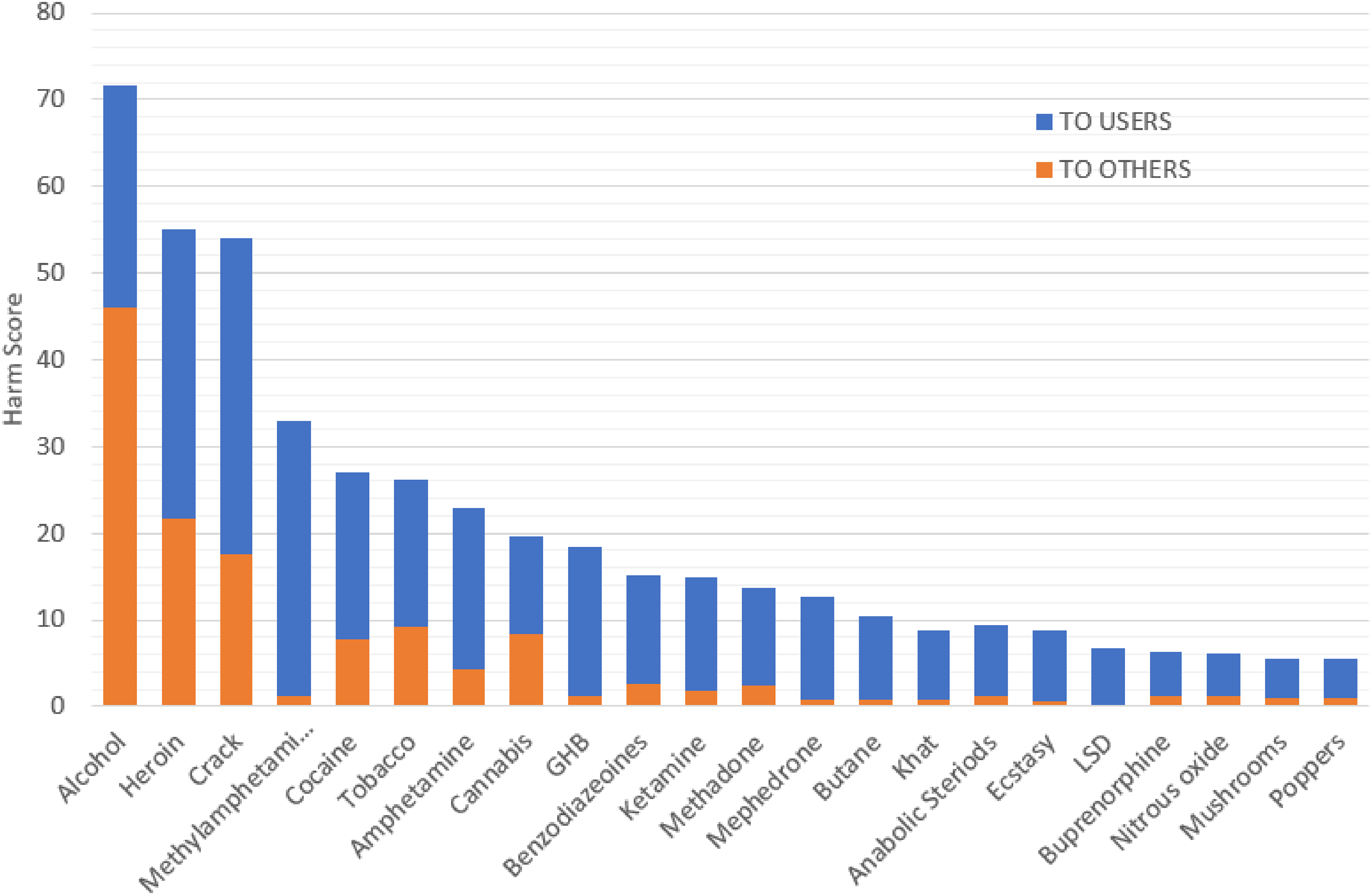
The overall weighted harm scores for all 22 substances. Harms to users in blue, harms to others in orange, data from Table 4.
Although the final weighted harm scores of both N2O and poppers are only 1 point apart, the reasons for their scores are mostly different. Figure 3 compares the final weighted scores.

Comparison between nitrous oxide and poppers on each of the harm criteria.
For this figure, the weighted difference (Wtd Diff) column shows the result of multiplying the cumulative weight (Cum Wt) for each harm by the difference in the difference (Diff) in their harm scores for each criterion-positive differences represent higher harms from N2O, while negative values show higher harms for poppers. The effects have been put in order of the weighted differences of the pair of drugs (starting with the highest N2O score minus poppers), with the Wtd Dif sum equal to the difference in their overall preference values, which is 0.6. The green horizontal bar graphs show the relatively greater harms of N2O, and the red bars represent the relatively greater harms of poppers. Only for the four criteria whose differences are zero are the two substances equally harmful, such as for Drug Specific Impairment of Mental Functioning, the criterion on which they both scored 50.
Nitrous oxide is more harmful than poppers for Dependence (a small minority of users express concerns over loss of control; Kaar et al., 2016), Environmental Damage (N2O is a potent greenhouse gas which contributes to ozone layer depletion; McGain et al., 2020), Drug Related Relative Impairment of Mental Functioning (accidents and injuries during intoxication; Kaar et al., 2016), and Family Adversities. Poppers are more harmful for Injury (fainting may occur), Drug Related Damage (maculopathy, methaemoglobinemia and possible relation to sexually transmitted diseases; Davies et al., 2017, Ferreira and Nutt, 2022), Economic Cost (tend to be more expensive than N2O, although both drugs are considered cheap), and Drug Related Mortality (accidental oral ingestion and HIV). However, even on these parameters their risk compared to almost all other drugs was very low, reflecting their overall good safety profile among the majority of users who tend to use infrequently.
A final instructive comparison is between magic mushrooms and poppers. Although they both achieved total scores of 5, the reasons are completely different, as can be seen in Figure 4.

Comparison between magic mushrooms and poppers on each of the harm criteria.
Magic mushrooms are more harmful than poppers mainly for Drug Specific Impairment of Mental Functioning. This is due to the much longer duration of action for psilocybin, whose effects can last for hours compared to minutes for poppers. The many red bars show that poppers are very slightly more harmful on many criteria, but the sum of those harms is still 0.2 points less than the sum of the two green harms for magic mushrooms.
On the criterion Drug Specific Impairment of Mental Functioning, magic mushrooms scored 85, while poppers scored 50, a difference of 35 points, weighted 0.057, for a difference of 2 points. Add to that the 0.3 points weighted difference for Drug Related Impairment of Mental Functioning, and the total weighted harm score of 2.3 is still 0.2 points higher than the weighted difference harm scores for poppers represented by the red bars.
Discussion
The results show that the overall weighted harm scores for N2O and poppers are very low: 6 for N2O and 5 for poppers, both about the same as for magic mushrooms. Although overall scores for N2O and poppers are almost equally low, the reasons behind the ratings are very different and reflect the holistic process underpinning the MCDA.
Although N2O, poppers, and magic mushrooms all scored about the same, the key differences compared to mushrooms, are that N2O is slightly more harmful on Dependence, and poppers are slightly more harmful for Physical/Psychological Damage. The authors accept that when making these judgments there are challenges and these were evident in the discussion where issues of the typical versus the atypical heavy users were explored and the paucity of information on the distribution of use within different communities of users. In scoring the substances, participants thus considered average users and range of use with frequency being the biggest predictor of drug related harm (though dose is of course an additional important parameter). The majority of scores were in single digits with only two scores at 10 and two at 12. The largest harm scores on any of the criteria were for Drug Specific Mental Functioning, where both scored 50. This is because these drugs produce a state of quite extreme altered consciousness, which although short-lived, are considered to be intense since users usually cannot perform simple motor activities when in this state of intoxication.
Some participants wondered what would happen if either substance were to be banned. Presumably users would switch to other, probably more risky drugs, or access them through newly emergent or diversified illegal markets, which themselves would likely be associated with a range of social and health harms. The discussion highlighted policy-making associated with drugs of low risks and predicted that criminalising the drug would only enhance the harms due to likely ensuing illegal activities as seen when other drugs are prohibited (Coyne and Hall, 2017).
This is a timely expert opinion manuscript which can be used as an aid for policy-making decisions and as a reference on how to compare the risks and harms of poppers and N2O in relation to other drugs. There is still lack of data on some of the criteria analysed and, eventually, the authors had to do rough estimations (e.g., pollution caused by N2O whippets; hospitalizations caused by oral intake of poppers). In general, the final scores provided little disagreement among the peers and the final result is a concise opinion from a heterogeneous group of specialists.
Conclusions
The main benefit of this MCDA model is that it showed the overall harm scores of N2O and poppers to be relatively low, albeit for different reasons. These differences should be considered in devising harm reduction policy initiatives. In comparing the scores of these substances to the other drugs in the 2010 model, participants occasionally noted how much knowledge and understanding has been gained over the past decade, especially in relation to ketamine and GHB. It was also noted that critiques of the 2010 methodology had emerged, and thinking on harm rankings of drug harms has subsequently evolved to better incorporate policy context and potential benefits of drugs (Bonomo et al., 2019; Rolles et al., 2021; Wilkins et al., 2022). Participants were keen to revisit previous scores and the reasoning behind them, including the limitations of considering typical patterns of use and the prevalence of less common heavy use, and new thinking on methodology, but that is for a future project.
Footnotes
Disclosure of interest
The author(s) declare no actual or potential conflict of interest